Journal of Chemical and Pharmaceutical Research, 2014, 6(6):1737-1742
Research Article
ISSN : 0975-7384
CODEN(USA) : JCPRC5
Quantitative evaluation and enhancement of adhesion between
bitumen and aggregates
Jiusu Li
1, Wenbo Zhang
1, Wenke Jia
1, Lubinda F Walubita
2and Guanlan Liu
31Changsha University of Science & Technology, Hunan, China 2TTI & PVAMU – The Texas A&M University System, CS, TX, USA 3
Department of Chemical Engineering, Texas A&M University, College Station, TX, USA
_____________________________________________________________________________________________
ABSTRACT
Stripping of asphalt-binder (bitumen) from the aggregate surface can undesirably contribute to various distresses in hot-mix asphalt (HMA) pavements such as ravelling (aggregate loss), cracking, pot-holing, etc. As a means to minimize this phenomenon, a quantitative adhesion test and evaluation method (QATE) was proposed and investigated in this study to characterize the bitumen-aggregate bond strength and adhesion properties. Concurrently, an innovative anti-stripping additive was developed in the laboratory through appropriate combination of the following chemical agents: Polyamide (PA), anti-moisture polymer (AMP), epoxy resin (EP), and dioctyl phthalate (DOP). The optimum anti-stripping mix proportions were determined and proved effective with an adherence percentage of 97.3% after 10 minutes boiling in water.
Key words: Adherence rate; bitumen; aggregate; cohesiveness; quantitative evaluation; anti-stripping agent _____________________________________________________________________________________________
INTRODUCTION
The bonding between asphalt-binder (bitumen) and aggregate plays an important role in governing the performance of hot-mix asphalt (HMA) pavements. Various reports about asphalt-aggregate interaction can be found elsewhere[1-5]. Inadequate bitumen-aggregate bonding can undesirably contribute to various distresses such as ravelling, stripping, cracking, pot-holing, rutting, etc.[6-10]. Thus, appropriate test methods for characterizing the bitumen-aggregate bond strength and adhesion properties to mitigate stripping are imperative. The ASTM D 3625 laboratory test method presents a generalized level of bitumen-aggregate adhesion/bonding based on the average stripping area of five bitumen-wrapped aggregates after sustaining 3 minutes exposure to boiling water as a measure of characterizing bonding and stripping potential in HMA mixes [11]. With this test method, however, it is often difficult (even for experienced researchers and technicians) to readily and effectively differentiate between Level II and III stripping, i.e., stripping area threshold greater or lower than 30%, respectively.
In this study, an innovative laboratory test method with an extended boiling time of 3-10 minutes was investigated to quantitatively characterize the adhesion between bitumen and aggregates. Additionally, an anti-stripping additive was also developed to aid in improving the HMA’s resistance to stripping propensity. Polyamide (PA) and epoxy resin (EP), being some of the commonly used chemical agents[12], were the baseline ingredients for the developed anti-stripping additive.
EXPERIMENTAL SECTION
1. Materials and test methods
moisture polymer (AMP), epoxy resin (EP), and dioctyl phthalate (DOP) were utilized as ingredients for the anti-stripping additive to improve the anti-stripping resistance potential of the resultant mix[7]. A commonly used aggregate type in China, granite, with a nominal maximum size of 31.5 mm was used. To obtain the optimum combination of various additives, i.e., the optimum mix proportions of the anti-stripping additives, an orthogonal (L9 (34))
experimental plan as shown in Tables 1 and 2 was devised and executed accordingly.
Table 1 Levels and factors in the orthogonal experiment
Item A B C D
Factor AMP/PA EP/PA DOP/PA Dosage (%)
Level 1 1/5 1/2 1/5 1
Level 2 1/4 1 1/4 2
[image:2.595.209.403.232.336.2]Level 3 1/3 3/2 1/3 3
Table 2 Orthogonal experimental arrangement
Item A B C D
Factors AMP/PA EP/PA DOP/PA Dosage (%)
# 1 1/5 1/2 1/5 1
# 2 1/5 1 1/4 2
# 3 1/5 3/2 1/3 3
# 4 1/4 1/2 1/4 3
# 5 1/4 1 1/3 1
# 6 1/4 3/2 1/5 2
# 7 1/3 1/2 1/3 2
# 8 1/3 1 1/5 3
# 9 1/3 3/2 1/4 1
The granite aggregates were then processed, cut, and reshaped into roughly cubic particles of approximately 15 mm in length. The anti-stripping additive was accordingly mixed with the original bitumen using a high speed shearing machine to produce the modified bitumen. The processed granite aggregates were then covered in a thin film of the original or modified bitumen as specified in the ASTM D 3625 test procedure[11]. After cooling, the granite aggregates were subjected to heating in water at 80 °C for 3-10 minutes as designed in this study.
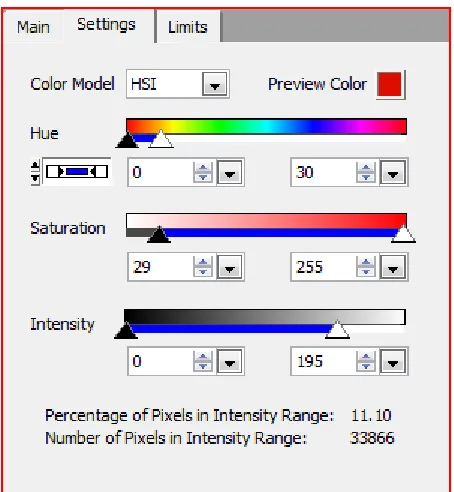
[image:2.595.194.421.484.730.2]Pictures of the six surfaces of each cubical-shaped granite particle were taken using a normal digital camera. Contrast to the specified method analysed by two experienced technicians from the estimated stripping rates of five particles, the proposed quantitative adhesion testing and evaluation (QATE) method presents the adherence rate automatically from the software of Vision Builder. The parameters including Hue, Saturation and Intensity were kept constant as shown in Figure 1.
Item Factors
A AMP/PA
B EP/PA
C DOP/PA
D Dosage
The test results in Figure 2 show that there is an insignificant difference in the adherence rate among the groups boiling for 3 and 5 minutes. However, a significant difference in the adherence rate among the groups was
[image:3.595.174.441.92.162.2]when the boiling time was increased to 10 minutes. Consequently, the adherence test results for the 10 minutes boiling time were further analysed.
Figure 2 Adherence rate of the nine groups of stones subjected to various boiling time
[image:3.595.161.455.246.443.2]Figure 3 Granite
Table 3 Adhesion test results for 10 minutes boiling
Factors Range Level
Average Adherence Rate (%)
1 2 3 Level 1 Level 2 Level 3
AMP/PA 3.723 1/5 1/4 1/3 93.357 95.153 91.43
EP/PA 3.66 1/2 1 3/2 95.6 91.94 92.4
DOP/PA 3.487 1/5 1/4 1/3 93.733 91.36 94.847
Dosage 0.543 1% 2% 3% 93.65 93.183 93.107
RESULTS AND DISCUSSION
The test results in Figure 2 show that there is an insignificant difference in the adherence rate among the groups boiling for 3 and 5 minutes. However, a significant difference in the adherence rate among the groups was
when the boiling time was increased to 10 minutes. Consequently, the adherence test results for the 10 minutes
Adherence rate of the nine groups of stones subjected to various boiling time
Granite particles coated with a thin film of bitumen (10 minutes boiling) Level 3
91.43
94.847 93.107
The test results in Figure 2 show that there is an insignificant difference in the adherence rate among the groups boiling for 3 and 5 minutes. However, a significant difference in the adherence rate among the groups was observed when the boiling time was increased to 10 minutes. Consequently, the adherence test results for the 10 minutes
Adherence rate of the nine groups of stones subjected to various boiling time
[image:3.595.107.510.471.749.2]Figure 4 Pictures processed by Vision Builder (10 minutes boiling)
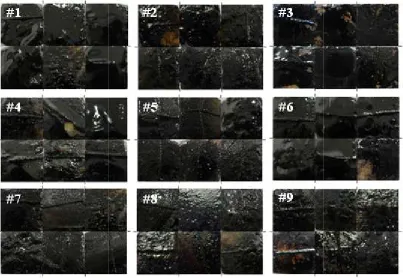
Pictures in Figure 3 show the nine groups of the stones exposed to 10 minutes boiling (note: each group contains six surfaces of the stone). All the pictures were analysed by Vision Builder, respectively. The stripping area was identified by red colour (Figure 4).
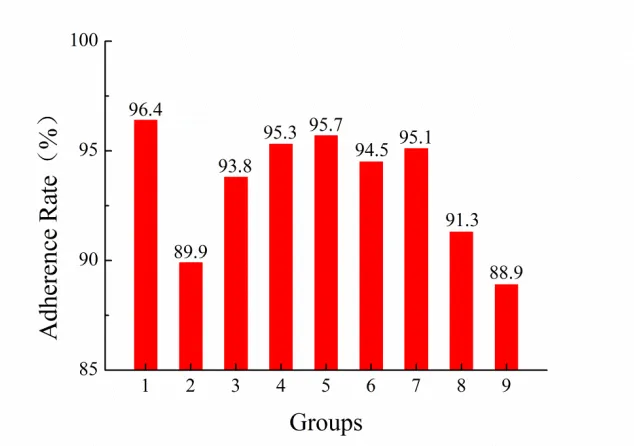
The adherence rate after 10 minutes boiling is illustrated in Figure 5. Group #1 demonstrates the highest adherence rate while group #2, group #8 and group #9 shows relatively low adherence rate. The intuitive analysis of the orthogonal results was listed in Table 3.
Figure 5 Adherence rate of granite exposed to 10 minutes boiling
From the result shown in Table 3, the critical factors influencing the material anti-stripping resistance in their rank order of significance are AMP/PA, EP/PA, DOP/PA and dosage. The optimum mix combination of the ingredients for the anti-stripping additive can then be A2B1C3D1, namely, AMP: EP: DOP: PA = 1/4:1/2:1/3:1, whereas the
[image:4.595.151.468.475.698.2]significantly influence the adherence coverage; however, such high dosages have the potential to raise the mix temperature susceptibility and the experiment costs. Thus, for practical purposes, the optimum dosage of the anti stripping additive was recommended as 1% and added in the subsequent tests.
To check the effect of the anti-stripping additive on the bitumen
adhesion tests were carried out without (Figure 6a) and with the additive (Figure 6b). After 1 water, the photos taken indicated favourable anti
[image:5.595.111.505.188.314.2](PG 76-22) was almost entirely striped off from the granite aggregate surfaces while the average adherence percentage of the granite surfaces with the anti
Figure 6 After 10
Due to the potential evaporation of the constituent compounds such as the fatty
and in-service, durability and temperature stability are pertinent issues associated with most commercial anti stripping additives[14,15]. To assess the temperature stability of the anti
adherence rate was measured using the same aforementioned methods after rolling thin
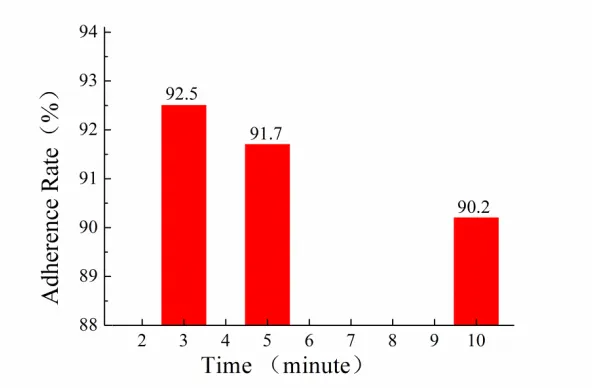
The results in Figure 7 shows that the adherence coverage was higher than 90% even after 10 minutes of boiling; indicating favourable heat and water resistance of the developed anti
As a supplement to the traditional ASTM D 3625 method for adhesion evaluation of bitumen and aggregate, an innovative adhesion test method, with an extended 10 minutes boiling time at 80
efficient in quantitatively evaluating th
developed combining four ingredients of PA, AMP, EP and DOP. The adherence percentage test results indicated a significant improvement in the stripping resistance of the HMA by bl
agent. Temperature stability was also satisfactory; with higher than 90% adhesion coverage after 10 minutes boiling time.
significantly influence the adherence coverage; however, such high dosages have the potential to raise the mix temperature susceptibility and the experiment costs. Thus, for practical purposes, the optimum dosage of the anti
ded as 1% and added in the subsequent tests.
stripping additive on the bitumen-aggregate bonding (i.e., PG 76 adhesion tests were carried out without (Figure 6a) and with the additive (Figure 6b). After 1
water, the photos taken indicated favourable anti-stripping improvement as illustrated in Figure 6. The bitumen film 22) was almost entirely striped off from the granite aggregate surfaces while the average adherence ge of the granite surfaces with the anti-stripping additive was maintained at 97.3%.
fter 10 minutes boiling - (a) without and (b) with anti-stripping additive
Due to the potential evaporation of the constituent compounds such as the fatty amine groups during construction service, durability and temperature stability are pertinent issues associated with most commercial anti
. To assess the temperature stability of the anti-stripping agent developed in this st adherence rate was measured using the same aforementioned methods after rolling thin-film oven (RTFO) aging The results in Figure 7 shows that the adherence coverage was higher than 90% even after 10 minutes of boiling;
and water resistance of the developed anti-stripped agent.
Figure 7 Adherence rate after RTFO aging
CONCLUSION
As a supplement to the traditional ASTM D 3625 method for adhesion evaluation of bitumen and aggregate, an innovative adhesion test method, with an extended 10 minutes boiling time at 80 °C, was proposed and proved efficient in quantitatively evaluating the anti-stripping effect. In addition, an innovative anti
developed combining four ingredients of PA, AMP, EP and DOP. The adherence percentage test results indicated a significant improvement in the stripping resistance of the HMA by blending with 1% of the developed anti
agent. Temperature stability was also satisfactory; with higher than 90% adhesion coverage after 10 minutes boiling significantly influence the adherence coverage; however, such high dosages have the potential to raise the mix temperature susceptibility and the experiment costs. Thus, for practical purposes, the optimum dosage of the
anti-aggregate bonding (i.e., PG 76-22 plus granite), adhesion tests were carried out without (Figure 6a) and with the additive (Figure 6b). After 10 minutes of boiling in stripping improvement as illustrated in Figure 6. The bitumen film 22) was almost entirely striped off from the granite aggregate surfaces while the average adherence
stripping additive was maintained at 97.3%.
additive
amine groups during construction service, durability and temperature stability are pertinent issues associated with most commercial
anti-stripping agent developed in this study, film oven (RTFO) aging[16]. The results in Figure 7 shows that the adherence coverage was higher than 90% even after 10 minutes of boiling;
[image:5.595.159.458.430.624.2]Acknowledgement and Disclaimer
The authors appreciate the financial support from Hunan Provincial Natural Science Foundation of China (No.14JJ2078), Guangdong Provincial Department of Technology (2012B091100478) and the Catastrophic Prophylaxis and Treatment of Road Traffic Safety Engineering Research Center, Education Ministry, China (kfj110301). The corresponding author also thanks the China Scholarship Council (CSC) for sponsorship as a Visiting Research Scholar to TTI (USA).
REFERENCES
[1] J Petersen; H Plancher; E Ensley;R Venable;G Miyake. Chemistry of asphalt-aggregate interaction: relationship with pavement moisture-damage prediction test. Transportation Research Record,1982.
[2]CW Curtis;K Ensley;J Epps. Fundamental properties of asphalt-aggregate interactions including adhesion and absorption. National Research Council. Strategic Highway Research Program,1993.
[3] D Cheng; DN Little;RL Lytton; JC Holste. Journal of the association of asphalt paving technologists, 2002,71. [4] A Bhasin;E Masad; D Little; R Lytton. Transportation research record: journal of the transportation research
board, 2006, 3-13.
[5] R Moraes; R Velasquez; HU Bahia.Transportation Research Record: Journal of the Transportation Research
Board, 2011,70-81.
[6] G Maupin. Transportation Research Record: Journal of the Transportation Research Board, 1681, 1999, 37-42. [7] A Aksoy; K Şamlioglu; S Tayfur; H Özen.Construction and building materials, 19, 2005,11-18.
[8] L Mo; M Huurman; S Wu; A Molenaar. Materials & Design, 30, 2009, 170-179. [9] AEAEM Behiry. Ain Shams Engineering Journal, 4(3), 2013, 351-363.
[10] HJ Fromm. The mechanisms of asphalt stripping from aggregate surfaces. Ministry of Transportation and Communications. 1974;191-223.
[11]American Society for Testing and Materials (ASTM). Standard practice for effect of water on bituminous-coated aggregateusing boiling water specification for concrete aggregates(ASTM D3625), ASTM Int West Conshohocken PA. 2005.
[12] U Bagampadde; U Isacsson; BM Kiggundu. Road materials and pavement design, 2004,5,7-43.
[13]Asphalt Institute. Superpave Asphalt Binder Specification - Performance Graded Asphalt Binder Specification and Testing (SP-1). Lexington Kentucky US.,1996.
[14] A Tarrer; V Wagh. The effect of the physical and chemical characteristics of the aggregate on bonding. Strategic Highway Research Program, National Research Council Washington, DC.,1991.
[15] A Buddhala; Z Hossain; NM Wasiuddin; M Zaman; EA O'rear. Journal of Testing and Evaluation, 2012,40, 91-99.