International Journal of Emerging Technology and Advanced Engineering
Website: www.ijetae.com (ISSN 2250-2459,ISO 9001:2008 Certified Journal, Volume 3, Issue 3, March 2013)
444
Intelligent Wireless Mesh Network
Pankaj R. Choudhary
1, Mohit T. Panchal
2, Hemant B. Jadhav
31,2 University of Pune 3University of North Maharashtra Abstract-- The drawbacks of the previous system is that if
we send the data from one location to another in mesh network due to the link failure data will be loosed. Now we overcome these drawbacks through intelligent wireless mesh network by using ARS (autonomous reconfiguration system).In this system we are using mobile terminals, two gateways, mobile server and four foreign agents. In this system we send the data from one foreign agents to another though the gateways. Our system is totally based on ARS algorithms. ARS generates the reconfiguration plan and does the localize changes to Network. ARS Accurately interacts across the network and link layer for the network planning. To maintain these ARS include rerouting for reconfiguration plan and also the connectivity with help of the routing protocol during recovery period.
Index terms-- Intelligent wireless mesh network, self reconfigurable network, wireless link failure.
I. INTRODUCTION
Wireless mesh network (wmn) term wireless defines the wireless connectivity over radio waves using mesh topology. Wireless mesh network consists of different network devices such as mesh router, mesh clients, and gateways. Mesh clients includes laptops, cell phones and other wireless devices. Wireless mesh network faces lots of problem due to link failure. To overcome these problems many solutions are there such as resource allocation algorithm, greedy channel assignment, fault tolerant routing protocol algorithms.
Resource allocation algorithms provide a complete network resource planning based on different approach and configuration network plans. Demerits are even though they provide the optimal solution they required the global configuration changes which creates the problem for link failure.
Greedy channel assignment algorithm does not require a complete global configuration changes to a network but only changes to failure nodes and also considering the configuration of neighboring nodes.
Fault tolerant routing protocol algorithm needs local routing and multiple routing techniques for the changes to the path avoiding to the failure link. The complete process requires more network utilization resources and network reconfiguration.
Autonomous Reconfiguration System (ARS) is the solution to the above mention limitation.
ARS performs the real time recovery of the failure link of the network. It enables the multi radio WMN to autonomously reconfiguration from the link failure on the different parameters.
Basically working of the ARS is as follows:-
If the link failure occurs then it searches for the local re configuration plan according to the network setup.
Fig.1. Wireless Mesh Network
Provides the solution to the failure, also prevent the ripple effect; monitoring protocols periodically measures the wireless link condition.
Depending on the above information ARS generates the reconfiguration plan and does the localize changes to Network.
International Journal of Emerging Technology and Advanced Engineering
Website: www.ijetae.com (ISSN 2250-2459,ISO 9001:2008 Certified Journal, Volume 3, Issue 3, March 2013)
445
II. MOTIVATION A.Why is self-reconfiguration necessary?
First of all we understand what is the meaning of the self-reconfiguration?
Self-reconfiguration means in simple words is self-healing to any condition. According to this paper we describe the self-reconfiguration of the failure link.
Self-reconfiguration depends on different factors. Maintaining the performance and the quality of the WMN from the failure of the link is the challenging problem. But above problems can be overcome by the Autonomous reconfiguration system (ARS).As ARS hold the important role for the complete functionality of the WMNs.
Fig.2. Need of self-reconfiguration
The above system shows the Broadcasting media and the client accessing it through wireless Mesh network. Packet is been transferred from one end to other end and if there is packet failure then packet is reconnected trough different path and packet is been delivered to the destination. Therefore need of self-reconfiguration is very important in the means of packet sending from source to destination.
III. ARSARCHITECTURE
First we describe the structure of ARS and its Algorithm.
A. Overview: - ARS is commonly used for Distributed system that is easily deployed in IEEE 802.11-based WMNs. Executing in every mesh node ARS supports self-reconfiguration with different features.
1. Localize reconfiguration changes:-
Based on multiple channels and radio links availability, ARS generates reconfiguration plan.
2. QOS planning :-
ARS identifies QoS satisfied reconfiguration plan by the quality of the link and channel utilization of the network.
3. Link quality monitoring :-
ARS monitors the accurate quality of links of each
node in distributed system. Depend upon
measurement of links quality of services and different constraint ARS detect local link failure and generate the network reconfiguration.
4. Cross layer interaction :-
ARS Accurately interacts across the network and link layer for the network planning. To maintain these ARS include rerouting for reconfiguration plan and also the connectivity with help of the routing protocol during recovery period.
B. Algorithm :-
(1) Monitoring period 1: for every link do
2: measure link-quality using passive monitoring; 3: end for
4: send monitoring results to a gateway
(2) Failure detection and group formation period
5: if link violates link requirements then 6: request a group formation on channel of link 7: end if
8: participate in a leader election if a request is received;
(3) Planning period
9: if node is elected as a leader then
10: send a planning request message to gateway; 11: else if node is a gateway then
12: synchronize requests from reconfiguration groups 13: generate a reconfiguration plan
14: send a reconfiguration plan to a leader node 15: end if
(4) Reconfiguration period
16: if includes changes of node then 17: apply the changes to links 18: end if
International Journal of Emerging Technology and Advanced Engineering
Website: www.ijetae.com (ISSN 2250-2459,ISO 9001:2008 Certified Journal, Volume 3, Issue 3, March 2013)
446
[image:3.612.55.282.189.336.2]Algorithm describes the operations of ARS. First ARS is in every mesh node and monitors the outgoing quality of the links example it send message to every interconnected node in every 10 sec. and report the result to the gateway.
Fig. 3.1Architecture of ARS
Second, If link failure is detected it request for the group formation on channel of links then leader node is elected on the bases of different parameter such as quality of link of different node , bandwidth , network traffic etc. And after the participation in the election finally Leader node is elected that provide the optimal path to gateway for transferring the packet to destination and if gateway is not available leader node itself become the gateway.
Third, finally the reconfiguration plan is been generated and ARS provides the Optimal path for traversal. It applies the localizes change depending upon neighboring node.
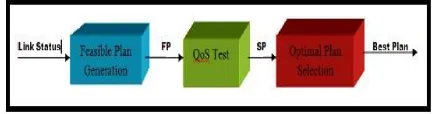
C. Localized Network Reconfiguration Feasible plan generation:-
Feasible plan generation is to search all legitimate changes in links and the combination around the faulty link. Multiple channels, radios, routes, ARS detects the feasible changes and avoid local link failure but maintain the previous network connectivity.
1. Avoid the faulty links.
2. Maintain Network connectivity.
3. Utilization of resources.
4. Scope of changes.
Quality of Service Test:-
Quality of services depends upon different parameters such as bandwidth, network traffic, and network utilization. According to QoS-test demands the satisfiability of different constraints that are been generated in feasible plan generation.
Optimal solution:-
Optimal plan is the final solution that is been implemented to overcome the failure path. Optimal selection is done on bases of QoS.
[image:3.612.334.553.218.275.2]The figure 3.2. Show the quality of test and the final selection of the optimal path.
Fig. 3.2 Quality of service test.
IV. IMPLEMENTATION
Implementation of the system is one of the important and the major factor for the development of the software or hardware and the complete product designing.
Self-reconfigurable wireless mesh network is been implemented and tested using the simulation developed using Java language; client server communication is used such as socket programming. Simulation has different parameter such as the gateway, Different nodes; mesh connectivity, mobile terminal etc.
A.Mobile Terminal
Terminal used to send the data to the destination using the network parameters.
Source file is selected and then path is been provide to send the file to the destination node.
[image:3.612.328.559.495.654.2]International Journal of Emerging Technology and Advanced Engineering
Website: www.ijetae.com (ISSN 2250-2459,ISO 9001:2008 Certified Journal, Volume 3, Issue 3, March 2013)
447
B. Gateway
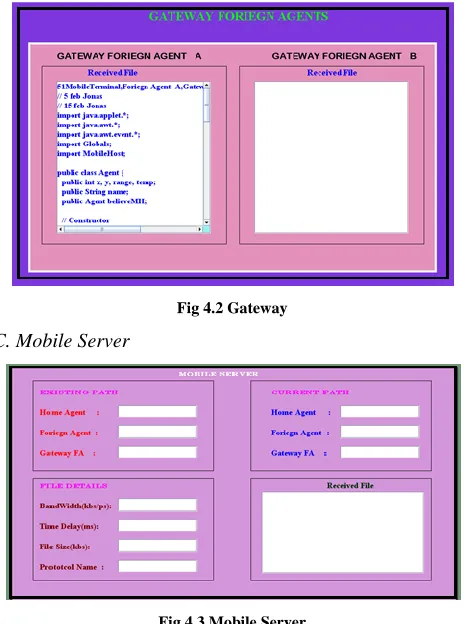
There are two major gateways used A and B. shown in the figure 4.2.
[image:4.612.332.557.131.326.2]If Gateway A fails or not available due to some reason the other gateway B is used to overcome the fails and faults caused.
Fig 4.2 Gateway
C. Mobile Server
Fig 4.3 Mobile Server
It provides the complete details on the configuration of the Networking parameters such as the protocol, bandwidth, and time delay, gateway size of the file.
D. Foreign Agents
Wireless Nodes for the receiving the data from mobile terminal. Figure 4.4 shows four nodes A,B,C,D.
Fig 4.4 Foreign Agent
V. CONCLUSION
Thus our paper presents ARS (Autonomous
Reconfiguration System) that helps a wireless mesh network to reconfigure intelligently from the link failures. ARS helps in generating an intelligent reconfiguration plan that requires changes in the networks. ARS generates the reconfiguration plan which satisfies the quality of services attributes. ARS Accurately interacts across the network and link layer for the network planning.
REFERENCES
[1 ] I. Akyildiz, X. Wang, and W. Wang, “Wireless mesh networks: A survey,” Computer Network, vol. 47, no. 4, pp. 445–487, Mar. 2005. [2 ] M. J. Marcus, “Real time spectrum market and interruptible spectrum: New concept of spectrum use enabled by cognitive radio,” in Proc. IEEE DySPAN, Baltimore, MD, Nov. 2005, pp. 512–517. [3 ] P. Kyasanur and N. Vaidya, “Capacity of multi-links wireless
networks: Impact of number of channels and interfaces,” in Proc. ACM MobiCom, Cologne, Germany, Aug. 2005, pp. 43–57. [4 ] K. Ramanchandran, E. Belding-Royer, and M. Buddhikot,
“Interference- aware channel assignment in wireless mesh networks,” in Proc. IEEE INFOCOM, Barcelona, Spain, Apr. 2006,pp. 1–12.
[image:4.612.52.284.212.524.2]International Journal of Emerging Technology and Advanced Engineering
Website: www.ijetae.com (ISSN 2250-2459,ISO 9001:2008 Certified Journal, Volume 3, Issue 3, March 2013)
448
[6 ] P. Bahl, R. Chandra, and J. Dunagan, “SSCH: Slotted seeded channel hopping for capacity greatly improved in IEEE 802.11 ad-hoc wireless networks,” in Proc. ACM MobiCom, Philadelphia, PA, Sep. 2004, pp. 216–230.
[7 ] D. Aguayo, J. Bicket, S. Biswas, G. Judd, and R. Morris, “Link-level quality measurements from an 802.11b mesh network,” in Proc. ACM SIGCOMM, Portland, OR, Aug. 2004, pp. 121–132. [8 ] A. Akella, G. Judd, S. Seshan, and P. Steenkiste, “Self-management
in wireless deployments,” in Proc. ACM MobiCom, Cologne, Germany, Sep. 2005, pp. 185–199.