A NEW GENETIC ALGORITHM BASED
CLUSTERING FOR BINARY AND IMBALANCED
CLASS DATA SETS
Sabariah Saharan
Acknowledgement
First and foremost, I am grateful to Almighty God for giving me many great opportunities in life, including this challenging yet wonderful PhD journey.
I am deeply thankful to Professor Jennifer Brown, Professor Roberto Baragona and A/Prof Marco Reale for their helpful supervision, generous assistance and encouragement to pursue this research that led to this thesis.
I owe very much to Professor Roberto Baragona for his thoughtful advice, knowledge and wisdom. His guidance and assistance were invaluable in helping me acquire the necessary skills to become a PhD researcher.
I would like to express my great appreciation to my parents, family and friends. It was hard being away from them, but their constant love and care touched me in many ways. Without their support, this work would not have been possible. To my closest friends in Christchurch, thank you for being an instant family to us these past years.
Imran Wafi, by my side throughout my study. I am forever in their debt for supporting me throughout countless weekends that were supposed to be reserved especially for them. Not forgetting my mum,Hajah Habibah Ma’som for her endless and countless pray, my siblings, and all my in laws. I would not have been able to complete this journey without their love, patience and pray.
I would like to acknowledge my employer, Universiti Tun Hussein Onn Malaysia (UTHM) and the Government of Malaysia for funding my PhD program and living expenses for my family and I in Christchurch. Without these financial support I would not have been able to undertake this program.
Contents
1 Introduction 11
1.1 Introduction. . . 11
1.2 Objectives of the Study . . . 15
1.3 Significance of the Study . . . 16
1.4 Scope and Limitation of the Study . . . 18
1.5 Overview of Thesis . . . 19
2 Overview of Genetic Algorithms 21 2.1 Introduction of Genetic Algorithms . . . 21
2.2 Encoding . . . 24
2.2.1 Point-based Encoding . . . 25
2.2.2 Centre-based Encoding . . . 25
2.2.3 Locus-based Adjacency Representation. . . 26
2.3 Fitness Function . . . 27
2.4 Elitism. . . 28
2.5 Selection Operator . . . 29
2.5.1 Fitness Proportional / Roulette Wheel Selection . . . 30
2.5.3 Stochastic Universal Sampling (SUS) . . . 32
2.5.4 Binary Tournament Selection . . . 33
2.6 Crossover Operator . . . 34
2.6.1 Single-point Crossover . . . 35
2.6.2 n-point Crossover. . . 36
2.6.3 Uniform Crossover . . . 36
2.7 Mutation Operator . . . 37
2.8 Summary . . . 38
3 Genetic Algorithm Clustering 40 3.1 Introduction. . . 40
3.2 Past literature on Genetic Clustering . . . 41
3.2.1 Multi Objective Genetic Algorithms, MOGAS. . . 46
3.2.2 GAs for Categorical Data Sets . . . 49
3.2.3 GAs clustering for Binary Data . . . 50
3.2.4 GAS clustering for imbalanced class data sets . . . 53
3.3 Summary . . . 54
4 GCUK-binary 56 4.1 Introduction. . . 56
4.2 Genetic Clustering for Unknown K, GCUK . . . 56
4.2.1 Encoding . . . 57
4.2.2 Population Initialization . . . 60
4.2.3 Fitness Function . . . 60
5
4.2.5 Crossover Operator. . . 62
4.2.6 Mutation Operator . . . 62
4.2.7 Termination Process . . . 63
4.3 Application to Real World Data Sets . . . 63
4.4 Results. . . 66
4.4.1 Number of clusters, K . . . 66
4.4.2 Parameter Settings . . . 72
4.4.3 GCUK-binary Results . . . 75
4.4.4 Summary . . . 76
5 Genetic Algorithm with Incremental K-Means 79 5.1 Introduction. . . 79
5.1.1 Incremental K-Means, IKM . . . 80
5.1.2 Data Representation . . . 81
5.1.3 Fitness Function . . . 82
5.1.4 Selection Process for GAIKM . . . 82
5.1.5 Crossover Process for GAIKM . . . 83
5.1.6 Mutation Process for GAIKM . . . 84
5.1.7 Termination Criteria . . . 85
5.1.8 The Process of GAIKM . . . 85
5.2 A Simulation Study . . . 86
5.3 Application to Real World Data Sets . . . 93
5.3.1 Results of Parameter Settings . . . 94
6 Conclusion 100 6.1 GCUK-binary . . . 100 6.2 GAIKM . . . 102 6.3 Recommended Future Studies . . . 103
APPENDIX 113
List of Figures
2.1 Basic steps in GA . . . 23
2.2 Locus-based Adjacency Representation illustration . . . 26
2.3 Roulette Wheel Selection Illustration . . . 30
2.4 Stochastic Roulette Wheel Selection Illustration. . . 32
2.5 Stochastic Universal Sampling Illustration . . . 33
2.6 Binary Tournament Selection Illustration . . . 34
2.7 Single Crossover Illustration . . . 35
3.1 Confusion Matrix . . . 46
3.2 Illustration of Pareto-front. . . 49
3.3 Illustration of Minimum Spanning Tree . . . 52
4.1 Silhouette index for Nursery data, k=4 . . . 69
4.2 Silhouette index for Nursery data, k=5 . . . 69
4.3 Silhouette index for Nursery data, k=6 . . . 69
4.4 Silhouette index for Car Evaluation data, k=3. . . 69
4.5 Silhouette index for Car Evaluation data, k=4. . . 69
4.6 Silhouette index for Car Evaluation data, k=5. . . 69
4.8 Silhouette index for Bank Marketing data, k=4 . . . 70
4.9 Silhouette index for Bank Marketing data, k=5 . . . 70
4.10 Silhouette index for CRTA data, k=5. . . 70
4.11 Silhouette index for CRTA data, k=6. . . 70
4.12 Silhouette index for CRTA data, k=7. . . 70
4.13 Silhouette index for CRTA2 data, k=4 . . . 71
4.14 Silhouette index for CRTA2 data, k=5 . . . 71
4.15 Silhouette index for CRTA2 data, k=6 . . . 71
4.16 Silhouette index for URTA data, k=5 . . . 71
4.17 Silhouette index for URTA data, k=6 . . . 71
4.18 Silhouette index for URTA data, k=7 . . . 71
1 Number of generations of the best individual for Nursery data set. . . 115
2 Number of generations of the best individual for Car Evaluation data set . . 116
3 Number of generations of the best individual for Bank Marketing data set . . 116
4 Number of generations of the best individual for CRTA data set . . . 117
5 Number of generations of the best individual for CRTA2 data set . . . 117
List of Tables
2.1 Terms in Genetic Algorithms . . . 22
3.1 Operational Taxonomic Units . . . 45
4.1 Clusters of variables obtained from the GCUK algorithm . . . 67
4.2 Silhouette index for GCUK-binary for all the data sets . . . 68
4.3 Different parameter settings and theDB value for Nursery data . . . 73
4.4 Different parameter settings and theDB value for Car Evaluation data . . . 73
4.5 Different parameter settings and theDB value for Bank Marketing data . . . 73
4.6 Different parameter settings and theDB value for CRTA . . . 74
4.7 Different parameter settings and theDB value for CRTA2 . . . 74
4.8 Different parameter settings and theDB value for URTA . . . 75
4.9 Result for GCUK-binary . . . 76
5.1 Cluster prototypes for the ”hand-made” clustering structure of the first data set 87 5.2 Results from Experiment 1 . . . 89
5.3 Probabilities that variables assume value 1 according to a Bernoulli scheme . 90 5.4 Results from Experiment 2 . . . 91
5.6 Results from Experiment 3 . . . 93
5.7 Different parameter settings and theqRW value for Nursery data. . . 94
5.8 Different parameter settings and theqRW value for Car Evaluation data . . 95
5.9 Different parameter settings and theqRW value for Bank Marketing data . . 95
5.10 Different parameter settings and theqRW value for CRTA . . . 96
5.11 Different parameter settings and theqRW value for CRTA2 . . . 96
5.12 Different parameter settings and theqRW value URTA . . . 97
Chapter 1
Introduction
1.1
Introduction
The increasing volume of data collected by individuals, firms and organizations at a specific range of time has triggered the urge to explore and process this type of information. Many statistical techniques have been proposed by researchers to analyze this large volume of data such as analysis of variance, linear regression, discriminant analysis, multi-dimensional scal-ing, classification and clustering.
The aim of clustering is to divide the data points intoK clusters, whereby the characteristics of the data within the cluster should be as similar as possible, and they should be different from the other data in other clusters. The higher the similarity within the cluster and the higher the difference between clusters, the better the clustering. In this study, the interest was to cluster the variables to see a similar pattern of these variables. For example given a set of n variables, X = x1, x2, . . . , xn to be clustered with each of these Xi ∈ RP is an
attribute vector used to describe the variables. These variables will be clustered into a set of clusters,C =C1, C2, . . . , CK where K is the number of clusters. The clusters are disjoint
C, Ci∩Cj = for i6=j. The numbers of K may be known a priori or not. Let ¯xk be the
mean of the clusterCk. The main goal of clustering is to find the minimum distance between
thexi to the closest center ¯xk as follows:
K
X
k=1
X
xi∈Ck
kxi−x¯k k2
A well-known clustering method is K-means [Macqueen,1967] algorithm which uses an itera-tive process. This algorithm is easy to implement and efficient [Jain,2010,Jain et al.,1999]. The method of K-means can be described by the following steps:
1. Choose the initial centers (¯x1, . . . ,x¯k) for each of the clusters C1, . . . , CK.
2. Find the new cluster membership by assigning each data point to the closest centres.
3. Recalculate the clusters centres.
13
Even though the K-means algorithm is computationally efficient, there are a few critical weaknesses. The quality of the clustering is totally dependent on the initial cluster centres and is sensitive to outliers. Moreover, it can also be easily trapped in a local minimum [Lu et al.,2004b,Ordonez, 2003,Pham et al., 2004]. The other weakness of K-means is that it
is time consuming when applied to a large data set [Sanjay Chakraborty,2011].
Incremental K-means (IKM) [Ordonez, 2003, Pham et al., 2004, Sanjay et al., 2011, San-jay Chakraborty,2011] was proposed to improve the performance of the standard K-means
with different objectives. Chakraborty and Nagwani [2011], Sanjay et al. [2011], Sanjay Chakraborty [2011] proposed an IKM where the new data are clustered by comparing their smallest distance from the means of the existing clusters. The result is same as if a stan-dard K-means was run for the whole data set, but this new proposed method needed less computation time. The proposed IKM showed better performance when compared with the standard K-means. However, when the threshold value or the % ofδ change in the database exceeded 57%, standard K-means outperformed IKM.
Pham et al. [2004] proposed an IKM variant that applied the device of allowing a cluster center to jump to a completely different point. This device may enable the cluster centres to move to reduce a cluster distortion. When the value ofK becomes larger, the search process is slowed down because the algorithm needs to find all possible beneficial places to insert the new clusters.
the standard K-means algorithms. Online K-means, most commonly known as sequential K-means, allows to update the model as new data is received. However, unlike these two methods, this IKM will not iterate until convergence, and only the values of the sufficient statistics N and M have to be updated at each step. Let n be the number of cases, then Nj, j = 1, . . . , k is the number of cases that are assigned to cluster j and Mij is the sum of
the instances that equal to 1 recorded for the factori for all the cases that are assigned to cluster j. The performance of IKM outperformed standard K-means, Scalable K-means and On-line K-means in most cases. However, when this algorithm was applied to very sparse matrices and very high dimensional data set, it was found that the Scalable K-means had slightly better solutions than IKM.
Another approach to improve the performance of the standard K-means is by using Genetic Algorithms. Genetic Algorithms or GA was an idea from John Holland and his friend in the early of 1970’s. It is a subclass of the Evolutionary Algorithms which use stochastic searching techniques [Goldberg,1989]. These techniques are inspired by the process of biological evo-lution; selection, crossover and mutation processes. The continues process for searching the best population of the problem solutions, gives GA the ability to escape from stopping at the local optima. This can make GA more efficient compared to other local optimization methods.
15
Algorithm ), andGuo et al. [2006],Li et al. [2010], Murthy and Chowdhury[1996],Tan and Lu [2009](An Improved K-means with Combined with the Genetic Algorithm). The details for the Genetic Clustering Algorithm will be explained in Chapter 3.
Based on these few examples, the idea of using GA for K-means improvement is not new. However, many of these studies focus on quantitative data (discrete and continuous). There-fore the development of clustering for categorical data has not grown as tremendously as that for numerical data. It may be due to the definition of clustering for categorical data being not as clear as the problem for numerical data [Duda and Hart, 1974]. For numerical data, the problem of high dimensionality [Ordonez and Omiecinski, 2002], data sparsity [Guha et al.,1998] and noise [Bradley et al.,1998] make clustering for this type of data sets more
challenging compared to categorical data.
Even though the idea of using GA to improve the performance of K-means has proposed by many researchers, most of them used numerical data sets as their test data. Thus, the main idea in this study, is to cluster the binary data sets by exploiting the advantages in GA to provide a good population and then cluster it by using computing devices taken from the efficient and effective IKM.
1.2
Objectives of the Study
1. exploit the most characteristics properties of binary data by using the existing GA based clustering methods.
2. to improve the performance of GCUK to cluster the binary data and imbalanced class data sets.
3. compare the performance of GCUK-binary with K-means clustering algorithm.
4. propose a new clustering algorithm from a combination of GA and IKM that specifically focusing on binary data and imbalanced class data sets.
5. to compare the performance of GAIKM with the existing clustering methods, IKM, SKM, GCUK and NSGAII.
1.3
Significance of the Study
GA is a well-known optimization method that has been shown by many researchers to be capable of successfully carrying out the clustering task. Unlike the other traditional cluster-ing algorithms, GA provides populations that are filled with only the best problem solutions. Each of the populations have a chance to be picked as the best solution. The continuous pro-cess to search for the best solution gives an advantage to GA to escape from being trapped at the local optima.
17
sets.
In spite of the effectiveness of GCUK to cluster large data sets, this algorithm has a weakness as it is uses the length of the data point as a chromosome representation. This results in increased time to converge if it involves large high dimensional data sets. It should be noted that GA must iterate over every string in the chromosome and basically the longer data point (string) the longer it takes to converge. The GCUK also has the capability to provide the number of clusters during the process. However, this advantage has a drawback as GCUK can give empty clusters. We show this in the experiment in Chapter 4 (GCUK-binary).
The objective of the version of GCUK implemented in this study was to exploit the most characteristic properties of binary data by using the well-known GA based clustering algo-rithm. Some new improvements were added in this algorithm to suit the binary environment as GCUK has never been used to cluster these types of data sets. Based on the findings, advantages and weaknesses from the results were used to develop a new clustering method.
of the standard K-means to cluster the binary data streams. His study proved that this algorithm is efficient and effective when compared with the Scalable K-means and On-line K-means. However, in some cases, where the data sets have some issues like sparsity and
high dimensionality, the ScalableK-means slightly outperformed the IKM.
Based on this weakness, this study used the advantages and the efficiency of the IKM from the idea of Ordonez [2003] and combine with the GA. Single objective optimization was chosen as from the findings and results, there are some gaps from this method that can be improve in this study.
The method used in this study has been used by other researchers before, and many of them have proposed a new method based on the improvement from the original method. Never-theless, this study is still important and contributes something new. Apart from the different types of data sets that were used, the other contribution is the application to imbalanced class data sets in this study which have never been tested with GCUK. The findings and results from this study can provide a new reference to future research involving GA and imbalanced class data.
1.4
Scope and Limitation of the Study
19
or imbalanced class data sets, except in an improvement of the GCUK method byLin et al. [2005].
The data involved in this study are four data sets that were retrieved from the UCI Machine Learning database [Lichman,2013] and two imbalanced data sets; Christchurch Road Traffic Accidents (CRTA) and United Kingdom Road Traffic Accidents (URTA). All the data sets from the UCI Machine Learning database contain categorical data which were then recoded into binary attributes.
This study does not focus on the natural clusters for each of the variables as the intention is to see the performance of the proposed method when compared to other clustering methods (standard K-means, GCUK, NSGAII, IKM and SKM). The time taken to converge by the proposed method was not recorded in this study and is suggested for future research.
1.5
Overview of Thesis
The aim of this thesis is to propose a new clustering method that can be applied specifically for binary and imbalanced class data sets. It is organised as follows:
Chapter 2 provides a brief explanations on GA.
Chapter 3 provides a literature reviews on GA based clustering.
versity, University of Wellington and University of Auckland. A paper that explained some part of the results has been submitted to International Conference on Education, Mathematics and Sciences 2016 (ICEMS2016) and The Asian Mathematical Conference (AMC 2016 Bali), Bali, Indonesia.
Chapter 5 introduces the new proposed GA based clustering method. This is a combination of simple GA with the IKM and Scalable K-means. A part of the analysis of the proposed method was given inSaharan and Baragona [2013].
Chapter 2
Overview of Genetic Algorithms
2.1
Introduction of Genetic Algorithms
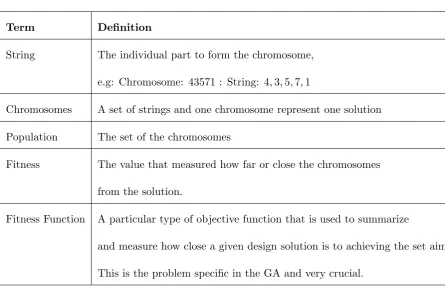
GAs are one of the best ways to solve a problem for which little is known. These algorithms can solve both constrained and unconstrained optimization problems based on a natural selec-tion process that mimics biological evoluselec-tion. GAs work within a search space that contains all feasible solutions. Each point in the search space represent one feasible solution and each of these feasible solutions will be marked by its fitness value. The set of solutions is called a population. One solution is taken from the population (P) to form a new population (P0). A strong possible solution will survive to the next generation, but weak solutions will be elimi-nated from the population. The critical problem in the GAs process is to assign the fitness function and the initialization of the starting point in the search space [S.N. Sivanandam and S.N. Deepa,2008].
Table 2.1: Terms in Genetic Algorithms
Term Definition
String The individual part to form the chromosome, e.g: Chromosome: 43571 : String: 4,3,5,7,1
Chromosomes A set of strings and one chromosome represent one solution Population The set of the chromosomes
Fitness The value that measured how far or close the chromosomes from the solution.
Fitness Function A particular type of objective function that is used to summarize
and measure how close a given design solution is to achieving the set aims. This is the problem specific in the GA and very crucial.
The solutions in the search space are nothing without the process of the combination and crossover. The new population will hopefully contain better solutions from the current pop-ulation and this is only done after the two solutions are combined. Furthermore, to make it more unique, some of the characters in the solutions will be changed or mutated with a very small probability. The objective of these two operators is to make sure that the new population will be fitter compared to the old population [Goldberg, 1989, S.N. Sivanandam and S.N. Deepa,2008].
23
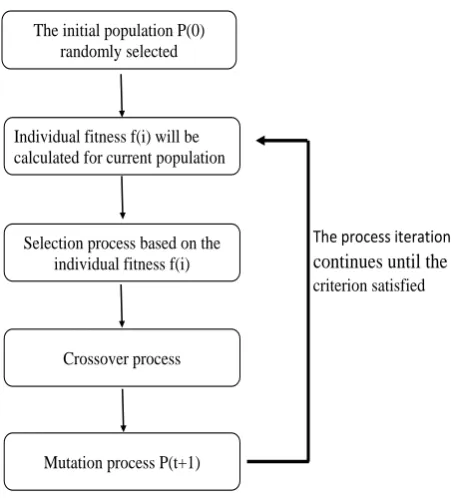
The process iteration continues until the
criterion satisfied The initial population P(0)
randomly selected
Individual fitness f(i) will be calculated for current population
Selection process based on the individual fitness f(i)
Crossover process
[image:25.595.260.488.173.424.2]Mutation process P(t+1)
Figure 2.1: Basic steps in GA
function ), then it can be selected and the weakest chromosomes will be eliminated from the population. Then, these chromosomes will go into the mating pool and two chromosomes will be randomly selected to mate and combine some of their genes to produce a new offspring. A small change (mutation) of a gene in a child may happen with a lower probability. The idea is to make the child more unique or have a high quality compared with their parent. The mutation process also has a role in preventing the algorithm from drop into the local minimum. Thus, as new generations develop, the quality of the chromosomes or the possible solutions are also increased. This process is repeated until some criteria are met or some predefined number of generations is achieved.
2.2
Encoding
The first step in GA is to choose the suitable encoding to represent the chromosomes or the possible solutions. The users will have to encode their problem’s variables into the chro-mosomes environment. Usually GA uses a binary encoding, but many researchers such as Bandyopadhyay and Pal[2007], Baragona et al. [2006], Jie et al.[2003],Maulik and Bandy-opadhyay [2000], Mukhopadhyay et al. [2009] used real numbers for encoding in GA. The binary encoding only contains 0’s (absent) and 1’s (present) and it was first used because of its relative simplicity [Goldberg, 1989]. These chromosomes will have a length of l that represent solutions for every objective. The number of solutions that can be obtained is then clearly 2l.
Bibliography
A. Casillas, M. T. Gonz´alez de Lena, and R. Mart´ınez (2003). Document Clustering into an Unknown Number of Clusters Using a Genetic Algorithm. Springer-Verlag Berlin Heidel-berg, 2807(1):43–49.
Arunprasath, S., Chandrasekar, S., Venkatalakshmi, K., Shalinie, S. M., and Arunprasath, S. and Chandrasekar, S. and Venkatalakshmi, K. and Shalinie, S. (2010). Classification of remote sensed image using Rapid Genetic k-Means algorithm. In Communication Control and Computing Technologies (ICCCCT), 2010 IEEE International Conference on, pages 677–682.
Baker, J. E. (1987). Reducing bias and inefficiency in the selection algorithm. InProc of the Second International Conference of Genetic Algorithms and their application, pages 14–21.
Bandyopadhyay, S. and Maulik, U. (2002a). An Evolutionary technique based on K-means algorithm for optimal clustering in RN. Information Sciences, 146:221–237.
Bandyopadhyay, S. and Maulik, U. (2002b). Genetic Clustering For Automatic Evolution Of Clusters And Application To Image Classification. Pattern Recognition, 35(6):1197–1208.
Classifica-tion and Learning Using Genetic Algorithms, Natural Computing Series, pages 181–212. Springer Berlin Heidelberg.
Baragona, R., Bocci, L., and Medaglia, C. M. (2006). Genetic Clustering Algorithms: a Com-parison Simulation Study.International Journal of Modelling & Simulation, 26(3):190–200.
Bezdek, J. C. (1981).Pattern Recognition with Fuzzy Objective Function Algorithms. Springer US, Boston, MA.
Boriah, S., Chandola, V., and Kumar, V. (2008). Similarity Measures for Categorical Data: A Comparative Evaluation. Proceedings of 2008 {SIAM} Data Mining Conference, pages 243–254.
Bradley, P. S., Fayyad, U., Reina, C., and Paul S. Bradley, Usama M. Fayyad, C. A. R. (1998). Scaling Clustering Algorithms to Large Databases. American Association for Artificial Intelligence, pages 9–15.
Chakraborty, S. and Nagwani, N. (2011). Performance Evaluation of Incremental K-means Clustering Algorithm.IFRSA International Journal of Data Warehousing & Mining, 1:54– 59.
Cole, R. M. (1998). Clustering With Genetic Algorithms. PhD thesis, Dept. of Computer Science,University of Western Australia.
106
Davies, D. L. and Bouldin, D. W. (1979). A Cluster Separation Measure. Pattern Analysis and Machine Intelligence, IEEE Transactions on, PAMI-1(2):224–227.
Deb, K. and Kalyanmoy, D. (2001). Multi-Objective Optimization Using Evolutionary Algo-rithms. John Wiley & Sons, Inc., New York, NY, USA.
Deb, K., Pratap, A., Agarwal, S., and Meyarivan, T. (2002). A fast and elitist multiobjective genetic algorithm: NSGA-II. Evolutionary Computation, IEEE Transactions on, 6(2):182– 197.
Deepa, T. and Punithavalli, M. (2010). An Analysis for Mining Imbalanced Datasets. Inter-national Journal of Computer Science and Information Security, 8(1):132–137.
Duda, R. O. and Hart, P. (1974). Pattern Classification and Scene Analysis. IEEE Transac-tion on Automatic Control, 19(4):462–463.
Fatima Zohra Bellala Belahbib, F. S. (2011). Genetic algorithm clustering for color image quantization. Visual Information Processing (EUVIP), 2011 3rd European Workshop on.
Goldberg, D. E. (1989). Genetic Algorithms in Search, Optimization and Machine Learning. Addison-Wesley Longman Publishing Co., Inc., Boston, MA, USA, 1st edition.
Guha, S., Rastogi, R., and Shim, K. (1998). CURE: an efficient clustering algorithm for large databases. ACM SIGMOD Record, 27(2):73–84.
Guo, H.-x., Zhu, K.-j., Gao, S.-w., and Liu, T. (2006). An Improved Genetic k-means Algorithm for Optimal Clustering. In Data Mining Workshops, 2006. ICDM Workshops 2006. Sixth IEEE International Conference on, pages 793–797. Ieee.
Handl, J. and Knowles, J. (2007). An Evolutionary Approach to Multiobjective Clustering.
IEEE Transactions on Evolutionary Computation, 11.
Hruschka, E. R., Campello, R., Freitas, A. A., and de Carvalho, A. (2009). A Survey of Evo-lutionary Algorithms for Clustering. Systems, Man, and Cybernetics, Part C: Applications and Reviews, IEEE Transactions on, 39(2):133–155.
Hubert, L. (1985). Classification ˜1985. Journal of Classification, 218:193–218.
Jain, A. K. (2010). Data clustering: 50 years beyond K-means. Pattern Recognition Letters, 31(8):651–666.
Jain, A. K., Murty, M. N., and Flynn, P. J. (1999). Data clustering: a review. ACM Comput. Surv., 31(3):264–323.
Jie, L. I., Xinbo, G. A. O., and Li-cheng, J. (2003). A GA-Based Clustering Algorithm for Large Data Sets With Mixed Numeric and Categorical Values. In Computational Intelli-gence and Multimedia Applications, 2003. ICCIMA 2003. Proceedings. Fifth International
Conference on, pages 102–107.
Kaukoranta, T. and Nevalainen, O. (1997). Genetic algorithms for large scale clustering problems. The Computer Journal, 40(9):547–554.
Krishna, K., Narasimha Murty, M., and Murty, M. N. (1999). Genetic K-means algorithm.
Systems, Man, and Cybernetics, Part B: Cybernetics, IEEE Transactions on, 29(3):433– 439.
108
Kwedlo, W. and Iwanowicz, P. (2010). Using genetic algorithm for selection of initial clus-ter cenclus-ters for the K-means method. Lecture Notes in Computer Science (including sub-series Lecture Notes in Artificial Intelligence and Lecture Notes in Bioinformatics), 6114 LNAI(PART 2):165–172.
Leisch, F., Weingessel, A., and Dimitriadou, E. (1998). Competitive Learning for Binary Valued Data. In Proceedings of the 8th International Conference on Arti Neural Networks (ICANN 98, pages 779–784. Springer.
Leon, E., Nasraoui, O., and Gomez, J. (2006). ECSAGO: Evolutionary Clustering with Self Adaptive Genetic Operators. 2006 IEEE International Conference on Evolutionary Computation, pages 1768–1775.
Li, M., Yang, S., Liu, X., and Wang, K. (2013). IPESA-II : Improved Pareto Envelope-Based Selection Algorithm II Miqing IPESA-II Problems of PESA-II. In Purshouse, R., Fleming, P., Fonseca, C., Greco, S., and Shaw, J., editors, Evolutionary Multi-Criterion Optimization, pages 143–155. Springer Berlin Heidelberg.
Li, X., Zhang, L., Li, Y., and Wang, Z. (2010). A improved k-means clustering algorithm combined with the genetic algorithm. In Digital Content, Multimedia Technology and its Applications (IDC), 2010 6th International Conference on, pages 121–124.
Lichman, M. (2013). UCI Machine Learning Repository.
Lin, H.-J., Yang, F.-W., and Kao, Y.-T. (2005). An Efficient GA-based Clustering Technique.
K-means Clustering Algorithm. In Proceedings of the 2004 ACM symposium on Applied computing, SAC ’04, pages 622–623, New York, NY, USA. ACM.
Lu, Y., Lu, S. Y., Fotouhi, F., Deng, Y. P., and Brown, S. J. (2004b). Incremental ge-netic K-means algorithm and its application in gene expression data analysis. In BMC BIOINFORMATICS, volume 5 of SAC ’04, pages 622–623, New York, NY, USA. ACM.
Macqueen, J. B. (1967). Some methods of classification and analysis of multivariate obser-vations. In Proceedings of the Fifth Berkeley Symposium on Mathematical Statistics and Probability, pages 281–297.
Maulik, U. and Bandyopadhyay, S. (2000). Genetic algorithm-based clustering technique.
Pattern Recognition, 33(9):1455–1465.
Maulik, U., Bandyopadhyay, S., and Mukhopadhyay, A. (2011). Multiobjective Genetic Al-gorithms for Clustering: Applications in Data Mining and Bioinformatics. Springer.
Mitchell, M. (1995). An Introduction to Genetic Algorithms. MIT Press, Cambridge, MA, USA.
Mukhopadhyay, A., Maulik, U., and Bandyopadhyay, S. (2009). Multiobjective Genetic Algorithm-Based Fuzzy Clustering of Categorical Attributes. Evolutionary Computation, IEEE Transactions on, 13(5):991–1005.
Mukhopadhyay, A., Maulik, U., and Bandyopadhyay, S. (2015). A Survey of Multiobjective Evolutionary Clustering. ACM Computing Surveys, 47(4):1–47.
110
Mukhopadhyay, A., Member, S., Maulik, U., and Member, S. (2014b). Survey of Multi-Objective Evolutionary Algorithms for Data Mining : Part-II. IEEE Transactions on Evolutionary Computation, 18(1):20–35.
Murthy, C. and Chowdhury, N. (1996). In search of optimal clusters using genetic algorithms.
Pattern Recognition Letters, 17(8):825–832.
Murty, M., Babaria, R., and Chiranjib, B. (2008). Clustering Based on Genetic Algorithms. InMulti-Objective Evolutionary Algorithms for Knowledge Discovery from Databases, vol-ume 98 ofStudies in Computational Intelligence, pages 137–159. Springer Berlin / Heidel-berg.
Nasraoui, O. and Krishnapuram, R. (2000). A novel approach to unsupervised robust cluster-ing uscluster-ing genetic nichcluster-ing. Ninth IEEE International Conference on Fuzzy Systems. FUZZ-IEEE 2000 (Cat. No.00CH37063), 1:170–175.
Ordonez, C. (2003). Clustering binary data streams with K-means. In Proceedings of the 8th ACM SIGMOD workshop on Research issues in data mining and knowledge discovery, DMKD ’03, pages 12–19, New York, NY, USA. ACM.
Ordonez, C. and Omiecinski, E. (2002). FREM: fast and robust EM clustering for large data sets. InProceedings of the eleventh international conference on Information and knowledge management, CIKM ’02, pages 590–599, New York, NY, USA. ACM.
ison. InProceedings of the 11th WSEAS international conference on neural networks and 11th WSEAS international conference on evolutionary computing and 11th WSEAS
inter-national conference on Fuzzy systems, NN’10/EC’10/FS’10, pages 28–36, Stevens Point, Wisconsin, USA. World Scientific and Engineering Academy and Society (WSEAS).
Pham, D. T., Dimov, S. S., and Nguyen, C. D. (2004). An incremental K-means algorithm.
Reeves, C. R. and Rowe, J. E. (2002). Basic Principles. In Sharda, R. and Vo, S., editors, Ge-netic AlgorithmsPrinciples and Perspectives, volume 20 ofOperations Research/Computer Science Interfaces Series, pages 19–63. Springer US.
Rousseeuw, P. J. (1987). Silhouettes: A graphical aid to the interpretation and validation of cluster analysis. Journal of Computational and Applied Mathematics, 20(null):53–65.
Rudolph, G. (1994). Convergence analysis of canonical genetic algorithms. Neural Networks, IEEE Transactions on, 5(Jan 1994):96–101.
Safe, M., Carballido, J., Ponzoni, I., and Brignole, N. (2004). On Stopping Criteria for Genetic Algorithms.
Saha, I., Sarkar, J. P., and Maulik, U. (2015). Ensemble based rough fuzzy clustering for categorical data.
Saharan, S. and Baragona, R. (2013). A new Genetic Algorithm for clustering binary data with application to traffic road accidents in Christchurch. Far East Journal of Theoritical Statistics, 45(1):67–89.
112
Sanjay Chakraborty, N. N. (2011). Analysis and Study of Incremental K-Means Clustering Algorithm. In High Performance Architecture and Grid Computing Communications in Computer and Information Science, pages 338–341. Springer Berlin Heidelberg.
S´ergio Moro and Paulo Cortez and Paulo Rita (2014). A Data-Driven Approach to Predict the Success of Bank Telemarketing. Decision Support Systems, 62:22–31.
S.N. Sivanandam and S.N. Deepa (2008).Introduction to Genetic Algorithms. Springer Berlin Heidelberg, Berlin, Heidelberg.
Soler, Vicen, Prim, and Marta (2009). Extracting a Fuzzy System by Using Genetic Algo-rithms for Imbalanced Datasets Classification: Application on Downs Syndrome Detection. In Zighed, D., Tsumoto, S., Ras, Z., and Hacid, H., editors,Mining Complex Data, volume 165 of Studies in Computational Intelligence, pages 23–39. Springer Berlin / Heidelberg.
Srinivas, N. and Deb, K. (1995). Muiltiobj ective Optimization Using Nondominated Sorting in Genetic Algorithms. Evolutionary Computation, 2(3):221—-248.
Tan, Z. and Lu, R. (2009). Application of Improved Genetic K-Means Clustering Algorithm in Image Segmentation. InEducation Technology and Computer Science, 2009. ETCS ’09. First International Workshop on, volume 2, pages 625–628.
Tseng, L. Y. and Yang, S. B. (1997). Genetic algorithms for clustering, feature selection and classification. In Neural Networks,1997., International Conference on, volume 3, pages 1612–1616.
balanced Data-Sets. International Journal of Uncertainty, Fuzziness and Knowledge-Based Systems, 20(03):369–397.
Wang, Y. and Zhang, W. (2009). Clustering analysis based on genetic algorithms. 2009 2nd IEEE International Conference on Computer Science and Information Technology, pages 325–328.
William M . Rand (1971). Objective Criteria for the Evaluation of Clustering Methods.
Journal of the American Statistical Association, 66(336):846–850.
Wu, S., Yin, S., and Li, M. (2012). A new approach for clustering problem based on bi-nary small world optimization algorithms. Computer Science and Automation Engineering (CSAE), 2012 IEEE International Conference on, 3:412 – 416.