ON VIBRATION CHARACTERISATION, MECHANICAL AND PHYSICAL PROPERTIES
EFFECTS OF ULTRA VIOLET IRRADIATION ON WASTE BIOPOLYMER BASED
SHAIQAH BINTI MOHD RUS
A thesis submitted in
fulfillment of the requirement for the award of the Degree of Master of Mechanical and Manufacturing Engineering
ABSTRACT
ix
ABSTRAK
xi
CONTENTS
TITLE i
DECLARATION v
DEDICATION vi
ACKNOWLEDGEMENT vii
ABSTRACT viii
ABSTRAK x
CONTENTS xii
LIST OF TABLES xvi
LIST OF FIGURES xvii
LIST OF SYMBOLS xxi
LIST OF ABBREVIATIONS xxii
CHAPTER 1 INTRODUCTION 1
1.1 General introduction 1
1.2 Problem statement 3
1.3 Hypothesis of research 4
1.4 Objectives of research 5
1.5 Scope of research 5
xiii
CHAPTER 2 LITERATURE REVIEW 7
2.1 Introduction 7
2.2 Polymer 8
2.2.1 Polymer synthesis 12
2.2.2 Polymer from renewable resources 13 2.2.3 Composites from oil-based polymers 15
2.3 Bio-polymer 16
2.4 Green technology 17
2.4.1 Recycling of bio-polymer foam 18
2.5 Environmental impact 19
2.6 Foam generation 20
2.6.1 Formation of foam 21
2.6.2 Production of foam 22
2.7 Modification of polymer using fillers 23 2.7.1 Composite foam and its properties 24
2.8 UV-irradiation on biopolymer 31
2.9 Vibration and its characteristics 32
2.9.1 Vibration classification 34
2.9.2 Vibration transmissibility measurement 34 2.10 Damping and its characteristic 40
2.10.1 Damping mechanism 41
2.10.2 Controlling damping 42
2.10.3 Data acquisition technique and constitutive
of WB model 43
2.10.4 Damping measurement system 45
2.11 Amorphous and glass transition, Tg 48 2.11.1 DSC materials and its properties 51
CHAPTER 3 METHODOLOGY 55
3.1 Introduction 55
3.2 Methodology chart 55
3.3 Fabrication of WB 58
3.4 Hot compression technique 60
3.5 UV weatherometer 61
3.6 Physical and mechanical tests 62
3.6.1 Morphology study 63
3.6.2 Density test 63
3.6.3 Compression test 64
3.6.4 Vibration transmissibility test 65 3.6.5 Determination of friction losses 69 3.6.6 Natural frequency of system deformation 71 3.6.7 Differential Scanning Calorimeter (DSC) 72
3.7 Summary 73
CHAPTER 4 RESULTS AND DISCUSSION 74
4.1 Introduction 74
4.2 UV-irradiated WB morphology 75
4.3 Density of UV-irradiated WB 76
4.4 Static stiffness (K), compression strain and stiffness analysis on UV-irradiated
WB in transmissibility system 78
4.5 Calculated value of natural frequency
of WB and UV-irradiated WB 81
4.6 Frictional losses (fixture losses) in WB
and UV-irradiated WB system 82
4.7 Vibration transmissibility results for laminated structure of WB and
xv
4.8 Damping characteristic of WB and
UV-irradiated WB fabricated 95
4.9 Summary to the vibration results and
discussion 97
4.10 Conclusion to the glass transition
temperature results and discussion 99
CHAPTER 5 CONCLUSION AND RECOMMENDATION 101
5.1 Conclusion 101
5.2 Future recommendation 103
REFERENCES 104
LIST OF TABLES
Table 2.1 Data of peak transmissibility and resonance frequency varied with resin technologies, density and hardness
(Koshute et al., 2001) 37
Table 4.1 Average compressive strain of UV-irradiated WB its
physical properties 80 Table 4.2 The damping ratio value of friction losses in force
vibration test 84
Table 4.3 (a) Data of resonance peak varied with fabricated WB (0 Hour UV) and UV-irradiated WB (1000 Hour UV), its base excitation and percentage of changes, ∆ 92 Table 4.3 (b) Data of resonance frequency varied with fabricated
WB (0 Hour UV) and UV-irradiated WB (1000 Hour UV), its base excitation and percentage of changes, ∆ 94 Table 4.3 (c) Data of attenuation frequency varied with fabricated
WB (0 Hour UV) and UV-irradiated WB (1000 Hour UV), its base excitation and percentage of changes, ∆ 95 Table 4.4 Damping ratio of WB (0 Hour UV) and UV-irradiated WB
(1000 Hour UV) by data measured from displacement and acceleration transmissibility test and its percentage of
changes, ∆ 97
xvii
LIST OF FIGURES
Figure 2.1 Polymers with linear and nonlinear chain architectures (Robyr, 2001) 9 Figure 2.2 Polymer compliance as a function of temperature
(Robyr, 2001) 10
Figure 2.3 Global PU production year 2012,
(utech-polyurethane.com, 2014) 11
Figure 2.4 Split of polyurethanes market by end-use application (Biesman, 2002) 12 Figure 2.5 Particle structure of waste bio-polymer foam
(Najibah, 2014) 19
Figure 2.6 Gelation Reaction or PU Cross Linking Reaction
(Kaushiva, 1999) 21 Figure 2.7 Effects of calcium carbonate of different particle sizes
and compositions on the Tensile Strength of Flexible
PU Foam (Latinwo et al., 2010) 25
Figure 2.8 Effects of calcium carbonate of different particle sizes and composition on the Elongation-at-break of Flexible
PU Foam (Latinwo et al., 2010) 25
Figure 2.9 (a) density, (b) elongation and (c) tensile strength of foam with concentration of CaCO3 (Usman et al., 2012) 26 Figure 2.10 Loss factor (tan δ) of unfilled and nano-filled PU rigid
foam (Nikje and Tehrani, 2010) 27
Figure 2.11 Compressive stress-strain curve for foam samples. Loading direction is parallel to the foam rise direction
(Alonso et al., 2006) 28
NRs as a function of foaming temperature and filler content
(Lee and Choi, 2007) 30
Figure 2.13 Vibration curve for normal (Polyol A) and high resilience foam (Polyol B) (Broos et al., 2000) 36 Figure 2.14 Typical occupied vertical vibration transmissibility output
(Kolich et al., 2005) 38
Figure 2.15 Mass-spring damper system was modeled as UV-irradiated
WB system 38
Figure 2.16 Foam model loaded with mass (Wang and Low, 2005) 43 Figure 2.17 Schematic of SDOF foam-block system (Joshi et al., 2010) 46 Figure 2.18 Fixture applied for dynamic response testing
(White et al., 2000) 47
Figure 2.19 Frequency response of SDOF system for mass of 2.5 kg and different base accelerations levels (a) 0.01 g, (b) 0.1 g, and (c) 0.2 g (Joshi et al., 2010) 48 Figure 2.20 No long-range or short-range order for amorphous structure
(Chelikowsky, 2001) 49
Figure 2.21 Schematic diagram of a power-compensated DSC (Marsh,
2001) 52
Figure 2.22 The DSC curves of PU/EP IPNs with different MMT
contents (Qingming et al., 2006) 53
Figure 3.1 Research Flow Chart 57
Figure 3.2 The Schematic Diagram of UV-irradiated WB Production Route using Hot Compression Moulding at 90 °C and 26
tonnes 59
Figure 3.3 Wabash Genesis Hyraulic Hot Press moulding machine schematic drawing of hot compression moulding and its
components (Drobny, 2007) 61
Figure 3.4 UV equipment (a) UV weatherometer (b) UV lamps 62 Figure 3.5 The (a) SEM machine and (b) Auto Fined Coater 63 Figure 3.6 Mettler Toledo Weighing for density test of WB samples 64
Figure 3.7 T-Jaw 3600 Vertical Band Saw machine 65
Figure 3.8 (a) The UTM machine of compression test (b) WB samples
xix
Figure 3.9 Set-up of vibration transmissibility test 66 Figure 3.10 Schematic diagram of WB test system: (1) load,
(2) sliding top plate, (3) WB, (4) base plate and (5) shaker 67 Figure 3.11 The setup of WB or UV-irradiated WB system in
vibration transmissibility 67
Figure 3.12 Mass spring damper with dry friction 70
Figure 3.13 The (a) acceleration and (b) displacement responses (as a function of time) of mass spring damper of free
vibration test 71
Figure 4.1 Morphology surface at 1000x magnification (a) 0 Hour UV (b) 250 Hour UV (c) 500 Hour UV (d) 750 Hour UV (e) 1000 Hour UV, with the red circle indicated voids areas 76 Figure 4.2 WB prepared for density test; (a) WB (brighter) and
(b) UV-irradiated WB (darker) 77
Figure 4.3 Density of WB and UV-irradiated WB 78
Figure 4.4 Average of compressive stress-stroke strain curves of WB
and UV-irradiated WB 79
Figure 4.5 The static stiffness (K) of UV-irradiated WB and WB when
loaded with a total mass of 462.42 g 79
Figure 4.6 Natural frequency of WB and UV-irradiated WB as a
function of WB and UV-irradiated WB inserted to the system 82 Figure 4.7 Free vibration data for displacement response 83 Figure 4.8 Displacement transmissibility from base to moveable top
plate at 1 mm of UV-irradiated WB structure (a) four
thicknesses (b) three thicknesses (c) for minimum thickness
of laminated structure 86
Figure 4.9 Displacement transmissibility from base to moveable top plate at 1.5 mm of UV-irradiated WB structure (a) four thicknesses
(b) three thicknesses (c) minimum thickness of laminated
structure 88
Figure 4.10 Acceleration transmissibility from base to moveable top plate at 0.1 g of UV-irradiated WB structure (a) four
thicknesses (b) three thicknesses (c) minimum thickness
Figure 4.11 Acceleration transmissibility from base to moveable top plate at 0.15 g of UV-irradiated WB structure (a) four
thicknesses (b) three thicknesses (c) minimum thickness
of laminated structure 91
xxi
LIST OF SYMBOLS
Tan δ - damping factor
ζ - stress
ε - strain
ρ, D - Density
k, K1 .K2, Kc - Stiffness
k3, k5 - Nonlinear stiffness
x, z - Displacement in uniaxial compression
t - time
Cc - Damping coefficient or damping constant
ξ - Damping ratio
A - Contact area
W, M, m - Total mass or total riding mass
ωn - Natural frequency
ω - Forced frequency
ωb - Base frequency
r - Frequency ratio
Kx, Ky, Kz - Stiffness in x, y, or z axis
S - Structural Coefficient
V - Volume
Tr - Transmissibility
NCO - Reactive isocyanate group (-N=C=O) R - Reactive group from isocyanate R‟ - Reactive group from polyol
n - Integer (1,2,3…)
Y1, Y2, Y3, Y4 - Displacement amplitude
LIST OF ABBREVIATIONS
Al - Aluminium
ASTM - American Society for Testing and Materials
C - Carbon
Ca - Calcium
CaCO3 - Calcium Carbonate or Calcite
Cl - Chlorine
CO2 - Carbon Dioxide
Cu - Copper
Comp. - Compression
DSC - Differential Scanning Calorimetry
Fe - Iron
H - Hydrogen
H2O - Water
IIR - Infinite Impulse Response
K - Potassium
MDI - Methylene Diphenyl Diisocyanate
Mg - Magnesium
N - Nitrogen
NaOH - Sodium Hydroxide
NH2 - Amine
O - Oxygen
OH - Hydroxide
PET - Polyethylene Terephthalate
PP - Polypropylene
PU - Polyurethane
xxiii
rpm - Revolutions per minute SDOF - Single Degree of Freedom SEM - Scanning Electron Microscopy
Si - Silicon
TDI - Toluene Diisocyanate
Ti - Titanium
UTHM - Universiti Tun Hussein Onn Malaysia UTM - Universal Testing Machine
UV - Ultra Violet
VCS - Vibration Control System
WB - Waste biopolymer
WB1 - One laminated structure of WB WB2 - Two laminated structure of WB WB3 - Three laminated structure of WB
wt. - weight
CHAPTER 1
INTRODUCTION
1.1General introduction
Choosing an appropriate and good material is among important factors in producing a quality design. Material technology increases the capacity and functionality of a material gives options to designers and innovators to select the best materials for their inventions. Over the years, polymer composite revolves the characteristics of a material. These improved materials properties that have been widespread used in various engineering fields such as in automotive. Recyclable materials can also be reused in the production of a polymer composite. Using these materials is a good step in addressing pollution problems involving discard items.
2
The Polyols from natural oils such as soybean and palm oils (Figure 1.1) are progressively being viewed by industries as a practicable alternative to hydrocarbon based feedstock. These oils are renewable, low cost as well as environmental friendly. Vegetable oil-based polyurethane is used as binders and agricultural films as reported by the United Soybean Board (Sharma and Kundu, 2008). In this research, the monomer from waste vegetable oil is used as the bio-polymer foam to produce waste biopolymer solid (Ghani et al., 2013). Then, the influence of UV irradiation on the characteristics of this waste biopolymer solid is studied.
Currently, waste cooking oil has proven to be a problematic material (Food Standards Agency, 2004). People usually pour waste cooking oil into the kitchen drainage or sewer because they unaware about this waste can be recycled. In point of fact, waste cooking oil can produce biopolymer foam composites based product and its physical and mechanical properties of the material formed can be improved. Consequently, this can reduce the environmental pollution and becomes an alternative to petroleum based products. Polymer from renewable resources has improvised over the years resulting in widespread acceptance and use in various fields. This makes it as an important engineering material because of its distinct properties compared with other materials.
Recyclable materials such as waste cooking oil, paper powder, and iron powder can be reused in the production of a polymer for the application of vibration or damping. This is also a good step in addressing pollution problems involving discard items. It is founded that one of the major productions from urethane material flexible polyurethane (PU) foam (Zhang, 2008) and it is widely used as cushioning material in applications of transportation and packaging. Properties of flexible PU foam can be improved to fulfill desired application by using suitable choice of raw materials, additive and manufacturing technology.
bio-polymer (WB) to focus on mechanical properties of the materials such as vibration test due to the less research pointed on the mechanical properties on polymer composites (Gibson, 2000). By using waste cooking oil monomer, bio-polymer foam was produced and the solid waste bio-polymer (WB) was fabricated by using hot compression technique from granular particles of bio-polymer foam (Ghani et al., 2013). After that the solid WB irradiated with UV radiation and the characteristics of the composite investigated and analyzed in details.
This composite expectantly provide superior damping to absorb vibration, better mechanical strength, longer service time (measured by UV weatherometer at prolonged harsh environmental exposure) and cheaper cost. This research would like to produce waste biopolymer from lowest grade of the green-monomer and natural fibers which later on irradiated with UV to ensure the robustness of the solid waste biopolymer formed. Also to ensure the material produced is suitable to use in many application especially in automotive such as door pockets, covers and instrument panel in automotive industries.
1.2Problem statement
The problem of vibration absorbing material in an automotive field or packaging which is based on petroleum derivative product that cannot be easily degraded needed some new material that can be used to replace or as alternative to the existing products. Material from renewable resources substitutes these non-degradable products and the use of renewable resources in the preparation of various industrial materials has been strengthened because of the environmental concerns. As a consequence, the difficult part is to generate new idea and formulae either in packaging or automotive or building production application.
4
substances. The cost effective recycling route for thermosetting polymers is still unavailable, that may restrict manufacturer‟s choice of materials to optimize the functional performance of components (Hulme and Googhead, 2003).
Referring to the Polyurethane Foam Association (1991) it is well known that flexible PU foam scrap is an easy product to recycle and nowadays generating revenue for many end-users. It has made great steps in technology and end-use applications to address waste problem since it is suitable to increase the application of the secondary raw materials. Polyurethane Foam Association (1991) mentioned that, the economic and environmental value will be protected as well as it can be used to produce revenue, offset raw material cost and lessen solid waste disposal problems by recovering and reusing scrap foam. For that reason, the crumbling technology reveals new ways for the recycling of PU foams and composites. Also it can be performed by using conventional crushing (Valclavik et al., 2012). In order to provide a particle size shape, a knife grinder can be used for PU foam.
1.3Hypothesis of research
The hypotheses of the research are:
i. To prove that the thickness of UV-irradiated waste biopolymer (WB) influences the vibration and damping characteristic
ii. The UV-irradiated WB has the potential to increase the dissipation of energy through absorption of vibration for comfortableness of any suitable application such as, bumper car, door panel or dashboard and also suitable for safety of packaging purposes.
iii. To ensure that the WB product is robust towards harsh condition in term of UV radiation.
1.4 Objectives of research
The objectives of this research are:
i. To develop solid waste biopolymer (WB) by hot compression technique. ii. To measure the vibration characteristic and damping of UV-irradiated
WB based on vibration transmissibility test.
iii. To calculate and compare the physical and mechanical properties of UV-irradiated WB before and after UV irradiation.
iv. To evaluate the physical properties based on SEM, density and DSC before and after UV- irradiation on solid WB composites.
1.5Scope of research
i. Literature review on the fundamental process of bio-polymer foam from vegetable waste cooking oil monomer and fabrication of solid waste polymer (WB) and the influence of UV radiation on bio-polymer produced.
ii. Then, the solid WB irradiated through UV weatherometer machine. iii. The damping characteristics of UV-irradiated WB by using vibration
transmissibility test according to ASTM standard conducted with different composition ratio or thickness of the samples (minimum thicknes or three layer thicknesses or four layer thicknesses).
6
1.6Significant of research
The significances of the research study included:
i. This research intended in improving or adds composite for the applications in absorbing vibration especially on the inside of automotive and packaging industry and the robustness of this solid WB towards harsh condition in terms of UV radiation. This research will determine whether this is able to increase the polymer mechanical properties of solid WB that serves as a vibration absorber even after exposure towards UV radiation.
ii. The solid WB was prepared for the application on the car dashboard or door panel focusing in increasing the comfortableness for driver and passengers. The emotional disturbance to driver and passengers due to environmental effect are decreased since the vibration is dissipated by solid WB before being transmitted to the driver and passengers.
iii. Since solid WB can absorb vibration and vibration is a critical factor during transport, it can also be used in the packaging, thus eliminating the possibility for the object to damage. Solid WB on the other hand keeps it protection even after strong impacts.
iv. This hot compression is an alternative recycling method for solid waste bio-polymer generated from recyclable of renewable resources.
CHAPTER 2
LITERATURE REVIEW
2.1Introduction
For present-day especially in Malaysia, possibilities for disposing of used cooking oil and grease are imperfect since people usually pour waste cooking oil into the kitchen drainage because they unaware that this waste can be recycled. In the fast food business alone, a single branch which serves fried food such as fried chicken, French fries and burgers can produce as much as 15 litres of used cooking oil per day. Considering that there are hundreds of these outlets in Malaysia, the total amount generated can reach to several thousand litres per day. Properties of degraded used cooking oil after it gets into sewage system are conductive to corrosion of metal and it also affects installations in waste water treatment plants. Thus, it increases the cost of treating effluent or pollutes waterways (Szmigielski et al., 2008).
8
2.2 Polymer
Polymers are substances consisting of large molecules also known as macromolecules which the molecules are built up of many subunits called monomers which are linked together, usually by covalent bonds (Robyr, 2001). Also, polymer is hydrocarbon based material elements comprise of carbon, hydrogen and oxygen. Furthermore it is a material that contains a lot of parts or smaller units; chemically bound to each other. Principally, there are only two really fundamental characteristics of polymers which are their chemical structure and their molar mass distribution pattern that determine the cohesive forces, the packing density (and potential crystallinity) and the molecular mobility with phase transition (Krevelen and Nijenhuis, 2009).
In a polymer, the number of subunits is generally larger than 100. Robyr, (2001) also mentioned that assemblies of less than 100 subunits of monomers are often referred to as oligomers. In living organisms, polymers make up many of the materials, as for example cellulose, lignin, proteins, and nucleic acids which are the latter two have highly specific roles in life. Synthetic polymers are man-made materials, and these polymers have a great industrial importance because they offer an attractive compromise between ease of processability and final mechanical and thermal properties.
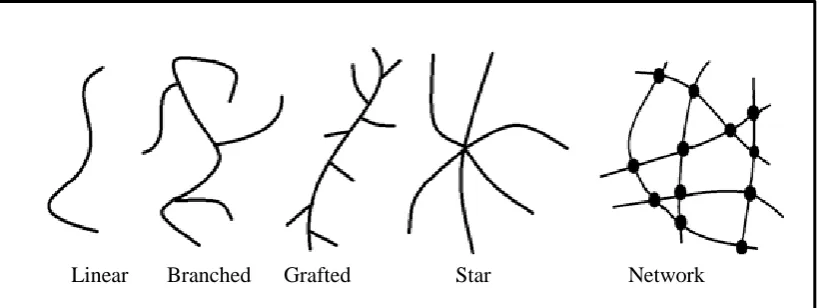
Polymers without configurationally regularity are called atactic while configurationally regular polymers can form crystalline structures; whereas atactic polymers are almost always amorphous as shown in Figure 2.1. The nonlinear polymers can have branched chains and short chains of oligomers can be grafted to the main chain while the chains may form a star-like structure. The chains can be cross-linked and form a network and most properties of linear polymers are controlled by two different factors which are (Robyr, 2001):
i. Chemical constitution of the monomers: determines the interaction strength between the chains, the interactions of the polymer with host molecules or with interfaces. The monomer structure also determines the possible local confirmations of the polymer chain.
The mechanical properties, solubility and miscibility of different polymers also depend on their molecular weights.
Figure 2.1 Polymers with linear and nonlinear chain architectures (Robyr, 2001).
In the geometrical arrangements of the atoms in a polymer chain two categories can be discerned which are arrangements fixed by the chemical bonding, known as configurations (the configuration of a chain cannot be altered unless chemical bonds are broken or reformed) and arrangements arising from rotation about single bonds known as conformations (Krevelen and Nijenhuis, 2009). The researchers also mentioned that simple molecules may occur in three states, the solid, the liquid and the gaseous state while polymers cannot be evaporated since they decompose before boiling.
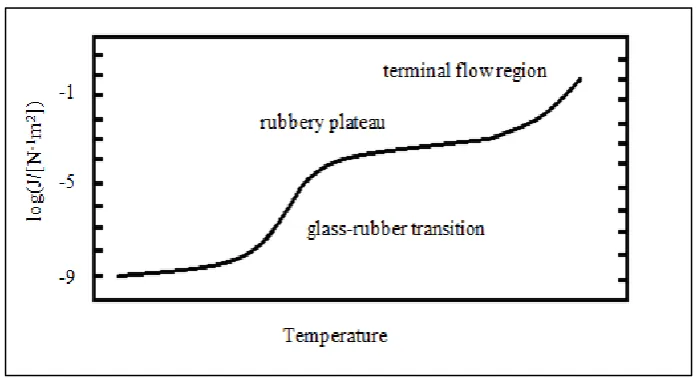
In addition, the usual states of polymers are the glassy, the rubbery and the semi-crystalline state all of which are thermodynamically metastable (Krevelen and Nijenhuis, 2009). The mechanical behavior of a polymer as a function of temperature is summarized in Figure 2.2. The compliance is about 10-9 Nm-2 in the glassy state and increases to about 10-5 Nm-2 after the glass-rubber transition and the width of the rubber plateau depends on the density of entanglement (Robyr, 2001). The researcher also stated that for chains below the critical molecular weight at the entanglement limit, Mc, the plateau disappears and the polymer directly enters the terminal flow region and it is important to note that even in this region polymers still behave as viscoelastic liquids. This is in contrast toward low-molecular-weight compounds above their melting point.
10
Figure 2.2: Polymer compliance as a function of temperature (Robyr, 2001)
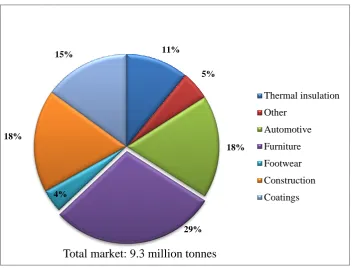
Robyr, (2001) stated that most polymers show qualitatively similar behavior under compression or shear but on the other hand under the application of tensile stress, two different deformation processes after the yield point are known. Ductile polymers elongate in an irreversible process similar to flow, whereas brittle systems whiten due the deformation of microvoids (Robyr, 2001). The researcher also stated that in glassy polymers, the chain entanglements could act as temporary cross-linking points. One of the most important polymers that contribute to the large global production is polyurethane. The applications of polyurethane are around the people playing a vital role in many industries which are from furniture to footwear, construction to cars. Polyurethane appears in an amazing variety of forms, making it the most flexible of any family of plastic materials.
Figure 2.3: Global PU production year 2012, (utech-polyurethane.com, 2014)
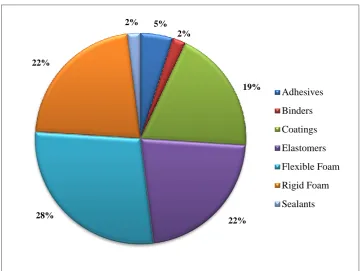
Since each sector requires its own approach, the polyurethanes market can also be described in terms of end-use applications, which is particular use in defining market strategies (Biesman, 2002). Based on Figure 2.4, the largest percentage of polyurethanes market by end-use application lies in furniture category which is 29% and second largest of percentage were construction and automotive. For that reason, the WB produced were intended to apply in furniture and automotive since these categories were in high demand globally.
5% 2%
19%
22% 28%
22%
2%
Adhesives
Binders
Coatings
Elastomers
Flexible Foam
Rigid Foam
12
Figure 2.4: Split of polyurethanes market by end-use application (Biesman, 2002)
2.2.1 Polymer synthesis
The foundations of the polyurethanes industry were laid in the late 1930s with the discovery by Otto Bayer of the chemistry of the polyaddition reaction between diisocyanate and diols to form polyurethane even though the reaction between isocyanate and hydroxyl compound was at first known in the 19th century (Randall and Lee, 2002). The successful preparation of polymers is achieved only if the macromolecules are stable and polymers are often prepared in solution where entropy destabilizes large molecular assemblies (Robyr, 2001).
For that reason, monomers have to be strongly bonded together and also, reaction kinetics favourable to polymeric materials must be fast, so that high-molecular-weight materials can be produced in a reasonable time. The polymerization reaction must also be fast, so that high-molecular-weight materials can be produced in a reasonable time as well, the polymerization reaction must also be fast compared to side reactions that often hinder or preclude the formation of the desired product (Robyr, 2001).
Polymerization reactions are generally divided into two main categories according to the mechanism of chain growth (Jenkins et al., 1996) which are:
11%
5%
18%
29% 4%
18%
15%
Total market: 9.3 million tonnes
Thermal insulation
Other
Automotive
Furniture
Footwear
Construction
i. Chain polymerization: chain growth proceeds exclusively by reaction between a monomer denoted as M in Equation 1 and the reactive site on the polymer chain denoted as with regeneration of the reactive site at the end of each growth step and possible production of a side-product L as refer to Equation 2.1
ii. Does not involve a chain reaction and is divided into two groups: polyaddition and polycondensation. In both reactions the growth of a polymer chains proceeds by reactions between molecules of all degrees of polymerization. In polycondensations a low-molecular-weight product L is eliminated, while polyadditions occur without elimination as in Equation 2.2. Since molecules of all degrees of polymerization can react with each other, the average molecular weight grows facter with a higher degree of conversion
2.2.2 Polymer from renewable resources
Nowadays, the increase in environmental consciousness among consumers and governments, make the polymer industry now facing not only with manufacturing and marketing concerns but with ecological and legislative issues as well. The development towards environmental protection and regulation is headed for a “cradle-to-grave” approach, in which the manufacturer is increasingly responsible for the handling of raw materials used in production and the finish products, eventual disposal (Swain et al., 2004). Bio-polymers from renewable resources have gained much attention in current year. As a consequence the recent research and development efforts have led to new products based natural resources. Certain of these are biodegradable polymers like PLA (polylactic acid), cellulose esters, polyhydoxyalkanoates and starch polymers (Benjamin and Jorg, 2008). Nearly all polymer material is produced based on crude oil as feedstock.
Polymers from renewable resources have attracted an increasing amount of attention over the last two decades; predominantly due to two major reasons: 1) { } (2.1)
14
environmental concerns and 2) realization that our petroleum resources are finite (Yu
et al., 2006). Composites made of natural fibres and biopolymers are completely biodegradable and are called “green composites” due to their environmentally valuable properties. As a result of increasing environmental awareness the use of traditional composites made of glass, aramid or carbon fiber reinforced plastics have recently been discussed critically (Benjamin and Jorg, 2008). Mohanty et al., (1999) defined that when a bio-degradable material (neat polymer, blended product or composite) is gained totally from renewable resources can call it a green polymeric material.
Renewable resources of polymeric materials deal an answer to maintaining sustainable development of economically and ecologically smart technology. The inventions in the development of materials from bio-polymers, the preservation of fossil-based raw materials, complete biological degradability, the reduction of the volume garbage and compost ability in the natural cycle, protection of the climate through the reduction of the carbon dioxides released, along with the application possibilities of agricultural resources for the production of bio/green materials are some of the reasons why such materials have attached the public interest (Mohanty et al., 1999).
Long et al., (2006) also point out that one of the most promising polymers in this concern is PLA, since it is made from agricultural products and is readily biodegradable. Through controlled depolymerisation of lactic acid, lactide can be prepared which in turn can be founded by the fermentation of corn, sugar cane, and sugar bead. The glass transition temperature of PLA (Tg) ranges from 50 °C to 80 °C while the melting temperature (Tm) ranges from 130 °C to 180 °C. In addition, PLA can be processed by thermoforming and film forming, blow moulding, injection moulding and sheet extrusion. Bacterially synthesized PHAs invite much consideration because they can be produced from a variety of renewable resources, and are truly bio-degradable and highly bio-compatible thermoplastics materials (Long et al., 2006). For that reason, PHAs are predictable to contribute to the formation of an environmentally sustainable society as above 90 different types of PHAs existing of various monomers have been reported and the number is increasing.
seating, textile lamination, acoustic barriers, energy absorbers and car component such as bumper. In addition, it is usually used as adhesives to join different materials in the footwear and automotive. The green monomer preparations begin with the catalyst preparation to create the epoxies from the unsaturated fatty compounds, and the second reaction is the acid-catalyst ring opening of the epoxies to form polyols or green monomer (Andrew et al., 2003). The effect of fillers for the mechanical properties of all solid polymers will be defined, particularly metal oxide such as titanium dioxide powder and natural fiber (Rus, 2009).
2.2.3 Composites from oil-based polymers
Polymers composites are used in a wide range of application areas, for example aerospace, military, construction, electrical and electronics, medicine, marine, transportation and so on (Guner et al., 2006). It is well-known that composites involve of two or more materials forming separate phase. Above and beyond, in polymer industry, vegetable oils which represent a major potential source of chemicals have been utilized as an alternative feedstock for monomers (Suresh et al.,
2007). Oil-based bio-polymers have many advantages compared to polymers formulated from petroleum-based monomers. Guner et al., (2006) mentioned that they are bio-degradable and in many cases, cheaper than petroleum polymers. Agreeing to the earlier researches Long et al., (2006), in general polymers from renewable resources (PFRR) can be classified into three groups which are firstly natural polymers such as starch, protein and cellulose, secondly synthetic polymers from natural monomers, such as polylactic acid (PLA), and thirdly polymers from microbial fermentation, such as polyhydroxybutyrate (PHB).
16
composite as an electrode material. Guner et al., (2006) stated that the 60 % (graphite, w/w) composite showed good mechanical and appropriated electric resistance, easy preparation and surface renovation. For other oils such as soybean oil and rapeseed oil-based polyols have been used to produce PU foams as well. Canola-PU foam gave better compressive properties than Soybean-PU foam but less than Castor-PU foam based on Suresh et al., (2007). The differences in performance were originated to be related to the differences in the number and position of OH-groups and dangling chains in the starting materials and to the differences in cellular structure.
For other investigator industrial, materials from soybean oil-based resin and natural fibers designed for using as the roof, floors or walls of a house or low-rise commercial buildings. Intended for preparing soybean oil-based resin, first, soybean oil was epoxidized and vinylated by styrene or acrylic acid (Guner et al., 2006). Other researcher produced polyurethanes with soybean oil-based polyol or petrochemical based polyol, and after that prepared glass-reinforced composites from them. Based on experiment, the mechanical properties discovered that properties of the soybean oil based composites were as good as with those based on petrochemical polyol and besides, thermal, oxidation, and hydrolytic stability of soybean oil-based composite were superior to those of the latter. Suhreta et al., (2005) stated that all results point out that polyurethane matrix based on soybean oil is a preferable alternative to the petrochemical polyurethanes in glass-reinforced composites.
2.3 Bio-polymer
polymers of amino acids and (iii) polysaccharides, which are often linear bonded polymeric carbohydrate structures (Chandra and Rustgi, 1998).
Referring to the Proterra International Center (2012), the present and future developments in biodegradable polymers and renewable raw materials focus on the scale up production and improvement of product properties. Larger scale production will increase obtainability and reduce prices. Presently, in order to produce bio-degradable polymers either renewable or synthetic, raw materials may become a concern. There are two main strategies may be followed in synthesizing a polymer which is, one is to build up the polymer structure from a monomer by a process of chemical polymerization and the alternative one is to take a naturally occurring polymer and chemically modify it to give it the desired properties. But the disadvantage of chemical modification is that the biodegradability of the polymer may be adversely affected. As a result, it is a failure aimed at related search for cooperation between the desired material properties and bio-degradability.
2.4Green technology
The applied research of green production technologies is the mainstream of the current human civilization awareness that benefactor‟s energy conservation and environmental protection. In order to saving the energy consumption of the existing products and benefits the society by the development of the new energy for environmental protection (Yijun and Gengxin, 2011). The main problem should be pointed and the improvement on the efficiency of the energy conservation and environmental protection should be made in order to diminish unnecessary energy waste.
By means of focusing on cost minimization and risk management techniques, internal today would apply in an operation context (Viet et al., 2011). As an example firms would focus to decrease environmental burden and associated costs of raw materials or disposal by integrate their employees concerns in decisions and ensure proper worker safety and health standard. Effective utilization of land, water, energy and other natural resources makes business more productive and economical.
18
environment by the practice of the complete green technology. By means of strive to sustain economic growth without harming the planet or exhausting its resources while improving the quality of life for current and future generations.
2.4.1 Recycling of bio-polymer foam
It is known that, the studies on WB using granular foam based on waste vegetable cooking oil for particular application are uncommonly found. However, one of the inventions from Kansas Polymer Research Center, Pittsburg State University introduced the production method for rigid PU foam using soybean oil with two different types of polyol in order to compare the mechanical strength (Guo et al.,
2006). A different invention is from Zhang (2008) that produced flexible PU foam synthesized from the castor oil.
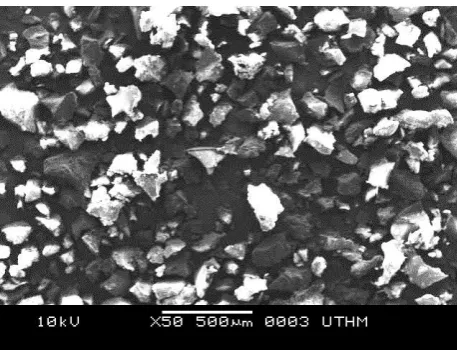
Polyurethanes (PU) foam wastes from end-of-life vehicles and many other sources are getting increased attention worldwide as a result of rapidly rising amounts and increasingly tight legislation on its treatment and disposal (Ron, 2004 and Vaclavik et al., 2012). In addition, around 25000 tonnes PU foam was recycled by regrinding founded by the researchers. Vaclavik et al., (2012) noted that new ways for recycling of rigid PU foams and composites by crumbling technology. It was implemented in this research by using conventional crushing and grinding methods. A knife grinder is used for flexible and rigid bio-polymer foam and it was provided a smaller particle size depends on grinder speed (Vaclavik et al., 2012).
Figure 2.5: Particle structure of waste bio-polymer foam (Najibah, 2014)
2.5Environmental impact
Governments begin to make laws and regulations to protect the environment because of the importance of environmental issues around the country and of course for the sake of the world. The use of six toxic materials in the manufacturing of all electronic and electrical equipment restricted by the Restriction of Hazardous Substances (RoHS) of the European Union (Jack et al., 2010). The researchers also said that it is important for firms to understand how to design and manage green product since the protection on the environment has appeared as one of the hottest global. For the time being, consumers are paying more attention as to whether companies are environmentally friendly since they are willing to purchase eco-friendly or so called green products even though these product are often more expensive.
20
In addition, lots of researches have been conducted to help corporation to become more environmentally friendly through process re-engineering such as reuse, remanufacturing, recycling and collaboration.
2.6 Foam generation
The leading commercial applications of polyurethane polymers for millable elastomers, coatings and adhesives, were established between 1945 and 1947, followed by flexible foams in 1953 and rigid foams in 1957 (Randall and Lee, 2002). Foam is an essential engineering material which offers unique benefits in terms of low cost and weight, stress-free to fabricate and has good energy absorption properties. Since that time, they have been finding use in an ever-increasing number of applications and polyurethanes are now all around and playing a vital role in many industries. Furthermore, foam is used in many applications; acoustic absorption, impact retardation and mechanical damping (Singh et al., 2003 and Lee and Choi, 2007). Nowadays, most modern automotive seats, static comfort and vibration isolation are now succeeded through the use of foam alone.
In general, PU foam is made from a formula that contains a host of components selected to achieve the desired grade of foam which are these components included polyol, isocynate, water, catalyst, surfactants, cross-linkage agent, auxiliary blowing agent, and additives such as colorant, flame retardant, antistatic agent, bacteriostat or UV stabalizer. Between all chemical components, polyol and isocyanate are the main components used to forms PU linkage.
desired cellular-structure. It was noted that the internal temperature of foam bun/rise would build upon the order of 140 °C during the foam generation.
Figure 2.6: Gelation Reaction or PU Cross Linking Reaction (Kaushiva, 1999)
Other components in recipe working as per surfactants are essential components in foam formation with the intention to produce a well open-celled morphology. They implement to lessen surface tension in PU, emulsifying in compatible ingredients, promoting bubble nucleation, stabilizing the rising foam, as a consequence decreasing the deformation effects and the most significant is to stabilize the cell wall. Through polymerization, surfactant prevents the coalescence of rapidly growing cells until those cells have achieved sufficient strength to become self-supporting (Klempner and Sendijarevic, 2004). Without this, cell coalescence would result in a total foam collapse. The catalyst is generally used in foam formulation and blow reaction. Above and beyond, it is also for reassuring completeness of reaction or “cure” in finished foam.
2.6.1 Formation of foam
Generally, most foamed polymers are generated by diffusing a gas all the way through a fluid polymer phase and stabilizing the resultant foam (Klempner and Sendijarevic, 2004). The foam is stretched out by increasing the bubble size before stabilize the system. There are many sources of gases may be involved in foaming process such as air from environment, gas such as from carbon dioxide, a low boiling liquid or gas may be produced by a chemical reaction.
The preparation of foams by the dispersion method usually consists of three steps as followed (Klempner and Sendijarevic, 2004):
Step 1: Bubble formation: The first step in producing foam is formation of gas bubbles in a liquid system and the bubbles will usually form more easily at
H
Isocynate Alcohol Urethane
H H
22
the liquid-solid interface
Step 2: Bubble growth: Once a bubble was formed, it may grow by diffusion of gas from solution in the liquid phase into the bubble
Step 3: Stabilization: There are many aspects that affect the stability of bubble which are pure liquids without surface tension. Moreover, a surfactant may be most effective for stabilization if it is design. Last but not least, the temperature can also affect stability which an increasing the temperature also increases the reaction rates as well as reduces both viscosity and surface tension.
2.6.2 Production of foam
Referring to the Sung et al., (2007), flexible PU foam is created by one-shot and free rise method which is means that the isocyanate, polyol, water and other ingredients are rapidly and intensively mixed and immediately poured to carry out the foaming. The method point out that once the process is taking place, the formation of foam is exothermic until they are complete. Fundamentally, flexible PU foams are made through two categories of fabrication process which are slabstock foam and moulded process where slabstock foams are used for cushioning (Polyurethane Foam Association, 1991) and in furnishing industry such as mattress and carpet backing whereas moulded foam are mainly used in transportation application such as automotive seating (Zhang, 2008).
The researchers also mentioned that usually, for the small or laboratory scale production, the flexible PU foams can be prepared as a simple hand or cup-foam mixes to techniques of box-foaming mixes. This technique is also called free rise-bun. Generally, the methods to make foams in laboratory scale are as follows (Klempner and Sendijarevic, 2004):
i. the components lists in recipe are weighed manually according to the proportion need
ii. they are mixed using the mechanical device according to the sequence of mixture
iii. after a mixing, the mixtures were poured into a cup or mould prepared iv. the flexible foam is moving out from the mould or cup and leaving for
cured after a short period
2.7 Modification of polymer using fillers
Usually, filler are described as materials that are added to the formulation to reduce the cost. In general, fillers are solid additives and dissimilar from plastic matrices in composition and structure which are added to the polymers to increase bulk or improve the behavior. Fillers practically used as solid additives into the polymer to examine its physical and mechanical properties of material development (George, 2000). There are a lot of factors e.g. properties of fillers and their fibres aspect ratio and particulate shape size, as well as filler-matrix interface would affect and govern the properties of composites material. Air and other gases could be considered as fillers in cellular polymers in certain condition.
Therefore, it is essential to have some basic knowledge about using fillers in any research. Agreeing to Lutz and Grossman (2000), each class of the fillers seems to show specific characteristics that make them exclusively suited for the given application. Fillers are much stiffer and stronger than the polymer which that one to increase its modulus and strength.
24
Flexible PU foams are one of the significant classes plastic used in the manufacture of such materials as foam mattresses, pillow, furniture, cushioning materials for automobiles, packing, recreation, shoes and so on (Usman et al., 2012). From the time when early 50 s, the fabrication of naval vessels, military vehicles, aircraft, building and offshore structure have been apply from epoxy foams. On the other hand, the discussion about rubber foam is not extensively covered but foamed rubbers are globally manufactured and are in service all over the world (Lee and Choi, 2007).
Mello et al., (2009) carried out post-consumer plastic bottle waste PET (Polyethylene terephthalate), PET as per reinforcement filler in flexible PU foams. The intention was to discover alternatives for recycling of polymer packaging; decrease the cost material and getting better mechanical properties from the new composite created. A particulate shape in size of < 297 μm were prepared by the researchers and it is added to PU at a concentration of 1.5 parts by hundred parts of polyol. They conducted some mechanical test such as tensile resistance, tear resistance and break strain (%) for testing in mechanical strength and the results presented by such testing revealed that the mechanical performance of PET foams exceeded than standard foam for all layers (top, mid top, mid bottom and bottom). Furthermore, the PET filled is also used to conduct the wear, compression strength and compression set tests and from the results achieved, a filled foam yield a better wear which has less mass losses during the wear test, a better compressive strength which point out that PET particles can efficiently absorb the compression energy and lower compression set test value.
REFERENCES
Alonso, M. V., Auad, M. L. and Nutt, S. (2006). Short Fiber-Reinforced Epoxy Foams. Journal of Composites: Part A. 37(11), 1952-1960
Andrew J. C., Leornarde M., Anika Zafiah Mohd Rus., Private Comm., DEFRA, 2003.
Averous, L. and Pollet, E. (2012). Biodegradable Polymers. Journal of Environmental Silicate and Nano-Biocomposites, Green Energy and
Technology. Vol 447, pp157. Retrieved on Nov16, 2014, from DOI
10.1007/978-1-4471-4108-2_2.
Behrendt, G. and Naber, B. W. (2009). The Chemical Recycling of Polyurethanes,
Journal of the University of Chemical Technology and Metallurgy, 44, 1, 2009, 3-23
Benjamin, B. and Jorg, M. (2008). Impact and Tensile Properties of PLA/ Cordenka and PLA/flax Composites. Journal of Composite Science and Technology.
Vol 68, pp. 1601-1607.
Berthelot, J. M., Assarar, M., Sefrani, Y. and Mahi, A. E. (2008). Damping Analysis of Composite Materials and Structures. Journals of Composite Structures.
Vol 85, pp. 189-204.
105
Broos, R., Sonney, J. M., Thanh, H. P. and Casati, F. M. (2000). Polyurethane Foam Moulding Technologies for Improving Total Passenger Compartment Comfort. Proceedings of the Polyurethane Conference 2000. Boston: CRC press, pp. 341-353.
Cavarretta, I. (2009). The Influence of Particle Characteristics on The Engineering Behaviour of Granular Materials. University of London: PhD Thesis. Chan, W. S. (2012). Characteristics of Developed Flexible Polyurethane Foams
Reinforced with Coconut Coir Fibres and Recycled Tyres: Master Thesis. Chandra, R. and Rutsgi, R. (1998). Biodegradable Polymers.Progress in Polymer
Science, Vol 23, pp. 1273.
Chandra, R., Singh, S. P. and Gupta, K. (1999). Damping Studies in
Fiber-Reinforced Composited-A Review. Journal of Composites Structures. Vol. 46, pp. 41-51.
Chelikowsly, J. R. (2001). Quantum Mechanics of Condensed Phase In Encyclopedia of Chemical Physics and Physical Chemistry. Vol.1., pp.79-122. London, UK. Institute of Physics Publishing.
Connolly, M., King, J., Shidaker, T. And Duncan, A. (2006). Characterization of Pultruded Polyurethane Composites: Environmental Exposure and
Component Assembly Testing. Journal of Composites 2006 Convention and
Trade Show (American Composites Manufacturers Association), October
2006.
Dao, V., Langella, I., and Carbo, J. (2011). From Green to Sustainability:
Information Technology and Integrated Sustainability Framework. Journal of Strategic Information Systems. Vol 20, pp. 63-79.
Food Standards Agency. (2004). Waste Cooking Oil from Catering Premises.
Retrieved on Dec 12, 2014, from
http://www.food.gov.uk/businessimdustry/guidanvenotes/foodguide/wastec ookingoil#.ULjq0uRth1M
George, W. (2000). Handbook of Fillers. 2nd. Canada: ChemTech Publishing. Ghani, A. and Rus, M. A. (2012). Influence of Hot Compression Molding of
Biopolymer Filled Waste Granulate Biopolymer. Proc. Of the 3rd International Conference of Material Engineering. Johor, Malaysia: University Tun Hussein Onn Malaysia.
Ghani, A., Rus, M. A. Z. and Latif, A. N. (2013). Characterization of High Density Solid Waste Biopolymer Foam. Proc of The 4th International Conference of Material and Manufacturing Technology. Seoul: Korea.
Gibson, L. J., and Ashby, M. F. (1997). Cellular Solids: Structure and Properties. 2nd . ed. Cambridge: Cambridge University Press.
Gibson, R. F. (1992). Damping Characteristics of Composite Materials and
Structures. Journal of Material Engineering and Performance. Vol 1. pp. 11-20.
Gibson, R. F. and Finegan, I. C. (2000). Recent Research on Enhancement of
Damping in Polymer Composites. Journal of Composites Structure. Vol 44, pp. 89-98.
Gu, J., Wu, G. and Zhang, Q. (2007). Effect of Porosity On the Damping Properties of Modified Epoxy composites Filled with Fly Ash. Journal of Scripta Materialia. Vol 57, pp. 529-532.
Guner, F. S., Yusuf, Y. and Erciyes, T. A. (2006). Polymers from Triglyceride Oils.
107
Guo, A., Javni, I. and Petrovic, Z. (2000). Rigid Polyurethane Foams Based on Soybean Oil. Journal of Applied Polymer Science. Vol 77, pp. 467-473. Guo, A., Zhang, W. and Petrovic, Z. S. (2006). Structure-property Relationship in
Polyurethanes Derived from Soybean oils. Journal of Material Science. Vol 41, pp. 4914-4920.
Guo, Y., Xu, W., Fu, Y. and Zhang, W. (2010). Comparison Studies on Dynamic Packaging Properties of Corrugated Paperboard Pads. Scientific Research, Vol 2, pp. 378-386.
Hamley, I. W. (2001). Liquid Crystals In Encyclopedia of Chemical Physics and Physical Chemistry. Vol.3., pp.2259-2284. London, UK. Institute of Physics Publishing.
Hsiao, B. S. and Benjamin, B. (2001). Scattering: Light, Neutrons, X-rays In
Encyclopedia of Chemical Physics and Physical Chemistry (Vol.2. pp.1197-1225). London, UK. Institute of Physics Publishing.
Hulme, A. J. and Googhead, T. C. (2003). Cost Effective Reprocessing of Polyurethane by Hot Compression Moulding. Journal of Materials Processing Technology. Vol 139, pp. 322-326.
Jack, C. P. S., Liya, W. and Johnny, C. H. (2010). The Impacts of Technology Evaluation on Market Structure for Green Products. Journal of Mathematical and Computer Modeling. Vol 55, pp. 1381-1400.
Jenkins, A. D., Kratochvỉl, P., Stepto, R. F. T. and Suter, U. W. (1996). Glossary of Basic Terms in Polymer Science Pure. Appl. Chem. Vol. 68, pp. 2287-3110 Joshi, G., Bajaj, A. K. and Davies, P. (2010). Whole-body Vibratory Response Study
Using Nonlinear Multi-body Model of Seat-occupant System with
Kaushiva, B. D. (1999) Structure-Property Relationships of Flexible Polyurethane Foams Dissertation Submitted to the Faculty of Virginia Polytechnic Institute and State University In Partial Fulfillment of the Requirements for the Degree of Doctor of Philosophy
Kelly, R. and Llamas, J. (1999). Determination of Viscous and Coulomb Friction by using Velocity Responses to Torque Ramp Inputs. Proceeding of the 1999 IEEE International Conference on Robotics & Automotion. Michigan: IEEE. Pp 1740-1745.
Kittel, C. (1996). Introduction to Solid State Physics 7th edition (New York: Wiley) Klempner, D. and Sendijarevic, V. (2004). Polymeric Foams and Foam Technology.
2nd. ed. Munich: Hanser.
Kolich, M., Essenmacher, S. D. and McEvory, J. T. (2005). Automotive Seating: The Effect of Foam Physical Properties on Occupied Vertical Vibration
Transmissibility. Journal of Sound and Vibration, 28(1-2), 409-416. Koshute, M. A., Blaszkiewics, M. and Neal, B. L. (2001). Benchmarking of
Polyurethane Technologies for Automotive Seat Cushion. Polyurethane
Expo 2001. Columbus: CRC Press, pp. 247-254.
Krevelen, D. W. and Nijenhuis K. T. (2009). Properties of Polymers: Their Correlation with Chemical Structure; their Numerical Estimation and Prediction from Additive Group Contributions. 4th Edition. Elsevier, pp. 7-885.
109
Lee, E. K. and Choi, S. Y., (2007). Preparation and Characterization of Natural Rubber Foams: Effects of Foaming Temperature and Carbon Black Content.
Korean J. Chem. Eng., 24(6), 1070-1075.
Liang, J. W. and Feeny, B. F. (1998). Identifying Coulomb and Viscous Friction from Free-Vibration Decrements. Nonlinear Dynamics, 16(4), 337-347. Long, Y., Katherine., Dean and Lin, L. (2006). Polymer Blends and Composites
from Renewable Resources. Progress in Polymer Science, 31, pp. 576-602. Lutz, T. J. and Grossman, R. F. (2000). Polymer Modifiers and Additives.
ISBN:0-8247-9949-6. Marcel Dekker Inc. pp. 1-507.
Ghani, M. K. Z. A. A. Z. M. Rus, N. A. Latif, "Characterization of High Density Solid Waste Biopolymer Foam", Advanced Materials Research, Vol 748, pp. 133-137, Aug. 2013.
Marsh, K. N. (2001). Calorimetry In Encyclopedia of Chemical Physics and Physical Chemistry. Vol.2., pp.1679-1699. London, UK. Institute of Physics
Publishing.
Mello, D. D., Pezzin, S. H. and Amico, S. C. (2009). The Effect of Post-Consumer PET Particles on the Performance of Flexible Polyurethane Foams. Polymer Testing, 28(7), 702-708.
Mohanty, A. K., Misra, M and Hinrichsen, G. (1999). Biofibres, Biodegradable
Polymers and Biocomposites: An Overview. Polymer Physics. Technical
University of Berlin, pp. 1-24.
Najibah, A. L (2014) Vibration damping characteristic and sound absorption of bio-polymer from waste cooking oil. Masters thesis, Universiti Tun Hussein Onn Malaysia.
Nikje, M. M. A. and Tehrani, Z. M. (2010). Polyurethane Rigid Foams Reinforced by Doubly Modified Nanosilica. Journal of Cellular Plastics. Vol 46, pp 159.
Nordson, (2014). Retrieved on March 6, 2015, from http://www.nordson.com/en-us/divisions/industrial-coating/products/container-coating
curing/PublishingImages/green_web.jpg
Pellizzi, E., Latuati-Derieux, A, Lavedrine, B. and Cheradame, H. (2014). Degradation of Polyurethane Ester foam Artifacts: Chemical properties, mechanical properties and comparison between accelerated and natural degradationn. Polymer Degradation and Stability. 107, 255-261
Polyurethane Foam Association (1991). Flexible Polyurethane Foam: A Primer, INTOUCH 1(1), Retrieved on Dec 11, 2014, from http://worldwide web.pfa.org/intouch/new_pdf/InTouch_V14_hr.pdf
Proterra International Centre for Agro-Based Material (2012). About Biopolymers: Biodegradable Polymers. Retrieved on Dec 16, 2014, from http://world wide web.o2.org/ideas/cases/biopolymers.html
Qingming, J., Maosheng, Z., Renjie, S. and Hongxiang, C. (2006). The glass transition temperature and microstructure of polyurethane/epoxy resin interpenetrating polymer networks nanocomposites. Chinese Science Bulletin Vol. 51 No. 3 293298 DOI: 10.1007/s11434-006-0293-3
Randall and Lee, (2002).The polyurethanes book, 2002, 477 pages, 0470850418, 9780470850411, Distributed by J. Wiley, 2002
111
Robyr, P.(2001). Quantum Mechanics of Condensed Phase In Encyclopedia of Chemical Physics and Physical Chemistry (Vol.3., pp.2231-2258). London, UK. Institute of Physics Publishing.
Ron, Z. (2004). Treatment and Disposal of Polyurethane Waste: Options for Recovery and Recycling. Final Report of Energy Engineering and Environmental Protection. Helsinki University of Technology.
Rotz, C. A. and Strong, A. B. (1999). Damping In Composites: It's There, But is it Understood?. Composites Fabrication, 15(2), pp. 30-34.
Rus, A. Z. M, (2009c). Effect of Titanium Dioxide on Material Properties for Renewable Rapseed and Sunflower Polyurethane International. Journal of Integrated Engineering (Issues on Mechanical, Materials and
Manufacturing Engineering), Volume 1, No 1, April 2009: ISSN:
1985-854X.
Rus, A. Z. M. (2009a). Material Properties of Novelty Polyurethane Based on Vegetables Oils, The 11th International Conference on QiR (Quality in Research), Depok, Indonesia, 3-6 August.
Rus, A. Z. M. (2009b). Degradation Studies of Polyurethane Based on Vegetables Oils. Part 2; Thermal Degradation and Material Properties, Prog React Kinet Mech, Vol 34, pp. 1-43 1468-6783 Science Reviews 2000 Ltd. Rus, A. Z. M. (2010). Polymer from renewable materials. Science Polymer, 93(3),
16-1.
Husić, S., Javni, I. and Zoran, S. Petrović (2005). Thermal and mechanical properties of glass reinforced soy-based polyurethane composites. Composites Science and Technology, Volume 65, Issue 1, January 2005, Pages 19-25
Sankar, H. R., Krishna, P. V., Rao, V. B. and Babu, P. B. (2010. The effect of Natural Rubber Particle Inclusions on the Mechanical and Damping Properties of Epoxy-Filled Glass Fibre Composites. Proceeding of the Institution of Mechanical Engineers, Part L: Journal of Material Design
and Applications. 224(2), 63-70.
Seddeq, H. S. (2009). Factors Influencing Acoustic Performance of Sound Absorption Materials. Australian Journal of Basic and Applied Sciences,
3(4), 4610-4617.
Sharma, V. and Kundu, P. P. (2008). Condensation Polymers from Natural Oils,
Progress in Polymer Science. Vol 33, pp. 1199-1215.
Shen, H. and Nutt, S., (2003). Mechanical Characterization on Short Fiber Reinforced Phenolic Foam. Applied Science Manufacturing. Vol 34, pp. 899-906.
Singh, R., Davies, P and Bajaj, A. K., (2003). Estimation of the Dynamical
Properties of Polyurethane Foam Through Use of Prony Series. Journal of Sound and Vibration. Vol 264, pp. 1005-1043.
Siswanto, W. A., Ibrahim, M. N., Madlan, M. A. and Mohamad, S. M. (2011). Table Design for Electronic Device Vibration Test System. International Journal of Engineering and Technology, 3(6), 663-667.
Sperling, L. H. (1992) Introduction to Physical Polymer Science (New York: Wiley) pp. 175-270.
113
Suhreta, H., Ivan, J. and Zoran, S., Petrovic. (2005). Thermal and Mechanical Properties of Glass Reinforced Soy-based Polyurethane Composites. Journal of Composite Science and Technology. Vol 65, pp.19-25
Sulong, N. (2011). Utilization of Low Hydroxyl Content of Waste Oil Polymer Foam Doped with Waste Materials for Sound Absorption Application. Universiti Tun Hussien Onn Malaysia: Master Thesis.
Sulong, N. and Rus, A. Z. (2010). Effect of Renewable Polymer Foam Porosity Upon Single Metal Oxide Loading. The proceedings of Malaysian Metallurgy. Sundarajan. C.(2009). Ph. D Compendium of Formulas for the Structural Vibration
Frequency Analysis of Beams. Houston: PDHengineer..
Sung, C. H., Lee, K. S., Oh, S. M., Kim, J. H., Kim, M. S. and Jeong, H. M. (2007).
Sound Damping of a Polyurethane Foam Nanocomposite. Macromolecular
Research. Vol 15, pp. 443-448.
Suresh, S. N., Xiaohua, K., Laziz, B. and Peter, S. (2007). Physical Properties of Polyurethanes Produced from Polyols from Seed Oils: II. Foams. Journal of Amer Oil Chem Soc, Vol 84. pp 65-72.
Swain, S. N., Biswal, S. M., Nanda, P. K. and Nayak, P. L. (2004). Biodegradable Soy-Based Plastics: Opportunities and Challenges. Journal of Polymers and the Environment. Vol 12, pp. 35-42.
Szmigielski, M., Maniak, B. and Piekarski, W. (2008). Evaluation of chosen quality parameters of used frying rape oil as fuel biocomponent, Int. Agrophys, 22 (4), pp.361-364.
Turi EA. Thermal Characterization of polymeric materials. In: Turi Edith A, editor. 1st ed. New York; London: Academic Press; 1981).
Usman, M. A., Adeosun, S. O. and Osifeso, G. O., (2012). Optimum Calcium Carbonate Filler Concentration for Flexible Polyurethane Foam Composite.
Journal of Minerals and Materials Charaterization and Engineering. Vol 11, pp. 311-320.
Proterra International Centre for Agro-Based Material (2012). About Biopolymers: Biodegradable Polymers. Retrieved on Dec 16, 2014, from http://world wide web.o2.org/ideas/cases/biopolymers.html
Urethanes Technology International (2014). Retrieved on Dec 16, 2014, from http://utech-polyurethane.com/wp-content/uploads/2014/01/Picture1.png Vaclavik, V., Dvorsky, T., Dirner, V. and Daxner, J. (2012). Recycled Polyurethane
Foam as New Filler in Restoration Mortars. The proceedings of Manufacturing Engineering and Management.
Viet, D., Ian, L. and Jerry, C. (2011). From Green to Sustainability: Information Technology and an Integrated Sustainability Framework. Journal of Strategic Information Systems. Vol 20. 63-79.
Wang, Y. and Low, K. H. (2005). Damped Response Analysis of Nonlinear Cushion Systems by a Linearization Method. Computers and Structures. 83(19-20), 1584-1594.
White, S. W., Kim, S. K., Bajaj, A. K. and Davies, P. (2000). Experimental
Techniques and Identification of Nonlinear and Viscoelastic Properties of Flexible Polyurethane Foam. Nonlinear Dynamics, 22(3), 281-313. Xu, T., Li, G. and Pang, S. (2011). Effects of Ultraviolet Radiation on Morphology
115
Yijun, H. and Gengxin, Y. (2011). The Applied Research of Green Production Technologies Based on The Production in Plastics Molding Factories. 2nd International Conference on Advances in Energy Engineering. Ningbo Polytechnic College Zhejiang China, pp. 247-254.
Yu, L., Dean, K. and Li., L. (2006). Polymer blends and composites from renewable resource. Progress in polymer Science. Vol 31, 576-602.
Zhang, L. and Dupuis, R. (2010). Measurement and identification of dynamic properties of flexible polyurethane foam. Journal of Vibration and Control,
17(4): 517-526.
Zhang, L. (2008). Structure-Property Relationship of Polyurethane Flexible Foam made from Natural Oil Polyols. University of Minneapolis: PhD.