Journal of Chemical and Pharmaceutical Research, 2014, 6(5):1182-1186
Research Article
ISSN : 0975-7384
CODEN(USA) : JCPRC5
Primary processing technology on gluten soy sauce with low-salt and
solid-state fermentation
Changlu Ma
1, Jianfeng Sun
2, Hongxia Luo
1, Shurong Li
1and Wentong Xue
3*
1
Food and Biology Department, Beijing Vocational College of Agriculture, China
2Food Science and Technology College, Agricultural University of Hebei, China
3Food Science and Nutrition Engineering Institute, China Agricultural University, China
_____________________________________________________________________________________________
ABSTRACT
Traditional low-salt solid-state fermentation soy sauce was based on soybean meal and wheat bran as raw material, after stewing, making Koji, then mixing with brine and fermenting again, that made soy sauce . This article was focusing on production techniques of gluten soy sauce made from gluten, wheat flour and bran. The strain As3.951 (Aspergillus oryzae), QuJing of HETIANKUAN and QuJing of DINGXIN were used to make Koji. After testing the activity of different Koji in different fermentation time, the neutral protease activity and the number of spores were highest in culture made from DINGXIN QuJing. Though the neutral protease activity was down when gluten took place of soybean meal as main nitrogen source, it was still available in production. Also through the four factors’
Orthogonal experiment of gluten, wheat flour, bran and water, the best proportion about them was 3:4:3:6, and the most effective factor was gluten, the water was next to gluten. Finally, tests showed that amino nitrogen content and the generation rate of amino nitrogen were highest when the pH was 7, the concentration of brine solution was
12% and the Solid-liquid ratio was 1:0.6 during fermentation.
Key words: gluten, gluten soy sauce, qujing, aspergillus oryae, low-salt and solid-state fermentation
_____________________________________________________________________________________________
INTRODUCTION
Soy sauce is a traditional condiment in China, in recent years, with the development of the society and the progress of technology, the soy sauce production of our country increased year by year. From 2002 to 2011, the soy sauce production of our country increased from 1,600,600t to 6,624,900t, the compound annual growth rate was 17.0%. In the future, with the fast steady development of national macroeconomic and the continuous improvement of people's living standard , for our residents, the consumption expenditure of condiments will continue to increase , the demand of soy sauce will continue to increase as well. Considering the soy sauce as consumer staples of the people's livelihood, and to predict the growth of China's macroeconomic in the future, on this basis, soy production in 2011 as the base, and combination with soy sauce production compound growth rate from 2002 to 2011, predicting that by 2015, the production of soy sauce will reach to 12,455,400t[1-2].
The protein materials of the soy sauce production are mainly based on soybean, and also based on peanut, sunflower seed cake, etc[3]. Gluten is also called the wheat protein powder, which is the by-product in wheat manufacturing edible flour, it is the wheat flour with water after kneading, washing with water to remove the starch, then gain the strong sticky dough, it was commonly known as the gluten, its protein content is as high as 75-85%, which generally used for bread flour, dumpling powder and other special powder to increase the ductility of product[4-5].
according to the different fermentation technology. Traditional low-salt solid-state fermentation soy sauce was made from soybean meal and wheat bran, produced through stewing, making Koji, mixing with brine into solid sauce fermented grains, then through the fermentation and obtained soy sauce. The cycle of low-salt solid-state fermentation production is short, soy sauce has good color and taste, aroma is thicker, the utilization rate of raw material is higher, production rate is stable, low cost, which is the mainstream of our country soy sauce production technology[6].However, in China, some soy sauce manufacturers’ production technology is outdated, products are single, they cannot satisfy the growing demand, there is no advantage in the fierce market competition, thus the reforms and innovations of low-salt solid-state soy sauce production technology are particularly important [7]. Zhou Bingchen[8] found that in the innovation of soy sauce processing technology with low-salt solid-state fermentation, changed the ratio of raw materials, increased the ratio of C/N, used more wheat, which can strengthen the delicate flavors of the soy sauce.
This paper mainly used gluten instead of soybean meal to make koji, choosing low-salt and solid-state fermentation method for the preliminary research on the new type of soy sauce processing technology. Through the analysis of the protease enzyme activity of daqu to determine the optimum conditions of making koji, and then through the analysis of amino nitrogen content and the generation rate of amino nitrogen in the fermentation products to determine the best fermentation conditions .
THE EFFECTS ON DAQU PROTEASE ACTIVITY AND THE NUMBER OF SPORES FROM DIFFERENT SOURCES STRAINS
In this experiment, three kinds of strains were selected .The strain As3.951 (Aspergillus oryzae) (provided by the institute of microbiology of Chinese academy of sciences), Qu Jing of HETIANKUAN (provided by Japanese Qu Jing), QuJing of DINGXING(provided by the shijiazhuang city dingxin brewing food science research institute). The above three kinds of strains were used respectively to make Koji. Sample respectively at 20 h, 24 h and 28 h in three daqu production process, determined its protease activity and the number of spores, to select an optimal strains which was used in daqu raw material proportioning experiments.
ORTHOGONAL EXPERIMENT OF DAQU RAW MATERIAL PROPORTIONING
[image:2.595.223.390.446.487.2]Select gluten, wheat flour, bran and water as the daqu raw ingredients[9], and orthogonal experiments of daqu raw material proportioning were designed, the experimental factors and levels were shown in table 1.
Table 1 Orthogonal experiment of daqu raw material proportioning
levels gluten wheat flour bran water
1 15 15 5 20
2 20 20 10 25
3 25 25 15 30
EFFECT OF DIFFERENT PH ON NEUTRAL PROTEASE ACTIVITY IN FERMENTATION
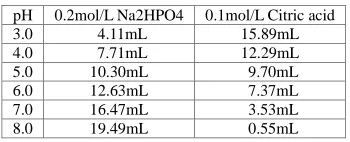
According to table 2, prepared the buffer solutions for different pH which were 3.0, 4.0, 5.0, 6.0, 7.0, 8.0, and
prepared 12% brine solutions with buffer solutions, and heated them to 45 ℃ ~ 50 ℃. Weighed 20 g daqu culture medium B into the six 250 ml flasks, added brine solution ,its mass was the 65% of the total mass of daqu raw materials, sauce billet moisture controlled at 50% ~ 53%, mixed evenly, sealed the bottle with a transparent plastic
film, placed them in the incubator at 45℃ for fermentation.. After 15 days, stopped the fermentation, the mixture was centrifuged to obtain soy sauce. In the10th day of fermentation, protease activity was measured.
Table 2 Preparation of buffer solution
pH 0.2mol/L Na2HPO4 0.1mol/L Citric acid
3.0 4.11mL 15.89mL
4.0 7.71mL 12.29mL
5.0 10.30mL 9.70mL
6.0 12.63mL 7.37mL
7.0 16.47mL 3.53mL
8.0 19.49mL 0.55mL
EFFECT OF BRINE CONCENTRATION ON THE QUALITY OF SOY SAUCE IN FERMENTATION
Prepared12%, 16% and 20% brine solutions with buffer solution of pH 7, and heated them to 45 ℃ ~
[image:2.595.219.394.616.687.2]EFFECT OF SOLID-LIQUID RATIO ON THE QUALITY OF THE SOY SAUCE IN FERMENTATION
Take daqu B and 12% brine concentration mixed following the ratio 1: 1, 1: 0. 8, 1: 0. 6 and 1: 0.4, put them into
250 ml flasks and placed them into 45℃ incubator for fermentation. After 28 days fermentation, the mixture was centrifuged to obtain soy sauce, measured the amino nitrogen, total nitrogen and amino nitrogen generation rate.
EFFECT ON DAQU PROTEASE ACTIVITY FROM DIFFERENT SOURCE STRAINS
[image:3.595.197.416.211.281.2]Through determining neutral protease activity of daqu, which was made from three different strains of sources, during different periods (as shown in table 3), it was found that the daqu made from the DINGXIN Qu Jing had the highest neutral protease activity.
Table 3 Neutral protease enzyme activity from three different strains sources
time
Protease activity(u/g)(Dry basis) As3.951
(Aspergillus oryzae)
Qu Jing of HETIANKUAN
Qu Jing of DINGXIN
20h 1062 1087 1210
24h 1040 1064 1125
28h 1126 1130 1258
EFFECT ON THE NUMBER OF DAQU SPORE FROM DIFFERENT SOURCE STRAINS
[image:3.595.193.419.362.429.2]Through determining the number of daqu spore, which was made from three different sources of strains, during different periods (as shown in table 4), it was found that the daqu made from DINGXIN Qu Jing had the most number of daqu spores .
Table 4 The number of daqu spore from three different strains sources
Time
The number of spores( *109)
As3.951 (Aspergillus oryzae)
Qu Jing of HETIANKUAN
Qu Jing of DINGXIN
20 h 1.1466 0.8935 1.8133
24 h 1.3819 0.8522 1.5257
28 h 0.9708 0.4800 1.1187
ORTHOGONAL EXPERIMENTS OF DAQU RAW MATERIAL PROPORTIONING
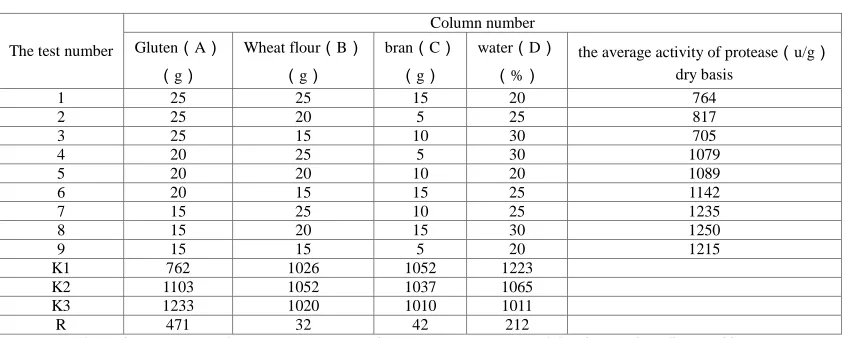
Daqu that was made of 9 groups raw material of orthogonal test was determined of neutral protease enzyme activity respectively through forint method, the results were shown in table 5, analyzed and got the following conclusions:
a) A3B2C1D3 combination, the highest of neutral protease activity was 1250 u/g, the best proportion ratio of medium was that gluten : wheat flour: bran: water = 3:4:3:6.
b) In the four factors, the order of affect the size was gluten (A), water (D), bran (C) and wheat flour (B), the most effective factor was gluten and the water was next to gluten.
c) Gluten processing was the key to the success of daqu in the production of gluten soy sauce, so we should strengthen the gluten grinding and water treatment in daqu production.
Table 5 Orthogonal experimental results of daqu raw material proportioning
The test number
Column number Gluten(A)
(g)
Wheat flour(B)
(g)
bran(C)
(g)
water(D)
(%)
the average activity of protease(u/g) dry basis
1 25 25 15 20 764
2 25 20 5 25 817
3 25 15 10 30 705
4 20 25 5 30 1079
5 20 20 10 20 1089
6 20 15 15 25 1142
7 15 25 10 25 1235
8 15 20 15 30 1250
9 15 15 5 20 1215
K1 762 1026 1052 1223
K2 1103 1052 1037 1065
K3 1233 1020 1010 1011
R 471 32 42 212
[image:3.595.96.519.576.745.2]EFFECT OF DIFFERENT PH ON THE NEUTRAL PROTEASE ACTIVITY IN FERMENTATION
[image:4.595.169.446.146.216.2]As table 6 showed, after 10-days fermentation, neutral protease residual enzyme activity increased in the external pH from 3.0 to 7.0 and declined in pH from 7.0 to 8.0. Residual enzyme activity reached to the maximum 572 u/g when its pH was 7.0. So the neutral pH was the most appropriate in fermentation.
Table 6 the neutral protease activity of different pH after 10 days fermentation
pH 0.2mol/l Na2HPO4 0.1mol/l Citric acid Neutral protease activity (u/g)
3.0 4.11mL 15.89mL 382
4.0 7.71mL 12.29mL 425
5.0 10.30mL 9.70mL 432
6.0 12.63mL 7.37mL 498
7.0 16.47mL 3.53mL 572
8.0 19.49 mL 0.55 mL 417
THE EFFECTS OF BRINE SOLUTION CONCENTRATIONS ON THE QUALITY OF THE SOY SAUCE IN FERMENTATION
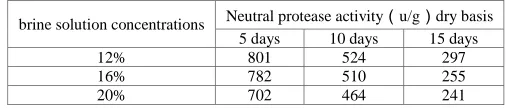
[image:4.595.178.431.336.390.2]When sauce fermented grains of various brine solution concentrations fermented for 5 d, 10 d ,15d and protease activity was determined (as shown in table 7), neutral protease activity was declined during the fermentation process, while the residual enzyme activity of 12% brine solution concentration was slightly higher than that of others .The reason may be that higher brine solution concentration inhibited the activity of protease, so 12% brine solution was more appropriate during fermentation.
Table 7 Effect of brine solution concentrations on the neutral protease activity
brine solution concentrations Neutral protease activity(u/g)dry basis 5 days 10 days 15 days
12% 801 524 297
16% 782 510 255
20% 702 464 241
After 28 days’ fermentation, soy sauce amino nitrogen, total nitrogen and the generation rate of amino acid within three concentrations were shown in table 8.
Table 8 Effect of brine solution concentration on the quality of the soy sauce
brine solution concentration the amino nitrogen ( gN/100mL)
total nitrogen
(gN/100mL)
amino nitrogen generation rate(%)
12% 1.12 1.78 62.93
16% 1.03 1.75 58.85
20% 0.91 1.62 56.22
Table 8 showed that the higher of brine solution concentration, the less of amino nitrogen content, the reason was that the increased of the brine solution concentration, which inhibited the effect of protease, and it made the amino acid generation rate decrease, so the amino nitrogen content decreased.
Table 9 Effect of solid-liquid ratio on the quality of soy sauce
Solid-liquid ratio the amino nitrogen ( gN/100mL)
total nitrogen
(gN/100mL)
generation rate of amino nitrogen
(%)
1:1 0.53 0.98 54.08
1:0.8 0.69 1.25 55.20
1:0.6 0.72 1.27 56.69
1:0.4 0.64 1.21 52.83
THE SOLID-LIQUID RATIO ON THE QUALITY OF THE SOY SAUCE IN FERMENTATION
Mix homemade daqu (gluten: wheat flour, bran: water = 3:4:3:6), with 12% of brine solution concentration(45 ℃ ~
50 ℃) according to 1:1, 1:0.8, 1:0.6 and 1:0. 4 ratio, and at 45℃ incubator in 250ml flasks at 45℃ incubator. After 28 days’ fermentation, the mixture was centrifuged to obtain soy sauce, and then we measured its amino nitrogen, total nitrogen and generation rate of amino nitrogen (as shown in table 9). With the increasing of brine
nitrogen and total nitrogen decreased. The fermentation mixture became more of the solid state due to the reduce of brine solution, so the content of amino nitrogen and total nitrogen increased. But when the ratio of brine solution was much less, which influenced the function of protease, amino nitrogen and total nitrogen decreased on the contrary [10].
CONCLUSION
This paper took gluten, wheat flour and wheat bran as raw material, through stewing, making koji, sauce fermented grains ,fermentation and so on, preliminary studied the low-salt and solid-state fermentation processing technology to product soy sauce fermentation, The strain As3.951 (Aspergillus oryzae), QuJing of HETIANKUAN and QuJing of DINGXIN were used to make Koji. After testing the activity of different Koji in different fermentation time, the neutral protease activity and the number of spores were highest in culture made from DINGXING QuJing. Though the neutral protease activity was down when wheat gluten took place of soybean meal as main nitrogen source, it
was still available in production. Also through the four factors’ orthogonal experiments of gluten 、wheat flour、bran
and water, the best proportion about them was 3:4:3:6, and the most effective factor was gluten, the water was next to gluten. Finally, through the study of gluten soy sauce fermentation technology, which showed that amino nitrogen content and the generation rate of amino nitrogen were highest when the pH was 7, the concentration of brine
solution was 12% and the Solid-liquid ratio was 1:0.6 during the fermentation .
REFERENCES
[1]Yang xu, Cao Lan. China Condiment, pp.18-20, October 2012.
[2]Peng Tao, Yang Xuxin, Chen Shaohua. China Condiment, pp.26-29, September 2007. [3]Gu Lizhong. Food Science, pp.180-183, September 2009.
[4]Wang Bo. Henan Science & Technology, pp.22-23, March 2001.
[5]Xu Ying, Wang Xuan, Liu Xiaodan, Wei hongyan. Cereal& Feed Industry, pp.29-32, October 2010. [6]Zhang Zongzhou, Zhang Yang. China brewing, pp.23-26, October 2006.
[7]Gu Lizhong, liu Qiang. Food and Fermentation Industries, pp.78-81, July 2009. [8]Zhou Bingchen. China Brewing, pp.1-3, January 2005.
[9]Wang Limei, Wang Qunfu. Chinese Condiment, pp.55 -59, August 2009.
[10]Wang Zhangcun, Lu Jie, Tian Weihuan. Journal of the china cereals and Oils Association, Vol.26, pp.8-12, June