A COMPARISON OF DISCRETE COSINE TRANSFORM AND DISCRETE WAVELET TRANSFORM ALGORITHM IN WATERMARKING AGAINST
COMMON ATTACKS
MOHAMED ABDISALAN SAID
A dissertation submitted in partial
fulfillment of the requirement for the award of the Degree of Master of Computer Science (Information Security)
Faculty of Computer Science and Information Technology Universiti Tun Hussein Onn Malaysia
ABSTRACT
ABSTRAK
1
CHAPTER 1
INTRODUCTION
1.1 Overview
2
The watermark has been introduced as a complementary protection of multimedia technology. Watermarking is a pattern of bits inserted into a digital content, including audio, video or image data to protect the copyright of information such as author, rights, etc.) which could be the owner’s logo, serial number or control information (Bamatraf, 2012). Recently, many watermarking schemes have been proposed in the area of images and watermarking research has received a very significant attention from many researchers since the early 1990s.
There are three main requirements of digital watermarking; robust, imperceptibility and capacity (Hussein and Mohamed, 2012). Robustness is one of the most important attributes of a digital watermark. The system is considered robust if the watermark is still detectable or recoverable under several kinds of attack on the watermarked host, such as cropping and compression. Imperceptibility is a measure of the quality of the watermarked image. It means that the human visual senses are unable to detect the difference between the watermarked image and the cover image. Capacity refers to the maximum amount of information that can be embedded in the cover image.
According to a digital watermarking classification, watermarking researchers can be divided into different categories based on: host signal, human perceptivity, robustness, necessary data for extraction process, features and by applications (Hussein and Mohamed, 2012).
3
1.2 Problem Statement
Ownership protection of digital information has become a pressing issue in many organizations and companies in the world wide, many of copyright owners are worried about protecting of an illegal duplication or reproduction of their data or work. Digital watermarking is one of the popular techniques used to protect the contents of an intellectual copyright. If copyright has some problems, anyone can claim the ownership rights of any digital media, such as audio (speech and music), images (photography and graphics), and video (movies), but digital watermark can provide evidence of the ownership authentication and rights of the multimedia objects. Therefore, Digital Watermarking is a technology of embedding watermark with intellectual property rights into images, audios and video files. Watermarks should not be removable and imperceptible by unauthorized persons and should be robust to incidental against intentional and unintentional attacks.
A watermarking scheme can be implemented either in spatial domain or transform domain. Each scheme has its own strength. Spatial domain watermarking produces a very good watermarked image and high capacity watermark, but it is less robust against certain attacks such as compression. However, the frequency domain watermarking outputs a watermarked image that is more robust, but with small capacity (Rao et al., 2012).
4
1.3 Motivation
In the last decade, the revolution of usage information hiding techniques in the digital multimedia has received more popularity. These information hiding can be mainly divided into three processes- steganography, cryptography and digital watermark. Usually the properties such as images need more protection, and keeping ownership authentication has become an important issue in this world. Nowadays digital images can be easily copied, distributed and forged by unauthorized criminals. Therefore, organizations and companies are using different watermarked methods to protect their own data from any attack trying to copy or manipulate this information. Digital watermarking is one of the popular approaches used to prevent copying and ownership authentication simultaneously. Many researchers have proposed watermarking techniques in the early 1990s, but mostly they are looking forward to find the best algorithm that can produce a watermarked image with lower distortion and has top performance (Bamatraf, 2012).
Day after day the number of copying images is increasing. The attackers are trying to break the watermark protection methods to see the embedded information. If the attacker can change the contents of an image, it is considers that the watermark method is weak. A powerful watermarked should be difficult to remove the mark
5
1.4 Objectives
The goals of this research are:
i. To implement an image watermarks system based on DCT and DWT.
ii. To compare the performances of DCT and DWT against common attacks using the standard datasets and measurements, including Peak Signal to Noise Ratio (PSNR), Mean Square Error (MSE) and Normalized Correlation (NC).
1.5 Scope
The scope of this research is limited to a comparison of DCT and DWT based on image watermarking. In this research, a Matlab environment tool is used to implement the performance of our system or work. Likewise, the host images used in this research are bmp format, but the output images that have been watermarked are saved as JPG format.
1.6 Significance of the Study
6
CHAPTER 2
LITERATURE REVIEW
2.1 Introduction
In this section of the study, all the related items in the review of digital watermarks used for pictures are discussed. It describes in detail how previous research works have been conducted by other researchers using different techniques.
2.2 History of Digital Watermarking
7
Figure 2.1: Representation of the oldest known watermark (Smith, 2003)
The history of watermark shows the existence of many various names in many languages. For instance, the Dutch called watermark as the 'Papermarken', from which the name paper mark comes. Similarly, the French used another name for watermark named 'Filigrane', which basically refers to the shape of the bent wire. On the other hand, in the beginning of the eighteenth century, the English started to use the name watermark, while the Germans began to use the word 'Wasserzeichen', which was their version of the English word. To the present day, some paper makers still use the name paper mark, for the shaped piece of wire, while the image left by it in the paper has become known as the watermark (Smith, 2003).
During the end of the thirteenth century, around 40 paper mills shared in Fabriano and produced paper with different shape, quality and price. They produced raw, rough paper which was smooth and post processed by artisans and sold by traders ((Hartung and Kutter, 1999).
8
Therefore, they began to import much desired watermarked paper from other countries like Italy. History also shows that there was a wealth of Greek manuscript dated back to the thirteenth century written on watermarked paper imported from Italy.
Smith, on the other hand, mentioned that the art and craft of papermaking started from the Middle East and southern Europe and further spread to other places. The earliest paper mill was found in northern European region in Germany. It was the first country to have the first paper mill built and established in 1390 in Nurnberg. The mill company was using a watermark that consisted of the letter 'S' and the Nurnberg’s heraldic arms. In the early 1405, a mill company was established in Netherland by Jean L’Espagnol and imported the papermaking from Spain. Later in 1495, introduced by John Tate in Hertfordshire, England joined the race of establishment of the paper making company. After that, other countries started to adopt the idea of establishing paper mill companies, and Russia happened to be one of them which established the company in 1576 in Moscow. In 1591, Mungo Russel and his son Gideon decided to uplift their country in terms of development by establishing the paper making company in their country which was the first of its kind in Scotland. In the mid-1400s, watermarks had received more attention in many areas in the world, and smaller papers were produced without watermark. Although there were some probabilities for applying watermarks into software programmes, this idea did not start till 1995, when they realized that there was a possibility to use watermark into software programmes to identify copyright violators.
9
2.3 Basic Watermarking Principles
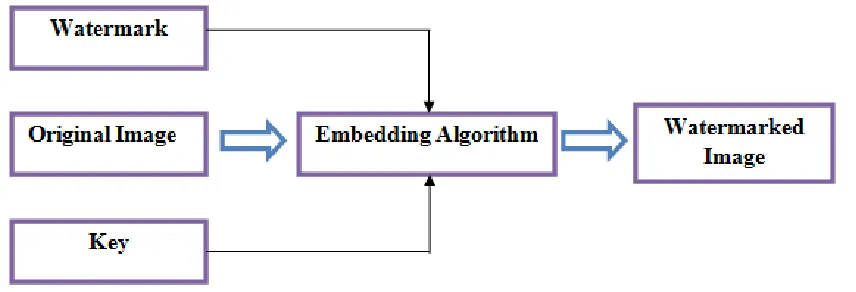
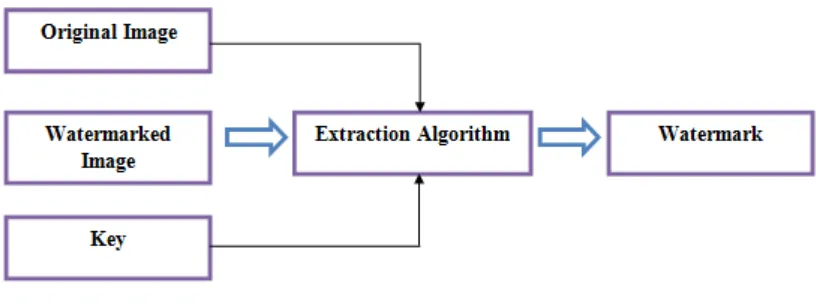
Generally, any watermarking algorithm consists of three parts; watermark embedding algorithm, watermark extraction algorithm and watermark detection algorithm (Zhang, 2009).
[image:19.612.118.546.394.540.2]In an embedding process, the algorithm allows adding a watermark signal into the original image to be watermarked image, that mark could be unique to the owners of digital contents to protect their products from unauthorized copying. Usually the watermarked signals transmit from a person to another person. If this person does not make any modification, the watermark is still present and it can be retrieved. Likewise, if the signal is copied, then the information is also carried in the copy (Syed, 2011). However, the private or public key is used to enforce security during the embedding and the retrieving process in order to prevent forgery or illegal access to the watermark.
Figure 2.2: Watermarking embedding process (Sharma and Gupta, 2012)
10
Figure 2.3: Watermarking extraction process (Hussein and Mohamed, 2012)
2.3.1 Peak Signal to Noise Ratio (PSNR)
In order to evaluate the performance of the watermarked images, there are some types of measurements to determine the quality of image including, PSNR and MSE. However, the PSNR is most commonly used as a measure of quality of reconstruction in image compression (Lee et al., 2008). Where the peak signal noise ratio (PSNR) formula is:
PSNR= 10.log (MAXi2) (2.1)
PSNR formula (Bamatraf, 2012)
Where MAXI is the maximum possible pixel value of the image and MSE is Mean Square Error. The high PSNR value indicates high security because it indicates the minimum difference between the original and watermarked data. So no one can suspect the hidden information.
11
2.3.2 Mean Square Error (MSE)
The MSE represents the cumulative squared error between the compressed and the original image. The mathematical formula for the mean square error is:
MSE= 1 ∑𝑚−1𝑖=0 ∑n−1i=0[I(i. j) − K(i, j)] 2 (2.2) m*n
MSE Formula (Bamatraf, 2012)
Where m and n are the number of rows and columns in the input images, respectively and I (i, j) is the original image, K (i, j) is the watermarked image.
2.3.3 Normalized Correlation (NC)
The watermarking system should be robust against data distortions introduced through standard data processing and attacks. Normalized Correlation is a measurement used to estimate the quality of extracted watermark.
[image:21.612.160.380.539.608.2](2.3)
Figure 2.4: NC Formula (Jadhav and Bhalchandra, 2010)
12
2.4 Classifications of Digital Watermarks
There are many ways which the digital watermarking schemes have been classified by researchers. These classifications are based on different categories according to several criteria. The following section describes the different types of watermarking.
2.4.1 Host Signals
The host signal is the object that carries the watermark inside it. The cover signals are used to transmit information from the sender to the recipient. According to Ensaf Hussein (2012), the common types of host signals are as the following:-
2.4.1.1 Image Watermarking
Nowadays, most of the digital watermarking researchers concentrate on the images. The cause might be back the availability of unlimited images on the World Wide Web without cost and also without any copyright protection.
2.4.1.1.1 Image Compression
13
in a given amount of disk or memory space. It also reduces the time required for images to be sent over the internet or downloaded from Web pages. Image compression is divided into two types: lossy and lossless compression (Morkel et al., 2005).
Lossy compression is a data embedding method that compresses data by losing
some of it. The goal of this procedure is to reduce the amount of data that needs to be handled or transmitted by a computer. This method is more harmful as compared to lossless compression methods. JPEG images are the most common use this technique.
A lossless compression method is considered as a data compression algorithm, which allows the original data to be perfectly reconstructed from the compressed data. It reduces a file’s size with no loss of quality of the images. This technique can be applied
with either GIF or Bmp image formats.
2.4.1.2 Video Watermarking
A video sequence is an extension of the image. Consequently, all the watermarking methods used in image can also be applied to video. This method requires real time extraction and robustness for compression. Video watermarking should be robust against all kinds of attacks including frame averaging, frame dropping and frame swapping.
2.4.1.3 Audio Watermarking
14
hologram, software, database, and text watermarking. In this research, the discussion is only focused on the digital image.
2.4.2 Human Perceptivity Watermarks
Digital watermarking can be divided into two basic types which are visible and invisible watermarking.
2.4.2.1 Visible Watermarking
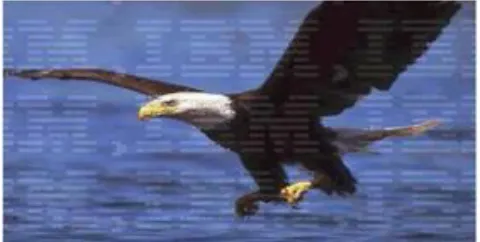
[image:24.612.207.447.550.671.2]The visible watermark is a semi-transparent in which text or logo can be overlapped on the original image. Mostly it is used to identify the ownership and copyrights of digital contents. Viewers can clearly see the original image, but it protected by copyright. Usually, visible watermarking techniques change the original signal because the watermarked signal is different from the original signal. However, visible watermark embedding algorithms are low computationally complex. The watermarked image cannot withstand the signal processing attacks. For example, the watermark can be cropped from the watermarked image (Chawla et al., 2012).
15
2.4.2.2 Invisible Watermarking
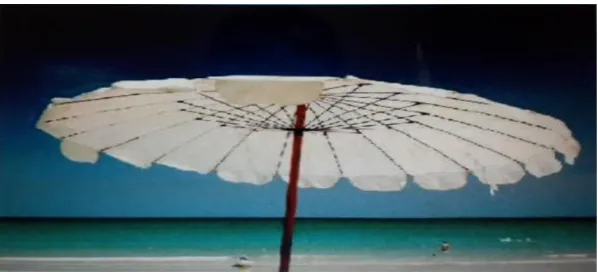
[image:25.612.179.478.338.474.2]Invisible watermark is embedded in an image or text in such a way that it cannot be perceived by the human eyes. Only electronic devices can retrieve the hidden information to identify the copyright owner. The Invisible watermarks are used as evidence of image authentication and preventing it from being copied. This watermark cannot be seen by the viewer. Similarly, the watermarked signal is almost similar to the original signal because the output signal does not change much when compared to the original signal. The invisible watermarking is more robust to signal processing attacks when compared to visible watermarking. Likewise, the quality of the image does not suffer much, it can be used in almost all the applications (Chawla et al., 2012).
Figure 2.6: Invisible watermarked image (Chawla et al., 2012)
2.4.3 Robustness of Watermarks
16
2.4.3.1 Fragile Watermark
[image:26.612.124.512.235.470.2]This watermark is designed with very low robustness. Fragile watermark is very sensitive and it can be easily destroyed with slight modifications in the watermarked signal (Chawla et al., 2012). Usually they used this kind of watermark to check the integrity of original contents.
Figure 2.7: Fragile watermarked images (Chawla et al., 2012)
2.4.3.2 Semi-Fragile Watermark
17
the addition of quantization noise from lossy compression. This method can be used to verify data integrity and authentication as well.
2.4.3.3 Robust Watermark
One of the most important demands of watermark is that the embedded watermark should be strong against intentional attacks such as cropping and compression and non-intentional malicious which are aimed to destroy the watermark. Robust digital watermark is a watermark that resists a designated class of transformations (Bamatraf, 2012). Any attempts to remove or destroy the watermark may affect or degrade the quality of the image (Chawla et al., 2012). Nowadays robust watermark is used widely to protect the owner’s legal application rights.
2.4.4 Division Based Extraction Process
The extraction process of digital watermarking consists of three different categories such as Non-blind, Semi-blind and Blind respectively.
2.4.4.1 Non-Blind Watermarks
18
2.4.4.2 Semi-Blind Watermarks
The semi-blind watermark requires secret key and watermark bit sequence for an extraction. Also, it needs some special information to detect the embedded data in the watermarked signal. It does not demand an original image for detection. Some applications of this watermark are fingerprinting and copy control (Singh et al., 2012).
2.4.4.3 Blind Watermarks
If the Digital watermark does not require an original image, it is called blind watermarking. This type of watermarks does not require either the original image or the embedded watermark. It is also referred to as public watermarking. Blind watermarks are less robust to any attacks on the signal (Singh et al., 2012).
2.4.5 Domain Watermarks
Most researchers have mentioned that the domain watermark consisted of two major domain types, which are spatial and frequency domains.
2.4.5.1 Spatial Domain
19
frequency transform is required. It has high capacity, more perceptual quality, but less robust and mainly capable for authentication applications. However, this approach is not reliable when subjected to normal media operations such as filtering or lossy compression (Syed, 2011).
2.4.5.2 Frequency Domain
The frequency domain is inserted into transformed coefficients of the host image, giving more information hiding capacity and more robustness against various watermarking attacks because information can spread out to the entire image (Gunjal and Manthalkar, 2010). Embedding is done by frequency domain techniques after taking an image transforms. Generally, frequency domain has more robust compared with spatial domain, less control of perceptual quality and it is suitable for copyright application.
2.4.6 Classification by Applications
Digital watermarking has been widely and successfully applied in billions of media applications objects across a wide range of applications such as copyright protection, data authentication, broadcast monitoring, copy protection and fingerprinting (Hussein and Mohamed, 2012).
2.4.6.1 Copyright Protection
20
from one person to another since the start of the internet revolution. Using digital embed watermarks is an efficient method which can ensure our ownership of media content. This watermark may contain imperceptible digital data that can include ownership information, contact details and usage rights. Copyright protection should be a high level of robustness. Therefore, the embedded image makes it difficult for the watermark to be removed without data distortion (Singh, 2011).
2.4.6.2 Data Authentication
A watermark is an evidence of ownership. The slight modification may remove or lose the authenticity of the digital contents where anyone can claim the ownership of these objects. For that reason, it needs to verify the ownership of the objects. Like this application, it detects the modification of data. To verify the authenticity of the received data, watermark is embedded in the host image (Singh, 2011).
2.4.6.3 Broadcast Monitoring
21
2.4.6.4 Copy Protection
Copy protection is a prevention of making, unofficial and unauthorized copies of copyrighted objects. Only those with permission can access or copy the contents of these media.
2.4.6.5 Fingerprinting
This method is used to detect the owner of the content. Each owner has only one unique fingerprint. The technique is like giving a serial number to every product. Each distributed multimedia copy is embedded with a different watermark. The objective is to transfer the information about the legal recipients. A robust watermarking algorithm is required for this application (Singh, 2011).
2.5 Techniques of Digital Watermarking
22
2.5.1 Spatial Domain Techniques
Spatial domain refers to embedding watermarks by directly modifying pixel values of an original image. Tirkel et al. implemented one of the earliest techniques used for image watermarking in 1993. They used two techniques to hide data in the spatial domain of watermarking images (Bamatraf, 2012). Least Significant Bit (LSB), mainly used to hide the information, is the most well-known image watermarking technique in spatial domain. A pixel in images is stored as binary integers. Usually, LSB indicates to right most bits which represent smaller values compared to the left side bits. Modifying the LSB of digital image does not cause changes in the visual quality of the original image (Chen and Lu, 2012). To implement this technique is very simple. In general, spatial domain methods are difficult to survive under malicious attacks compared with the frequency domain. In 1995, Laterin et al. proposed an algorithm relied on the pixel region classification. Pixels are divided into homogeneous luminance zones. Then, the pixels have their gray levels changed following a rule that takes into account the location where the pixel is inserted and the value of the byte to be embedded. However, extracting the least significant bits of the watermarked image can give a distortion estimation of the watermark image (Bamatraf, 2012).
2.5.2 Frequency Domain Techniques
23
[image:33.612.85.572.318.408.2]watermarking algorithms in frequency domain have been developed (Bamatraf, 2012). The watermark has been embedded and extracted using different frequency domain techniques. The most well-known transform operating in the frequency transform are Discrete Fourier Transform (DFT), Discrete Cosine Transform (DCT) and Discrete Wavelet Transform (DWT). However, compared to spatial domain, watermark in frequency transform is more robust and suitable to popular image compression standards. Therefore, this research area has received more attention since the application of digital watermarking on an image in 1993.
Table 2.1: Comparison between watermarking techniques (Hussein and Mohamed, 2012)
Characteristics Spatial Domain Frequency Domain
Computation Cost Low High
Robustness Fragile More Robust
Perceptual Quality High Control Low Control
Capacity High (depending on the size of the
image)
Low
Applications Mainly Authentication Copy Rights
2.5.2.1 Discrete Cosine Transform
24
(Nivedita et al., 2012), (Fung et al., 2011). Watermarking based on DCT has two facts. The first fact is that much of the signal energy lies at low-frequencies sub-band which contains the most important visual parts of the image. The second fact is that the high frequency components of the image are usually removed during compression and noise attacks. Therefore, the watermark is embedded by modifying the coefficients of the middle frequency sub-band so that the visibility of the image is not affected and the watermark is not removed by compression (Amirgholipour and Nilchi, 2009). There are many variants of the Discrete Cosine Transform, but DCT that have 2-dimensional is the most commonly used for digital images. The formula of 2D (N by M) DCT is defined as the following:
F (u, v) = (𝑁2)½ (𝑀2)½ ∑𝑁−1𝑖=0 ∑𝑖=0𝑀−1˄ (I).˄ (j). cos [𝜋.𝑢2.𝑁 (2𝑖 + 1)]Cos[2.𝑀𝜋.𝑣 (2𝑗 + 1)].𝑓 (i, j)
(2.4)
However, the corresponding inverse 2D-DCT transform F-1 (u, v) formula is:
˄ (𝛏) =f(x) = {
1 √2
1 (2.5)
The equation (2.4) given by:
Figure 2.8: Elements of an 8x8 DCT matrix (Marshall, 2001)
The 1D DCT is applied to each row of F and then to each column of the result. Since the 2D DCT can be computed by applying 1D transforms separately to the rows and columns, it may say that the 2D DCT is separable in the two dimensions. However, the process of Discrete Cosine Transforms algorithm steps are the following:-
85
REFERENCES
Amirgholipour, S. & Nilchi, A. (2009). Robust Digital Watermarking Based on Joint DWT-DCT. International Journal of Digital Content Technology and its Applications(JDCTA), 3(2), pp. 42 - 54.
Bamatraf, A. O. (2012). An Improved Digital Watermarking Algorithm using
Combination of Least Significant Bit (LSB) and Inverse Bit. Universiti Tun Hussein Onn Malaysia: Master’s Thesis.
Chawla, C. & Saini, R. & Yadav, R. (2012). Classification of Watermarking Based upon Various Parameters. International Journal of Computer Applications & Information Technology, 1(2).
Chen, C. & Lu, H. (2012). Robust Spatial LSB Watermarking of Color Images against JPEG Compression. Fifth International Conference on Advanced Computational Intelligence (ICACI). Jiangus. China. IEEE. pp. 872-875.
Delaigle, J. & Christophe, D. (1996). Digital Watermarking. Proceedings-Spie The International Society for Optical Engineering. pp. 99-110.
Fung, C. & Gortan, A. & Junior, W. (2011). A Review Study on Image Digital
Watermarking. The Tenth International Conference on Networks (ICN). CAPES. Brazil. pp. 24-28.
Gunjal, B. & Manthalkar, R. (2010). Discrete Wavelet Transform based Strongly Robust Watermarking Scheme for Information Hiding in Digital Images. Third International Conference on Emerging Trends in Engineering and Technology (ICETET). Geo. IEEE. pp. 124-129.
Hartung, F. & Kutter, M. (1999). Multimedia Watermarking Techniques. Proceedings of the IEEE. pp. 1079-1107.
86
Jadhav, S., & Bhalchandra, A. (2010). Robust Digital Image-Adaptive Watermarking using BSS Based Extraction Technique. International Journal of Image Processing (IJIP), 4(1), pp. 77.
Khalid, S. & Deris, M. & Mohamad, K. (2013). Anti–Cropping Digital Image
Watermarking using Sudoku. International Journal of Grid and Utility Computing, 4(2), pp. 169 - 177.
Kim, J. & Sungeon, H. (2009). Development of Digital Watermarking Technology to Protect Cadastral Map Information. Proceedings of the 2nd International Conference on Interaction Sciences: Information Technology, Culture and Human. pp. 923-929.
Lee, G. & Yoon, E. & Yoo, K. (2008). A New LSB based Digital Watermarking Scheme with Random Mapping Function. International Symposiun on Ubiquitous Multimedia Computing. Hobart. Australia. IEEE. pp. 130-134.
Mansoori, S. & Kunhu, A. (2012). Robust Watermarking Technique based on DCT to Protect the Ownership of DubaiSat-1 Images against Attacks. International Journal of Computer Science and Network Security (IJCSNS), 12(6), pp. 1.
Marshall, D. (2001). Discrete Cosine Transform. Retrieved on May 2, 2014, from http://www.cs.cf.ac.uk/Dave/Multimedia/node231.html#
Morkel, T. & Eloff, J. & Olivier, M. (2005). An Overview of Image Steganography.
Information and Computer Security Architecture (ICSA). pp. 1-11.
Nivedita. & Singh, P. & Jindal, S. (2012). A Comparative Study of DCT and DWT- SPIHT. International Journal of Computational Engineering and Management (IJCEM), 15(2), pp. 26 – 32.
Rao, S. & Shekhawat, R. & Srivastava, V. (2012). A DWT-DCT-SVD based Digital Image Watermarking Scheme using Particle Swarm Optimization. IEEE
Students’ Conference on Electrical, Electronics and Computer Science (SCEECS). pp. 1-4.
87
Saini, L. & Shrivastava, V. (2014). Analysis of Attacks on Hybrid DWT-DCT
Algorithm for Digital Image Watermarking With MATLAB. International Journal of Computer Science Trends and Technology (IJCST), 2( 3).
Sharma, M. & Gupta, P. (2012). A Comparative Study of Steganography and
Watermarking. International Journal of Research in IT & Management (IJRIM), 2 (2), pp. 2231 - 4334.
Singh, V. (2011). Digital Watermarking: A Tutorial. Cyber Journals: Multidisciplinary Journals in Science and Technology, Journal of Selected Areas in Telecommunications (JSAT), January Edition.
Singh, A. & Dave, M. & Mohan, A. (2012). A Novel Technique for Digital Image Watermarking in Frequency Domain. 2nd International Conference on Parallel Distributed and Grid Computing (PDGC). Solan. India. IEEE. pp. 424-429.
Smith, L. (2003). Watermarking Blossoms through the Renaissance. Retrieved on April 15, 2014, from http://www.motherbedford.com/Watermark1B3.htm
Song, C. & Sudirman, S. & Merabti, M. (2009) Recent Advances and Classification of Watermarking Techniques in Digital Images. International Conference. October. Liverpool. UK.
Song, C. & Sudirman, S. & Merabti, M. & Jones, D. (2010). Analysis of Digital Image Watermark Attacks. 7th International Conference on Consumer Communications and Networking Conference (CCNC). Las Vegas. USA. IEEE. pp. 1-5.
Syed, A. (2011). Digital Watermarking. The University of Texas: Master’s Thesis.
Wang, J. (2011). New Digital Audio Watermarking Algorithms for Copyright Protection. National University of Ireland Maynooth: Ph.D. Thesis.
Zhang, Y. Digital Watermarking Technology: A Review. (2009). ETP International Conference on Future Computer and Communication. Wuhan. China. IEEE. pp. 250-252.