3791
SENDING IMAGE IN NOISY CHANNEL USING
ORTHOGONAL FREQUENCY DIVISION MULTIPLEXING
SCHEME
1*GHASSAN MUSLIM HASSAN, 2KHAIRUL AZMI ABU BAKAR, 3MOHD ROSMADI MOKHTAR
1, 2, 3Faculty of Information Science & Technology, University Kebangsaan
Malaysia (UKM), Malaysia
*Computer Dep., College of Science, Al-Mustansiriyah University, Baghdad, Iraq
E-mail: 1[email protected], 1[email protected], 2[email protected], 3[email protected]
ABSTRACT
Orthogonal frequency division multiplexing (OFDM) is dependable in data transmission with high speed by the benefit of its robustness to multi-path fading, high data rate, and high spectral efficiency. OFDM is a multi-carrier modulation scheme. Synchronization is the major problems of the OFDM system. In this research, the power consumption was considering through a noisy channel when an image was transmitted in the OFDM system. To support the work, many features were tested such as minimizing the complexity with fast Fourier transforms/inverse fast Fourier transform (FFT/IFFT). The size of bandwidth (BW) play the main role and how its effect on the transmission and how its related to the FFT size (Nfft). The modulation type was also tested to see which one is the best for image transmitted. These types are phase shift keying (PSK) and quadrature amplitude modulation (QAM). In addition, signal to noise ratio (SNR) is one of the performances in OFDM system and consider one of the factors which wireless communication depends on related with bit error rate (BER). Another drawback of the OFDM system was Peak-to- average power ratio (PAPR), therefore, the effect of Nfft on the PAPR has been tested with simulation results in which additive white Gaussian noise (AWGN) had been used in the MATLAB simulation.
Keywords: Bit Error Rate, Fast Fourier Transform, Orthogonal frequency division multiplexing, Peak-to-Average power ratio, Signal-to-Noise Ratio.
1. INTRODUCTION
This By the improvement of the hardware, digital signal processing made orthogonal frequency division multiplexing (OFDM) an accurate decision for wireless systems [1]. Latterly, OFDM emerged as a key candidate for high-data-rate applications. Now, it's used for digital video broadcasting (DVB), digital audio broadcasting (DAB), wireless local area networks, fourth-generation cellular systems, and WiMAX [2].
The principle of OFDM system is as follows; The transmitted signal (data) is divided into many smaller signals, transmit these sub-signal to receiver in a simultaneous manner with various frequencies. The main bandwidth (BW) is also divided into many subbabnds, therefore, the signal crosstalk was reduced using OFDM. Due to the channel transmission errors, the data are either
3792 the symbol rate [4]. The algorithm in this research paper has been implemented to read the stored image (features such as color, shape, and robust) then transmitted it by choosing many types of modulation with different size of fast Fourier transform and SNR, which is equal to 18dB. Changing the type of modulation will also change the constellation, which will be helpful in determining the effectiveness of the transmitted data. The method of the channel estimator is the most important technique to estimate the incoming signal. In the present work, least squares (LS) estimators have been chosen in changing the parameters of the estimator to enhance the estimation process of LS.
The paper is organized as follows. Section 2 shows the literature review for OFDM studies, while Section 3 describes a background of OFDM. Section 4 explains the peak-to-average power ratio (PAPR), which is the main part of the drawback in OFDM. The proposed algorithm was explained in Section 5. The simulation analysis and results are discussed in Section 6. Finally, the conclusion is presented in Section 7.
2. LITERATURE REVIEW
The authors in [6] show an image that is compressed using the DWT, and the compressed data are arranged in four subbands. These subbands are packetized and serially mapped to the OFDM system. After receiving the channels at the receiver, the bad channel drops at the receiver side. The main drawbacks of this study are the synchronization and BER. In [7], the authors propose an estimator for the channel delay spread and analyzed the DVB system. The authors consider the synchronization problem and frequency Doppler. PAPR is the main disadvantage of OFDM, but it is not mentioned in the study. Reference [8] proposes an effective technique for color image transmission with a power saving approach over the OFDM system. The reception quality of the receiving image is also perfect enough with various peak signal-to-noise ratios (PSNR) that save 60% energy. However, the synchronization problem did not consider including the PAPR problem. In [9], the authors describe the Simulink implementation of all functional blocks of a standard digital video broadcasting (DVB)-T transmitter and receiver and presents the simulation model for the DVB-T system according to the European Telecommunications Standards Institute (ETSI EN 300 744 V1.6.1). The implemented model contains all channel coding and modulation building blocks with the following parameters: 8K
3793 several subcarriers using QPSK in OFDM modulation. Authors in [17] proposed an enhanced algorithm of the timing synchronization which implemented the training sequence, and the estimation function of the timing synchronization which improved for this algorithm.
3. BACKGROUND
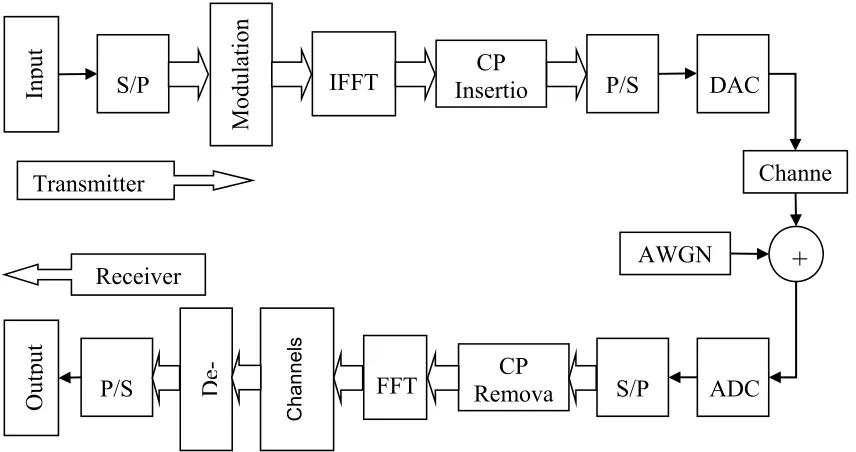
[image:3.612.101.529.205.431.2]OFDM is found to have total immunity to multipath delay spread provided the reflection time is less than the guard period used in the OFDM signal. The typical OFDM transceiver (transmitter + receiver) block diagram is shown in figure 1 [18],[19].
Figure 1: OFDM Generation And Reception Block Diagram
The transmitter part converts the data for transmission into a mapping of subcarrier amplitude and phase. After converting the input binary data from serial to parallel (S/P) and modulation using quadrature amplitude modulation (QAM) or phase shift keying (PSK) the spectral representation of the data transforms from frequency domain to time domain using an inverse FFT. Moreover, a cyclic prefix (CP) or guard band is added to support the synchronization. A conversion of the data occurs from parallel to serial (P/S) followed by conversion from digital to analog. The output signal is as follows:
x n 1
√N X m . e 1
where x (n) is the OFDM signal and X(m) is the modulated symbol in frequency domain for the mth subcarrier. By contrast, N−1 ≥ m ≥ 0, n is a time domain sample index, and N denotes the number of subcarriers.
In the channel, the incoming signal will be mixed with a noise of type AWGN. The reverse operation of the transmitter had been done in the receiver. Before the FFT, there are analog to digital conversion, S/P, and CP removal; FFT also analyzes the signal in the frequency domain. The amplitude and phase of the subcarriers are identified and converted back to digital data
Y m y n . e w n 2
where Y(m) is the output of the FFT stage, w(n)
is the AWGN, y(n) is the received signal after passing through the AWGN channel affected by frequency offset, and ε is the normalized frequency offset and is given by ∆fNTs, where ∆f is the frequency difference of the local oscillator between transmitter and receiver, and
Ts is the symbol period.
In
put
S/P
Modulation
CP
Insertio
IFFT
P/S
DAC
Channe
+
AWGN
Out
put
P/S
De
-
CP
Remova
FFT
S/P
ADC
Transmitter
Receiver
Cha
nnel
3794 One of the main performances in the receiver side and considered one of the important factors in a communication system is BER. The BER may be affected by noise, distortion, interference, and wireless multipath fading. It may be improved by choosing a strong signal strength, choosing a slower and a robust modulation scheme or line coding scheme, and applying channel coding schemes, such as redundant forward error correction codes [2], and can be expressed mathematically as follows
3
Several factors can affect BER estimation, such as the form of the data, which are sent through a BER measurement that can influence the result. Fake signals from additional channels, interference of sweep transmitter, in-channel access (burst noise and impulse), interference of adjacent channels, and incorrectly aligned and/or faulty amplifiers are several degrading causes of BER.
4. PROBLEM IN OFDM
One of the main problems of OFDM is PAPR. This necessary issue of subcarriers force vacillation forces that have the undesirable multifaceted nature of digital to analog conversion, as they should work in a more general element range. A power amplification, which is situated on the transmitter part, should also work in an enormous straight area to avoid spectral development. Therefore, noise becomes out-of-band. All past requirements are important for the presence of high PAPR, which builds the general expense of an OFDM system [21],[22],[23].
In a system with multi-carrier, if the subcarriers are out of phase between each other, then PAPR will happen. PAPR is relative between the maximum sample power value in a transmitted OFDM signal, divided by an average power of the same OFDM signal in equation 4.
| |
| | 4
where Ppeak is the peak of power output,
Paverage is the average of power, E[] is the
expected value, and X(n) is the transmitted signal of OFDM.
Reducing the power of the transmitted signal to bypass the effect of PAPR will, therefore, reduce the SNR and then to increase BER. So, there are many techniques which are used or reduction PAPR [20],[21],[22],[23],[24].
5. PROPOSED ALGORITHM
The proposed algorithm has three stages;
i) Stage 1, transmitter
At this stage, the image data is prepared to be transmitted using an OFDM technique. After choosing the modulation type (BPSK, QPSK, 8PSK, 16QAM, 32QAM, and 64QAM), then, convert the data from serial to parallel for converting the domain from frequency to time by using IFFT. CP was inserted into each symbol to prevent the inter-symbol interference (ISI), then parallel to serial. The OFDM signal is ready to transmit which is represented by equation 1. Calculation of PAPR using equation (4) is used in the calculation and performance of the algorithm.
ii) Stage 2, channel
Through the transmission channel, noise and AWGN are added to the OFDM signal. SNR is changed from -5dB up to 40dB step 5. At this stage, the power of data is calculated using equation (5), and then use in the calculations.
data power X x 5
where Is the mean value of the transmitted data and x(s) is the transmitted
data.
iii) Stage 3, receiver
3795
6. SIMULATION RESULTS
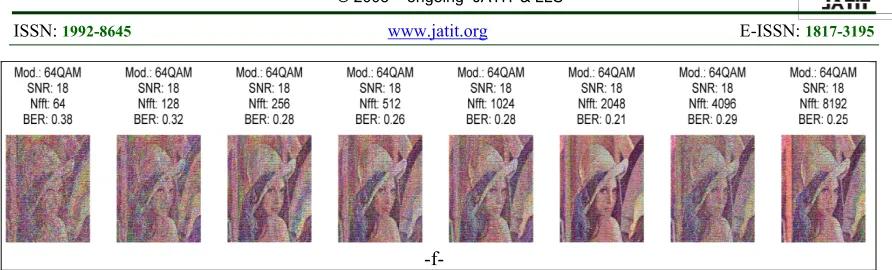
Figure 2 illustrates the receiving image for different types of modulation. When the value of SNR had been fixed and modulation type was changed, the value of BER had been
calculated for different values of Nfft. The clarity of the received image changed by the type of the modulation and Nfft values which give different values of BER as in table 1.
-a-
-b-
-c-
-d-
3796 -f-
[image:6.612.156.463.252.368.2]Figure 2: Receiving Image Using Different Type of Modulation, (a) BPSK, (b) QPSK, (c) 8PSK, (d) 16QAM, (e) 32QAM, and (f) 64QAM
Table: BER Values for Different Modulation Types, With Different Nfft Values When SNR=18
Mod.
FFT BPSK QPSK 8PSK 16QAM 32QAM 64QAM
64 0.0042 0.076 0.20 0.31 0.36 0.37
128 0.00028 0.050 0.15 0.28 0.32 0.32
256 6.3e-05 0.014 0.095 0.24 0.24 0.28
512 9.7e-06 0.035 0.04 0.17 0.18 0.26
1024 0 0.0043 0.035 0.17 0.18 0.28
2048 0 0.0019 0.012 0.14 0.12 0.21
4096 0 0.00019 0.008 0.13 0.17 029
8192 0 0.00099 0.0079 0.14 0.15 0.25
6.1 Bit Error Rate with Signal-to-Noise Ratio
In this research, the BER value had been analyzed for different modulation techniques with different SNR values. At the end of the analysis, we have concluded that BPSK is the best modulation techniques used for image transmission with decreasing in the BER.
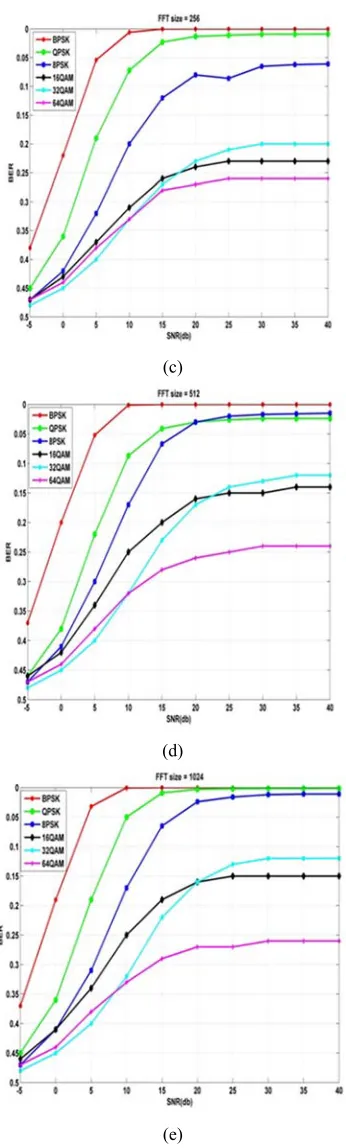
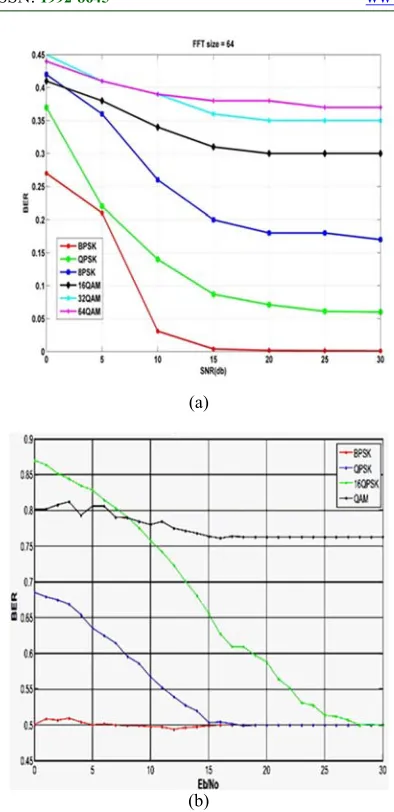
As a first stage of the algorithm, the data of the stored image were converted to the binary form, with using different types of modulation to get the relation between SNR and BER. Many values of SNR had been taken from -5dB to 40dB step 5dB with using different values of Nfft (64, 128, 256, 512, 1024, and 2048). The algorithm was done in two sets of modulation, the first set for phase shift keying (PSK) include BPSK, QPSK, and 8PSK, while the second set for quadrature amplitude modulation (QAM) include 16QAM, 32QAM, and 64QAM. Figure 3 illustrates the different effect of each type of modulation in each set when calculating the error values of the transmitted data.
(a)
3797
(c)
(d)
(e)
[image:7.612.93.542.43.711.2](f)
Figure 3: Performance of BER ~ SNR With Different Size of FFT, (a)Nfft =64, (b ) Nfft =128, (c) Nfft =256,
(d) Nfft =512, (e) Nfft =1024,(f) Nfft =2048
From the results of figures 2 and 3, the best modulation type used to transmit and receive an image is BPSK, especially when the SNR = 20 dB and higher, depending on the implementation of the algorithm and the value of SNR which related to the signal power and the noise power. Therefore, Increased SNR value due to increased signal power that leads to a decrease in BER. While QPSK and 8PSK is the second and third choice respectively. The same result has been devised even though the increase in the size of the FFT (Nfft).
[image:7.612.108.281.104.678.2]3798
(a)
[image:8.612.95.292.80.486.2](b)
Figure 4: BER for different modulation type (a) this research (b) result of research using in comparison [26]
6.2 Bit Error Rate with Size of FFT (Nfft)
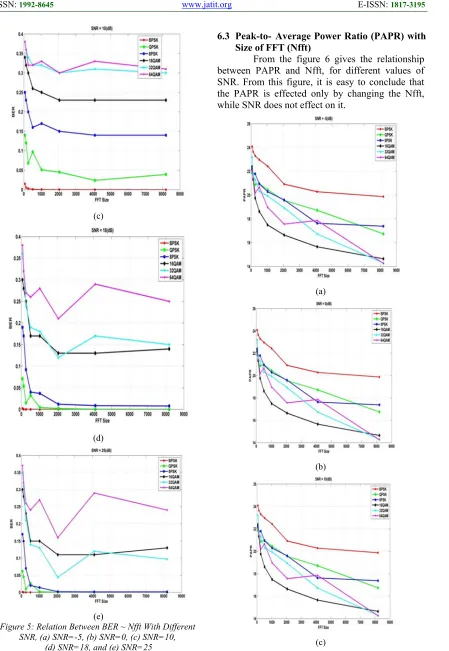
This part of the research results show the relation between BER and Nfft. Figure 5 reveals that the clearly visible thing of BPSK is the best modulation type, with SNR equal to 18dB and more. Figure 5.d, e shows the curve of BPSK like a straight line, so at these values of SNR, the FFT symbols has no effects to get the best results with minimum BER. Also, the results of QAM modulation have values like random numbers, as shown in the figure. Therefore, the PSK is preferred over the QAM.
Figure 5.a shows the result when the SNR is less than zero. Its almost the same results for all modulation types and reach near BER = 0 when Nfft = 131072 and up. However, any increase in Nfft will increase the complexity (FFT
multiplications) of calculation, which depends on equation 6 and as seen in Table 2.
Complexity = (Nfft /2).log2 (Nfft) (6)
Table 2: Relation Between Nfft and FFT Multiplication
Furthermore, any increase in Nfft size will lead to increase the channel BW; for example, if Nfft = 2048 and suppose the time needed for calculating these Nfft equal to 100 µsec, then;
Sampling frequency (fs) = 2048/100 = 20.48 MHz, BW = fs/2 = 10.24 MHz.
[image:8.612.329.556.368.726.2]Table 3 shows relation between Nfft size and BW.
Table 3: Relation Between Nfft and BW
(a)
3799
(c)
(d)
[image:9.612.96.545.74.725.2](e)
Figure 5: Relation Between BER ~ Nfft With Different SNR, (a) SNR=-5, (b) SNR=0, (c) SNR=10,
(d) SNR=18, and (e) SNR=25
6.3 Peak-to- Average Power Ratio (PAPR) with Size of FFT (Nfft)
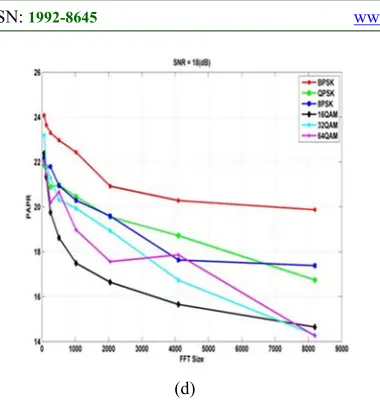
From the figure 6 gives the relationship between PAPR and Nfft, for different values of SNR. From this figure, it is easy to conclude that the PAPR is effected only by changing the Nfft, while SNR does not effect on it.
(a)
(b)
3800
[image:10.612.101.291.70.274.2](d)
Figure 6: Relation Between PAPR ~ Nfft With Different SNR, (a) SNR=-5, (b) SNR=0, (c) SNR=10, and
(d) SNR=18
7. CONCLUSION
In this study, the OFDM structure was reviewed with a transceiver of the system. The algorithm had been done on this structure to send and receive an image in a noisy fading channel with AWGN channel. Bit error rate is the most important performance of the OFDM system. Thus, the discussion and simulation were done on BER, especially with the several sizes of FFT (Nfft) and multi-values of SNR. The type of modulation and its control on the transmission and reception are considered. One important drawback of the system is the PAPR. Numerous methods are used to minimize the PAPR, but the easiest method is clipping and filtering [27, 28]. The major drawback is that in the case of increment the number of subcarriers, the quantity of the system will be significantly discredited and the efficiency of the spectrum usage will be decreased.
If an image is transferred from one station to the other, the best modulation type is BPSK followed by QPSK and 8PSK, as shown in the simulation. Therefore, the set of phase shift keying is preferred over that of the set of QAM. The size number of FFT is also important, especially when they are increasing, but with relative relation with a bandwidth of the signal (when Nfft increases the BW increase too). Therefore, a balance must be established between the values (performances) to obtain the best image transmission from the sender to the recipient.
The limitations of this work are to maintain the SNR ratio, which is the main and important factor of communication. The real-time
platform implementation based on Field- Programmable Gate Array (FPGA) can be done in the case of availability of implementation card is also one of the difficulties in the working
REFRENCES:
[1] A. F. Molisch, “Wireless Communications”,
Second Edition, University of Southern
California, USA, John Wiley & Sons Ltd, 2011.
[2] A. Agarwal1 and K. Agarwal, “Implementation and Performance Evaluation of OFDM System in Diverse Transmission Channel Using Simulink”, American Journal of Electrical and
Electronic Engineering, Vol. 3, No. 5, 2015, pp.
117-123.
[3] V. Yatnalli and K. L. Sudha, “Image Transmission Over Multipath Fading Channel and Image De-noising Using Directional Weighted Median Filter”, International Journal
of Computer Applications, Vol. 109, No. 10,
2015, pp.18-23.
[4] M. M. Salah and A. A. Elrahman, “Coded OFDM Scheme for Image Transmission Over Time-Varying Multipath Rayleigh Fading Channels”, 15th IEEE Mediterranean Electro
technical Conference, 2010, pp. 602-607.
[5] R. Baranwal, “Optimization of PAPR Using HPA and Amplitude Clipping Reduction Technique”, International Journal of Innovative Research in Computer and Communication
Engineering, Vol. 2, No. 4, 2014, pp.
3788-3793.
[6] A. Sharma, S. De, and H. M. Gupta, “Energy-Efficient Transmission of DWT Image Over OFDM Fading Channel”, Third International Conference on Communication System and
Networks (COMSNETS), IEEE, 2011, pp. 1-7.
[7] A. Soni and A. C. Tiwari, “Performance Analysis of OFDM System Under FFT, DWT and DCT Based Transform Techniques”,
International Journal of Emerging Technology
and Advanced Engineering, Vol. 4, No. 7, 2014,
pp. 702-709.
[8] P. Dhok and A. Dhanvijay, “A Review on Digital Video Broadcasting Terrestrial (DVB-T) Based OFDM System”, International Journal
of Engineering and Techniques, vol. 1, no. 2,
2015, pp.27-31.
[9] V. S. Devi and S. V. Naresh, “An Effective Approach for Color Image Transmission Over OFDM for Video Broadcasting Applications”,
3801
Engineering, Technology, Management and
Research, Vol. 4, No. 12, 2014, pp. 26-31.
[10] M. N. A. Shareef and M. I. A. Ahsan, “Energy Efficient Transmission of DWT Image Over OFDM Using BPSK, QPSK and 16PSK”,
International Journal of Advanced Research in Computer Engineering & Technology
(IJARCET), Vol. 4, No. 5, 2015, pp. 2444-2449.
[11] D. Patne and P. N. Pusdekar, “Optimized Transmission of Images With OFDM Over
AWGN Channel Using Trigonometric
Transforms”, International Journal of Science
and Research (IJSR), Vol. 5, No. 4, 2016, pp.
1540-1543.
[12] M. Elsharief, A. Zekry and M. Abouelatta, “Implementing a Standard DVB-T System Using MATLAB Simulink”, International
Journal of Computer Applications, Vol. 98, No.
5, 2014, pp. 27-32.
[13] L. P. Dachuri and N. Uppala, “Energy Efficient Transmission of Image Over DWT-OFDM System”, International Journal of Electrical, Computer, Energetic, Electronic and
Communication Engineering. Vol. 7, No. 9,
2013, pp. 1264-1270.
[14] Elshirkasi, Ahmed M., Mohammad Umar Siddiqi, and Mohamed Hadi Habaebi. "Generalized Discrete Fourier Transform Based Improvement of Partial Transmit Sequence Scheme to Reduce PAPR in OFDM Systems",
Journal of Theoretical & Applied Information
Technology (JATIT), Vol. 76, No. 1, 2015, pp.
76-81.
[15] D. Li, X. Xiong and H. Wang, “Performance Analysis of CFO Estimation for OFDM Systems With Low-Precision Quantization”,
Wireless Communications, Networking and
Applications, Springer India, 2016, pp.
1005-1016.
[16] S. Sharma1 and J. Gupta, “Performance Analysis of OFDM With QPSK Using AWGN and Rayleigh Fading Channel”, International Journal of Advances in Engineering &
Technology, Vol. 6, No. 6, 2014, pp.
2635-2645.
[17] D. Jing and W. Yanmei, “Study on OFDM Symbol Timing Synchronization Algorithm”,
International Journal of Future Generation
Communication and Networking, Vol. 7, No. 1,
2014, pp. 43-50.
[18] B. R. Rao, K. Srivani and D. S. Prasanna, “ICI Cancellation Schemes and Selection Criteria in Orthogonal Frequency Division Multiplexing
System: A Review”, International Journal of Engineering and Advanced Technology
(IJEAT), Vol. 2, No. 3, 2013, pp. 628-631.
[19] H. D. Joshi, “Performance Augmentation of OFDM System”, PhD Thesis, Department of
Electronics & Communication Engineering,
Jaypee University of Engineering &
Technology, India, 2012.
[20] S. Manzoor, V. Jeoti, N, Kamel and M. Asif Khan, “Novel SNR Estimation Technique In Wireless OFDM Systems”, International Journal of Future Generation Communication
and Networking, Vol. 4, No. 4, 2011, pp. 1-20.
[21] S. Sengar and P. P. Bhattacharya, “Performance Improvement in OFDM System by PAPR Reduction”, Signal & Image Processing : An International Journal (SIPIJ),
Vol. 3, No. 2, 2012, pp. 157-169.
[22] S. Sharma and P. K. Gaur, “Survey on PAPR Reduction Techniques in OFDM System”,
International Journal of Advanced Research in
Computer and Communication Engineering,
Vol. 4, No. 6, 2015, pp. 271-274.
[23] M. Bisht and A. Joshi, “Various Techniques to Reduce PAPR in OFDM Systems: A Survey”,
International Journal of Signal Processing,
Image Processing and Pattern Recognition,
Vol. 8, No. 11, 2015, pp. 195-206.
[24] A. Sroy, R. Li, F. Zeng and M. Fall, “A Novel Iterative Clipping and Filtering Technique for PAPR Reduction of OFDM Signals: System Using DCT/IDCT Transform”, International Journal of Future Generation Communication
and Networking, Vol. 6, No. 1, 2013, pp. 1-8.
[25] J. Lim, “Is BER The Bit Error Ratio or The Bit Error Rate?”, EDN Network, Vol. 14, 2010. [26] C. U. Ndujiuba, O. Oni and A. E. Ibhaze,
“Comparative Analysis of Digital Modulation Techniques in LTE 4G Systems”, Journal of Wireless Networking and Communications, vol. 5, no. 2, (2015), pp. 60-66
[27] S. Surabhi, P. Rajnish and Y. Pankaj, “Effect of windowing functions on clipping and filtering based PAPR reduction techniques in OFDM Systems”, International Conference on Signal Processing and Communication (ICSC), IEEE,
2015, pp. 171-176.
[28] P. V. Chandrakantbhai, "PAPR Reduction in OFDM system using Clipping & Filtering Technique.", International Journal of
Engineering Development and Research, Vol.