IJPSR (2011), Vol. 2, Issue 9 (Research Article)
Received on 18 May, 2011; received in revised form 23 June, 2011; accepted 15 August, 2011
BIOEFFACY OF TWO TRADITIONAL BOTANICAL INSECTICIDES AGAINST HUMAN HEAD LICE
Ajay Ramdev*1,Richa 2 and M. L. Sharma 2
Department of Botany, Government College 1, Dhaliara, District Kangra (H.P.) India Department of Botany, Panjab University 2, Chandigarh, India
ABSTRACT
Two plants, Spilanthes acmella and Boenninghauseniaalbiflora used against the insect Pediculus humanus by the Gaddi tribals of Himachal Pradesh were presently tested for their insecticidal activity. The methanolic extracts of these plants were prepared from different parts of the plant collected in different months of the year since the active principle is known to vary in different parts of the plant and also with change in climate. Best results were obtained in the extracts made from the plants collected in the month of November. The flowers of S. acmella and the stem of B. albiflora gave the best results when crude extracts of different parts of the plant were used against the insect. When purified extracts of different concentrations made from these parts were tested against the target insect, 80% mortality was obtained with 800 ppm of S. acmella extract made from flowers and 90% mortality was obtained with 800 ppm of B.albiflora extract made from stem after an exposure of 24 hrs. The mortality remained constant at 80% even after exposure to 48 hrs for S. acmella whereas it rose to 90% on exposure to 48 hrsin case of B. albiflora. KC 50 and KD 90 values for these plant extracts showed that 50% of the population will be destroyed at 467.71ppm after 24 hrs of exposure to S. acmella extract and similar results will require 392.37 ppm for 48hrs. In the case of B. albiflora extract, the KD 50 value after 24hrs of exposure was 206.26 ppm and that after 48 hrs of exposure was 197.67 ppm.
INTRODUCTION: Plant based remedies have been used against biting arthropods since times immemorial and such records can be found in every ancient civilization ¹. Ever since that time, botanical insecticides are being used in some form or the other for the control of insect pests. The discovery of chemical insecticides, especially D.D.T. by Paul Miller in1939, probably turned the attention of scientists towards chemical alternatives for use as insecticides ². As a result, a large number of chemical insecticides were formulated and the plant based insecticides remained neglected although some like Pyrethrum and Rotenone still
found acceptance. However the prolonged over use of all such chemicals resulted in multiple problems. The fact that broad spectrum materials harm pests and useful species alike, coupled with the environmental problems caused by these chemicals made the scientists look for botanical insecticides all over again 3. In recent times, a large number of plants have been tested against insects with an aim to search for a better insecticide and some of the plants like
Azadirachta indica did show remarkable results. In the present study, we have tested the efficacy of two Keywords:
Plant insecticides, Ectoparasites,
Lice, Gadditribals, Himachal Pradesh
Correspondence to Author: Ajay Ramdev
plants viz. Boenninghausenia albiflora and Spilanthes acmella used against ectoparasites by the Gaddi tribals living in the mid Himalayan ranges of the Kangra district of Himachal Pradesh in India. These tribals are traditionally sheep herders and they depend on plants for medicines to cure ailments in both humans and animals. They use plants to control the ectoparasites like lice, ticks and mites which cause problems for them and their animals.
The present study was undertaken with a view to test the efficacy of two plants against the common head lice Pediculus humanis whichis a tough hardy pest and is never completely under control, inspite of many available remedies. Boenninghausenia albiflora Linn.is called ‘Pissu mar’ (Flea killer) by the local tribals of Himachal Pradesh ⁴ and Spilanthes acmella Murr. has shown insecticidal activity against larvae of Aedes mosquito ⁵. Thus, both plants are potential insecticides.
MATERIALS AND METHODS
Materials: The two plant species used in the present study were collected from the wild in the Kangra district of Himachal Pradesh while the human head lice was collected from the heads of local children. Brief information about the two plants and the insect is provided below.
Scientific Name: Spilanthes acmella Murr. Family: Asteraceae (Compositae)
English name: Pellitary, Tooth-ache plant. Local name: Akar kara
Brief morphology: A perennial herb with long leaves 6-8cms in length and 2-3 cms in width. The flowers are borne in capitulum heads which are bright yellow or red and contain the active principle Spilanthol which is responsible for its medicinal value against tooth- ache. Distribution: Tropical regions, chiefly America. Found throughout warmer regions in India, ascending to 1500m.
Traditional uses: Although this plant has frequently been mentioned in folk literature for its ability to cure tooth ache, the Gaddi tribals have been using it as an
insect repellant. The fresh and dried flower buds of this plant are made into a paste with water and applied on the heads of children having lice infestations. When flowers are not available, the leaves and roots are also used.
Scientific Name: Boenninghusinia albiflora Linn. Family: Rutaceae
English Name: Boennin Local Name: Pissu mar
Brief morphology: It is a slender, branched, perennial herb, 30-60 cm high, woody at the base. Stems brownish-red, glabrous or sometimes sparsely pubescent. Leaves alternate, 3-5-pinnate. The flowers are small, white, borne in cymes.
Distribution: The plant is found in the hills of Himachal Pradesh, Uttaranchal and Nepal, between 2000 and 3000 mts.
Traditional uses: The leaves and flowers are effective against lice and ticks. A paste of the plant is made with water and rubbed directly on the body of the infected animal, to get rid of these insects. According to the tribal’s, the dried plant acts as a repellent even against the bed bugs and dust mites (‘pissu’). The plant is simply kept in between the beddings and quilts during storage to fumigate these articles
Scientific name: Pediculus humanus
Family: Pediculidae. English name: Lice Local name: Jhun, Joon
Brief morphology: Like other insects of the suborder Anoplura, adult head lice is small (1–3 mm long), dorso-ventrally flattened, and entirely wingless. The thoracic segments are fused, but otherwise distinct from the head and abdomen, the latter being composed of seven visible segments.
Methods: The whole plants were collected during the months of active growth and separated into various parts like root, leaves, stem and flowers. These parts were then shade dried, powdered, and dissolved in methanol and hexane in a ratio of 1:3 (1 part plant material and 3 parts solvent) to give the crude extracts. The extracts so prepared were vacuum dried to give the starting material for the subsequent experiments. A solution of 1000 ppm was prepared from the starting material of each solvent (methanol and hexane) obtained from various parts of both the plants. This solution was then tested against the target insect
Pediculus humanus in order to find the most effective dosage, the respective solvent, and the corresponding plant part source. After this, the most effective dosages of both the plants were further purified; using HPLC and the available fractions were again tested against the insect. The HPLC fraction that gave the best results and the corresponding plant part source for each plant were then procured in sufficient quantity and solutions of varying concentration (between 100ppm and 1000ppm) were prepared.
The insect was exposed to all these concentrations and the mortality rate for each concentration was noted. The data so obtained was used to calculate the KC 50 & KD 90 values for each plant, using probit analysis and regression analysis and statplus software. KC 50 is measured in micrograms (or milligrams) or parts per million (ppm) of air or water and is the standard measure of the toxicity of the toxic substance that will kill half of the sample population of a specific test-animal on exposure for a specified period. The lower the value, more toxic is the material.
It is also called median lethal concentration or population critical concentration 50and abbreviated as LC50. This value is referred to as KC 50 in studies where the insect is not killed but only knocked out by the treatment. LD 90 is the dosage that is expected to kill 90% of the target population and is the indicator of the highest concentration at which the substance should be administered ⁶.
The insect specimens of Pediculus humanus were collected from tribal children by wet combing method. Within one hour of collection, 10 insects were placed in each petri-dish, lined with filter paper, pre-soaked in the plant extract. The mouth of the petri-dishes was closed with muslin cloth and the knocked down lice count was taken after 24 hrs and 48 hrs by inverting the petri dishes and counting the lice that could not cling to the paper. These fallen lice were treated as knocked out or dead as per the modified WHO protocol ⁷. All trials were carried out in triplicate and a negative control was used in which ten lice were placed in a petri- dish having filter paper soaked in only the solvent.
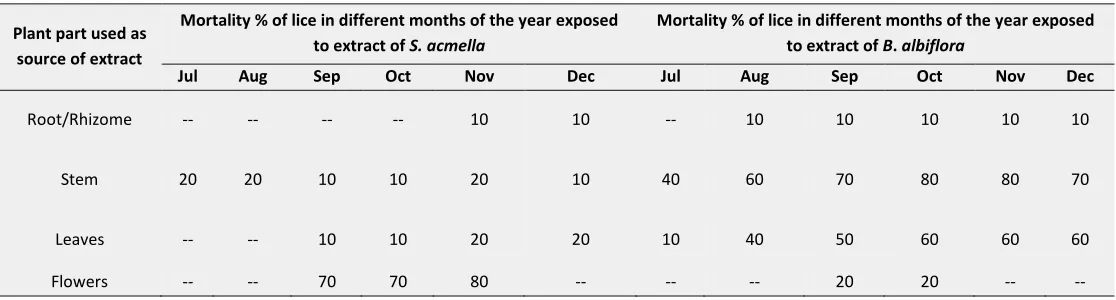
RESULTS: Four different extracts of1000 ppm strength made from root, stem, leaf and flowers of each plant were tested on the insect. It was found that the crude extract made from flowers was the most effective part in case of Spilanthes acmella giving a minimum mortality of 70% and a maximum mortality of 80%. Results also showed that the plant material of
[image:3.612.28.586.581.731.2]Spilanthes acmella collected in the month of November showed the maximum mortality. Mortality was 80% with flowers; 20% with stem and leaves; 10% with roots as shown in Table 1.
TABLE 1: MORTALITY PERCENTAGE OF LICE EXPOSED TO 1000 PPM METHANOLIC EXTRACT OF S. ACMELLA AND B. ALBIFLORA MADE DURING DIFFERENT MONTHS AND FROM DIFFERENT PARTS OF THE PLANT
Plant part used as source of extract
Mortality % of lice in different months of the year exposed to extract of S. acmella
Mortality % of lice in different months of the year exposed to extract of B. albiflora
Jul Aug Sep Oct Nov Dec Jul Aug Sep Oct Nov Dec
Root/Rhizome -- -- -- -- 10 10 -- 10 10 10 10 10
Stem 20 20 10 10 20 10 40 60 70 80 80 70
Leaves -- -- 10 10 20 20 10 40 50 60 60 60
In case of Bonninghusenia albiflora, the most effective plant part was the stem with a minimum mortality of 40% and a maximum mortality of 80%. Also, best results were obtained with the plant material collected in the months of October and November, which was 80% with stem extract; 60% with leaf extract; 20% with the extract prepared from flowers; and 10% with the extract of roots as shown below in Table 1.
The purified extract of Spilanthes acmella showed a mortality percentage of nil, 20.40, 60 & 80 after 24hrs of exposure to solutions of 100 ppm, 200 ppm, 400 ppm, 600 ppm, 800 ppm and 1000 ppm respectively. After 48 hrs of exposure the same concentrations gave a mortality percentage of 10, 40, 60 80 and 90 respectively. Best results of 90% were obtained after 48 hrs of exposure to extract of 1000 concentration. In a similar analysis of the purified extract of
Bonninghusenia albiflora the results with solutions of 100 ppm, 200 ppm, 400 ppm, 600 ppm, 800 ppm and 1000 ppm after 24hrs of exposure gave a mortality percentage of 30, 50, 70, 80, 90 & 90. On exposure to the purified extract for 48 hrs with the above mentioned concentration of solutions, the mortality percentage was 30, 50, 80, 80, 90 & 90 respectively. Thus, the most effective concentrations here were
both 800ppm and 1000 ppm as is shown above in Table 1.
The KC50 and KD90 values for these plants were calculated using probit analysis and regression analysis on statplus software ⁸. A probit analysis of these values showed that after 24hrs the KC 50 values for Spilanthes acmella purified extract were 467.71ppm and the dosage for 90% mortality was 1290.11 ppm. These values after 48 hrs changed to 392.37 ppm and 1369.09ppm respectively as shown below in Table 2. Similarly, the KC 50 values for the purified extract of
Bonninghausenia albiflora after 24 hrs were 206.26 ppm and the dosage for 90% mortality was 881.00 ppm. These values after 48 hrs changed to 197.67 ppm and 961.60 ppm respectively (table 2). This shows that the two plants can control the population of this insect at relatively low concentration, and repeated exposure will require a lower dosage for the insecticide to be effective. The KD 90 values of 1290.11 ppm and 1369.09 ppm for 24hrs and 48 hrs respectively in the case Spilanthes acmella, and 881.00 ppm and 961.60 ppm for 24hrs and 48 hrs respectively for
Boenninghusenia albifloraTable 2, are high as also shown in a lower mortality rate but this can be supplemented by repeated application of these doses.
TABLE 2: KC 50 AND KD 90 VALUES OF LICE EXPOSED TO PURIFIED METHANOLIC EXTRACT OF S. ACMELLA AND B. ALBIFLORA
Plant species KC 50 Values KD 90 Values
After 24 hrs After 48 hrs After 24 hrs After 48 hrs
Spilanthes acmella 467.71 *(0.91) 392.37 (0.87) 1290.11 (1.239) 1369.09 (0.230)
Bonninghausenia albiflora 206.26 (0.154) 197.67 (0.088) 881.00 (0.150) 961.60 (0.156)
* (The values given in parenthesis are S.D. values for the KC 50 and KD 90 values)
DISCUSSION: Pediculus humanus is one of the most problematic insect ectoparasite that infests human adults and children, especially in tropical countries including India. Although synthetic products to control this insect are available, natural sources remain attractive primarily because they are inexpensive, less toxic when compared with synthetic products, readily available, capable of multitude of chemical modifications, potentially degradable, and compatible due to their natural origin ⁹. The two plants studied here have been used against this insect by the Gaddi tribals since ages. There have been a few studies on botanical insecticides which have yielded some plants with good potential. A study screened a total of 54
were Cinnamomum porphyrium, followed by Aloysia citriodora and Myrcianthes pseudomato ¹⁰. Similarly, chloroform extracts of leaves of Annona squamosa
(Annonaceae), Datura metel Solanaceae) and Vitex negundo (Verbenaceae) were used in combination, as insecticides against lice ¹¹ and the KD 50 value was found to be 600 ppm which is a relatively low dose for achieving this mortality rate.
Spilanthes acmella and the leaves of Boenninghausenia alibiflora gave the best results when compared with the other parts of the plants. These results show that the potent insecticidal chemical present in the two plants is soluble in methanol and not in hexane and that this chemical is present in maximum concentration in the flowers in S.acmella and in the stem in B. alibiflora The present study has also validated the potential of both these plants as effective control measures against the head lice. Also, the Gaddi tribals have been using these plants against insect parasites for many years; therefore their safety for human use is already established.
REFRENCES:
1. Birkinshaw, C. R. and Colquhoun, I. C. Pollination of Ravenala madagascariensis and Parkia madagascariensis by Eulemur macaco in Madagascar. Folia Primatolgica 1998. 69:252. 2. Mason, J.M., Matthews, G.A. and Wright, D.J. Appraisal of
spinning disc technology for the application of entomopathogenic nematodes. Crop Protection 1998 17: 453-461.
3. Annis, B. Comparison of the effectiveness of two deet formulations against Aedes albopictus in Philipines, J. Am. Mosq. Assoc., 1991 7: 543.
4. Collett, H. Flora Simlensis. Thacker Spink & Co., London 1900 PP 246-247.
5. Dixit V.K. and Saraf D. K. Spilanthes acmella Murr. : Study on Its Extract Spilanthol as Larvicidal compound. Asian J. Exp. Sci. 2002 16(1 & 2):9-19.
6. Hodgson, Ernest. A Textbook of Modern Toxicology, Wiley-Interscience (3rd Edition) 2004. 126 – 128.
7. Zeichner, B. C. Baseline susceptibility of a laboratory strain of Pediculus humanus (Anoplura: Pediculidae) using a modified World Heath Organization testing protocol. J. Med. Entomol, 1999. 36: 903–905.
8. Greenberg GR, Marliss EB & Zinman B. Effects of exercise on the pancreatic polypeptide response to food in man. Hormone and Metabolic Research 1986 18: 194–196.
9. Vijayalakshmi M, Periyanayagam, K, Lakshmana, Prabu, S.. In vitro Antilice activity of Dichrostachys cinerea (L.) Wight & Arn. International Journal of Pharm.Tech. Research 2010: 45 -56. 10. Toloza, Ariel C, Julio, Zygadlo, Fernando, Biurrun, Alicia,
Rotman, and María, I. Picollo Bioactivity of Argentinean essential oils against permethrin resistant head lice, Pediculus humanus capitis. J. Insect Science. 2007. 10: 21-29.
11. Sharma, A., Shailajan, S. and Menon, S. Individual and synergistic effects of leaf powder of Annona squamosa Linn., Datura metel Linn., Vitex negundo Linn. and their combination on Pediculus humanus. Journal of Herbal Medicine and Toxicology2009. 3 (2) :105-110