19
SYSTEM FOR SELECTION STARTING LINEUP OF A
FOOTBALL PLAYERS BY USING ANALYTICAL
HIERARCHY PROCESS (AHP)
1IMAM N. PURWANTO, 2AGUS WIDODO, 3SAMINGUN HANDOYO
1, 2Department of Mathematics, Universitas Brawijaya Malang, Indonesia 3Department of Statistics, Universitas Brawijaya Malang, Indonesia
E-mail: 1[email protected], 2[email protected], 3[email protected]
ABSTRACT
In a Football match is inseparable from the role of a coach in charge of selecting players as the starting lineup that is formed subjectively without regard to various criteria. The decision of the coach can impact team performance is not maximal. In this article discussed the selection method of the starting lineup that is objective based on the desired criteria of Physical, Technique, Tactic, and Mental using AHP method and also built a system for selection of starting lineup which is easy to use and also user-friendly. The successfully built system provides some important features, a namely menu for entry and data store, menu to display the results of AHP calculation, menu to display the ranking of players based on their position and menu to display the selected starting lineup based on the player's top ranking. By using the built-in system, the Coach can easily explain to all parties about his starting lineup decision chosen. With this transparency, it is expected to satisfy all the components of the club and impact on the team's more maximal performance. Based on the AHP calculation results for club Arema Cronus Indonesia U_21 obtained information that the factor of technical ability and physical fitness is very significant influence the position of the player ranking.
Keywords: AHP, Decision Making, Football Game, Starting Lineup, System for Selection
1. INTRODUCTION
In today's modern era, the most popular sport and also the pride of a nation is football. In the championship competition event all the sports branches both at the regional and international level, the football final is always used as a closing match, so that a region or nation will not feel as a true champion if it does not become a champion of this sport. A large number of people who love watching football games has made this sport as a business segment.
From an organizational standpoint, businesses also look to successful sports coaches for leadership techniques and advice [1]. A decision-making involves steps including the analysis of information and culminating a resolution depending on several alternatives [2]. Hierarchical dynamics exist between those who make decisions and those who execute decisions [3]. While most sports teams have a captain, acting as a leader on the field, ultimately, the head coach
has the highest leadership position on a sports team. The Coaches are not only responsible for technical aspects, such as both of developing players’ finesse and team strategies, but they also have strong interpersonal responsibilities in fostering team cohesion and trust [4].
One important decision that must be taken by the coach is to determine the starting lineup of players. Starting lineup is the composition of players who play at the beginning of the game. This decision will be very influential on the success of the team to achieve victory. Starting lineup is determined subjectively by the coach so that for certain parties felt a less fulfilling element of transparency and element of justice. The impact of this subjective decision-making causes the coach to be the most blamed if the team suffers defeat.
20 by Saaty [5] is categorized as multi-criteria decision making (MCDM). The decision-making process at MCDM begins with compiling hierarchical diagrams which the highest level is the goal of the decision-making [6], followed by the criteria or factors being considered, then the sub-criteria of each criterion and to the lowest level in the form of alternatives that can be chosen. This structured and hierarchical decision-making process is called Analytical Hierarchy Process (AHP) [5],[7-8].
Problem-solving in the form of a hierarchical structure makes AHP easy to understand and explained to others so that AHP is widely used for solving business problems. Akarte [9] evaluates casting suppliers with web-based applications. Assessment of suppliers based on environmental criteria is carried out by Handfield [10]. In addition, AHP is also applied for the selection of profitable convention locations [11] and selection of appropriate project delivery methods[12]. The AHP application for the development of geographic information systems (GIS) by Marioni [13] and GIS landslide susceptibility mapping by Yalkin [14-15]. Meanwhile, landslide modeling using AHP in various countries such as in Nepal by Kayastha et al[16] and in Korea by Park et al[17].
Several recent studies of the application of AHP in various fields include Dynamic assessment of the quality of forest resources at the provincial level [18]. The idea of recommending sugar-free ice cream based on potions such as carbohydrates, fats, protein and dietary fiber, plays an important role in influencing blood glucose levels in diabetics and not diabetics [19]. The interactive visualization of multi-dimensional data based on objective function at each hierarchy level, and observe quantitative dependency of the objective function by using graph [20]. Improved integrated performance measurement system (PMS) of SMEs based on the role of human resources of Information Technology users. Parameters include accounting transactions, promotion, design, sales and purchases, and payroll [21].
In particular, the application of AHP methods in the field of sports includes: Development of a comprehensive evaluation system in the selection of volleyball players for the selection of volleyball athletes using the scientific method and reasonable through the formation of volleyball players, screening on expert advice and reference indicators of volleyball teacher
selection[22]. Chang [23] had applied AHP method for the NBA game schedule. The NBA basketball competition is one of the most popular games around the world. As many as 30 teams in the NBA, each team must make 82 matches per season. The game schedule is very important, to analyze the fairness and timeliness of the schedule.
Based on the above explanation, this current study has objectives to overcome the subjectivity of the coach in determining the starting lineup of football players and to build a system for selection of a starting lineup that considers the 4 main criteria that are physical, technique, tactics, and mental of football players. Because there are not yet studies that the application of AHP in relation to the football game, then the systems developed based on the AHP method and user-friendly interface so as to help the coaching team to determine the starting lineup transparently. In addition, it also wants to know the criteria and sub-criteria that influence significantly in the ranking of each player. As a case study selected Club Arema Cronus, Indonesia. Arema Cronus is a well-known club which has the best and fanatical supporter group called Aremania.
2. ANALYTICAL HIERARCHY PROCESS
(AHP) 3.
Saaty[5] has defined that AHP is a method to solve a complex and unstructured problem divided into a number of groups, then organize the groups into a hierarchical arrangement. Entering individual perceptions of comparing relative to two elements are brought into numerical values and finally with a synthesis method the highest priority element is obtained [5]. AHP is a method of decision making that uses several variables with a multilevel analysis process. This analysis is done by giving the priority value of each variable, then do pairwise comparison of the variables and alternatives that exist[8].
According to Saaty[5], there are several principles that must be understood in solving problems using AHP, there are:
1. Prepare a hierarchy, the step of simplifying the problem into the parts that are the basic elements of the compilers. Each basic element is subdivided into a more detailed sub-section so that it eventually arrives at decision alternatives. 2. Determining the priority vector, ie the vector
21 according to the preferences of an individual based on a certain criterion. Pairwise comparison is done on all elements in every level. The weights are assigned to each element according to its priority, then combine the priorities that have been obtained at each level of the hierarchy to produce an overall priority. 3. Logical consistency, which is a rational
principle in AHP that must reflect two things, there are:
a. Similar objects are grouped according to homogeneity and relevance.
Example: wine and marbles Criteria: round (can be grouped). Criteria: taste (can not be grouped). b. The relation between objects based on
certain criteria must be mutually justified logically.
Example: criteria: sweetness If honey is 2x sweeter than sugar. If the sugar is 3x sweeter than molasa. Then honey should be 6x sweeter than molasa.
The stages of decision making in the AHP method basically include [8]:
1. Define the problem and determine the desired solution.
2. Create a hierarchical structure that begins with a general purpose, followed by the criteria, sub criteria and alternatives of choice to be ranked. 3. Form a pairwise comparison matrix that
describes the relative contribution or influence of each element against each of the above objectives or criteria. Comparisons are made by choice or judgment of decision makers by assessing the importance of an element compared to other elements.
4. Normalize the data by dividing the value of each element in the matched matrix in pairs with the total value of each corresponding column.
5. Calculate the eigenvector value and test its consistency, if not consistent then the data picker about the preference needs to be repeated. The eigenvector value in question is the eigenvector maximum value.
6. Repeat steps 3, 4 and 5 for all levels of the hierarchy.
7. Calculate the eigenvector of each pairwise comparison matrix. The eigenvector value is the weight of each element.
8. Synthesize alternatives and prioritize elements at the lowest hierarchy level to achieve the objectives.
9. Test the consistency of the hierarchy. If CR <0.1 is not met then the assessment should be repeated.
2.1 Priority Setting
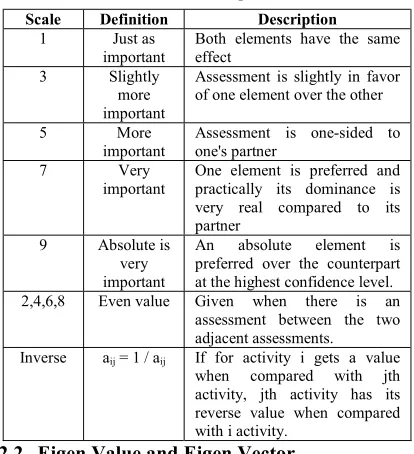
[image:3.612.314.521.265.492.2]Priority setting is an important part of the AHP phase. In this section is determined the scale of interest of an element against other elements. The first step in setting priorities is to set up pairwise comparisons, comparing in pairs of each hierarchical sub-system. The comparison is then transformed into an nxn matrix. Comparisons were made using the comparison scale in Table 1 by Saaty [5].
Table 1. Pairwise Comparison Scale
Scale Definition Description
1 Just as
important
Both elements have the same effect
3 Slightly
more important
Assessment is slightly in favor of one element over the other
5 More
important
Assessment is one-sided to one's partner
7 Very
important
One element is preferred and practically its dominance is very real compared to its partner
9 Absolute is
very important
An absolute element is
preferred over the counterpart at the highest confidence level.
2,4,6,8 Even value Given when there is an
assessment between the two adjacent assessments. Inverse aij = 1 / aij If for activity i gets a value
when compared with jth activity, jth activity has its reverse value when compared with i activity.
2.2 Eigen Value and Eigen Vector
The consideration A = (aij) is a matrix whose
elements aij, where i denotes the ith row and j
denotes the column of j from A, where i, j = 1, 2, ..., n . According to Anton [24], to find the eigenvalues of A can be done by:
(1) The equation (1) has a solution if and only if:
(2)
The equation (2) is called the characteristic equation for A and has n characteristic roots, denoted by , i = 1, 2, ..., n, which is called the eigen value of A. The values of which satisfy the equation (1) is referred to as the eigenvector of A.
22 largest eigen value is expressed by , as expressed in equation (3) as follows:
(3)
In the matrix with dimension n x n, for all i obtained as follows:
, for i, j = 1, 2, ..., n
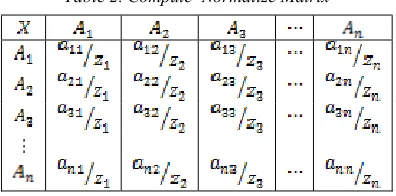
Technically, to obtain the eigen vector is done by normalizing A first, so that . Normalization is done by dividing each entry with the sum of the column of the entry.
, for i, j = 1, 2, ..., n (4) where is the sum of entries in the jth column, as
[image:4.612.88.299.95.241.2]for how to normalize the matrix can be described as in Table 2.
Table 2. Compute Normalize Matrix
Once normalized, the elements of the columns are summed by row, so we get priority that shows the weight of the value of the criteria / sub criteria contained in the matrix. To obtain an eigenvector, the elements of each line are calculated average. Mathematically, the eigen vector element can be written as follows:
, for i = 1, 2, ..., n. (4) where is the priority criterion or sub-criterion or ith alternative in the row matrix. The priority value
of an alternative is obtained by summing all entries on a row. Suppose the ith priority value is indicated
by that is the sum of all entries on the ith row.
2.3 Logical Consistency
Assessment in comparing between one criterion and another is mutually independent, and this can lead to inconsistency. Saaty [5] has proved that the consistency index of the matrix with dimension n x n can be obtained by the formula:
(5)
A pairwise comparison matrix is consistent if the value of consistency ratio (CR) ≤ 10% (Saaty, 1994). A larger CR value of the criterion identifies inconsistencies, so it needs to be improved to obtain a consistent pairwise comparison matrix. CR value can be obtained with the following formula with Random consistency index (RI) value shown in Table 3 [7]:
(6)
Tabel 3. Random consistency index (RI)
n 1 2 3 4 5
RI 0.00 0.00 0.58 0.90 1.12
n 6 7 8 9 10
RI 1.24 1,32 1.41 1.45 1.49 If the value of CR is closer to zero means the value is better and shows the consistency of the pairwise comparison matrix.
2.4 Football Starting Lineup
Football is a game played by two teams where each team consists of 11 players. The eleven players chosen to play at the start of the game are called starting lineups. The eleven football players are divided into several positions in accordance with the functions and duties. In addition to the goalkeeper(gk), the players are divided into three main positions, defenders(df), midfielders(mf), and forward/strikers(st). Each major position is subdivided into several more specific positions according to the task and role in the field. For the defender is divided into central defender, wing back , and sweeper. The midfielder's position is divided into defensive midfielders, winger midfielders, central midfielders and attacking midfielders [25].
[image:4.612.96.294.364.462.2]23
Table 3. Criteria For Determining The Starting Lineup of U-21 Arema Cronus Academy
Criteria Sub Criteria
Physical Agility
Coordination Speed Endurance
Strength
Technical Non
Goalkeeper
Goalkeeper
Dribbling Catching
Ball Control Body Shape
Short Passing Diving
Long Passing Foot Work
Shooting On Ball
Heading Under Ball
Side Ball Straight Thigh Ball
Tactical Use of Space
Positional Play Group Tactics
Mental Independence
Maturity
According to Coach Bastian, the technique factor is most emphasized for players in the young age range, including U-21. The next factor chosen after the technique factor is the physical factor of the players because the physical players in the young age range can still be improved and adjusted as needed. Subsequent factors are sequentially mental and player tactics.
3. DATA AND METHOD
3.1 Data Source
The data used in this study is the primary data obtained from interviews with related parties namely the coach Arema Cronus Academy, Indonesia. The criteria in determining the selection of players in Arema Academy is divided into two groups: goalkeeper and non-goalkeeper player. Criteria that become the reference in determining the selection of the starting lineup of players is divided into physical, technical, tactical and mental criteria, where each of these criteria has several sub criteria.
3.1.1 Physical Criteria
[image:5.612.313.519.135.302.2]Assessment for physical players criteria can be seen as in Table 4.
Table 4. Physical Assessment Criteria
No. Assessment
Criteria Description
1 Agility The ability to change direction
runs fast and balanced
2 Coordination The ability to harmonize
movements in harmony
(harmony of motion)
3 Speed Ability to travel a distance as
efficiently as possible
4 Endurance The body's ability to overcome
fatigue for as long as possible
5 Strength The ability of the body to
generate voltage against a certain load
3.1.2 Technical Criteria
Assessment for player techniques criteria for non goalkeepr can be seen as in Table 5.
Table 5. Technical Assessment Criteria For Non Goalkeeper
No. Assessment
Criteria
Description
1 Dribbling Ability to master variations of
dribbling technique
2 Ball Control Ability to master variations of
ball control techniques
3 Short Passing Ability to master variations of
short pass feedback techniques
4 Long Passing Ability to master variations of
techniques pass gastric bait
5 Shooting Ability to master variations of
technique shoot the ball towards the goal
6 Heading Ability to master variations of
ball technique
While the assessment for goalkeeper techniques criteria can be seen as in Table 6.
Table 6. Technical Assessment Criteria for Goalkeeper
No. Assessment
Criteria
Description
1 Catching The ability of the technique to
catch the ball
2 Body Shape Ability to position the body before
catching the ball
3 Diving The ability of the technique to
drop
4 Foot work Ability to regulate foot work
techniques / footwork
5 Set and go Ability always ready to face the
speed of the ball
6 On ball Ability to catch the upper Balls
7 Under ball Ability to catch the bottom Balls
8 Side ball Capability in capturing Side balls
9 Straight thigh
ball
[image:5.612.315.522.355.501.2] [image:5.612.315.520.548.712.2]24
3.1.3 Tactical Criteria
[image:6.612.93.295.151.274.2]Assessment for player tactics criteria can be seen as in Table 7.
Table 7. Assessment of Player Tactics Criteria
No Assessment
Criteria Description
1 Use of Space Ability to use space to score
goals
2 Positional Play Ability to understand tasks
and functions in certain playing positions
3 Group Tactics Ability to understand team
tactics both when defending and attacking
3.1.4 Mental Criteria
Assessment for player mental criteria can be seen in two aspects that are both independence and maturity.
3.2 Research Method
The steps taken in this research are as follows:
1. Define the problem and determine the desired solution, then compile the hierarchy of the problems encountered. The preparation of the hierarchy is to set goals that are the overall target of the system at a limited level.
2. Determining the priority of the elements. The first step in determining the priority of the elements is to make a pair comparison, ie comparing the elements in pairs according to given criteria. A pairwise comparison matrix is filled with numbers to represent the relative importance of an element against other elements.
3. Give consideration to matched paired comparison matrices to obtain overall priority. The things done in this step are:
a. Sums the values of each column in pairwisecomparison matrices
b. Dividing each entry from a matrix column of pairs in pairs to the total of the corresponding columns to obtain a normalized matrix.
c. Sums the values of each row of the normalized matrix and divides it by the number of elements to get the average value of the priority value
4. Test consistency on pairwise matrices. In making decisions it is necessary to know how well the consistency of pairwise matrices is matched, since it is not desirable to draw decisions based on consideration with low consistency. Things to do in this step are a. Multiply each entry in the matrix column
with Priority Value.
b. Sums the entry of each row of the matrix to get .
4. Computes consistency index (CI) 5. Computes consistency ratio (CR)
6. Check the consistency ratio, if the value is more than 10%, then the value assignment to the data based on judgment must be corrected. However, if the consistency ratio is less than or equal to 0.1, then the calculation result can be stated correctly.
7. Develop a system for starting lineup selection based on step 3 to step 7
8. Incorporating physical, tehnique, tactical, and mental data into the system database.
9. Displays the starting lineup based on the system that has been built in step 8.
3.3 Data Flow Diagram Level Two
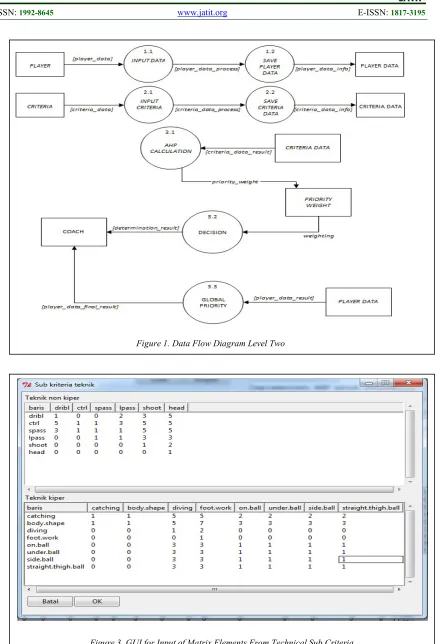
The system for the starting lineup selection of football players is built using software R with attention to the stages of developing a standard system. There is a Figure 1, which is part of system design that is data flow diagram (DFD) at level 2 which explain the following informations:
1. The input process of the data player that describes the flow of data in the process of inputing and storing data in the form of pairwise matrices comparation into the database players. 2. The process of input data criteria that describes
the input and save process from pairwise matrices on criteria and sub criteria of each player into the database criteria.
3. The process of determining the starting lineup player that describes the stages of the computation process in AHP.
4. RESULTS AND DISCUSSION
25
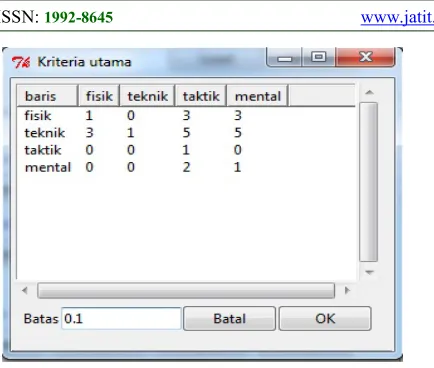
Figure 2. GUI to Input The Main Criteria Matrix
The pairwise comparison matrix between the criteria is worth between 0 and 9, where the value is derived based on the preferences of the related party. A matrix element of value 0 has actual value as the inverse of element i or j corresponding to a 1/n value which will automatically be calculated by the system, then from pairwise comparison matrix is calculated priority value which is weight value from each criteria as can be seen in Table 8.
Table 8. Priority Value of Main Creteria
Criteria Physical Technical PriorityValue 0.249 0.550
Criteria Tactics Mentally PriorityValue 0.083 0.118
Table 8 exposed that the technical criteria has the greatest priority value of 0.55 which means that the technical criteria is the most important criteria in determining a player's rank, and the next criteria are physical, mental and tactical respectively.
The button is named “batas” in figure 2, to know the consistency of the comparison matrix at the critical point specified by the user. Suppose the user uses a critical value of 0.1, then this value is called the consistency ratio (CR) in which the comparison matrix is said to be consistent if the value of the consistency ratio (CR) ≤ 10%.
The calculation of the consistency value of Priority value is done by finding the value of Eigen Vector ( ) as follows
then calculated Consistency Index (CI) and Consistency Ratio (CR) value as follows
because the CR value <10% then the pairwise comparison matrix formed is consistent and can be used as the basis for AHP calculations.
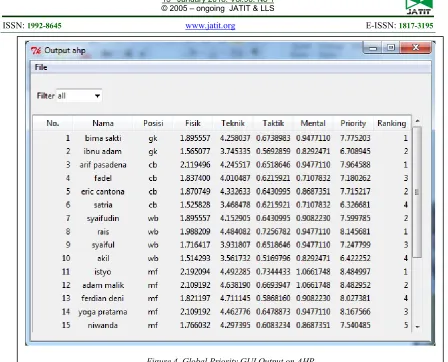
The interface to input elements from the matrix of pairwise comparison between sub criteria on each criteria also made GUI respectively. The GUI on the technical criteria is presented in Figure 3 which is a GUI for inputting elements of a pairwise comparison matrix for technical criteria, by comparing the sub-criteria present in the technical criteria. The GUI on these criteria includes techniques for non goalkeeper and goalkeeper players. The matrix element containing 0 (zero) has the actual value of the inverse value of the matrix element i or j corresponding to the 1 / n value which will automatically be calculated by the system. Based on paired comparison matrix that has been input to the system, then system automatically calculate priority value between sub criteria. For example the priority value of technical criteria for goalkeeper and non goalkeeper players is presented in Table 9 and Table 10 respectively.
Table 9. Priority Value Non Goalkeeper Technical Criteria
[image:7.612.325.515.520.578.2]Technique Dribl B. Ctrl S.Pass Prty.Value 0.16 0.34 0.26 Technique L.Pass Shoot Head Prty. Value 0.15 0.06 0.04
Table 10. Priority Value Technical Criteria for Goalkeeper
Technique Catch Body Dive work Prty. Value 0.22 0.28 0.04 0.04 Technique On
ball
Und. ball
Side ball
S.T ball Prty. Value 0.11 0.11 0.11 0.11
Based on table 8, the sub criteria of the ball control has the highest priority for non goalkeeper player with priority value of 34%, while for goalkeeper body shape sub criteria is the main priority with priority value = 0.28, followed by sub criteria ability to catch the ball where the two sub criteria have a total priority value of 50% as shown in table 10.
4.2 The AHP Computation Result
26 menu on the main menu of the system, then Output. The AHP output display also comes with several attributes ie player name, team position, priority value of each main criterion, and the player's ranking in the position shown in Figure 4.
Based on Figure 4, the AHP calculation results for each criteria between players with the priority value as a reference in determining the player's rank in each position. The filter menu can be used to display the ranking of players grouped by position as shown in Figure 5.
As an illustration, the contents on the Filter menu are filled with gk (goalkeeper) as shown in Figure 5, then the system will display the player rank in goalkeeper position based on AHP calculation result.
4.3 System Hierarchy for Selection of Starting Lineup
The hierarchical groove formed is the representation of the system for the selection of the starting lineup of football players in a multilevel structure, where the first level is the goal followed by the level of the criterion factor to the sub criteria. The system hierarchy is presented in Figure 6.
Based on the Figure 6 can be retrieved information as a reference in the selection of the starting lineup of football players from the criteria level to sub-criteria. Determination of players based on criteria with the biggest weight to the smallest of technical(0.55), physical(0.25), mental(0.08) and tactical(0.12) criteria successively. The joint of technical and physical criteria have proportion 0.80 weight in determination player who selected as starting lineup. Determination of the most important weight of each criterion is presented in sub-criteria level. The order of priority of player selection based on sub criteria can be seen in the above figure complete along with their respective priority order and the weight value.
4.4 The Composition of Starting Lineup
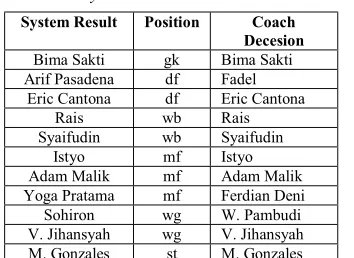
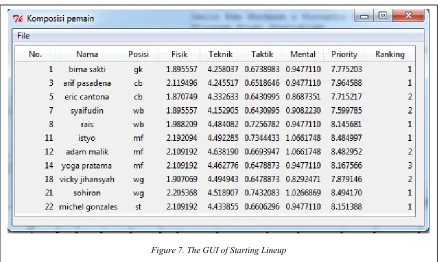
In this system, the selection of the starting lineup of football players can be done by selecting the AHP menu and then click Composition. The system will display the players who have the top rank of each position to be selected as the starting lineup as shown in Figure 7.
Based on Figure 7 can be seen the results of the system for the selection of the starting lineup of football players at the Academy Arema Cronus,
Indonesia. The Starting Lineup provides the top 11 players in each position. The composition of player selection based on its position are: 1
gk(goalkeeper),4 defenders( 2 df and 2 wb), 3mf (midfielder ), and 3 forward (2 wg, and 1st).
[image:8.612.332.509.228.357.2]A comparison between system output and starting lineup result decided by the coach is presented in Table 10 belows:
Table 10. Comparison of Starting Lineup between system result and coach decision
System Result Position Coach
Decesion
Bima Sakti gk Bima Sakti
Arif Pasadena df Fadel
Eric Cantona df Eric Cantona
Rais wb Rais
Syaifudin wb Syaifudin
Istyo mf Istyo
Adam Malik mf Adam Malik
Yoga Pratama mf Ferdian Deni
Sohiron wg W. Pambudi
V. Jihansyah wg V. Jihansyah
M. Gonzales st M. Gonzales
It can be seen based on the comparison in Table 10 that there are some differences in the players selected by the coach as the starting lineup. In the defender position, there is one player that does not fit, in the midfielder’s position there is also a different player, while in the forward position there is a difference of two players. The difference of some players based on the results of interviews with the coach is due to the players are in a condition that is not prime or in a condition of injury. Thus, in order for players selected as starting lineup by the coach the same or almost the same as the starting lineup produced by the system then some external factors of players such as the current condition of players' health must be included as criteria in the system.
5. CONCLUSION
Based on the results of the analysis and discussion can be drawn the following conclusions: 1. The system has been successfully developed to
select the starting lineup of football players based on the AHP method that can assist the Coach team in providing rational and measurable reasons for the management and the group of supporters to the decision on the selection of the starting lineup they took. 2. The both factor of technical ability and
27 have a great contribution for the player to be selected as a starting lineup player.
To get a better system, then in the next research to notify several considerations include:
Adding new criteria as weighting in the calculation of player rankings, such as statistical performance data play each player and the location of the game.
Build a dynamic system that can add or subtract criteria that can be adapted to the environment and the atmosphere of the game.
REFRENCES:
[1]
P. Guenzi and D. Ruta. Leading teams: Tools and techniques for successful team leadership from the sports world. San Francisco, CA: Jossey-Bass. (2013).
[2] P. Shockley-Zalabak. Fundamentals of organizational communication:Knowledge, sensitivity, skills, values (3rd ed.). White Plains, NY: Longman Publishers. (1995). [3] C. Baraldi. “Forms of decision making:
Gatekeeping and dialogic coordination in CISV organizational meetings”. Journal of
Business Communication, 50. (2013):339-361.
[4] L. Kidman. Athlete-centered coaching: Developing decision makers. Worcester, UK: Innovative Print Communications. (2010). [5] TL. Saaty. Fundamentals of decision making
and priority theory with the analytic hierarchy process, Vol. VI. Universitas Pittsburgh. USA (1994).
[6] A. Akgun. "A comparison of landslide susceptibility maps produced by logistic regression, multi-criteria decision, and likelihood ratio methods: a case study at İzmir, Turkey". Landslides 9.1 (2012): 93-106.
[7] TL. Saaty. Decision making for leaders: The analytical hierarchy process for decisions in a
complex world. Pittsburgh, PA: RWS
Publications. (1999).
[8] TL. Saaty. "Decision making with the analytic hierarchy process" . International journal of services sciences 1.1 (2008): 83-98.
[9] MM. Akarte, et al. "Web based casting supplier evaluation using analytical hierarchy process". Journal of the Operational Research Society (2001): 511-522.
[10] R. Handfield, et al. "Applying environmental criteria to supplier assessment: A study in the application of the Analytical Hierarchy
Process". European journal of operational research 141.1 (2002): 70-87.
[11] CF. Chen. "Applying the analytical hierarchy process (AHP) approach to convention site selection." Journal of Travel Research 45.2 (2006): 167-174.
[12] IM. Mahdi and K. Alreshaid. "Decision support system for selecting the proper project delivery method using analytical hierarchy process (AHP)". International Journal of
Project Management 23.7 (2005): 564-572.
[13] O. Marinoni. "Implementation of the analytical hierarchy process with VBA in ArcGIS". Computers & Geosciences 30.6 (2004): 637-646.
[14] A.Yalcin. "GIS-based landslide susceptibility mapping using analytical hierarchy process and bivariate statistics in Ardesen (Turkey): comparisons of results and confirmations." Catena 72.1 (2008): 1-12.
[15] A.Yalcin, et al. "A GIS-based comparative study of frequency ratio, analytical hierarchy process, bivariate statistics and logistics regression methods for landslide susceptibility mapping in Trabzon, NE Turkey". Catena 85.3 (2011): 274-287.
[16] P. Kayastha, MR. Dhital, and FD. Smedt. "Application of the analytical hierarchy process (AHP) for landslide susceptibility mapping: a case study from the Tinau watershed, west Nepal". Computers & Geosciences 52 (2013): 398-408.
[17] S. Park, et al. "Landslide susceptibility mapping using frequency ratio, analytic hierarchy process, logistic regression, and artificial neural network methods at the Inje area, Korea". Environmental earth sciences 68.5 (2013): 1443-1464.
[18] J. Feng et al. "Dynamic assessment of forest resources quality at the provincial level using AHP and cluster analysis". Computers and Electronics in Agriculture 124 (2016): 184-193.
[19] AR. Laddha, RR. Joshi, and P. Mulay.
"ENRICHING PROCESS OF ICE-CREAM
RECOMMENDATION USING
COMBINATORIAL RANKING OF AHP AND MONTE CARLO AHP". Journal of
Theoretical and Applied Information
Technology 85.3 (2016): 298-304.
[20] AA. Vakulenko, and DA. Sytnik.
"INTERACTIVE VISUALIZATION OF
MULTI-DIMENSIONAL DATA ON
28 OBJECTS IN THE DECISION SUPPORT
SYSTEMS FOR SOLVING
MULTICRITERIA CHOICE PROBLEM".
Journal of Theoretical and Applied
Information Technology 81.3 (2015): 453-465.
[21] F. Irhamni, BK. Khotimah, and D.
Rahmawati. "IMPROVEMENT
INTEGRATED PERFORMANCE
MEASUREMENT SYSTEM (IPMS) FOR SMALL AND MEDIUM ENTERPRISE
IMPACT OF INFORMATION
TECHNOLOGY". Journal of Theoretical and Applied Information Technology 95.2 (2017): 319-327.
[22] Y. Liu, Z. Li, and H. Yang. "Volleyball Athlete’s Selection Index Weight Based on Analytic Hierarchy Process Consistency Check". Journal of Computational and Theoretical Nanoscience 13.12 (2016): 9979-9982.
[23] C. Chang . "Based on Analytic Hierarchy Process Model of Big Data Analysis of the NBA Schedule Impact on Team Ranking" . Journal of Computational and Theoretical
Nanoscience 13.12 (2016): 10001-10005.
[24] H. Anton. Linear Algebra Elementer. Edition 5. Translation by P. Silaban and N. Susila. Erlangga Jakarta.(1995).
29 .
Figure 1. Data Flow Diagram Level Two
[image:11.612.96.534.66.710.2]
30
Figure 4. Global Priority GUI Output on AHP
31
Figure 7.The Hierarchy Diagram For Starting Lineup
[image:13.612.80.518.454.716.2]