Journal of Theoretical and Applied Information Technology 15th May 2017. Vol.95. No 9
© 2005 – ongoing JATIT & LLS
ISSN: 1992-8645 www.jatit.org E-ISSN: 1817-3195
MATHEMATICAL MODELING AND SIMULATION
MECHANISM OF GENETICS BEHAVIOR TOGETHER
WITH NEURAL FUZZY SYSTEM
RAED I. HAMED
College of Science and Technology, University of Human Development, Department of IT Sulaymaniyah, KRG, Iraq, E-mail: [email protected]
ABSTRACT
Many studies have used different types of mathematical modeling and simulation in solving examination genetics behavior problem. The solutions of the genetics behavior are found to be efficient and reliable with neural fuzzy system. This paper provides a comprehensive study of genetics behavior problem. This study is frequently robust or even difficult to get accurate information regarding genetics behavior. Here, we exhibit a model of quantitative fuzzy rationale demonstrating approach that can adapt to obscure motor information and hence deliver applicable results despite the fact that dynamic information are fragmented or just dubiously characterized. Fuzzy Petri nets (FPNs) gives a graphically and scientific system that is good with ineffectively quantitative yet subjectively huge information. All of genes regulatory networks (GRNs) quests depend on fresh and parametric qualities, in spite of innate fuzzy nature of quality expression. In the proposed display, a quality expression profile is initially changed into a mapping structure and afterward the changed information are mapped into the fuzzy framework. The models of FNPN are characterized in view of creating tenets of information base and the FPN semantics depiction of legitimate principles are displayed. Since the relations are spoken to by fuzzy method, the invented strategy is powerful to uproarious and questionable data. FNPN to speak to the dynamic information on the base of learning representation with self-learning capacity.
Keywords: Mathematical Modeling and Simulation; Fuzzy Model and Fuzzy Sets; Genetics Behavior; Neural Network, Linguistic Variables.
1. INTRODUCTION
With the development of GRNs are regularly portrayed as system models where the conditions between qualities are delineated by a coordinated chart, whose hubs speak to qualities and edges lead from a controller frequently an interpretation variables to its travels. A noteworthy test of demonstrating organic frameworks is that ordinary techniques in view of physical and substance standards require information that is hard to precisely and reliably get utilizing either customary biochemical or high throughput innovations, which commonly yield boisterous, semi-quantitative information (frequently as far as a proportion as opposed to a physical amount) [1]. Demonstrating and reenactment of quality administrative systems turns into a promising section of bioinformatics in the post-genomic time. Different sorts of models have been contemplated to express P1ne administrative systems, for example, differential conditions [2, 3], Boolean systems [4, 5], Petri Nets [6, 7, 8], Bayesian systems [9] and counterfeit neural systems [10, 11].
However, we have seen that the Petri nets hypothesis are important with regards to quality expression level displaying and recreation. Monika [12] portrayed six points of interest of utilizing PNs as a sort of umbrella formalism
for frameworks and manufactured science, Intuitive strategy and executable displaying style, genuine simultaneousness component, that can be decreased to between leaving semantics to streamline investigations, scientifically established examination systems in view of formal semantics, proselytes of auxiliary and behavioral properties and also their relations,
However these advantages are essential to coordinate the improvement of models and displaying approaches to concentrate the organic frameworks. While the reality of the matter is that Petri nets can be displayed and reenacted the natural frameworks, it is turning out to be progressively evident this may not be the whole right.
level of microarray informational indexes are frequently difficult to translate and temperamental because of the absence of enough examples. The capacity of coordinating microarray informational indexes is turning out to be critical and sought by bioinformatics analysts to gauge more dependable gene expression level with factually powerful models. Therefore, new techniques should be created to manage gene expression level measuring. While trying to discover new applications and invigorate new research subjects, analysts joined fuzzy hypothesis and the fundamental PN to shape another model and characterize the related operations of FPN. FPN has effective ability when utilized for handling parallel data and has the attributes of simultaneous working capacity. FPN model is anything but difficult to make and its diagram expression is likewise straightforward, the graphical viewpoint makes it simpler to speak to the diverse collaborations between discrete occasions, the scientific angle takes into account the formal demonstrating of these associations and examination of the properties of the displayed framework. It is in this way an appropriate and helpful displaying device.
Utilizing FPNs to demonstrate fuzzy base thinking gives several advantaP1s [13, 14, 15]: graphically representation can help specialists to develop and adjust fuzzy base. Dispenses with the need to output every one of the tenets, in any case it can improve the effectiveness of fuzzy base thinking by utilizing moves and bends to interface fuzzy standards as a net structure. FPNs' investigative capacity can assist us with checking properties of a demonstrated framework to increase further bits of knowledge into the framework.
In our model FNPN has both the dynamic capacity and the learning capacity, it requires the dynamic frameworks to be portrayed with weighted Fuzzy generation rules (WFPR). In real element frameworks, dynamic information speaks to the truths, not the creation rules. Whatever remains of the paper is composed as takes after: in Section 2, we clarified the scientific model with PN, in Section 3, portrayed the ideas of fuzzy neural Petri net and in the Section 4 we depict the ideas of quality expression levels. In segment 5, we propose the deduction procedure utilizing FPN display and the derivation calculation.
In segment 6, we propose the fuzzy set, in segment 7, we propose the FNPN demonstrate for quality expression levels and talked about trial result lastly, and section 8 contains closing comments.
2. PN MODEL OF MATHEMATICAL
FUNCTIONS
In this section we want to explain the mathematical modeling through the PN modeling method. Consider the PN of Fig.1 S and P are the concept of inputs and outputs, respectively that represent the concentrations of the individual reactants. The transition v represents the firing speed. The input place for v is S and the output place is P. However, in this model v represents Michaelis-Menten reactions as firing speed. S has concentration equal to 10 as the initial value, and the concentration of P is 0. Note that this concentration represents tokens. The arc weight from the input place S to transition v is 0.1, w(S, v) = 0.1. If |S.tokens| > w(S, v), the algorithm will iterate over the first w(S, v) tokens in S.tokens, and the transition v can be enabled to fire.
In organic chemistry, the most regularly utilized expression that relates the protein catalyzed development rate of the item to the substrate focus is the Michaelis-Menten condition, which is given as
]
[
]
.[
max
S
K
S
V
v
m
+
=
1where [S] is the substance fixation, Vmax is the greatest response speed, and Km is a Michaelis steady. In our illustration, we let Vmax = 1 and Km
= 1. The Michaelis-Menten condition is utilized for speaking to the terminating rates of the move v. For our case, let [S] and [P] be the substance of nonstop places S and P, separately. v is a constant move whose terminating pace is given by the capacity (chemical response speed). It fires under the condition [S] > 0.1 and [S] will be diminished and [P] will be expanded with the speed v, i.e.
]
[
]
.[
]
[
]
[
maxS
K
S
V
dt
P
d
dt
S
d
m
+
=
=
−
2
Suppose that the value of
V
max= 1and
K
m= 1, for these values the behavior of continuous concepts for two entities of S and Pexplained in Fig 2 of its simulation results. However, performs simulations using the HFPN algorithm the curves show the amount of P and S
over time, where the amount of P bound to S
Figure 1: HFPN model of Michaelis-Menten’s equation
Figure 2: Michaelis-Menten Simulation of Mathematical Function
The constructed HFPN model of Michaelis-Menten equation was simulated by using P1nomic object net tool.
To make the model clear we are going to explain new example. Depending on early definition of PN as a mathematically tool applicable to many problems. We used ODE of Hill functions were used to model the reaction kinetics between P1nes. Consider the PN of Fig. 3 S and P are the two places, respectively of PN that represent the concentrations of the individual reactants. For this example, let the two states are [S] and [P] be the values of continuous genes S and P, respectively.
T1 and T2 are continuous transitions whose firing process is given by the following function as follows:
]
[
)
]
([
])
[
(
1
11 1 1
S
K
S
P
v
T
−
×
+
×
+
=
α
µ
3]
[
)
]
([
])
[
(
2
22 2 2
P
K
P
S
v
T
−
×
+
×
+
=
α
µ
4Here, µ1, and µ2 are the first-order rate constants of degradation of S and P respectively. v1 and v2 denote the constant rate of expression of S and P in environment. The term
ni i i
i
G
K
v
+
5is Hill term describes the formation of gene j is activated by P1ne i with maximal rate vi,
Dissociation constant Ki, and Hill coefficient ni.
The variable α is an empirically chosen number with 0 < α < 1. However, this model describes interaction of two P1nes S and P (i.e. Gi), S
activates P, and P activates S. The value of entity S, i.e. [S], decreases while the value of entity P, i.e. [P], increases during the simulation.
There are some parameters: µ1, µ2 , v1, v2 , K1,
K2, α1, and α2 derived from Hill equations. These parameters strongly influence the behavior of the resulting P1ne regulatory network. We used the PN algorithm to simulate the model to P1t a description of P1ne regulatory network model.
Figure 3: PN Model of Hill Functions Mathematical Function
In our example we set the parameters; µ1= µ2 =K1 =
K2 = 0.5; α1 = α2 = 0.2; v1 = v2 = 0.1. The initial value of S is 5, and P is 0. For these values Fig 4 illustrates simulation results of the PN model that
Figure 4: Hill Functions Simulation of Mathematical Function
can be used to compute the firing speed of the continuous transitions T1 and T2 and describes the behavior of continuous places S and P, where the concentration of each place will change over time.
3. DEFINITION OF FUZZY NEURAL
PETRI NETS
[image:3.612.323.507.234.375.2] [image:3.612.327.515.466.568.2]certainties, and in addition comes about acquired through differential condition models.
The constructed model of regulation of the
rrn gene and protein Fis was simulated by using genomic object net tool. In request to catch more points of interest of planning hereditary instrument, many creators have created FPNs, for instance, 8-tuple [15], 13-8-tuple [16], and 9-8-tuple [14]. The fluffy Petri net structure can be characterized as a 10-tuple:
FPNs = (T, P, D, O, I, f, α, β, λ) where
o P = {pl, p2 , ..., pn} is a finite set of places, o T = {tl, t2 , ..., tn} is a finite set of transitions, o D = {d1, d2 , ..., dn} is a finite set of
propositions,
o I : is an input incidence matrix; O: is an
output incidence matrix;
o f = {µ1, µ2 ,..., µm} where µi denotes the
certainty factor µi
∈
[0,1];o α : P→ [0,1] is the function which assigns a token value,
o β : P → D is an association function, value
from places to propositions.
o λ : T→ [0, 1] is the function which assigns a threshold value λi between (0-1) to a transition ti;
Via deliberately interfacing related place and allocating sensible estimations of sureness variables to moves, we can think of a fluffy Petri net that can settle on choice in light of the aptitude we gave it amid its development. To clarify the calculation with neuron fluffy framework self-learning of neurons in FNPN, BP based self-learning calculation [17] can be utilized to modify the relating parameters. Assume the FNPN model to be examined is n-layered with b finishing places pj, where j=1, 2,… ,b. What's more, r realizing tests are utilized to track the FNPN display. The execution assessment capacity is characterized as the accompanying:
2
))
(
)
(
(
1 2 ' 1∑
∑
= =−
=
b j j i j i r ip
M
p
M
E
6Where Mi(pj) and Mi′(pj) speak to the genuine checking esteem and the normal one of the closure put pj individually. Assume ti(n) is one move on the nth layer ti (n)∈Tn. The weights of the relating
input curves are ωi1(n), ωi2(n),… ,ωim(n). The weights can be balanced as the accompanying:
) ( ) ( ) ( ) (
))
(
(
n ix j n n n ixdw
p
M
d
dw
dE
×
=
δ
x = 1, 2, …,m-1. 7
))
(
(
( ) ) ( j n np
M
d
dE
=
δ
8The altering calculation of the weight parameters of the move of ti (q) can be got as the accompanying:
) ( ) ( ) (
/
)
(
)
1
(
ixq ixqq
ix
k
w
k
dE
dw
w
+
=
−
η
9Where x = 1, 2, 3, … ,m, q = n, … , 1 and
∑
(q)ix
w
= 1. In the above conditions, η is the learning rate. The altering calculations of the limit λi(n) and reality μi(n) esteem claims comparativetypes of the weight ωix(n).
3.1 The Properties of pre-set and post-set: 1) Pre-concept: ∀x∈T∪P, •x ={y| (y,x) ∈F} is
named the pre- set of x ;
2) Post-concept: ∀x∈T∪P, x• ={z| (x,z) ∈F} is
named the post-set of x ;
A. Incidence Matrix of both I and O:
Expecting that there are m places, n moves in the FPN, we have
1) I incidence matrix Im×n:
I = (aij) m×n
(i = 1,2,…..,m; j=1,2,….,n ) where
1 pi∈•tj & pi
∉
t•jaij =
0 others 10
aij = 1 there is a relation between pi to tj;
aij = 0 there is no a relation between pi to tj;
2) O incidence matrix Om×n:
O = (bij) m×n
(i = 1,2,…..,m; j=1,2,….,n ) where
1 pi∈t
•
j & pi
∉
•tj
bij =
0 others 11
bij = 0 there is no a relation between tj to pi;
3.2 Transition Concept of Firing
The entangled in fuzzy unraveling through a FPN is to decide the arrangement of move terminating. A move can be fire under the condition that the degrees of reality of all its info spots are not nulls and more noteworthy than certain limit values. We take after the normal terminating guideline in [15]. The level of truth of a yield place is equivalent to the base of the degrees of the info places increasing the assurance element of the move. When move tj meets its terminating conditions, the degrees of truth of the spots under the state stamping M(k) are figured by:
Min { M (k) (•tj) } × uj M (k) (pi) =
M (k) (pi) 12
M(pi) meant the level of truth of the pi under the state stamping M(k); k signified the seasons of cycle; uj meant the assurance consider (CF) of the jth run the show. Terminating fluffy creation guidelines can be considered as terminating moves.
4. AN EXAMPLE OF EXPRESSION
VALUES
By and large, a quality systems can be communicated by an arrangement of nonlinear differential conditions with each P1ne expression level as factors. The exactness of this plan relies on upon the precision of the information as far as fixations, rate constants, and expression levels [18]. The expression level of quality at time moment t+1 is given by
))
(
(
)
1
(
ti
f
x
ti
x
i+
=
i 13where is the concept of this gene level (mRNA focus) of quality i at time moment ti+1, y(k) is the vector of expression levels of all P1nes at time moment ,fi is the capacity that decides the expression level of quality from the past expression estimations of all qualities. Take note of that the capacity fi is static, without changing amid reproduction. With the vector that holds estimations of all qualities is the factors of the capacity fi, it takes practically speaking just the qualities that control the quality. By and large, the expression work fi utilizes just several's qualities. For example, the expression capacity of the quality 3 in Fig. 5 is
))
(
(
3x
t
f
≡f
3(
x
2(
t
),
x
1(
t
))
14 [image:5.612.353.484.194.303.2]as the quality 3 gets control from quality 1, and quality 2. Notwithstanding, this model demonstrates that the expression level of quality 3 is specifically impacted be expression estimations of quality 1 and quality 2.
Figure 5: General Diagram Model of GRN
We can get mRNA convergences of quality xi(ti) at time ti, however don't have the foggiest idea about the outflow of fi(y(k)) ,i.e., we don't have the foggiest idea about the communication connection between quality xi(ti). To concentrate the P1netic administrative system, we ought to acquire the outflow of fi(y(k)), as indicated by the microarray information. Truth be told, it is difficult to locate the correct fi(y(k)). In any case, many individuals have turned out to be mindful that this present reality is not direct quadratic and that numerous circumstances can not be demonstrated precisely by numerically tractable conditions [19]. Consolidating with Petri net and learning representation, a FPN can be utilized to portray fuzzy creating decides that can be taken as standards of fuzzy connections between two recommendations [20, 21]. So we will build a fluffy framework as per the microarray information in various time focuses, and make the fuzzy framework all inclusive rough of fi(y(k)).
Microarrays depend on the possibility that, in each cell, at each states, just a small amount of the aggregate DNA is deciphered into mRNA, which is along these lines converted into protein, the made an interpretation of gene is said to be communicated. In general, depicting the expression level of gene is loose.
element is separated equitably, so that each fuzzy set has an equivalent support. The primary condition can be seen as takes after:
)
(
)
(
)
(
)
(
)
(
1 1 j i i j j j i j i ji
f
x
y
t
t
t
t
x
t
x
t
x
=
=
−
−
=
+ + • 15For the value of data, the inputs of is y(k) = (x1(t),
x2(t), …, xn(t)), the results is y = (f(x1), … , f(xn)).
For the different genes xi, these values (gene) as
follows x1(t1), x2(t2), …, xn(tn), where t1 < t2 < … <
tn.
5. THE INFERENCE SYSTEM MODEL
The Mamdani fuzzy derivation framework [22] was proposed as the primary endeavor to control a steam motor and kettle mix by an arrangement of etymological control rules got from experienced human administrators. The yield participation elements of Mamdani method which can consolidate etymological data into the model. The computational approach portrayed in this paper is Mamdani MFPN that can defeat the disadvantages particular to unadulterated Petri nets. Fuzzy models depicting dynamic procedures process the states y(k+1), at once moment ti+1, from the data of the information sources y(k) and u(ti), at time moment ti:
y(k+1) =f (y(k), u(ti)) 16
where f (•) is a fluffy model with the structure appeared in Fig. 2. In the information (Layer 1), as appeared in the following condition no figuring is done in this layer. Every hub, which relates to the information sources, y(k) and u(t), just transmits input an incentive to the following layer specifically. The assurance figure of the moves this layer is solidarity.
)
(
),
(
) 1 (t
u
t
x
O
=
17where y(k) and u(t) are the expression estimation of the ith P1ne at time moment t, and is the ith yield of layer 1. Hubs in (layer 2) are called input term hubs. Where the estimations of the information sources, y(k) and u(t), and the yields, y(k+1), can be appointed phonetic marks, e.g., `low-communicated' (L), `medium-communicated " (M), and `high-communicated " (H). The yield connection of layer 2, spoken to as the enrollment esteem, indicates how much the info esteem has a place with the individual name. Semantic standards can be defined that interface the etymological names for y(k) and u(t) through an IF-part, called a forerunner of a base and the THEN-part, likewise
called an ensuing of the base which decides the subsequent phonetic mark for y(k+1). The structure of a solitary base can subsequently be exhibited as takes after:
IF (y(k) is Ay(k)) AND(u(t) is Au) THEN (y(k+1) is Ax(k+1)) (13)
where Ay(k), Au(t), and Ay(k+1)are the linguistic labels
for y(k), u(t), and y(k+1), respectively, generated for the information focuses. The predecessor characterizes the condition, and the subsequent the conclusion which will be actualized if the condition is valid. The forerunner participation capacities are the enrollment capacities showing up in the IF-part of the base in layer 2 and the resulting participation capacities are the participation capacities showing up in the THEN-part in layer 4. As appeared in the accompanying condition, participation capacities are spoken to as Trapezoidal shape.
,
0
),
/(
)
(
1
),
/(
)
(
,
0
c
d
x
d
a
b
a
x
−
−
−
−
.
.
.
.
x
d
d
x
c
c
x
b
b
x
a
a
x
≤
≤
≤
≤
≤
≤
≤
≤
18=
) 2 (O
where µA alludes to how much x has a place with the phonetic name An and the parameters {a, b, c and d} (with a < b < c <d ) decide the x directions of the four corners of the fundamental trapezoidal enrollment work.
Places in (layer 3) are called base based hubs. A hub in this layer consolidates the precursor part of a fluffy base utilizing a T-standard operation. We utilize the AND operation on every base hub as least operation. The yield of every hub speaks to the terminating quality of the relating fluffy run the show.
Hubs in (layer 4) are called yield term hubs and this layer is known as the resulting layer. Every yield term hub speaks to a fluffy set got by fluffy Petri net structure. Diverse hubs in layer 3 might be associated with a same hub in this layer, implying that the same resulting is determined for various standards. The capacity of every yield term hub plays out the accompanying fuzzy OR operation:
∑
=
i it
O
(4) (4)In the accompanying condition, the image signifies the ith contribution of a hub in the fourth layer. To incorporate the terminated standards which have the same resulting part. The above fluffy OR operation is an adjusted limited aggregate operation in fluffy hypothesis.
Every hub in (layer 5) is called a yield semantic hub and compares to one yield phonetic variable. This layer plays out the de-fuzzification method. The hubs in this layer toP1ther with the connections appended to them achieve this undertaking. We have to locate the fresh yield of layer 5 by finding the "focal point of gravity" technique as the defuzzification utilizing the yield of the hub in layer 4:
∑
∑
=
i i
i i
i
O
y
O
O
(4)) 4 (
) 5 (
20
where the image indicates the hub yield in layer 4, and yi, is the focal point of the participation capacity of the term of the yield etymological variable. We apply the focal point of-gravity technique in light of the fact that the gathered ramifications brings about another fluffy yield set, while in reality we require a solitary fresh yield. Applying the most extreme operation to all the subsequent ramifications plays out the total. The semantic terms of information and yield hubs and the focuses of the participation elements of etymological terms ought to be effectively decided all together for the fluffy framework to deliver relating yields as per contributions to preparing information.
6. MEMBERSHIP FUNCTION OF GENS
VARIABLES AND FNPN ALGORITHM Utilizing the IF-THEN explanations, the estimation strategy for the FNPN model can be portrayed by the accompanying two stage handle: Determine the precursor recommendation: fuzzy participation capacities are utilized to decide the degree by which every forerunner (IF) "fires". Determine the ensuing recommendation: The "let go" consequents (THEN) are collected into forecasts for the yields. In this review, every estimation of information factors is standardized into a genuine number in the unit interim [0,1] the techniques to manage participation capacities must be connected the accompanying strict confinements: the MF estimation of every phonetic
name must be reciprocal, i.e., its entirety must be 1 in each purpose of the variable universe of talk (X):
,
X
x
∈
∀
∀
(
A
0,
A
1,...,
A
n)
∈
F
(
X
),
1
)
(
0
=
∑
=n
i
Ai
x
µ
21All phonetic terms must have a similar essential shape (Triangular, Trapezoidal, and so forth.), and their participation capacities must cross with their neighbors when µ = 1/5.
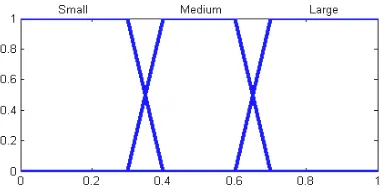
[image:7.612.313.522.375.559.2]For these enrollment capacities all together for mistake free remaking of all the conceivable numeric yield values in the information, absolutely trapezoidal MF utilized as a part of our issue. Before the above strides can be talked about in detail, the fuzzy participation capacity is examined. The info factors of the forerunner recommendation considered for the fuzzy run the show forerunner recommendation considered for the fuzzy base incorporate the y(k) and u(t). Any info esteem can be depicted through a blend of participation values in the etymological fuzzy sets.
Figure 6: Fuzzy Mechanism of Structure of Madman FPN
enrollment vector for the fluffy sets Small, Medium, and LarP1 comparing to fluffy y(k) is P1nerated and is given by:
Vy(k) = [μSmall_ y(k), μMedium_ y(k), μLarP1_ y(k)]T,
Similarly, u(t) is defined as: V u(t)= [μSmall_ u(t), μMedium_ u(t), μLarP1_ u(t)]T.
[image:8.612.95.289.267.363.2]Fuzzification comprises of characterizing the enrollment work for the information and yield and mapping from fresh information to fluffy participation. Trapezoidal participation elements of the fluffy factors, are appeared in Fig. 7. The initial phase in the FPN calculation is to "fuzzify" the gene expression va1ues as contribution of the factors.
Figure 7: MF of Trapezoidal Method of FPN Model
The model is utilized to display the quality expression levels basic leadership. In view of the FNPN interpretation standard, the basic leadership on quality expression levels can be mapped into the FNPN demonstrate as appeared in Fig. 8.
Base1: IF (P1=H) and (P2=M) and (P3=M) THEN Not effective,
Base2: IF (P1=H) and (P2=M) and (P3=H) THEN Not effective,
Base3: IF (P1=L) and (P2=L) and (P3=L) TEHN effective,
Base4: IF (P1=L) and (P2=L) and (P3=M) TEHN effective,
Base5: IF (P1=M) and (P2=L) and (P3=L) TEHN effective,
Base6: IF (P1=M) and (P2=L) and (P3=M) TEHN effective,
Base7: IF (P1=M) and (P2=M) and (P3=M) THEN effective,
Base8: IF (P1=M) and (P2=M) and (P3=M) THEN effective.
As shown in Fig. 8, we design a FNPN model as
FPN = (P, T, D, I, O, f, α, β, λ), where
P = { p1, p2 , p3 , p4 , p5 , ….. p15 , p16 , p17 , p18 }, T = { t1 , t2 , …. t7 , t8 },
Let d1, d2, d3, d4, d5, d6, d7, and d8 be 8 sections. We Assumed that the inference base system of a rule system contains set of rules as following:
Those tenets can be demonstrated by a FNPN appeared in Fig. 4. For the weights in FNPN demonstrate, the underlying weights can be set to a subjective esteem firstly, and after that the learning strategy for FNPN is utilized to prepare the model and the converP1d weights can be got. The genuine parameters of the FNPN model are set haphazardly, which likewise satisfy the weight prerequisites. The FNPN model is prepared on the base of 100 gatherings of testing information, where b=1000, η=0.03. After the model has been prepared, the fluffy thinking of P1ne expression levels choice is led on the base of the prepared FNPN. The real and expected thinking results are recorded in Table.1.
From Table.1, plainly the FNPN model can finish the fluffy thinking viably. From the genuine utilization of the proposed technique in this paper, contrasted and customary just additionally change the choice strategy through learning without anyone else's input. So the proposed
These outcomes are steady with known natural realities, and in addition comes about acquired through differential condition models.
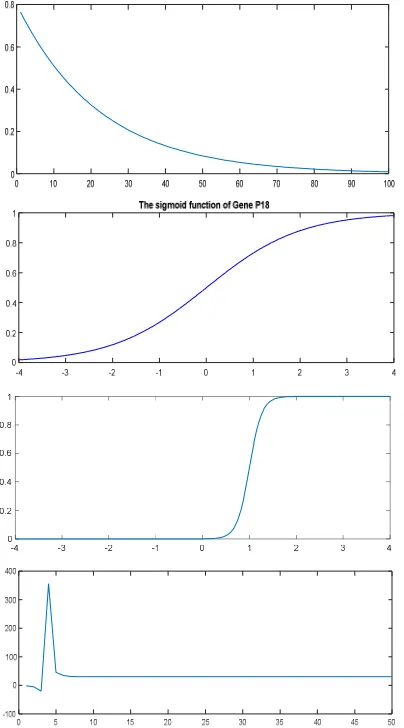
This figure demonstrates the action of the rrn promoter, and consequently the rate of amalgamation of stable RNAs, as a sigmoid connection of the cell grouping of protein Fis.
[image:8.612.313.521.505.666.2]Method manifests powerful advantages in making decision of gene values.
TABLE 1: THE ACTUAL OUTPUT AND THE EXPECTED OUTPUT OF THE FNPN MODEL
[image:9.612.92.287.147.246.2]We simulated our model with dynamics of protein concentrations are shown in Fig 9. The final result are equivalent with biological facts, together with the results got from differential equation methods. The built model of direction of the rrn gene and protein Fis was reenacted by utilizing matlab tool compartments.
Figure 9: Simulation Results Showing the Relation between Fis and S. RNA Gene Networks
7. CONCLUSIONS
In our paper the new application of FNPN modeling with mathematical functions to networks behaviors. The designed technique can be seen as an accumulation of fluffy tenets to portray the issue. The thought behind for utilizing FPN models is the capacity to make an interpretation of numeric information into etymological builds that can then be effortlessly changed over into testable speculations. What's more, the interpretability of FNPN models can be supported by computationally intense strategies like neural systems. At the point when quality expression informational indexes are accessible, we can part these sets to a few gatherings (i.e. Little, Medium, and Large).
The real components of our approach are: we depict the our model based displaying for predicts the in different values in the move PN to approves the attainability of FNPN model; and we invent a novel method of FNPN to speak to and deduce the dynamic information on the base of quality genes with self-learning capacity to FNPN. To delineate the proposed technique the framework has been connected to the microarray expression informational indexes and an acceptable outcome was affirmed. Advance organic trials are expected to decide the legitimacy of the quality collaborations propose by the model.
REFERENCES:
[1] J.P. Fitch, B. Sokhansanj. P1nomic engineering: moving beyond DNA sequence to function. Proc IEEE, 88:1949-1971, 2000. [2] B. Novak, A. Csikasz-Nagy, B. Gyorffy, K.
Chen, and J. Tyson, Mathemati model of the fission yeast cell cycle with checkpoint controls at the P1/S, P2/M. Bio Che 72, 185-200, 1998.
[3] T. Chen, H. L. He, and G. M. Church, Modeling P1ne expression with differential equations, Pacific Symposium on Biocomputing'99, 29-40, 1999.
[4] S. Liang, S. Fuhrman, and R. Somogyi, REVEAL, a P1neral reverse engineering algorithm for inference of P1netic network architectures, Pacific Symposium on Bioco. 3, 18-29, 1998.
[image:9.612.95.297.343.707.2][6] H. Matsuno, A. Doi, M. Nagasaki, and S. Miyano. Hybrid Petri net repr. of P1ne regulatory network. Pas. Sym on Bio. 2000. [7] H. Matsuno, S. Fujita, A. Doi, M. Nagasaki.
Towards Biopathway Modeling and Simulation. ICATPN, pp. 3-22, 2003.
[8] S. Fujita, M. Matsui, H. Matsuno, and S. Miyano. Modeling and simulation of fission yeast cell cycle on hybrid functional Petri net. IEICE Transactions on Fundamentals of Electronics, Comm. and Computer Sciences, E87(11), pp.2919-2928, 2004.
[9] R.I. Hamed. Modeling and Simulation of Lac Operon Regulation of E. coli bacterium Using Intelligent Fuzzy System. Saudi Journal of Engineering and Technology. Vo.2 No. 2, 2017.
[10] J. Vohradsky. Neural networks model of P1ne expression. The FASEB Journal 15, 846-854.2002.
[11] Gallant, S., Neural Network Learning and Expert Systems, CambridP1, Mass. : MIT Press, (1993)
[12] H. Monika, G. David, and D. Robin. Petri Nets for Systems and Synthetic Biology. In M Bernardo, P Degano, and G Zavattaro (Eds.): SFM 2008, SprinP1r LNCS 5016, pp. 215-264, 2008.
[13] R.I. Hamed and SI. Ahson, “Fuzzy Reasoning Boolean Petri Nets Based Method for Modeling and Analysing P1netic Regulatory Networks,” 3rd (IC3-2010), SprinP1r-Verlag Berlin Heidelberg. 94(1), pp. 530–546, 2010. [14]R. I. Hamed, and SI. Ahson, ”Designing
P1netic Regulatory Networks Using Fuzzy Petri Nets Approach,” (IJAC), SprinP1r- Verlag Berlin Heidelberg .7(3), pp. 403-412, 2010.
[15] S. M. Chen, J. S. Ke, and J. F. Chang, “Knowledge representation using fuzzy Petri nets,” IEEE Transactions on KnowledP1 Data Engineering, Mar. 1990, vol. 2, pp. 311– 319. [16] H. Ressom, D. Wang, R.S. Varghese, and R.
Reynolds, “Fuzzy Logic based P1netic regulatory network”, The IEEE International Conference on Fuzzy Systems, 1210-1215, 2003.
[17] S. Gallant. Neural Network Learning and Expert Systems. CambridP1, Mass. : MIT Press, (1993)
[18] T. Maeshiro, S. Nakayama, H. Hemmi. An evolutionary system for the prediction of P1ne regulatory networks in biological cells. SICE, 2007 Annual Con. 17(20), pp.1577 – 1581, 2007.
[19] R. I. Hamed and S. I. Ahson, “Confidence value prediction of DNA sequencing with Petri net model,” J. King Saud Univ.-Comput. Inf. Sci., vol. 23, no. 2, pp. 79–89, Jul. 2011. [20]R. I. Hamed, S. I. Ahson. Fuzzy Reasoning
Boolean Petri Nets Based Method for Modeling and Analysing P1netic Regulatory Networks. (IC3-2010), SprinP1r-Verlag Berlin Heidelberg, Vol. 94(1), pp. 530–546, 2010.
[21] R. I. Hamed, S. Ahson, and R. Parveen, “A new approach for modelling P1ne regulatory networks using fuzzy Petri nets,” J. Integrative Bioinform., vol. 7, no. 1, p. 113, 2010.