4672
A STUDY ON THE QUALITY CHECK PROCESS MODEL
FOR SOFTWARE DEVELOPMENT USING QUALITY GATE
1OK-SU YANG, 2*KOO-RACK PARK, 3DONG-HYUN KIM, 4JAE-WOONG KIM
1Dep. of Computer Engineering, Kongju National University, 31080, Rep. of Korea
2*Dep. of Computer Science & Engineering, Kongju National University, 31080, Rep. of Korea
3Dep. of Computer Engineering, Kongju National University, 31080, Rep. of Korea
4Dep. of Computer Science & Engineering, Kongju National University, 31080, Rep. of Korea
E-mail: 1[email protected], 2*[email protected], 3[email protected], 4[email protected]
ABSTRACT
Abstract Many SW development companies have recently made a number of efforts to improve their organization's development capabilities and product quality. Although advanced process models such as CMMI and SPICE were introduced in Korea, they are too complex and diverse to apply to small domestic projects with limited efficiency. There have been many existing evaluation models, but the reality is that there is a lack of research on performance models that can be applied to projects. This thesis introduces the Software Development Quality Check Management Execution Model, a simple model that can be easily applied to small projects. Applying the proposed model to small projects is expected to improve the quality of the software.
Keywords: Software engineering, CMMI, SPICE, Development methodology, SW Development Process,
QG(Quality Gate)
1. INTRODUCTION
Many SW companies are pushing for Software Process Improvement(SPI) to improve the development capabilities of SW developers and the quality of SW products[1][2][3][4]. However, quantitative evidence for the performance of the SPI is still lacking[5][6]. The SPI aims to establish an infrastructure and culture that supports practices and procedures through a methodology for effective SW development and can be integrated into ongoing corporate activities. However, these goals are presented as difficult to achieve[7].
SW development productivity requires three main elements of SW development projects: technology, manpower, and Balanced Perspective and Approach to Processes [13]. Until now, efforts to increase productivity of SW development have focused mainly on technical aspects related to SW construction and related alternatives have been suggested[14]. Due to the human-centric nature of SW development, the benefits of technological improvements must be supported by the necessary personnel and processes for the development process in order to be fully realized in the SW
development process. The ultimate meaning of the success of the SW project is that it is a complete SW project success only when the expected business changes and corresponding values are communicated properly to the organization after the SW project is completed[15].
Many SW companies are pushing for improvements in SW processes such as CMMI or ISO/IEC 15504 (SPICE) to comply with period of delivery and cost, along with improved quality of SW products, and to bring the product to customer at the right time. However, given the high cost and manpower of improving the SW process, it is very important to present objective evidence of SW process capability level and SW project performance. Therefore, it is not enough to introduce a typical software process model without filtering, many small projects desperately need performance models that are adapted to the development environment or level of many small projects.
4673
2. RELATED RESEARCH
2.1 Software Process Assessment Relationship
Model
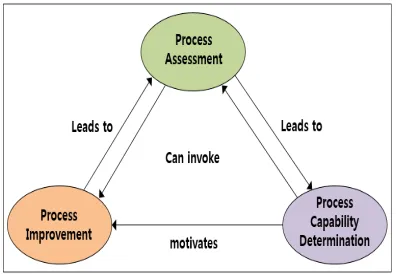
[image:2.612.317.528.200.343.2]Defining the correct processes and effective activities related to software development is very important because they facilitate the availability of the manpower and resources needed for successful software development, as well as the efficient use of the tools and equipment necessary for development. These activities also play a key role in improving the cost, schedule, and quality of software development projects[8]. The software process audit relationship model is the same as <Figure 1>. It is configured to diagnose an organization's current ability to perform processes through Process Assessment and to perform Process Capability Determination, which can be used for Process Improvement[9].
Figure 1: Process Assessment relationship
2.2 CMMi and ISO15504
The Capability Maturity Model Integration (CMMi)[11][12] was developed by the U.S. Software Engineering Institute (SEI) and consists of process, personnel, and technology levels. CMMi's individual processes consist of Specific Goal, Generid Goal to achieve, and activities that must be carried out to achieve these goals < Figure 2>.
Figure 2: The Process Area Structure of CMMi
[image:2.612.94.292.345.482.2]ISO15504 consists of five components, including Concept and Vocabulay, Performing and Assessment, Guidance on Performing An Assessment, Guidance on use for Process Improvement and Process Capability Determination, and An Exemplar Process Assessment based upon ISO/IEC, as shown in <Figure 3>[10].
Figure 3: Components of ISO/IEC 15504
ISO/IEC 15504-2 makes it possible to create and use a Process Assessment Model (PAM) that defines a software assessment model that defines the process objectives and performance outcomes defined in the software process reference model. Process capability determination defines the target capability for a particular requirement and involves analyzing the differences between current capabilities and the capabilities required by the project to derive risks [9]. The process improvement flow is the process of defining organizational needs and business objectives, determining current capabilities, and then performing improvement activities repeatedly to achieve improvement objectives [10][11][12].
[image:2.612.90.299.616.717.2]4674 quality, and pushing for improvement of SW process as a way to develop SW successfully and increase productivity[17][18].
3. QUALITY INSPECTION
MANAGEMENT EXECUTION MODEL
USING QG
3.1 Quality Gate Execution Model
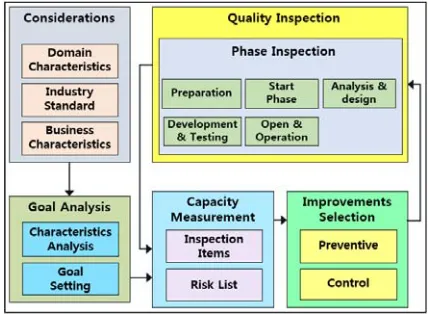
The SW QG Quality Check Execution Model proposed in this thesis focused on the Project and Work Management, Service Establishment and Delivery parts of the CMMi category area, as shown in <Table 1>, and Based on the ISO15504 process audit relationship model, it consists of inspection, step-by-step capacity measurement and improvement as shown in <Figure 4>. Inspection is carried out through level diagnosis, and emphasis and risk are derived and managed through capability measurement in stages. Improvement consists of prevention, control, and education.
Table 1: PA(Process Area) by CMMi Category
Category Process Area Maturity Level
Process Management
Organizational Performance Management (OPM) 5
Organizational Process
Performance (OPP) 4
Organizational Process
Definition (OPD) 3
Organizational Process Focus
(OPF) 3
Organizational Training (OT) 3
Project and Work Management
Quantitative Work
Management (QWM) 4
Capacity and Availability
Management (CAM) 3
Integrated Work Management
(IWM) 3
Risk Management (RSKM) 3
Service Continuity (SCON) 3
Requirements Management
(REQM) 2
Supplier Agreement
Management (SAM) 2
Work Planning (WP) 2
Work Monitoring and Control
(WMC) 2
Service Establishment
and Delivery
Strategic Service Management
(STSM) 3
Service System Development
(SSD) 3
Service System Transition
(SST) 3
Incident Resolution and
Prevention (IRP) 3
Service Delivery (SD) 2
Support
Causal Analysis and
Resolution (CAR) 5
Decision Analysis and
Resolution (DAR) 3
Configuration Management
(CM) 2
Measurement and Analysis
(MA) 2
Process and Product Quality Assurance (PPQA) 2
[image:3.612.313.529.72.234.2]Measure the difference before and after performing the step-by-step inspection activities
Figure 4:Framework of Quality Inspection management Execution Model
[image:3.612.315.529.279.436.2]4675
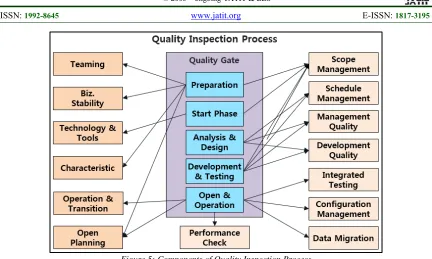
Figure 5:Components of Quality Inspection Process
3.2 QG(Quality Gate) Inspection Check List
The item composition of the software process quality check consists of 5 areas and each stage consists of detailed inspection items. 41 items for the Preparation Phase, 24 items for the Start Phase, 37 items for the Analysis & Design Phase, 40 items for the Development & Testing Phase, and 95 detailed items for the Open & Operation Phase.
3.2.1 Preparation Phase Inspection Check
List
[image:4.612.90.296.578.723.2]During the Preparation Phase, Scope Estimate, Project Risk, Operations Organization Collaboration, Development Schedule and Productivity, Scope management, Inspect Infra/Security Results, Review Technical Standards are Perform, as shown in <Table 2>.
Table 2:Preparation Phase Inspection Table
Inspection
contents Details of inspection
Teaming Check the adequacy of the company's manpower ratio [Key]
Appropriateness of input personnel
Scope Estimate
Apply Quality Effort (QA, Common, Architect) [Key]
Specific customer requirements
Calculate the functions by dividing them into detail up to the screen menu criteria
Applying non-functional/functional requirements
Securing objectivity in calculating scale
Project Risk
Possible issues related to Project Milestone and technology (performance, stability) [Key]
Possible compliance issues
Having experience in performing similar projects
History of project past performance
Operations Organization Collaboration
Inspection of consultation with the operation organization (Application, Infra), scope of work, development schedule, etc.
Consider the customer's unit test and third-party test
Development Schedule and Productivity
Check project open schedule
Check the appropriateness of input by development process
Check the productivity of the development program
Scope
management Identify and prevent possible changes to requirements
Inspect Infra/Security
Results
Check impact assessment results for each area of Infra (AA, TA, DA, NW)
Check the review results of security experts
Review Technical Standards
Check the review of technical standards, specific items, and non-standard cases
Share project success or failure experiences
3.2.2 Start Phase Inspection Check List
4676
Table 3:Start phase Inspection Table
Inspection
contents Details of inspection
Scope management
Check that the contract with the customer has been completed
Inspect items discussed about project scope
Mile Stone Customer Participation
Check the weekday schedule step by step [Key]
Check the engagement organization and engagement plan of the customer [Key]
Project Progress Organization
Checks the completion status and size of personnel for collaboration
Purchase status
Inspect the establishment of
outsourcing and product purchase plans
Change Management
Check if the contract size and scope change control procedures have been agreed with the customer [Key]
Constraints
Check support request as a result of project execution
Check if the project performance environment is in place
Identify the environmental status of projects
3.2.3 Analysis & design Phase Inspection
Check List
[image:5.612.89.296.105.407.2]During the Analysis & design Phase, Project Progress, Requirements Management, Scope management, Development and Data Migration, Purchase status, Constraints are Perform, as shown in <Table 4>.
Table 4:Analysis & design Phase Inspection Table
Inspection
contents Details of inspection
Project Progress
Check that the project is progressing without delay
Change of Milestone
Requirements Management
Conducts review activities with customers to check if requirements have been reached
Review that non-functional requirements have been derived without omission
Scope management
Setting design baselines [Key]
Agree with the customer about the established baseline [Key]
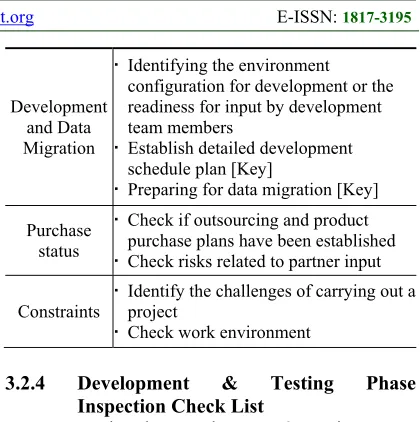
Development and Data Migration
Identifying the environment configuration for development or the readiness for input by development team members
Establish detailed development schedule plan [Key]
Preparing for data migration [Key]
Purchase status
Check if outsourcing and product purchase plans have been established
Check risks related to partner input
Constraints
Identify the challenges of carrying out a project
Check work environment
3.2.4 Development & Testing Phase
Inspection Check List
[image:5.612.313.523.365.694.2]During the Development & Testing Phase, Project Progress, Scope management, Unit Testing Progress, integration Testing Plan, Open and Inspection Indicators, Purchase status, Constraints are Perform, as shown in <Table 5>.
Table 5:Development & Testing Phase Inspection Table
Inspection
contents Details of inspection
Project Progress
Check if progress of project is being made in accordance with plan
Check the progress of the test phase
Check if the data transfer is aligned with the target and implementation time objectives.
Change of Milestone
Scope management
Change request details
Check the progress of CCB settlement
Unit Testing Progress
Perform third-party testing of developed programs
If a test has been performed, check the defect level (defect rate is lower than 10%).[Key]
integration Testing Plan
Establish integrated test plan and agree with customer [Key]
Open and Inspection Indicators
Check the agreed open schedule and check sheet with the customer attainable [Key]
Purchase status
Check if outsourcing and product purchase plans have been established
Constraints
Identify the challenges of carrying out a project
4677
3.2.5 Open & Operation Phase Inspection
Check List
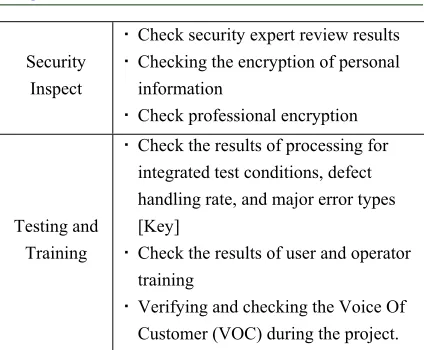
[image:6.612.312.524.83.258.2]During the Open & Operation Phase, Operation Transfer, Data Migration, Stakeholder Opinions, Inspect Infra/Security Results, Security Inspect, Testing and Training are Perform, as shown in <Table 6>.
Table 6:Open & Operation Phase Inspection Table
Inspection
contents Details of inspection
Operation Transfer
Review operation transfer plans [Key]
Check operation plan, scope of failure, and resolution by type of failure [Key]
Check for possible change in requirements after system open
Secure a minimum stabilization period of 2 weeksData Migration
Ensuring that data migration results are free from errors [Key]
Confirms agreement with the customer regarding the data migration result [Key]Stakeholder Opinions
Listening to the opinions of the operatorsInspect Infra Results
Check the results of impact assessment by infra(AA, TA, DA, NW)
Security Inspect
Check security expert review results
Checking the encryption of personal information
Check professional encryption
Testing and Training
Check the results of processing for integrated test conditions, defect handling rate, and major error types [Key]
Check the results of user and operator training
Verifying and checking the Voice Of Customer (VOC) during the project.
3.3 Design and Implement SQMS Tool
3.3.1 SQMS Basic Model and Schematic
For objective QG activities, the project team and the QG implementation team are divided into the procedures of the project team and the QG team as shown in <Figure 6> to review the quality of the performance of the project or stage to determine whether the project should be continued or not, and the major activities are defined in Entry Critia and Exit Critia at each stage, and judgment based on detailed measurement plans and objective measurement results are established. Phase-by-Phase QGs are essential activities that proactively reduce risk factors to increase project success and ensure product quality.
[image:6.612.84.496.213.719.2]4678
3.3.2 SQMS Basic Model and Schematic
The QG Phase defines the list and timing to be inspected, and comprehensively examines the major activities of the Software Process to comprehensively integrate development progress to control or prevent development in advance< Figure 7>.
3.3.3 SQMS Basic Model and Schematic
As shown in <Figure 8>, the Common Area for QMS defines the standard checklists,
[image:7.612.106.504.230.492.2]objectives for step inspection, characteristics of Biz. And Domain, and the four areas of the SQMS are divided into Phase Inspection Area for detailed processing of the Step Inspection Items, Measurement Area for capacity measurement and step by step, Goal Control Area for identifying and processing strengths and weaknesses of the Step Inspection, and DashBoard Area for understanding and Monitoring the status of the step quality inspection.
[image:7.612.104.508.278.699.2]Figure 7: SQMS Based Model
[image:7.612.107.505.522.712.2]4679
3.3.4 QG(Quality Gate) Inspection Result
Level
The results of the inspection are documented in detail at each stage and the
inspection result is defined as Step 5(Great, Good, Moderate, Insufficient, Bad) based on <Table 7> considering the execution status of the project step.
Table 7:QG(Quality Gate) Inspection Result Level Table
Inspection
Result Distribution Document Execution Details of Inspection Result
Great More Than 90% ~ 100% O O
100 % status of project execution in phase
Document(O), Current document(O)
Execution(O), Weakness(X)
Good More Than 80% ~ Less Than 90% O 80%↑
Status of project execution by 80 % or more
Document(O), Current document(X)
Execution(O), Weakness(O)
Moderate More Than 50% ~ Less Than 80% O 30%↑~80%↓
Partial project status (30 % or less, less than 80 %)
Document(O), Current document(X)
Execution(O), Weakness(X)
Insufficient More Than 35% ~ Less Than 50% X 1%↑~30%↓
Partial project status (1 % or less, less than 80 %)
Document(X), Current document(X)
Execution(O), Weakness(X)
Bad More Than 1% ~ Less Than 35% X X
Not performing project in phase
Document(X), Current document(X)
Execution(X), Weakness(X)
N/A - - -
Not applied to the scope of execution
Not Target
Not Execute
3.4 Detailed key functions of SQMS
3.4.1 Project Quality Check Dashboard
The following <Figure 9> is an integrated dashboard for quality inspection by project stage.
This is a function that provides real-time information on quality status by step and manages them collectively by utilizing dashboards.
4680
3.4.2 Quality inspection status by step
The following <Figure 10> is a function to monitor progress by expressing the quality check by project stage on a single screen.
3.4.3 Quality inspection results by step
The following functions <Figure 11> calculate the quality check result values for each
[image:9.612.144.471.546.708.2]checklist and provide information for improvement by expressing the status of the inspection. The results of the inspection criteria are linked to the results of the inspection criteria to express the scores and the status of the inspection zone in a straightforward manner. Therefore, it is possible to check the improvements easily and make up for the defects in the next step.
Figure 10:Status of quality inspection by Phase
4681
3.4.4 Quality inspection items by step
The following <Figure 12> lists the quality inspection by inspection stage. It is a
[image:10.612.91.525.136.443.2]function to check inspection classification and inspection items, register performance results in the system, and share quality results in real time.
Figure 12:Quality Check Item by Phase
4. EXPERIMENTAL CLASSIFICATION
RESULTS AND ANALYSIS
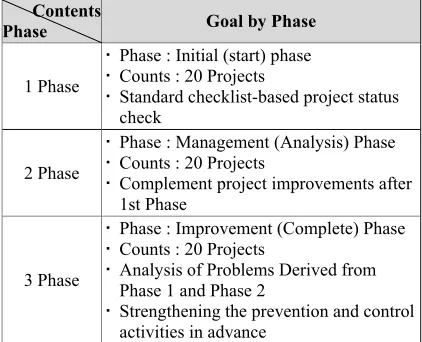
[image:10.612.87.298.557.728.2]Inspection items were selected in three stages for 60 small projects of S company and applied as project manager and quality manager.
Table 6: QG Inspection Result Level Table
Contents
Phase Goal by Phase
1 Phase
Phase : Initial (start) phase
Counts : 20 Projects
Standard checklist-based project status check
2 Phase
Phase : Management (Analysis) Phase
Counts : 20 Projects
Complement project improvements after 1st Phase
3 Phase
Phase : Improvement (Complete) Phase
Counts : 20 Projects
Analysis of Problems Derived from Phase 1 and Phase 2
Strengthening the prevention and control activities in advance
4.1 Inspection results by QG through SQMS
The analysis results of quality inspection in 60 projects are as shown in <Table 8>.
Prevention is required for Teaming and Scope Estimate as part of starting a project. In the beginning phase of the project, preventive measures are required for Scope Management and Milestone Customer Partication, and in the analysis & design phase requires the prevention of Scope Management and Requirements Management related to the task, and the development & testing phase requires a lot of resources to be involved in the project progress and unit testing progress. The last step, Open & Operation Phase, requires intensive management of Stakeholder Opinion Extensions for project inspection.
Table 8: Inspection results by QG
Phase Inspection Contents Result A B C D E
Prepara-tion
Teaming ●
4682
Phase Inspection Contents Result A B C D E
Project Risk ○ Operation Organization
Collaboration ○ Development Schedule and
Productivity ○ Scope Management ○ Inspect Infra/Security Results ○ Review Technical Standards ○
Start
Scope Management ● Milestone Customer
Participation ● Project Progress Organization ○ Purchase Status ○ Change Management ○
Constraints ○
Analysis & Design
Project Progress ○ Scope Management ● Requirement Management ● Development and Data
Migration ○
Purchase Status ○
Constraints ○
Developm ent
& Testing
Project Progress ● Scope Management ○ Unit Testing Progress ● Integration Testing Plan ● Open and Inspection Indicators ○ Purchase Status ○
Constraints ○
Open & Operation
Operation Transfer ○ Data Migration ○ Stakeholder Opinions ● Inspect Infra/ Security Results ○ Security Inspect ○ Testing and Traing ○ A: Great, B: Good, C: Moderate, D: Insufficient, E: Bad
4.2 SQMS Model Inspection
[image:11.612.88.312.71.545.2]In each phase of the project, items checked for nonconformity or defect in <Table 9> were selected for each phase of the project to derive key prevention and control activities such as <Table 9>. The derived Check List was supplemented to the Inspection Check List at each stage, and insufficient items were drawn for each phase to focus on the new project.
Table 9: Enhancements required for Phase-by-Phase focused prevention
Phase Details of improvements
Preparation Clarify customer's role and number of inputs
Clarification of scope of work
Start
10% schedule buffer confirmation when establishing WBS
Team Building to a level that Project Leader can manage
Analysis & Design
Agree program priorities with the customer
Re-agreement on the Development Scale through the Estimation of the Design Period
Development & Testing
Strengthening the review of development programs on a two-week basis
Introducing automation tools to improve productivity
Open & Operation
Agree pending status of remaining work
4.3 Qualitative and Quantitative expected
effects
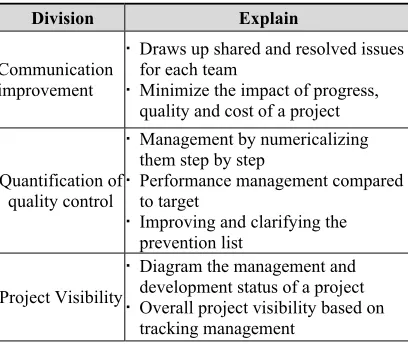
The expected effects of applying the quality techniques of this project can be summarized as in <Table 10>.
Table 10: Qualitative expectations
Division Explain
Communication improvement
Draws up shared and resolved issues for each team
Minimize the impact of progress, quality and cost of a project
Quantification of quality control
Management by numericalizing them step by step
Performance management compared to target
Improving and clarifying the prevention list
Project Visibility
Diagram the management and development status of a project
Overall project visibility based on tracking management
[image:11.612.318.522.474.646.2]4683 improvement can be summarized as in <Table 11> by over 20%.
Table 11: Quantitative expectations
Phase 1 Inspection Results 2 3
Preparation 55% 70% 83%
Start 60% 75% 85%
Analysis &
Design 63% 72% 87%
Development &
Testing 67% 79% 86%
Open &
Operation 53% 67% 81%
5. CONCLUSION AND FUTURE
DIRECTIONS
Establishing and operating a development process that conforms to the characteristics of an organization or project is an essential condition for achieving successful project results. And conducting quality control activities is an essential process for continuous value creation.
[image:12.612.317.531.327.616.2]The differences between the quality techniques of this project and the previous quality techniques can be summarized as in <Table 12>.
Table 12: Differences from Prior SW Quality Management System (SQMS)
Divi
sion Prior SQMS After SQMS
Com
mon Using Advanced Processes (CMMi,SPICE) SW
Proc
ess Complexity
Applied according to business characteristics
Simplify
Sche dule
Process-centric management (Start, Implement, Close)
Project Milestone-centric management
(Preparation, Start, Analysis & Design, Development & Testing, Open & Operation) Reso
urce
SPG-centric progression
Project Team Member-centric Progress
Project on its own Qual
ity contr
ol
Document-centric management
Analysis by expert judgment
System Automation Deployment
System-based analysis
The software development quality inspection management process model proposed in this thesis consists of quality diagnosis, step-by-step measurement and improvement, and to prevent project failure, check the process and check the outputs. Accordingly, the software's completeness was increased so that the budget, schedule, and quality of the project could be improved in a balanced manner. Analysis of 60 projects based on the software development quality inspection management process model over one year showed an improvement of more than 20% in performance capability for each project.
The expected effects of solving key issues in the development process using SQMS of this study are summarized in <Table 13> as Real Time Information, System Utilization, and Flexibility.
Table 13: Expected Effects of the Study
Divi
sion After QMS
Real-Time Infor matio n
Strengthen connection between departments
Increase efficiency of work by establishing information sharing system
Visualize the progress of the job in real time through business automation
Establishing a system of compliance with the delivery date
Facilitates rapid decision making with real-time analysis of work processes
Syste m Utiliz
ation
Improve the standard process compliance of development tasks
Reliable data for continuous process improvement
Increase system utilization through process-centric system auto linkage
Improve system utilization by effectively supporting on-site operations rather than administrative processes
Flexi bility
Increased flexibility of work through dynamic reflection of changes in development processes
Monitor task load, progress, delays, and performance indicators for each process step
Enhance integrated management of processes, organizations, and systems
Manage the history of the iterative process and derive improvement points
[image:12.612.90.304.499.716.2]4684 REFRENCES:
[1] Baddoo, N. and Hall, T., “De-motivators for software process improvement: an analysis of practitioners’ views”, The Journal of Systems
and Software, Vol. 66, No. 1, 2003, pp. 23–33
[2] Gibson, D.L., Goldenson, D.G and Kost, K, "Performance Results of CMMI-Based Process Improvement", Technical Report
CMU/SEI-2006-TR-004, Software Engineering Institute, Carnegie Mellon
University, Pittsburgh, PA,2006.
[3] Kuilboer, J. P., and Ashraf, N., “Software process and product improvement: an empirical assessment”, Information &
Software Technology, Vol. 42, No. 1, 2000,
pp.27~34
[4] Cattaneo, F., Fuggetta, A., and Sciuto, D., “Pursuing coherence in software process assessment and improvement”, Software
Process Improvement and Practice, Vol. 6,
No. 1, 2001, pp. 3-22
[5] Staples, M., and Niazi, M., “Systematic review of organizational motivations for adopting CMM-based SPI”, Information and
Software Technology, Vol. 50, No. 7, 2008,
pp. 605-620
[6] Iversen, J. H., Mathiassen, L., Nielsen, P. A., “Managing Risk in Software Process Improvement: An Action Research Approach”, MIS Quarterly, Vol.28, No.3,
2004, pp .395-433
[7] Ilkyu Nam, “A Study of Software Quality Management Execution Model for the SMBs”,
Journal of Information Technology and
Architecture, Vol. 13. No. 4, 2016, pp. 686.
[8] NIPA, “SW Process Quality Assurance Criteria”, 2013.
[9] ISO/IEC 15504-1, “Information Technology - Process Assessment Part 1: Concepts and Vocabulary”, 2004, pp. 10.
[10] ISO/IEC TR 15504-4, “Information Technology Process Assessment-Part 5: An exemplar Process Assessment Model”, 2006. [11] CMMI, “CMMI for Development Version 1.2,
CMU/SEI-2006-TR-008”, Technical Report,
Software Engineering Institute, 2006.
[12] CMMI, “CMMI Product Team CMMI for Development, Version 1.3”, Software Engineering Institute, Carnegie Mellon
University, Pittsburgh, PA, 2010.
[13] R. Ponce, “Steps to On-Time, On-Budget
Project Delivery”, ITworld, May 2009.
[14] Byungha Choi, Sung-kyo Choi, Kyungsan Cho, “A Design of Framework based on Distributed System for Enhancing Productivity”, Journal of the Korea society of
computer and information, Vol 17, No. 1,
2012.
[15] Seung-gweon Kim, Jong-soo Yoon, “Exploring the Relationship between Software Capability Level and Software Project Productivity”, Journal of The Korea
Society of Computer and Information, Vol. 17
No. 8 , August 2012.
[16] Paulk, M.C., Curtis, B., Chrisses, M.B., Weber, C.V. “Capability Maturity Model for software”, CMU/Software Engineering Institute, Technical Report, CMU/SEI-93-TR-024, Feb. 1993.
[17] In-Oh Song, Sung-Yul Rhew, Sung-Eung Lee, “A Software Process Certification Model of Small sized Software Development Using Scrum”, Journal of the Korea society of
computer and information, Vol. 16, No. 4,
2011.
[18] R. Hefner, “Achieving the Promised Benefits of CMMI”, presentation file, CMMI
Technology Conference & User Group,