Munich Personal RePEc Archive
Inter-generational effect of parental time
and its policy implications
Zhu, Guozhong and Vuralz, Gulfer
Guanghua School of Management, Peking University, Department of
International Trade, Bogazici University
May 2012
Online at
https://mpra.ub.uni-muenchen.de/40670/
Inter-generational Effect of Parental Time and
Its Policy Implications
∗
Guozhong Zhu
†and Gulfer Vural
‡Abstract
Why do parents with more human capital spend more time
teach-ing and takteach-ing care of their children, in spite of the higher opportunity
cost? How does this affect inter-generational mobility and wage
in-equality? Does this have any implications on the policy that provides
public schooling through income taxation? We develop and estimate a
theoretical model to answer these questions, in the light that parental
time investment is a powerful means of transmitting human capital
inter-generationally.
JEL Classification: E20, R20, R30.
Keywords: Human capital production, Parental time investment, Wage
inequality, Earnings persistence, Public schooling.
∗For helpful critiques and suggestions, We thank Marina Azzimonti, Sandra Black,
Russell Cooper, Dean Corbae, and seminar participants at the University of Texas at
Austin, Renmin University and Shanghai University of Finance and Economics.
1
Introduction
Empirical studies reveal that parental time with children is strongly
posi-tively correlated with parents’ human capital, proxied by either wage rate or
educational attainment. Using the 2003-2006 waves of the American Time
Use Survey, Guryan et al. (2008) document a positive wage/education
gradi-ent in child care time which holds true for differgradi-ent categories of child care,
including basic, educational, recreational and travel-related child care.
Sim-ilar patterns have been documented in many earlier studies, although in a
less comprehensive way. Positive wage gradient of parental time is found
in Hill and Stafford (1974), Kimmel and Connelly (2007) and others; while
positive education gradient is seen in Leibowitz (1974b), Leibowitz (1974a),
DeSimone and Dills (2006), Ramey and Ramey (2010), etc. The positive
correlation is also found in countries other than the U.S., including both
developed and developing countries.1
Why should higher wage/education parents spend more time with their
children despite the higher opportunity cost? We answer this question based
on a simple idea – altruistic parents make both time investment and goods
investment to produce their next generation’s human capital. If the two types
of investment have low substitutability, then higher wage/education parents
make more time investment in optimality to complement goods investment.
We formalize this idea in a model featuring inter-generational
transmis-sion of human capital. We show analytically that the wage gradients of
parental investment are positive if time-goods substitutability is low.
Fur-ther, the gradients are reduced by the public policy that levies a proportional
1
tax on labor income and provides public schooling.
Ramey and Ramey (2010) provide another channel that leads to the
pos-itive wage/education gradient of time investment. Using a model in which
parental time is the only input in human capital production, Ramey and
Ramey (2010) show that more educated parents make more time investment
on the premise that their time investment is more efficient than that of their
less educated counterparts. This channel is admitted in an extended version
of our model. When human capital production needs both goods and time
inputs, we show that whether higher productivity of time investment leads
to more time investment also depends on the substitutability between time
and goods investment. When the substitutability is high, parents with more
human capital should make less time investment and work more to provide
more goods investment, unless their advantage in parenting outweighs the
advantage on the labor market.2
Our model is developed for studying the inter-generational effects of
parental investment. Through time and goods investment, parents partially
transmit their human capital to the next generation, thus earnings must
ex-hibit inter-generational persistence. In addition, because richer parents make
more investment, parental investment is also a source of long-run wage
in-equality. In order to assess these inter-generational effects, we estimate the
model parameters through the simulated method of moments, then use these
parameters to decompose wage inequality and earnings persistence
quantita-tively.
2
We are grateful to a referee for pointing out the importance of this additional
We also quantitatively analyze the policy effects of public schooling. Since
the public policy triggers a reinforcing mechanism among time investment,
goods investment and human capital accumulation, it effectively reduces
wage inequality and earnings persistence, and increases wage level, leisure
and consumption. In an otherwise similar model that assumes exogenous
time investment, the policy effects are significantly weaker. Given the strong
empirical evidence of positive wage gradient, the endogenization of time
in-vestment is critical in policy analysis.3 We also show that, if parents with
more human capital are more efficient in time investment, the public
pol-icy is less effective in reducing inequality and earnings persistence, but more
effective in promoting human capital accumulation.
The paper that is closest to ours is Restuccia and Urrutia (2004) which
considers a model of inter-generational human capital transmission featuring
two types of goods investment: early education, and college education. Many
important traits exist both in that paper and ours. Both papers assume that
altruistic parents make all the decisions for children. Individuals are
hetero-geneous in their own human capital and their children’s innate ability which
is persistent across generations. Innate ability interacts multiplicatively with
parental investment in the production of human capital. In addition, both
3
Two stylized data facts are consistent with the view that parental time with
chil-dren is a type of investment. First, in cross sectional data, parental time with chilchil-dren
follows a different pattern than either leisure or home production time – the amount of
time allocated to home production and to leisure falls sharply as income and educational
attainment rise (Aguiar and Hurst (2007),Kimmel and Connelly (2007), Guryan et al.
(2008)). Second, parental time exhibits positive effects on children’s outcome (Leibowitz
papers find that innate ability accounts for the majority of inter-generational
persistence. The distinctive feature of our model is the role of parental time
investment. We compare our model and a variant of their model to show
that policy effects are significantly different when parents can respond to
the policy with changing time investment. Our paper is also closely related
to Glomm and Ravikumar (1992) and Glomm and Ravikumar (2003). Both
papers use dynamic models to explore the interactions among parental
invest-ment, inter-generational earnings persistence and long-run wage inequality.
The paper is also related to the vast literature that studies the
inter-generational correlation of earnings and educational attainment. Empirically,
earnings exhibit a significant inter-generational correlation. For example,
Solon (1992) regresses children’s log earnings when adults against parents’
log earnings, and obtains the slope coefficient that is around 0.45. Aaronson
and Mazumder (2008) also report high inter-generational correlation.4 It is
debated whether the inter-generational correlation is largely due to the
“na-ture effect” or the “nur“na-ture effect”. A large number of studies find that the
“nature effect” is the key determinant.5 Using a life cycle model, Huggett
et al. (2011) also find that learning ability differences constitute an important
part of the rise in earnings dispersion over the lifetime. Our structural
esti-4
Parental income (or parents’ educational performance) is also correlated with
chil-dren’s educational outcomes. See Acemoglu and Pischke (2001), Dahl and Lochner (2008)
and Tominey (2009), Oreopoulos et al. (2003), Chevalier (2004), Black et al. (2005) and
others.
5
See Behrman and Taubman (1989), Shea (2000), Sacerdote (2002), Plug and
Vijver-berg (2003), Maurin (2002). A number of papers explicitly study the causality between
parental income (education) and children’s educational attainment. See, for example, Blau
mation results are consistent with these findings, showing that the “nature
effect” accounts for a large fraction of inter-generational earnings persistence.
The rest of the paper is organized as follows: Section 2 introduces the
model and presents the analytical results regarding positive wage gradient
of time investment. Some analytical results related to policy effects are also
obtained. In section 3, we estimate the parameter values of the model and
use them to show how public policy affects resource allocation and wage
structure. Quantitative decomposition of wage inequality and earnings
per-sistence are also carried out in this section. Section 4 emphasizes the role
played by time investment by comparing results between our model and a
model in which time investment is exogenous. Section 5 includes further
dis-cussion of (i) the extended model in which parents with more human capital
are more efficient in time investment, (ii) substitutability between time and
goods investment, (iii) cross country comparison of parental time and public
spending on education, (iv) other forms of parental altruism. Section 6
con-cludes. Description of the data and model solution strategy are left to the
Appendix.
2
The baseline model and analytical results
In this section we lay out the baseline model and present its properties. We
consider an overlapping generations model. The economy is populated by
a continuum of individuals who live for two periods. In the first period, an
individual is a child, receiving time and goods investment from the adults
adult, making decisions regarding her time and goods allocation.
2.1
Human capital production
Lethi be the human capital of theith adult,ei andgi be her time investment
and goods investment, then the human capital of her child is
h′i =ziA[αeσi + (1−α)giσ]1σ (1)
whereziis the child’s learning ability,A >0 is the aggregate technology level.
Since our paper focuses on the role of time investment in determining earnings
persistence and wage inequality, we simply view A as a scaling parameter. The model can easily be extended to encompass growth by including a time
trend inA. The coefficient σ∈(−∞,1] governs the substitutability between
ei and gi. Define η= 1−1σ, then η is the elasticity of substitution between ei
and gi. We say that ei and gi are gross complements if η < 1 (σ < 0), and
gross substitutes if η >1 (σ > 0). The coefficient α ∈(0,1) determines the relative share of time investment and goods investment in the production of
human capital.
Learning ability zi is random and exogenous. It evolves according to
lnzi′ =ρlnzi+ǫi (2)
whereǫi is an i.i.d. random shock drawn from normal distribution with mean
−121+ν2ρ and variance ν2. It is easy to show that the unconditional mean of
learning ability is E[zi] = 1.6
6
From the distribution ofǫi, lnziis also normally distributed with meanµlnz=−
1 2
ν2
The formulation in equation (1) assumes that the human capital of a child
is entirely chosen by the adult. This distinguishes our model from those that
assume a child can choose her own human capital stock. For example, Glomm
and Ravikumar (1992) assume that a child allocates her time between leisure
and human capital production. In this paper we emphasize the role played
by parental time in human capital formation and its effect on wage inequality
and inter-generational earnings persistence. Therefore we do not take child’s
own time allocation decision into account.
2.2
Individual’s optimization behavior
An adult is endowed with one unit of time, and allocates it among work,
leisure and time investment to maximize lifetime utility.
2.2.1 The optimization problem
The ith adult solves the following optimization problem. max
ci,ni,ei,gi
lnci+γlnni+βlnh′i
subject to equation (1) and
ci+gi = (1−ei−ni)wi (3)
wi =hi (4)
where ci and ni are consumption and leisure respectively. The relative im-portance of leisure is governed by γ, and the strength of parental altruism is
and variance ν2 lnz =
ν2
1−ρ2. Therefore zi follows log-normal distribution with mean
exp(µln + 1
ν2
determined by β. In equation (3), 1−ei −ni is the adult’s work hour and
wi is the wage rate which equals the stock of human capital (hi). Shocks to
learning ability are revealed before the adult makes decisions, hence there is
no uncertainty about the outcome of these decisions.
It is assumed that the adult cares only about the child’s human capital
stock. This modeling strategy, following Glomm and Ravikumar (1992), is
very common in the literature of inter-generational transmission of human
capital. In our framework, it enables us to derive closed-form solutions to
individual’s optimization problem and analytical results regarding the effects
of public policy.
2.2.2 Optimal decisions
Why do parents with more human capital make more time investment? The
question is answered in the solution to the individual’s optimization
prob-lem. For simplicity we omit subscript i. The following equations present the optimal investment decisions as functions of the adult’s human capital stock
h.7
g = h
1+γ β + 1
h
1−α
α
σ−11
hσσ−1 + 1
i (5)
e =
1−α
α
σ−11
hσσ−1
1+γ β + 1
h
1−α
α
σ−11
hσσ−1 + 1
i (6)
7
Following Becker (1981), a strand of literature emerged discussing whether parents
choose to invest more in the human capital of abler children or not. From equation (5)
and equation (6) below, it can be seen that our model implicitly assumes that parental
The derivatives of parental investment with respect to human capital stock
are given in the following two equations.
dg dh =
1 1−σ
1−α
α
σ−11
hσ−σ1 + 1
1+γ β + 1
h
1−α
α
σ−11
hσ−σ1 + 1
i2 (7)
de dh =
− 1−σσ 1−α
α
σ1
−1 hσ−11
1+γ β + 1
h
1−α
α
σ−11
hσ−σ1 + 1
i2 (8)
Equations (7) and (8) are the wage gradients of parental investment. Both
are positive as long as time and goods investment are complements (σ < 0). Therefore, our model can explain the stylized data facts we introduced
in the very beginning. These results are delivered by two model
assump-tions. First, altruistic parents equate their own marginal utility with the
marginal product of goods investment, thus richer parents make more goods
investment. Second, the two types of investment have low substitutability,
thus richer parents also make more time investment to complement goods
investment.
2.2.3 Evolution of human capital
Plugging the solutions for g and e into equation (1), we express the child’s human capitalh′ as a function of her own learning ability (z) and her parents’ human capital (h).
h′ =zD1−σσ
"
α
1−α
1−1σ
+h1−σσ
#1−σσ
(9)
where D is a constant defined as D=1+βAγ+β
σ
1−σ
Clearlyh′ increases withh and z. Therefore in our model wage is persis-tent inter-generationally for two reasons: inter-generational transmission via
parental time and goods investment, and the persistence of learning ability
z. Recall that we assumed that z follows an AR(1) process in equation (2). From equation (9), h is convergent as long as D < 1. To see this, it is sufficient to show that h∗
=h1−σσ is convergent. The law of motion of h∗ is
h∗′ =z1−σσD
α
1−α
1−1σ
+z1−σσDh∗
Therefore h∗′
is a linear function of h∗
. Recall that z is a random number with mean one. When z = 1, as long as D < 1, the linear function can be represented by a straight line that crosses the 45-degree line in a
two-dimensional space, so h∗
is convergent. Whenz is random, the function can be represented by perturbations around the straight line, and h∗
is still
con-vergent. The convergent h ensures the existence of a stationary equilibrium in which we study inter-generational persistence, wage inequality and policy
effects.
2.3
The public policy
We introduce into our model the public policy that levies proportional tax
and uses the tax revenue to provide public schooling. With the policy, the
wage gradients of parental investment are reduced, but remain positive until
2.3.1 Description of policy
The public policy considered here can be fully characterized by the sequence
{τ, Pt}∞t=1 where τ is the tax rate and Pt is total public investment in human
capital in period t. Notice that we assume tax rate τ to be time invariant. Given any τ, Pt changes over time until the economy reaches the stationary
equilibrium defined below. For simplicity, in the individual’s optimization
problem below, we drop time subscripts.
2.3.2 Policy effects
In the regime with public schooling, an individual maximizes the same
util-ity function, but subject to different constraints. Specifically, the budget
constraint becomes
c+g = (1−τ)(1−e−n)w
where w is before-tax wage rate which again equals human capital stock h. With public schooling, h evolves according to
h′ =zA[αeσ + (1−α)(g+P)σ]σ1 (10)
where g+P is the total goods investment. Equation (10) implicitly assumes that public investment and private investment are perfectly substitutable.8
When the government makes excessive investment in education, the
in-dividual prefers to make negative private investment. We preclude that and
assumeg ≥0. When the nonnegativity constraint of goods investment is not binding, we have the following.
8
Proposition I When time and goods investments are gross complements
(σ < 0), the model with public schooling has the following properties.
1. ∂g∂h > 0, and ∂e
∂h > 0 as long as the two types of investment have low
substitutability (a sufficient condition is σ <−1+βγ).
2. Private goods investment decreases with P, while time investment and
human capital accumulation increase with P.
3. Both ∂h∂e and ∂g∂h decrease with P.
Proof of the proposition is given in the Appendix. The first property
states that wage gradients are still positive in the presence of the policy.
Next, the proposition states that public investment in education crowds out
private goods investment, but crowds in time investment. Overall it induces
more human capital accumulation. Public investment leads to more equalized
time and goods investment, thus the policy leads to reduced wage inequality
and persistence.
When the nonnegativity constraint of goods investment is binding, private
goods investment is zero. In this case, it is easy to show that wage gradient
of time investment is zero. In addition, time investment no longer increases
with public investment P rather, it decreases with P.9 This is because, as the
government makes excessive public investment, the marginal value of the next
generation’s human capital is too low and marginal utility of consumption
is high. Therefore the optimal strategy for individuals is to reduce time
investment, and increase consumption and leisure.
9
Next, we consider the case of σ > 0. Proposition II summarizes the results.
Proposition IIWhen time and goods investments are gross substitutes (σ >
0), the model with public schooling has the following properties.
1. ∂g∂h >0, but ∂e ∂h <0.
2. Private goods investment decreases with P, while time investment and
human capital accumulation increase with P.
3. ∂h∂e decreases with P, but ∂h∂g increases with P.
Proof of the proposition II is also given in the Appendix. Notice that
the second property in Proposition II is exactly the same as in Proposition
I. When σ > 0, however, the wage gradient of time investment is negative, which is inconsistent with the data. Furthermore, public schooling now leads
to more unequal private investment, implying that public schooling is less
effective in reducing wage inequality and persistence compared with the case
of σ < 0.
In the model with public investment in education, the explicit solution
for ˜h is not obtained, but ˜h satisfies:
˜
h=D1−σσ
"
1−α α
σ1
−1
[(1−τ)˜h]σσ−1 + 1
#1−σσ
[(1−τ)˜h+P] (11)
Figure 1: The reinforcing mechanism
Income taxation and public schooling
More total goods investment
Lower price of parental time
More time investment
More human capital accumulation
More public investment
Complementarity
Tax revenue
The figure illustrates the reinforcing mechanism among goods investment,
time investment and human capital accumulation.
2.3.3 The Reinforcing Mechanism
In the presence of parental time investment, income taxation and public
schooling crowd in time investment. Increased time input, along with
pub-lic goods input, leads to more human capital accumulation. More human
capital results in more tax revenue and public investment. This in turn
induces increased time investment due to the complementarity. This
rein-forcing mechanism, as illustrated in Figure 1, implies significantly stronger
policy in our model than in a model without endogenous time investment.
2.4
Distribution and Stationary Equilibrium
We are interested in the inter-generational earnings persistence and wage
in-equality implied in our model. In this subsection we discuss the distribution
of individuals and provide definitions of persistence, inequality and
equilib-rium. These definitions prepare us for the quantitative study that follows.
2.4.1 Distribution of Individuals
Adult individuals in the economy are heterogeneous in two aspects: own
human capital stock (h) and the child’s learning ability (z). Individuals are distributed across the state space H ×Z where H ⊂ ℜ+ is the space for
adult’s human capital stock, and Z ⊂ ℜ+ is the space for child’s learning
ability.
Let λt(h, z) be the distribution of individuals across state space H×Z
in period t. We need to know how the distribution evolves over time. The transition ofz is given by equation (2), and the transition ofhis determined by the policy function h′(h, z). Therefore once the policy function is known, we can track the transition of individuals from one generation to another.
To describe the evolution of λt(h, z) over time formally, let H × Z be a
typical subset of H×Z. Define Q((h, z),H × Z) as the probability that the next generation of the adults with current state (h, z) transmits to the set
H × Z. Formally
Q((h, z),H × Z) =
Z
Z
I{h′(h, z)∈ H}dz (12)
period t to period t+ 1 is
λt+1(H × Z) =
Z
H×Z
Q((h, z),H × Z)dλt(h, z) (13)
2.4.2 Stationary Equilibrium
We have shown the existence of a steady state when the model is stripped
of random shocks. Adding shocks back to the model, the economy converges
to a stationary distribution λ∗
(h, z) in which the economy operates around
h = ˜h and z = 1. For any given tax rate τ, a stationary equilibrium is the set of policy functionsh′(h, z),c(h, z),e(h, z),n(h, z),g(h, z), the public investment in education P, and a distribution λ∗
(h, z) such that
1. h′(h, z), c(h, z), e(h, z), n(h, z), g(h, z) solve the adult’s optimization problem.
2. Government budget is balanced. i.e.,R
H×Zτ(1−e−n)hdλ ∗
(h, z) =P.
3. For any subsetH×Z, the distributionλ∗
(h, z) is time invariant. Math-ematically
λ∗
(H × Z) =
Z
H×Z
Q((h, z),H × Z)dλ∗
(h, z)
In the qualitative analysis below, we start from the stationary equilibrium
without public policy. After introducing the public policy into the economy,
we solve for the evolution of distribution λt computationally until the econ-omy reaches a new stationary equilibrium. Using the distributions during
the transition period, we are able to compute the transitions of wage,
con-sumption, time allocation, as well as earnings persistence and wage inequality
2.4.3 Definition of Earnings Persistence and Wage Inequality
Given any distribution λ(h, z), we define wage inequality as the coefficient of variation of wage rate. We define inter-generational earnings persistence in a
standard way. Let the earning of adultibeyi = (1−e−n)w, and the earning of the next generation be yi′, then earnings persistence is the coefficientb1 in
the following regression
lnyi′ =b0+b1lnyi
3
Quantitative Results I: Effects of Public
Policy
We have shown analytically that parental time investment increases with
wage rate within our framework. In this section we quantitatively study how
the public policy changes inter-generational earnings persistence and wage
inequality. We also examine the transition paths of resource allocation and
wage structure after the implementation of the public policy. To do so, we
estimate the model parameters via the Simulated Method of Moments.
The quantitative analysis involves solving the general equilibrium model
numerically. We provide details of the model solution strategy in the
Ap-pendix.
3.1
Estimation
Table 1: Model parameters
Symbol Definition
β degree of altruism toward children
α relative importance of time investment
σ substitutability between time and goods investment
γ relative importance of leisure in preference
ρ inter-generational persistence of learning ability
ν standard deviation of shocks to learning ability
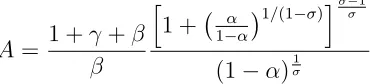
the steady state human capital stock to one, which implies
A= 1 +γ+β
β
h
1 + α
1−α
1/(1−σ)i
σ−1
σ
(1−α)σ1
Therefore, once we estimate the remainder of the 6 parameters, A is pinned down.10 Table 1 recapitulates the definitions of the 6 parameters to be
estimated.
3.1.1 Data moments
We estimate the parameters using the Simulated Method of Moments as
formalized in Ingram and Lee (1991). Basically we choose moments that
characterize a set of key data features, then search for the parameter values
that minimize the distance between data moments and model moments from 10
It is easy to show that when A is defined like this, human capital stock is convergent.
Based on the estimation results, A is around 11.5 which is not reported in the table of
Table 2: Data moments
Value Standarderror Source
Average consumption 0.469∗
0.003 CEX 2003
Average goods investment 0.025∗
0.016 CEX 2003
Average time investment 0.086∗∗
0.002 ATUS 2003
Wage elasticity of goods investment 1.067 0.371 CEX 2003
Wage elasticity of time investment 0.206 0.077 ATUS 2003
Inter-generational earnings correlation 0.449 0.095 Solon (1992)
Coefficient of variation of wage 0.663 0.021 ATUS 2003
* relative to wage/(1-saving rate)
** a fraction of total time available
simulated data. The distance is defined by l2-norm, weighted by the inverse
of the variance of data moments.11
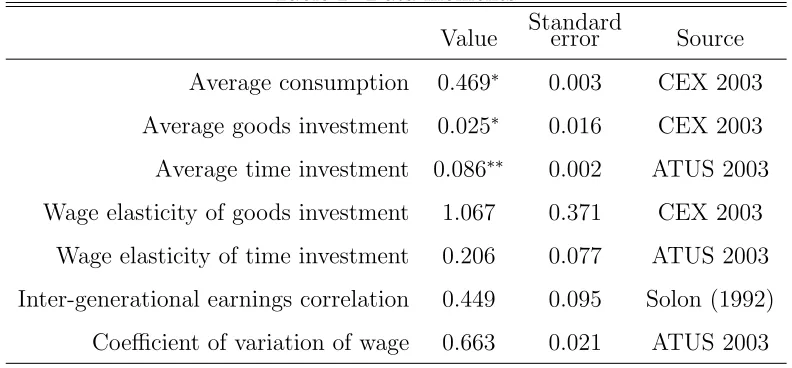
Seven moments are used. Six of them are calculated from the 2003 waves
of the American Time Use Survey and the Consumer Expenditure Survey.
The remaining moment, inter-generational earnings persistence, is taken from
Solon (1992). Table 2presents the data moments and their sources.
The first three moments are the mean levels of consumption, goods
in-vestment and time inin-vestment. These moments pin down the allocation of
parents’ resources. In addition they are informative about the relative
im-11
Ideally we should have used the optimal weighting matrix which is the inverse of the
variance-covariance matrix of the data moments. However the off-diagonal components
are not available from the data, due to the lack of panel data and the fact that moments
portance of time investment in human capital production and the degree of
altruism towards the next generation.
The fourth and fifth moments are wage elasticities of parental investment,
obtained by regressing the logarithm of goods and time investment on the
logarithm of wage rate, instrumented by educational attainment.12
The sixth moment is the inter-generational correlation in earnings.
Ac-cording to Solon (1992), the correlation is around 0.45. This moment is
particularly informative on ρ, the persistence of learning ability over gener-ations.
The last moment is the coefficient of variation in wage rate. This moment
measures the overall wage inequality in the economy. It is very responsive to
the size of random shocks to learning ability. From ATUS 2003, the number
is around 0.66. The literature on economic inequality uses the variance of
logarithm of wage rate as a typical measure of inequality. Since wage rate in
the model is much smaller in scale than in the data, we use the coefficient of
variation so that the model moment is comparable to that in the data.
3.1.2 Estimation results
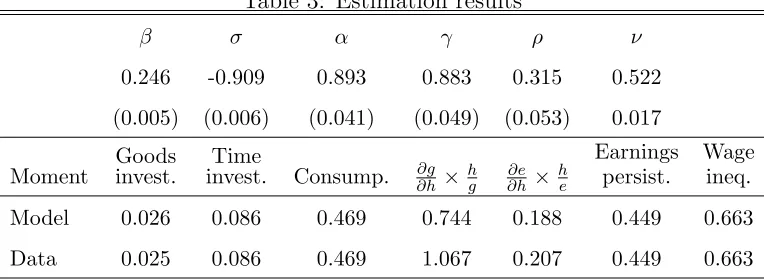
Table 3reports the estimation results. Not surprisingly,σ is negative, which means the elasticity of substitution between goods and time investment is
η = 1 1−σ =
1
1−(−0.909) ≈0.524. The estimate of inter-generational altruism,β,
is 0.246. If we consider one generation to be 20 years, then this is equivalent
12
We use education attainment to instrument wage rate because we want to capture
the human capital element in wage rate. In particular, this filters out shocks to wage rate
Table 3: Estimation results
β σ α γ ρ ν
0.246 -0.909 0.893 0.883 0.315 0.522
(0.005) (0.006) (0.041) (0.049) (0.053) 0.017
Moment invest.Goods invest.Time Consump. ∂h∂g × hg ∂h∂e ×he
Earnings persist.
Wage ineq.
Model 0.026 0.086 0.469 0.744 0.188 0.449 0.663
Data 0.025 0.086 0.469 1.067 0.207 0.449 0.663
The table reports estimated parameter values and standard errors.
Mo-ments from simulated data are reported together with those from real
data.
to an annual discount factor of 0.932. Regarding the two parameters for the
unobservable stochastic learning ability process, we find that ρ = 0.315 and
ν = 0.522. Overall our model delivers the data facts very well, except that the wage elasticities of time and goods investment are a little lower in the
model than in the data.
3.2
Inter-generational persistence and wage inequality
Earnings persistence and wage inequality have two sources: exogenous
learn-ing ability and parental investment, which correspond to “nature” and
“nur-ture” effects in the literature respectively. In order to show the roles played
by the latter, we decompose earnings persistence and wage inequality
quan-titatively. First we calculate them in the case in which every individual
makes a steady state level time and goods investment. Next, we keep time
endogenously chosen. Finally, we allow both types of investment to be
en-dogenous. Different results from these cases, reported in Table 4, reveal the
roles played by time and goods investment.
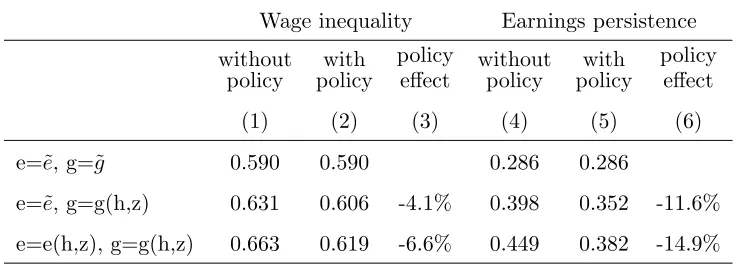
Table 4 shows that parental investment accounts for a relatively small
portion of the wage inequality and earnings persistence. Fixing e and g at the steady state levels, wage inequality is 0.590, while it is 0.663 when bothe
and g are endogenous. Loosely speaking, parental investment, the so-called “nurture effect”, accounts for 11% of overall wage inequality. It accounts for
[image:24.612.121.491.372.505.2]36.4% of earnings persistence. Within “nurture effect”, both time investment and goods investment are important contributors.13
Table 4: Wage inequality and earnings persistence
Wage inequality Earnings persistence
without
policy policywith
policy
effect withoutpolicy policywith
policy effect
(1) (2) (3) (4) (5) (6)
e=˜e, g=˜g 0.590 0.590 0.286 0.286
e=˜e, g=g(h,z) 0.631 0.606 -4.1% 0.398 0.352 -11.6%
e=e(h,z), g=g(h,z) 0.663 0.619 -6.6% 0.449 0.382 -14.9%
The table reports the decomposition of wage inequality and earnings
per-sistence. The “with policy” case corresponds to an economy where a 5%
income tax is imposed with the revenue invested in public schooling. ˜e
and ˜gare time and goods investment in the steady state.
Columns (2) and (5) of the table report wage inequality and earnings
13
As pointed out by Cunha and Heckman (2007), “nurture effect” and “nature effect”
on inter-generational persistence are nonlinear, and they interact with each other. Our
persistence in the model with public schooling, assuming 5% tax rate. Here
˜
e is still the steady state time investment in the absence of the policy, and ˜
g is defined as public goods investment plus steady state private goods in-vestment. As we allow goods investment to be endogenous and keep time
investment fixed, both inequality and earnings persistence increase, but to
a much less extent compared with the no policy case. Columns (3) and (6)
show the policy effects. Allowing both time and goods investment to be
en-dogenous, the public policy reduces inequality by 6.6% and persistence by 14.9%.
We further decompose the above policy effects by conducting two
ex-periments. Results are reported in Table 5. First, we impose 5% tax, but
assume no public investment in education. This leads to slightly higher
in-equality and persistence, because income tax strengthens the inin-equality in
time investment. In addition, the “tax only” policy leads to slightly lower
time and goods investment. Next, we consider the “public investment only”
policy that keeps public investment from the baseline model unchanged but
assumes away income taxation. The results reveal that much of the policy
effects in the previous discussion are due to public investment, rather than
to income taxation.
3.3
Transition paths
Starting from the original stationary equilibrium, the economy converges to
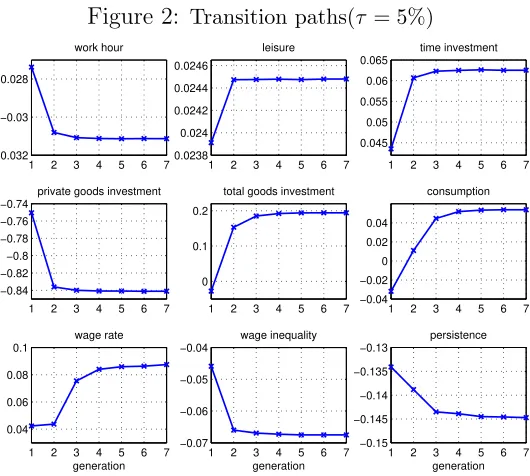
a new equilibrium after the policy is implemented. Given τ = 0.05, we plot the transition paths in Figure 2.
alloca-Figure 2: Transition paths(τ = 5%)
1 2 3 4 5 6 7 −0.032
−0.03 −0.028
work hour
1 2 3 4 5 6 7 0.0238 0.024 0.0242 0.0244 0.0246 leisure
1 2 3 4 5 6 7 0.045 0.05 0.055 0.06 0.065 time investment
1 2 3 4 5 6 7 −0.84 −0.82 −0.8 −0.78 −0.76 −0.74
private goods investment
1 2 3 4 5 6 7 0
0.1 0.2
total goods investment
1 2 3 4 5 6 7 −0.04 −0.02 0 0.02 0.04 consumption
1 2 3 4 5 6 7 0.04 0.06 0.08 0.1 wage rate generation
1 2 3 4 5 6 7 −0.07 −0.06 −0.05 −0.04 wage inequality generation
1 2 3 4 5 6 7 −0.15 −0.145 −0.14 −0.135 −0.13 persistence generation
The figure shows percentage changes due to the implementation of the
public policy. Tax rate is 5%. The top panels plot paths for time
alloca-tion, the middle panels for goods allocation and the lower panels for wage
[image:26.612.173.438.245.483.2]Table 5: Further decomposition of policy effects Time
investment investmentGoods
Wage rate
Wage inequality
Earnings persistence
(1) (2) (3) (4) (5)
Tax + public inv. 6.1% -84.6% 8.4% -6.6% -14.9%
Tax only -0.8% -4.2% -1.6% 0.4% 0.9%
Public inv. only 6.4% -82.3% 9.1% -6.3% -14.0%
The table reports percentage changes due to different policies. The “Tax
only” case imposes 5% income tax rate, but tax revenue is not invested
in public schooling. The “Public investment only” case keeps public
in-vestment from the baseline model unchanged, but assumes away income
taxation.
tion. The policy shifts parents’ time from work to leisure and human capital
investment. Consistent with the predictions in Proposition I, private goods
investment decreases during the transition, but total goods investment and
wage rate (human capital) increase, which reflects the reinforcing mechanism
among time investment, goods investment and human capital accumulation.
Regarding wage structure, the policy increases average wage rate and
decreases wage inequality and intergenerational persistence. Consumption is
4
Quantitative Results II – the role of time
investment
The reinforcing mechanism illustrated in Figure 1 exists in our model, but
does not exist in the traditional-type model in which parental time investment
is exogenous. Therefore in our model, the policy is much more effective in
promoting human capital accumulation, and in reducing inter-generational
earnings persistence and wage inequality. We quantitatively compare the
policy effects between our model and a version of the traditional model in
which time investment is exogenous.
4.1
The traditional model
We consider a traditional type model that is identical to our baseline model,
except that the human capital production function has the following form
h′ =zA[B + (1−α)(g+P)σ]σ1
Here, we have replaced αeσ in our baseline model with a constant B.
4.2
Comparing policy effects
To compare the policy effects, for each model, we compute the stationary
equilibria in two regimes: with and without public policy, then compute the
percentage changes of variables due to public policy. Differences in results
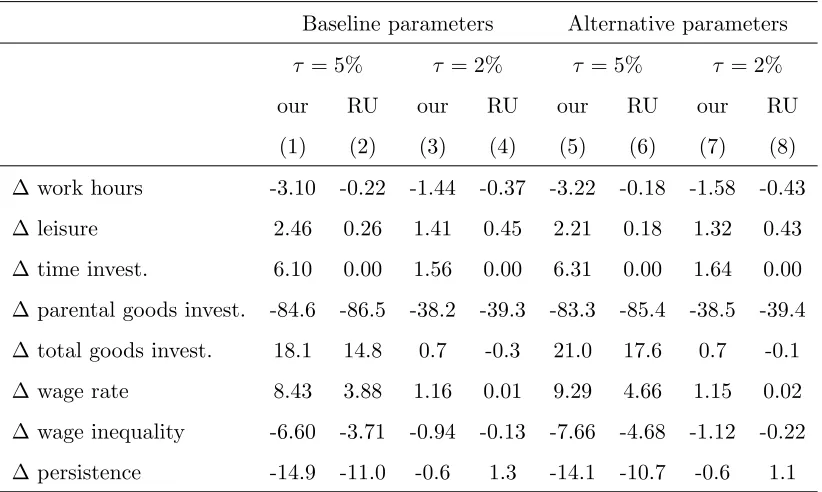
between the two models reflect the roles played by time investment. Columns
Table 6: Effects of public policy (percentage change)
Baseline parameters Alternative parameters
τ = 5% τ = 2% τ = 5% τ = 2%
our RU our RU our RU our RU
(1) (2) (3) (4) (5) (6) (7) (8)
∆ work hours -3.10 -0.22 -1.44 -0.37 -3.22 -0.18 -1.58 -0.43
∆ leisure 2.46 0.26 1.41 0.45 2.21 0.18 1.32 0.43
∆ time invest. 6.10 0.00 1.56 0.00 6.31 0.00 1.64 0.00
∆ parental goods invest. -84.6 -86.5 -38.2 -39.3 -83.3 -85.4 -38.5 -39.4
∆ total goods invest. 18.1 14.8 0.7 -0.3 21.0 17.6 0.7 -0.1
∆ wage rate 8.43 3.88 1.16 0.01 9.29 4.66 1.15 0.02
∆ wage inequality -6.60 -3.71 -0.94 -0.13 -7.66 -4.68 -1.12 -0.22
∆ persistence -14.9 -11.0 -0.6 1.3 -14.1 -10.7 -0.6 1.1
The table reports policy effects in our model as opposed to the traditional
model (RU) in which parental time investment is exogenous. Columns
(1)-(4) show the comparison based on baseline parameter values (Table3).
Columns (5)-(8) are based on parameter values that minimize the distance
[image:29.612.111.522.238.484.2]Both models predict a decrease in work hours, which is due to the reduced
after-tax wage rate, but the decrease is more significant in our model where
individuals have the option to make more time investment. Both models
predict increased leisure, and the increase is again much more significant in
our model. Similar changes of time use patterns are found under different
tax rates.
Private goods investment demonstrates huge drops in both models. The
drop is larger in the traditional model. This is because the marginal return
on goods investment is relatively lower due to the inability of individuals
to increase time investment. Total goods investment is increased less in the
traditional model. The policy increases average consumption in both regimes,
but to a greater extent in our model.
Regarding wage structure, the public policy is significantly more effective
in increasing wage rate, and in reducing wage inequality and earnings
persis-tence in our model. With τ = 5%, average wage rate is increased by 8.43%, as opposed to 3.88% in the traditional model. Wage inequality and earnings persistence are decreased by 6.6% and 14.9% respectively in our model, but only 3.7% and 11.0% in the traditional model.
Columns (5)-(8) report the results from an alternative set of parameters
given in Table 7. These are the parameters that minimize the distance
be-tween data moments and moments from the traditional model. Clearly, we
Table 7: Calibration based on the traditional model
β α σ γ ρ ν
0.230 0.854 -0.697 0.883 0.315 0.522
The table reports parameter values that minimize the
distance between data moments and simulated moments
from the traditional model.
5
Further Discussions
5.1
Higher efficiency of time investment by more
edu-cated parents
Ramey and Ramey (2010) point out that more educated parents should be
more efficient in time investment, hence wage/education gradient of parental
time should be positive. We extend our baseline model to admit this
poten-tially important channel.14
5.1.1 Human capital production function and optimal time
in-vestment
Let the human capital production function be
h′i =ziAα(hδiei)σ + (1−α)giσ
1
σ (14)
The termhδ
i in equation (14) allows for the channel in Ramey and Ramey
(2010). Since goods investment is absent in their framework, our human
14
We are grateful to a referee for suggestions that led to the development of this
capital production function is essentially the same as in Ramey and Ramey
(2010) if α=1.
When δ = 0, we are back in the baseline model. With non-zero δ, it is straightforward to show the following.
∂gt ∂ht =
1−σδ
1−σ
1−α
α
σ−11
h
(1−δ)σ σ−1
t + 1
1+γ β + 1
1−α
α
σ1
−1 h (1−δ)σ
σ−1
t + 1
2 (15)
∂et ∂ht =
−(11−−δσ)σ
1−α
α
σ1
−1 h 1−δσ
σ−1
t
1+γ β + 1
1−α
α
σ−11
h
(1−δ)σ σ−1
t + 1
2 (16)
Given these equations, there exist two cases in which wage/education
gradients of goods and time investment are positive.
Case (i), δ < 1 and σ < 0. In this case, for parents with more human capital, the efficiency of time investment does not outweigh their advantage
on the labor market. Complementarity between two types of investment is
still needed for the wage/education gradients to be positive.
Case (ii), δ > 1 and σ > 0. In this case, parents with higher human capital are much more efficient in time investment. ∂et
∂ht will be positive if
time and goods investment are substitutes. In addition, from equation (15),
ifδ is large enough, goods investment will decrease with human capital. This is because for parents with more human capital, the advantage in parenting
outweighs the advantage on the labor market, and they substitute goods
investment for time investment.
Since more educated women are more likely to be in the labor force, it is
labor market time more than that of time spent in parenting. Therefore we
focus our discussion on case (i). When the same public policy is introduced
into our model, we find that all the results in proposition I and II hold. The
exception is that the sufficient condition for positive wage gradient of time
investment becomes σ <−(1+β(1γ−)(1δσ−)δ).
15
5.1.2 Re-estimation of the model
To conduct a quantitative study based on the extended model, we re-estimate
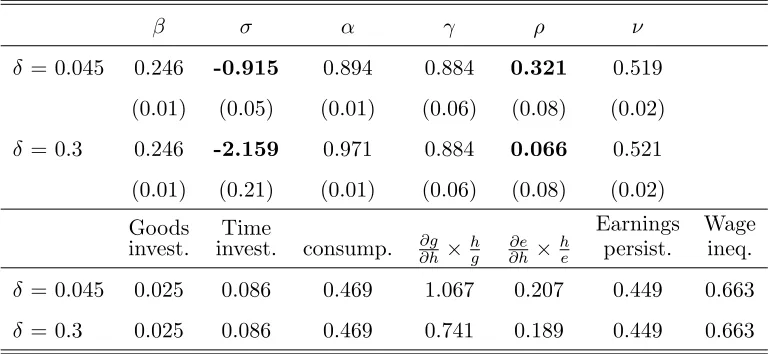
the model with δ as an additional parameter. The estimation yields δ = 0.045. However, the standard errors ofσ,ρ and δ are large. The model fails to precisely identify time-goods substitutability (σ), persistence in learning ability (ρ) and higher productivity of more able parents (δ), because the product of δ and σ enters the exponential term in the production of human capital.16. We proceed by fixingδ at different values and estimating the rest of the parameters. Generally we find the distance between model and data
moments increases slightly with δ, supporting a low δ.17 Table 8 reports the results with δ fixed at 0.045 and 0.3. When δ is higher, the estimated persistence in learning ability ρ is much lower. Substitutability between
15
Proof of the proposition withδin human capital production function is available upon
request.
16
We thank Dean Corbae for pointing this out.
17
The existing literature provides some indirect evidence in support of a positiveδ. For
example, more educated parents are less likely to use non-parental child care (Leibowitz
(1974a)). Subsidized non-parental care tends to have positive impact on outcomes for
disadvantaged children whose parents on average have lower income and education
attain-ment, but negative impact for children from more educated families. See Blau and Currie
goods and time is also lower, which enables the model to match the positive
[image:34.612.113.499.195.372.2]wage gradient of goods investment in the data.
Table 8: Estimation results with fixed δ
β σ α γ ρ ν
δ = 0.045 0.246 -0.915 0.894 0.884 0.321 0.519
(0.01) (0.05) (0.01) (0.06) (0.08) (0.02)
δ = 0.3 0.246 -2.159 0.971 0.884 0.066 0.521
(0.01) (0.21) (0.01) (0.06) (0.08) (0.02)
Goods
invest. invest.Time consump. ∂g∂h×hg ∂h∂e ×he
Earnings persist.
Wage ineq.
δ = 0.045 0.025 0.086 0.469 1.067 0.207 0.449 0.663
δ = 0.3 0.025 0.086 0.469 0.741 0.189 0.449 0.663
The table reports estimation results for the extended model for two cases,
δ= 0.045 and δ= 0.3. Implied model moments are also reported.
5.1.3 Policy effects in the extended model
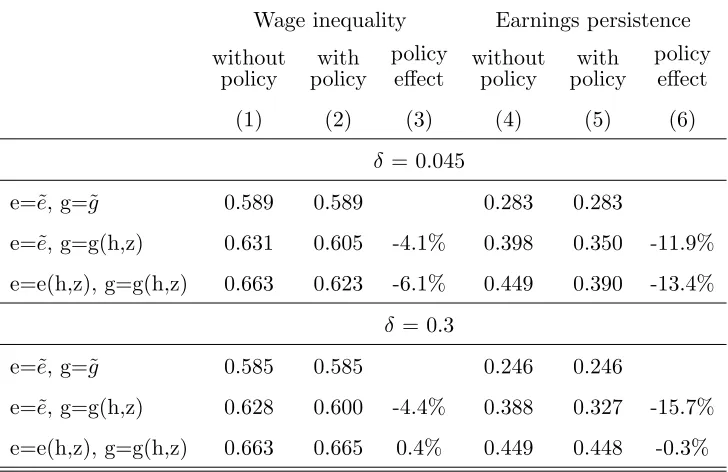
Table9reports the policy effects given different values ofδ. A higherδmeans more of the inter-generational effect is driven by time investment. Compared
with the baseline case, the public policy induces even more parental
invest-ment, hence is less effective in reducing the inter-generational effect. The
table also shows that if time investment is fixed (e=˜e), then policy effects increase with δ.
Table 9: Wage Inequality and earnings persistence from different δ
Wage inequality Earnings persistence
without
policy policywith
policy
effect withoutpolicy policywith
policy effect
(1) (2) (3) (4) (5) (6)
δ = 0.045
e=˜e, g=˜g 0.589 0.589 0.283 0.283
e=˜e, g=g(h,z) 0.631 0.605 -4.1% 0.398 0.350 -11.9%
e=e(h,z), g=g(h,z) 0.663 0.623 -6.1% 0.449 0.390 -13.4%
δ = 0.3
e=˜e, g=˜g 0.585 0.585 0.246 0.246
e=˜e, g=g(h,z) 0.628 0.600 -4.4% 0.388 0.327 -15.7%
e=e(h,z), g=g(h,z) 0.663 0.665 0.4% 0.449 0.448 -0.3%
The table reports the decomposition of persistence and inequality for two
cases, δ = 0.045 andδ = 0.3. Overall policy effects are weaker when δ is
Figure 3: Comparing transition paths from differentδ
1 2 3 4 5 6 7 −0.04 −0.035 −0.03 −0.025 −0.02 work hour δ=0 δ=0.2
1 2 3 4 5 6 7 0.0238 0.024 0.0242 0.0244 0.0246 leisure
1 2 3 4 5 6 7 0.04 0.06 0.08 0.1 0.12 time investment
1 2 3 4 5 6 7 −0.9
−0.85 −0.8 −0.75 −0.7
private goods investment
1 2 3 4 5 6 7 −0.1
0 0.1 0.2 0.3
total goods investment
1 2 3 4 5 6 7 −0.05 0 0.05 0.1 0.15 consumption
1 2 3 4 5 6 7 0 0.05 0.1 0.15 0.2 wage rate generation
1 2 3 4 5 6 7 −0.08 −0.06 −0.04 −0.02 0 wage inequality generation
1 2 3 4 5 6 7 −0.1
−0.05 0
persistence
generation
The figure shows percentage changes due to the implementation of the
public policy, given different value of δ. Tax rate is 5%.
persistence. However, the policy is more efficient in promoting human capital
accumulation, because the reinforcing mechanism illustrated in Figure 1 is
even stronger with a positive δ.
5.2
The substitutability between goods and time
in-vestment
The substitutability between time and goods investment plays a key role in
this paper. In reality, some activities, such as baby sitting, appear to be more
easily substituted by purchased child care. Others, such as breastfeeding, are
the overall substitutability for which there exists little direct evidence. The
observed positive wage/education gradient of parental time can serve as an
indirect evidence. In this subsection we provide a summary of relevant studies
in the literature.18
The literature of home production typically finds a large elasticity of
substitution between goods input and home production time. However, the
production of children’s human capital should be different from usual home
production because time with children has totally different patterns from
other home production time. Due to the lack of direct evidence, some
theo-retical papers assume unit elasticity so that time and goods are combined in
Cobb-Douglas form (Trostel (1993)).
A number of empirical observations imply that parental child care can
be substituted to some extent. Leibowitz (1974a) shows that child care time
is reduced when non-parental child care is present, and such an effect is
most significant among less educated mothers. Government programs that
provide universal day care typically induce more maternal participation in
the labor market, and crowd out some child care time from mothers (Baker
et al. (2008), Havnes and Mogstad (2009) and Gupta and Simonsen (2010)).
On the other hand, there exist a number of empirical observations that
are consistent with a low substitutability.
First, maternal labor market participation only leads to a small-sized
reduction in mother’s child care time, and leads to increased child care time
of fathers (See Leibowitz (1974a), Bianchi (2000), Sandberg and Hofferth
18
We are grateful to a referee for suggestions which led to the development of this
(2001) and references therein). After entering the labor market, mothers tend
to cut back leisure and home production time unrelated to child care, but try
to preserve their time with children. This phenomenon is more pronounced
among more educated women. Using Dutch data, Annemarie Nelen and
Fouarge (2011) even find that maternal working hours are positively related
with planned activities with children, such as going together to a museum or
library.
Second, recent studies revealed the negative impact of maternal labor
market participation on child outcome. Although earlier studies on this
is-sue had reached different conclusions, more recent ones generally document
negative effects. Ruhm (2004) shows that maternal employment has a
nega-tive impact on a child’s verbal ability, and reading and mathematics
achieve-ment.19 Bernal and Keane (2011) further document a significantly negative
and sizeable effect of the increased single mother employment caused by the
1996 Welfare Reform Law along with earlier state policy changes adopted
under federal waivers.
Third, the literature on the correlation between child outcomes and
pro-vision of universal child care programs by governments generally favors a low
substitutability. Baker et al. (2008) use data from Quebec and find that
chil-dren are worse off by a wide range of measures which are likely to be caused
by less and lower quality maternal care. Based on Danish data, Gupta and
Simonsen (2010) show that, compared to parental care, low-quality
non-19
Ruhm (2004) reviewed the existing literature and found that his conclusion is
consis-tent with the most recent analysis , and suggests that the inconsistency with earlier ones
parental care (obtained from so-called family day care) significantly worsens
child outcomes20. Havnes and Mogstad (2009) show that the subsidized child
care program crowds out informal care arrangements from friends, relatives
and unlicensed care givers, leaving parental care virtually unchanged.
Fourth, there exists strong evidence that children with lower birth
or-der (those who are born earlier) have better outcomes. These children on
average receive much more parental time investment than their younger
sib-lings (Price (2008)). On the other hand, they are likely to receive less goods
investment, because parent’s income on average increases with age. The
sig-nificantly better outcomes of children with lower birth order are consistent
with our low substitutability assumption.
From the above discussion, it is not unreasonable to assume that the
sub-stitutability between time and goods is low on average, even though some
parenting activities are clearly more substitutable. Leibowitz (2003) provides
a discussion about why the substitutability appears to be low. First, it is
difficult to monitor the quality of purchased child care. A hired nanny or
babysitter may not spend her time investing in the child’s human capital,
but enjoying her own time at the expense of the child. Secondly, the
psy-chological and sociological literature emphasizes that parent-child bonding
affects child’s development, which is further supported by neurobiologists
(See the references in Leibowitz (2003). Also see Belsky (1988).) Thus, even
for activities such as baby sitting, it is not completely safe to say they can
20
Gupta and Simonsen (2010) also show that enrollment in high-quality preschool does
not lead to significantly different child outcomes, but longer hours in non-parental care
be substituted by purchased care.
5.3
Parental time and public spending on education –
cross country comparison
In Proposition I, we make two predictions regarding parental time and public
spending on education. We roughly check these predictions with cross
coun-try data.21 We use the parental time reported in Guryan et al. (2008) and
public spending on education reported by the World Bank. Figure 4 plots
child care time by working women against public spending on education per
capita. Consistent with proposition I, child care time increases with
pub-lic investment. This relationship also holds for working men. On the other
hand, we find a very weak correlation between education gradient of
parent-ing time by workparent-ing mothers and public spendparent-ing – correlation coefficient
is 0.18 with standard error equals 0.31. In summary we find strong support
for the positive correlation between parental time and public investment, but
little support for the wage gradient of parental time to decreasing with public
investment.
5.4
Other forms of parental altruism
For transparency and tractability, this paper assumes a simple form of parental
altruism – parents care only about the wage rate of their children. In this
21
We are grateful to a referee for suggestions which led to the development of this
Figure 4: Public investment and child care time
0 50 100 150 200 250
4 5 6 7 8 9 10
public spending on education per capita
child care hours −− level
Austria Canada
Chile Estonia
France Germany Italy
Netherlands
Norway
South Africa
UK
US
The figure shows the correlation between public spending on education
subsection we discuss other forms of altruism.22
5.4.1 Financial transfer
We extend our model to admit financial transfer from parents to children.
Let bi be the transfer from the ith parents who maximize max
ci,ni,ei,gi,bi
lnci+γlnni+βlnh′i+φlnbi
subject to
ci+gi+bi = (1−ei−ni)wi
(17)
Letg∗
and e∗
be the optimal goods and time investment in the baseline
model given {hi, zi}, the optimal goods and time allocation in this extended model is
g = 1 +γ+β 1 +γ+β+φg
∗
and
e= 1 +γ+β 1 +γ+β+φe
∗
Therefore compared with the baseline model, optimal time and goods
investment are reduced by a fixed proportion. As a result, the analytical
properties regarding time allocation and policy effects derived in the
previ-ous sections still hold. Since parents allocate relatively less time and goods
to human capital production compared with the baseline case, the extended
model must attribute a larger part of observed intergenerational persistence
22
We are grateful to a referee for suggestions which led to the development of this
to the “nature effect”, i.e., the persistence in learning ability. Hence
quanti-tatively public policy would be less effective.
5.4.2 Infinite horizon
Another form of parental altruism is to assume that parents care about the
value of their children, which include children’s own utility and the value of
grandchildren. The problem essentially becomes an infinite horizon one with
the following objective function for parents.
max
c,n,e,gE
∞ X
t=1
βtu(ct, nt)
where u(ct, nt) = lnct+γlnnt is the utility of the tth generation, and E is the expectation operator, taken with respect to the learning ability of future
generations.
In this setup, the time-goods investment ratio is the same as in the
base-line model which is e g =
1−α
α
σ1
−1 hσ−11. However, income tax would reduce goods investment to a greater extent23. This is because forward-looking
par-ents care about the future generations’ consumption and leisure which are
directly affected by tax. To see this point, we derive the first order conditions
with respect to time and goods investment given income tax rate τ.
(1−τ)wt
∂u(ct, nt) ∂ct =
∂ht+1
∂et
(1−τ)(1−nt+1−et+1)
∂u(ct+1, nt+1)
∂ct+1
∂u(ct, nt)
∂ct
= ∂ht+1
∂gt
(1−τ)(1−nt+1−et+1)
∂u(ct+1, nt+1)
∂ct+1
It is easy to show that the first order conditions are exactly the same as
those in the baseline model, except for the extra term in brackets which is
23
the marginal value of human capital. In the baseline model, the marginal
value is 1, because parents care about children’s human capital itself. Here,
the marginal value is measured by marginal utility, and lowered by tax rate
τ. Therefore, compared with the baseline case, parental goods investment is reduced to a greater extent. However, the public investment still stimulates
parental time investment due to time-goods complementarity.
6
Conclusion
This paper is motivated by the data observation that parents with higher
wage or education attainment spend more time teaching and taking care of
their children. We show this is consistent with a model of inter-generational
transmission of human capital. A key feature of the model is the low
sub-stitutability between goods and parental time investment in the production
of children’s human capital. We also show that the positive wage/education
gradient of parental investment is reduced by the policy that taxes income
to finance public schooling.
We use the parameterized model to quantitatively study the impact of the
public policy on resource allocation and wage structure. We first show that
parental investment contributes to wage inequality and earnings persistence,
but the contribution is decreased by the policy. Then we derive the
transi-tion paths of the economy from the old equilibrium without public policy to
the new one. The policy leads to increased wage rate, but decreased wage
inequality and earnings persistence. Consumption is decreased initially, but
The public policy triggers a reinforcing mechanism among time
invest-ment, public investment and human capital accumulation. This reinforcing
mechanism does not exist in the traditional model where time investment
is exogenous. Therefore the policy is more effective in our model relative
to a traditional one. This point is made clear as we quantitatively
com-pare the results between our model and a version of the traditional model.
Given the strong evidence that parents use time investment as a means of
inter-generational human capital transmission, we recommend our model as
a framework to analyze relevant public policies.
As an extension to our model we allow parents with more human capital to
be more efficient in time investment. Compared with the baseline case,
pub-lic popub-licy becomes less effective in reducing inequality and intergenerational
persistence, but more effective in promoting human capital accumulation.
We also discuss briefly the implications of alternative forms of parental
altruism. It is worthwhile to study some other extensions. For example,
the model can be enriched by embedding a life-cycle model in the OLG
framework, which facilitates the study of rich dynamics among consumption,
saving and human capital production. This would also allow us to examine
how credit constraints impede human capital formation, and how the
prob-lem can be relieved by public policy. We leave detailed discussion of these
7
Appendix
7.1
Data Appendix
In this paper we estimate the model parameters by matching seven key
mo-ments in the model to their data counterparts. Except for the moment of
inter-generational correlation in earnings which is taken from Solon (1992),
all the moments are obtained from the 2003 waves of the American Time Use
Survey and the Consumer Expenditure Survey.
The American Time Use Survey is conducted by the U.S. Bureau of
La-bor Statistics (BLS) and the data are available from the BLS website. Using
the time use taxonomy introduced in Aguiar and Hurst (2007), we consider
three categories of parental time with children: basic child care, teaching,
and playing. Teaching children includes activities such as reading to/with
children, talking/listening to children, and helping children with their
home-work. Clearly these should be regarded as time investment. Much of the
time categorized as basic child care and playing with children is beneficial
or auxiliary to the development of human capital. For example, “basic child
care” includes activities such as picking up children from school, attending
children’s events; “playing with children” includes playing sports with
chil-dren, doing arts and crafts with chilchil-dren, etc. Therefore we take the sum
of the three categories as the proxy for parental time investment. We proxy
leisure with the time spent on activities related to the following: lawn, garden
and houseplants, animals and pets, socializing and relaxing, sports, exercise
and recreation, telephone calls, household and personal mail, travel related
is precisely “leisure measure two” in Aguiar and Hurst (2007).
Consumer Expenditure Survey data are publicly available from the NBER
collection. Educational expenditure has three categories in the data. The
first one is tuition for college (higher education). The second one is the
tuition for Nursery, Elementary, and Secondary Education. This category
includes tuition for elementary and high school, payment for private school
bus, and other expenses for day care centers and nursery schools. The third
category, other educational service, includes tuition for other schools, rental
of books and equipment and other school-related expenses, and contributions
to educational organizations. We take the sum of the three as the proxy
for goods investment in children’s human capital. The survey provides no
information on whether these expenditures are for children or not, therefore
we delete the observations of families whose head of household is younger
than 25 or not married or have no children. Consumption is measured by
the sum of expenditures on nondurable non-educational goods and services.
We need to calculate educational expenditure normalized by wage rate.
We also need to regress educational expenditure on wage rate to compute the
response of goods investment with respect to parents’ wage rate. Since the
data set provides only family level expenditures, the corresponding wage rate
should also be at the family level. We take wage rate to be the sum of both
spouses’ wage divided by the sum of work hours. i.e.,w= whusband+wwif e
hourshusband+hourswif e.
Note that for both spouses, CEX provides information about annual wage,
weeks worked in the year and hours worked in each week.
In both ATUS and CEX, we delete observations that have one of the