Inter-center variation in the efficiency of sperm
DNA damage reduction following density
gradient centrifugation
Carmen López-Fernández1*, Stephen D. Johnston2, Altea Gosálbez1, Jose Luís Fernández3, Juan G. Álvarez4, Jaime Gosálvez1
1Department of Biology, Genetics Unit, University Autónoma of Madrid, Madrid, Spain; *Corresponding Author: [email protected]
2School of Agriculture and Food Science, The University of Queensland, Gatton, Australia
3Laboratorio de Genética Molecular y Radiobiología, Centro Oncológico de Galicia, A Coruña, Spain 4Centro ANDROGEN, A Coruña, Spain
Received 23 May 2013; revised 24 June 2013; accepted 2 July 2013
Copyright © 2013 Carmen López-Fernández et al. This is an open access article distributed under the Creative Commons Attribution License, which permits unrestricted use, distribution, and reproduction in any medium, provided the original work is properly cited.
ABSTRACT
This was a prospective multicenter study aiming at comparing the efficiency of sperm selection by density gradient centrifugation (DGC) in re- ducing sperm DNA fragmentation (SDF) in dif- ferent ART centers. The study was designed using 290 semen samples collected from 10 different ART centers performing artificial in- semination, in vitro fertilization and blind as- sessment of SDF at the University facilities. The results showed that while there was a significant reduction in the SDF levels in sperm isolated from the gradient centrifuged pellet (DGC) com- pared to neat semen samples (NSS), there was also significant inter-center variability in the ef- ficiency to reduce SDF values by DGC (78.5% to 29.2%). Surprisingly, for some patients, the level of SDF actually increased following sperm se- lection. The main conclusions derived from this study were that 1) isolation of sperm from the gradient pellet by DGC must be performed using validated, optimized protocols; 2) routine com- parison of SDF values in NSS semen and in processed sperm after DGC or swim-up must be recommended as part of the internal quality control (QC) of ART laboratories to test the effi- cacy of sperm processing; and 3) SDF values in processed spermatozoa should be obtained to compare with the pregnancy rate when insemi- nation or fertilization is about to be performed, otherwise, attempts to predict pregnancy out- come from SDF could be biased or are essen- tially meaningless.
Keywords:Assisted Reproductive Technology; Fertility; Sperm DNA Fragmentation; Male Factor; Semen Processing
1. INTRODUCTION
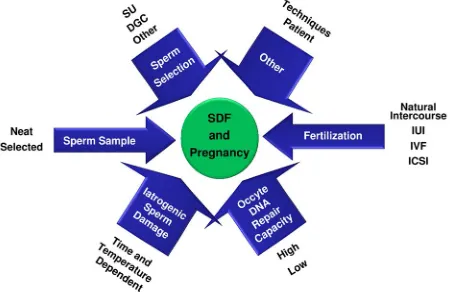
Predicting the success rate of human pregnancy using estimates of sperm DNA damage to date has been a very controversial issue, and that is no doubt further compli- cated by a plethora and permutation of techniques and procedures that vary in competency and delivery from laboratory to laboratory, all of which result in a funda- mental lack of standardization. Figure 1 illustrates some
[image:1.595.311.536.559.705.2]of the potential factors impacting on the success of SDF as a predictive measure and its relative interconnected- ness with other assisted reproduction parameters. These variables include 1) the type of fertilization technique
Figure 1. Factors affecting the reliability of sperm DNA
(e.g.natural intercourse, intrauterine insemination [IUI],
in vitro fertilization [IVF] and intra cytoplasmic sperm
injection (ICSI) [1-11]); 2) the use of neat or selected spermatozoa [4,12]; 3) the specific techniques used for sperm selection such as swim-up, density gradient cen- trifugation (DGC) whether used alone or in combination with intracytoplasmic morphologically-selected sperm injection (IMSI), Physiological ICSI (PICSI) or Mag- netic activated cell sorting (MACS) [13-16]; 4) iatro- genic induced sperm damage during sperm ex vivo han- dling [17,18]; 5) the type of technique used to assess DNA damage [19]; and 6) the quality of the donor oocyte [20-22].
Given the wide range of variables that contribute to the success of an ART outcome, it is therefore not sur- prising that this variability is also reflected in the ability of sperm DNA fragmentation (SDF) to predict pregnancy outcome. This concept is well illustrated if we consider just one of the variables in Figure 1, such as sperm se-
lection. In order to improve the predictive power of SDF it is important that we account and describe the precise conditions used when conducting our sperm selection procedure; these issues might include how long the sperm was stored after ejaculation and prior to sperm selection, what specific type of sperm selection proce- dure was employed, for how long and under what condi- tions was the sperm sample stored or incubated prior to fertilization and what was the quality of the donor oo- cytes to be used? In fact, it is logical to assume that the quality of the oocyte contributes a minimum of 50% to predictive nature of sperm DNA for pregnancy outcome.
We would, therefore, contend that if SDF is to be used as a predictive measure of pregnancy success, then there needs be close attention given to standardizing the spe- cific processes and conditions of ART that are used in the different laboratories. Even when such standardization is accounted for, there is still the potential for innate vari- ability in the efficiency of SDF reduction usually ob- served after sperm selection among different individuals processed within the same laboratory [23]; this pheno- menon is likely to be related to inherent differences as- sociated with the ejaculate of each patient, to the techni- cal competencies of the respective andrologist’s ability to process the sperm sample or a synergistic combination of both. In the current study, we explore this general idea by investigating the relative efficiency of standardized den- sity gradient centrifugation protocols (DGC), as rou- tinely used in ART clinics to improve sperm DNA qua- lity.
2. MATERIAL AND METHODS
A total of 290 semen samples from 10 different Span- ish ART Centers performing artificial insemination and
in vitro fertilization were included in this study. All pa-
tients consented to their participation according Spanish legislation and confidentiality and following adherence to Spanish government ethical standards and the internal ethics committee of the participating clinic. The study used a double blind strategy for sperm collection and for sperm analysis. All the semen samples were processed in each clinic as per “in house” standard protocols. Two semen samples per ejaculate were prepared for SDF analysis; 1) Neat semen samples (NSS) were cryopre- served using standard procedures following immediate liquefaction of the ejaculate; and 2) Selected semen sam- ples were processed following liquefaction and density gradient centrifugation (DGC) at the time equivalent to that of fertilization and then cryopreserved as per the NSS to be analyzed at a different facility. Each sample was processed using the standard methodologies for DGC as routinely used in each clinic; consequently in our analysis of results we made no attempt to standardize reagents or methodologies used for DGC in each center or methodologies used for cryopreservation. Rather, we focussed our attention on the final net result of the effi- ciency to reduce the level of SDF with respect to the NEAT recovered in each clinic.
Semen samples were collected from case studies of patients and the decision for patient inclusion was taken by an andrologist without coordination or reference to technicians processing the samples. In order to be in- cluded in the study, the neat semen samples were re- quired to have a sperm concentration of greater than 20 x 106 per mL and a sperm motility of >50%. Patients with varicocele, teratozoospermia, oligozoospermia, leukocy- tospermia were excluded from the study. Cryopreserved samples from each center were sent to the Unit of Ge- netics at the University Autónoma de Madrid, where all the samples were assessed for sperm DNA damage (Ha- losperm G2-Halotech, Madrid, Spain) by the same tech- nician.
To avoid iatrogenic DNA damage, SDF was immedi- ately assessed after thawing. NSS and DGC samples were diluted to achieve a concentration of 10 × 106 per ml in Modified Ham’s F-10 Basal Medium—HEPES (Irvine Scientific, CA, USA) and assessed for the level of SDF. After comparing the values of SDF using Halos- perm G2 (Halotech, Madrid, Spain) obtained for NSS and DGC samples, the efficiency in sperm DNA damage reduction, defined as the e-value (percent reduction of
SDF when NSS and DGC samples are compared) was calculated.
compare two related samples. The Fisher’s Least Sig- nificant Difference test was used to compare and arrange differences in the efficiency to reduce SDF using group means. Correlation analysis was performed using a non- parametric Pearson test.
3. RESULTS
Table 1 shows the mean and standard deviation of
NSS and DGC samples and e-value for each ART center.
Figure 2 summarizes the descriptive statistics of SDF
values across the 10 ART centers examined in this study. There were significant differences in mean SDF values of both NSS (Kruskal-Wallis; χ2 = 9.7; P = 0.00) and
DGC (Kruskal-Wallis; χ2 = 78.1; P = 0.00) when differ-
ent centers were compared (Figures 2(a) and (b)). When
data for all ART centers was pooled and the efficiency
Table 1. Mean ± (SD) values for sperm DNA fragmentation
(SDF) of neat semen samples (NSS) and density gradient cen- trifuged (DGC) samples obtained in 10 different ART centers. The efficiency for SDF reduction—e-value—was expressed as
the percentage of variation obtained for SDF after comparing NSS and DGC.
Control n NSS DCG Reduction in SDF e-value
1 13 32.2 ± 3.6A 17.3 ± 3.2B 49.6 ± 9.6
2 21 21.8 ± 2.8A 5.2 ± 2.5B 76.0 ± 7.5
3 19 26.8 ± 3.0A 9.7 ± 2.6B 67.1 ± 7.9
4 30 43.9 ± 2.4A 28.8 ± 2.1B 34.1 ± 6.3
5 18 37.1 ± 3.1A 9.7 ± 2.7B 71.6 ± 8.1
6 45 26.3 ± 1.9A 14.8 ± 1.7B 36.2 ± 5.1
7 27 25.5 ± 2.5A 6.8 ± 2.2B 78.5 ± 6.6
8 40 18.5 ± 2.0A 12.7 ± 1.8B 29.1 ± 5.4
9 33 30.0 ± 2.3A 17.1 ± 2.0B 44.8 ± 6.0
10 44 27.1 ± 1.9A 11.3 ± 1.7B 60.6 ± 5.2
Pooled 290 28.9 ± 7.4A 13.3 ± 6.8B 54.8 ± 18.4
Figure 2. Box Whisker plot showing the distribution of sperm
DNA fragmentation (SDF) in (a) neat semen samples (NSS); and (b) density gradient processed (DGC) semen samples from different Spanish ART centers (1 - 10); (c) Pooled mean in NSS and DGC SDF values for all centers.
for SDF calculated, there was a 54.8% reduction in SDF (e-value = 54.8%) following DGC (Table 1 and Figure 2(c)). There were significant differences in the efficiency
for SDF reduction between the different centers (Krus- kal-Wallis; χ2 = 87.1; P = 0.00).
ART centers were then ranked according to their re- spective e-value (Table 2). Center 7 was very successful
in selecting high-quality sperm from the DGC pellet with an overall reduction efficiency of approximately 80%. At the other end of the spectrum, Center 6 had a reduction efficiency of only 29%. Following analysis using the Fisher’s Least Significant Difference test to compare group means, significant differences in the efficiency to reduce SDF were obtained, whereby it was possible to statistically differentiate 5 different levels of centers based on their efficiency to reduce SDF (Table 2). This
analysis essentially revealed that 5 clinics were efficient at reducing SDF, ranging from an e-value of 60% to 80%,
while the remainder presented an e-value ranging be-
tween 30% and 50%.
Although the raw data are not presented, 8% of indi- vidual patient cases across all the centers actually re- sulted in an increase of SDF following selection by DGC when compared to the corresponding neat semen samples. The lowest efficiency was observed again in Center 6, where 20% (9/45 cases) of the samples subjected to DGC yielded higher levels of DNA damage in the DGC pellet compared to the NSS.
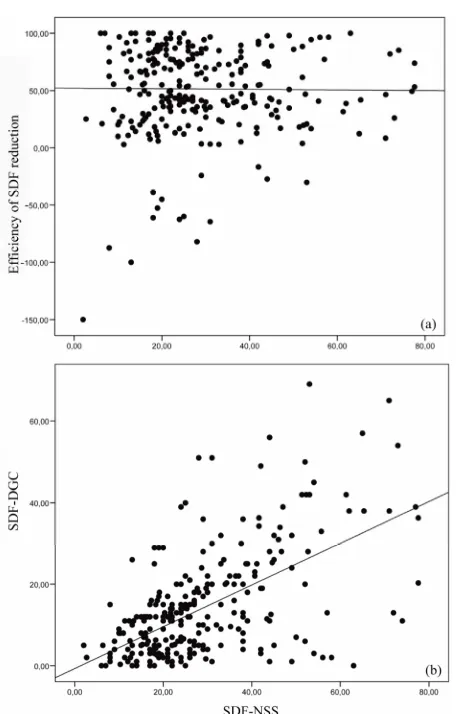
As differences were found in the SDF of the neat se- men samples from the different clinics, we examined by means of a correlation analysis, whether the e-value, was
dependent on the initial SDF of the neat semen sample. This analysis revealed no significant correlation between these variables (Pearson = −0.01; n = 290; Figure 3(a));
this lack of correlation was also upheld when the data for
Table 2. Efficiency of sperm DNA fragmentation (SDF) re-
ducetion in each center and ranking efficiency per center. Five different groups (ranked and groups from 1 to 5 in the right column) were predicted according to the Fisher’s Least Significant Difference test; e-value represents SDF reduction
after comparing SDF values obtained in NSS and DGC.
Centre % SDF Reduction (e-value) Mean Group Rank
7 78.5 1
2 76.0 21
5 71.6 321
3 67.1 321
10 60.6 43
1 49.6 54
9 44.8 5
6 36.2 5
4 34.1 5
Figure 3. Graphic representation of the correlation between (a)
% sperm DNA fragmentation (SDF) of the neat semen sample (NSS) and the efficiency of sperm DNA fragmentation (SDF) reduction and (b) SDF of NSS plotted against SDF in DCG samples.
each center was plotted separately. Collectively, these findings appear to indicate that the SDF value in the NSS was not influencing the efficiency of the selection pro- cedure in reducing SDF in the DGC pellet.
Despite the lack of correlation between the level of SDF in the NSS and the efficiency for SDF reduction after DGC, there was still a significant correlation, using Pearson’s test (Pearson = 0.58; P < 0.01; n = 290), be- tween SDF observed in the NSS and SDF obtained in DGC samples (Figure 3(b)), i.e. generally low/high lev-
els of SDF in the NS give rise to low/high SDF following the DGC procedure.
4. DISCUSSION
Two main conclusions emerge of this study 1) in gen-eral, there was a significant reduction in the levels of SDF in sperm isolated in the gradient pellet following DGC; and 2) there was significant inter-center variability
in the efficiency to select DNA intact spermatozoa from the gradient pellet following DGC.
The reported reduction in sperm DNA damage after sperm selection is not a novel observation as this effect has been previously reported in other studies [14,24-26]. Rather, the uniqueness of this study was that it examined the efficiency to achieve such a reduction across multiple centers; it was clear from our analysis that the level of SDF reduction was significantly different across the ART centers. It is highly likely that this variability in the effi- ciency of sperm recovery with low levels of DNA dam- age will have a significant impact on the pregnancy rate achieved in each of the respective centers, since the probability of selecting one sperm containing a damaged DNA molecule is expected to be higher if the efficiency to remove the damage is low. Our results suggest that it would be prudent for some centers to develop better methods of quality control for the sperm selection pro- cedures.
[image:4.595.60.288.78.435.2]In the present study and according to the grouping cri- teria obtained from the Fisher’s Least Significant Diffe- rence test (Table 2), Centers 7, 2, 5 and 3 (as ranked in Table 2) showed the most efficiency in terms of relative
sperm DNA quality improvement. The e-value for SDF
reduction in this group ranged from 68% - 78% while those in less efficient group (Centers 8, 4, 6, 9 and 1) ranged from 30% to 50%. We perceive three plausible explanations for these observations. Firstly, we suggest that the inter-center differences are related to the possible differences in the design and performance of the DGC protocol, which may be related to centrifugation speed, centrifugation time and the ability to aspirate a clean pellet. We also suggest that the skill associated with the isolation of the different density gradient layers may also be a significant factor contributing to this variability, because layer mixing and contamination may occur dur- ing aspiration of fractions 1 and 2, where the highest levels of immature spermatozoa and the higher levels of affected sperm are typically found [27]. This is likely to be the most parsimonious explanation and would pos- sibly account for those cases where the level of SDF af- ter DGC was actually higher than that found in the NSS.
The other potential explanation for the observed vari- ability between clinics with respect to the efficacy in the reduction of spermatozoa with DNA damage after DGC could be the often overlooked negative impact of iatro- genic damage prior to, during and following sperm se- lection. Sperm DNA damage tends to increase after eja- culation and differences in the sperm DNA longevity exists among different individuals. This phenomenon has been previously been described [31,32] and appears to be related to the lag time between sperm selection and DNA damage analysis. The dilemma as we see it is that the high efficiency of SDF reduction in some centers (close to 80%) may in fact only be compensating for the iatro- genic DNA damage inherent to the DGC protocol, ren- dering the DGC a potentially redundant process. When the level of SDF after the DGC protocol is higher than that of the NSS, as it happens in some of the cases re- ported in this study or published elsewhere [23], the rea- lity is that we may be wasting our time and in fact, in some cases actually reducing the chance of successful pregnancy by increasing the level of SDF when exposing sperm to selection procedures.
5. CONCLUSIONS
We derive three main “take-home” messages from this study: 1) isolation of sperm from the gradient pellet by DGC must be performed using validated, optimized pro- tocols; this should reduce the observed inter-center varia- tion, not only in SDF values but also for other seminal parameters; 2) routine comparison of SDF values in NSS and DGC or swim-up should be recommended as part of the internal quality control of the ART laboratory to test the safety and efficacy of sperm processing; and 3) SDF values in processed spermatozoa should be obtained to compare with the pregnancy rate when insemination or fertilization is about to be performed, otherwise, attempts to predict pregnancy outcome from SDF could be essen- tially confusing if not meaningless.
6. ACKNOWLEDGEMENTS
The author(s) declared no potential conflicts of interest with respect to the research, authorship, and/or publication of this article. This re-search was supported with public funding (Spanish Ministry of Science and Technology (MCYT: BFU2010-16738).
REFERENCES
[1] Lopes, S., Sun, J.G., Jurisicova, A., Meriano, J. and Cas- per, R.F. (1998) Sperm deoxyribonucleic acid fragmenta- tion is increased in poor-quality semen samples and cor- relates with failed fertilization in intracytoplasmic sperm injection. Fertility and Sterility, 69, 528-532.
doi:10.1016/S0015-0282(97)00536-0
[2] Evenson, D.P., Jost, L.K., Marshal, D., Zinaman, M.J., Clegg, E., Purvis, K., De Angelis, P. et al. (1999) Utility of the sperm chromatin structure assay as a diagnostic and prognostic tool in the human fertility clinic. Human Reproduction, 14, 1039-1049.
doi:10.1093/humrep/14.4.1039
[3] Spano, M., Bonde, J.P., Hjollund, H.I., Kolstad, H.A., Cordelli, E. and Leter, G. (2000) Sperm chromatin da- mage impairs human fertility. The Danish first pregnancy planner study team. Fertility and Sterility, 73, 43-50.
[4] Bungum, M., Humaidan, P., Spano, M., Jepson, K., Bun- gum, L. and Giwercman, A. (2004) The predictive value of sperm chromatin structure assay (SCSA) parameters for the outcome of intrauterine insemination, IVF and ICSI. Human Reproduction, 19, 1401-1408.
doi:10.1093/humrep/deh280
[5] Collins, J.A., Barnhart, K.T. and Schlegel, P.N. (2008) Do sperm DNA integrity tests predict pregnancy with in vitro
fertilization? Fertility and Sterility, 89, 823-831.
doi:10.1016/j.fertnstert.2007.04.055
[6] Bakos, H.W., Thompson, J.G., Feil, D. and Lane, M. (2008) Sperm DNA damage is associated with assisted reproductive technology pregnancy. International Journal of Andrology, 31, 518-526.
doi:10.1111/j.1365-2605.2007.00803.x
[7] Castilla, J.A, Zamora, S., Gonzalvo, M.C., Luna Del Castillo, J.D., Roldan-Nofunentes, J.A., Clavero, A. et al.
(2010) Sperm chromatin structure assay and classical se- men parameters: Systematic review. Reproductive Bio- medicine Online, 20, 114-124.
doi:10.1016/j.rbmo.2009.10.024
[8] Gandini, L., Lombardo, F., Paoli, D., Caruso, F. Eleuteri, P., Criminna, R. et al. (2004) Full-term pregnancies achi-
eved with ICSI despite high levels of sperm chromatin damage. Human Reproduction, 19, 1409-1417.
doi:10.1093/humrep/deh233
[9] Li, Z., Wang, L., Cai, J. and Huang, H. (2006). Correla- tion of sperm DNA damage with IVF and ICSI outcomes: A systematic review and meta-analysis. Journal of As- sisted Reproduction and Genetics, 23, 367–376.
doi:10.1007/s10815-006-9066-9
[10] Virro M.R., Larson-Cook, K.L. and Evenson, D.P. (2005) Sperm chromatin structure assay (SCSA) parameters are related to fertilization, blastocyst development, and on- going pregnancy in vitro fertilization and intracytoplamic sperm injection cycles. Fertility and Sterility, 81, 1289-
1295. doi:10.1016/j.fertnstert.2003.09.063
[11] Simon, L., Castillo, J., Oliva, R. and Lewis, S.E. (2011) Relationships between human sperm protamines, DNA damage and assisted reproduction outcomes. Reproduc- tive Biomedicine Online, 23, 724-734.
doi:10.1016/j.rbmo.2011.08.010
[12] Santiso, R., Tamayo, M., Gosálvez, J., Meseguer, M. Garrido, N and Fernandez, J.L. (2010) Swim-up proce- dure selects spermatozoa with longer telomere length.
Mutation Research, 688, 88-90.
doi:10.1016/j.mrfmmm.2010.03.003
human sperm capacitated by multiple-tube swim-up and Percoll gradient centrifugation. Journal of in Vitro Fer- tilization and Embryo Transfer, 5, 119-122.
doi:10.1007/BF01131172
[14] Zini, A., Finellia, A., Phanga, D. and Jarvi, K. (2000) Influence of semen processing technique on human sperm DNA integrity. Urology, 56, 1081-1084.
doi:10.1016/S0090-4295(00)00770-6
[15] Bungum, M., Spano, M., Humaidan, P., Eleteri, P., Rescia, M. and Giwercman, A. (2008) Sperm chromatin structure assay parameters measured after density gradient centri- fugation are not predictive for the outcome of ART. Hu- man Reproduction, 23, 4-10.
doi:10.1093/humrep/dem353
[16] Enciso, M., Iglesias, M., Galán, I., Sarassa, J. Gosalvez, A. and Gosalvez, J. (2011) The ability of sperm selection techniques to remove single- or double-strand DNA da- mage. Asian Journal of Andrology, 13, 764-768.
doi:10.1038/aja.2011.46
[17] Mortimer, D. (1991) Sperm preparation techniques and iatrogenic failures of in vitro fertilization. Human Repro- duction, 6, 173-176.
[18] Gosálvez, J., López-Fernández, C., Fernández, J.L., Gou- rand, A. and Holt, W.V. (2011) Relationships between the dynamics of iatrogenic DNA damage and genomic design in mammalian spermatozoa from eleven species. Mo- lecular Reproduction and Developmen, 78, 951-961.
doi:10.1002/mrd.21394
[19] Gosálvez J., López-Fernández, C. and Fernández, J.L. (2011) Sperm Chromatin Dispersion (SCD) test: Techni- cal aspects and clinical applications. In: Zini, A., Agarwal, A., Eds., Sperm DNA damage: Biological and clinical applications in male infertility and assisted reproduction.
Springer Verlag, New York, 151-170.
[20] Menezo, Jr. Y., Russo, G.L., Tosti, E., Moutassim, S. and Benkhalifa, M. (2007) Expression profile of genes coding for DNA repair in human oocytes using pangenomic mic- roarrays, with a special focus on ROS linked decays.
Journal of Assisted Reproduction and Genetics, 24, 513- 520. doi:10.1007/s10815-007-9167-0
[21] Meseguer, M., Santiso, R., Garrido, N., Garcia-Herrero, S., Remohi, J. and Fernandez, J.L. (2011) Effect of sperm DNA fragmentation on pregnancy outcome depends on oocyte quality. Fertility and Sterility, 95, 124-128.
doi:10.1016/j.fertnstert.2010.05.055
[22] Nuñez-Calonge, R., Caballero, P., López-Fernández, C., Guijarro, J.A., Fernandez, J.L., Johnston, S. and Gosalvez, J. (2012) An improved experimental model for under- standing the impact of sperm DNA fragmentation on hu- man pregnancy following ICSI. Reproductive Science, 19,
1163-1168. doi:10.1177/1933719112459238
[23] Gosálvez, J., De La Torre, J., López-Fernández, C., Pe- rez-Gutierrez, L., Ortega, L., Caballero, P. and Nunez, R.
(2010) DNA fragmentation dynamics in fresh versus fro- zen thawed 1 plus gradient-isolated human spermatozoa.
Systems Biology in Reproductive Medicine, 56, 27-36.
doi:10.3109/19396360903515430
[24] Parmegiani, L., Cognigni, G.E., Bernardi, S., Troilo, E., Ciampaglia, W. and Filicori, M. (2010) “Physiologic ICSI”: Hyaluronic acid (HA) favors selection of sper- matozoa without DNA fragmentation and with normal nucleus, resulting in improvement of embryo quality. Fer- tility and Sterility, 93, 598-604.
doi:10.1016/j.fertnstert.2009.03.033
[25] Tavalaee, M., Deemeh, M.R., Arbabian, M. and Nasr- Esfahani, M.H. (2012) Density gradient centrifugation before or after magnetic-activated cell sorting: Which technique is more useful for clinical sperm selection?
Journal of Assisted Reproduction and Genetics, 29, 31-38.
doi:10.1007/s10815-011-9686-6
[26] Ebner, T., Shebl, O., Moser, M., Arzt, W. and Tews, G. (2011) Easy sperm processing technique allowing ex- clusive accumulation and later usage of DNA-strand break-free spermatozoa. Reproductive Biomedicine On- line, 22, 37-43. doi:10.1016/j.rbmo.2010.09.004
[27] Ollero, M., Gil-Guzman, E., Lopez, M.C., Sharma, R.K., Agarwal, A., Larson, K. et al. (2001) Characterization of subset of human spermatozoa at different stages of ma- turation: Implications in the diagnosis and treatment of male infertility. Human Reproduction, 16, 1912-1921.
doi:10.1093/humrep/16.9.1912
[28] Agarwal, A., Makker, K. and Sharma, R. (2008) Clinical relevance of oxidative stress in male factor infertility: An update. American Journal Reproductive Immunology, 59, 2-11. doi:10.1111/j.1600-0897.2007.00559.x
[29] Aitken, R.J. and De Iuliis, G.N. (2010) On the possible origins of DNA damage in human spermatozoa. Molecu- lar Human Reproduction, 16, 3-13.
doi:10.1093/molehr/gap059
[30] López-Fernández, C., Johnston, S.D., Fernández, J.L., Wilson, R.J. and Gosalvez, J. (2010) Fragmentation dy- namics of frozen-thawed ram sperm DNA is modulated by sperm concentration. Theriogenology, 74, 1362-1370.
doi:10.1016/j.theriogenology.2010.06.006
[31] Gosálvez, J., Cortés-Gutierrez, E., López-Fernádez C., Fernandez, J.L., Caballero, P. and Nunez, R. (2009) Sperm DNA fragmentation dynamics in fertile donors.
Fertility and Sterility, 92, 170-173.
doi:10.1016/j.fertnstert.2008.05.068
[32] Calamera, J.C., Buffone, M.G., Doncel, G.F., Brugo-Ol- medo, S., De Vincentiis, S., Calamera, M.M. et al. (2010)
Effect of thawing temperature on the motility recovery of cryopreserved human spermatozoa. Fertility and Sterility,