2017 2nd International Conference on Computer Science and Technology (CST 2017) ISBN: 978-1-60595-461-5
Quantum Ant Colony Optimizing Theory and Its Application in
Fuzzy Pattern Recognition Method of Flatness
Jia YANG
1and Qiang XU
2,a*1School of Electrical and Electronics Engineering, Chongqing University of Technology,
Chongqing, China
2College of Computer Science and Information Engineering, Chongqing Technology
and Business University, Chongqing, China
*Corresponding author
Keywords: Flatness, Fuzzy pattern recognition, Quantum ant colony.
Abstract. To overcome the disadvantage of poor antiinterference ability and uncertain approaching ranks in traditional flatness pattern recognition, then earn essprinciple of Euclidean distance is applied to classify the flatness pattern and to complete the pattern recognition of flatness signal according to the fuzzy classification theory. On this basis, in order to improve the recognition accuracy, quantum ant colony theory is applied to the pattern recognition of flatness and to optimize the result of pattern recognition. Compared with the simplex optimization method, the validity of quantum ant colony theory applied in flatness pattern recognition is testified. This method can improve the recognition accuracy, the result after optimization can accurately control the flatness adjusting sets to meet the need of high precision flatness control.
Introduction
stability is relatively poorer, thus it limits the application of neural network in the actual production to some extent[5].
In view of the above questions, this article adopts Legendre orthogonal polynomial to express the basic pattern of flatness defect, adopts its linear combination to establish flatness signal mathematical model, and adopts improved quantum ant colony optimization method for solution. In order to improve the accuracy and speed of recognition results, fuzzy recognition and quantum ant colony optimization method are combined, reducing solving dimension and search space, and giving play to the advantage of quantum ant colony optimization algorithm more efficiently.
Fuzzy Pattern Recognition of Flatness
Expression of Flatness Signal Defect Pattern
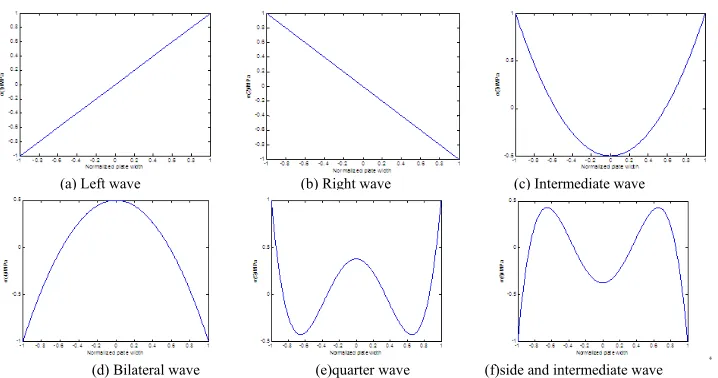
When strip steel is cold-rolled, the uneven extension of the metal in the direction of the plate width due to factors like mechanical or roll heating deformation causes different patterns of flatness defects[3-4], usually the transversal distribution of strain of the detected plate strip being taken as flatness signal. In accordance with the requirements of the technology, process and control of the controlled rolling mill, usually only 6 kinds of flatness defect patterns can be eliminated [5]. their residual stress distribution curves are as shown in Fig 1.
(a) Left wave (b) Right wave (c) Intermediate wave
[image:2.612.129.488.338.527.2](d) Bilateral wave (e)quarter wave (f)side and intermediate wave
Figure 1. Flatness Standard Pattern Curves Based on Legendre Polynomials.
Mathematical Model Recognized by Flatness Signal Pattern
It can be known from the fundamental principle of flatness control that its math process is to break an unknown sample signal to be identified ( )σ xi (i = 1, 2, K, n) down into
polynomials of certain known controllable flatness defects so as to choose the actuator of control system and to determine the control amount.
1 2 4 1
min n i i i i
i
f σ αp βp γp =
=
Δ − − −(1)
to solve the flatness characteristic parameters
α
, β and γ at equation minimum. Wherein,α , β and γ are characteristic parameters of flatness. σ( )k is flatnessstandard defect sample, k = 1, 2, ..., 6,
Flatness Pattern Recognition Optimization Based on Quantum Ant Colony Theory
The mathematical model recognized by flatness signal is a non-convex nonlinear equation, more difficult for direct solving. To reduce the difficulty for solving and to improve the recognition efficiency, the preliminary recognition model of flatness can be established on the basis of fuzzy recognition theory.
Specific Fusion Process of QACO[10]
(1)Generation of Initial Population. In QACO, the probability amplitude of quantum bit is directly taken as the code of the current position of ant. In consideration of population initialization and the randomness of coding, we adopt the following coding scheme:
1 2
1 2
cos( ) cos( ) cos( )
sin( ) sin( ) sin( )
i i in
i
i i in
q θ θ θ
θ θ θ
= ( 2) Wherein θij= ×2π rnd ; rnd is a random number between (0,1); i=1,2, …,m; j=1,2,…,n; m is population size; n is space dimensionality. Thus, it can be seen that each ant in the population occupies two positions in ergodic space, thus when the ant colony scale remains unchanged, the space searched can be doubled so as to speed up convergence rate. These two positions correspond to probability amplitudes of quantum states |0> and |1> respectively.
0 (cos( ), cos( ), , cos( ))1 2
i i i in
q = θ θ θ (3 )
1 (sin( ),sin( ), ,sin( ))1 2
i i i in
q = θ θ θ (4)
For the convenience of expression, take qi0as |0> state position, take qi1as|1> state position.
(2)Solution Space Transformation of Continuous Optimization Problem. As previously mentioned, the definitional domain of variable Xi of continuous optimization problem is [ai, bi], take the j quantum bit of ant qi as [cos ,sin ]
T ij ij
θ θ , then
the corresponding solution space variable is:
0
1
1 cos 1 cos
1
1 sin 1 sin
2 j
ij ij i
i j
ij ij i
i b p a p
θ
θ
θ
θ
+ − = + − Therefore, each ant corresponds to two solutions of optimization problem. Wherein, the probability amplitude of quantum state |0> corresponds to 0
j i
X ; the probability amplitude of quantum state |1> corresponds to 1
j i
X . Wherein, i=1,2, …,m; j=1,2,…,n. (3)Updating of Ant Position. Use the following revolving gate to update qubit phase:
cos( ) sin( )
( )
sin( ) cos( )
U θ θ θ
θ θ
Δ − Δ
Δ =
Δ Δ
Regarding the orientation of rotation angleΔθ, the usual practice is to work out a table listing various possibilities, which is very tedious. The purpose of rotation is to make the current solution approach the current global optimal solution, after a careful observation of the phase relationship of the quantum bits in these two solutions, it is not difficult to draw the following conclusion.
The orientation of rotation angleΔθcan be fixed from the following equation:
sgn( ) 0
sgn( )
0
A A
A
θ − ≠
Δ =
± =
当
当 (
6) Regarding the fix of rotation angle, our strategy is: add the local adjustment and global adjustment of the incremental quantity of pheromone strength in the ant passageway in ordinary ACO to the design of rotation angle step function. We propose the following rotation angle step function.
1 2
( 1) sgn( )( ( ) ( ) ( ))
ij t A ij t c Lijt c Gij t
θ
θ
τ
τ
Δ + =− Δ + Δ + Δ (7)
1 ( ) m
Lij k ij Q t d τ =
Δ =
(8)
1 ( ) m
Gij k k Q t L τ =
Δ =
(9) Wherein, c1and c2 mean the local adjustment coefficient and global adjustment coefficient of pheromone strength respectively. Q is pheromone strength, Lkmeans the
total length of the path taken of the k ant in this circulation, and dij means the distance
of the path ij taken by the k ant. ΔτLij( )t expresses the variable quantity of the global
pheromone, and ΔτGij( )t expresses the variable quantity of the local pheromone.
(4)Variation Processing of Ant Position. In many cases, ACO algorithm is easy to fall into local minimum [11], it is chiefly due to the loss of the diversity of the population in search space. The purpose of introducing mutation operator in evolutionary algorithm is to increase the diversity of the population and to avoid the premature convergence of the algorithm. In QACO, mutation operator is realized by quantum non-gate [11-12]. First mutation probabilitypmis given, a random number of
between (0,1) - randi is given to each ant, if randi < pm, quantum bit of [n/2] in this
cos( )
sin( )
cos(
/2)
0 1
sin( )
cos( )
sin(
/2)
1 0
ij ij ij
ij ij ij
θ
θ
θ π
θ
θ
θ π
+
=
=
+
(10)Wherein, i∈{1, 2, , } m ; j∈{1, 2, , } n .It can be seen from the above equation that this variation is also a rotation, with regard to j quantum bit, the rotation angle is
/2
ij
θ π
Δ = . Since this rotation has nothing to do with the optimal position of its memory, neither has anything to do with the current optimal position of the population, therefore, the diversity of the ant individual can be increased[13-15].
Flatness Pattern Recognition Optimization Based on Quantum Ant Colony Theory
The search space of this article's research question is three-dimensional, supposing there are m ants in the three-dimensional space, the coordinate of each ant is
1 2 3
( , , )( 1, 2,3)
id i i i
x = x x x d = , corresponding to the characteristic parameters of flatness to be recognized
(
α β γ, ,)
, each ant moves with the iterative process in the three-dimensional space, the i ant experiences the best position in the movement, marking as xpi, the whole ant colony experiences the best position in the movement,marking as xg. Specific steps are as follows:
Step 1 Ant colony initialization. The equation of (2) generates ant position to make up initial population Q(t); the initial values of the three positions of each ant corresponds to three nonzero inclusion degree P KE( ) of fuzzy pattern recognition.
Step 2 Solution space transformation as per the equation of (5) generates the solution P(t), in accordance with specific optimization objective function
3
( ) 1 2
1 1
min ( ) min ( , , , ) n ( ) k
n E i i
i k
f x f x x x P Kσ σ
= =
= =
−Δ calculate the fitness of each ant. If the current position of ant is superior to the optimal position of its memory, then the latter is replaced by the current position; if the current global optimal position is superior to the global optimal position searched previously, then the latter is replaced by the current global optimal position.Step 3 Complete the update of ant position according to the equations of (7), (8) (9). Step 4 In accordance with mutation probability, each ant varies as the equation of (10). Step 5 Return to Step 2 for loop computing until the condition of convergence is met or the algebra reaches the maximum limit. Output the position coordinate of the current ant. Step 6 To conclude, return to the three position values ( ,x xi1 i2,xi3) corresponded by the current global optimal value , namely characteristic parameters of flatness
(
α β γ, ,)
.Experiment Simulation and Result Analysis of Flatness Recognition
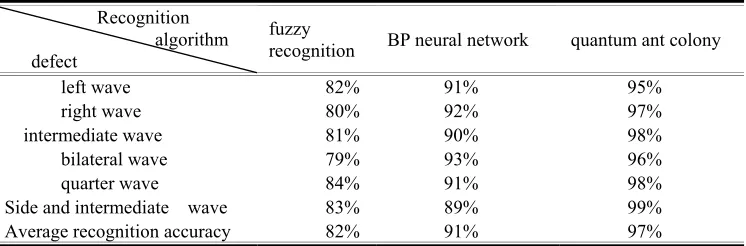
recognition and neural network recognition and the method based on quantum ant colony optimization respectively, the recognition results are shown as in Table 1.
[image:6.612.122.495.156.279.2]It can be seen by comparing the output results that quantum ant colony optimization recognition result is superior to fuzzy recognition method, its accuracy exceeds the method of neural network recognition.Language.
Table 1. Comparison of the Results of Three Recognition Methods.
Recognition algorithm defect
fuzzy
recognition BP neural network quantum ant colony
left wave 82% 91% 95%
right wave 80% 92% 97%
intermediate wave 81% 90% 98%
bilateral wave 79% 93% 96%
quarter wave 84% 91% 98%
Side and intermediate wave 83% 89% 99%
Average recognition accuracy 82% 91% 97%
Conclusions
In this paper, an effective flatness pattern recognition method is proposed based on quantum ant colony theory. Compared with the BP neural network and fuzzy recognition method, the validity of quantum ant colony theory applied in flatness pattern recognition is testified. This method can improve the recognition accuracy, the result after optimization can accurately control the flatness adjusting sets to meet the need of high precision flatness control.
Acknowledgement
This work is supported by Natural Science Foundation Project of Chongqing CSTC (CSTC2012jjA40061),also supported by Scientific and Technological Research Program of Chongqing Education Commission(KJ130834),and supported by Scientific and Technological Research Program of Chongqing Education Commission (KJ1500619).The authors are also most grateful for the constructive advice and comments from the anonymous reviewers.
References
[1] Sun Yikang, Tong Caonan. Cold rolling production automation technology[M]. Beijing: Press of Metallurgy Industry, 2006. pp.32-44 In Chinese
[2] Bao Ren-ren, Zhang Jie, et al. Flatness pattern recognition of ultra-wide tandem cold rolling mill [J]. Chinese Journal of Engineering, Vol. 37, Suppl.1: 6-11, May 2015. In Chinese
[3] Ding Shunfeng, Yang Li-po, YU Bingqiang. Intelligent Model for Evaluating Cold Rolled Strip Shape Based on Fuzzy Evaluation Rule[J]. Iron and Steel, 2014,49(9):61-70. In Chinese
[5] Burnhamr, Colei, Gentilea, et al. Model based flatness control of thin strip and foil[J]. Iron and Steel, 2003,38(6):36-40.
[6] Zhang Xuewei, Wang Yan. Application and Development trend of intelligent recognition methods for flatness recognition[J]. Journal of iron and steel research, 2010, 22(1):1-4
[7] Ding Shunfeng, Yang Li-po, YU Bingqiang. Intelligent Model for Evaluating Cold Rolled Strip Shape Based on Fuzzy Evaluation Rule[J]. Iron and Steel, 2014, 49(9):61-70.
[8] Huang Changqing, Zhao Min. Research Progress of Plate-Profile Recongnition and Control for Cold-Rolled Strip[J]. Journal of Iron and Steel Research, 2013, 25(12):1-7
[9] Zhang Xiuling, LIU Hongmin. GA-BP Model Of Flatness Pattern Recognition And Improved Least-Squares Method, Iron and Steel, 2003, 38(10):29.
[10] Dorigo M, Gambardella L M. Ant colonies for the traveling salesman problem[J]. Biosystems, 1997, 43(2): 73-81
[11] Jia Yang, Changxiu Cao, Qiang Xu, etc. A novel quantum ant colony optimization algorithm[J]. Journal of sun yat-sen university (natural science edition), 2009, 48(3):22-27.
[12] Han K H, Kim J H. Genetic Quantum Algorithm and its Application to Combinatorial Optimization Problem[C]. 2000(1):1354-1360.