2017 2nd International Conference on Computer Engineering, Information Science and Internet Technology (CII 2017) ISBN: 978-1-60595-504-9
Situation Assessment Method Based on Bayesian
Network and Its Application in Space Battlefield
TING LI, WEI ZHANG, SHENG GAO and XU HE
ABSTRACT
The space situation awareness ability is the development of space resources, the protection of space assets and the control of space. It’s the key to the implementation of space military action. Therefore, the satellite in the space military confrontation as the research object is discussed to solve the situation assessment problem of space battlefield. A method of situation assessment is proposed which based on Bayesian Network and its advantages to solve the imprecise knowledge representation problems and inference problems. Firstly, a Bayesian Network model for situation assessment is established based on expert experience knowledge. Then, the Bayesian inference algorithm is used to predict the spatial situation and achieve the situation assessment. Finally, the algorithm is validated and analyzed by using the BNT toolbox of MATLAB. Simulation results show that the method can adapt to the change of battlefield situation, and are more accurate and reliable for the prediction of situation. It has some important practical values in the future space battlefield.
KEYWORDS
Situation assessment; Bayesian network; Satellite; BNT toolbox.
INTRODUCTION
In recent years, in order to provide timely and accurate space target information for future space battles, some countries are vigorously expanding and improving the ability of space situational assessment, focusing on the development of space monitoring network to seize the ‘high ground’ of space battlefield. Space weapons and equipment can be divided into space offensive weapons, space defensive weapons, space information confrontation equipment and space situation assessment equipment. Space situational assessment is the priority of the evolution of space capability.
Battlefield situation assessment which based on the current situation established a multi-view of battle activities, events, time, locations, strengths and other forms of organization. Combining battle force distribution with battlefield environment and the enemy's intent, the reasons of the incident can be analyzed to estimate the enemy's strength structure and analyze its features.
In the process of situation assessment, uncertainty knowledge representation and reasoning are two important problems to be solved. Bayesian Network uses probability theory to deal with the uncertainty caused by the conditional correlation
between different knowledge components.
_________________________________________
A BRIEF INTRODUCTION OF BAYESIAN NETWORK
Since Bayesian Network has been defined explicitly by Pearl, it has become the focus of research in the field of imprecise knowledge representation and inference in the field of artificial intelligence for decades. This network uses probability theory to deal with the uncertainty of knowledge, and directly provides a method of visualizing knowledge map. Bayesian Network is a directed acyclic graph, in which the nodes represent random variables. The directed edges between the nodes represent the direct dependencies between variables. Each node has a probability distribution in which the root node X is attached to its edge probability P(X). The non-root node X is attached to the conditional probability distribution P(X|pa(X)).
SITUATION ASSESSMENT ALGORITHM BASED ON BAYESIAN NETWORK
Situation Assessment
Endsley argues that situational awareness contains three levels:
(1) Situation awareness; (2) Situation comprehension and (3) Situation prediction. According to the enemy's behavior, situation assessment can be used to estimate and analyze the space situation and in order to help the commanders make correct decisions predict the development of the battlefield. Therefore, situation assessment plays a key role in the modern war.
CONSTRUCTION OF BAYESIAN NETWORK FOR SITUATION ASSESSMENT
Due to the particularities of battlefield situation assessment, it is impossible to get a large number of training data in Bayesian Network. Therefore, experts from military field usually give a lot of knowledge expressed by rules based on experience and information. Using manual modeling method the Bayesian Networks which can be updated by simulated training are built by experts.
(1) Define nodes. The Bayesian Network consists of nodes which represent different events. The events include the action of the sensor, weapon action, combat platform action, group action, sensor action intention, weapon action intention, combat platform intention, group intention, spatio-temporal mode, battlefield environment information, our antagonistic action. Some of these military incidents might happen, but some are inevitable.
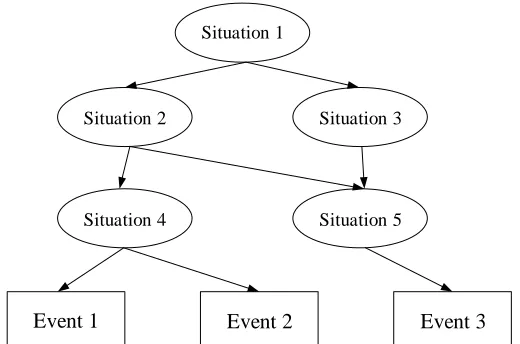
First, a set of random variables is selected to describe the events, such as {X1, X2, …, Xn}. Then the variables should be placed in order, as α={ X1, X2, …, Xn }. Each of these variables should be added into the network according to the order. In FIGURE 1, it contains variables like X1, X2, …, Xn-1. Finally, a directed edge of the node Xi is added to each node which is belong to the directed acyclic graph. The steps can be disorganized during the procedure.
build a directed acyclic graph of Bayesian Networks. Bayesian Network nodes of situation assessment are divided into situation node and event node. The situation nodes are represented as ellipses, and the event nodes are represented as squares. As it is shown in FIGURE 1.
[image:3.612.168.428.393.565.2](3) Define the conditional probability table. The Bayesian Network needs to determine the conditional probability for each node. If the nodes are discrete variable, its parameter constitutes a conditional probability table. The conditional probability table represents the strength of the relation between nodes. In situation assessment, it represents the probability value of an action taken by enemy when they want to accomplish military intent.
SITUATION ASSESSMENT BASED ON BAYESIAN INFERENCE
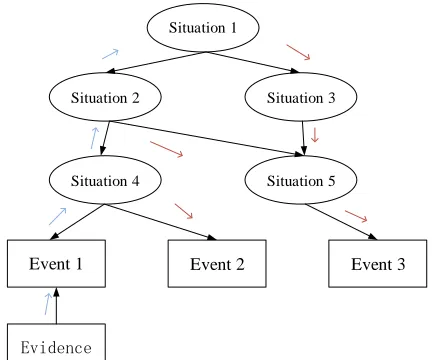
Using Bayesian Network structure and conditional probability table, posterior probability distribution of non-evidential nodes can be calculated with knowing the state of the proof nodes. The purpose of reasoning algorithm is to speed up reasoning, improve the accuracy of calculation and reduce complexity of complexity. In this paper, situation is regarded as the cause of hypothesis. The events are regarded as results, and data obtained from sensor can be regarded as proof. Impact of events on the situation can be achieved by Bayesian logic back-propagation to estimate the relationship between situation and events. The updated situation confidence can be predicted by the forward prediction of future events by forward inference, so that it leads to a new round of situation assessment when new event clues occur.
Situation 1
Situation 2 Situation 3
Situation 4 Situation 5
Event 1 Event 2 Event 3
Situation 1
Situation 2 Situation 3
Situation 4 Situation 5
Event 1 Event 2 Event 3
[image:4.612.189.405.53.233.2]Evidence
FIGURE 2. Bayesian Network inference model for situation assessment.
In FIGURE 2, when a new proof supports event 1, arrows next to the arc indicate the proof. According to the established situation assessment model, it can identify single controlled object state, network status and sub situation through bottom-up reasoning. Through the use of the Bayesian Network inference algorithm, the bottom-up reasoning and top-down reasoning are used to achieve the estimation and prediction of the situation.
APPLICATION OF SPACE BATTLEFIELD
In the space battlefield, our satellites as the main targets of the war, need to estimate the situation of the enemy. Battle intention (B) is divided into three node Interference (I), Offensive (O) and Reconnaissance (R). The node I indicates that the enemy intent to interfere our satellite. This kind of interference enemy may carry out can include Electromagnetic interference (E) and Infrared Jamming (IJ). If the enemy's situation is Offensive (O), the enemy in order to may Launch Missiles (LM), use a Laser Weapon (LW) to destroy our satellites. The enemy can also Approach (A) our satellite to complete the offensive situation. If the enemy's situation is Reconnaissance (R), it may approach and Monitor (M) us. The state of Interference Detector (ID) can be defined as ID={On, Off}. The state of Radar System (RS) can be defined as RS={On, Off}. The state of the Speed of the enemy (S) can be defined as S={Fast, Slow}. The state of the Distance between (D) the enemy and our satellite s can be defined as D={Far, Near}.
Battle intention
Interference Offensive Reconnaissance
Electromagnetic Interference
Infrared jamming
Launch Missiles
Laser Weapons
Approach
targets Monitor
Interference
[image:5.612.139.459.55.206.2]Detector Radar System Speed Distance FIGURE 3. Bayesian Network model for space battlefield situation assessment.
FIGURE 4. Space battlefield model based on Matlab BNT toolbox.
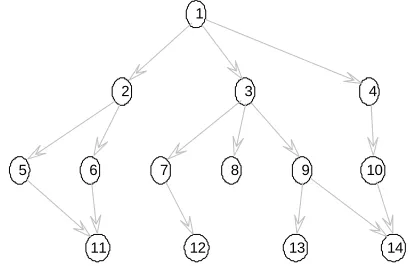
Each node is expressed digitally, so that the network is easier to represent using programs. For example, the node Battle intention (B) is represented by the number 1. And the node Interference (I) is expressed in number 2. This will indicate the Bayesian Network in the program, as shown in FIGURE 4.
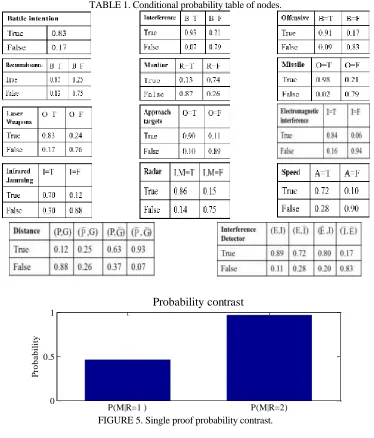
The second step is to determine the parameters of the Bayesian Network. It means that the conditional probability of the sub node and the edge probability of the root node can be determined. Each node has two discrete states which are true and false. The node can also include more states if it is desired. In this case, from the point of view of simplification, there are only two states are taken into account. The probability of each node is shown in table 1.
1
2 3 4
5 6 7 8 9 10
[image:5.612.193.399.238.371.2]TABLE 1. Conditional probability table of nodes.
[image:6.612.99.499.503.653.2]FIGURE 5. Single proof probability contrast.
FIGURE 6. Multiple proof probability contrast.
P(M|R=1 ) P(M|R=2) 0
0.5 1
P
ro
b
a
b
il
it
y
Probability contrast
Original probability Bayesian prediction probability 0
0.2 0.4 0.6 0.8 1
P
ro
b
a
b
il
it
y
Probability contrast
The third step is to input the proof of the event tiers and to select the inference engine. The joint tree engine, which is the foundation of all accurate inference engines is utilized in this paper.
The fourth step is to input proof and implemented the process of situation assessment. In the Matlab BNT toolbox, it is set that false (false) ==1, true (true) ==2 as usual. The proof of the event tier entering is RS=1. It indicates that the local enemy radar detectors we have monitored are closed. It can be calculated that P(LM|RS=1)=0. 4597. Input information RS=2 indicates that the local enemy radar detectors we have monitored are on. It can be calculated that P(LM|RS=2)=0. 9669. FIGURE 5 shows that the probabilities before and after the entered proof is given.
When the input proof is RS=2, it indicates that the probability of our satellites attacked by missile is greatly increased when the state of enemy’s radars is on. At this point, the state of the parent layer changed to 2, LM=2. Thus the calculation of P (O|LM=2) is also greatly increased. It can be judged that when the enemy radars are on, they will attack our satellites. So the situation of the enemy is Offensive.
Similarly, multiple proof can be entered simultaneously
The state ID=1, RS=1, S=1, D=1 indicated that the state of the Interference Detectors is off, the radars of the enemy are off, the speed is low and the distance is long.
P(O| ID=1, RS=1, S=1, D=1)=0. 2902 P(I| ID=1, RS=1, S=1, D=1)=0. 5408 P(R| ID=1, RS=1, S=1, D=1)=0. 6671
It indicated that the radars of enemy are closed,the target speed is slow and the Offensive probability is low. When the Interference Detectors are closed, the Offensive probability of enemy is low. When the enemy target is far away from us, the Reconnaissance probability of enemy is low.
As the proof inputted to the system, the Interference Detectors are on (ID=2) and the enemy is gradually getting closer to our satellites (D=2). The probability of each node's situation will change at the same time. The state is ID=2, RS=1, S=1, D=2.
P(O| ID=2, RS=1, S=1, D=2)=0. 2661 P(I| ID=2, RS=1, S=1, D=2)=0. 9328 P(R| ID=2, RS=1, S=1, D=2)=0. 8662
It can be seen in FIGURE 6 that the radar is closed, the target speed is slow and the distance is short, and the Offensive probability is slightly reduced. When the Interference Detector is turned on, the enemy's interference with us is obviously increased. As the enemy's target approaches us, the Reconnaissance probability increases. It is possible to determine the situation of enemy when the radars of enemy are closed, the speed is low, but the distance is short and the Interference Detectors are turned on. The enemy will not attack us, but are more likely to detect and interfere our satellites.
SUMMARY
probability. The simulation results show that the spatial battlefield situation awareness based on Bayesian Network can effectively reflect the simulation environment of complex battlefield, and accurately predict the enemy situation. It is important for us to win the wars with the advantages.
ACKNOWLEDGEMENTS
Corresponding author: Wei Zhang. zhangwei@sia. Cn; Shenyang Institute of Automation, Chinese Academy of Sciences, Shenyang 110016, China.
REFERENCES
1. Sun Zhaolin:Research on the Bayesian Networks Methods for Situation Assessment. (Nation University of Defense Technology, China, 2005). p. 18-29.
2. Endsley MR, Garland D J. Situation awareness analysis and measurement, Lavorence Erlbaum Asso-ciates 2000, p. 23-29.
3. Laskey K B. Hypothesis management in situation specific network construct//17th Conference on UAI, SanMateo, CA: Morgan Kanfmann, 2001, p. 301-309.
4. Young-Seol, Lee, Sung-Bae Cho. Mobile context inference using two-layered Bayesian Networks for smartphones. Expert Systems with Applications. (2013) No. 40, p. 4333-4345.
5. Li Weisheng, Wang Baoshu. Situation Assessment Based on Bayesian Networks. System Engineering and Electronics. Vol. 25(2003) No. 4, p. 481-483.
6. Zhang Fen, Jia Ze, Sheng Jiagen. Application of Bayesian Networks in Tactical Situation Assessment. Computer Measurement & Control. Vol. 16(2008) No. 4, p. 521-522.
7. Brownfield M I,Mehrjoo K. Wireless sensor network energy adaptive MAC protocol. Consumer Communications and Networking Conference, 2006: 778- 782.