Alignment-Based Neural Machine Translation
Tamer Alkhouli, Gabriel Bretschner,
Jan-Thorsten Peter, Mohammed Hethnawi, Andreas Guta and Hermann Ney Human Language Technology and Pattern Recognition Group
RWTH Aachen University, Aachen, Germany
{surname}@cs.rwth-aachen.de
Abstract
Neural machine translation (NMT) has emerged recently as a promising statis-tical machine translation approach. In NMT, neural networks (NN) are directly used to produce translations, without re-lying on a pre-existing translation frame-work. In this work, we take a step to-wards bridging the gap between conven-tional word alignment models and NMT. We follow the hidden Markov model (HMM) approach that separates the align-ment and lexical models. We propose a neural alignment model and combine it with a lexical neural model in a log-linear framework. The models are used in a standalone word-based decoder that explicitly hypothesizes alignments during search. We demonstrate that our system outperforms attention-based NMT on two tasks: IWSLT2013German→English and BOLT Chinese→English. We also show
promising results for re-aligning the train-ing data ustrain-ing neural models.
1 Introduction
Neural networks have been gaining a lot of at-tention recently in areas like speech recognition, image recognition and natural language process-ing. In machine translation, NNs are applied in two main ways: In N-best rescoring, the neural
model is used to score the first-pass decoding out-put, limiting the model to a fixed set of hypotheses (Le et al., 2012; Sundermeyer et al., 2014a; Hu et al., 2014; Guta et al., 2015). The second approach integrates the NN into decoding, potentially allow-ing it to directly determine the search space.
There are two approaches to use neural els in decoding. The first integrates the
els into phrase-based decoding, where the mod-els are used to score phrasal candidates hypothe-sized by the decoder (Vaswani et al., 2013; Devlin et al., 2014; Alkhouli et al., 2015). The second approach is referred to as neural machine trans-lation, where neural models are used to hypoth-esize translations, word by word, without relying on a pre-existing framework. In comparison to the former approach, NMT does not restrict NNs to predetermined translation candidates, and it does not depend on word alignment concepts that have been part of building state-of-the-art phrase-based systems. In such systems, the HMM and the IBM models developed more than two decades ago are used to produce Viterbi word alignments, which are used to build standard phrase-based systems. Existing NMT systems either disregard the no-tion of word alignments entirely (Sutskever et al., 2014), or rely on a probabilistic notion of align-ments (Bahdanau et al., 2015) independent of the conventional alignment models.
Most recently, Cohn et al. (2016) designed neu-ral models that incorporate concepts like fertility and Markov conditioning into their structure. In this work, we also focus on the question whether conventional word alignment concepts can be used for NMT. In particular, (1) We follow the HMM approach to separate the alignment and translation models, and use neural networks to model align-ments and translation. (2) We introduce a lexical-ized alignment model to capture source reorder-ing information. (3) We bootstrap the NN trainreorder-ing using Viterbi word alignments obtained from the HMM and IBM model training, and use the trained neural models to generate new alignments. The new alignments are then used to re-train the neural networks. (4) We design an alignment-based de-coder that hypothesizes the alignment path along with the associated translation. We show com-petitive results in comparison to attention-based
models on the IWSLT 2013 German→English and BOLT Chinese→English task.
1.1 Motivation
Attention-based NMT computes the translation probability depending on an intermediate compu-tation of an alignment distribution. The alignment distribution is used to choose the positions in the source sentence that the decoder attends to dur-ing translation. Therefore, the alignment model can be considered as an implicit part of the trans-lation model. On the other hand, separating the alignment model from the lexical model has its own advantages: First, this leads to more flexi-bility in modeling and training: not only can the models be trained separately, but they can also have different model types, e.g. neural models, count-based models, etc. Second, the separation avoids propagating errors from one model to the other. In attention-based systems, the translation score is based on the alignment distribution, which risks propagating errors from the alignment part to the translation part. Third, using separate models makes it possible to assign them different weights. We exploit this and use a log-linear framework to combine them. We still retain the possibility of joint training, which can be performed flexibly by alternating between model training and align-ment generation. The latter can be performed us-ing forced-decodus-ing.
In contrast to the count-based models used in HMMs, we use neural models, which allow cov-ering long context without having to explicitly ad-dress the smoothing problem that arises in count-based models.
2 Related Work
Most recently, NNs have been trained on large amounts of data, and applied to translate indepen-dent of the phrase-based framework. Sutskever et al. (2014) introduced the pure encoder-decoder ap-proach, which avoids the concept of word align-ments. Bahdanau et al. (2015) introduced an atten-tion mechanism to the encoder-decoder approach, allowing the decoder to attend to certain source words. This method was refined in (Luong et al., 2015) to allow for local attention, which makes the decoder attend to representations of source words residing within a window. These translation mod-els have shown competitive results, outperforming phrase-based systems when using ensembles on
tasks like IWSLT English→German 2015 (Luong and Manning, 2015).
In this work, we follow the same standalone neural translation approach. However, we have a different treatment of alignments. While the attention-based soft-alignment model computes an alignment distribution as an intermediate step within the neural model, we follow the hard align-ment concept used in phrase extraction. We sepa-rate the alignment model from the lexical model, and train them independently. At translation time, the decoder hypothesizes and scores the alignment path in addition to the translation.
Cohn et al. (2016) introduce several modifi-cations to the attention-based model inspired by traditional word alignment concepts. They mod-ify the network architecture, adding a first-order dependence by making the attention vector com-puted for a target position directly dependent on that of the previous position. Our alignment model has a first-order dependence that takes place at the input and output of the model, rather than an ar-chitectural modification of the neural network.
Yang et al. (2013) use NN-based lexical and alignment models, but they give up the probabilis-tic interpretation and produce unnormalized scores instead. Furthermore, they model alignments us-ing a simple distortion model that has no depen-dence on lexical context. The models are used to produce new alignments which are in turn used to train phrase systems. This leads to no sig-nificant difference in terms of translation perfor-mance. Tamura et al. (2014) propose a lexicalized RNN alignment model. The model still produces non-probabilistic scores, and is used to generate word alignments used to train phrase-based sys-tems. In this work, we develop a feed-forward neural alignment model that computes probabilis-tic scores, and use it directly in standalone de-coding, without constraining it to the phrase-based framework. In addition, we use the neural models to produce alignments that are used to re-train the same neural models.
net-works are used to hypothesize translation candi-dates directly, and the scores are computed online during decoding.
We use the feed-forward joint model introduced in (Devlin et al., 2014) as a lexical model, and in-troduce a lexicalized alignment model based on it. In addition, we modify the bidirectional joint model presented in (Sundermeyer et al., 2014a) and compare it to the feed-forward variant. These lexical models were applied in phrase-based sys-tems. In this work, we apply them in a standalone NMT framework.
Forced alignment was applied to train phrase ta-bles in (Wuebker et al., 2010; Peitz et al., 2012). We generate forced alignments using a neural de-coder, and use them to re-train neural models.
Tackling the costly normalization of the out-put layer during decoding has been the focus of several papers (Vaswani et al., 2013; Devlin et al., 2014; Jean et al., 2015). We propose a sim-ple method to speed up decoding using a class-factored output layer with almost no loss in trans-lation quality.
3 Statistical Machine Translation
In statistical machine translation, the target word sequence eI1 = e1, ..., eI of length I is assigned
a probability conditioned on the source word se-quencef1J = f1, ..., fJ of lengthJ. By
introduc-ing word alignments as hidden variables, the pos-terior probabilityp(eI1|fJ
1)can be computed using
a lexical and an alignment model as follows.
p(eI1|f1J)
=X
bI 1
p(eI1, bI1|f1J)
=X
bI 1
I
Y
i=1
p(ei, bi|b1i−1, ei1−1, f1J)
=X
bI 1
I
Y
i=1
p(ei|bi1, ei1−1, f1J)
| {z }
lexical model
·p(bi|b1i−1, ei1−1, f1J)
| {z }
alignment model
wherebI1 = b1, ..., bI denotes the alignment path,
such thatbi aligns the target wordeito the source
word fbi. In this general formulation, the
lexi-cal model predicts the target wordei conditioned
on the source sentence, the target history, and the alignment history. The alignment model is lexical-ized using the source and target context as well. The sum over alignment paths is replaced by the maximum during decoding (cf. Section 5).
4 Neural Network Models
There are two common network architectures used in machine translation: feed-forward NNs (FFNN) and recurrent NNs (RNN). In this section we will discuss alignment-based feed-forward and recur-rent neural networks. These networks are condi-tioned on the word alignment, in addition to the source and target words.
4.1 Feed-forward Joint Model
We adopt the feed-forward joint model (FFJM) proposed in (Devlin et al., 2014) as the lexical model. The authors demonstrate the model has a strong performance when applied in a phrase-based framework. In this work we explore its performance in standalone NMT. The model was introduced along with heuristics to resolve un-aligned and multiply un-aligned words. We denote the heuristic-based source alignment point corre-sponding to the target positionibyˆbi. The model
is defined as
p(ei|bi1, ei1−1, f1J) =p(ei|eii−−1n, f ˆbi+m
ˆbi−m) (1)
and it computes the probability of a target word
ei at position i given the n-gram target history eii−−1n = ei−n, ..., ei−1, and a window of2m+ 1
source wordsfˆbi+m ˆ
bi−m = fˆbi−m, ..., fˆbi+m centered
around the wordfˆbi.
Figure 1: Examples on resolving word alignments to obtain word affiliations.
Computing normalized probabilities is done us-ing the softmax function, which requires ing the full output layer first, and then comput-ing the normalization factor by summcomput-ing over the output scores of the full vocabulary. This is very costly for large vocabularies. To overcome this, we adopt the class-factored output layer consisting of a class layer and a word layer (Goodman, 2001; Morin and Bengio, 2005). The model in this case is defined as
p(ei|eii−−1n, f ˆbi+m ˆ
bi−m) = p(ei|c(ei), eii−1−n, f
ˆ bi+m ˆ
bi−m)·p(c(ei)|e i−1 i−n, f
ˆ bi+m ˆbi−m)
wherecdenotes a word mapping that assigns each
target word to a single class, where the number of classes is chosen to be much smaller than the vocabulary size |C| << |V|. Even though the
full class layer needs to be computed, only a sub-set of the significantly-larger word layer has to be considered, namely the words that share the same class c(ei) with the target word ei. This helps
speeding up training on large-vocabulary tasks.
4.2 Bidirectional Joint Model
The bidirectional RNN joint model (BJM) pre-sented in (Sundermeyer et al., 2014a) is another lexical model. The BJM uses the full source sen-tence and the full target history for prediction, and it is computed by reordering the source sentence following the target order. This requires the com-plete alignment information to compute the model scores. Here, we introduce a variant of the model that is conditioned on the alignment history in-stead of the full alignment path. This is achieved by computing forward and backward representa-tions of the source sentence in its original order, as done in (Bahdanau et al., 2015). The model is given by
p(ei|bi1, ei1−1, f1J) =p(ei|ˆbi1, ei1−1, f1J)
Note that we also use the same alignment heuris-tics presented in Section 4.1. As this variant does not require future alignment information, it can be applied in decoding. However, in this work we apply this model in rescoring and leave decoder integration to future work.
4.3 Feed-forward Alignment Model
We propose a neural alignment model to score alignment paths. Instead of predicting the abso-lute positions in the source sentence, we model the jumps from one source position to the next po-sition to be translated. The jump at target posi-tion i is defined as ∆i = ˆbi −ˆbi−1, which
cap-tures the jump from the source positionˆbi
−1toˆbi.
We modify the FFNN lexical model to obtain a feed-forward alignment model. The feed-forward alignment model (FFAM) is given by
p(bi|bi1−1, ei1−1, f1J) =p(∆i|eii−1−n, f ˆ bi−1+m ˆbi−1−m) (2)
This is a lexicalized alignment model condi-tioned on the n-gram target history and the
(2m+ 1)-gram source window. Note that,
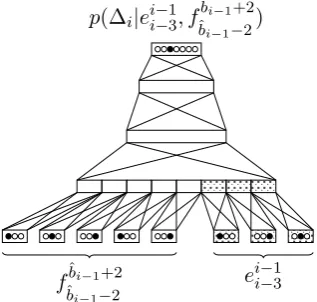
dif-ferent from the FFJM, the source window of this model is centered around the source positionˆbi−1. This is because the model needs to predict the jump to the next source positionˆbito be translated. The alignment model architecture is shown in Fig-ure 2.
In contrast to the lexical model, the output vo-cabulary of the alignment model is much smaller, and therefore we use a regular softmax output layer for this model without class-factorization.
4.4 Feed-forward vs. Recurrent Models
fˆbi−1+2
ˆbi−1−2 e
i−1 i−3
[image:5.595.102.261.68.219.2]p(∆i|eii−−31, f ˆbi−1+2 ˆ bi−1−2)
Figure 2: A feed-forward alignment NN, with 3 target history words, 5-gram source window, a projection layer, 2 hidden layers, and a small out-put layer to predict jumps.
faster to train due to their simple architecture, and second, they are more flexible to integrate into beam search decoders. This is because feed-forward networks only depend on a limited con-text. RNNs, on the other hand, are conditioned on an unbounded context. This means that the com-plete hypotheses during decoding have to be main-tained without any state recombination. Since feed-forward networks allow the use of state re-combination, they are potentially capable of ex-ploring more candidates during beam search.
5 Alignment-based Decoder
In this section we present the alignment-based de-coder. This is a beam-search word-based decoder that predicts one target word at a time. As the models we use are alignment-based, the decoder hypothesizes the alignment path. This is different from the NMT approaches present in the literature, which are based on models that either ignore word alignments or compute alignments as part of the attention-based model.
In the general case, a word can be aligned to a single word, multiple words, or it can be un-aligned. However, we do not use the general word alignment notion, rather, the models are based on alignments derived using the heuristics discussed in Section 4. These heuristics simplify the task of the decoder, as they induce equivalence classes over the alignment paths, reducing the number of possible alignments the decoder has to hypothe-size significantly. As a result of using these heuris-tics, the task of hypothesizing alignments is
re-Algorithm 1Alignment-based Decoder 1: procedureTRANSLATE(f1J,beamSize)
2: hyps←initHyp .previous set of partial hypotheses 3: newHyps← ∅ .current set of partial hypotheses 4: whileGETBEST(hyps)notterminated do
5: .compute alignment distribution in batch mode 6: alignDists←ALIGNMENTDISTRIBUTION(hyps)
7: .hypothesize source alignment points 8: forposFrom1toJdo
9: .compute lexical distributions of all 10: .hypotheses in hyps in batch mode
11: dists←LEXICALDISTRIBUTION(hyps,pos) 12: .expand each of the previous hypotheses 13: forhypinhyps do
14: jmpCost←SCORE(alignDists,hyp,pos) 15: dist←GETDISTRIBUTION(dists,hyp)
16: dist←PARTIALSORT(dist,beamSize) 17: cnt←0
18: .hypothesize new target word 19: forwordindistdo
20: ifcnt > beamSizethen
21: break
22: newHyp←EXTEND(hyp,word,pos,jmpCost) 23: newHyps.INSERT(newHyp)
24: cnt←cnt+ 1
25: PRUNE(newHyps,beamSize) 26: hyps←newHyps
27:
28: .return the best scoring hypothesis 29: returnGETBEST(hyps)
duced to enumerating allJ source positions a
tar-get word can be aligned to. The following is a list of the possible alignment scenarios and how the decoder covers them.
• Multiply-aligned target words: the heuris-tic chooses the middle link as an alignment point. Therefore, the decoder is able to cover these cases by hypothesizingJ many source positions for each target word hypothesis.
• Unaligned target words: the heuristic aligns
these words using the nearest aligned target word in training (cf. Figure 1, right). In de-coding, these words are handled as aligned words.
• Multiply-aligned source words: covered by
revisiting a source position that has already been translated.
• Unaligned source words: result if no target word is generated using a source window centered around the source word in question.
words. Alignments are hypothesized in the loop starting at line 8. Once an alignment point is set to positionpos, the lexical distribution over the full
target vocabulary is computed using this position in line 11. The distribution is sorted and the best candidate translations lying within the beam are used to expand the partial hypotheses.
We batch the NN computations, calling the alignment and lexical networks for all partial hy-potheses in a single call to speed up computations as shown in lines 6 and 11. We also exploit the beam and apply partial sorting in line 16, instead of completely sorting the list. Partial sorting has a linear complexity on average, and it returns a list whose first beamSize words have better scores
compared to the rest of the list.
We terminate translation if the best scoring par-tial hypothesis ends with the sentence end symbol. If a hypothesis terminates but it scores worse than other hypotheses, it is removed from the beam, but it still competes with non-terminated hypotheses. Note that we do not have any explicit coverage constraints. This means that a source position can be revisited many times, hence generating one-to-many alignment cases. This also allows having un-aligned source words.
In the alignment-based decoder, an alignment distribution is computed, and word alignments are hypothesized and scored using this distribution, leading alignment decisions to become part of beam search. The search space is composed of both alignment and translation decisions. In con-trast, the search space in attention-based decoding is composed of translation decisions only.
Class-Factored Output Layer in Decoding
The large output layer used in language and trans-lation modeling is a major bottleneck in evaluating the network. Several papers discuss how to evalu-ate it efficiently during decoding using approxima-tions. In this work, we exploit the class-factored output layer to speed up training. At decoding time, the network needs to hypothesize all target words, which means the full output layer should be evaluated. In the case of using a class-factored output layer, this results in an additional compu-tational overhead from computing the class layer. In order to speed up decoding, we propose to use the class layer to choose the top scoringkclasses,
then we evaluate the word layer for each of these classes only. We show this leads to a significant speed up with minimal loss in translation quality.
Model Combination
We embed the models in a log-linear framework, which is commonly used in phrase-based systems. The goal of the decoder is to find the best scoring hypothesis as follows.
ˆ
eI1ˆ= arg max
I,eI 1
( max
ˆ bI
1 M
X
m=1
λmhm(f1J, eI1,ˆbI1)
)
whereλmis the model weight associated with the
modelhm, andM is the total number of models.
The model weights are automatically tuned using minimum error rate training (MERT) (Och, 2003). Our main system includes a lexical neural model, an alignment neural model, and a word penalty, which is the count of target words. The word penalty becomes important at the end of transla-tion, where hypotheses in the beam might have different final lengths.
6 Forced-Alignment Training
Since the models we use require alignments for training, we initially use word alignments pro-duced using HMM/IBM models using GIZA++ as
initial alignments. At first, the FFJM and the FFAM are trained separately until convergence, then the models are used to generate new word alignments by force-decoding the training data as follows.
˜
bI1(f1J, eI1) =argmax
bI 1
I
Y
i=1
pλ1(∆
i|eii−−1n, fbbii−−1−1+mm)
·pλ2(e
i|eii−−1n, fbbii−+mm)
whereλ1andλ2are the model weights. We
mod-ify the decoder to only compute the probabilities of the target words in the reference sentence. The for loop in line 19 of Algorithm 1 collapses to a single iteration. We use both the the feed-forward joint model (FFJM) and the feed-forward align-ment model (FFAM) to perform force-decoding, and the new alignments are used to retrain the models, replacing the initial GIZA++alignments.
IWSLT BOLT
De En Zh En
[image:7.595.74.288.63.200.2]Sentences 4.32M 4.08M Run. Words 108M 109M 78M 86M Vocab. 836K 792K 384K 817K FFNN/BJM Vocab. 173K 149K 169K 128K Attention Vocab. 30K 30K 30K 30K FFJM params 177M 159M BJM params 170M 153M FFAM params 101M 94M Attention params 84M 84M
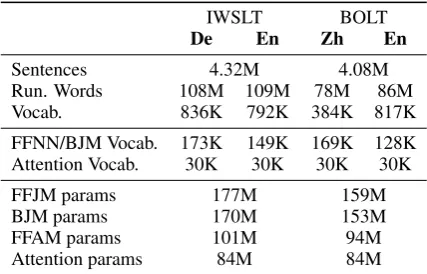
Table 1: Corpora and NN statistics.
7 Experiments
We carry out experiments on two tasks: the IWSLT 2013 German→English shared
transla-tion task,1 and the BOLT Chinese→English task. The corpora statistics are shown in Table 1. The IWSLT phrase-based baseline system is trained on all available bilingual data, and uses a 4-gram LM with modified Kneser-Ney smoothing (Kneser and Ney, 1995; Chen and Goodman, 1998), trained with the SRILM toolkit (Stolcke, 2002). As ad-ditional data sources for the LM, we selected parts of the Shuffled News and LDC English Giga-word corpora based on the cross-entropy differ-ence (Moore and Lewis, 2010), resulting in a to-tal of 1.7 billion running words for LM training. The based baseline is a standard phrase-based SMT system (Koehn et al., 2003) tuned with MERT (Och, 2003) and contains a hierarchical re-ordering model (Galley and Manning, 2008). The in-domain data consists of137K sentences.
The BOLT Chinese→English task is evaluated on the “discussion forum” domain. We use a 5-gram LM trained on2.9billion running words in total. The in-domain data consists of a subset of 67.8K sentences. We used a set of 1845 sentences
as a tune set. The evaluation settest1contains 1844 andtest2contains 1124 sentences.
We use the FFNN architecture for the lexical and alignment models. Both models use a win-dow of9source words, and5target history words. Both models use two hidden layers, the first has 1000units and the second has500units. The lex-ical model uses a class-factored output layer, with 1000singleton classes dedicated to the most fre-quent words, and1000 classes shared among the rest of the words. The classes are trained using a separate tool to optimize the maximum likelihood
1http://www.iwslt2013.org
training criterion with the bigram assumption. The alignment model uses a small output layer of201 nodes, determined by a maximum jump length of 100(forward and backward). 300nodes are used for word embeddings. Each of the FFNN models is trained on CPUs using 12 threads, which takes up to 3 days until convergence. We train with stochastic gradient descent using a batch size of 128. The learning rate is halved when the devel-opment perplexity increases.
Each BJM has4LSTM layers: two for the for-ward and backfor-ward states, one for the target state, and one after merging the source and target states. The size of the word embeddings and hidden lay-ers is350nodes. The output layers are identical to those of the FFJM models.
We compare our system to an attention-based baseline similar to the networks described in (Bah-danau et al., 2015). All such systems use single models, rather than ensembles. The word embed-ding dimension is 620, each direction of the en-coder and the deen-coder has a layer of 1000 gated recurrent units (Cho et al., 2014). Unknowns and numbers are carried out from the source side to the target side based on the largest attention weight.
To speed up decoding of long sentences, the decoder hypothesizes21 and41 source positions around the diagonal, for the IWSLT and the BOLT tasks, respectively. We choose these numbers such that the translation quality does not degrade. The beam size is set to 16 in all experiments. Larger beam sizes did not lead to improvements. We apply part-of-speech-based long-range verb reordering rules to the German side in a pre-processing step for all German→English systems (Popovi´c and Ney, 2006), including the baselines. The Chinese→English systems use no such
pre-ordering. We use the GIZA++ word alignments
to train the models. The networks are fine-tuned by training additional epochs on the in-domain data only (Luong and Manning, 2015). The LMs are only used in the phrase-based systems in both tasks, but not in the NMT systems.
mea-test 2010 eval 2011
[image:8.595.74.289.64.176.2]# system BLEU TER BLEU TER 1 phrase-based system 28.9 51.0 32.9 46.3 2 + monolingual data 30.4 49.5 35.4 44.2 3 attention-based RNN 27.9 51.4 31.8 46.5 4 +fine-tuning 29.8 48.9 32.9 45.1 5 FFJM+dp+wp 21.6 56.9 24.7 53.8 6 FFJM+FFAM+wp 26.1 53..1 29.9 49.4 7 +fine-tuning 29.3 50.5 33.2 46.5 8 +BJM Rescoring 30.0 48.7 33.8 44.8 9 BJM+FFAM+wp+fine-tuning 29.8 49.5 33.7 45.8
Table 2: IWSLT 2013 German→English results in BLEU[%] and TER[%].
sured in case-insensitive BLEU [%] (Papineni et al., 2002) and TER [%] (Snover et al., 2006) on a single reference. We used the multeval toolkit (Clark et al., 2011) for evaluation.
7.1 IWSLT 2013 German→English
Table 2 shows the IWSLT German→English re-sults. FFJM refers to feed-forward lexical model. We compare against the phrase-based system with an LM trained on the target side of the bilin-gual data (row #1), the phrase-based system with an LM trained on additional monolingual data (row #2), the attention-based system (row #3), and the attention-based system after fine-tuning towards the in-domain data (row #4). First, we ex-periment with a system using the FFJM as a lex-ical model and a linear distortion penalty (dp) to encourage monotone translation as the alignment model. We also include a word penalty (wp). This system is shown in row #5. In comparison, if the distortion penalty is replaced by the feed-forward alignment model (FFAM), we observe large im-provements of 4.5% to 5.2% BLEU (row #5 vs. #6). This highlights the significant role of the alignment model in our system. Moreover, it in-dicates that the FFAM is able to model alignments beyond the simple monotone alignments preferred by the distortion penalty.
Fine-tuning the neural networks towards in-domain data improves the system by up to 3.3%
BLEU and2.9% TER (row #6 vs #7). The gain from fine-tuning is larger than the one observed for the attention-based system. This is likely due to the fact that our system has two neural models, and each of them is fine-tuned.
We apply the BJM in 1000-best list rescoring (row #8). Which gives another boost, leading our system to outperform the attention-based system by0.9% BLEU oneval 2011, while a
compa-rable performance is achieved on test 2010. In order to highlight the difference between us-ing the FFJM and the BJM, we replace the FFJM scores after obtaining the N-best lists with the BJM scores and apply rescoring (row #9). In com-parison to row #7, we observe up to0.5% BLEU and 1.0% TER improvement. This is expected as the BJM captures unbounded source and tar-get context in comparison to the limited context of the FFJM. This calls for a direct integration of the BJM into decoding, which we intend to do in fu-ture work. Our best system (row #8) outperforms the phrase-based system (row #1) by up to 1.1%
BLEU and 2.3% TER. While the phrase-based system can benefit from training the LM on addi-tional monolingual data (row #1 vs. #2), exploit-ing monolexploit-ingual data in NMT systems is still an open research question.
7.2 BOLT Chinese→English
The BOLT Chinese→English experiments are
shown in Table 3. Again, we observe large im-provements when including the FFAM in compar-ison to the distortion penalty (row #5 vs #6), and fine-tuning improves the results considerably. In-cluding the BJM in rescoring improves the system by up to0.4% BLEU. Our best system (row #8)
outperforms the attention-based model by up to 0.4% BLEU and2.8% TER. We observe that the length ratio of our system’s output to the reference is 93.3-94.9%, while it is 99.1-102.6% for the
attention-based system. In light of the BLEU and TER scores, the attention-based model does not benefit from matching the reference length. Our system (row #8) still lags behind the phrase-based system (row #1). Note, however, that in the WMT 2016 evaluation campaign,2 it was demonstrated that NMT can outperform phrase-based systems on several tasks including German→English and
English→German. Including monolingual data (Sennrich et al., 2016) in training neural transla-tion models can boost performance, and this can be applied to our system.
7.3 Neural Alignments
Next, we experiment with re-aligning the train-ing data ustrain-ing neural networks as described in Section 6. We use the fine-tuned FFJM and FFAM to realign the in-domain data of the IWSLT German→English task. These models are initially
test1 test2
[image:9.595.311.510.64.206.2]# system BLEU TER BLEU TER 1 phrase-based system 17.6 68.3 16.9 67.4 2 + monolingual data 17.9 67.9 17.0 67.1 3 attention-based RNN 14.8 76.1 13.6 76.9 4 +fine-tuning 16.1 73.1 15.4 72.3 5 FFJM+dp+wp 10.1 77.2 9.8 75.8 6 FFJM+FFAM+wp 14.4 71.9 13.7 71.3 7 +fine-tuning 15.8 70.3 15.4 69.4 8 +BJM Rescoring 16.0 70.3 15.8 69.5 9 BJM+FFAM+wp+fine-tuning 16.0 70.4 15.7 69.7
Table 3: BOLT Chinese→English results in BLEU [%] and TER[%].
test 2010 eval 2011 Alignment Source BLEU TER BLEU TER
GIZA++ 25.6 53.6 29.3 49.7
[image:9.595.74.289.64.178.2]Neural Forced decoding 25.9 52.4 29.5 49.4
Table 4: Re-alignment results in BLEU [%] and TER [%] on the IWSLT 2013 German→English in-domain data. Each system includes FFJM, FFAM and word penalty.
trained using GIZA++ alignments. We train new
models using the re-aligned data and compare the translation quality before and after re-alignment. We use0.7and0.3as model weights for the FFJM and FFAM, respectively. These values are based on the model weights obtained using MERT. The results are shown in Table 4. Note that the base-line is worse than the one in Table 2 as the models are only trained on the in-domain data. We ob-serve that re-aligning the data improves translation quality by up to0.3% BLEUand1.2% TER. The new alignments are generated using the neural de-coder, and using them to train the neural networks results in training that is more consistent with de-coding. As future work, we intend to re-align the full bilingual data and use it for neural training.
7.4 Class-Factored Output Layer
Figure 3 shows the trade-off between speed and performance when evaluating words belonging to the top classes only. Limiting the evaluation to words belonging to the top class incurs a perfor-mance loss of 0.4% BLEUonly when compared to the full evaluation of the output layer. However, this corresponds to a large speed-up. The system is about 30 times faster, with a translation speed of 0.4 words/sec. In conclusion, not only does the class layer speed up training, but it can also be used to speed up decoding considerably. We use the top3classes throughout our experiments.
27 27.5 28 28.5 29 29.5
1 10 100 1000 0
5 10 15 20 25 30 35
BLEU[%]
speed-up
factor
classes BLEU[%] speed-up factor
Figure 3: Decoding speed-up and translation qual-ity using top scoring classes in a class-factored output layer. The results are computed for the IWSLT German→Englishdevdataset.
and the proposal was to
build
a lot of other coal factories .
und war der Vorschlag, zu bauenviele weitereKohleFabrik en .
Figure 4: A translation example produced by our system. The shown German sentence is pre-ordered.
8 Analysis
We show an example from the German→English task in Figure 4, along with the alignment path. The reference translation is ‘and the proposal has been to build a lot more coal plants .’. Our sys-tem handles the local reordering of the word ‘was’, which is produced in the correct target order. An example on the one-to-many alignments is given by the correct translation of ‘viele’ to ‘a lot of’.
As an example on handling multiply-aligned target words, we observe the translation of ‘Nord Westen’ to ‘northwest’ in our output. This is pos-sible because the source window allows the FFNN to translate the word ‘Westen’ in context of the word ‘Nord’.
[image:9.595.343.486.285.435.2]1
source sie w¨urden verhungern nicht , und wissen Sie was ? reference they wouldn ’tstarve, and you know what ? attention NMT you wouldn ’tinterview, and guess what ? our system they wouldn ’tstarve, and you know what ?
2
source denn sie sind diejenigen , die sind auch Experten f¨ur Geschmack . reference because they ’re the ones that areexperts in flavor, too .
attention NMT because they ’re the ones who are alsoexperts. our system because they ’re the ones who are alsoexperts in flavor.
3
source es ist ein Online Spiel , in dem Sie m¨ussen ¨uberwinden eine ¨Olknappheit . reference this is an online game in which you try to survive anoil shortage. attention NMT it ’s an online game where you need to get through aUNKOWN. our system it ’s an online game in which you have to overcome anastrolabe.
4
source es liegt daran , dass gehen nicht M¨oglichkeiten auf diesem Planeten zur¨uck, sie gehen vorw¨arts . reference it ’s becausepossibilitieson this planet , theydon ’t go back, they go forward .
[image:10.595.75.526.63.255.2]attention NMT it ’s becausethere ’s no way backon this planet , they ’re going to move forward . our system it ’s becauseopportunities don ’t goon this planet , they go forward .
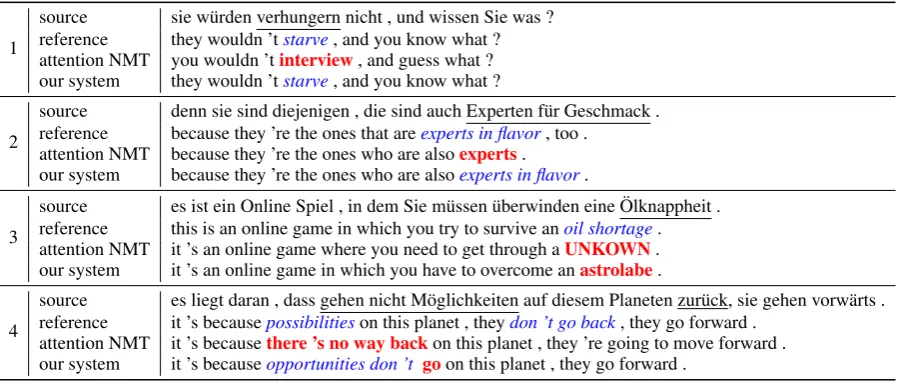
Table 5: Sample translations from the IWSLT German→English test set using the attention-based system (Table 2, row #4) and our system (Table 2, row #7). We highlight the (pre-ordered) source words and their aligned target words. We underline the source words of interest, italicizecorrecttranslations, and use bold-face forincorrecttranslations.
as alignment. While we use larger vocabularies compared to the attention-based system, we ob-serve incorrect translations of rare words. E.g., the German word ¨Olknappheit in sentence 3 oc-curs only7times in the training data among108M words, and therefore it is an unknown word for the attention system. Our system has the word in the source vocabulary but fails to predict the right translation. Another problem occurs in sentence 4, where the German verb “zur¨uckgehen” is split into “gehen ... zur¨uck”. Since the feed-forward model uses a source window of size 9, it cannot include both words when it is centered at any of them. Such insufficient context might be resolved when integrating the bidirectional RNN in decod-ing. Note that the attention-based model also fails to produce the correct translation here.
9 Conclusion
This work takes a step towards bridging the gap between conventional word alignment concepts and NMT. We use an HMM-inspired factoriza-tion of the lexical and alignment models, and em-ploy the Viterbi alignments obtained using con-ventional HMM/IBM models to train neural mod-els. An alignment-based decoder is introduced and a log-linear framework is used to combine the models. We use MERT to tune the model weights. Our system outperforms the attention-based sys-tem on the German→English task by up to 0.9%
BLEU, and on Chinese→English by up to 2.8%
TER. We also demonstrate that re-aligning the training data using the neural decoder yields better translation quality.
As future work, we aim to integrate based RNNs such as the BJM into the alignment-based decoder. We also plan to develop a bidirec-tional RNN alignment model to make jump deci-sions based on unbounded context. In addition, we want to investigate the use of coverage constraints in alignment-based NMT. Furthermore, we con-sider the re-alignment experiment promising and plan to apply re-alignment on the full bilingual data of each task.
Acknowledgments
This paper has received funding from the Euro-pean Union’s Horizon 2020 research and innova-tion programme under grant agreement no645452 (QT21). Tamer Alkhouli was partly funded by the 2016 Google PhD Fellowship for North America, Europe and the Middle East.
References
Tamer Alkhouli, Andreas Guta, and Hermann Ney. 2014. Vector space models for phrase-based ma-chine translation. In EMNLP 2014 Eighth Work-shop on Syntax, Semantics and Structure in Statis-tical Translation, pages 1–10, Doha, Qatar, October.
mod-els. InProceedings of the EMNLP 2015 Tenth Work-shop on Statistical Machine Translation, pages 294– 303, Lisbon, Portugal, September.
Dzmitry Bahdanau, Kyunghyun Cho, and Yoshua Ben-gio. 2015. Neural machine translation by jointly learning to align and translate. InInternational Con-ference on Learning Representations, San Diego, Calefornia, USA, May.
Fr´ed´eric Bastien, Pascal Lamblin, Razvan Pascanu, James Bergstra, Ian J. Goodfellow, Arnaud Berg-eron, Nicolas Bouchard, and Yoshua Bengio. 2012. Theano: new features and speed improvements. De-cember.
James Bergstra, Olivier Breuleux, Fr´ed´eric Bastien, Pascal Lamblin, Razvan Pascanu, Guillaume Des-jardins, Joseph Turian, David Warde-Farley, and Yoshua Bengio. 2010. Theano: a CPU and GPU math expression compiler. In Proceedings of the Python for Scientific Computing Conference, Austin, TX, USA, June.
Stanley F. Chen and Joshua Goodman. 1998. An Empirical Study of Smoothing Techniques for Lan-guage Modeling. Technical Report TR-10-98, Com-puter Science Group, Harvard University, Cam-bridge, MA, August.
Kyunghyun Cho, Bart van Merrienboer, Caglar Gul-cehre, Dzmitry Bahdanau, Fethi Bougares, Holger Schwenk, and Yoshua Bengio. 2014. Learning phrase representations using RNN encoder–decoder for statistical machine translation. InProceedings of the 2014 Conference on Empirical Methods in Nat-ural Language Processing, pages 1724–1734, Doha, Qatar, October.
Jonathan H. Clark, Chris Dyer, Alon Lavie, and Noah A. Smith. 2011. Better hypothesis testing for statistical machine translation: Controlling for opti-mizer instability. In49th Annual Meeting of the As-sociation for Computational Linguistics, pages 176– 181, Portland, Oregon, June.
Trevor Cohn, Cong Duy Vu Hoang, Ekaterina Vy-molova, Kaisheng Yao, Chris Dyer, and Gholamreza Haffari. 2016. Incorporating structural alignment biases into an attentional neural translation model. InProceedings of the 2016 Conference of the North American Chapter of the Association for Computa-tional Linguistics: Human Language Technologies, pages 876–885, San Diego, California, June.
Jacob Devlin, Rabih Zbib, Zhongqiang Huang, Thomas Lamar, Richard Schwartz, and John Makhoul. 2014. Fast and Robust Neural Network Joint Models for Statistical Machine Translation. In 52nd Annual Meeting of the Association for Computational Lin-guistics, pages 1370–1380, Baltimore, MD, USA, June.
Michel Galley and Christopher D. Manning. 2008. A simple and effective hierarchical phrase reordering
model. InProceedings of the Conference on Empiri-cal Methods in Natural Language Processing, pages 848–856, Honolulu, Hawaii, USA, October.
Joshua Goodman. 2001. Classes for fast maximum en-tropy training. InProceedings of the IEEE Interna-tional Conference on Acoustics, Speech, and Signal Processing, volume 1, pages 561–564, Utah, USA, May.
Andreas Guta, Tamer Alkhouli, Jan-Thorsten Peter, Jo-ern Wuebker, and Hermann Ney. 2015. A Com-parison between Count and Neural Network Mod-els Based on Joint Translation and Reordering Se-quences. InConference on Empirical Methods on Natural Language Processing, pages 1401–1411, Lisbon, Portugal, September.
Yuening Hu, Michael Auli, Qin Gao, and Jianfeng Gao. 2014. Minimum translation modeling with recur-rent neural networks. In Proceedings of the 14th Conference of the European Chapter of the Associ-ation for ComputAssoci-ational Linguistics, pages 20–29, Gothenburg, Sweden, April.
S´ebastien Jean, Kyunghyun Cho, Roland Memisevic, and Yoshua Bengio. 2015. On using very large tar-get vocabulary for neural machine translation. In Proceedings of the Annual Meeting of the Associa-tion for ComputaAssocia-tional Linguistics, pages 1–10, Bei-jing, China, July.
Reinhard Kneser and Hermann Ney. 1995. Improved backing-off for M-gram language modeling. In Pro-ceedings of the International Conference on Acous-tics, Speech, and Signal Processing, volume 1, pages 181–184, May.
Philipp Koehn, Franz J. Och, and Daniel Marcu. 2003. Statistical Phrase-Based Translation. In Pro-ceedings of the 2003 Meeting of the North Ameri-can chapter of the Association for Computational Linguistics, pages 127–133, Edmonton, Canada, May/June.
Hai Son Le, Alexandre Allauzen, and Franc¸ois Yvon. 2012. Continuous Space Translation Models with Neural Networks. InConference of the North Amer-ican Chapter of the Association for Computational Linguistics: Human Language Technologies, pages 39–48, Montreal, Canada, June.
Minh-Thang Luong and Christopher D. Manning. 2015. Stanford neural machine translation systems for spoken language domains. InProceedings of the International Workshop on Spoken Language Trans-lation, pages 76–79, Da Nag, Vietnam, December.
R.C. Moore and W. Lewis. 2010. Intelligent Selec-tion of Language Model Training Data. In Proceed-ings of the 48th Annual Meeting of the Association for Computational Linguistics, pages 220–224, Up-psala, Sweden, July.
Frederic Morin and Yoshua Bengio. 2005. Hierarchi-cal probabilistic neural network language model. In Proceedings of the international workshop on artifi-cial intelligence and statistics, pages 246–252, Bar-bados, January.
Franz Josef Och. 2003. Minimum Error Rate Train-ing in Statistical Machine Translation. In Proceed-ings of the 41th Annual Meeting of the Association for Computational Linguistics, pages 160–167, Sap-poro, Japan, July.
Kishore Papineni, Salim Roukos, Todd Ward, and Wei-Jing Zhu. 2002. Bleu: a Method for Automatic Evaluation of Machine Translation. In Proceed-ings of the 41st Annual Meeting of the Associa-tion for ComputaAssocia-tional Linguistics, pages 311–318, Philadelphia, Pennsylvania, USA, July.
Stephan Peitz, Arne Mauser, Joern Wuebker, and Her-mann Ney. 2012. Forced derivations for hierarchi-cal machine translation. In International Confer-ence on Computational Linguistics, pages 933–942, Mumbai, India, December.
Maja Popovi´c and Hermann Ney. 2006. POS-based word reorderings for statistical machine transla-tion. InLanguage Resources and Evaluation, pages 1278–1283, Genoa, Italy, May.
Holger Schwenk. 2012. Continuous Space Translation Models for Phrase-Based Statistical Machine Trans-lation. In 25th International Conference on Com-putational Linguistics, pages 1071–1080, Mumbai, India, December.
Rico Sennrich, Barry Haddow, and Alexandra Birch. 2016. Improving neural machine translation models with monolingual data. InProceedings of 54th An-nual Meeting of the Association for Computational Linguistics, August.
Matthew Snover, Bonnie Dorr, Richard Schwartz, Lin-nea Micciulla, and John Makhoul. 2006. A Study of Translation Edit Rate with Targeted Human Annota-tion. InProceedings of the 7th Conference of the As-sociation for Machine Translation in the Americas, pages 223–231, Cambridge, Massachusetts, USA, August.
Andreas Stolcke. 2002. SRILM – An Extensible Language Modeling Toolkit. InProceedings of the International Conference on Speech and Language Processing, volume 2, pages 901–904, Denver, CO, September.
Martin Sundermeyer, Tamer Alkhouli, Joern Wuebker, and Hermann Ney. 2014a. Translation Modeling with Bidirectional Recurrent Neural Networks. In
Conference on Empirical Methods on Natural Lan-guage Processing, pages 14–25, Doha, Qatar, Octo-ber.
Martin Sundermeyer, Ralf Schl¨uter, and Hermann Ney. 2014b. rwthlm - the RWTH Aachen university neu-ral network language modeling toolkit. In Inter-speech, pages 2093–2097, Singapore, September.
Ilya Sutskever, Oriol Vinyals, and Quoc V. V Le. 2014. Sequence to sequence learning with neu-ral networks. In Advances in Neural Information Processing Systems 27, pages 3104–3112, Montr´eal, Canada, December.
Akihiro Tamura, Taro Watanabe, and Eiichiro Sumita. 2014. Recurrent neural networks for word align-ment model. In52nd Annual Meeting of the Asso-ciation for Computational Linguistics, pages 1470– 1480, Baltimore, MD, USA.
Bart van Merri¨enboer, Dzmitry Bahdanau, Vincent Du-moulin, Dmitriy Serdyuk, David Warde-Farley, Jan Chorowski, and Yoshua Bengio. 2015. Blocks and fuel: Frameworks for deep learning. CoRR, abs/1506.00619.
Ashish Vaswani, Yinggong Zhao, Victoria Fossum, and David Chiang. 2013. Decoding with large-scale neural language models improves translation. In Proceedings of the 2013 Conference on Empiri-cal Methods in Natural Language Processing, pages 1387–1392, Seattle, Washington, USA, October.
David Vilar, Daniel Stein, Matthias Huck, and Her-mann Ney. 2010. Jane: Open source hierarchi-cal translation, extended with reordering and lexi-con models. InACL 2010 Joint Fifth Workshop on Statistical Machine Translation and Metrics MATR, pages 262–270, Uppsala, Sweden, July.
Joern Wuebker, Arne Mauser, and Hermann Ney. 2010. Training phrase translation models with leaving-one-out. In Proceedings of the Annual Meeting of the Association for Computational Lin-guistics, pages 475–484, Uppsala, Sweden, July.
Joern Wuebker, Matthias Huck, Stephan Peitz, Malte Nuhn, Markus Freitag, Jan-Thorsten Peter, Saab Mansour, and Hermann Ney. 2012. Jane 2: Open source phrase-based and hierarchical statistical ma-chine translation. In International Conference on Computational Linguistics, pages 483–491, Mum-bai, India, December.

![Table 2: IWSLT 2013 German→English results inBLEU [%] and TER [%].](https://thumb-us.123doks.com/thumbv2/123dok_us/1480366.687699/8.595.74.289.64.176/table-iwslt-german-english-results-inbleu-and-ter.webp)
![Table 3: BOLT Chinese→English results in BLEU[%] and TER [%].](https://thumb-us.123doks.com/thumbv2/123dok_us/1480366.687699/9.595.311.510.64.206/table-bolt-chinese-english-results-bleu-ter.webp)