The London School of Economics
and Political Science
Doctoral dissertation
“Escaping” the Great Depression
Monetary policy, financial crises and
banking in Spain, 1921-1935
Author:
Enrique
Jorge-Sotelo
Supervisors:
Olivier
Accominotti
Stefano
Ugolini
A thesis submitted to the Department of Economic History in
fulfillment of the requirements for the degree of
Doctor of Philosophy
I certify that the thesis I have presented for examination for the PhD degree of The London School of Economics and Political Science is solely my own work other than where I have clearly indicated that it is the work of others (in which case the extent of any work carried out jointly by me and any other person is clearly identified in it). I further declare:
• The copyright of this thesis rests with the author. Quotation from it is
permitted, provided that full acknowledgment is made. This thesis may not be reproduced without my prior written consent.
• I warrant that this authorization does not, to the best of my belief, infringe
the rights of any third party.
• The thesis consists of 89454 words (excluding footnotes and references).
Statement of inclusion of previous work:
• Some parts of the data used in Chapters 3 and 4 were collected for my
MSc in Economic History thesis, submitted to the Department of Economic History of the London School of Economics and Political Science in 2013.
Declaration about published work in this thesis:
• A revised version of Chapter 3 was published at the European Review of
Economic History in January 2019 under the same title.
Abstract
In the autumn of 2008 I made a short trip to London to visit a friend from childhood that I had not seen for a long time. During this visit, and the many more that the fall of the British Pound kindly helped lengthen, I found out that my friend from childhood had become (had always been, apparently) the most wonderful person I have ever met. Since then, and through endless walks that somehow always ended in a rainy and windy Trafalgar Square, M´ıriam, you have been caring, understanding and loving. I thank you for having walked always by my side, from London to Barcelona and back to London and then back again and then once more, so I could pursue my academic ambitions and enjoy the oppor-tunities I was given. You did that without asking for collateral, without charging high interest rates and with infinite generosity. I would have never achieved this without your unconditional love and support. If any beauty remains in these lines plagued with obscure and boring lingo, it is for you. Ah, and yes, you were right; more footnotes than text pages. What can I say? Ajde Jano, Clap Hands.
Since the very first moment I started to work on this thesis in October 2014, I have been gifted with the continuous support, inspiration, guidance and intellec-tual stimulation from my supervisors, Olivier Accominotti and Stefano Ugolini. By now, Olivier and Stefano are well aware of how much I struggle to pen down my thoughts clearly and in a few words, but I will try. For those who know them and their work, saying that their feedback and comments have been priceless is stating the obvious. It is also evident that, despite all my efforts, the final version of this thesis reflects just a fraction of what the quality of their input would imply. However, their influence on my work has not been only intellectual. To add to my luck, they have also been generous, responsive and understanding, especially in difficult moments. For all this, I will be always indebted to them.
I also thank my Ph.D examiners, Harold James and Mar´ıa ´Angeles Pons. It
they liked it. Their comments on my work will certainly help me expand it and improve it in the future.
During these years at LSE I have met great people with whom I have shared much more than the journey towards submission. Through countless games of chess, Vigyan became a member of the family. Cyril brought wine, cheese and good vibes across the Channel. Alejandra and I traded virgin olive oil for Bioy Casares books; gold for paper at an unknown parity. Greta and I shared the good and the not so good moments as colleagues, friends and London
Southern-ers. Despite Indonesian SMEs and the Banco de Espa˜na being worlds apart, I
learned a lot from her and I will always be keen on (finally) sharing that rainbow cake at Garrick’s. It has also been a gift to meet great people with great minds and great sense of camaraderie: Andrea, Leo, Yasin, Thilo, Gerardo, Kazuo,
Rebecca, Mattia, Walter, Young, Sumiyo, Katja, Sam, Maanik, Iv´an, Mauricio,
Mexican David, Spanish David, Laura Maravall, Laura de la Villa and Daniel. I also thank the LSE jazz/hip-hop collective “The Instrumental Variables” (David, Carry, Margaux, Nuno, Peter, Shyaam, and Leo and Gerardo) for allowing me to think for a second that I was some sort of mix between Kool Herc and Miles Davis when I was just making terrible noise. What a feeling, though.
I have also greatly benefited and learned from workshops, seminars, confer-ences and discussions with colleagues that I will very much miss when I leave the
Department. I thank Joan Ros´es for kindly and patiently helping me clarify ideas
about my thesis on many occasions. It was a great privilege to learn from
Nat-acha Postel-Vinay, Lars B¨orner, Peter Cirenza, Mary Morgan, Albrecht Ritschl,
Philip Epstein, Eric Schneider and Patrick Wallis. Linda Sampson, Tracy Keefe, Loraine Long, Jennie Stayner and Helena Ivins provided excellent administrative assistance. Outside LSE, I benefited from discussing my work with great
schol-ars. In particular, I am indebted to Pablo Mart´ın-Ace˜na. Apart from writing the
book I always came back to when I was lost, he kindly suggested to look at some of the sources I ended up using in the thesis. I also thank Miguel Artola, Michael
Bordo, Germ´an Forero, Alfonso Herranz, Elena Mart´ınez, Christopher Meissner,
´
Angeles Pons, Javier Sanjuli´an, Eugene White and Nikolaus Wolf. I also
ben-efited from comments and feedback from participants at workshops, seminars and conferences hosted at LSE, Barcelona, Carlos III de Madrid, Cambridge, the
Federal Reserve Bank of St. Louis, EHS at Royal Holloway, EHES at T¨ubingen,
Financial historians like to ask “how it all began” or “where it all began”. To me, all began in Barcelona, and it began—as it begins for everybody—with
great teachers. I will always be indebted to Carles Sudri`a, Pere Pascual, Jordi
Pascual, Joan F. Marull and Jos´e Antonio Garc´ıa-Dur´an for making Economics
and Economic History such a great thing to invest a big part of your life in. In Barcelona, I also met Yolanda Blasco, who guided and supported me through my first incursion in researching financial history, helped me get to the archives, and continued to support me throughout the PhD, when I was having serious doubts I could finish this. Having had all these great teachers and mentors, I tried, humbly, to give back. At LSE I had the opportunity to enjoy teaching a variety of courses to a crowd of incredibly interested, talented, motivated and hard-working students. To all of them, a big thank you and a big apology. A big thank you for being interested and for having pushed me to improve my un-derstanding of the topics I taught. A big apology for the lame jokes; I can’t help it.
I would have never been able to undertake my studies at the LSE
with-out the privilege of receiving generous funding from the Societat Econ`omica
Barcelonesa d’Amics del Pais (SEBAP) and the Economic and Social Research
Council (ESRC), who funded my MSc and PhD in Economic History, respec-tively. In particular, I am grateful to Rose Harris (ESRC). This thesis draws on a significant amount of archival material that I collected with the invaluable
help and assistance of Virginia Garc´ıa de Paredes and Gema Hern´andez (Banco
de Espa˜na), Jos´e Antonio Guti´errez and Maite G´omez (Banco de Santander),
Victor Arroyo, Gorka Fuente and Borja Fern´andez (BBVA), Merc`e Marsal (Banc
Sabadell), Melanie Aspey (Rothschild Archive), Piet Clement (Bank of Interna-tional Settlements) and Grace Freeman and Margherita Orlando (Bank of Eng-land).
Once you become friends with London, it is forever, but it takes some time to adapt to her mood swings. Adapting was easier thanks to my in-laws Pere
and Conxita: gr`acies per ajudar-me a viure amb una cama a Londres, l’altra a
Barcelona, i aix´ı poder seguir sense tocar de peus a cap terra (als meus cunyats,
gr`acies per fer fam´ılia). To Dorothea Einhauser, meiner lieben Frau Pingelig,
contributed to make London a big home for a growing family. My friends from Barcelona have always been there. They knew this was very important for me and they always supported me. Through quick but intense visits to London and
Barcelona, Sara, Abel, Leandro, Serji, Alex, Tiare, I˜naki, Mireia, Victor,
Gav-ina, Mar, Marta, Teresa, Pablo, Pal´e, Clara and Alfonso made distance hardly
felt. ´Angel and Luc´ıa (and Emma!) gifted me with their hospitality in Boston.
Jos´e Luis put the books and Pilar put the hugs every Christmas. Mar´ıa and
Antoni-Italo became much closer friends during these years. Mar´ıa shared her intelligence and clarity when it was badly needed. Antoni-Italo allowed me to beat him at chess only once, but boy did I feel smart that night. Javi made hand digitizing 1930s bank balance sheets much more enjoyable by playing 1930s blues tunes on his guitar in La Vera. Finally, with her generosity and love, Carmen demonstrated that, contrary to the common and clearly misguided belief, there is such a thing as a free lunch. My sisters Sabela and Mar kept feeding that Jorge-Sotelo corpus of unique sense of humor (and brought lovely Fabio, Diana
and Giulia to the club); they are the only ones that really get it.
Even if we did not talk a lot during these years I have been abroad, I know that, looking towards London through the windows of her flat in L’Hospitalet de Llobregat, with the somewhat mischievous, time-defying smile that persists in her eyes, my grandmother Rosario is very proud.
To my mother, Aurora, who took a thousand pictures with me and the LSE logo in the background, I can do nothing but apologize for not having under-stood at the time that you were not being too proud, but doing the hard work of conveying my dad’s pride as well. Your strength, resilience and generosity have always been an example to me; I would have never achieved any of this if you had not taught me so much.
1 Introduction 18
1.1 Motivation . . . 18
1.2 Argument . . . 20
1.3 Contribution. . . 23
1.4 Political and macroeconomic context . . . 24
1.5 The Great Depression, the Gold Standard and banking stability in Spain: a literature review . . . 30
1.5.1 The Spanish historiography . . . 30
1.5.2 The international historiography. . . 35
1.5.3 The relevance of the Spanish experience . . . 38
1.6 Chapter summaries . . . 50
1.6.1 Chapter 2: Conflicting goals: banking reform, debt mone-tization and the fall of the Spanish peseta, 1921-1931 . . . 50
1.6.2 Chapter 3: The limits to lender of last resort interventions in emerging economies: evidence from the Gold Standard and the Great Depression in Spain . . . 51
1.6.3 Chapter 4: Allocation of limited lender of last resort assis-tance: bank-level evidence from the 1931 crisis in Spain . . 52
1.6.4 Chapter 5: Explaining bank stability in Spain during the 1930s . . . 53
2 Conflicting goals: banking reform, debt monetization and the fall of the Spanish peseta, 1921-1931 55 2.1 Introduction . . . 55
2.2 Historical background. . . 60
2.2.1 Liquidity and solvency: the 1920 banking crisis . . . 63
2.2.2 The legislative reaction to the crisis and the reaction to the new law . . . 65
2.2.4 Contemporary critiques to the 1921 Banking Law . . . 77
2.3 The impact of the 1921 Banking Law in the money market . . . . 80
2.4 Monetary policy transmission model and empirical estimation . . 86
2.5 Data . . . 89
2.5.1 Bank balance sheets . . . 89
2.5.2 Monetary policy indicators . . . 89
2.5.3 Economic activity . . . 90
2.5.4 Prices . . . 91
2.5.5 Bank characteristic variables . . . 91
2.6 Results . . . 93
2.7 Conclusion . . . 99
2.8 Appendix . . . 101
2.8.1 The model . . . 101
2.8.2 BdE rate changes: 1928-1931 . . . 104
2.8.3 Size, capitalisation and liquidity normalized measures . . . 109
2.8.4 Comparison with other estimates in the literature . . . 109
2.8.5 Stock market index . . . 110
2.8.6 Information about banks used in the estimation . . . 111
3 The limits to lender of last resort interventions in emerging economies: evidence from the Gold Standard and the Great De-pression in Spain 128 3.1 Introduction . . . 128
3.2 The Gold Standard and the Great Depression in Spain . . . 132
3.2.1 Revisiting tradition . . . 132
3.2.2 Gold Standard mentalit´e and twin crises . . . 134
3.3 The Banco de Espa˜na as a constrained lender of last resort . . . . 137
3.3.1 The stabilization of the peseta and “original sin” . . . 137
3.3.2 Capital outflows and fiduciary issuing limits . . . 146
3.4 Data . . . 153
3.5 The 1931 financial crisis: empirical analysis. . . 154
3.5.1 Determinants of deposit withdrawals . . . 154
3.5.2 Liquidity assistance and bank lending . . . 159
3.6 Conclusion . . . 165
3.7 Appendix . . . 167
4.1 Introduction . . . 177
4.2 The Bagehot Rule and gold-inconvertible currencies . . . 179
4.2.1 Pricing emergency liquidity provision . . . 180
4.3 Data . . . 182
4.4 The discount window of the BdE . . . 183
4.4.1 Discount rate, eligibility and the identity of borrowers. . . 185
4.5 Allocation of liquidity at the bank level . . . 191
4.5.1 Determinants of allocation during the crisis . . . 192
4.5.2 Borrowing before and after the interest rate hike . . . 205
4.6 Consequences of allocation . . . 211
4.7 Conclusion . . . 215
4.8 Appendix . . . 217
4.8.1 Reconstruction of the market discount rate: 1900-1935 . . 217
5 Explaining bank stability in Spain during the 1930s 234 5.1 Introduction . . . 234
5.2 Who failed and why? . . . 236
5.2.1 Bauer y Cia: misusing the right connections . . . 238
5.2.2 Catalan banks and their wrong connections . . . 243
5.3 The suspension of mark-to-market accounting . . . 251
5.3.1 The discussion between banks, BdE and the Government . 254 5.3.2 Counterfactual analysis . . . 265
5.4 Banks vs. savings banks . . . 269
5.5 The role of information disclosure . . . 274
5.6 Conclusion . . . 278
6 Conclusion 281 6.1 Implications for the literature on the Great Depression . . . 282
6.2 Implications for the literature on the history and development of central banking in emerging economies . . . 285
6.3 Implications for the Spanish historiography . . . 288
6.4 Limitations and further steps for research. . . 290
A Archival sources 293
List of Figures
1.1 GDP per capita (1929-33) . . . 29
1.2 Two crises compared, 1925 vs. 1931 . . . 43
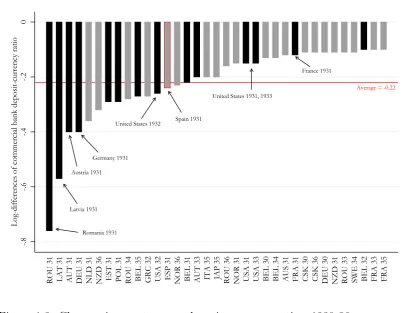
1.3 Changes in country-year deposit-currency ratios, 1930-36 . . . 49
2.1 Public bonds and private stocks issued (1903-33). . . 57
2.2 Trade balance as % of GDP, 1900-1935 . . . 61
2.3 The expansion of the Banc de Barcelona, 1900-1922 . . . 63
2.4 BdE rates and yield of public debt (YTM) . . . 73
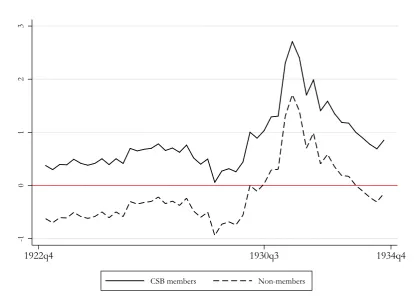
2.5 Spread between yield of public debt and Lombard rate, CSB mem-bers and non-memmem-bers (1922q4-1934q4). . . 114
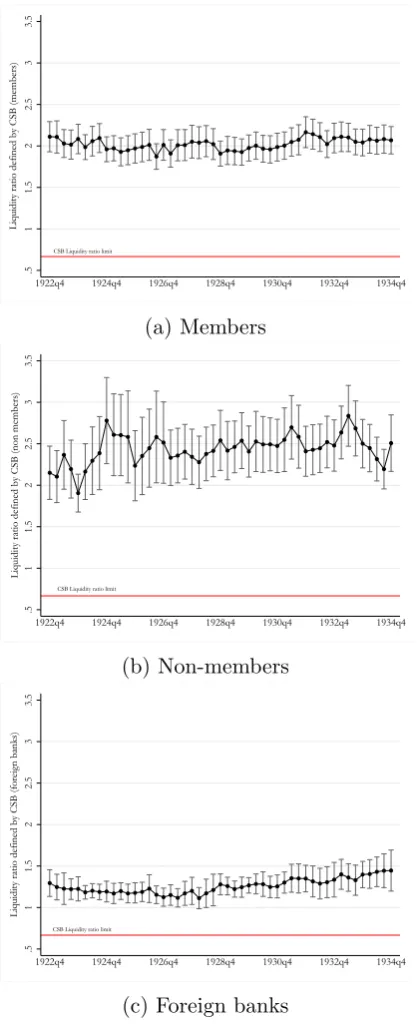
2.6 Liquidity ratios established by the CSB, 1922-1934 . . . 115
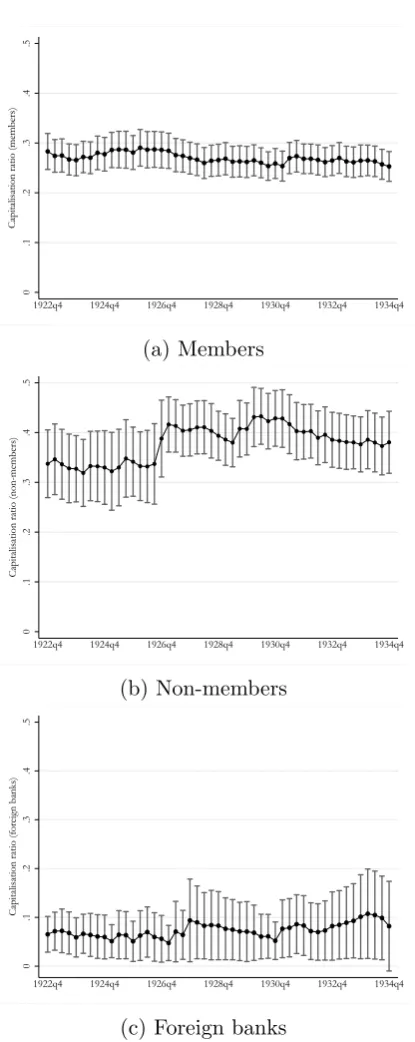
2.7 Capital ratios, 1922-1934 . . . 116
2.8 Public debt as % of securities portfolio . . . 117
2.9 Changes in the balance sheet of the BdE (ratio of advances to discounts) . . . 118
2.10 Composition of BdE’s profits (1900-1935) . . . 119
2.11 Composition of banks’ portfolios (1922q4-1934q4) . . . 120
2.12 Public debt in circulation(1922-1935) . . . 121
2.13 Evolution of total bank short term commercial credit and lending (1922q4-1934q4). . . 122
2.14 Economic Activity indicators compared (1925q1-1934q4) . . . 123
2.15 Different price indexes (1922q4-1934q4) . . . 124
2.16 Share of deposits at the BdE in banks’ total deposits (1925q1-1934q4)125 2.17 Total interbank assets and interbank liabilities, CSB banks (1925q1-1934q4) . . . 126
2.18 Madrid stock market index, 1922-1934 (1926q1=100) . . . 127
3.6 Gold reserves, Government and Banco de Espa˜na (1913-1934) . . 140
3.9 Spot exchange rate and forward premium/discount of the peseta
in London (daily) . . . 149
3.10 Evolution of bank lending, affected and unaffected banks (1931q1=100)161 3.1 Economic activity (1930=100) . . . 169
3.2 Capital flows and exchange rate (1915-1934) . . . 170
3.3 Evolution of the peseta exchange rate (1924-1936) . . . 171
3.4 Evolution of total deposits and loans (1931q1=100) . . . 172
3.5 Currency mismatches in the banking system . . . 173
3.11 Liquidity assistance and bank lending . . . 174
3.12 Evolution of bank lending, affected and unaffected banks (1931q1=100), alternative estimation. . . 176
4.1 Discount and Advance portfolio, BdE (1928-1935) . . . 185
4.2 Top 6 banks deposit losses and access to BdE discount window (1931q1-1931q3). . . 197
4.3 Market and BdE discount rate for 3-month bills of exchange (1921-1935) . . . 198
4.4 Allocation (1931q1-1931q3), kernel density estimates . . . 199
4.5 Correlation between the two LLR reliance measures . . . 200
4.6 Top 6 banks’ share of discount window lending (April to September 1931) . . . 204
4.7 Liquidity pressure and credit crunch, September 1931 . . . 208
4.8 Liquidity pressure and loan contraction, April to September 1931 209 4.9 Banco Urquijo de Madrid (BUMA), daily borrowing from BdE . . 210
4.10 Evolution of Top 6 banks’ balance sheets (Apr-Sep 1931) . . . 213
4.11 Evolution of each bank’s balance sheet (Apr-Sep 1931) . . . 214
4.12 Top 6 banks’ dependence on BdE liquidity (1925-1934) . . . 225
4.13 El Economista’s official and market discount rates, Spain and other countries (1905) . . . 226
4.14 Market rates in London, Paris and Madrid (1900-1914) . . . 227
4.15 Official and market rates, January 1900 - July 1914 . . . 228
4.16 Official and market rate (1914-1918) . . . 229
4.17 Interest rates applied by banks in the city of Cordoba, 1927 . . . 230
4.18 Market and BdE discount rate for 3-month bills of exchange (1921-1935) . . . 231
4.20 Official and market rates, Spain (1900-1936) . . . 233
5.1 Bauer y Cia, debt-to-equity ratio, liability structure and borrowing from the BdE . . . 242
5.2 Banco de Catalu˜na, debt-to-equity ratio (1922-1931) . . . 245
5.3 Leverage ratios of banks connected to Banco de Catalu˜na . . . 247
5.4 Banco de Catalu˜na, borrowing from BdE . . . 249
5.5 Evolution of BCAT portfolio and CAMPSA liabilities . . . 250
5.6 Indexes of the price of public debt and stocks . . . 255
5.7 Impact of the stock market shock on banks’ capital and portfolios 256 5.8 Bank profits, 1922-1934 (million pesetas) . . . 263
5.9 Actual and counterfactual estimates of banking sector’s securities portfolios (1922-1934). . . 266
5.10 Estimated counterfactual capital losses (1931q4) . . . 267
5.11 Deposits in financial institutions (1922-1934) . . . 271
5.12 Subsidiary savings banks, savings banks and banks’ deposits (1922-1933) . . . 272
1.1 Determinants of banking crises: replication of Grossman (1994) . 45
2.1 Composition of bank balance sheets (1922-1934) . . . 58
2.2 Share of government bonds used as collateral by banks (1931q1) . 74
2.3 Central banks’ portfolio composition, 1880-1928 . . . 82
2.4 Loan equations with different indicators of monetary policy . . . . 95
2.5 Loan equations with different measures of liquidity . . . 97
2.6 Comparison of the estimation results with the literature on
mone-tary policy transmission . . . 109
2.7 Shares included in the index and type of firm . . . 110
2.8 Banks’ names, membership and size of loan portfolio (thousand
pesetas, in 1928q3) 1/3 . . . 111
2.9 Banks’ names, membership and size of loan portfolio (thousand
pesetas, in 1928q3) 2/3 . . . 112
2.10 Banks’ names, membership and size of loan portfolio (thousand
pesetas, in 1928q3) 3/3 . . . 113
3.1 Determinants of deposit withdrawals (1931q1-1931q3) . . . 158
3.2 Differences in lending behavior (1928-34), OLS panel fixed effects
estimation . . . 160
3.3 Allocation of emergency liquidity, (April-September, 1931) . . . . 162
3.4 Evolution of banks’ lending and assets after the 1931 crisis (OLS) 163
3.5 Evolution of banks’ portfolio of securities after the 1931 crisis (OLS)164
3.6 Descriptive statistics of all variables . . . 167
3.7 Banks included in Tables 3.4 and 3.5 . . . 168
3.8 Subscribers of gold bonds issued in December 1929 (million pesetas)175
3.9 Differences in lending behavior (1928-34), OLS panel FE
(alterna-tive estimation) . . . 175
4.2 Determinants of allocation of LLR assistance (Bindseil (2014)
mea-sure) . . . 202
4.3 Top 6 banks’ portfolios compared . . . 205
4.4 Liquidity ratios for top 6 banks (BdE measure) . . . 215
4.5 Haircut charged by the BdE to Lombard operations . . . 222
4.6 Reserves, capital and deposits of different banking areas. . . 222
4.7 Discount rates charged by main banks in Spain in Madrid (1929-1931) . . . 224
5.1 Failed banks compared to Spanish banking sector . . . 237
5.2 Estimated failed banks’ market share in Catalonia (deposits) . . . 238
5.3 Balance sheet of Bauer y Cia before declaring insolvency in July 1931 . . . 240
Introduction
To read about Spain during the Great Depression of the 1930s is to puzzle oneself. One might read that Spain was the one European country that escaped the Great Depression and then turn the page to find out about a run on banks, a collapsing currency, capital flight or a severe stock market contraction. Turning more pages one would then find political instability, failed military coups, religious and so-cial conflict, proto-fascism and in the end, another, this time successful, military coup. How can such a country be portrayed as escaping the Great Depression? As it is natural, this depends to a great extent on the metrics and definitions used when comparing different countries exposed to similar economic shocks dur-ing the interwar years. In this sense, escapdur-ing might just work as a relative term, a word used more to illustrate the challenges faced by other countries rather than to provide a faithful description of economic and political developments in Spain. Therefore, it might seem exaggerated to put so much emphasis–include it in the title of a doctoral dissertation even–on that single word. It turns out, however, that it is not. Portraying Spain as escaping the Great Depression does not only depend on the metrics or the words chosen. It also depends on how much do we actually know about economic, monetary and financial developments in Spain during the interwar years.
1.1
Motivation
countries that did not see widespread or large bank failures during the 1930s, as opposed of a number of countries that saw important parts of their banking sectors going under. It is tempting to draw a causal link between these two exceptional features of the Spanish experience: exchange rate depreciation and banking stability. This link is, in fact, a crucial part of the widely-held answer to one of the central questions about the Great Depression: how would countries have fared if they had not been constrained by the Gold Standard? This thesis argues that we need to know more about Spain in order to help answer this ques-tion. An exception might not be enough to grant a valid counterfactual.
Spain was indeed exceptional in many crucial ways during the 1920s and 1930s, but in this thesis I argue that this does not imply that it is the counterfac-tual it is commonly thought of as. If Spain is to be informative to cross-country analyses of the Great Depression, there are other questions that need to be an-swered first. Was a flexible exchange rate enough to escape the Great Depression? Did Spanish policy makers just outsmart everyone else in designing a monetary framework that would isolate the country from external shocks, or did that policy come as an accident? How much monetary autonomy did Spain actually enjoy during the Great Depression? Why did Spain not see large or widespread bank failures? Can Spain be portrayed as having escaped the Depression or should it be perhaps portrayed as having masked its deep consequences? What are the implications of revisiting the Spanish experience for the international literature on the Great Depression? To answer these questions we need to understand if currency depreciation was a stabilizing factor, as it is commonly thought of, or a rather destabilizing one. If the latter is true, then what did bring about the banking stability we observe in the data? By drawing on a wealth of newly col-lected and previously unexplored data, this thesis aims to provide an answer to these important questions.
“Escaping” the Great Depression Chapter 1
neighbors, thought of a stable and strong exchange rate as the cornerstone of eco-nomic prosperity. Spanish policymakers did much more than pay lip service to the gold standard, they implemented policies to join the gold club and these poli-cies had implications. Ironically enough, Spain only managed to peg the peseta to gold–to the French Franc–in mid 1932, with strong capital controls in place, and when only a handful of countries were still somewhat stubbornly attached to gold. By that time, Spain had already been exposed to a number of shocks that caused a strong economic contraction.
Crucially, in 1931, following a sudden political regime change from an author-itarian monarchy to a democratic republic, the Spanish banking system experi-enced a severe liquidity shock that pushed banks to contract credit supply, as monetary authorities faced binding limitations when providing emergency liquid-ity to overcome the shock. Monetary autonomy did not keep the banking system afloat, because in fact, Spain did not have much more monetary autonomy than other countries on gold. To be sure, whatever small room was available for mon-etary activism on its own, it was used and it certainly helped; it was necessary, but in no way sufficient. Crucially, specific government interventions in the form of capital controls, negotiation of international financial assistance and policies aimed at protecting the erosion of bank capital helped Spain to keep its banking sector afloat throughout the 1930s. This, however, did not prevent Spain from undergoing a severe economic contraction between 1929 and 1933 which resem-bled the one experienced by Germany, Italy or France and in which the collapse of financial intermediation was also a key driver.
1.2
Argument
The fluctuations of the peseta during the 1920s and 1930s were not a deliberate decision of Spanish monetary authorities, especially when these implied a depre-ciation. I argue that right at the end of the Great War, Spain lost an opportunity to introduce a well-defined monetary policy framework that would put monetary authorities in effective control of the evolution of credit. The 1921 Banking Law,
which established the Banco de Espa˜na as the provider of an elastic currency and
an eventual liquidity backstop for the rest of the banking sector, failed to deter-mine responsibilities over exchange rate policy. Neither the Government nor the
exchange rate relative to other currencies, at the same time that exchange rate dynamics played a pivotal role in the political backdrop. In contrast, the Law was successful in institutionalizing a system of credit expansion that was based on the indirect monetization of public debt by banks. The Law tied monetary policy to the fiscal needs of past, present and future governments. The Law made sure banks would have an incentive to accumulate government bonds by deeming
the latter eligible at the discount window of the Banco de Espa˜na at subsidized
rates. The Banco de Espa˜na became a passive actor that was only ascribed with
the task of “commanding the credit of the nation”, while banks continued to fuel a credit boom that added pressure to the external value of the Spanish peseta. This system worked in favour of Spain and its authorities through the first half of the 1920s. However, when the country started accumulating current account deficits in the second half of that decade, and the reversal in international capital flows accelerated, the Spanish peseta started an unstoppable fall.
Unhappy with any sign of weakness in the external value of the peseta, the
Government took action. At this moment, the 1921 Law revealed its flaws. With one hand, the Government tried to stop the fall of the peseta by borrowing in foreign exchange and conducting a number of failed interventions and by
per-suading the Banco de Espa˜na to raise interest rates. With the other hand, the
Government kept allowing for banks to monetize their holdings of public debt at subsidized rates, thus canceling out any effects of interest rate changes on bank lending. In the last days of 1929, as stabilization policies had repeatedly failed, the Spanish government embarked into what was expected to be the definitive stabilization plan and issued ten-year gold bonds payable and redeemable in gold or gold-convertible currencies. Bonds were bought by Spanish banks in the ex-pectation that the stabilization would succeed. Spanish banks, however, lacked gold or foreign exchange, so in order to subscribe the bonds, they borrowed gold abroad at very short maturities. Being affected by what economists have dubbed as the “original sin”—that is, being unable to borrow internationally in its own currency—the gold loan planted the seeds of a potential currency mismatch prob-lem in bank balance sheets. As the peseta continued to fall, rolling over these operations became increasingly difficult for banks. Despite that, and with a ral-lying stock market and the continued increase in bank deposits, the currency
mismatch caused by the contracting of the gold loan was theonly pressure banks
“Escaping” the Great Depression Chapter 1
In 1931, however, banks suffered two additional shocks. First, following the proclamation of the Second Spanish Republic, between April and September de-positors withdrew 20% of their funds from the banking sector. This shock to their liabilities, coupled with the already growing currency mismatches caused by the subscription of the aforementioned gold bonds, put banks under severe liquidity
pressure, especially in April and May. The Banco de Espa˜na, even if operating a
non gold-convertible currency, faced quantitative limitations on how much liquid-ity could provide, as any expansion in its fiduciary issue limits had to be approved by the Minister of Finance. The latter, fearing capital flight and the effects of the expansion of base money on the exchange rate, did only authorize the Banco to lend freely to banks once capital controls were in place. This, however, took place a month and a half after banks had suffered their sharpest liquidity shock, which pushed many banks to contract their credit supply. Monetary autonomy in the form of large room for a lender of last resort intervention by the Banco
de Espa˜na was only feasible when Spanish monetary authorities gave up capital
mobility. Importantly, only banks that suffered a deposit withdrawal contracted lending significantly. Banks that were not affected by the bank run or borrowed
large amounts from the Banco de Espa˜na continued to lend. This particular part
of the argument is elaborated in Chapter 3, for which a revised version was
pub-lished in January of this year at the European Review of Economic History.
Bank assets also suffered from the shocks experienced in 1931. In that year, the stock market suffered a sharp contraction. Spanish banks—mostly univer-sal banks—held large portfolios of private stocks, as well as public debt, which greatly exposed their solvency to developments in the stock market. Aware of this, Spanish authorities sought to provide a fast solution to keep the banking
sector afloat. The solution that banks, the Banco de Espa˜na and the Minister
bank-ing sector and lendbank-ing did not recover.
In sum, this thesis argues that exchange rate volatility was not only decried and fought by monetary authorities; more importantly, it did not contribute to improve Spain’s financial position and bank stability. In fact, exchange rate dy-namics operated in the opposite direction, they created fragilities in the banking
sector. It is a fact that the Banco de Espa˜na intervened as a lender of last resort
during 1931, and that this was a necessary step, but this is not enough to explain why Spain was exceptional in terms of bank stability during the Great Depres-sion. Instead, it was a combination of policy measures—that were either absent or came much later in a number of other countries—that kept the banking system afloat. This, however, did not translate in the resumption of economic growth or price stability. The Spanish economy contracted as sharply as the Italian, the French or the German did. Deflation also kicked in from 1933. Bank lending remained depressed. As a result, the Spanish experience does not seem to be a reliable counterfactual for other countries when discussing the links between exchange rate regimes and financial stability during the Great Depression. Spain
was exceptional for reasons that had to do with ad hoc policy choices that were
not necessarily determined by its exchange rate regime.
1.3
Contribution
“Escaping” the Great Depression Chapter 1
stability into question.
A second pervasive assumption that this thesis proposes to reconsider is, there-fore, the widely held idea that banking stability—measured by the number or size of bank failures—was a by-product of the effects of a depreciating currency. As the argument usually goes, allowing the Spanish peseta to depreciate while other European economies were tied to gold, avoided the debt-deflation dynamics that brought down economic activity and contributed to the collapse of the banking system. Moreover, devaluation is also thought as the reflection of an increase in room for lender of last resort interventions by central banks, which undoubtedly contribute to banking stability. However, this assumption overlooks the fact that devaluation or rapid depreciation of a currency can have very different effects in different contexts. In particular, it can have strong destabilizing effects if the country in question is exposed to currency mismatches, either in the balance sheet of the Government or in the banking sector’s. It can also add to political turmoil, especially in a context in which exchange rate stability remained as a key policy objective, even in countries like Spain, that operated non gold-convertible cur-rencies. More importantly, currency depreciation can impose severe limitations on monetary authorities when responding to shocks to the banking sector, as it was the case in Spain in 1931, and as it is commonly the case in emerging market economies. Revisiting the Spanish case by reconsidering these two assumptions implies that the sources of banking stability have to be found elsewhere and, therefore, that the implications of exchange rate flexibility and financial stability during the Great Depression are not fully supported by the Spanish experience.
1.4
Political and macroeconomic context
demo-cratic waters was to hold a local election on 12 April 1931. The results of the local elections materialized the discredit of the Monarchy and its various forms of Government. Republican parties won by a landslide in most provinces, including
the cities of Madrid, Barcelona and Bilbao. As Admiral Aznar Caba˜nas–who
had been appointed head of Government of the Monarchy two months earlier–
famously put it: “will there be a crisis? Is it not enough crisis that of a country
that goes to bed as monarchic and wakes up as republican?”.
On 14 April 1931, having lost the support of the Army, and with republican supporters celebrating the results of the election in the streets, the Second Span-ish Republic was proclaimed and the King and its closer allies fled the country. In what turned out to be a remarkably peaceful transition, given the scope of the regime change, a Provisional Republican Government was formed right after the local elections and the support of the masses opened the door for a change. In May, however, violent clashes between Monarchics and Republicans took place in the streets of several cities and villages; a number of churches and convents were burnt down, including some emblematic buildings such as the Professed House of the Society of Jesus in Madrid. These incidents, which might at first seem unrelated to bank balance sheets, had direct implications for some banks that had very close relations with religious congregations. In particular, as I discuss in Chapters 4 and 5, these ties affected one of the most important banks at the time, Banco Urquijo de Madrid. As a response to these events, and fearing con-tagious social unrest, the Provisional Government declared a “state of war”, the army took the streets and incidents subdued. A month and a half later, in the last days of June 1931, the first General Election was held. Results confirmed the strong support the newborn Republic. After some months of internal disputes, mostly centered around the role of the Catholic Church in the Republic, a Gov-ernment was formed in November 1931. The new Republican Constitution was voted and approved in December of the same year.
Span-“Escaping” the Great Depression Chapter 1
ish society or the degree of autonomy granted to different regions like Catalonia or the Basque Country aimed at pushing Spain towards a progressive reform agenda after almost a decade of stagnation in these areas. Between November 1931 and February 1936, Spain embarked into a gradual but increasingly volatile path towards political polarization. Constantly affected by political swings, the implementation and reaction of policies by different governments, the short but intense life of the Second Spanish Republic came to a sudden end with the mili-tary coup that started the Civil War in July 1936.
The historiography concerned with the political aims, limitations and threats faced by the Second Spanish Republic is vast. It pales in comparison to the thousands of pages that have been written about the Spanish Civil War, but the political and social history of the 1920s and first half of the 1930s has been an area of extensive research, and continues to be. Next to politics, however, there was the economy. There is a broad agreement in the historiography of the period in that any economic origins of the Spanish Civil War are to be found on structural reasons; an unfinished land reform as well as income and wealth inequality and a general protracted backwardness are amongst the main factors. The effect of specific and sudden economic shocks, which were a feature of the pe-riod, however, are commonly downplayed as having had any identifiable influence; Spain is often described as a country that was isolated from the Great Depression.
As its political leaders, the Spanish economy was also bounded by its aims, its limitations, and to some extent, a degree of exceptionality. A peripheral, mostly agricultural but rapidly urbanizing and growing economy, during the 1920s and early 1930s, Spain remained exceptional in the international monetary system. Since it suspended the gold-convertibility of its currency in the late nineteenth century, Spain was the only major European economy that operated a currency that was not convertible into gold during the so-called Classical Gold Standard era (1880-1914) and the Interwar Gold Exchange Standard (1925-1931/36). This exception meant that, by the late 1920s, Spain remained the only major Euro-pean country whose currency was not stabilized, and that was depreciating. As opposed to most of its European neighbors, neither the Spanish Government nor
the Banco de Espa˜na held formal responsibility over the maintenance of a specific
when the peseta appreciated collapsed as the exchange rate started to deteriorate. In particular, the Dictatorship fell into that trap when in 1926 it tied the prestige of the Regime to the value of the Spanish peseta. In that year, General Primo de Rivera claimed that the appreciation that the currency was experiencing was an unequivocal sign of the strength of the Regime’s economic program. Two years later, he could not get out of the trap. As the peseta started depreciating rapidly from 1928, Primo de Rivera (and the subsequent heads of Government after he retired) tried, policy after policy, Minister of Finance after Minister of Finance, to stop the fall of the peseta. Having placed the strong exchange rate as the most salient outcome of the economic success of the Regime, the fall of the Spanish currency in foreign exchange markets could only anticipate its collapse. Crucially, Spanish authorities did not deliberately allow the peseta to fall. All governments decried the fall of the peseta and introduced measures to stop it. To illustrate this, it is perhaps useful to reproduce the opinion of the representative
of the Rothschild Fr`eres in Spain, Ignacio Bauer, when in 1930 he wrote to the
House of Rothschild in Paris1: “it is hard to believe how much the question of
the exchange rate weights in all aspects of Spanish politics. (...) Mr. Arg¨uelles
[the Minister of Finance] has been replaced by Mr. Wais. I have nothing to say
against the new Minister, on the contrary, he is intelligent, young and honest.
His predecessor, however, had the same qualities, and despite all this, the peseta
continued to fall. Nowadays everything depends on the exchange rate”. Despite
several attempts to stop it, the depreciation of the peseta survived the Dictator-ship and the SoftatorDictator-ship. In fact, and along with mounting financial fragility, the fall of the peseta did not only survived these regimes, it contributed to their demise. The depreciation was only stopped by a combination of external financial support, capital controls and the departure of Sterling from the gold standard in September 1931.
“Escaping” the Great Depression Chapter 1
1931, the price of public and private securities fell rapidly. The Spanish peseta, which had been almost finally stabilized in March, started falling rapidly again. Capital flight was, as it is commonly the case, a cause and a consequence of ex-change rate dynamics. When the banking panic subdued, during the third quarter of the year, the banking sector had lost 20% of its deposits, loans outstanding had contracted by a similar percentage, asset prices remained depressed (albeit public debt recovered relatively fast) and private investment had collapsed. All in all, however, the banking, currency and stock market crisis of 1931 took little casualties: only four, relatively small banks failed during this year.
If one was to delete the last sentence of the previous paragraph, it could be easily claimed that 1931 was a terrible year for the Spanish financial system. In fact, doing so reveals the important similarities between Spain and other coun-tries that underwent deep economic difficulties during 1931, like Germany. The two countries suffered similar economic contractions during the Great
Depres-sion (Figure 1.1), and were plagued by political instability during this period. It
can also be argued that both countries experienced strong exchange rate pres-sure, even if they were under different exchange rate arrangements for most of the interwar years. Both countries were under constant threat of capital flight, introduced capital controls, and experienced comparable shocks to their banking
system (Figure1.3). Spanish banks lost 20% of their deposits between April 1931
and September 1931, a figure that is very similar in size and timing to the shock
experienced by German banks (Balderston,1991;Schnabel,2004a). Interestingly,
-.3
-.2
-.1
0
.1
% change in GDP/head
[image:30.595.115.525.83.405.2]CAN USA AUT NLD DEU FRA ESP ITA BEL CHE GBR IRL SWE FIN GRC DNK NOR PRT
Figure 1.1: Change in GDP per capita in %, (1929-33)
Source: Bolt and Van Zanden(2013).
“Escaping” the Great Depression Chapter 1
1.5
The Great Depression, the Gold Standard
and banking stability in Spain: a literature
review
Over the course of the last forty years, research on causes, transmission and consequences of the Great Depression has developed extensively. New empirical evidence both at the macroeconomic and microeconomic level has contributed to filling important gaps in the historiography, as well as to deepening our under-standing of some well established historical facts. As the international literature developed, and despite substantial progress in the 1980s and 1990s, important as-pects of the impact of the Great Depression in Spain have remained unexplored, especially in the subfield of financial history and also in terms of empirical re-search. Here I discuss the main contributions made by the literature and contex-tualize my contribution to this body of research.
1.5.1
The Spanish historiography
Pablo Mart´ın-Ace˜na’s book“La pol´ıtica monetaria en Espa˜na, 1919-1935”
(Mon-etary Policy in Spain, 1919-1935) remains the most comprehensive analysis of the
period2. This work was complemented with new long-run estimates of monetary
aggregates also provided by the same author (Mart´ın-Ace˜na,1984,1985).
Mart´ın-Ace˜na’s work focused primarily on the evolution of monetary policy formulation,
analysing both the intellectual framework in which it operated (the international context), as well as in the specific policy decisions taken (the domestic context).
He concluded that over the Interwar Period, the Banco de Espa˜na (BdE) took a
rather passive stance in monetary policy affairs. Engaged in almost constant con-flict with the Government about the responsibilities over exchange rate stability and the ultimate causes of currency depreciation, the central monetary institution failed to emerge as a central bank that could command the credit of the nation, even if this was its main mandate.
While Mart´ın-Ace˜na documented the numerous and unsuccessful attempts to
of a proactive Ministry of Finance which allowed for increases in the fiduciary issue coupled with the liberality with which the BdE lent during the crisis, are the main explanations of banking stability and the relatively mild economic
con-traction that Spain suffered vis-`a-vis other European economies. That said, he
also concluded that the overall monetary policy stance in Spain after 1931 was definitely not expansive and that Spanish monetary authorities’ decision to peg the peseta to the French Franc in 1932 and join the gold bloc contributed to
im-port deflationary pressures (Mart´ın-Ace˜na, 1984, 2013). This view was partially
shared by Hern´andez Andreu (1983), who also argued that the depreciation of
the peseta between 1928 and 1932 did not avoid a sharp economic contraction in Spain, and that the decision to peg it to the Franc in 1932 was also detrimental for the Spanish economy. In general, however, he attributed the poor performance of the Spanish economy during the Great Depression to structural deficiencies, mainly an underdeveloped agriculture and an external sector dependent on
ex-ports of primary goods and imex-ports of machinery3.
Compared to the depth of the analysis of the institutional foundations,
intel-lectual framework and policymaking decisions of the Banco de Espa˜na provided
byMart´ın-Ace˜na(1984), his analysis of the evolution of individual Spanish banks
during the 1920s and 30s remained captured mostly by the evolution of mone-tary aggregates, although he provided qualitative evidence of bank-specific events when relevant. In a contribution aimed at filling this gap, Gabriel Tortella and Jordi Palafox switched the focus from monetary policymakers to the receivers of the policy—the banking and industrial sectors—by incorporating bank balance sheets to their analysis of banking and industry during the early 20th century
(Tortella and Palafox, 1984). Their analysis relied on annual data from the
An-uario Financiero y de Sociedades An´onimas de Espa˜na (AFYSADE), and
in-cluded mostly consolidated balance sheet data of the Spanish banking system, albeit they narrowed the focus to the largest six banks for certain parts of their work. Overall, their conclusions about the impact and the consequences of the
1931 crisis in Spain, the role of the Banco de Espa˜na during the whole period,
as well as the stance of monetary policy during the 1930s are, if acknowledgedly
provisional, remarkably optimistic. Tortella and Palafox (1984) concluded that
during the 1930s4: “(...) nothing massive or dramatic occurred, no really
impor-tant banks suspended payments; no large scale “salvaging operation” was required.
“Escaping” the Great Depression Chapter 1
In essence, their conclusion stems from three main arguments. First, banks never had a liquidity problem, so the sharp contraction in bank lending that the economy suffered can be explained entirely by the deterioration in economic ex-pectations brought about by the regime change that took place in April 1931. Falling demand due to a sharp deterioration in economic expectations brought down bank lending. Second, while the authors acknowledged a contraction in balance sheet items relating to commercial banking, they concluded that other assets like securities (public bonds and industrial securities) experienced healthy increases. Third, bank profits, if not comparable to those accruing during the
1920s, remained healthy during the 1930s5. Similarly, Palafox (1991) concluded
that the impact of the Great Depression in Spain was limited; the path of do-mestic economic activity—measured by the evolution of industrial production— constituted an exception to the rest of the world. The author highlighted the differential path of deflation between Spain and other countries in the world; however, his work also showed that deflation kicked in in 1932-33, after Spain stabilized the peseta and pegged it to the French Franc. Palafox concluded that the 1928-31 depreciation, if decried by the Government, had positive effects, mostly through inflation, which compensated for the distortions it created in the determination of import prices in pesetas. The benefits of the depreciation out-weighed the costs. Regarding the impact of the proclamation of the Republic on
the financial sector, Palafox(1991) showed that deterioration in economic
expec-tations had started in 1930, but that the impact of the regime change had severe consequences for the Spanish economy. In particular, he discussed the impact of deposit withdrawals on the banking system in 1931 and the following years.
The sharp contraction in lending, he concluded6:“(...) can not be attributed only,
and certainly not mainly, to a drop in the demand for credit, but to the attitude
of the great banks, which affected by the deterioration in expectations, contracted
supply.”
Palafox rejected the hypothesis that monetary factors or liquidity pressure could explain the contraction in lending; instead, he attributed it entirely to the
change in expectations7. In general, in his interpretation of the crisis, there is
no role for a contraction in lending explained by liquidity constraints suffered by different banks; any source of heterogeneity in the lending behaviour of individual banks had to do with differences in their expectations over the newborn Republic.
of the previous account, while he broadly agreed with Palafox (1991) in that credit supply played a role in the contraction of lending and private investment.
Garc´ıa Ruiz (1987, 1992, 1993) argued that bank lending might have been, in
fact, affected by supply constraints. In contrast with the account provided by
Tortella and Palafox(1984), he pointed to a “liquidity crisis” in 1931, and argued
that banks restricted credit supply during the 1930s, a period dominated by high
real interest rates compared to other countries in Europe, something that Com´ın
(2012) also documented, but that was not reflected in nominal interest rates,
which fell between 1932 and 1936. Garc´ıa Ruiz’s contribution, if innovative and certainly at odds with some of the previously established accounts, also relied on aggregated data and suffered from the lack of archival evidence available at the
time. Accordingly, his provisional conclusions left the door open for “a deepening
that is only going to be feasible when private bank archives are open.”8
More recently, authors interested in a long term approach to financial crises have reassessed the importance of the 1931 crisis in Spain. In a recent article that focuses on the importance of current account deficits as determinants of financial
crises, Betr´an and Pons (2018) provide a comparative analysis of the severity
of financial crises in Spain between 1850 and 2015. Their interpretation of the
1931 crisis coincides with that of Mart´ınez-Ruiz and Nogu´es-Marco (2014), but
contrasts with previous classifications of the 1931 crisis, such as the one inBordo,
Eichengreen, Klingebiel, and Mart´ınez-Peria (2001). Betr´an and Pons(2018)
de-scribe it as a triple crisis: currency, banking and stock market. Using qualitative and quantitative evidence on the evolution of monetary aggregates, their own
es-timates of current account imbalances and eses-timates of annual GDP from Prados
de la Escosura(2003), they show that Spanish GDP lost an accumulated 13.04%
compared to the pre-crisis trend after 1931 and they argue that current account imbalances sit at the core of the explanations of financial crises during the period.
Recent updated GDP per head estimates for the period provided byPrados de la
Escosura (2017) also suggest that previous accounts might seem too optimistic;
he concluded that the real contraction experienced by Spain during the 1930s is
comparable to European countries and therefore“challenges the view of a weaker
impact due to Spain’s relative international isolation and backwardness.”9. To be
“Escaping” the Great Depression Chapter 1
comparable–the difference is clear: 1931 was a severe crisis, while the GDP loss from the 1925 banking crisis was negligible. A similar account is provided by
Mart´ın-Ace˜na (2013): the 1931 crisis was much more severe than that
experi-enced in 1925. A more recent experience might help contextualize these figures:
by 2016, the GDP of the United States was still 13% below its pre-crisis trend10.
There are, therefore, two broad interpretations of the developments of
Span-ish banking during the Great Depression. On the one hand, Tortella and Palafox
(1984) described the crisis as mild and argued that its consequences were limited.
On the other hand, the works of Mart´ın-Ace˜na (1984, 1995, 2013), Garc´ıa Ruiz
(1987, 1992, 1993), Palafox (1991) and Betr´an and Pons (2018) argue that 1931
was definitely a crisis year, although they differ on the main drivers. That said, they all agree in that banking, currency and stock market problems coincided and they had an effect on the evolution of GDP, which had been growing steadily since the mid-1920s. As stressed above, in some cases the conclusions reached are con-ditional on the metric chosen to compare Spain to other countries. For example,
Tortella and Palafox(1984) do not attach too much importance to the contraction
in bank lending as a sign of distress during and after 1931, while they emphasize the evolution of bank portfolios of securities and profits as a proof of the strength
of the Spanish banking system during the 1930s. In contrast,Garc´ıa Ruiz (1993)
went beyond bank failures, and concluded that if there was a contraction in bank lending, this was mostly because banks reallocated their portfolios towards more liquid and safe assets. At the same time, a liquidity shortage during the 1931
crisis is not a crucial part of his explanation of the crisis11. The argument he
presented emphasizes high real interest rates and credit rationing, rather than the persistence of a sharp liquidity shock. The most updated conclusion of the Spanish historiography is, therefore, that Spain had a crisis in 1931, albeit there is no agreement on its exact extent, its causes and its actual scope.
Interestingly, as I shall show in the next section, the international literature that flourished in the late 1980s and 1990s about the international dimension of
the Great Depression relied mostly on the conclusions reached by Tortella and
Palafox (1984). Most international accounts and cross-country comparisons do
not incorporate the explanation of the evolution of monetary policy provided by
Hern´andez Andreu (1983) and Mart´ın-Ace˜na (1985, 1995), but also the not so
optimistic approach about banking during the 1930s taken byGarc´ıa Ruiz (1987,
1.5.2
The international historiography
The conclusions reached by Tortella and Palafox (1984) about the performance
of the Spanish banking sector during the 1920s and 30s influenced greatly the perception of the Spanish experience during the Great Depression in the interna-tional literature. Accordingly, the most influential and comprehensive accounts of the period tend to conclude–to summarize it in one representative quote–
that “Spain avoided the Great Depression by never being on the Gold Standard”
(Temin, 1993). This narrative has, in turn, been incorporated also by the most
recent publications in the history of financial crises; the last example of this is the work the historical recurrence and common patterns of financial crises provided
by Reinhart and Rogoff (2009). As recently documented by Albers (2018), it is
almost common knowledge that Spain escaped the Great Depression.
Besides the fact that the aforementioned account of Spanish banking develop-ments can be considered perhaps overly optimistic, as I discuss in the following chapters, there are at least two important additional shortcomings with the way the Spanish experience is introduced in cross-country analyses. Frequently, these analyses rely on dummy variables to define countries’ exchange rate arrange-ments or monetary frameworks, and also use dichotomic definitions of banking crises: a country had a crisis or it did not. This approach, while justified from the point of view of the methodology needed to establish international compar-isons given binding data constraints, hides important nuances. Dummy variables fail to capture structural variations in the relationship between the operation of the exchange rate regime and outcome variables. Similarly, a binary definition of
banking crises fails to account for the variety of countries’ experiences12. Between
the black and white of a dummy variable, there is a wide spectrum of relevant
gray (Urban, 2009).
This matters because Spain is usually presented as an important example in the literature connecting adherence to the Gold Standard, banking panics and economic performance during the Great Depression. Unable and unwilling to let exchange rates depreciate during the late 1920s and the early 1930s, governments
and central banks enforced deflationary pressures on their economies (Bernanke
and James,1991;Eichengreen,1992;Eichengreen and Temin,1997). Deflation did
“Escaping” the Great Depression Chapter 1
uncertainty, as highlighted byTemin(1989,1993),Romer(1990) orOlney(1999).
It also contributed to add pressure on bank balance sheets through debt-deflation
spirals (Fisher,1933; Bernanke and Gertler, 1990). Importantly, these pressures
contributed to increased financial fragility. Bank failures, in turn, caused the costs of financial intermediation to rise, transforming monetary shocks such as
the one described by Friedman and Schwartz (1963) into a real contraction in
economic activity through the collapse of the supply of bank loans (Bernanke,
1983; Bernanke and James, 1991; Calomiris and Mason, 1997; Anari, Kolari,
and Mason, 2005; Richardson, 2007;Richardson and Troost,2009; Postel-Vinay,
2016). In this context, gradual exchange rate depreciation (or sharp devaluation)
would have avoided countries falling into the Depression or helped recovering from it. This is because exchange rate depreciation eased the effects of deflationary
pressures in industrial production (Choudhri and Kochin, 1980). It facilitated
the adjustment of current account deficits by boosting exports (Eichengreen and
Sachs,1985); it also contributed to banking stability during the 1930s (Grossman,
1994; Temin, 2008). In particular, suspending gold convertibility allowed central
banks to engage in monetary expansion and gave them more latitude to respond
to banking crises (Temin,1989; Eichengreen,1996). Therefore, not being on the
gold standard allowed for countries to incorporate a more aggressive lender of last
resort reaction to their toolbox (Grossman,2010). Somewhat taking the argument
to the extreme, some authors have argued that in a country that operated a fiat currency (a variant, but not the only one of gold-inconvertibility), the monetary base could be expanded without constraints to assist the banking system, thus
allowing the exchange rate to take the hit (Martin,2009). Although recent works
on the history and theory of banking and central banking like Grossman (2010)
or Ugolini (2017) question the extent to which this is actually a feasible policy
in the presence of fiscal and/or political constraints (even in flexible exchange rate regimes), this account has been incorporated to cross-country and long term
analyses of the determinants and the incidence of financial crises. Reinhart and
Rogoff(2009) summarize this widely-held narrative by claiming that Spain:
“ex-perienced runs, but the Bank of Spain could lend freely as a lender of last resort.”13
A second limitation of the conventional methodology is that it downplays the importance of twin crises and, in particular, their incidence in emerging markets
and peripheral economies. An explanation for this–asSchnabel(2004a) argued–is
explain why a number of the works outlined above did not include the possibility of a twin crisis when they observed the sharp depreciation of the peseta between 1928 and 1931. Another explanation is that, given the need for a standard for comparison between countries with different levels of financial development, and the difficulty to find a representative measure of the latter, researchers had to rel-ativize the importance of the differences between core and peripheral economies in their ability to deal with financial crises. To be sure, however, the effects of de-valuations or sharp depreciations depend greatly on the composition of economic agents’ liabilities, which tend to be very different in core and peripheral countries. Either way, I argue that the conventional interpretation of the Great Depression in Spain puts too much emphasis on the effects of currency depreciation in
coun-tering deflationary pressures, mostly through the influential work of Choudhri
and Kochin (1980), but alsoTemin(1993) and Grossman (1994). This is done at
the expense of taking into account that rapid exchange rate depreciation can have negative effects on the banking system if the latter holds significant short term
liabilities denominated in foreign currencies, as widely documented by
Kamin-sky and Reinhart (1999),Krugman (1999), Chang and Velasco(2000) andCalvo
(2006), among others. In this case, exchange rate depreciation worsens currency
(and maturity) mismatches in bank balance sheets and can contribute to addi-tional pressure on the banking system. This is especially the case if the latter is already under liquidity problems as depositors are withdrawing funds from banks. Moreover, this account seems to ignore the fact that during the Interwar Period, fixed exchange rates and adherence to the Gold Standard were a very ingrained
aspiration in policymakers’ agenda (Eichengreen, 1992; Eichengreen and Temin,
1997; Mour´e, 1991, 2002; Straumann, 2010). As I show in Chapter 3, Spain was
no exception to this trend; very few economic agents could see benefits stemming from a falling peseta. Some observers acknowledged that it contributed to ease deflationary pressures, but this was definitely over in 1931 when prices began to stagnate and fall as international deflation and internal factors affected the Spanish economy.
de-“Escaping” the Great Depression Chapter 1
preciation from the point of view of banking stability are not linear and might be negative altogether. The next two subsections contextualize these limitations in the international historiography and explain why the Spanish case is important to improve our understanding of the mechanisms underlying banking stability during the Great Depression.
1.5.3
The relevance of the Spanish experience
The importance of Spain as a benchmark for comparison in the literature about the Great Depression can hardly be exaggerated. It is literally reflected in the following quote from one of the most influential papers in the historiography,
Choudhri and Kochin (1980)14. In their paper, Ehsan U. Choudhri and Levis A.
Kochin compared the performance of industrial production and the price level with the evolution of exchange rates between 1928 and 1932. They found a pos-itive correlation between exchange rate depreciation and industrial production. As they put it:
“The centerpiece of our evidence is Spain, which, during the Great Depression, operated on flexible exchange rates combined with fairly
stable monetary conditions while most of the world was committed to
the gold standard. A comparison of Spanish experience in this period
with the gold-standard countries provides a striking historical
experi-ment on the insulation capabilities of the flexible exchange rate system.
(...) Thus, at the onset of the Great Depression, Spain was the only
major country operating on a flexible exchange rate system. During
the depression, while Spain went through several changes in its
govern-ment, the Spanish economy was largely unaffected by political turmoil until the Civil War several years after. The Spanish peseta was flexible
until March of 1934. (...) Spanish prices and output remained, for the
most part, unaffected during the depression period. Indeed, the 1932
level of prices and production in Spain was not much different from
the level in 1928. (...) [Spain]virtually escaped the Great Depression.”
Interestingly, and as opposed to the rest of authors that deal with the Spanish
experience, Choudhri and Kochin(1980) did not draw from Spanish
historiogra-phy to contextualize or inform their empirical findings. While their data come
the narrative of the Spanish experience (both economic and political) is drawn
from Delaplane (1934), a Ph.D. dissertation from Duke University. The nature
of the secondary sources used by these authors can explain the arguably opti-mistic account about Spain’s performance during the Great Depression.
Inter-estingly, however, they acknowledged that “the Spanish money supply behaviour
(...) remained reasonably stable except in the year 1931 when there was a sizeable
decrease in the money stock”, albeit they did not report why, or discuss its
im-plications for the sharp contraction in industrial production they observed from 1931. In addition, there are many aspects of the Spanish experience that are not
accurately captured by the data that Choudhri and Kochin(1980) had access to.
AsAlbers(2018) has recently pointed out, the focus on industrial production as a
proxy of economic activity during the Great Depression, while indicative, comes
with strong limitations. Empirical work by Rodrik (2013) showed that
uncon-ditional convergence can take place in the industrial sector but not necessarily in less modern parts of the economy. This implies that industrial production can grow independently from other sectors, which might be quantitatively more important, and thus can render a misleading picture of the overall evolution of economic activity. Accordingly, using principal component methodology to
es-timate the evolution of monthly economic activity, Albers (2018) found a sharp
contraction in economic activity in Spain. As Figure 3.1 shows, while private
investment collapsed by more than 30% during 1931, industrial production only
contracted by 10%. In fact, GDP contracted almost 10% during the period that
Choudhri and Kochin (1980) discussed, which is in sharp contrast with their
conclusion that output remained unaffected (Figure 1.1). In addition, Spain did
indeed experience political volatility during the 1920s and 30s, before the Civil War. In fact, political shocks were instrumental to the magnification of some economic and financial shocks. Finally, it is inaccurate that the Spanish peseta floated until 1934. This is not a minor question, because the fact that Spain sta-bilized in 1932 shows that even right after the worst of the crisis, exchange rate stability remained a main policy goal. Spanish monetary authorities pegged the peseta to the French Franc in 1932 (i.e. to gold) overvaluing the exchange rate
and importing deflation (Hern´andez Andreu,1983; Mart´ın-Ace˜na, 1984). This is
reflected in the evolution of wholesale prices, which fell by 8.2% between 1931
and 1935 (Maluquer de Motes, 2013). While deflation kicked in later and with
“Escaping” the Great Depression Chapter 1
WhileChoudhri and Kochin(1980) focused only on the link between exchange
rate depreciation and economic activity–thus not including the banking system in their analysis–other authors put the focus on the implications of exchange rate policy for central bank interventions during the Great Depression. In this strand
of the literature, one of the most influential works isTemin(1993). Peter Temin’s
“Transmission of the Great Depression” has been highly influential in the
histo-riography of the Great Depression, and since it summarizes the interpretation of the Spanish experience in international academic debates quite succinctly, it is
also worth quoting at length15:
“Spain stands as the prime example of a country that avoided the worst
excesses of the Great Depression by staying off the gold standard. Did
it also avoid financial panics? Spain tried to fix the peseta in the late
1920s as France and Italy stabilized their currencies, but the
defla-tionists lacked the political muscle. The government continued to run
deficits which were monetized by healthy banks. There was a run on
Spanish banks contemporaneous with the failure of the Credit Anstalt in Austria. Mart´ın-Ace˜na (1992) cites internal causes, but the peseta
was under pressure as well. Very few banks failed, and the experience
is not thought of as a panic. The Bank of Spain acted as a lender of
last resort enabled to do so by two factors. The banks held large
port-folios of government debt that could be so