2017 2nd International Conference on Wireless Communication and Network Engineering (WCNE 2017) ISBN: 978-1-60595-531-5
Research and Implementation of the Interface of Oder Notification for
Nuclear Power Plant Based on Mobile Platform
Qing-hua GUAN, Wen-qu CHEN
and Qi-ning HE
Centre of Information Technology, CGN Power Co., Ltd., Shenzhen City, China
Keywords: Nuclear Power Plant, SAP, Mobile platform, WeChat, Interface.
Abstract. The nuclear power plant has enabled order notification function in the SAP system. However, in practical work, it’s not very convenient for end user to use this function because all the operations have to be done in PC environment. In the meantime, the application of the mobile platform is more and more widely used, and many applications can be migrated to WeChat through SAP PI system. Based on such situation, this paper designs and implements a reporting and updating interface for order notification based on mobile platform which can asynchronies the data exchange between WeChat and SAP, and realizes the data automatic updating through SAP background jobs.
Introduction
With the maturing of nuclear power technology, the construction of nuclear power plants (NPP) is also accelerating. As more and more new power plants are put into operation, the function of SAP PM management system and work order system has been activated at those plants [1]. On the other hand, the current mobile platform is also used widely [2], so we have the technical possibilities of transferring ordinary SAP daily tasks to the mobile platform [3].
The NPP tries to implement the interface between WeChat Enterprise platform and SAP. This interface is to achieve the following two purposes: WeChat fulfills the NG notification and SAP synchronizes data to WeChat. For WeChat in NG notification filling it mainly includes: WeChat fills in NG Notification and WeChat views NG notification. The SAP synchronization features include the following functions:
1. The functional position of the SAP main data needs to be synchronized and recorded to the WeChat side as the function position data changing in SAP;
2. The user can query the synchronization log, and process the deduplication of data;
3. The initial data processing: users download the main location of the functional SAP data, and then manually upload to the WeChat.
Therefore, it is necessary to design interfaces and reports to implement the above functions so as to improve work efficiency and bring convenience to end users.
This paper is organized as follows: Chapter 2 introduces the programming design; Chapter 3 introduces the architecture specific program and implementation; Chapter 4 is the summarized and future work.
Overall Designs
Figure 1. Architecture of System.
Features Implementation
Design and Implementation at WeChat
WeChat provides the following data to SAP:
Table 1. Structure of Notification Data. SAP NG Notification Fields Length
Notice type CHAR
Short description CHAR Functional location CHAR
Planner CHAR
Planning factory CHAR
Main work center NUMC
The main work center factory CHAR
Reporter CHAR
Request conditions CHAR The functions at WeChat are as follows:
1. When creating a NG notification, the system first determines whether the function has been enabled for current NPP (as determined by a custom configuration table);
2. Save the notice and return a result value to the WeChat side (Success or failure); 3. Create a new NG notification via the interface in the SAP system.
The fields in the message delivered by SAP PI are as follows:
1. Notification Number: According to the rules of SAP automatically generation. 2. Attachment: Save as an attachment in the SAP Notification.
Because the interface does not limit the planned plant (NPP in SAP system), if there are multiple nuclear planned plants, it can be enabled according to the actual arrangement. Therefore, a custom configuration table is required to configure the nuclear planned plant contents. The contents of this table can include ‘Planning Factory’ and ‘Whether to enable’.
Design and Implementation at SAP
Design the Message Structure of Notification. Considering of SAP has created a set of standard BAPIs (SAP Business Application Programming Interface) for creating order notifications, we just need to prepare the right data and use the previously created BAPI.
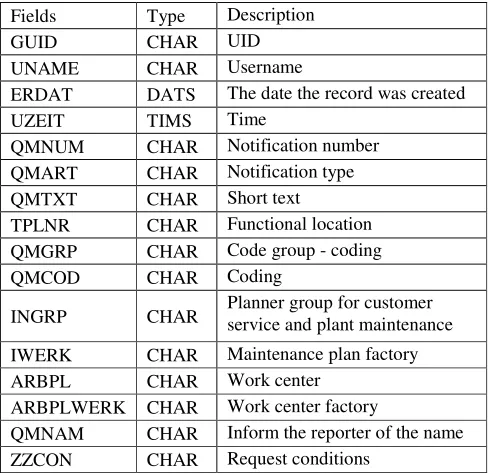
[image:3.612.184.428.227.464.2]In order to distinguish the independence of each transmission data and avoid duplication of creating the same notification, the message need to fill a necessary field which is a globally unique code (GUID) to the WeChat while transmitting data. For example, when a notification is received, the WeChat end does not receive the return result due to various reasons such as network delay. When the same unique ID is sent to SAP ECC again, the interface can return the once created notification to WeChat, and shows the successful tag, SAP here will not repeatedly create useless data. The LOG records created by NG Notifications in SAP are self-built data tables whose fields are as follows:
Table 2. Structure of Log Data. Fields Type Description
GUID CHAR UID
UNAME CHAR Username
ERDAT DATS The date the record was created
UZEIT TIMS Time
QMNUM CHAR Notification number QMART CHAR Notification type QMTXT CHAR Short text
TPLNR CHAR Functional location QMGRP CHAR Code group - coding
QMCOD CHAR Coding
INGRP CHAR Planner group for customer service and plant maintenance IWERK CHAR Maintenance plan factory ARBPL CHAR Work center
ARBPLWERK CHAR Work center factory
QMNAM CHAR Inform the reporter of the name ZZCON CHAR Request conditions
After SAP receives the data, a series of rule checking is needed, such as checking whether the GUID is transmitted, checking whether the type of the notification is NG type, description of the notification, functional position of the notification, code group of the notification, notification Single coding, work centers, factories, notifies and other fields will be lost.
When processing the WeChat attachment information, the attachment is first saved to the shared server, then the address of attachment in the shared server corresponding to the attachment is sent to the SAP along with the data, and the newly created notification message stores the corresponding URL information. Doing so enables attachments to be stored by a unified file server, reducing the amount of space occupied by the SAP server (storage is very expensive for SAP server) and reducing the size of messages as they are transmitted through the interface. When viewing a notification, you can go directly to the attachment URL and open the document (with access rights).
Synchronize Location Information from SAP to WeChat. We use a report that allows SAP to modify the functional location, and then synchronize the data to the WeChat side. Report can be ran on the user's foreground, or can be configured as background job that regularly synchronizes the function of the previous day's location data.
Design and Implementation for SAP PI Interface
[image:4.612.180.430.158.317.2]SAP PI is a system that integrates with SAP ECC systems and other systems. The main functional components include two parts: Integrated Repository (IR) and Integrated Directory (ID). IR is used to define the structure of the data segment, message type and mapping; ID is used to define the integrated directory, which includes configuration information such as routing rules, active status services, executable mapping rules and specific system status. The architecture is descripted below:
Figure 2. Structure of SAP PI System.
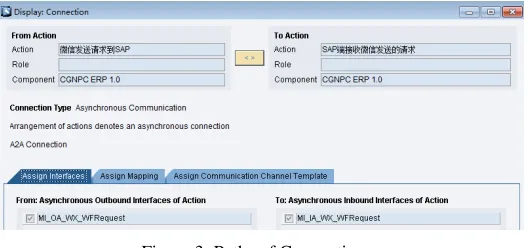
IR Composition. In the IR, according to the above-mentioned business process design, will be divided into two parts: WeChat fills NG notification and SAP synchronizes function location. Therefore, the IR also contains two parts. According to the requirements of PI development, each parts needs to define two corresponding service interfaces to send and receive NG notification information, as shown in the following figure:
Figure 3. Paths of Connections.
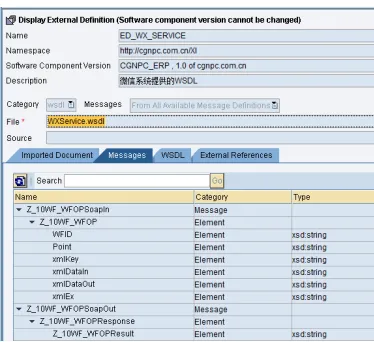
It should be noted here that, in order to avoid the mapping between the message structure fields, the message type between the two service interfaces can use the same source. This will not only help to avoid development mistakes, but also in the real process of message delivering, non-mapping messages due to data format standardization, and its transmission will be speed up.
[image:4.612.176.440.419.543.2]Figure 4. Structure of Message Data Imported by WSDL File.
[image:5.612.191.422.309.427.2]ID Structure. The design of ID is the organization of message routing. A typical configuration scenario includes three parts: integrated configuration, communication channel, and business systems, as shown in the following figure:
Figure 5. Components of ID Scenario.
As can be seen from the figure above, the entire data routing contains two data paths, WeChat to SAP and SAP to WeChat. The four service interfaces that are used in the aforementioned IR design.
Integrated configuration in ID is the most crucial part, it is configured by the actual data routing channel, that is, a message is from which source system, using which service interface / communication channel; send to which receiving system, using which receiving service interface, and which receiving communication channel, all of which are defined in the integrated configuration. Here only shows the WeChat sent to the SAP configuration, the reverse path of SAP synchronization functional location to the WeChat side are similar:
[image:5.612.182.431.552.705.2]Summary
Aiming at solving the problem of the current filling NG notification form of nuclear power plant, this paper proposes a solution based on mobile platform. By following the enterprise page in WeChat, users can perform functional operations after passing authentication. Users can create a new notification, search history data or browse drafts and other operations on their mobile phone. Such operations can be done any time if convenient. We are not only solves these problems, but also give new functions, such as: automatically synchronize functional location, automatically duplication removal, and standardization of transmission data and so on. Our method provides a better solution and more flexibility than traditional method.
Our future work includes the following two aspects: first, deploying this function to more nuclear power plants; second, synchronize more data to Wechat rather than order notification.
References
[1] Chen Yan, Luo Jun-xian, Shen Zhen-hua. Work Order and Operation Ticket Management for Hydropower Stations Based on SAP WCM. East China Electric Power [J]. 2007 (5). pp. 116-118.
[2] Yang Shu-chun, Xin Yun-fei, Wang Yi, Zhang Fu-zheng. Design and Realization of Mobile Platform Based on WeChat Enterprise. Journal of Huazhong University of Science and Technology (Natural Science Edition) [J], 2016(S1). pp. 158-161.
[3] Chen Chuan, Wang Tao. Construction of WeChat and Cloud Platform for Nuclear Radiation Monitoring System. Nuclear Electronics & Detection Technology. 2016(01). pp. 112-116.
[4] Wang Wen-ge, Wang Xin-gong. Analysis and Application of SAP PI Application Integration Platform. Inner Mongolia Electric Power. 2013 Vol. 36, No. 10. pp. 69-75.