The London School of Economics and Political Science
The impact of globalisation on the position of developing
countries in the international tax system
Isabel Calich
A thesis submitted to the Department of Law of the
London School of Economics for the degree of Doctor
of Philosophy
Declaration
I certify that the thesis I have presented for examination for the PhD degree of the London School of Economics and Political Science is solely my own work other than where I have clearly indicated that it is the work of others.
The copyright of this thesis rests with the author. Quotation from it is permitted, provided that full acknowledgement is made. This thesis may not be reproduced without the prior written consent of the author.
Abstract
The objective of this thesis is to analyse the relationship between international taxation and developing countries. The main idea is to examine this relationship through arguments that challenge the current legal debate that has described their interest as capital importers of foreign direct investment.
Globalisation has changed the economic relations between developed and developing countries. The evolution of the economic aspects as well as tax policies implemented during the process of globalisation provides the background necessary to understand the increased importance of international taxation and the participation of developing countries in the global economy.
The hypothesis tested here addresses the question whether the dichotomy between developing and developed countries and their characterisation as capital importers and capital exporters still provides an appropriate basis for the legal debate on international taxation in the context of globalisation. To approach this question, the behaviour of international flow of capital will be assessed in order to provide an overview of the economic relations among these countries.
Acknowledgements
In 2006, I started the LLM programme at the London School of Economics and Political Science (LSE). During that year, I focused my studies in international taxation and I came across the question of what was the position of developing countries in the international tax system regarding the current profile of the international flow of capital.
The traditional assumptions regarding the position of developing countries in the international tax system were intriguing me, since based on economic studies it was clear that some premises about the international flow of capital have changed. However, it was not possible to describe what was really going on and how it was affecting countries’ interests in international taxation.
After some discussions with Dr. Roxan, I realised that the LSE was the right place to develop my ideas not only because I could count on his expertise in this field, but also because the LSE could provide the interdisciplinary environment that I was looking for to develop my research.
In 2007, I started this journey. The research process fascinated me from the beginning. Throughout this process, I came across many very interesting ideas and the challenge was to narrow them down. During critical moments, I could count on Dr. Roxan, whose knowledge and experience helped me to organise my ideas and to move forward in the research process.
I would like to thank Professor John Avery Jones and Dr. Andrew Lang for their contribution to my upgrade material. I would also like to thank the Law department staff for their background support and Mr. Eduardo Baistrocchi for our interesting discussions about taxation in developing countries.
This project would have not been possible without the support of my husband. He encouraged me to develop this project from the beginning. He supported me during the entire period, not only by moving to London, but also by understanding my full-time dedication to the development of this project.
I also would like to thank my beloved parents who taught me this love of studying and whose academic careers were also important inspirations for me.
The opinions and errors in the text are my entire responsibility. I adopted the UK spelling in the text, only in quotations from US sources did I maintain the original spelling.
CONTENTS
List of Tables... 9
List of Charts and Diagrams………... 10
List of Abbreviations………. 11
Introduction: Hypothesis and Structure……….. 13
Chapter I. Globalisation and International Taxation………. 19
1.1. The meaning of globalisation……… 19
1.2. The impact of globalisation on tax policies……….. 27
1.3. The use of tax treaties to allocate taxing rights………. 33
Chapter II. The effective meaning of harmful tax competition………. 43
2.1. Introduction……….……….. 43
2.2. The meaning of tax competition………... 43
2.3. Is tax competition good or bad?... 47
2.4. The legal debate on harmful tax competition……….... 50
2.4.1. Historical aspects of tax havens and preferential tax regimes…………... 50
2.4.1.1. The relationship between developed countries and tax havens…... 51
2.4.1.2. The relationship between developing countries and tax havens……. 57
2.4.2. The OECD concept of harmful tax competition………. 59
2.4.2.1. Tax havens……….. 60
2.4.2.2. Preferential tax regimes………. 64
2.4.3. The dialogue with non-member countries……….. 67
2.5. Conclusion……….. 74
Chapter III. The international flow of capital………. 75
3.1. Objective of this chapter……… 75
3.2. Methodology……….. 77
3.3. Analysis of the database……… 90
3.3.1. Flows of Capital from 1994 to 2007………. 91
3.3.1.1. FDI………. 91
3.3.1.2. Portfolio Investment……….. 96
3.3.2. Stocks of foreign assets and liabilities from 1970 to 2004……… 100
3.3.2.1. International Investment Position……….. 100
3.3.2.2. Stocks of FDI………. 108
3.3.2.3. Stocks of Portfolio Equity……….. 113
3.3.3. Outcomes of data analysis………. 127
3.4. Comparison with the First Period of Globalisation (1870-1914)………. 129
3.5. Conclusion………. 132
Chapter IV. Tax havens and the problem of capital flight……… 134
4.1. The net asset discrepancy………. 137
4.2. The meaning of capital flight adopted in this study………. 139
4.3. The behaviour of tax havens………. 141
4.4. Capital flight and the interplay of tax policies………. 145
4.5. The importance of capital flight……… 152
4.5.1. Method adopted to calculate capital flight……… 152
4.5.2. Analysing the data………. 156
4.5.2.1. The Hot Money method………. 156
4.6. Conclusion………. 163
Chapter V. Taxation of Portfolio Investment……….. 164
5.1. Introduction……… 164
5.2. Economic aspect: neutrality policies………. 167
5.3. The taxation of portfolio investment in Double Tax Conventions……… 176
5.4. Tax Policies adopted by Developed and Developing Countries……… 181
5.5. Conclusion………. 192
Chapter VI. Updating the legal debate………. 194
Chapter VII. Current mechanisms for exchange of tax information………… 206
7.1. Introduction………... 206
7.2. Mechanisms for Exchange of Information……… 211
7.2.1. Bilateral Agreements………. 212
7.2.1.1. The evolution of exchange of information’s clause in the OECD Model Conventions………. 213
7.2.1.2. United Nations Model Conventions………... 220
7.2.1.3. Tax Information Exchange Agreements (TIEA)……… 226
7.2.2. Multilateral Agreements……… 244
7.2.2.1. The Nordic Convention………. 245
7.2.2.2. The Joint Council of Europe/OECD Convention on Mutual Administrative Assistance in Tax Matters (CMAATM)……… 247
7.3. Supranational laws……… 252
7.3.1. Direct taxation: Council Directive 77/799/EEC……… 254
7.3.3. Indirect Taxation: Council Regulation EC 1798/2003 and Commission
Regulation EC 1925/2004………... 262
7.3.4. Reforms on the Council Directive 77/799/EEC concerning mutual assistance in the field of direct taxation………. 264
7.4. Conclusion……… 265
Chapter VIII. Recasting the position of developing countries……….. 267
8.1. Introduction……….. 267
8.2. Dynamic perspective on how the existing mechanisms for exchange of information work………... 267
8.2.1. Domestic dimension ………. 267
8.2.2. International Dimension……… 273
8.3. Conclusion: Moving forward on exchange of information……….. 281
Chapter IX. Final conclusion………. 285
Bibliography………... 290
ANNEXES 1. Flows of FDI... 303
2. Flows of Portfolio Investment... 305
3. International Investment Position... 307
4. Stocks of FDI... 309
5. Stocks of Portfolio Equity... 311
6. Stocks of Portfolio Debt and Other Investments... 313
LIST OF TABLES
Table 3.1 – Countries Classification………... 80
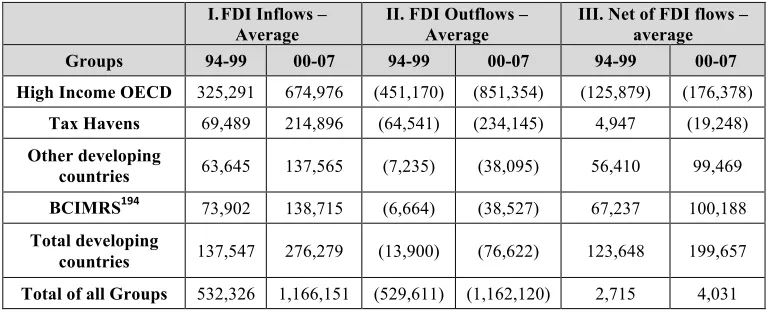
Table 3.3.1.1. (a) FDI Flows from 1994 to 2007……… 91
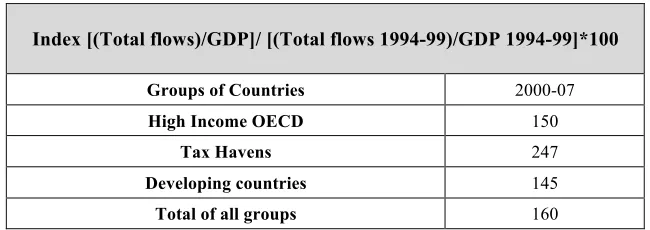
Table 3.3.1.1. (b) Variation of FDI Flows per GDP………... 93
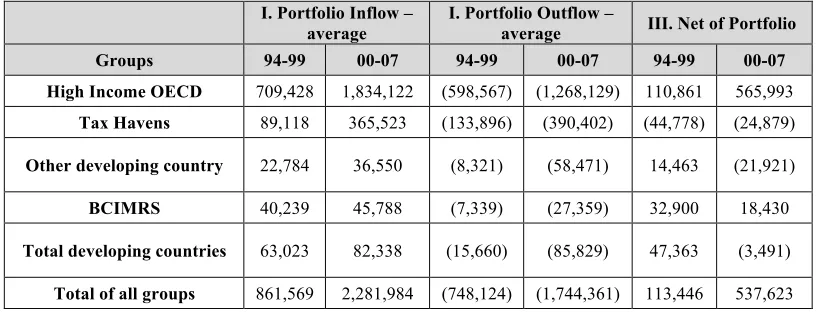
Table 3.3.1.2. (a) Portfolio Flows from 1994 to 2007……… 96
Table 3.3.1.2. (b) Variation of Portfolio Flows per GDP………... 98
Table 3.3.2.1. (a) Total Assets of groups, per decade, from 1970 to 2004………. 101
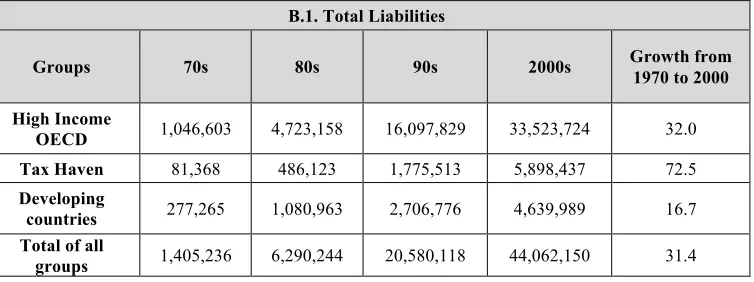
Table 3.3.2.1. (b) Total Liabilities of groups, per decade, from 1970 to 2004…... 101
Table 3.3.2.1. (c) Net values of groups, per decade, from 1970 to 2004………… 102
Table 3.3.2.1. (d) Annual rate of change in Asset and Liability Stocks…………. 103
Table 3.3.2.1. (e) Total Assets of groups from 1970 to 2004………. 106
Table 3.3.2.2. (a) Stocks of FDI Assets……….. 110
Table 3.3.2.2. (b) Stocks of FDI Liabilities……… 110
Table 3.3.2.2. (c) Net of FDI stocks………... 110
Table 3.3.2.3. (a) Stocks of PI Equity Assets………. 115
Table 3.3.2.3. (b) Stocks of PI Equity Liabilities………... 115
Table 3.3.2.3. (c) Net of PI Equity Stocks……….. 115
Table 3.3.2.4. (a) Stocks of PI Debt Assets……….... 120
Table 3.3.2.4. (b) Stocks of PI Debt Liabilities……….. 120
Table 3.3.2.4. (c) Net of PI Debt and Other Investment Stocks………. 121
Table 3.3.2.4. (d) Growth of Net Debt……… 124
Table 3.3.2.4. (e) Sum of net values of stocks of FDI, PI Equity and PI Debt and Other investments……… 125
Table 3.3.2.4. (f) Evolution of official reserves held by countries………. 126
Table 3.3.3. (a) Summary table of movements of flows……… 128
Table 3.3.3. (b) Summary table of net stock position………. 128
Table 4.3. (a) Evolution of tax havens’ IIP………. 142
Table 4.3. (b) Portfolio equity liability……… 144
Table 4.5.2.1. Hot Money and Capital Flight……….. 156
Table 5.3. Distribution of Taxing Rights in DTC Model Convention……… 177
Table 5.4. (a) Withholding taxes applied by OECD countries on interest……….. 183
Table 5.4. (b) Worldwide taxation and territorial taxation………... 185
Table 5.4. (c) Exemptions offered on the levy of withholding tax by the source country………. 185
LIST OF CHARTS AND DIAGRAMS
LIST OF ABBREVIATIONS
BCIMRS: Brazil, China, India, Mexico, Russia and South Africa
BIS: Bank for International Settlements
BMP: Balance of Payments Manual
BOPS: Balance of Payments Statistics
CCN: Common Communication Network
CEN: Capital Export Neutrality
CFC: Controlled Foreign Company
CIAT: Inter-American Centre of Tax Administration
CIN: Capital Import Neutrality
CMAATM: OECD Convention on Mutual Administrative Assistance in Tax Matters
CPIS: Coordinated Portfolio Investment Survey
CSI: Common System of Interface
DTC: Double Tax Convention
EU: European Union
FATCA: Foreign Account Tax Compliance Act.
FDI: Foreign Direct Investment
GAO: Government Accountability Office
GATT: General Agreement on Tariffs and Trade
GDP: Gross Development Product
IBRD: International Bank of Development and Reconstruction
IFS: International Financial Statistics
IIP: International Investment Position
IMF: International Monetary Fund
NEO: Net Errors and Omissions
NN: National Neutrality
ODA: Official Development Assistance
OECD: Organisation for Co-operation and Development
OEEC: Organisation for European Economic Cooperation
OFC: Offshore Financial Centres
PI: Portfolio Investment
TIEA: Tax Information Exchange Agreement
UK: United Kingdom
UN: United Nations
US: United States
VAT: Value Added Tax
Introduction: Hypothesis and Structure
The objective of this thesis is to analyse the relationship between international taxation and developing countries. The main idea is to examine this relationship through arguments that challenge the current legal debate that has associated their interest as capital importers of foreign direct investment.
Globalisation has changed the economic relations between developed and developing countries. The evolution of the economic aspects as well as tax policies implemented during the process of globalisation provides the background necessary to understand the increased importance of international taxation and the participation of developing countries in the global economy.
The standard assumption that limits the interest of developing countries in attracting foreign direct investment has also guided their involvement with tax policies defined at the international level such as harmful tax competition. What is this tax policy really about? What was the involvement of developing countries in the development of rules to combat harmful tax competition? These aspects need to be addressed to lay down the main question that this thesis will investigate: what is the effective interest of developing countries in international taxation?
In order to update developing countries’ perspective of international taxation, the international flow of capital, which represents the economic premises that underpin the legal debate, will need to be examined. The aim of this analysis is to identify new arguments that can make the debate move forward from the paradigm that justifies the interest of developing countries in international taxation only from the perspective of capital importers of foreign direct investment.
in the context of globalisation. To approach this question, the behaviour of the international flow of capital will be assessed in order to provide an overview of the economic relations among these countries. The idea is not to prove that the old premises are necessarily wrong, but to comprehend how they have changed and in this new context how the legal debate needs to be approached.
On the other hand, it has to be clear that the objective of this study was not to improve data on international flow of capital. The scope is limited to the economic data available from international organisations (e.g. International Monetary Fund, World Bank, OECD, etc.) and economic studies performed by other researchers. To this extent, the analysis performed reflects the limitations of the economic data adopted. These limitations are also connected to the broad scope of this research. If the focus was narrower, it would be easier to find more detailed information about countries’ economic profiles. Nevertheless, the broader scope allowed a logical view of the relationship between countries of different profiles. The legal debate on international taxation was then examined based on the outcomes of the economic analysis.
Having in mind the cornerstone arguments of this study, as well as its limitations, the research developed in each chapter and the connection between them becomes clear. In other words, the structure of this study reflects a logical sequence of questions originated in the development of the research. Consequently, firstly, basic concepts related to the scope of the thesis were examined (globalisation and international taxation); secondly, current flaws of the legal debate were identified (harmful tax competition); thirdly, economic data that underpin the legal debate were examined (international flow of capital); fourthly, possible explanations for the current profile of the international flow of capital were analysed (tax havens’ behaviour and the problem of capital flight); fifthly, regarding the problem of capital flight, tax policies on portfolio investment were examined; and sixthly, putting together the arguments raised in the previous chapter, the legal debate was updated, recasting the position of developing countries and their interest on international exchange of tax information.
Chapter I and II.
international level, whereas others remain to be decided domestically. To this extent, international taxation has been dealt with at the international level under two main issues: tax treaties and harmful tax competition. The former tackles the discussion based on allocation of taxing rights between source and residence countries as well as to the classification of income in different categories (e.g. dividends, interest, capital gains, etc.); while the latter is focused on harmful tax practices involving tax havens and offshore financial centres. The initial step, therefore, will be to dismantle these arguments in order to understand how they have guided the discussion to aspects that cannot really point out the effective position of developing countries.
Chapter III.
In order to challenge the current legal debate, new economic premises will be evaluated. The analysis will use data from the international flow of capital as well as the international stocks of assets and liabilities held by three groups of countries: developing countries, high income OECD countries and tax havens. The economic data will be used to demonstrate that the international flow of capital is much more complex and basic assumptions that have characterised developing countries as capital importers and developed countries as capital exporters. Furthermore, it will emerge that the discussion cannot be polarised into two groups only (developed countries v. developing countries); it is necessary to evaluate the position of tax havens separately.
Chapter IV.
a reasonable explanation. The phenomenon of capital flight will be examined in order to evaluate a possible explanation for the current profile of the international flow of capital and, consequently, to verify how it can be affecting developing countries’ interest in international taxation.
Chapter V.
Another aspect emphasised by the economic analysis is the significant increase of Portfolio Investment. This type of investment is concentrated in developed countries and this premise has dominated the studies about this topic, underestimating its importance to developing countries. It is necessary to evaluate their interest regarding not only inflows but also outflows, i.e. accumulated capital flight held abroad. Thus, the importance of portfolio investment to developing countries needs to be considered from this angle, which extrapolates the conclusions reached until now, relating portfolio investment to developing countries.
Chapter VI.
Chapter VII.
Assuming that developing countries are also interested in taxing income derived from assets held abroad by their residents, tax policies that deal with the problem of harmful tax practices are also of interest to them. In other words, developing countries are also interested in enforcing residence taxation. The OECD through the work on harmful tax competition has developed rules to improve transparency and exchange of information for tax purpose. How do these rules work? What are the advantages and weaknesses of these tax policies? These questions will be addressed in order to demonstrate whether these tax policies can help developed countries to solve the crisis of residence taxation.
Chapter VIII.
The analysis of the rules to improve transparency and exchange of information for tax purposes created the requested background to examine whether they can help developing countries to deal with the problem of capital flight. In a sense, the problem of capital flight represents the crisis of residence taxation for developing countries. This last chapter, therefore, will close the debate about developing countries and international taxation by examining the current instruments for exchange of information from the perspective of developing countries, considering the problem of capital flight. It will become clear if the measures adopted by developed countries to solve the crisis of residence taxation from their perspective can also help developing countries to deal with the problem of capital flight.
Chapter IX.
Chapter I. Globalisation and International Taxation
Most studies have discussed the impact of globalisation on taxation in order to call for changes in tax policies. However, what is the effective meaning of globalisation? This term has been used in so many different contexts that before associating it to taxation it is necessary to approach its effective meaning for the study performed. The approach adopted to understand globalisation will reveal its impact on taxation and, consequently, the increased importance of international taxation. To this extent, the history of tax treaties will show how international taxation has been discussed and its focus on allocation of taxing rights.
The structure of this chapter consists of three sections: (i) the meaning of globalisation; (ii) the impact of globalisation on tax policies; and (iii) the use of tax treaties to allocate taxing rights. The first section provides the necessary arguments to comprehend the development of international taxation from a broader perspective, considering the economic changes suffered by countries brought on by globalisation. The second section explains the increased importance of the international aspect of domestic tax policies. The third section examines the background of tax treaties in order to demonstrate how the legal debate on international taxation has focused on allocation of taxing rights between source and residence countries. Globalisation has reshaped the economic relations among countries and international taxation became an emerging issue in this scenario.
1.1. The meaning of globalisation
The analysis of the characteristics of the current process of globalisation as well as its historical context will provide the required information to understand the underlying economic relations among countries that gave support to the development of international taxation.
Globalization is a complex phenomenon encompassing economic, political and social aspects, which allows it to be interpreted in many different ways by researchers, depending on their field of research and the question being investigated. Kohler, former managing director of the IMF, defined globalisation in a broad sense, focusing on the idea of free flow: ‘the process through which an increasingly free flow of ideas, people, goods, services and capital leads to the integration of economies and societies’.1
The idea of free flow is the core characteristic of globalisation. In fact, people, goods, services and capital can flow in different manners depending on the level of liberalisation adopted. As discussed next, the characteristics of the two periods (i.e. 1870-1914 and 1970- to present date) of outstanding economic integration differ considerably due to the combination of restrictions on trade and movement of capital and labour.
From a historical perspective, globalisation is not a new phenomenon. The period from 1870 to 1914 (start of the First World War) was also marked by high levels of overseas investment and labour migration.2 By that time, labour’s mobility was at the same level as capital mobility. In terms of international trade, industrialised countries exported manufactured goods while the rest of the world supplied raw materials to them.3 Most
1 H. Kohler, ‘Working for a Better Globalization’ (Conference on Humanizing the Global Economy, Jan
2002) <http://www.imf.org/external/np/speeches/2002/012802.htm> accessed 16 June 2009.
2 There is a discussion in current literature about how many processes of globalisation occurred
throughout the entire history of humanity. As the objective of this study focuses on the economic aspects of this phenomenon, the previous period that also had a high level of economic integration was from 1870 to 1914. J. Osterhammel and N. P. Petersson, Globalisation: A Short History (Princeton University Press 2005).
3 Developed and developing countries’ nomenclature was not used by that time. Developed countries were
developing countries were still colonies of the industrialised world, having their interests limited and controlled by industrialised countries’ necessities.
Even though there was a high level of international trade, tariffs were still a barrier in the ‘golden age’ of liberalism before 1914. Trade was conducted on a bilateral basis rather than on a multilateral agreement, which demonstrates the absence of any significant institutionalisation of intergovernmental collaboration in the period of 1870-1914. There was neither an international institution to control the international financial system. Thus, the main facilitator of economic integration was the adoption of the gold standard. The gold standard allowed the convertibility of a domestic currency to a specific amount of gold, eliminating the risk of foreign exchange.4
The free flow of capital was unidirectional, i.e. from industrialised countries to the ‘rest of the world’. It was easy to classify countries as capital importers and capital exporters. In sum, the premises of the economic integration that happened between 1870 and 1914 were stipulated by the industrialised nations, it becoming easy for them to identify their economic interest and match it with the policies embraced and enacted by them in a global scale.
The current process of globalisation (1970 to present) is much more complex than the previous one. In terms of free flow, the current period has a free movement of trade and capital supported by the lowering of trade barriers and the liberalisation of exchange and capital control.5 The development of new technologies has also contributed to the free flow of capital and trade through the improvement of communication (e.g., Internet and Email) and transfer of resources (e.g., electronic banking and worldwide transfer of funds). However, people are not allowed to move in the same way as capital and trade.6
the world’. ‘The rest of the world’ encompassed independent non-industrialised nations as well as many colonies of the industrialised countries.
4 J. Ravenhill, ‘The Study of Global Political Economy’ in J. Ravenhill (ed.), Global Political Economy
(Oxford University Press 2007) 8-9.
5 Osterhammel (n 2) 143.
6 A. Mcgrew, ‘The Logics of Economic Globalization’ in in J. Ravenhill (ed.), Global Political Economy
Consequently, nowadays labour’s mobility is more limited than capital’s mobility; which reflects constraints on policies of migration. The limitation of labour’s mobility is a remarkable difference from the previous period of globalisation. In terms of capital and trade, in both periods there was a high level of flow, even though with completely different characteristics since trade tariffs were not reduced in the first period of globalisation and capital performed a unidirectional movement: from industrialised to ‘the rest of the world’.
Focusing on the premises of the current process of globalisation, what we see is a completely different scenario from the previous period: (i) developing countries are not anymore colonies of the industrialised world; (ii) there are international institutions to control the international financial system and the international trade; (iii) countries adopt floating exchange rates; and (iv) multinationals dominate the international trade. What are the facts that led to a so different scenario between the first and the last process of globalisation? In order to answer this question it is necessary to examine the historical facts that happened between the start of the First World War (1914) and 1970, which will be denominated the ‘inter-globalisation’ period.
In 1914, the outbreak of the First World War jeopardised the economic integration of the world. It was the end of the liberal argument that economic interdependence could grant a peaceful period among nations. As a result, many industrialised nations only achieved economic integration at the same level of pre-First World War in the 1970s.7
With the start of the First World War, the international gold standard broke down with a speculative attack on sterling. The end of the gold standard caused a misalignment of currencies around the world creating a barrier to international trade. Notwithstanding the difficulties brought by the end of the gold standard, the US raised its tariffs to high levels, which was answered by the European countries with retaliations, imposing more
obstacles on the international trade system. These measures reduced the value of world trade by two-thirds between 1929 and 1934.8
The apex of the crisis of the liberal economic model is represented by the Great Depression in 1930 in which an international financial crisis triggered the collapse of both international lending and the international gold standard.9 Governments were unable to agree on a viable international financial system. Consequently, the main characteristic of the inter-globalisation period is the absence of a consensus to establish a new economic order around the world.
An opportunity to create an international financial system only arose in the early 1940s, when the US and the UK policymakers began to plan the organisation of the post-war international monetary and financial system. US policymakers did not want to see a return to the classical liberal international economic order of the pre-1930s period. Instead, they hoped to find a way to settle liberal multilateralism with the domestically orientated priorities to fight unemployment and encourage social welfare that had emerged in the New Deal.10
In 1944 a new economic regime was agreed. The new consensus was reached at the United Nations Monetary and Financial Conference, in the village of Bretton Woods, New Hampshire. There, forty-four governments agreed on the principles that would guide the international monetary system in the post-war years. The Bretton Woods participants sought to re-establish a world of international currency stability. John Maynard Keynes from the UK and Harry Dexter White from the US guided the discussions.11
8 ibid 12.
9 E. Helleiner, ‘The evolution of the International Monetary and Financial System’ in J. Ravenhill (ed.), Global Political Economy (Oxford University Press 2007) 215.
The new regime would have to reconcile market-oriented policies with prerequisites of domestic policies such as stability and full employment. The architects of Bretton Woods needed to find a way to settle domestic and international policies since the Great Depression had offered contradictory lessons about economic closure. On one hand, economic closure had precipitated the Great Depression and exacerbated its effects; on the other hand, an open economy could destabilise domestic economy, affecting the money supply and obstructing full employment. It was necessary to find a new balance between domestic and international policies. Therefore, instead of what happened before the First World War when economies needed to adjust themselves to global pressures, the global economy would need to adjust itself to local necessities. A global market should exist and be enforced by multilateral agreements but local governments would control the market’s power.12
The influence of developing countries on the Bretton Woods negotiations and on the nature of the institutions that emerged was insignificant.13 The Bretton Woods system created two multilateral organizations (the International Monetary Fund - IMF and the International Bank of Development and Reconstruction - IBRD, an institution of the World Bank Group) and one standing conference (GATT) in order to enforce economic stabilisation;14 however developing countries were at the margin of the decision process. The IMF would supervise and support the fixed exchange rates regimes and act as a lender of last resort.15 Its capacity to lend comes primarily from the contribution of members, whereas the World Bank can borrow from the private sector to finance its lending.16 The IBRD main function was to help European countries to recover from the war. Only later, its focus changed to developing countries. The Bretton Woods members did not achieve an agreement about an International Trade Organisation - ITO since the major players (the UK and the US) were not sure about how the after war trade would
12 H. M. Schwartz, States Versus Markets: History, Geography, and the Development of the International Political Economy (Macmillan 2000) 192-93.
13 C. Thomas, ‘Globalization and Development in the South’ in J. Ravenhill (ed), Global Political Economy (Oxford University Press 2007) 419.
14 ibid 420.
be configured and any concession/agreement at that time might damage their trade position. Thus, only later in 1947, fifty countries signed in Havana the General Agreement on Trade and Tariffs.17
The main features agreed at the Bretton Woods conference were: (i) a financial order underpinned on the ‘embedded liberal’ ideology in which market allocation was limited by political process; (ii) currency convertibility for current account payments; (iii) gold-dollar standard; (iv) an adjustable exchange-peg rate regime; (v) control of capital movements; and (iv) establishment of international financial institutions. The Bretton Woods conference managed to establish a new world consensus on how the international monetary system should work. The Bretton Woods International Monetary Regime stood until the US suspended the convertibility of the US dollar into gold in 1971.18
The aftermath of the Bretton Woods collapse was the privatisation of the financial markets, which is one of the main characteristics of the current process of globalisation. The growth of financial markets surpassed the cross-border trade of goods. It is worth noting that the Bretton Woods architects (Keynes and White) endorsed an international financial order in which governments could control cross-border private financial flows, and public international institutions would have a key function in allocating short-term and long-term capital at the world economy. Today, as discussed next, the opposite situation is configured at the international level: enormous sums of private capital flow around the world quite freely and the size of these flows surpasses the lending activities of the IMF and World Bank.19
The end of the Bretton Woods system caused a new ideology to emerge: neoliberal policies. These policies are based on the assumption that global economic integration through free markets is the most effective route to promote growth.20 The neoliberal
17 Schwartz (n 12) 194.
18 Helleiner (n 9) 221-22.
19 ibid 233.
economic agenda reflected ideas of the virtue of the free market combined with small regulatory states, which were implemented by Reagan and Thatcher in the 1980s.21 Market intervention was only conceived to supply a range of public goods that could not be provided through competitive profit seeking and to enforce rules of competition.22 The market-oriented policy based on the neoliberal ideas was conceived to be suitable to both developed and developing countries.23
The facts listed above revealed the economic policies that led to the development of an integrated financial market. In fact, the main economic policy that granted the development of a global financial market was the end of exchange control, since it allowed the free flow of private capital around the world. However, it is interesting to note that the original idea was to control private financial flows, rather than leave them free as occurs today.
Another relevant aspect is how developing countries were inserted into the global economy. During the first period of globalisation, most developing countries were just colonies of the imperialist world and their economic roles were restrained to the supply of raw materials requested in the process of industrialisation. Later, in the inter-globalisation period, developing countries remained at the margin of the economic and political process that reshaped the world economy. Only recently the position of developing countries started to change: developed countries became conscious that to maintain the current economic order, developing countries needed to be inserted into it. From this perspective, different policies were designed by developed countries and international organisations to change the position of developing countries in the international economy.
21 R. Wade, ‘Financial Regime Change?’ (2008) 53 New Left Review 1, 1-6. 22 ibid.
23 Since the adoption of neoliberal policies, new policies have been enacted, however, the ideology behind
1.2. The impact of globalisation on tax policies
Domestic aspects of tax policies have guided policymakers when discussing tax reforms until recently. Policymakers’ major concerns were related to the internal constraints of a tax system such as administrative efficiency, raising of tax revenue and possible impact of reforms on economic growth. However, the phenomenon of globalisation has changed the economic facts that supported policymakers’ decisions. Nowadays policymakers need not only to regard the internal dimension of tax reforms, but also to consider the international aspects of national tax policies, which mean how to use tax policies to gain competitiveness and to influence the international movement of capital.24
Most characteristics of tax systems were developed in a period around the Second World War or shortly after. The international economic relations among countries were very different from today since the underpinning economy had a different dynamic. As already described in the previous section, between 1945 and 1970, there were: (i) trade restrictions since many countries protected their domestic markets by using quantitative restrictions such as high trade tariffs and quotas; (ii) capital movement barriers curbing the development of multinationals’ operations and international finance; (iii) individual mobility limitations due to restrictions on migration and high travelling costs; (iv) limited amount of portfolio investment; and (v) tax havens had a marginal role in the movement of capital, only being used in evading taxes and in laundering money from illegal activities.25 In this scenario, policymakers were quite free to choose the features of a tax system and the tax rates of individual income tax, corporate tax, trade tariffs and excise taxes. The concern with the movement of capital and the attractiveness of foreign investment did not exist. Policymakers focused on features of the national economy to plan tax reforms.
The present situation is considerably different. With the process of globalisation, i.e. after 1970, the international economic relations of countries have become more open, following the market oriented policies implemented by the neoliberal ideology. In this new economy: (i) trade tariffs were reduced; (ii) capital movement barriers were removed enhancing the activity of multinationals’ operations and the availability of international finance; (iii) travelling costs were reduced, but restrictions to migration did not change except in specific regions such as the European Union; (iv) the volume of portfolio investment surpassed all other types of foreign investment; and (v) tax havens have an essential function on the movement of capital, being used not only for illegal activities but also by multinational enterprises to structure their business around the world.
The current economy is centred on financial flows across countries. The magnitude of capital flows in many countries has surpassed not only the volume of foreign trade but also their GDP.26 In the new global economy, the tax policy of a country can have a significant impact on other countries’ tax policies, making policymakers face a fundamental dilemma when defining tax policies: the trade-off between raising tax revenue and gaining competitiveness to attract foreign investments. Globalisation has changed the way policymakers structured tax reforms, since the international aspects of national tax policies became a crucial element.
From a political perspective, the cross-border effect of tax policies has a major impact on state’s sovereignty. State sovereignty has been challenged in this new integrated economy. Although globalisation has collaborated to create an economic integration among countries, national political sovereignty has increasingly come into conflict with this new economy. The problem is that the limit of economic markets no longer corresponds to national territories and thus, the taxation of economic activities requires the involvement of more than one jurisdiction.27 National tax policies are now affected
by other countries’ tax policies, which compel the design of tax policy to reflect the international environment.
The global scenario, therefore, can be described as economically integrated, in which there is a remarkable mobility of resources through trade and investment (e.g. FDI and portfolio investment), but politically fragmented, where traditional territorial borders are maintained. Jeffery explained this situation as an evolution from economic nationalism to international economic integration. According to him, an important characteristic of economic integration is that it has not been even or uniform in the rate, nature or extent of assimilation. This uneven process has derived from the variations among countries in their compliance to adapt to the new changes through the national and international law making processes. In this process of adaptation, there are two main issues that might be considered by countries when determining their tax policies: (i) certain matters should be dealt at the international level; and (ii) matters that must be regulated at the national level should be consistent with the world economy. 28 This bifocal perspective of tax policies helps to understand how domestic and international tax rules are related to each other.
Regarding matters regulated at the national level, there are two crucial external influences on developing countries’ tax systems that made their domestic laws consistent with the international environment: (i) tax reforms conducted by international organisations; and (ii) negotiation of tax treaties. During the post Second World War period, economic policy of many developing countries involved a strong role for the state and a high priority given to industrialization, diversification and modernization of the economy. For tax policy, this economic policy was implemented through tariff protection for domestic industry, input subsidies and favourable tax regimes for industry.29
28 R. J. Jeffery, The Impact of State Sovereignty on Global Trade and International Taxation (Kluwer Law
International 1999) 13-21.
29 M. Stewart, ‘Global Trajectories of Tax Reform: Mapping Tax Reform in Developing and Transition
During the 1980s due to the debt crisis in developing countries, in order to lend money, international organisations such as the IMF and the World Bank imposed some conditions on developing countries’ economic policies. Some conditions were related to tax reforms and, consequently, developing countries had to adjust their tax systems to the requirements imposed by the international organisations. In the 1990s, the aim of tax reforms implemented by these international organisations changed following new tendencies in the world economy and the fact that the old model of tax reform failed in many developing countries. Today the overarching goals of tax reform are the opposite of the previous period, i.e. a ‘broad based’ corporate tax that encourages savings and operates in an open market economy; an increased reliance on consumption taxes, such as the value added tax; and the elimination of trade-tariffs.30
The current tax reform recognises the difficulty of taxing capital in an integrated global economy, but does not propose any global solution or a better understanding of what is going on in developing countries’ tax systems. The assumptions of the current tax reforms are based on the impact of globalisation on developed countries’ tax systems.
In practical terms, developing countries usually accepted the interference of the IMF and the World Bank in their economies, implementing the tax policies suggested since they needed foreign investment to compensate the shortage of internal savings. The shortage of capital also induced developing countries to enact laws that offered tax exemptions to foreign investors. Developing countries, therefore, have engaged themselves in tax competition for foreign direct investment, i.e. productive investment that would bring economic benefits despite the tax incentives being offered.
Another point is that the coordination of the interaction of developing countries’ domestic tax laws was not included in the scope of the tax reforms conducted by the IMF and World Bank. This coordination was left to the development of tax treaties.
Thus, the second fact that has influenced the adaptation of developing countries’ domestic tax laws to the international environment was the negotiation of tax treaties.31
Tax treaties, as explained in the next section, were developed by reference to developed countries’ tax laws and countries willing to negotiate them had their domestic tax laws adapted. For instance, it was necessary to develop an individual income tax and a corporate income tax, otherwise it would be impossible to avoid double taxation since this concept is based on the imposition of comparable taxes in two states in respect of the same income and in the hands of the same person. Therefore, without a comparable income tax system between developed and developing countries, the flow of capital would be barred by the imposition of unparalleled taxes which tax treaties were not prepared to deal with. Thus, the tax treaty was the instrument elected by developed countries to deal with the problem of double taxation that emerged in an integrated global economy.
Regarding matters dealt with at the international level, since the 1920s the allocation of taxing rights is controlled by tax treaties. Even though the current process of globalisation has exacerbated the cross-border tax spillovers due to the volume of economic transactions taking place in more than one jurisdiction, the concern with double taxation is not recent and the first tax treaty was made in 1899 between Prussia and the Austro Hungarian double monarchy.
The concern with allocation of taxing rights acquired an effective global dimension in the 1920s when the League of Nations started to address this matter. By that time, the international financial market was much less complex and the concerns on the allocation of taxing rights were simplified to the allocation of tax revenue since the international movement of capital had a different dynamic: it flew from ‘industrialised countries’ to ‘the rest of the world’.
The allocation of taxing rights involves, in practice, the decision on how to tax the foreign income of residents and the source income of non-residents since in both situations there is more than one jurisdiction involved which can claim the right to tax certain income. The problem arises when both jurisdictions claim the right to tax the same income in the hands of the same legal person, characterising juridical double taxation. Double taxation inhibits the flow of capital, discouraging an efficient allocation of investments.
There are two different alternatives to avoid double taxation by enacting: (i) unilateral tax policies; and/or (ii) bilateral tax policies, i.e. tax treaties. The first alternative is dealt with at the national level; whereas the second one is dealt at the international level. The provisions of a tax treaty override the conflicting measures provided in the domestic legislation, which means that when a tax treaty is signed, the methods used to relieve double taxation will be the ones established in the treaty and not the rules established in the domestic legislation. There is no need for the domestic law to be harmonised with the tax treaty. In fact, the more outrageous the provisions of the internal law, the better the starting position for negotiating treaties.32 Both unilateral and bilateral tax policies limit the exercise of taxing rights of sovereign jurisdictions. Accepting those rules, national tax systems recognised some limitations on their scope of application.
Unilateral tax policies allow countries to relieve double taxation by enacting rules that recognise a tax credit or a tax deduction for the amount of tax paid abroad or, alternatively, exempts foreign income from domestic taxation. On the other hand, tax treaties avoid double taxation by first distributing the allocation of taxing rights between source and residence countries and when the previous division allows both states to tax, the credit and the exemption method can be applied. Although both unilateral and bilateral tax laws can relieve double taxation, tax treaties have played a core function in determining the international allocation of taxing rights. Tax treaties, therefore, have not
32 J. F. Avery Jones, ‘The David R. Tillinghast Lecture: Are Tax Treaties Necessary?’ (1999-2000) 53
only influenced domestic laws but also assumed a dominant position in determining the allocation of taxing rights at the international level.
Tax treaties emerged as the main instrument used internationally to avoid double taxation by allocating taxing rights between the source and the residence countries. The bilateral aspect of how taxation is dealt with at the international level has made it necessary to have more than 1,400 separate tax treaties in order to make the international tax system to work.33 In fact, the loose network of bilateral tax treaties proved an inadequate mechanism for coordinating tax jurisdiction. The allocation of taxing rights promoted by tax treaties in which, basically, business profits could be taxed at the source, whereas returns of investment were primarily taxed at the residence of the investor, concealed the disagreement between major capital importers and capital exporters. 34 A global approach was never considered in the original debate of international double taxation, the bilateral approach remaining the only measure accepted worldwide. Thus, analysing the historical background of tax treaties will shed some light on how we have been thinking about international taxation and the problems that emerged in its evolving process.
1.3. The use of tax treaties to allocate taxing rights
The idea of examining the background of international tax treaties35 is to make clear how developed and developing countries have been thinking on international taxation. The objective is not to point out specific problems of tax treaties but to understand how tax treaties work from a broader perspective, demonstrating the line of reasoning that has guided the current discussion between developed and developing countries.
The basic ideas of a tax treaty started with the studies developed by the International Chamber of Commerce. Organised in 1920, this organisation emphasised the problem of
33 ibid 1.
34 S. Picciotto, International Business Taxation: A Study in the Internalization of Business Regulation
(Weidenfeld & Nicolson 1992) xiv.
35 The expression Double Tax Convention (‘DTC’) is also referred as tax treaty in the body of this study,
double taxation in the international scenario. In its organisational meeting, influenced by the American vision, the Chamber suggested taxation by both residence and source with residence deferring some taxing rights to source, while retaining a ‘right to claim the difference between the tax paid and the home tax.’ 36
In the years that followed, the International Chamber of Commerce developed resolutions regarding double taxation that were to be voted on at the 1923 Rome Congress and were to become the draft of a model tax treaty. The Rome Resolutions incorporated classification and assignment rule of categories of income, restating the ideal of non-discrimination and proposing the allocation of business profits to source nations based on objective mechanisms. Because of disagreements between the American Committee and the British Committee (i.e. the Americans accepted taxation by both source and residence; while the British maintained that all taxation should be residence-based), the International Chamber of Commerce could not achieve a consensus and a committee of economists was appointed by the League of Nations to conduct research on double taxation.37
It is worth noting that even though both US and UK were capital exporters, they had diverging positions on the allocation of taxing rights. The American position was influenced by Adams’ work, which admitted source taxation as an appropriate meaning of the benefit principle of taxation; administrative advantages; and as an alternative to reconcile the debtor nation position with the creditor nation position. On the other hand, the British Committee did not admit source taxation and argued that all taxation should be residence based, focusing on its own economic situation as the major capital exporter in the world.38 For instance, in 1855 the UK outflow of capital was 700 million dollars
which corresponded to almost 80% of the total stock of foreign assets held worldwide.39
36 M. J. Graetz and M. M. O’Hear, ‘The “Original Intent” of U.S. International Taxation’ (1996-97) 46
Duke Law Journal 1021, 1066-67.
37 ibid 1070. 38 ibid 1072.
39 M. Obstfeld and A. M. Taylor, ‘Globalisation and Capital Markets’ in M. D. Bordo, A. M. Taylor and J.
In 1923 the League of Nations invited four economists (Professor G. W. J. Bruins of the Netherlands, Professor Luigi Einaudi of Italy, Prof. Edwin R. A. Seligman of the United States and Sir. Josiah Stamp of Great Britain) to prepare a report on how to avoid international double taxation.40 The report prepared by the economists was based on the doctrine of economic allegiance:
A part of the total sum (of taxes) paid according to the ability of a person ought to reach the competing authorities according to his economic interest under each authority. The ideal solution is that the individual’s whole faculty should be taxed, but that it should be taxed only once, and that liability should be divided among the tax districts according to his relative interests in each.41
The 1923 Report suggested four factors to determine economic allegiance: (1) where the result is physically or economically produced; (2) where the final product of the economic process is located; (3) where the rights over the income produced can be exercised; and (4) where the income is consumed or disposed of. Some authors regard factors 1 and 4 as the primitive idea that led to the source and residence principles of taxation.42 By that time, the report already admitted that to allocate the exact proportion of economic allegiance to each category of income is a very difficult task.43
Considering that the only way to prevent double taxation is through concessions made by the source and the residence countries, the report of the four economists presented the following alternatives: (i) the residence country would allow a deduction of the tax paid abroad on its income tax levied on foreign income earned by a resident; (ii) the source country would exempt non-residents from taxation of income produced from sources within its territory; (iii) a convention would divide the taxing rights between the source and the residence states, recognising the primary right of the source (limited by
40 N. Tadmore ‘Source Taxation of Cross-Border Intellectual Supplies: Concepts, History and Evolution
into the Digital Age’ (2007) January Bulletin for International Taxation 2, 4.
41 M. B. Carrol, Prevention of International Double Taxation and Fiscal Evasion (League of Nations,
22nd ed, June 1939) 13.
certain parameters) and the residual right of the residence state; or (iv) also by convention, the source country would keep the right to tax wholly certain categories of income, for instance, income connected to property rights, but would exempt other categories of income; thus, the residence country would recognise the tax paid abroad as a deduction from its income tax with respect to those categories of income, while it would fully tax the other categories of income.44
The economists’ report concluded that the best alternative would be the second one, which is the exemption of income from non-residents by the source state. It also recognised that some countries would be reluctant to abandon source taxation and in those cases the fourth alternative was advisable, with some adjustments proposed in the third one. A very interesting point is that the economists believed that by increasing the level of industrialisation in developing countries, they would be willing to renounce source taxation.45 Another reason in favour of residence taxation was that it would ensure taxation based on the ability to pay principle, by the application of progressive income taxes on the world-wide income of a resident taxpayer.46
There were differences between the ideas developed previously in the International Chamber of Commerce and the ones presented by the four economists in the 1923 Report. While the first broadly admitted source taxation, the second clearly preferred residence taxation. The conceptual difference in these approaches is a consequence of the distinct lines of argument sustained by the American Professors: Seligman and Adams. Prof. Seligman preferred a pure theoretical vision, which can be synthesised in the economic allegiance doctrine; whereas Prof. Adams was pragmatic and sensitive to political and administrative problems and chose not to base his ideas on a single theory but on a mix of arguments that leaned toward the technical aspects of a problem.47 In other words, Prof. Seligman defended residence taxation based on economic allegiance
44 ibid. 45 ibid 15.
46A. Cockfield, ‘Purism and Contextualism within International Tax Law Analysis: How Traditional
Analysis Fails in Developing Countries’ (2007) 5 e-Journal of Tax Research 2, 203 <http://www.atax.unsw.edu.au/ejtr/content/issues/previous/paper2_v5n2.pdf> accessed 18 May 2009.
doctrine, while Prof. Adams recognised the interests of debtor countries and suggested an alternative that considered political arguments rather than pure economic theory. The emphasis on residence taxation by the 1923 Report can also be justified by the fact that only capital export countries manifested their opinion on this report, since Prof. Einaudi never made any contribution, and by that time Italy was the only one of the four countries (UK, US, Italy and Netherlands) that was a net capital importer.48
The outcome of the 1923 Report was a model that distinguished between taxes on global income and all other taxes. The former were levied only by residence country, whereas the latter were to be split between source and residence countries, according to the economic allegiance doctrine. Moreover, contrary to what was suggested by the International Chamber of Commerce, the 1923 Report attributed the right to tax interest and dividends to residence countries. 49
Even though the 1923 Report envisaged a model tax treaty, its development was reassigned to the Committee of Technical Experts who elaborated a new report in 1925. The objective of this new report was to transform the 1923 Report into a more balanced proposal, i.e. a proposal that attributed taxing rights not only to residence countries but also to source countries. The classification of taxes as global income and other taxes was substituted by a classification of personal and impersonal taxes and the right to levy the former attributed to residence countries, while the right to levy the latter attributed to source countries. Explaining the division of taxing rights, the technical experts argued that they had no intention of theoretical coherence and, therefore, practical purposes were their major concern.50 Even though the 1925 Report said it considered the outcome
of the previous report, it was not an important influence on impersonal taxes51, since the right to tax them was fully attributed to source countries.52
48 J. F. Avery Jones, ‘The History of the United Kingdom’s First Comprehensive Double Taxation
Agreement’ (2007) British Tax Review 1, 2.
49 Graetz (n 36) 1077. 50 ibid 1077-80.
51 Impersonal taxes were levied on: immovable property; industrial, commercial or agricultural income;
shipping; directors’ fees; earned income; dividends and interests.
The 1925 Report was further developed into a model treaty by an enlarged committee of experts meeting in 1926, 1927 and 1928. In these meetings, the US was represented by Prof. Adams assisted by Mitchell B. Carrol, who later contributed to the development of the threshold (i.e. the permanent establishment concept) that allows source countries to tax active business income.53
In October 1928, a Bilateral Convention for the Prevention of Double Taxation in the Special Matter of Direct Taxes and three other model conventions dealing with succession duties, administrative assistance in tax matters and judicial assistance in the collection of taxes were drafted. The 1928 models set the fundamental elements of current tax treaty models.54
The next model convention was drafted in 1943 and was called the Mexico model. It promoted taxation at the source, being recognised as the first attempt by the developing world to write a model treaty that reflected their particular interests. Residence taxation was admitted but residence countries had to provide a credit of the taxes paid abroad even if limited to the proportion of the tax due at home. Later on, in 1946, the Fiscal Committee of the League of Nations met in London and elaborated a new model which became known as the London model. Contrary to the source taxation tendency expressed in the Mexico model, the London model benefited residence taxation expressing the economic interest of capital exporting countries. The differences between these two models, i.e. the Mexico and the London model demonstrate what was going to be perpetuated as the opposite view of developed and developing countries in the allocation of taxing rights. Nowadays these differences of economic interests are identified in the OECD and UN model tax conventions.55
53 Graetz (n 36) 1082.
54 J. Li, International Taxation in the Age of Electronic Commerce: A Comparative Study (Canadian Tax
Foundation 2003) 40–43.