N A N O E X P R E S S
Open Access
Transformation of sludge Si to nano-Si/SiO
x
structure by oxygen inward diffusion as
precursor for high performance anodes in
lithium ion batteries
Qiqi Hua, Dongyang Dai, Chengzhi Zhang, Fei Han
*, Tiezheng Lv
*, Xiaoshan Li, Shijie Wang, Rui Zhu,
Haojie Liao and Shiguo Zhang
*Abstract
Although several Si/C composite structures have been proposed for high-performance lithium-ion batteries (LIBs), they have still suffered from expensive and complex processes of nano-Si production. Herein, a simple, controllable oxygen inward diffusion was utilized to transform Si sludge obtained from the photovoltaic (PV) industry into the nano-Si/SiOxstructure as a result of the high diffusion efficiency of O inside Si and high surface area of the sludge.
After further process, a yolk/shell Si/C structure was obtained as an anode material for LIBs. This composite demonstrated an excellent cycling stability, with a high reversible capacity (∼1250 mAh/g for 500 cycles), by void space originally left by the SiOxaccommodate inner Si expansion. We believe this is a rather simple way to convert the waste Si into a valuable
nano-Si for LIB applications.
Keywords:Si sludge, Oxygen diffusion, Anode, Lithium-ion battery
Background
Lithium-ion batteries (LIBs) are the primary energy stor-age devices in our life [1]. Recently, the rapid develop-ment of electrical vehicles (EVs) has caused increasing demand for high-performance LIBs with a low price, high energy density, stability, and safety [2]. In this respect, various new active anode materials for LIBs are being developed; in particular, Si-related anode research has attracted considerable interest since it has the high-est theoretical capacity of 4200 mAh/g. The main prob-lem of Si is that the Li+insertions/extractions produce a significant volume expansion (> 300%), which causes particle pulverization, lost electrical contact of the active materials, and a rapidly diminishing capacity [3]. Several well-designed Si structures or Si-based composites anodes for LIBs have been developed, such as Si nanowire [4], porous Si [5], Si/C/TiO2 double shell composite [6],
granadilla-like Si/C composite [7], or binder free composite
anode [8]. Despite many impressive achievements for Si anodes, most of the Si composite anodes were obtained using very expensive, low-yield commercial Si nanoparti-cles as starting material (http://www.sigmaaldrich.com/ catalog/product/aldrich/795585?lang=zh®ion=CN). In-vestigations of inexpensive, simply fabricated Si precursor for the anode of LIB are urgently needed.
The main applications of Si are in photovoltaic (PV) industry, as a wafer. For producing wafer, some Si from ingot is crushed into particles by grit and carried away in an aqueous slurry, eventually forming Si sludge. The total Si waste sludge is more than 100,000 MT yearly and increases nowadays. This Si sludge has dimensions with a D50 of approximately 1–2μm [9]. Moreover, they have a larger active surface area than a bulk substrate for oxidation, which is favorable for SiOxformation. The
mass production of PV wafers causes considerable solid pollution of Si sludge; actually, this could be a good re-source as an anode material for LIBs if an appropriate phase transformation could be performed.
Cui developed a novel method to obtain micrometer-level Si as rather stable anodes [10]; however, this
* Correspondence:[email protected];[email protected]; [email protected]
College of Materials Science and Engineering, Hunan University, Changsha 410082, Hunan, China
© The Author(s). 2018Open AccessThis article is distributed under the terms of the Creative Commons Attribution 4.0 International License (http://creativecommons.org/licenses/by/4.0/), which permits unrestricted use, distribution, and reproduction in any medium, provided you give appropriate credit to the original author(s) and the source, provide a link to the Creative Commons license, and indicate if changes were made.
Fig. 1aSchematic illustration for nano-Si/SiOxformation and further Si/C yolk/shell structure formation.bSEM image of nano-Si/SiOxsample. cReal sample images
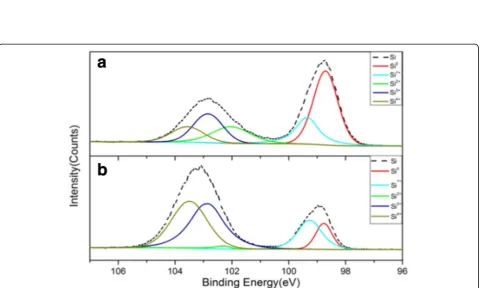
Fig. 2Si 2p XPS spectra (dash line) and their deconvolution fitting into five chemical states (from Si0 to Si4+, color lines) of the Si 2p for Si sludge in
[image:2.595.57.538.88.377.2] [image:2.595.59.540.414.702.2]process is still rather complicated, which involves Ni plating on Si particles and graphene CVD growth as indispensable steps. Solid Si sub-oxide, like SiO, has also been researched as a promising anode [11]. The reaction between SiO and Li+ in the first lithiation/delithiation produces a Li2O and Li4SiO4matrix, which could diminish
the huge volume variation of Si. Using metallurgical Si in ball milling with H2O can produce porosity-controlled
SiOx, which has shown very promising electrochemical
results [12]. Therefore, studying the role of O in fabricating a particular Si anode structure for an LIB is very important for future Si anode development.
Methods
Firstly, Si sludge from a multi-wire slicing process, which was provided by LONGI Silicon Materials Corp., was cleaned with HCl and ethane to remove impurities. Because this crystalline Si wafering process is a mechan-ical cleavage process occurring along the tetrahedral Si, the Si sludge almost forms the flake shape. Meanwhile, most photovoltaic Si wafer has preferred p-type boron doping, this could help the conductivity as anode mater-ial for lithiation/delithiation [13]. Black Si sludge was annealed in alumina crucibles under an air atmosphere at 550 °C for 10 h to obtain a sufficient oxygen inter-diffusion process and convert to brownish nano-Si/SiOx
sample. Afterward, 1 g annealed sample was dispersed in 240 mL of deionized water and 0.8 mL of NH3•H2O
(Aladdin, 28%). After vigorously stirring for 20 min, 400 mg of resorcinol and 0.56 mL of formaldehyde-water solution (37 wt.%) were added into the very diluted mixture and stirred overnight, to coat a resorcinol-formaldehyde (RF) resin layer on the surface of nano-Si/SiOxsample. The
RF layer was then converted to a carbon layer under Ar at 850 °C for 2 h with a heating rate 5 °C/min. Finally, the composites were dispersed in 10 wt% of HF solution to remove the SiOxpart, and Si/C yolk/shell structure can be
obtained, detailed process is referred in Reference [14], a control sample was prepared in same procedure using Si sludge, without the process of oxygen inward diffusion to form nano-Si/SiOx part. The whole process was shown in
Fig.1a, and this nano-Si/SiOxsample has a flake shape as
seen in Fig. 1b SEM image. The resulting flakes were brownish, as seen in Fig.1c.
For electrochemical characterization, a 1 MLiPF6 in EC/ DEC/DMC 1:1:1 (volume ratio) as the electrolyte, and a Celgard 2400 membrane was used as the separator. The working electrodes were prepared by mixing 80 wt% ac-tive materials (Si/C), 10 wt% acetylene black, and 10 wt% PVDF dissolved in an NMP solution. The cells were charged and discharged on a land test system (LAND CT2001A) in a voltage window of 0.01–2.5 V at a rate of 100 mA/g. Cyclic voltammetry (CV) and electrochemical impedance spectroscopy (EIS) were conducted on an
electrochemical workstation (CHI660C) at a scanning rate of 0.5 mV/s. EIS measurements were recorded by applying an AC voltage of 10 mV over a frequency range of 105to 0.01 Hz.
Results and Discussion
X-ray photoluminescence spectroscopy (XPS) measure-ments were conducted, as shown in Fig. 2. The Si 2p spectra can be de-convoluted into five valence states: Si0, Si1+, Si2+, Si3+, and Si4+ [15]. Figure 2a shows the XPS results of the Si 2p spectra for the original Si sludge, these for the nano-Si/SiOxsamples after diffusion
are shown in Fig.2b, and these results confirm the obvi-ous phase change from the Si sludge.
In particular, the pure Si0 is clearly reduced, and various sub-oxide states become more pronounced. The various Si sub-oxide states can actually be considered to be stoichiometrically different for the Si and SiO2
mix-ture. The amounts of the Si oxidation states for each sample are summarized in Table1.
Inter-diffusion is a thermodynamically preferred process for Si wafer-based semiconductor industry [16]. Here, the O interstitial diffusion acted as a knife, cutting the Si core into nano-fragments, and diffused O formed SiOx with
the rest of the neighboring Si parts. The volume ratios of the nano-Si:SiOx actually relied on the diffusion
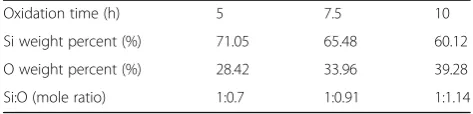
condi-tions such as the amount of O participated in the thermal diffusion [17]. Table 2 lists the weight percentages of Si and O in nano-Si/SiOxparticles examined by X-ray
fluor-escence (XRF), which confirms the oxygen content of pro-duced SiOx increases as long as the thermal oxidation
time increase.
Transmission electron microscopy (TEM) was con-ducted as shown in Fig. 3a, b. The lattice structure of the nano-Si/SiOx sample was confirmed using selected
[image:3.595.304.539.120.163.2]area electron diffraction (SAED). The elemental map-pings of the nano-Si/SiOx sample and final Si/C yolk/ Table 1Percentages of Si oxidation states by XPS measurements in Fig.2. Obvious enhancements of various Si oxidation states can be founded from (a) to (b)
Sample Si0(%) Si1+(%) Si2+(%) Si3+(%) Si4+(%)
(a) 41.7 14.7 4 23.1 16.5
[image:3.595.303.540.675.732.2](b) 9.1 16.4 1.4 37.7 35.4
Table 2Percentages of Si and O of different thermal oxidized Si sludge samples with different oxidation times. All data are before normalization
Oxidation time (h) 5 7.5 10
Si weight percent (%) 71.05 65.48 60.12
O weight percent (%) 28.42 33.96 39.28
Si:O (mole ratio) 1:0.7 1:0.91 1:1.14
Fig. 3TEM characterizations for the nano-Si/SiOxmatrix sample.aParticle morphology.bParticle observation under high magnification shows
the crystalline Si core and amorphous oxide surrounding.cSTEM/EDX elemental mapping prove the miscible feature of Si and O.dImage of Si/C yolk/shell structure
[image:4.595.57.539.87.347.2] [image:4.595.58.539.383.693.2]shell sample were evaluated using high-resolution STEM/ EDX (Tecnai G2 F20 S-TWIN), as shown in Fig. 3c, d, respectively. Figure3ashows that nano-Si/SiOxspecimen
retained the flake shape of the original Si sludge, and under high magnification, as shown in Fig. 3b, we found that polycrystalline Si phases were dispersed inside the amorphous matrix, existing as either nano-Si islands or nano-chains. The mechanism of this nano-Si/SiOx
struc-ture can be explained by the oxygen inward diffusion along the interface [18]. The air atmosphere acted as an O reservoir; there was no energy barrier to O interstitial dif-fusion across the Si/Si oxide interface; the O could con-tinuously penetrate the Si until reaching saturation. It can be observed in the element mapping of Fig.3cthat the O is miscible with Si, and a certain region with rich Si con-tent indicates a nanocrystalline Si site. After removing oxide, clear yolk/shell Si/C composite structure can be seen in Fig.3d. Moreover, HF removing SiO2is not
envir-onmental friendly, but experience learned from semicon-ductor industry could provide a low cost and green method to recycle HF from fluorosilicic acid, such as am-moniated precipitated [19].
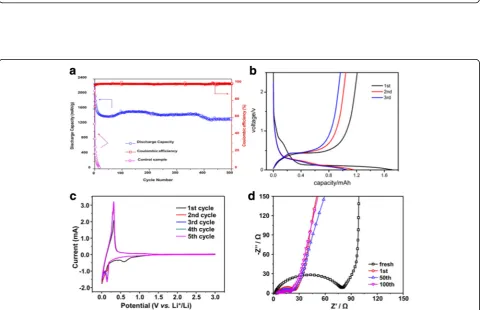
Electrochemical tests were shown in Fig.4, performed half-cells (this Si/C composite was used nano-Si/SiOx
with Si:O = 1:0.85, as raw material) showed an excellent performance with 500 cycles. Its capacity still remained above 1250 mAh/g, and the average Coulombic effi-ciency of the cells was up to 99.5% in Fig. 4a. In con-trast, the controlled sample was totally fail charge/ discharge process after less than 20 cycles. Figure 4b
provides the voltage profiles of the Si/C electrode at the 1st, 10th, and 100th cycles at a rate of 100 mA/g be-tween 0.01 and 2.5 V. An irreversible plateau is observed at around 0.75 V at first cycle, which can be attributed to the formation of a SEI film on the surface of the Si/C electrode. For all of the cycles, a plateau is shown at ap-proximately 0.5 V, which was caused by the de-alloying of the Li-Si. The cycle voltammetry (CV) results shown in Fig.4care also the typical electrochemical features of Si [20]. The peak below 0.2 V in the negative scan and the peaks ~ 0.4 V in the positive scan, respectively, cor-respond to Li alloying and de-alloying process with Si. These peaks retain with cycles, implying that the Si parts are stable and accessible to Li ions. C coating provides a rapid lithium transport pathway, which may account for the very small cell impedance (Fig. 4d), as compared to most reported Si/C composite structure.
Conclusions
In summary, the abundant Si sludge was utilized to produce a novel nano-Si/SiOx using simple oxygen
thermal diffusion as a precursor. After further coating a carbon layer and HF etching, a Si/C yolk/shell structure was obtained, which showed an excellent
electrochemical performance for LIB anode. We found a simple, environmentally friendly way by converting the large of waste Si sludge into a valuable anode material for LIB applications. This“kill two birds with one stone” work will be beneficial for both the PV and LIB industries.
Acknowledgements
This study was financially supported in 2013 by“the Fundamental Research Funds for Central Universities”Program at Hunan University; by the Opening Funding Program at the State Key Lab of Silicon Materials, Zhejiang University at 2016 with Nr.SKL2016-4; by the“2016 Hunan Province Technology Planning Program”with contract Nr.2016GK2009; and by the “2015 Changsha Technology Planning Program”with contract Nr.1601183.
Availability of Data and Materials
All data are fully available without restriction.
Authors’Contributions
TZLv conceived and designed the experiments. QQH and DYD performed the experiments. CZZ and FH did the electrochemical tests for cells. SGZ contributed reagents/materials/analysis tools. TZLv wrote the paper. All authors read and approved the final manuscript.
Competing Interests
The authors declare that they have no competing interests.
Publisher’s Note
Springer Nature remains neutral with regard to jurisdictional claims in published maps and institutional affiliations.
Received: 27 March 2018 Accepted: 19 April 2018
References
1. Kang KS, Meng YS, Breger J, Grey CP, Ceder G (2006) Science 311:977–980 2. Dunn B, Kamath H, Tarascon JM (2011) Science 334:928–935
3. Kasavajjula U, Wang CS, Appleby AJ (2007) J Power Source 163:1003–1039 4. Wu H, Cui Y (2012) Nano Today 7:414–429
5. Ge MY, Lu YH, Ercius P, Rong JP, Fang X, Mecklenburg M, Zhou CW (2014) Nano Lett 14:261–268
6. Luo W, Wang YX, Wang LJ, Jiang W, Chou SL, Dou SX, Liu HK, Yang JP (2016) ACS Nano 10:10524–10532
7. Zhang L, Rajagopalan R, Guo H, Hu X, Dou S, Liu H (2016) Adv Funct Mater 26:440–446
8. Liao W, Chen D, Zhang Y, Zhao J (2017) Mater Lett 209:547–550 9. Drouiche N, CuellarGuardado PR, Fouad K, Medjahed S, Boutouchent-Guefti
N, Ouldhamou M (2014) Renew Sust Energ Rev 32:936–943 10. Li YZ, Yan K, Lee HW, Lu ZD, Liu N, Cui Y (2016) Nat Energy 1:15029 11. Hwa Y, Park CM, Sohn HJ (2013) J Power Source 222:129–134
12. Zong LQ, Jin Y, Liu C, Zhu B, Hu XZ, Lu ZD, Zhu J (2016) Nano Lett 16: 7210–7215
13. Woo JH, Baek SH, Park JS, Jeong YM, Kim JH (2015) J Power Source 299:25–31 14. Fang XL, Liu SJ, Zang J, Xu CF, Zheng MS, Dong QF, Sun DH, Zheng NF
(2013) Nano 5:6908–6916
15. Yang Y, Wang Z, Zhou R, Guo H, Li X (2016) Mater Lett 184:65–68 16. Hu SM (1974) J Appl Phys 45:1567–1573
17. Marcus RB, Sheng TT (1982) J Electrochem Soc 129:1287–1282 18. Devine RAB, Mathiot D, Warren WL, Aspar B (1996) J Appl Phys 79:
2302–2308
19. Dahlkea T, Ruffinera O, Cant R (2016) Procedia Eng 138:231–239 20. Wang MS, Fan LZ (2013) J Power Source 244:570–574