http://ijmms.hindawi.com © Hindawi Publishing Corp.
A GENERALIZED BETA FUNCTION AND ASSOCIATED
PROBABILITY DENSITY
Y. BEN NAKHI and S. L. KALLA
Received 30 April 2001
We introduce and establish some properties of a generalized form of the beta function. Corresponding generalized incomplete beta functions are also defined. Moreover, we de-fine a new probability density function (pdf) involving this new generalized beta function. Some basic functions associated with the pdf, such as moment generating function, mean residue function, and hazard rate function are derived. Some special cases are mentioned. Some figures for pdf, hazard rate function, and mean residue life function are given. These figures reflect the role of shape and scale parameters.
2000 Mathematics Subject Classification: 33C20, 60E10, 62E15.
1. Introduction. Recently, many authors have defined and studied generalized form of different special functions [4,5,8,12,13]. Virchenko et al. [12] have treated a gen-eralized gamma function in the form,
ω D
a,b;c;v u,µ
=v−a
∞
0 t u−1
e−pt2ωR1
a,b;c;−t
v
dt, (1.1)
wherea, b, andc are complex parameters,ω >0, Rep,Reu >0,|argv|< π, and
c≠0,−1,−2,.... The case whereω=p=1,b=creduces to Kobayashi’s generalized gamma function [8]. Moreover, if we takea=0 in this equation, we get the well-known gamma function. Kalla and Al-Saqabi [6] have used this function to define a probability density function, which generalizes results of Kobayashi [8] and Kalla et al. [7].
Definition1.1. Continue with the preceding assumptions on the parametersa,
b,c,ω,u, andv. Then for Re(a+µ)and Re(b+µ) >0, we define a generalized form of the beta function as
ω B
a,b;c;v u,µ
v−a
∞
0 t u−1
(1+t)−µ−u2ωR1
a,b;c;−t
v
dt, (1.2)
where2ωR1(a,b;c;x)is the ω-Gauss hypergeometric function [12,13] whose series representation is given by,
ω
2R1(a,b;c;x)= Γ(c)
Γ(b)
∞
k=0
(a)kΓ(b+ωk)
Γ(c+ωk) xk
and its integral representation in the form,
ω
2R1(a,b;c;x)=L 1
0t b−1
(1−t)c−b−11−xtω−adt
= L
ω 1
0t
b/ω−11−
t1/ωc−b−1(1−xt)−adt,
(1.4)
where
Re(c) >Re(b) >0, L= Γ(c)
Γ(b)Γ(c−b). (1.5)
Forω=1, (1.4) is the classical Gauss hypergeometric function, hence (1.2) becomes
B
a,b;c;v u,µ
=v−a
∞
0 t u−1
(1+t)−µ−u2F1
a,b;c;−t
v
dt, (1.6)
and by lettingb=c, we have [11]
B
a,b;b;v u,µ
=
∞
0 t u−1
(1+t)−µ−u(v+t)−adt
=v−aB(u,µ+a) 2F1
u,a;u+a+µ; 1−1
v
.
(1.7)
Further, if we takea=0 then (1.2) reduces to the well-known beta function, that is,
B(u,µ)= ∞
0 t u−1
(1+t)−µ−udt, Re(u),Re(µ) >0. (1.8)
InSection 2, we establish a number of analytic properties, such as recurrence re-lations and the asymptotic expansions for our generalized beta function. We express this generalized beta function in terms ofω-hypergeometric functions [13]
ω 3R2
a1,a2:b;x c:d
ΓΓ(c)
(b)
∞
k=0
a1ka2kΓ(b+ωk) (c)kΓ(d+ωk)
xk
k!. (1.9)
InSection 3, we define generalized incomplete beta functions associated with the func-tion defined by (1.2). These incomplete forms of the generalized beta funcfunc-tions are used to study some statistical functions in later sections. Moreover, we introduce and study a new probability density function (pdf) involving the generalized beta function inSection 4. Finally, we derive some basic functions associated with this density func-tion, namely, thekth moment, moment generating function, the hazard rate function, and the mean residue life function. Corresponding results for beta distribution are listed. Some figures are given for pdf, hazard rate function, and mean residue life function.
2. The generalized beta function. We begin this section by observing that (1.2) can be rewritten as
ω B
a,b;c;v u,µ
=vu−a
∞
0 t
u−1(1+vt)−µ−u ω
We express this generalized beta function in terms ofω-hypergeometric functions in the following theorem.
Theorem2.1. The generalized beta functionωBa,b;c;v u,µ
can be represented as
ω B
a,b;c;v u,µ
=ωE1
a,b;c;v
u,µ
+ωE2
a,b;c;v u,µ
, (2.2)
where,
ω E1
a,b;c;v
u,µ
=v−a×B(u,µ)×3ωR2
u,a:b;v1 1−µ:c
,
ω E2
a,b;c;v
u,µ
=v−a−µ×ωΓ(∗)× ω 3R2
a+µ,u+µ:b+ωµ;v1 1+µ:c+ωµ
(2.3)
with
ω
Γ(∗)=Γ
c,a+µ,b+ωµ,−µ a,b,c+ωµ
. (2.4)
Proof. Using (1.4), the integral representation for2ωR1, yields
ω B
a,b;c;v u,µ
=v−a
∞
0 x
u−1(1+x)−µ−u ω 2R1
a,b;c;−x
v
dx
=v−aL 1
1
0t
b−1(1−t)c−b−1
∞
0 x
u−1(1+x)−µ−u
1+tω
vx −a
dx
dt
=v−aL2 1
0t b−1
(1−t)c−b−12F1
a,u;a+u+µ; 1−tω
v
dt,
(2.5)
where
L1= 1
B(b,c−b), L2=
B(u,a+µ)
B(b,c−b). (2.6)
Using the transformation formulae [1,9], yields
F=L3×2F1
a,u; 1−µ;t
ω v
+L4×
tω
v µ
×2F1
u+µ,a+µ; 1+µ;t
ω v
, (2.7)
where
F=2F1
a,u;a+u+µ; 1−t
ω v
, L3=Γ
µ,a+u+µ a+µ,u+µ
, L4=Γ
−µ,a+u+µ a,u
.
Let
ω E1
a,b;c;v
u,µ
v−a×L2L3× 1
0t b−1
(1−t)c−b−12F1
a,u; 1−µ;t
ω v
dt
=v−a×L 2L3×
∞
k=0
(a)k(u)k (1−µ)k ×
v−k k!
1
0t
b+ωk−1(1−t)c−b−1dt
=v−a×B(µ,u)×Γ(c)
Γ(b)
∞
k=0
(a)k(u)kΓ(b+ωk) vk(1−µ)kΓ(c+ωk)k!
=v−a×B(µ,u) ω 3R2
u,a:b;v1 1−µ:c
,
ω E2
a,b;c;v
u,µ
L2L4 va ×
tω
v µ
× 1
0t
b−1(1−t)c−b−1 2F1
u+µ,a+µ; 1+µ;t
ω v
dt
= L2L4 va+µ
∞
k=0
(a+µ)k(u+µ)k (1+µ)k ×
v−k k!
1
0t
b+ωk+ωµ−1
(1−t)c−b−1dt
=v−a−µ×ωΓ(∗)×ΓΓ(c+ωµ)
(b+ωµ)
∞
k=0
(a+µ)k(u+µ)kΓ(b+ωµ+ωk) vk(1+µ)kΓ(c+ωµ+ωk)k!
=v−a−µ×Γω(∗)×3ωR2
a+µ,u+µ:b+ωµ;v1 1+µ:c+ωµ
(2.9)
and the proof is complete.
Remark2.2. Forω=1, we get the representation ofBin terms of hypergeometric
functions given in [11, page 315], that is,
B
a,b;c;v u,µ
=E1
a,b;c;v
u,µ
+E2
a,b;c;v u,µ
, (2.10)
where
E1
a,b;c;v u,µ
=B(u,µ)
va 3F2
u,a,b;v1 1−µ,c
,
E2
a,b;c;v u,µ
=v−a−µ×Γ(∗)×3F2
u+µ,a+µ,b+µ;v1 1+µ,c+µ
,
(2.11)
with
Γ(∗)=Γ
c,a+µ,b+µ,−µ a,b,c+µ
. (2.12)
Asymptotic expansions forωBa,b;c;v u,µ
. Now we establish the asymptotic
Theorem2.3. Recall3ωR2(x), then asv→ ∞, it leads to
ω B
a,b;c;v u,µ
∼v−a×B(µ,u)× ω 3R2
u,a:b;v1 1−µ:c
. (2.13)
Recurrence relations. The following recurrence relations forωB can be easily
derived from its definition and the recurrence relations ofRωgiven in [12, equations (8)–(12)].
Theorem2.4. The following relations hold:
(b−aω)ωB
a,b;c;v u,µ
=bωB
a,b+1;c;v u,µ
−avωωB
a+1,b;c;v u,µ
,
(c−aω−1)ωB
a,b;c;v u,µ
=(c−1)ωB
a,b;c−1;v u,µ
−avωωB
a+1,b;c;v u,µ
,
(c−b−1)ωB
a,b;c;v u,µ
=(c−1)ωB
a,b;c−1;v u,µ
−bωB
a,b+1;c;v u,µ
,
cωB
a,b;c;v u,µ
=(c−b)ωB
a,b;c+1;v u,µ
+bωB
a,b+1;c+1;v u,µ
.
(2.14)
Moreover, using [12, equation (17)] and integration by parts to the integral
repre-sentation ofωBwe obtain the following result.
Lemma2.5. With the preceding assumptions, one can easily derive
ω B
a,b;c;v u,µ
=u+µ
u ω B
a,b;c;v u+1,µ + L vu ω B
a+1,b+ω;c+ω;v u+1,µ−1
(2.15)
with
L=aΓΓ(c)Γ(b+ω)
(b)Γ(c+ω) . (2.16)
We conclude this section by giving the partial derivatives of the generalized beta function.
Lemma2.6. The partial derivatives ofωBa,b;c;v u,µ are ∂n ∂un ω B
a,b;c;v u,µ
=v−a
∞
0 (−
1)n+1t−1ln(1+t)n(1+t)−µ−u ω 2R1
a,b;c;−t
v dt, ∂n ∂vn ω B
a,b;c;v u,µ
=(−1)n(a)nωB
a+n,b;c;v u,µ
.
Proof. The first formula is obtained by observing that
∂n ∂un
tu−11+t−µ−u=
(−1)n+1t−1ln(1+t)n
(1+t)−µ−u. (2.18)
The second formula is obtained by using the integral representation of2ωR1, that is,
ω 2R1
a,b;c;−t
v
=L 1
0s
b/ω−11−
s1/ωc−b−1
1+t
vs −a
ds, L= 1
ω×B(b,c−b)
(2.19)
and recalling that,
∂n
∂vn(v+st)
−a=(−1)n(a)n(v+st)−a−n. (2.20)
This ends the proof.
3. The generalized incomplete beta functions. We define forx,ω >0, Reu,Re(a+
µ),Re(b+µ) >0, and|argv|< π, the related functions:
ω Bx
0
a,b;c;v u,µ
=v−a
x
0t
u−1(1+t)−µ−u ω 2R1
a,b;c;−t
v
dt, (3.1)
and call it thegeneralized incomplete beta function, and its companion function,
ω B∞x
a,b;c;v
u,µ
=v−a ∞
x t
u−1(1+t)−µ−u ω 2R1
a,b;c;−t
v
dt (3.2)
which may be called thegeneralized complementary incomplete beta function. In other words, we have
ω B
a,b;c;v u,µ
=ωBx0
a,b;c;v
u,µ
+ωB∞x
a,b;c;v u,µ
. (3.3)
The next theorem lists some differential properties and recurrence relations of these incomplete functions. For simplicity, we let
Bx 0
ω Bx
0
a,b;c;v u,µ
, Bx∞ ω B∞x
a,b;c;v
u,µ
. (3.4)
Theorem 3.1. Continue with the preceding notations, to obtain the following
formulas:
ω Bx0
a,b;c;v
u,µ
=u+µ
u ω Bx0
a,b;c;v
u+1,µ
+xu−1(1+x)−µ−u
va
ω 2R1
a,b;c;−x
v
+ L
vu ω Bx0
a+1,b+ω;c+ω;v u+1,µ−1
withL=aΓ(c)Γ(b+ω)/Γ(b)Γ(c+ω).
ω B∞x
a,b;c;v
u,µ
=u+µ
u ω B∞x
a,b;c;v
u+1,µ
−xu−1(1+x)−µ−u
va
ω 2R1
a,b;c;−x
v
+ L
vu ω B∞x
a+1,b+ω;c+ω;v u+1,µ−1
, (3.6) d dx x1−uBx
0
=(1−u)x−uBx
0+v−a(1+x)−µ−u ω 2R1
a,b;c;−x
v , d dx
(1+x)µ+uB0x
=(u+µ)(1+x)µ+u−1Bx0+v−axu−1 ω 2R1
a,b;c;−x
v , d dx x1−uB∞x
=(1−u)x−uB∞x−v−a(1+x)−µ−u ω 2R1
a,b;c;−x
v , d dx
(1+x)µ+uB∞
x
=(u+µ)(1+x)µ+u−1B∞
x−v−axu−1 ω 2R1
a,b;c;−x
v
.
(3.7)
The proof of the formulas (3.5), (3.6), and (3.7) is straight forward from the respec-tive definitions.
4. The probability density function. In a systematic study of generalized pdf and their statistical properties, special functions have played a significant role [2,3,6,7, 10]. Chaudhry and Zubair [5,4] have used modified Bessel functions to extend the gamma function, and then used them to define some densities. Kalla et al. [7] have used a generalized form of hypergeometric function to study a new pdf Ismail Ali et al. [3] have usedτ-confluent hypergeometric function to define and study a generalized inverse Gaussian distribution. Here we study a new probability density involving the function defined by (1.2).
The pdf of a random variableXassociated with (1.2) is defined by,
f (x)=v−axu−1(1+x)−µ−u
ω 2R1
a,b;c;−x/v ω
B
a,b;c;v u,µ
×1[x >0]. (4.1)
It is obvious that0∞f (t)dt=1. We observe that the behavior off (x)at zero de-pends onu, that is,
f (0)=
0, u >1
vaωB
a,b;c;v
1,µ −1
, u=1. (4.2)
Moreover, we have limx→0+f (x)= ∞,u <1, and limx→∞f (x)=0. It can be easily shown that
d
dxf (x)= u−1
x − µ+u
1+x− L v
ω 2R1
a+1,b+ω;c+ω;−x/v ω
2R1
a,b;c;−x/v !
f (x), (4.3)
2 4 6 8 10 0.1
0.2 0.3 0.4 0.5
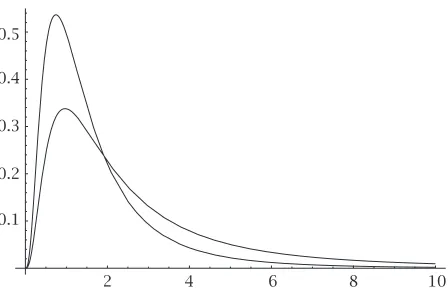
[image:8.498.132.356.81.227.2]Figure4.1.The probability density functionf (x)whenv=1,u=4,m=2, a=3,b=2,c=7. The lower graph representsf (x)whenω=4 whereas the upper graph representsf (x)whenω=1.
Figure 4.1represents the pdf for the indicated parameters. It shows the effect of the parameterω.
Special cases. If we setω=1, the density function becomes
f (x)=v−axu−1(1+x)−µ−u2F1
a,b;c;−x/v
B
a,b;c;v u,µ
×1[x >0]. (4.4)
Furthermore, if we letb=c, the density function (4.4) reduces to
f (x)=xu−1(1+x)−µ−u
1+x/v−a×1[x >0] B(u,µ+a)2F1
u,a;u+a+µ; 1−1/v . (4.5)
The beta density function of second kind is recovered from (4.1) whena=0
f (x)=xu−1(1+x)−µ−u
B(u,µ) ×1[x >0]. (4.6)
5. Some statistical function. The aim of this section is to obtain some basic func-tions associated with the pdff (x), such as the population moments, the cumulative distribution function (cdf), the survivor function, the hazard rate function, and the mean residue life function.
5.1. Population moments. We derive several types of moments such as thekth moment and the moment generating function. We begin by evaluating thekth moment, since it will be used to obtain the remaining basic moments, such as the mean, the variance and the moment generating function
Thekth Moment. Thekth moment about the origin of the random variableX
whose pdff (x)given by (4.1), is defined by
EXk ∞
0 t
By virtue of (4.1), we get
EXk=v−a ∞
0 tk+u−1(1+t)−µ−u ω 2R1
a,b;c;−t/vdt ω
B
a,b;c;v u,µ
=
ω B
a,b;c;v u+k,µ−k
ω B
a,b;c;v u,µ
. (5.2)
Now since the mean, expected value of the random variableX, is a special case of this moment, namely, the mean is the first moment
E[X] ∞
0 tf (t)dt= ω B
a,b;c;v u+1,µ−1
ω B
a,b;c;v u,µ
. (5.3)
Similarly, we can obtain the variance of the random variableX,σ2
X, using (5.2) with k=2, and (5.3), since it is defined as
σ2 XE
X2−E[X]2. (5.4)
Moment generating function. The moment generating function of the
ran-dom variableXis defined by
M(t)EetX= ∞
0 e
txf (x)dx. (5.5)
To avoid the difficulty of this integration, we observe, using Taylor expansion, that
EetX=
∞
k=0 tk k!E
Xk. (5.6)
Using this beside (5.2), we obtain
M(t)= ∞
k=0 ω B
a,b;c;v u+k,µ−k
ω B
a,b;c;v u,µ
×tk
k!. (5.7)
5.2. The distribution function. The cdfF(x)of the random variableXis given by,
F(x)P (X≤x)= x
0f (t)dt= ω Bx0
a,b;c;v
u,µ
ω B
a,b;c;v u,µ
hence the survivor functionS(x)can be expressed as
S(x)P (X≥x)=1−F(x)= ∞
x f (t)dt= ω B∞x
a,b;c;v
u,µ
ω B
a,b;c;v u,µ
. (5.9)
5.3. The hazard rate function. For a pdff (x)the hazard rate function is defined by
h(x)f (x)
S(x). (5.10)
Using (5.2) and (5.9), it follows that
h(x)=v−axu−1(1+x)−µ−u
ω
2R1a,b;c;−x/v ω
B∞x
a,b;c;v u,µ
×1[x >0]. (5.11)
A particular case of the hazard functionh(x)results whenω=1, that is,
h(x)=v
−axu−1(1+x)−µ−u2F1a,b;c;−x/v
Bx∞
a,b;c;v u,µ
×1[x >0]. (5.12)
Further, forb=c, the hazard function (5.12) reduces to
h(x)=xu−1(1+x)−µ−u(v+x)−a×1[x >0]
B∞x
a,b;b;v u,µ
. (5.13)
The hazard function of the beta distribution of the second kind is recovered from (5.11) whena=0
h(x)=xu−1(1+x)−µ−u
Bx∞(u,µ) ×
1[x >0]. (5.14)
5.4. The mean residue life function. For a random variableX, the mean residue life function is defined by
K(x)=E[X−x/X≥x]= ∞
x(t−x)f (t)dt
S(x) =
∞
xtf (t)dt
S(x) −x. (5.15)
Now since
∞
x tf (t)dt= ω B∞x
a,b;c;v u+1,µ−1
ω B
a,b;c;v u,µ
2 4 6 8 10 0.2
0.4 0.6 0.8
Figure5.1. The hazard functionh(x)whenv=1,u=4,m=2,a=3, b=2,c =7. The lower graph representsh(x)whenω=4 whereas the upper graph representsh(x)whenω=1.
2.5 5 7.5 10 12.5 15
3 4 5
Figure5.2.The mean residue life functionK(x)whenv=1,u=4,m=2, a=3,b=2,c=7. The lower graph representsK(x)whenω=1 whereas the upper graph representsK(x)whenω=4.
therefore, using this and (5.9), we get
K(x)=
ω B∞x
a,b;c;v u+1,µ−1
ω B∞x
a,b;c;v
u,µ
−x. (5.17)
Fora=0, we obtain the mean residue life functionK(x)of the beta distribution of the second kind
K(x)=B∞x(u+1,µ−1) Bx∞(u,µ) −x.
Figures5.1and5.2represent the hazard functionh(x)and the mean residue life functionK(x). They show the effect of the parameterω.
References
[1] A. Abramowitz and I. Stegun,Handbook of Mathematical Functions, Dover Publications, New York, 1972.
[2] A. Al-Zamel,On a generalized gamma-type distribution withτ-confluent hypergeometric function, Kuwait J. Sci. Engrg.28(2001), 25–36.
[3] I. Ali, S. L. Kalla, and H. G. Khajah, A generalized inverse Gaussian distribution with τ-confluent hypergeometric function, Integral Transform. Spec. Funct.12(2001), no. 2, 101–114.
[4] M. A. Chaudhry and S. M. Zubair,Generalized incomplete gamma functions with applica-tions, J. Comput. Appl. Math.55(1994), 99–124.
[5] ,On an extension of generalized incomplete gamma functions with applications, J. Austral. Math. Soc. Ser. B37(1996), 392–405.
[6] S. L. Kalla and B. N. Al-Saqabi,Further results on a unified form of gamma-type distribu-tions, Fract. Calc. Appl. Anal.4(2001), no. 1, 91–100.
[7] S. L. Kalla, B. N. Al-Saqabi, and H. G. Khajah,A unified form of gamma-type distributions, Appl. Math. Comput.118(2001), no. 2-3, 175–187.
[8] K. Kobayashi,On generalized gamma functions occurring in diffraction theory, J. Phys. Soc. Japan60(1991), no. 5, 1501–1512.
[9] W. Magnus, F. Oberhettinger, and R. P. Soni,Formulas and Theorems for the Special Func-tions of Mathematical Physics, 3rd ed., Springer-Verlag, New York, 1966.
[10] A. M. Mathai,A Handbook of Generalized Special Functions for Statistical and Physical Sciences, The Clarendon Press Oxford University Press, New York, 1993.
[11] A. P. Prudnikov, Y. A. Brychkov, and O. I. Marichev,Integrals and Series. Vol. 3. Direct Laplace Transforms, Gordon and Breach Science Publishers, New York, 1992. [12] N. Virchenko, S. L. Kalla, and A. Al-Zamel,Some results on a generalized hypergeometric
function, Integral Transform. Spec. Funct.12(2001), no. 1, 89–100.
[13] N. A. Virchenko,On some generalizations of the functions of hypergeometric type, Fract. Calc. Appl. Anal.2(1999), no. 3, 233–244.
Y. Ben Nakhi: Kuwait University, Department of Mathematics and Computer Science,
P.O. Box5969, Safat13060, Kuwait E-mail address:[email protected]
S. L. Kalla: Kuwait University, Department of Mathematics and Computer Science,