International Journal of Research (IJR)
e-ISSN: 2348-6848, p- ISSN: 2348-795X Volume 2, Issue 08, August 2015Available at http://internationaljournalofresearch.org
F
ASTING
H
EADACHE
A
C
ROSS
-S
ECTIONAL
S
TUDY
ADNAN SALIMA; MUHAMMAD AHMED ILYASA;MEHWISHRIZVIA;ARZALANULLAHBAIGA;SYED
HASSAANAHMEDA;ZUHAPANDITA &SALEEMILYASB a
Dow Medical College, Dow University of Health Sciences, Karachi, Pakistan
b
Director, Medical and Allied, Professional Development Centre, Dow Medical College, Dow University of Health Sciences, Karachi, Pakistan
[email protected]; [email protected];[email protected];
[email protected]; [email protected]; [email protected]; [email protected]
Corresponding author: Adnan Salim;[email protected]
The authors did not receive funding of any kind and declare no conflict of interest.
Abstract
Background
Headache is a predominant disorder in general population and is classified into primary and secondary forms by the International Headache Society. Fasting headache is currently classified in Group 10 of ICHD-III as “Headache attributed to disorders of homeostasis”. In spite of continuing research, there is still indistinctness regarding the exact cause of fasting headache. Hypoglycaemia, previous history of headache, stress, caffeine withdrawal, lack of sleep and female gender have been speculated as causative factors. Our rationale for this study is to find out what percentage of the population experiences fasting headache and to find out any link between the occurrence of this phenomenon and any associated factors. Methods:
This study was based on online questionnaires which were distributed in the first week of Ramadan 2013. 423 subjects returned validly filled forms. Only fasting subjects were included. Pearson Chi-square and Independent-samples T tests were used for statistical analysis.
Results:
The response rate of people reporting headache on the first day of fast was 35.7%. Our results showed that those people who had a diagnosed
cause of headache (Migraine, cluster etc.) were more likely to experience the same on the first day of their fast (p= .002). Caffeine withdrawal followed an interesting pattern in this study. Conclusion:
From the data, it is evident that those subjects who are already diagnosed with certain headache disorders are more likely to experience headache. This signifies that fasting itself is not the sole reason for the occurrence of headache. Caffeine withdrawal also appeared to play minor role in the pathogenesis of first-of-Ramadan headache.
Keywords: Fasting; Ramadan; Ramadhan; Headache; Islam; Muslims; Yom Kippur
BACKGROUND
:
International Journal of Research (IJR)
e-ISSN: 2348-6848, p- ISSN: 2348-795X Volume 2, Issue 08, August 2015Available at http://internationaljournalofresearch.org
[6]. Secondary headaches frequently arise due to any disturbance in general body homeostasis, such as hypoglycaemia, electrolyte disturbancesetcetera, or more commonly as a consequence of prolonged food deprivation [7]. Fasting headache is currently classified in Group 10 of ICHD-III as “Headache attributed to disorders of homeostasis” [5]. As perthe ICHD-III criteria, fasting headache is a diffuse non-pulsating type of headache fluctuating between mild to moderate in intensity, and is due to fasting for at least 8 hours. It persists throughout the duration of the fast, on average, and is commonly relieved on the consumption of food.
In spite of continuing research, there is still ambiguity regarding the exact cause of fasting headache. Different researchers have proposedvarious theories as to its generation. One of such theories hypothesizes that hypoglycaemia, similar to its role in initiating an attack of migraine, is a likely precipitant of fasting headache as well [8-14]. Another study has concluded that delayed food intake, due to a fast, can predispose a susceptible individual to headache [15]. Direct correlation has been found between the duration of fasting and severity of headache attack, attributing the cause to increasing stress as the day progresses. A well versed study regarding Yom Kippur, a Jewish festival, ornately describes the relationship between headache and fasting [16, 17]. Additionally, dehydration has also been speculated as a causative factor of fasting headache [18]. Chronic headache sufferers have been implied to experience fasting headache more than people who do not usually have anyprevious history of headache [19]. Consequently, many researchers in the Middle East have taken the Muslim month of Ramadan to execute their efforts in strengthening the relationship between occurrence of headache and different stresses experienced during fasting. Muslims observe fast as an annual religious practice in the month of Ramadan. The
Muslim abstains from drinking and eating from sunrise till sunset, a cycle which must be repeated for exactly a month [20]. In 1999, Awada et al researched on first of Ramadan headache, and concluded that a past history of headache and a low caffeine intake can be probable trigger factors for the first of Ramadan headache [21]. Possible association between withdrawal of caffeine and headache has been widely pursued, concluding that this can trigger migraine like symptoms and can be a possible aggravating factor of a formerly present headache. [22-24]. According to a study conducted in Malaysia, Ramadan headache has been given multiple attributions including lack of sleep, stress, and is found to be more common among females [25].
Our rationale for this study is to find out what percentage of the population experiences the above mentioned fasting headache. We also aim to try and find out any link between the occurrence of this phenomenon and any associated factors.
M
ETHODS:
This study was a cross-sectional study for which was developed anonline questionnaire, the URL of which was distributed to a random sample of population living in Karachi, Pakistan. They were distributed on the first week of Ramadan 2013 (coinciding with the month of July) and 423 subjects returned validly filled forms. Only fasting subjects were included. Bio-data was collected (gender, age, occupation) as well as responses regarding sleep duration, caffeine intake and smoking. The subjects were also asked if they regularly experienced headaches, and if yes, what the frequency was. They were further asked if they had a diagnosed headache disorder, such as Migraines, Cluster headaches or tension-type headaches. Pearson Chi-square and Independent-samples T tests were used for statistical analysis.
International Journal of Research (IJR)
e-ISSN: 2348-6848, p- ISSN: 2348-795X Volume 2, Issue 08, August 2015Available at http://internationaljournalofresearch.org
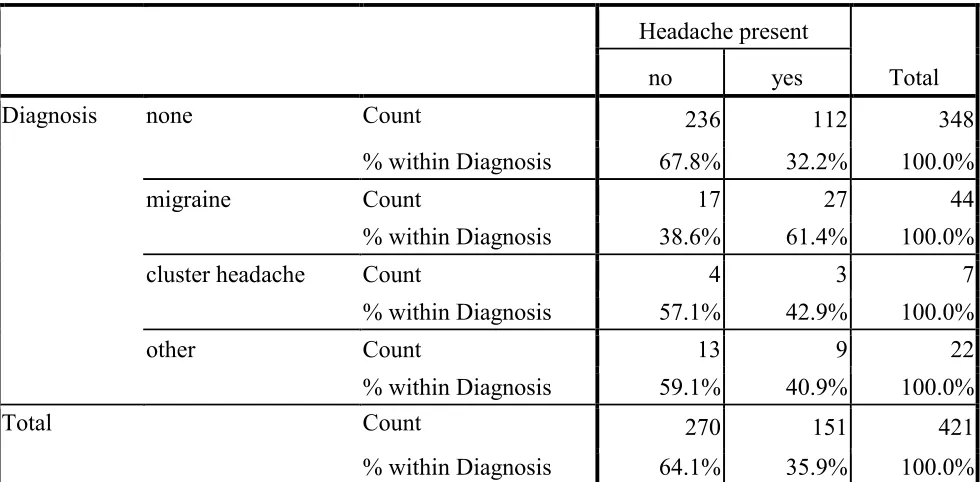
Completed questionnaires were obtained from 423 subjects. They included 290 females (68.9%) and 131 males (31%). Their mean age was 21.2 years. Of these, 151 people reported headache on the first day of fast (35.7%). 71.8% of those who experienced the headache were females, but this value is not statistically significant. People with the headache had a mean age of 21.9 years. Our results showed that those people who had a diagnosed cause of headache were more likely to experience the same on the first day of their fast (p= .002). 61.4% of those with migraines reported first-of-Ramadan headaches, as well as 42.9% of those with cluster headaches and 40.9% of those with any other headache disorder. In contrast, most of those who did not have any such disorder reported in negative for this headache (67.8%) (Table1). People having a high frequency of regular headaches had a far higher rate of responding in affirmative to our main question (p=.000). 77.6% of the population who do not experience usual headaches had no episode of headache on fasting. In comparison, people who have headaches approximately twice per week had a 66.7% chance of experiencing the nuisance on the first fasting day.
Regarding sleep, 45% of headache positive subjects reported sleeping for lesser amount of time than usual, but as 44% of those without headache also reported the lack of sleep, this value is statistically insignificant. A similar trend was noticed regarding the assumption of caffeine withdrawal as a cause of the first-of-Ramadan headache. While 37.8% of headache positive subjects reported decrease in caffeine consumption on the fasting day, 38% of those who did not experience headache reported the same. An interesting fact observed though was that 82.3% of people who did not consume caffeine regularly did not experience this inconvenient headache.
DISCUSSION:
Fasting Headache is a common form of headache among secondary forms of the
International Classification of Headache Disorders, (ICHD-III beta version). Results obtained after complete analysis of data illustrate that 35.7% (151/423) subjects experienced headache on the first day of fast. From the data, it is evident that those subjects who are already diagnosed with certain headache disorders are more likely to experience headache as compared to normal subjects. It is a significant finding which elaborates that fasting itself is not the sole reason for the occurrence of headache but other pre-existing pathologies resulting in headache are also accountable and it is consistent with our findings that subjects having migraine headache, cluster headache or other headache syndromes have more complaints of headache in fasting conditions.
Some other factors are possibly responsible for this phenomenon too, such as hypoglycaemia (low blood glucose level), dehydration, psychological stress and probably caffeine withdrawal. The role of hypoglycaemia as a primary cause of fasting headache is doubtful because, under normal conditions, glycogen reserves are ample to maintain blood glucose levels in the normal range for about 24 hours [26]. However, in liable individuals, hypoglycaemia may trigger a headache attack during the fasting period attributable to alteration in their glucose metabolism.
Fasting period and intensity varies from region to region and climate to climate. In some parts of world, the duration of fast is short and climatic constituents are favourable and in other parts, the equation is entirely opposite. In countries with hot climate and longer duration of fasting, dehydration can play a role in the development of headache and it is shown in literature [27],butthe role of dehydration as a major factor for fasting headache is yet to be determined.
International Journal of Research (IJR)
e-ISSN: 2348-6848, p- ISSN: 2348-795X Volume 2, Issue 08, August 2015Available at http://internationaljournalofresearch.org
schedule etcetera. These changes in conjunction with some psychological stress from fasting itself might be hypothesized as additional minor factors for development of headache.
An interesting finding that we came across is the effect of caffeine. Many individuals who are used to caffeine consumption reported headache upon its withdrawal but those who are not in the habit of caffeine consumption in their daily lives did not demonstrate this trend. This relationship emphasizes the fact that caffeine withdrawal also plays some role in the pathogenesis of fasting headache.
CONCLUSIONS:
Headache on the first day, or couple days, of fasting period is a relatively common occurrence which does not require active management. There appears to be different levels of susceptibility in a given population and those affected should be counselled as to some minor lifestyle modifications e.g. tapering off caffeine consumption before the approach of the Holy Month. Further detailed studies are required to search for additional provoking factors.
C
OMPETING INTERESTS:
The authors declare no conflict of interest.
A
UTHORS’
CONTRIBUTIONS;
AS, MAI, MR, AUB, SHA, ZP were involved in the development of the questionnaire. Afore-mentioned authors also carried out literature review of relevant studies and in the distribution of the questionnaire. AS was involved in data entry and analysis.AS, MAI, MR, AUB and ZP executed the writing of the manuscript. SI supervised the study, guiding us at all points and in reviewing the final draft. All authors read and acknowledged the final manuscript. All were equally involved in the conception of the idea.
A
CKNOWLEDGMENTS:
The authors would like to acknowledge Mr Syed Adnan Ali, Lecturer in Bio-statistics, Department of Research and PhD Program, Dow Medical College for his technical help concerning the analysis of the data.
No funding was received for this study.
R
EFERENCES:
[1.]Jensen R, Stovner LJ. Epidemiology and comorbidity of headache. Lancet Neurol. 2008;7:354-361.
[2.]Lipton RB, Scher AI, Kolodner K, Liberman J, Steiner TJ, Stewart WF. Migraine in the United States. Epidemiology and patterns of health care use. Neurology. 2002;58:885-894.
[3.]Brandes JL. The migraine cycle: Patient burden of migraine during and between migraine attacks. Headache. 2008;48:430-441.
[4.]Hu XH, Markson LE, Lipton RB, Stewart WF, Berger ML. Burden of migraine in the United States. Disability and economic cost. Arch Intern Med. 1999;159:813-818.
[5.]Headache Classification Subcommittee of the International Headache Society. The International Classification of Headache Disorders. Cephalalgia.2013. DOI: 10.1177/0333102413485658
[6.]Fasting Headache: A Review of the Literature and New Hypotheses Paola Torelli, MD; Andrea Evangelista, MD; AnnamariaBini, MD; Paola Castellini, MD;GiorgioLambru, MD; GianCamillo Manzoni, MD doi: 10.1111/j.1526-4610.2009.01390.x
International Journal of Research (IJR)
e-ISSN: 2348-6848, p- ISSN: 2348-795X Volume 2, Issue 08, August 2015Available at http://internationaljournalofresearch.org
[8.]Critchley M. Migraine. Lancet. 1933;1:123-126.
[9.]Gray PA, Burtness HL. Hypoglycemicheadache.Endocrinology.
1935;19:549-560.
[10.] Blau JN, Cummings JN. Method of precipitating and preventing some migraine attacks. Br Med J. 1966;2:1242-1243.
[11.] Blau JN, Pike DA. Effect of diabetes in migraine.Lancet. 1970;2:241-243.
[12.] Blau JN. Migraine: Clinical, Therapeutic, Conceptual and Research Aspect. London: Chapman and Hall; 1987:3-30.
[13.] Pierce J. Insulin-induced hypoglycemia in migraine. J NeurolNeurosurg Psychiatry. 1971;34:154-156.
[14.] Jacome DE. Hypoglycemia rebound migraine. Headache. 2001;41:895-898.
[15.] Dalton K. Food intake prior to a migraine attackstudy of 2313 spontaneous attack. Headache. 1975;15:188-193.
[16.] Mitsikostas DD, Thomas A, Gatzonis S, Ilias A, Papageorgiu C. An epidemiological study of headache among the Monks of Athos (Greece). Headache 1994;34:539-541.
[17.] Mosek A, Korczyn AD. The Yom Kippur headache.Neurology. 1995;45:1953-1955.
[18.] Mosek A, Korczyn AD. Fasting headache, weight loss, and dehydration.Headache. 1999;39:225-227.
[19.] Current Pain and Headache
ReportsAugust 2010, Volume 14, Issue 4, pp
284-291Date: 20 May 2010 Fasting HeadachePaolaTorelli, GianCamillo Manzoni.
[20.] Topacoglu H, Karcioglu O, Yuruktumen A, et al. Impact of Ramadan on demographics and frequencies of disease-related visits in the emergency department. Int J ClinPract. 2005;59:900-905
[21.] Awada A, Al Juman AI. The First-of-Ramadan headache.Headache. 1999;39:490-493.
[22.] Shapiro RE. Caffeine and headache.Neurol Sci. 2007;28:179-183.
[23.] Smith R. Caffeine withdrawal headache. J Clin Pharm Ther. 1987;12:53-57.
[24.] ShorofskyMA,Lamm N. Caffeine withdrawal headache and fasting. N Y State J Med. 1977;77:217-218.
[25.] Ramadan headache Nee Kong CHEW, Chong Tin TAN, HengThay CHONG, YauHoong CHAN, KuohRen CHONG, Hee Hong LAM, Yan Beng NGE, Chek Tung NGO.
[26.] Service FJ. Hypoglycemic disorders. In: Wyngaarden JB, Smith LH, Bennett JC, eds: Cecil’s textbook of medicine. 18th ed. Philadelphia: WB Saunders, 1992:1310-7.
International Journal of Research (IJR)
e-ISSN: 2348-6848, p- ISSN: 2348-795X Volume 2, Issue 08, August 2015Available at http://internationaljournalofresearch.org
TABLE 1: COMPARISON OF OCCURENCE OF HEADACHE WITH PRE-EXISTING
DIAGNOSIS
Headache present
Total
no yes
Diagnosis none Count 236 112 348
% within Diagnosis 67.8% 32.2% 100.0%
migraine Count 17 27 44
% within Diagnosis 38.6% 61.4% 100.0%
cluster headache Count 4 3 7
% within Diagnosis 57.1% 42.9% 100.0%
other Count 13 9 22
% within Diagnosis 59.1% 40.9% 100.0%
Total Count 270 151 421