Copyright © 2004, American Society for Microbiology. All Rights Reserved.
Multiple-Locus Variable-Number Tandem Repeat Analysis, a Novel
Typing Scheme To Study the Genetic Relatedness and
Epidemiology of
Enterococcus faecium
Isolates
Janetta Top,
1,2* Leo M. Schouls,
3Marc J. M. Bonten,
2and Rob J. L. Willems
1,2Eijkman-Winkler Institute for Microbiology, Infectious Diseases and Inflammation1and Department of Internal Medicine,
Division of Acute Internal Medicine and Infectious Diseases,2University Medical Center Utrecht, Utrecht, and
Laboratory for Vaccine-Preventable Diseases, National Institute for Public Health and the Environment, Bilthoven,3The Netherlands
Received 14 April 2004/Returned for modification 28 May 2004/Accepted 9 June 2004
MultiresistantEnterococcus faeciumis a major cause of hospital acquired infections and outbreaks. Here, we
describe the development of multiple-locus variable-number tandem repeat (VNTR) analysis (MLVA) as a
novel typing method to assess the genetic relatedness of E. faecium isolates. Six VNTR loci were used to
genotype 392 isolates recovered from different animals and human community, hospital survey, and clinical isolates. From 3 to 13 alleles were found per locus, resulting in 127 different MLVA profiles. Clustering of MLVA profiles confirmed the host-specific genogroups found by multilocus sequence typing (MLST) and showed the grouping of clinical and epidemic isolates that belonged to the MLST-C1 cluster in a distinct MLVA-C1 cluster (sensitivity of 97% and specificity of 90%). Furthermore, the discriminatory power of MLVA is comparable to MLST. MLVA profiles appeared to be relatively stable, since isolates from a single outbreak shared the same MLVA profile, which is a prerequisite when MLVA is used to study hospital outbreaks. Our data show that MLVA is a highly reproducible and portable typing method; in contrast to MLST, it is fast, relatively cheap, and easy to perform. Furthermore, it has the abilities of MLST to recognize genetically related and potential epidemic isolates. Submission of MLVA profiles is possible via a Web-based database for international comparison.
During the last decade, vancomycin-resistantEnterococcus faecium(VREF) has emerged as an important cause of noso-comial infections, especially in immunocompromised patients (20). VREF are often resistant to almost all available antibi-otics, seriously hampering treatment of infections. Emergence of ampicillin resistance inE. faeciumin the United States in the early 1980s preceded the rapid increase of vancomycin resistance (10, 18, 20). Nowadays, VREF is endemic in many hospitals in the United States, and prevalence rates in Euro-pean hospitals are rising, with VRE rates above 10% in at least six European countries (3, 4, 9, 15, 26, 32; Annual report of the European Antimicrobial Resistance Surveillance System, 2002 [www.earss.rivm.nl]).
Molecular epidemiological studies of both hum and an-imal-derived E. faecium isolates with amplified fragment length polymorphism (AFLP) and multilocus sequence typing (MLST) revealed the existence of host-specific genogroups (12, 34). Furthermore, a specific genetic lineage (C1), associ-ated with nosocomial outbreaks and infections and clearly dis-tinct from lineages composed of human community- and ani-mal-derived isolates, was identified. This so-called epidemic genetic lineage, C1, was further characterized by ampicillin resistance and the presence of theespvirulence gene (3, 4, 18). Theespgene encodes the enterococcal surface protein (Esp),
which was first described for Enterococcus faecalis and is thought to be an adhesin involved in colonization of the uri-nary tract (24, 27). Theespgene is located on a pathogenicity island inE. faecalisas well as inE. faecium(17, 23).
Important for infection control is to improve recognition and early detection of the potential epidemic isolates as deter-mined by AFLP and MLST. A low-cost typing scheme that is rapid, reproducible, easy to perform, with the portable char-acter of MLST and the ability to recognize the epidemic MLST-C1 genogroup isolates would therefore be a useful tool for outbreak management. AFLP, although rapid, has a poor rate of reproducibility, and interlaboratory data exchange is not possible. In contrast, MLST is highly reproducible and is appropriate for data exchange via the Internet (www.mlst.net). However, this method is labor intensive and therefore time consuming and rather expensive. Multiple-locus variable-num-ber tandem repeat analysis (MLVA) is based on differences in the variable number of tandem repeats (VNTR) on multiple loci on the chromosome of bacteria, which can rapidly be detected by PCRs with specific primers based on the flanking regions of the tandem repeats. MLVA fulfills the previously mentioned criteria. Since MLVA types (MTs) are discrimi-nated by gain and loss of discrete repeats, MLVA also provides an unambiguous assignment and nomenclature of genotypes, making it a portable technique suitable for data exchange.
In this study, a MLVA typing scheme based on six different tandem repeat loci was developed for E. faecium. Here, we show that MLVA typing is as discriminatory as MLST and able to recognize previously identified host-specific genogroups.
* Corresponding author: Mailing address: Eijkman-Winkler Insti-tute for Microbiology, Infectious Diseases and Inflammation, Univer-sity Medical Center Utrecht (UMC), P.O. Box 85500, 3508 GA Ut-recht, The Netherlands. Phone: 31 30 2507627. Fax: 31 30 2541770. E-mail: [email protected].
4503
on May 15, 2020 by guest
http://jcm.asm.org/
MATERIALS AND METHODS
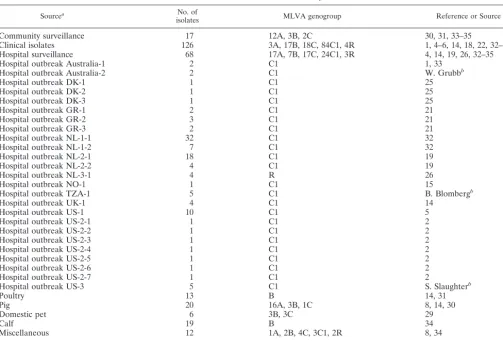
Bacterial isolates.MLVA was performed with 392 isolates, including isolates from clinical sites like blood, urine, and wounds (126 isolates); hospital surveys (68 isolates); 25 different documented hospital outbreaks (111 isolates); commu-nity surveys (17 isolates); and samples from various animals, food, and the environment (70 isolates) (Table 1). Hospital and community survey isolates were derived from fecal samples, and none of these were associated with hospital outbreaks. Hospital outbreak isolates were recovered from clinical sites like blood and urine, as well as from feces. Computer and statistical analyses were performed on all isolates, including one representative isolate from each out-break (306 isolates).
Tandem repeat search.A search for tandem repeats in the unfinished genome
sequence ofE. faeciumpublished on the Internet site of the DOE Joint Genome
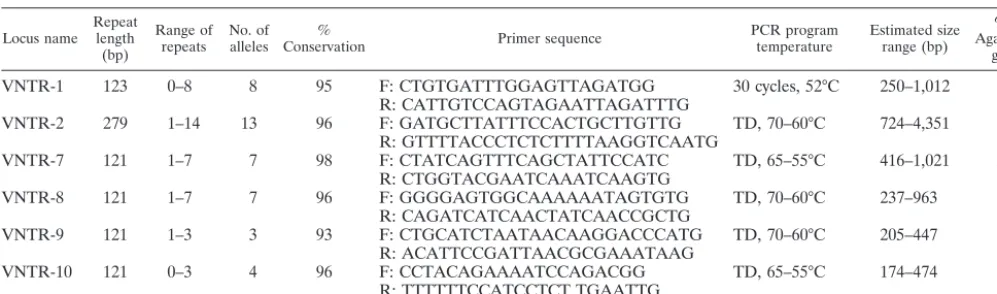
Institute (http://www.jgi.doe.gov/JGI_microbial/html/index.html) was performed using the program repeat finder (http://tandem.bu.edu). From the list of tandem repeats, a selection of 10 different loci was made. This selection was based on the following criteria: (i) minimum repeat size of 20 bp, allowing differentiation of the polymorphic VNTR loci by size on agarose gels, (ii) conservation between the tandem repeats (⬎90%), and (iii) presence in noncoding regions. Initially the 10 VNTR loci were tested on a set of 72 isolates from different origins designated VNTR-1 to VNTR-10. Eventually, six VNTR loci were used and their charac-teristics are listed in Table 2.
DNA preparation and VNTR PCR.Bacterial isolates were grown overnight on Columbia blood agar plates. Three colonies of bacterial cells were suspended in 20l of lysis buffer (0.25% sodium dodecyl sulfate, 0.05 N NaOH) and incubated at 95°C for 5 min. The cell lysate was spin by short centrifugation and diluted with 180l of buffer (10 mM Tris-HCl [pH 8.5]). After the lysate was thoroughly
mixed, another centrifugation for 5 min at 16,000⫻gwas performed to remove
cell debris. Supernatants were frozen at⫺20°C until further use.
A total of 2.5l of lysate was used in the PCR. Chromosomal DNA was
extracted from isolates that did not yield a PCR product with the QiaAmp Blood kit (QIAGEN, Inc., Valencia, Calif.) according to the manufacturer’s instruc-tions for gram-positive bacteria, with some minor changes in the lyses of the bacteria. From an overnight culture, 1.5 ml was spin for 2 min, suspended in 200 l of 10 mM Tris–1 mM EDTA (pH 8.0) and 10l of a 50-mg/ml solution of egg white lysozyme (Roche), and incubated at 37°C for 15 min. The bacteria were
lysed by the addition of 30l of 10% sodium dodecyl sulfate and 20l of a
20-mg/ml proteinase K (Merck) solution and subsequently incubated at 65°C for 1 h. Subsequently, the protocol according to the manufacturer’s instructions was used. The PCR conditions were not the same for all of the amplification reaction mixtures (Table 2). In all cases, initial denaturation was at 95°C for 15 min, and a final extension step consisted of 5 min at 72°C. For VNTR-1, 35 cycles, each consisting of 30 s at 94°C, 30 s at 52°C, and 30 s at 72°C, were performed. For VNTR-2, VNTR-8, and VNTR-9, a touchdown (TD) PCR was used that in-cluded 10 cycles, each consisting of 30 s at 94°C, 30 s at 70°C down to 60°C, and 30 s at 72°C. The annealing temperature during the first cycle was 70°C and decreased 1°C at each cycle during the next nine cycles. During the remaining 25 cycles, an annealing temperature of 60°C was used. For VNTR-7 and VNTR-10, the initial annealing temperature was 65°C and was decreased to 55°C. Reactions
were performed in 25-l volumes with HotStarTaqpolymerase and HotStar
[image:2.603.46.549.79.426.2]master mix buffers from QIAGEN. PCR fragments were separated on 1 or 2% agarose gels with a 50-bp, 100-bp, or 1-kb ladder as a size marker (Invitrogen) (Table 2).
TABLE 1. Isolates used in this study
Sourcea No. of
isolates MLVA genogroup Reference or Source
Community surveillance 17 12A, 3B, 2C 30, 31, 33–35
Clinical isolates 126 3A, 17B, 18C, 84C1, 4R 1, 4–6, 14, 18, 22, 32–35
Hospital surveillance 68 17A, 7B, 17C, 24C1, 3R 4, 14, 19, 26, 32–35
Hospital outbreak Australia-1 2 C1 1, 33
Hospital outbreak Australia-2 2 C1 W. Grubbb
Hospital outbreak DK-1 1 C1 25
Hospital outbreak DK-2 1 C1 25
Hospital outbreak DK-3 1 C1 25
Hospital outbreak GR-1 2 C1 21
Hospital outbreak GR-2 3 C1 21
Hospital outbreak GR-3 2 C1 21
Hospital outbreak NL-1-1 32 C1 32
Hospital outbreak NL-1-2 7 C1 32
Hospital outbreak NL-2-1 18 C1 19
Hospital outbreak NL-2-2 4 C1 19
Hospital outbreak NL-3-1 4 R 26
Hospital outbreak NO-1 1 C1 15
Hospital outbreak TZA-1 5 C1 B. Blombergb
Hospital outbreak UK-1 4 C1 14
Hospital outbreak US-1 10 C1 5
Hospital outbreak US-2-1 1 C1 2
Hospital outbreak US-2-2 1 C1 2
Hospital outbreak US-2-3 1 C1 2
Hospital outbreak US-2-4 1 C1 2
Hospital outbreak US-2-5 1 C1 2
Hospital outbreak US-2-6 1 C1 2
Hospital outbreak US-2-7 1 C1 2
Hospital outbreak US-3 5 C1 S. Slaughterb
Poultry 13 B 14, 31
Pig 20 16A, 3B, 1C 8, 14, 30
Domestic pet 6 3B, 3C 29
Calf 19 B 34
Miscellaneous 12 1A, 2B, 4C, 3C1, 2R 8, 34
Total 392
aAbbreviations: DK, Denmark; GR, Greece; NL, The Netherlands; NO, Norway; TZA, Tanzania; UK, United Kingdom; US, United States.
bPersonal communication.
on May 15, 2020 by guest
http://jcm.asm.org/
Computer analysis of MLVA data.An MLVA profile was created from the number of repeats for each of the VNTR loci. For each MLVA profile, an MT was assigned. Clustering of the MLVA profiles was performed with BioNumerics software (version 3.5; Applied Maths) by the unweighted pair group method using arithmetic averages (UPGMA) with the categorical coefficient of similarity and with the eBURST algorithm described by Feil et al. (7), initially developed for MLST but also suitable for MLVA. This algorithm is implemented as a Java applet at http://eburst.mlst.net.
Statistics.To compare the discriminatory ability of MLVA, MLST, and AFLP,
Simpson’s index of diversity (D) and 95% confidence intervals (CI) were
calcu-lated for 78 isolates typed by MLST, MLVA, and AFLP according to the formulas described by Grundmann et al. and Hunter et al. (11, 13). To determine
whether MLVA was able to identifyE. faecium genotypes belonging to the
epidemic MLST-C1 genogroup, the sensitivity and specificity of MLVA were calculated with a set of 291 isolates. In addition, positive and negative predictive values (PPVs and NPVs) of different MLVA profile combinations were calcu-lated to determine to what extent isolates belonging to the MLST-C1 genogroup were identified.
Isolate characterization using MLVA via the Internet.Comparable to the MLST Internet site (http://www.mlst.net), an Internet site has been developed
for theE. faeciumMLVA scheme (http://www.mlva.umcutrecht.nl). Through this
site, submission of MLVA profiles and assignment of MLVA types are possible. Furthermore, a database with MLVA profiles and strain information can be queried.
RESULTS
Characteristics of VNTR loci.An MLVA scheme for the
molecular typing ofE. faeciumwas developed. All 10 VNTR loci were initially tested with a set of 72 isolates of different origins. PCRs were performed on crude bacterial lysate with the exception of the VNTR-2 PCR, which was also performed on QiaAmp-purified DNA. None of the 10 VNTR PCRs yielded PCR products when E. faecalisDNA was used as a template. Four of the 10 VNTR loci were unsuitable for typing purposes, due to insufficient polymorphism (one locus) and absence in a number of isolates (three loci). The remaining six VNTR loci were used to type the entire strain set. None of the six VNTR loci were found within open reading frames, and they were present on different contigs of the preliminary ge-nome sequence, indicating that the six VNTR loci are probably scattered over the chromosome. The repeat size of the six VNTR loci ranged from 121 to 279 bp, and the number of alleles ranged from 3 for VNTR-9 up to 13 for VNTR-2 (Table 2). The percentage of sequence conservation of the repeats was above 90% for each VNTR locus.
Genogrouping of MLVA profiles.MLVA typing of 392
iso-lates resulted in 127 different MTs. An UPGMA clustering of
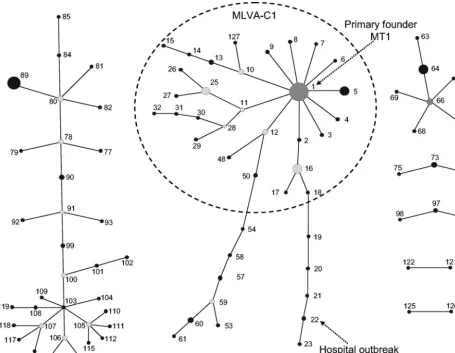
the MLVA profiles revealed the existence of five MLVA geno-groups (A, B, C, C1, and R) (Fig. 1). Isolates within each group shared repeat numbers in at least two of the six loci (⬎33%). Naming of the MLVA genogroups was based on MLST and AFLP classifications (12, 34). The majority of isolates (74%) clustered similarly when typed by either MLVA, MLST, or AFLP (Fig. 1). With MLVA, the majority of community survey isolates (12 of 17) and pigs (16 of 20) clustered in genogroup A. Isolates from poultry (13 of 13) and calf (19 of 19) clustered in genogroup B, clinical infection isolates (102 of 126) clus-tered in genogroups C and C1, and all but 1 hospital outbreak isolate (24 of 25) clustered in genogroup C1. The hospital survey isolates were proportionally represented among geno-groups A (17 isolates), B (7 isolates), C (17 isolates), and C1 (24 of 68 isolates). Finally, a small number of isolates of mis-cellaneous origin clustered in genogroup R (Table 1). The UPGMA clustering of MLVA profiles confirmed clustering of isolates that belonged to the MLST-C1 group (12 isolates) into one MLVA-C1 group with the exception of a single hospital outbreak clone, NL-3-1 (MT-22) (Table 1 and Fig. 1). In ad-dition, three outbreaks—GR-3 (MT-5), NL-2-2 (MT-25), and US-1 (MT-1)—that did not cluster in the epidemic C1 geno-group by MLST (data not shown) geno-grouped within the MLVA-C1 cluster. UPGMA clustering was used to assess the genetic relationship of MLVA profiles and to define and com-pare genogroups by MLST and AFLP. UPGMA was not suit-able for obtaining insight in the evolutionary descent of E. faeciumMTs. For this purpose, the eBURST algorithm was used. eBURST was originally developed for the analysis of large MLST data sets to reveal biologically meaningful clusters of sequence types and patterns of evolutionary descent from predicted founder types (7). As both MLST and MLVA pro-files are based on a combination of numbers, eBURST should also be suitable for cluster analysis of MLVA profiles (Fig. 2). In Fig. 2, the dotted circle surrounds all MLVA profiles be-longing to the MLVA-C1 genogroup based on UPGMA clus-tering except for MT-33, MT-34, MT-35, and MT-37, which are double-locus variants and therefore not connected to the MLVA-C1 complex. The eBURST clustering suggested that MT-1 is the primary founder of the other MLVA-C1 types. In the MT-1 group, 12 of the 25 documented hospital outbreak isolates, 36 clinical infection isolates, and 12 hospital survey isolates were found. These 60 isolates originated from
geo-TABLE 2. VNTR characteristics and specific primers used in MLVA
Locus name Repeatlength
(bp)
Range of
repeats No. ofalleles Conservation% Primer sequence PCR programtemperature Estimated sizerange (bp)
% Agarose
gel
VNTR-1 123 0–8 8 95 F: CTGTGATTTGGAGTTAGATGG 30 cycles, 52°C 250–1,012 2
R: CATTGTCCAGTAGAATTAGATTTG
VNTR-2 279 1–14 13 96 F: GATGCTTATTTCCACTGCTTGTTG TD, 70–60°C 724–4,351 1
R: GTTTTACCCTCTCTTTTAAGGTCAATG
VNTR-7 121 1–7 7 98 F: CTATCAGTTTCAGCTATTCCATC TD, 65–55°C 416–1,021 2
R: CTGGTACGAATCAAATCAAGTG
VNTR-8 121 1–7 7 96 F: GGGGAGTGGCAAAAAATAGTGTG TD, 70–60°C 237–963 2
R: CAGATCATCAACTATCAACCGCTG
VNTR-9 121 1–3 3 93 F: CTGCATCTAATAACAAGGACCCATG TD, 70–60°C 205–447 2
R: ACATTCCGATTAACGCGAAATAAG
VNTR-10 121 0–3 4 96 F: CCTACAGAAAATCCAGACGG TD, 65–55°C 174–474 2
R: TTTTTTCCATCCTCT TGAATTG
on May 15, 2020 by guest
http://jcm.asm.org/
[image:3.603.44.543.80.227.2]on May 15, 2020 by guest
http://jcm.asm.org/
FIG.
1.
UPGMA
clustering
of
the
127
dif
ferent
MLVA
pro
files
with
a
categorical
similarity
coef
ficient.
For
each
MT,
the
number
of
isolates,
MLST
sequence
types,
MLST
and
AFLP
genogroups,
and
MLVA
pro
file
are
depicted.
C1,
epidemic
isolates
(24
of
25
isolates);
C
and
C1,
clinical
infection
(102
of
126
isolates);
B,
calf
(19
of
19
isolates)
and
poultry
(13
of
13
isolates);
A,
community
survey
(12
of
17
isolates)
and
pigs
(16
of
20
isolates).
A
(17
isolates),
B
(7
isolates),
C
(17
isolates),
and
C1
(24
of
68
isolates),
hospital
survey;
R,
miscellaneous
origin.
on May 15, 2020 by guest
http://jcm.asm.org/
[image:5.603.46.538.71.710.2]graphically widespread regions (the United States, Europe, Israel, Tanzania, and Brazil).
Comparing the level of discrimination of MLVA, MLST,
and AFLP.The discriminatory ability of MLVA, MLST, and
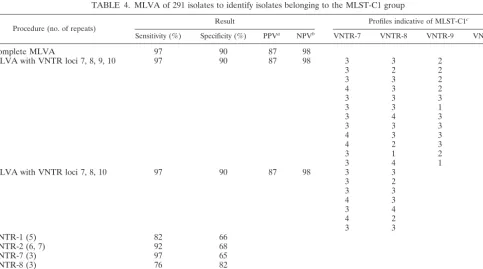
AFLP was determined and compared by calculating the ge-netic diversity (D) with 95% CIs of 78 isolates typed by all three methods. MLVA showed the same level of discrimina-tion as MLST and AFLP (Table 3). When the D values of different combinations of VNTR loci and the complete MLVA scheme of 291 isolates were compared to MLST, the genetic diversity of MLST and the complete MLVA were comparable. The D value of MLVA based on combinations of a limited number of VNTR loci was lower (Table 3). One exception was the combination of VNTR loci 1, 7, 8, and 10, in which the 95% CI of the genetic diversity of this profile just overlapped with that of MLST. Using MLST as a reference, sensitivities of individual VNTR loci and profiles of different VNTR loci combinations to identify isolates that belong to the MLST-C1 cluster ranged from 76% for typing based on VNTR-8 to 97% for MLVA of the complete set of loci. Remarkably, 97% of the MLST-C1 isolates appeared to have three repeats for VNTR-7. The specificity for VNTR-7 was the lowest 65%, but increased to 90% for MLVA on the complete set of loci and
for MLVA with combinations of VNTR loci 7, 8, and 9 or VNTR-7, VNTR loci 8, 9, and 10 (Tables 3 and 4). The PPVs and NPVs to identify the MLST-C1 cluster were calculated for the complete MLVA profile and for a combination of either VNTR loci 7, 8, 9, and 10 or VNTR loci 7, 8, and 10. The PPV was 87% and the NPV was 97% for all three VNTR locus combinations analyzed (Table 4).
Stability of tandem repeats in outbreaks and in vitro.To
[image:6.603.65.521.71.424.2]analyze the stability of MLVA profiles, MLVA profiles of isolates recovered during two related outbreaks in the years 2000 to 2003 were determined. The collection comprised 32 isolates collected during hospital outbreak NL-1-1 and 18 iso-lates collected during hospital outbreak NL-2-1. With the ex-ception of two isolates, all isolates from both outbreaks were shown to have MT-16. One patient carried the outbreak strain for more than 2 years. The MLVA profiles of the isolates recovered from this patient remained unchanged (data not shown). These data suggest that MLVA profiles are stable among strains that are recovered during a hospital outbreak. Two patients from outbreak NL-2-1 acquired colonization with a VREF belonging to MT-17, which is a single-locus variant of MT-16, in which VNTR-1 changed from five to six repeats. The stability of the MLVA profiles in vitro was determined by
FIG. 2. eBURST clustering of the 127 different MLVA profiles. In the eBURST algorithm, each MT is represented as a node (solid black dot). For clarity, only clusters or clonal complexes of related MTs are depicted. Dark-gray dot, primary founder. Light-gray dots, subgroups or secondary founders. The clinical relevant genogroup MLVA-C1 based on the UPGMA clustering is surrounded with a dotted circle.
on May 15, 2020 by guest
http://jcm.asm.org/
repeated subculturing of various isolates with a known MLVA profile; no change in MLVA profiles was observed in any case (data not shown).
DISCUSSION
The availability of a fast, reproducible, cheap, and highly discriminatory bacterial typing method is essential for hospital epidemiology. MLVA is a typing technique that combines
these characteristics and has been used to type and study the transmission of various bacterial species (16, 28). In this study, we have developed an MLVA typing scheme for E. faecium and compared its discriminatory ability to that of AFLP and MLST. The data presented here show that MLVA is extremely useful for studying the genetic relatedness ofE. faecium iso-lates. Furthermore, MLVA can be used to study the local and global epidemiology ofE. faecium.
The comparison of Simpson’s index of diversity revealed that MLVA achieved the same degree of discrimination as MLST or AFLP. Moreover, UPGMA cluster analysis of MLVA profiles showed a degree of clustering of isolates in genogroups previously found by AFLP and MLST (12, 34). One specific MLVA genogroup designated MLVA-C1 har-bored the majority of clinical isolates and all but one of the hospital outbreak-associated isolates. This genogroup was highly comparable to the MLST-C1 genogroup, which con-tained epidemic and clinical isolates (12). One hospital out-break did not cluster in both the MLVA-C1 and the AFLP-C genogroup. Isolates from this outbreak clustered together with the other outbreak-associated isolates only by MLST. In con-trast, three other hospital outbreak isolates with three different MLST sequence types that clustered outside the MLST-C1 group did group within MLVA-C1. eBURST confirmed the grouping of clinical relevant isolates in the MLVA-C1 cluster and revealed that MT-1 was the primary founder of this clus-ter. The existence of a cluster of clinical and epidemic E. faeciumisolates was also reported previously (12, 18, 34).
[image:7.603.43.284.88.248.2]We determined the sensitivity, specificity, PPV, and NPV of
TABLE 3. Comparison of Simpson’s index of diversity (D) and 95% CI
Typing method
Isolates typed by: AFLP, MLST, and
MLVAa MLST and MLVAb
D CI D CI
AFLP 0.94 0.90–0.97
MLST 0.94 0.91–0.97 0.96 0.95–0.97
MLVA 0.93 0.90–0.97 0.95 0.92–0.97
VNTR loci 1, 7, 8, 9, 10 0.93 0.91–0.95
VNTR loci 1, 7, 8, 10 0.91 0.89–0.93
VNTR loci 2, 7, 8, 10 0.90 0.87–0.93
VNTR loci 7, 8, 9, 10 0.91 0.89–0.93
VNTR loci 7, 8, 10 0.86 0.83–0.89
VNTR loci 1, 8, 10 0.90 0.88–0.92
VNTR loci 1, 8, 9 0.90 0.88–0.92
VNTR loci 2, 7, 10 0.86 0.82–0.90
aA total of 78 isolates were tested.
bA total of 291 isolates were tested.
TABLE 4. MLVA of 291 isolates to identify isolates belonging to the MLST-C1 group
Procedure (no. of repeats) Result Profiles indicative of MLST-C1
c
Sensitivity (%) Specificity (%) PPVa NPVb VNTR-7 VNTR-8 VNTR-9 VNTR-10
Complete MLVA 97 90 87 98
MLVA with VNTR loci 7, 8, 9, 10 97 90 87 98 3 3 2 3
3 2 2 3
3 3 2 2
4 3 2 3
3 3 3 3
3 3 1 3
3 4 3 3
3 3 3 1
4 3 3 3
4 2 3 3
3 1 2 3
3 4 1 3
MLVA with VNTR loci 7, 8, 10 97 90 87 98 3 3 3
3 2 3
3 3 2
4 3 3
3 4 3
4 2 3
3 3 1
VNTR-1 (5) 82 66
VNTR-2 (6, 7) 92 68
VNTR-7 (3) 97 65
VNTR-8 (3) 76 82
VNTR-9 (2) 79 83
VNTR-10 (3) 93 66
aPPVs are the number of MLST-C1 and MLVA-C1 isolates divided by the number of MLST-C1 and MLVA-C1 plus MLST-nonC1 and MLVA-C1 isolates.
bNPVs are the number of MLST-nonC1 and MLVA-nonC1 negative isolates divided by the number of MLST-nonC1 and MLVA-nonC1 plus MLST-C1 and
MLVA-nonC1 isolates.
cValues are the number of repeats.
on May 15, 2020 by guest
http://jcm.asm.org/
[image:7.603.53.537.421.690.2]MLVA based on combinations of various VNTR loci to iden-tify isolates that belong to the MLST-C1 cluster. It appeared that a single VNTR locus, VNTR-7, yielded the same sensitiv-ity (97%) in identifying genotypes belonging to MLST-C1 as the complete MLVA profile, yet specificity and PPV were rather low (65%). Addition of the VNTR loci 8, 9, and 10 increased specificity to 90% and PPV to 87%, comparable to the complete MLVA profile. Consequently, for rapid screening to identify epidemic isolates, a multistage approach can be used, starting with a single PCR to determine the number of repeats in VNTR-7. Subsequent PCRs with VNTR loci 8, 9, and 10 can confirm the potential epidemic nature of the iso-lates, when the single PCR revealed three repeats for VNTR-7. However, for library typing and study of the epidemiology ofE. faecium, it is recommended that MTs be assigned that based on all six VNTR loci, since the index of diversity decreased strongly when loci were excluded from the full MLVA profile. MLVA of multiple isolates from two hospital outbreaks (NL-1-1 and NL-2-1) (19, 32) were used to analyze the stability of the tandem repeats and thus the MLVA profiles; such anal-ysis is a prerequisite for identifying and studying hospital out-breaks. The first isolates from these outbreaks date from 2000 and were found in patients from the nephrology departments of both hospitals. Most of the patients were hemodialysis pa-tients who came to the hospital on a regular basis and were often treated with antibiotics, including vancomycin. From the 50 isolates collected during a 3-years period, only 2 isolates isolated from two different patients were found to have a divergent MLVA profile. However, this was only due to the addition of a single repeat in one of the six VNTR loci. This means that MLVA profiles generally remain unchanged during hospital outbreaks, demonstrating that MLVA can be used to study local outbreaks.
The MLVA method described in this study is much faster and cheaper than MLST, because it is a PCR-based method that utilizes simple agarose gels for analysis. AFLP is also considered a fast typing method, but the reproducibility and portability of AFLP are problematic. The fact that this MLVA uses agarose gels to detect and size amplicons also makes it an attractive typing method for use in local laboratories to deter-mine patient-to-patient transmission and to identify potential epidemic isolates. MLVA profiles can easily be stored in a database, facilitating the exchange of MLVA typing data through a Web-based database. Therefore, an Internet site (http://www.mlva.umcutrecht.nl) has been developed for the submission of MLVA profiles to assign the MTs. Furthermore, a strain database is available on the Web site, which contains MTs as well as strain characteristics like MLST sequence type, isolate source, and country of isolate origin.
In theE. faeciumMLVA scheme, tandem repeat loci were chosen that, according to the partially annotated E. faecium genome sequence (http://genome.ornl.gov/microbial/efae/), were not located within known open reading frames. There-fore, we assume that changes in repeat numbers are not the result of selective pressure, which means that MLVA data can also be used to study the phylogeny ofE. faecium. However, since the E. faecium genome sequence is not yet annotated completely, we cannot exclude that some of the loci are located within coding or regulatory regions.
In conclusion, we developed a fast, reproducible, cheap, and
portable typing method that can be used as a tool to study the epidemiology of E. faeciumin general and to rapidly detect potential epidemic isolates. We suggest using MLVA as an initial method to screen and typeE. faeciumin hospital labo-ratories. Subsequently, MLVA profiles could be added to a Web-based database for international comparison, and repre-sentative isolates could be subjected to MLST to gain insight into the global epidemiology of particular MLVA profiles.
ACKNOWLEDGMENTS
We thank Jan van Embden (National Institute for Public Health and the Environment) for a critical review of the manuscript, Bob van der Putten for the development of a web-based database on the Internet, and Erik Drenth for hosting the database.
REFERENCES
1. Bell, J. M., J. C. Paton, and J. Turnidge.1998. Emergence of vancomycin-resistant enterococci in Australia: phenotypic and genotypic characteristics
of isolates. J. Clin. Microbiol.36:2187–2190.
2. Bonten, M. J., M. K. Hayden, C. Nathan, T. W. Rice, and R. A. Weinstein. 1998. Stability of vancomycin-resistant enterococcal genotypes isolated from
long-term-colonized patients. J. Infect. Dis.177:378–382.
3. Bonten, M. J., R. Willems, and R. A. Weinstein.2001. Vancomycin-resistant enterococci: why are they here, and where do they come from? Lancet Infect.
Dis.1:314–325.
4. Coque, T. M., R. Willems, R. Canton, R. del Campo, and F. Baquero.2002.
High occurrence ofespamong ampicillin-resistant and
vancomycin-suscep-tibleEnterococcus faeciumclones from hospitalized patients. J. Antimicrob.
Chemother.50:1035–1038.
5. Dunne, W. M., Jr., and W. Wang.1997. Clonal dissemination and colony
morphotype variation of vancomycin-resistantEnterococcus faeciumisolates
in metropolitan Detroit, Michigan. J. Clin. Microbiol.35:388–392.
6. Endtz, H. P., N. van den Braak, A. van Belkum, J. A. Kluytmans, J. G. Koeleman, L. Spanjaard, A. Voss, A. J. Weersink, C. M. Vandenbroucke-Grauls, A. G. Buiting, A. van Duin, and H. A. Verbrugh.1997. Fecal carriage of vancomycin-resistant enterococci in hospitalized patients and those living
in the community in The Netherlands. J. Clin. Microbiol.35:3026–3031.
7. Feil, E. J., B. C. Li, D. M. Aanensen, W. P. Hanage, and B. G. Spratt.2004. eBURST: inferring patterns of evolutionary descent among clusters of re-lated bacterial genotypes from multilocus sequence typing data. J. Bacteriol.
186:1518–1530.
8. Franz, C. M., A. B. Muscholl-Silberhorn, N. M. Yousif, M. Vancanneyt, J. Swings, and W. H. Holzapfel.2001. Incidence of virulence factors and anti-biotic resistance among enterococci isolated from food. Appl. Environ.
Mi-crobiol.67:4385–4389.
9. Goossens, H., D. Jabes, R. Rossi, C. Lammens, G. Privitera, and P. Cour-valin.2003. European survey of vancomycin-resistant Enterococci in at-risk hospital wards and in vitro susceptibility testing of ramoplanin against these
isolates. J. Antimicrob. Chemother.51:(Suppl. S3)iii5–iii12.
10. Grayson, M. L., G. M. Eliopoulos, C. B. Wennersten, K. L. Ruoff, P. C. De Girolami, M. J. Ferraro, and R. C. Moellering, Jr.1991. Increasing
resis-tance to-lactam antibiotics among clinical isolates ofEnterococcus faecium:
a 22-year review at one institution. Antimicrob. Agents Chemother.35:2180–
2184.
11. Grundmann, H., S. Hori, and G. Tanner.2001. Determining confidence intervals when measuring genetic diversity and the discriminatory abilities of
typing methods for microorganisms. J. Clin. Microbiol.39:4190–4192.
12. Homan, W. L., D. Tribe, S. Poznanski, M. Li, G. Hogg, E. Spalburg, J. D. Van Embden, and R. J. Willems.2002. Multilocus sequence typing scheme forEnterococcus faecium. J. Clin. Microbiol.40:1963–1971.
13. Hunter, P. R., and M. A. Gaston.1988. Numerical index of the discrimina-tory ability of typing systems: an application of Simpson’s index of diversity.
J. Clin. Microbiol.26:2465–2466.
14. Jordens, J. Z., J. Bates, and D. T. Griffiths.1994. Faecal carriage and
nosocomial spread of vancomycin-resistantEnterococcus faecium. J.
Antimi-crob. Chemother.34:515–528.
15. Jureen, R., J. Top, S. C. Mohn, S. Harthug, N. Langeland, and R. J. Willems.
2003. Molecular characterization of ampicillin-resistantEnterococcus
fae-ciumisolates from hospitalized patients in Norway. J. Clin. Microbiol.41:
2330–2336.
16. Keim, P., L. B. Price, A. M. Klevytska, K. L. Smith, J. M. Schupp, R. Okinaka, P. J. Jackson, and M. E. Hugh-Jones.2000. Multiple-locus vari-able-number tandem repeat analysis reveals genetic relationships within
Bacillus anthracis. J. Bacteriol.182:2928–2936.
17. Leavis, H., J. Top, N. Shankar, K. Borgen, M. Bonten, J. van Embden, and R. J. Willems.2004. A novel putative enterococcal pathogenicity island
linked to theespvirulence gene ofEnterococcus faeciumand associated with
epidemicity. J. Bacteriol.186:672–682.
on May 15, 2020 by guest
http://jcm.asm.org/
18. Leavis, H. L., R. J. Willems, J. Top, E. Spalburg, E. M. Mascini, A. C. Fluit, A. Hoepelman, A. J. de Neeling, and M. J. Bonten.2003. Epidemic and
nonepidemic multidrug-resistantEnterococcus faecium. Emerg. Infect. Dis.
9:1108–1115.
19. Mascini, E. M., A. C. Gigengack-Baars, R. J. Hene, T. E. Kamp-Hopmans, A. J. Weersink, and M. J. Bonten.2000. Epidemiologic increase of various
genotypes of vancomycin-resistantEnterococcus faeciumin a university
hos-pital. Ned. Tijdschr. Geneeskd.144:2572–2576. (In Dutch.)
20. Murray, B. E.2000. Vancomycin-resistant enterococcal infections. N. Engl.
J. Med.342:710–721.
21. Routsi, C., E. Platsouka, R. J. Willems, M. J. Bonten, O. Paniara, G. Saroglou, and C. Roussos.2003. Detection of enterococcal surface protein
gene (esp) and amplified fragment length polymorphism typing of
glycopep-tide-resistantEnterococcus faeciumduring its emergence in a Greek
inten-sive care unit. J. Clin. Microbiol.41:5742–5746.
22. Schouten, M. A., R. J. Willems, W. A. Kraak, J. Top, J. A. Hoogkamp-Korstanje, and A. Voss.2001. Molecular analysis of Tn1546-like elements in vancomycin-resistant enterococci isolated from patients in Europe shows
geographic transposon type clustering. Antimicrob. Agents Chemother.45:
986–989.
23. Shankar, N., A. S. Baghdayan, and M. S. Gilmore.2002. Modulation of
virulence within a pathogenicity island in vancomycin-resistantEnterococcus
faecalis. Nature417:746–750.
24. Shankar, N., C. V. Lockatell, A. S. Baghdayan, C. Drachenberg, M. S. Gilmore, and D. E. Johnson.2001. Role ofEnterococcus faecalissurface protein Esp in the pathogenesis of ascending urinary tract infection. Infect.
Immun.69:4366–4372.
25. Simonsen, G. S., L. Smabrekke, D. L. Monnet, T. L. Sorensen, J. K. Moller, K. G. Kristinsson, A. Lagerqvist-Widh, E. Torell, A. Digranes, S. Harthug, and A. Sundsfjord.2003. Prevalence of resistance to ampicillin, gentamicin
and vancomycin inEnterococcus faecalisandEnterococcus faeciumisolates
from clinical specimens and use of antimicrobials in five Nordic hospitals. J.
Antimicrob. Chemother.51:323–331.
26. Timmers, G. J., W. C. van der Zwet, I. M. Simoons-Smit, P. H. Savelkoul, H. H. Meester, C. M. Vandenbroucke-Grauls, and P. C. Huijgens.2002.
Outbreak of vancomycin-resistantEnterococcus faeciumin a haematology
unit: risk factor assessment and successful control of the epidemic. Br. J.
Haematol.116:826–833.
27. Toledo-Arana, A., J. Valle, C. Solano, M. J. Arrizubieta, C. Cucarella, M. Lamata, B. Amorena, J. Leiva, J. R. Penades, and I. Lasa.2001. The
en-terococcal surface protein, Esp, is involved inEnterococcus faecalisbiofilm
formation. Appl. Environ. Microbiol.67:4538–4545.
28. van Belkum, A., S. Scherer, L. van Alphen, and H. Verbrugh.1998. Short-sequence DNA repeats in prokaryotic genomes. Microbiol. Mol. Biol. Rev.
62:275–293.
29. van Belkun, A., N. van den Braak, R. Thomassen, H. Verbrugh, and H. Endtz.1996. Vancomycin-resistant enterococci in cats and dogs. Lancet
348:1038–1039.
30. van den Bogaard, A. E., P. Mertens, N. H. London, and E. E. Stobberingh. 1997. High prevalence of colonization with vancomycin- and pristinamycin-resistant enterococci in healthy humans and pigs in The Netherlands: is the addition of antibiotics to animal feeds to blame? J. Antimicrob. Chemother.
40:454–456.
31. van den Bogaard, A. E., R. Willems, N. London, J. Top, and E. E. Stobber-ingh.2002. Antibiotic resistance of faecal enterococci in poultry, poultry
farmers and poultry slaughterers. J. Antimicrob. Chemother.49:497–505.
32. van der Steen, L. F., M. J. Bonten, E. van Kregten, J. J. Harssema-Poot, R. Willems, and C. A. Gaillard.2000. Vancomycin-resistantEnterococcus
fae-ciumoutbreak in a nephrology ward. Ned. Tijdschr. Geneeskd.144:2568–
2572. (In Dutch.)
33. Willems, R. J., W. Homan, J. Top, M. Santen-Verheuvel, D. Tribe, X. Man-zioros, C. Gaillard, C. M. Vandenbroucke-Grauls, E. M. Mascini, E. van Kregten, J. D. Van Embden, and M. J. Bonten.2001. Variantespgene as a
marker of a distinct genetic lineage of vancomycin-resistantEnterococcus
faeciumspreading in hospitals. Lancet357:853–855.
34. Willems, R. J., J. Top, N. van den Braak, A. van Belkum, H. Endtz, D. Mevius, E. Stobberingh, A. van Den Bogaard, and J. D. van Embden.2000.
Host specificity of vancomycin-resistantEnterococcus faecium. J. Infect. Dis.
182:816–823.
35. Willems, R. J. L., J. Top, N. van den Braak, A. van Belkum, D. J. Mevius, G. Hendriks, M. van Santen-Verheuvel, and J. D. van Embden.1999. Molecular
diversity and evolutionary relationships of Tn1546-like elements in
entero-cocci from humans and animals. Antimicrob. Agents Chemother.43:483–
491.