ROAR, the University of East London Institutional Repository:
This paper is made available online in accordance with publisher policies. Please
scroll down to view the document itself. Please refer to the repository record for this
item and our policy information available from the repository home page for further
information.
To see the final version of this paper please visit the publisher’s website.
Access to the published version may require a subscription.
Author(s):
Hossein Jahankhani, M. Yarandi, A.R. Tawil
Article Title:
An adaptive mobile learning system for learning a new language
based on learner’s abilities
Year of publication:
2011
Citation:
Jahankhani, H., Yarandi, M., Tawil, A.R.. (2011) ‘An adaptive mobile
learning system for learning a new language based on learner’s abilities',
Proceedings of the
University of East London, January 2011, ISBN: 978-0-9564747-1-1
Information on how to cite items within roar@uel:
An adaptive mobile learning system for learning a new language based on
learner’s abilities
Hossein Jahankhani, M. Yarandi, A. R.Tawil, School of Computing Information Technology and Engineering
University of East London
[email protected], [email protected],
Abstract:The rapid development of wireless infrastructure and wide use of mobile devices in our daily life has a major impact on our way of learning using computing technology. Particularly, learning a new language is a challenging concept for researcher. Furthermore, adaptive services is nowadays an important research topic in the field of web-based and mobile learning systems as there are no fixed learning path which are appropriate for all learners. However, most studies in this field have only focus on learning style and habits of learners. Far too little attention has been paid on the ability of learner. Therefore, the purpose of this paper is to propose a new adaptive mobile learning model for learning new languages based on ability of learner. Furthermore, an ontology-based knowledge modelling technique is proposed to classify language learning materials and describe user profile in order to provide adaptive learning environment.
Keywords: adaptive system, personalised learning, mobile learning, Item response theory, language learning
Introduction
Mobile learning is the flexible way to teach a new language as it is readily accessible, anywhere, anytime and ubiquitous which makes learning a rewarding lifelong process.(Sharples, 2000). Learning a new language effectively is a challenging and continuous process which involves learning correct pronunciation, grammar and vocabulary and includes a lot of repetitions. Having considered the facts above, mobile learning has many advantages over traditional learning. As a result, many mobile learning systems have been successfully developed to aid language learning. However, most of them support statistic content which is not adapted to the specific learners.
Additionally, the concept of adaptive technology is increasingly developed in learning environment. In order to design a strong adaptive learning environment, we need to enable delivery learning content according to needs of learners. Most learning system usually ignore personalisation feature such as difference in learning style, knowledge level, needs and so on and they deliver same learning content to every learner. However, recent developments of semantic web technologies have shown a trend of using ontology to promote adaptive learning services.
Ontology is widely recognised as a main mean of modelling digital collections and user context. Its main purpose is to present knowledge within specific domain. They can also be used for the refinement of query. Ontology is also capable of modelling concepts and relationships to a high level of abstraction. They provide rich semantics information to perform automatic processing and reasoning by computer.
State of art
Learning a new language gives the learners the ability to communicate and understand other people in the world for different purposes such as education, business, learning a new culture and so on. On the other hand, nowadays, learning environment is supported by computer and internet technologies. Furthermore, providing adaptive contents based on learner’s characteristics are important for the learners. Thus, there are several approaches to develop an adaptive mobile learning system to teach a new language. However, most mobile learning systems do not consider designing adaptive test and adapting them to the learner’s ability and also using the ontology for modelling the user profile as well as learning materials. Paredes et al demonstrate an approach to design a language learning system outside the classroom with handhelds for learning Japanese language for foreign students in Japan and English as a second language for Japanese students. The aim of this project is to integrate the information obtained in class and the needs of the learners in their daily life. Lu (2008) conducted a research on the effectiveness of vocabulary learning via mobile phone in Taiwan. One of the most interesting findings of this research was that high frequency of brief SMS reading has a significant effect on improving learning vocabulary. Not surprisingly, the author points out that the frequency of reading SMS lessons were reported by the students. Therefore the validity of the result may be influenced by the students’ unfairness. Chen et al (2008) exhibit another approach to develop an adaptive learning. They presented a personalised e-learning system using item response theory which provides personalised learning according to difficulty parameters of course materials and learners’ responses (Chen, Lee, & Chen, 2005). They proposed some personalised learning systems namely personalised curriculum sequencing during learning processes(Chen, 2008), a personalised intelligent mobile learning system (PIMS) to promote the reading ability of English news for individual learners (Chen & Hsu, 2008). They also have proposed a personalised mobile learning system to learn English vocabulary for non English speakers using Item Response theory and learning memory cycle. Baylari et al have presented a personalised multi-agent e-learning system which presents adaptive tests and acts as a human instructor and gives the learners a friendly and personalised teaching environment (Baylari & Montazer, 2009).
Nowadays, by rapid developing in semantic web technologies, some researchers are involved to find new ways to design adaptive learning systems based on presenting knowledge by ontology. Pan el al, Henze et al and Jovanovic et al used ontology to model user profile in developing adaptive e-learning system (Henze, Dolog, &
Nejdl, 2004; Jovanović, et al., 2006; Pan, Zhang, Wang, & Wu, 2007). Golemati et al create a general ontology
to model user profile which able to adapt to every applications (Golemati, Katifori, Vassilakis, Lepouras, & Halatsis, 2007). Gemmis et al proposed an extension of the vector space retrieval model in which user profiles learned by a content-based recommender system (Gemmis, Semeraro, Lops, & Basile, 2008). Al-Mekhlafi et al present a different approach to Context-aware Mobile Chinese Language Learning for foreign students (CAMCLL) with a context model including location, time, activity and learner’s level context. The specific feature of proposed approach is to combine the ontology-based matching and rule-based reasoning in order to build context matching. The ontology is used to understand the location and activity context and rule-based reasoning determine suitable sentences according to quantitative variable like time and learner's level. Authors conclude that the CAMCLL system can implement and test in the future (AL-MEKHLAFI, HU, & ZHENG, 2009).
This paper proposes a novel approach to design an adaptive mobile learning system applied for learning a new language in which learner’s ability is estimated during the learning process according to the item response theory. In our system the ontological user profile is updated based on new learner’s ability. The other strength of the present approach is using ontology technique to classify language learning materials.
Item response theory
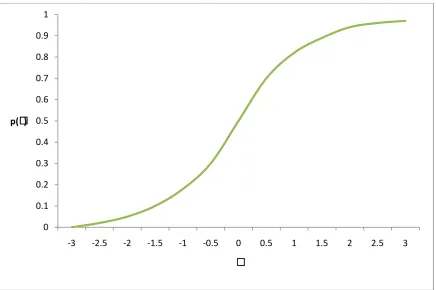
The purpose of item response theory is to estimate the ability of examinees based on their response to the test items. (Wang, 2006) The items are dichotomously scored. It means that, examinee gets one for correct answer and zero for incorrect answer. Furthermore, in each level of ability, there will be a probability that an examinee with this ability response correctly to this item. (There will be the probabilities of giving the correct answer across different levels of ability.) Item Characteristic Curve (ICC) presents the relationship between probabilities and abilities as shown in figure 1. (Yu, 2007)
Each item in test has its own Item characteristic curve. However, the shape of classic Item Characteristic Curve is s-shape. The Item Characteristic Curve is the basic building block of Item Response Theory and other component of theory builds on this curve. (Baker, 2001)
[image:4.612.84.521.253.543.2]Item Characteristic Curve has two technical attribute. The first is the difficulty of an item which describes the position of ICC in relation to the ability scale (Hambleton, Swaminathan, & Rogers, 1991) and the second is discrimination parameter which discriminates between high-proficient examinee and less-proficient examinee. (Yu, 2007) The slope of Item Characteristic Curve reflects the discrimination parameter. (Baker, 2001)The steeper curve demonstrates a much better discrimination than the flatter curve.
Figure 1: Item Characteristic Curve
There are three common mathematical models for Item Characteristic Curve according to the number of parameters in logistic function; one Parameter Logistic function (1PL), Two Parameter Logistic function (2PL) and Three Parameter Logistic function (3PL) models. In the 1PL model each item i is characterised by only one parameter. Based on this model, only the difficulty parameter can take on different values. The equation for this model is given by the following:
(1)
0 0.1 0.2 0.3 0.4 0.5 0.6 0.7 0.8 0.9 1
-3 -2.5 -2 -1.5 -1 -0.5 0 0.5 1 1.5 2 2.5 3 p()
Where:
bi is the difficulty parameter of item i θ is the ability level of examinee
P(θi) is the probability that examinee with ability θ can responses correctly to the item i.
In the 2PL model, another parameter called discrimination degree ai is added into the item characteristic function. The equation for this model is given by the following:
(2)
One of the facts of life in testing is that examinees will get items correct by guessing. Thus, a guess degree ci is added to the 2PL model and resulting model has become known as the 3PL model. The equation for the 3PL model is:
(3)
Item Response Theory is used in the computerised adaptive test to determine the best items for examinees based on their individual abilities. Currently, the CAT concept has been successfully used in many real applications such as GMAT, GRE and TOEFL.
System architecture
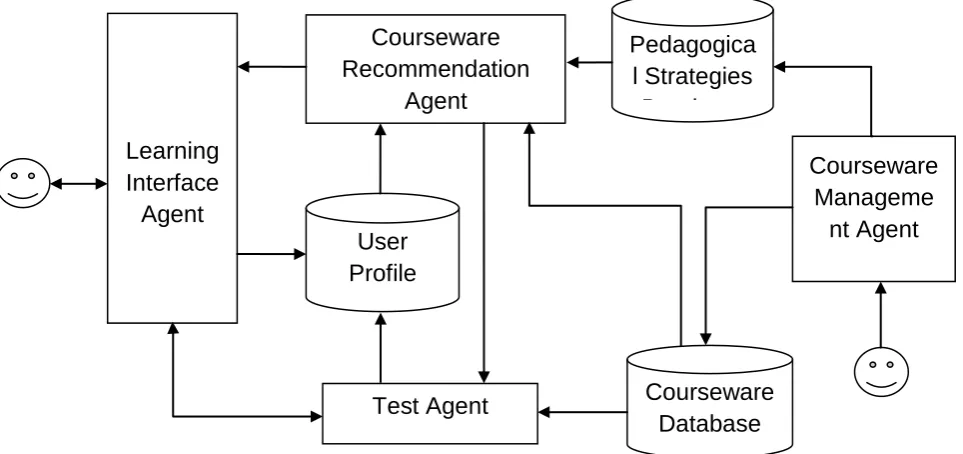
Figure 2 illustrates the architecture of proposed agent-based adaptive mobile learning system. The proposed system contains four agents, namely user interface agent, course recommendation agent, test agent and courseware management agent.
The user interface has a friendly communication with learners. It transfers user characteristic to user profile, returns the recommended courseware from recommendation agent to learners, transfers the test from test agent to learner and returns the response of learner to test agent.
The course recommendation agent selects suitable courseware from courseware database based on pedagogical rules and ontological user profiles and proposes it to learner through user interface.
The test agent extracts user ability from user profile and selects appropriate test based on this ability and presents it to learner through user interface. Then this agent gets the learner’s response. According to the learner’s response and based on item response theory, the learner’s ability will be re-evaluated. Finally, it will be updated in the ontological user profile.
For a beginner learner, the user interface agent performs a registration process. During this process the general and educational characteristics of the learner are taken and recorded to the ontology base user profile.
The courseware management agent provides a friendly interface for instructor in order to insert, delete and modify course wares and pedagogical. Each course ware contains different learning contents, relationship between them and testing items related to learning content. Each learning contents has learning objective. According to these learning objectives, the instructor design testing items for each learning content. The difficulty parameters of these testing items are determined based on IRT. After that, designed courseware is stored in the course ware database through the courseware management agent.
Figure 2: the architecture of adaptive mobile learning system
Test Calibrated Process
In order to measure the learner’s ability accurately Bloom suggested a system of classification based on levels of intellectual behaviour. This classification is called Bloom’s Taxonomy. Today, educators implement Bloom’s taxonomy to design tests and assess the degree of learning by assuring that their tests follow the criteria offered by Bloom (Krathwohl, 2002).
In the first step of the test calibration, several experienced instructor were invited as courseware expert. The expert instructors analyse the learning contents, specify learning objectives for each learning contents and design suitable multiple choice items according to the learning objective at the level of remembering and understanding based on the Bloom’s Taxonomy. After that, every item will be assigned to a group of examinees and the examinees’ responses are dichotomously scored. It means that, the examinee gets one for the correct answer and zero for an incorrect answer. Then mathematical procedures are applied to the item response data by the BILOG program to obtain the value of the item parameters under 3PL model and the ability parameters of the examinees. In this stage, collaborated items are created. Then the test instructor designs a few appropriate tests consisting of 10 items at each ability level. These tests are constructed for each ability scale and will be stored in the ontological courseware database.
Estimation of learner’s ability
In order to estimate the ability of the learner which is an unknown value we can assume that all the numerical parameters of the items in the test is known. The direct result is that the scale of the measurement is the same as the scale of the parameters in the item. After taking the exam and the response of the examinee to all the items are received, the items are dichotomously scored. This means that, the examinee gets one for the correct answer and zero for the incorrect answer. Hence, we will have a response pattern (U1,U2,U3,....,Uj,....,Un) which is called item response vector, where Uj=1 represents a correct answer given by the examinee where this is for the jth item in the test. On the contrary, Uj=0 represents an incorrect answer given by the examinee for the jth item in the test. After that, the maximum likelihood estimator (MLE) is applied to effectively estimate item parameter and examinee’s abilities (Hambleton et al 1991). Bock and Mislevy derived the quadrature form to estimate learner ability (Baker, 1992). This formula is as follow:
(4)
Courseware
Recommendation
Agent
Learning
Interface
Agent
Test Agent
User
Profile
Courseware
Database
Courseware
Manageme
nt Agent
Pedagogica
Where θ is the estimation of the ability of the examinee, is the value of likelihood function and A(θ) represents the quadrature weight at a level below the examinee’s ability.
The likelihood function has been calculated as follows:
(5)
Where Pi(θ) denotes the probability that examinee responds correctly to the ith item at a level below ability level θ, Qi(θ)= 1- Pi(θ) represents the probability that the examinee responds incorrectly to the ith item at a level below the ability level θ, ui=1 if the answer of ith is correct and ui=0 if the answer of ith is incorrect (Chen & Chung, 2008).
Adaptive system
[image:7.612.94.536.354.689.2]A key technical problem in developing adaptive learning systems is the issue of how to build precise and complete user profile for individual learners and how these can be used to recognise a learner and describe his or her behaviour. In the proposed system, domain ontologies are used to model user profiles and to categorise content. It also provides a language learning course, capable to provide adaptive mobile learning environment. The class hierarchy of the proposed ontology is shown in figure 3.
The Courseware class are used to describe the complex language learning course. Metadata is essentially used to describe courseware. In specific, it provides information about the language which is taught by the courseware and its suitability for different learners at different levels and age group. A courseware consists of several sections which has some lessons and review test. Based on the result of review tests, the designed system recommends learners to review the prior learning stages or to go to the next stage. In particular, hasLesson property points to the set of Lessons that compose a section.
The Lesson class comprise the knowledge about different skills of learning language. This class contains data type properties LessonName for the identifier of the class, LessonDescription for describing the class and LessonObjective points a set of objectives that should be achieved after studying the lesson. It also contains object properties in order to have a relation with other classes. The hasSkill property points to the collection of Skills which has a SkillType property in order to represent Listening, Speaking, Reading and Writing skill for each Skill class. Finally, each Skill possesses different Activities with a simple, moderate or advanced difficulty level and also each activity has a Suggested time for doing this activity. Based on the ability of the leaner and the description in each Skill a suitable activity for the learner is chosen.
The learner classes contain all the user profile characteristics. They may be simple types such as name and age or may be instances of other ontology classes like Ability or Language.
The learner’s ability will be considered by proposing an adaptive learning system to the learners with different abilities and backgrounds in the realm of new language learning. The proposed system will also monitor learners at each step of language learning to ensure that specific objective has been made prior to the next part of learning. Moreover, selecting the difficulty level of next activities for a particular learner is based on the result of prior activities and comparison of the elapsed time by learner and suggested time by computer. Moreover, in order to estimate the learner’s ability, the results of some technical pre-test and regular activities are fed into Item response Theory formulas and the output of the formulas are saved in the user profile. Based on the information in the user profile, appropriate contents are provided to the learner. Note that the proposed intelligent learning system is a self adaptive system which will automatically be updated based on the result of regular activities given by the learner at different stages of the learning.
Conclusion
In present paper, we propose a mobile learning architecture for learning a new language, which creates adaptive contents for mobile learners based on ability of learners. Ontology-based model is used to describe user profile and also to categorise language learning material in 5 levels of hierarchical classes namely courseware, section, lesson, part and activity. This modelling can facilitate determination of the choice of the next stage of learning process. The response of the learner to pre, post and review test is fed to the item response theory formula and the new ability of learner is evaluated. After that, the progress from one stage of learning process to the next stage is determined based on the new ability of learner. It also selects the difficulty level of new activities according to the result of the prior activities. We have shown that the presented mobile learning system can provide more efficient language learning compared to previous works.
References
AL-MEKHLAFI, K., HU, X., & ZHENG, Z. (2009, June 27-June 28).
An Approach to Context-Aware
Mobile Chinese Language Learning for Foreign Students.
Paper presented at the 2009
Eighth International Conference on Mobile Business, Washington, DC, USA.
Baker, F. B. (1992).
Item Response theory: Parameter estimation techniques
. New York: Marcel
Dekker.
Baker, F. B. (2001).
The basics of item response theory
(2 ed.). Washington: ERIC clearing house on
assessment and evaluation.
Baylari, A., & Montazer, G. A. (2009). Design a personalized e-learning system based on item
response theory and artificial neural network approach.
Expert Systems with Applications,
Chen, C.-M. (2008). Intelligent web-based learning system with personalized learning path
guidance.
Computers & Education, 51
(2), 787-814.
Chen, C.-M., & Chung, C.-J. (2008). Personalized mobile English vocabulary learning system based
on item response theory and learning memory cycle.
Computers & Education 51
(2),
624-647.
Chen, C.-M., & Hsu, S.-H. (2008). Personalized Intelligent Mobile Learning System for Supporting
Effective English Learning.
Educational Technology & Society, 11
(3), 153-180.
Chen, C.-M., Lee, H.-M., & Chen, Y.-H. (2005). Personalised e-learning system using item response
theory.
Computers & Education, 44
(3), 237 - 255.
Gemmis, M. d., Semeraro, G., Lops, P., & Basile, P. (2008).
A Retrieval Model for Personalized
Searching Relying on Content-based User Profiles
. Paper presented at the Association for
the Advancement of Artificial
Intelligenc
Golemati, M., Katifori, A., Vassilakis, C., Lepouras, G., & Halatsis, C. (2007).
Creating an Ontology
for the User Profile: Method and Applications.
Paper presented at the In Proceedings of
the First IEEE International Conference on Research Challenges in Information Science
(RCIS), Morocco.
Hambleton, R. K., Swaminathan, H., & Rogers, H. J. (1991).
Fundamentals of Item Response Theory
(1 ed.). London: Sage publications, the International Professional Publishers.
Henze, N., Dolog, P., & Nejdl, W. (2004). Reasoning and Ontologies for Personalized E-Learning in
the Semantic Web.
Educational Technology & Society
7
(4), 82-97.
Jovanović, J., Gašević, D., Brooks, C., Knight, C., Richards, G., & McCalla, G. (2006).
Ontologies to
Support Learning Design Context.
Paper presented at the PROCEEDINGS OF EUROPEAN
CONFERENCE ON TECHNOLOGY ENHANCED LEARNING.
Krathwohl, D. R. (2002). A Revision of Bloom's Taxonomy: An Overview.
Theory Into Practice
41
(4), 212-218.
Pan, J., Zhang, B., Wang, S., & Wu, G. (2007).
A Personalized Semantic Search Method for
Intelligent e-Learning
. Paper presented at the International Conference on Intelligent
Pervasive Computing.
Sharples, M. (2000). The design of personal mobile technologies for lifelong learning.
Computers &
Education, 34
, 177-193.
Wang, F.-H. (2006).
Application of componential IRT model for diagnostic test in a standard
conformant elearning system
. Paper presented at the Sixth IEEE International Conference
on Advanced Learning Technologies.