An ANFIS-based cache replacement method for mitigating cache pollution
attacks in Named Data Networking
Amin Karami∗, Manel Guerrero-Zapata
Computer Architecture Department (DAC), Universitat Polit`ecnica de Catalunya (UPC), Campus Nord, Jordi Girona 1-3, 08034 Barcelona, Spain
Abstract
Named Data Networking (NDN) is a candidate next-generation Internet architecture designed to overcome the funda-mental limitations of the current IP-based Internet, in particular strong security. The ubiquitous in-network caching is a key NDN feature. However, pervasive caching strengthens security problems namely cache pollution attacks including cache poisoning (i.e., introducing malicious content into caches as false-locality) and cache pollution (i.e., ruining the cache locality with new unpopular content as locality-disruption).
In this paper, a new cache replacement method based on Adaptive Neuro-Fuzzy Inference System (ANFIS) is pre-sented to mitigate the cache pollution attacks in NDN. The ANFIS structure is built using the input data related to the inherent characteristics of the cached content and the output related to the content type (i.e., healthy, locality-disruption, and false-locality). The proposed method detects both false-locality and locality-disruption attacks as well as a combination of the two on different topologies with high accuracy, and mitigates them efficiently without very much computational cost as compared to the most common policies.
Keywords: Named Data Networking, False-locality, Locality-disruption, Cache replacement, ANFIS
1. Introduction
Content-Centric Networking (CCN) has recently been considered as a promising architecture for the next-generation Internet, shifting from sender-driven end-to-end communication paradigm to receiver-driven content retrieval paradigm [1, 2, 3]. This change from host-centric to content-centric has several significant advantages such as network load reduction, low dissem-ination latency, scalability, etc. Additionally, strong se-curity has been one of the main design requirements for these architectures [4, 5, 6].
Named Data Networking (NDN) [7] is a prominent ex-ample and ongoing research effort of CCN design. In NDN, a consumer asks for a Content by sending an Interest request towards the location of the content’s origin where it has been published using name prefix (content identifier) instead of today’s IP prefix (con-tent location). The network can satisfy an Interest
∗Corresponding author, Telephone: 0034-934011638 Email addresses:[email protected](Amin Karami),
[email protected](Manel Guerrero-Zapata)
URL:http://personals.ac.upc.edu/amin(Amin Karami),http://personals.ac.upc.edu/guerrero(Manel Guerrero-Zapata)
packet with a requested content from any intermedi-ate node that holds a copy of the content in its cache (Content Store). On the way back, -in reverse, the ex-act path of the proceeding Interest- all the intermedi-ate nodes store a copy of the content in their caches to satisfy subsequent users interested in that content (i.e., in-network caching) [8, 9, 10]. The ubiquitous in-network caching is a key NDN feature as it reduces overall latency and improves bandwidth utilization for popular content [11, 12, 13, 14, 15]. However, pervasive caching strengthens the security problem of cache pol-lution attacks in two generic classes: locality-disruption and false-locality [16, 17, 18, 19]. Locality-disruption attacks continuously generate requests for new unpopu-lar files to force routers (i.e., the victims of the attack) to cache unpopular content, thus degrading cache effi -ciency by ruining the cache file locality. False-locality attacks repeatedly request the same set of unpopular (i.e., fake popular) files, thus degrading the hit ratio by creating a false file locality at cache.
make a space for new content. However, the most re-placement algorithms and policies are susceptible to a subclass of pollution attacks [21, 22]. These algorithms and policies consider just one criterion and ignore other criteria that may influence on the caching efficiency and suffer from cache pollution attacks [23, 24, 25]. In this paper, a new cache replacement method in NDN is developed to detect and mitigate these two types of cache pollution attacks. The proposed method is based on the relationship between inherent characteristics of the cached content and the content type (i.e., attack or non-attack). Many researchers have proposed mean-ingful relationship between a series of nonlinear input-output data patterns using Adaptive Neuro-Fuzzy In-ference System (ANFIS) [26, 27, 28, 29]. ANFIS is a beneficial method to handle linguistic concepts and find nonlinear relationships between inputs and out-puts, which is a combination of the strength of Artifi-cial Neural Network (ANN) and fuzzy systems [30, 31]. In ANFIS, neural networks extract automatically fuzzy rules from numerical data through the learning process, and the membership functions are adaptively adjusted. The whole proposed ANFIS-based cache replacement method contains three steps: the input-output data pat-terns are extracted from the NDN scenarios at first. The input features are the inherent characteristics and statis-tical data of the cached content, and the output is the numerical value which refer to the type of the content, i.e., locality-disruption, false-locality or healthy. After that, the accuracy of constructed ANFIS is verified un-der different cache pollution circumstances. And finally, the constructed model is established in a simulation en-vironment to be integrated with NDN topologies as a novel cache replacement method to mitigate cache pol-lution attacks in a timely manner.
The main objective of the proposed method is to enable the caching efficiency through a novel nonlinear cache replacement method in the presence of the cache pollu-tion attacks and satisfy some applied performance met-rics. The evaluation through simulations shows that the proposed nonlinear cache replacement method based on ANFIS provides benefits in cache robustness and mit-igating cache pollution attacks with high accuracy in a timely manner. We then illustrate that the proposed method provides a suitable compromise between over-head and applied performance metrics as compared to some common existing countermeasures.
The reminder of this paper is constructed as follows. In Section 2, a short overview of NDN is presented. Sec-tion 3 presents previous works on cache polluSec-tion at-tacks and countermeasures in NDN. ANFIS architecture is outlined in Section 4. The proposed ANFIS-based
cache replacement method for mitigating cache pollu-tion attacks is introduced in Secpollu-tion 5. Experimental setup, observations and results of the proposed method are studied in detail in Sections 6 and 7, respectively. At last, the conclusion is given in Section 8.
2. NDN overview
All communication in NDN is performed using two types of packets: Interest and Content (Data). Both types of packets carry a name, which uniquely identifies a piece of data that can be carried in one data packet [7]. Data names in NDN are hierarchically structured, e.g., seven fragment of a YouTube video would be named
/youtube/videos/B87Rdx9s2/7. Each NDN node
maintains three major data structures: Content Store, Pending Interest Table (PIT), andForwarding Informa-tion Base (FIB). To retrieve a content, a consumer sends an Interest packet using name prefix instead of today’s IP prefix towards the location of the content’s origin where it has been published. When a NDN router re-ceives an Interest packet, it first checks its content store (i.e., temporary cache of Data packets for data retrieval efficiency). If there is no the requested content, the PIT table records the Interest’s name, incoming interface(s), and outgoing interface(s) and then forwards the Inter-est packet using its FIB towards potential data sources. The PIT table holds all not yet satisfied Interest packets. The FIB is a name-prefix-based routing table to deter-mine interfaces for forwarding incoming Interest pack-ets based on the forwarding strategies. When an Inter-est packet is satisfied, on the reverse path of InterInter-est, all the intermediate nodes remove the corresponding PIT table entry and cache the content in their content store to answer to probable same Interest requests from sub-sequent consumers [4, 32].
3. Related work
al. [17] introduce a technique, called CacheShield with the goal of improving NDN cache robustness against lo-cality disruption attacks. In CacheShield, when a router receives a content object, the CS evaluates a shield-ing function based on a logistic function that deter-mines whether the content object should be cached. The CacheShield must run continuously even when no at-tack is in progress and store a large amount of statis-tics at each router that may reduce the space available to cache content. Paper [20] shows that CacheShield is ineffective against some pollution attacks and intro-duces new attacks specific to CacheShield. Ghali et al. [19] propose a ranking algorithm for cached content that allows routers to probabilistically distinguish good and bad content. This ranking is based on statistics collected from consumers’ actions following delivery of content objects. Authors evaluate the performance of their rank-ing algorithm with inactive adversaries. They also as-sume that any fake content has a valid version till the proposed algorithm detects fake versions. The ranking algorithm must store several versions of the same con-tent to detect a valid version, and therefore consume routers’ storage and computing resources such as FIB for returning back the different possible versions of a same content.
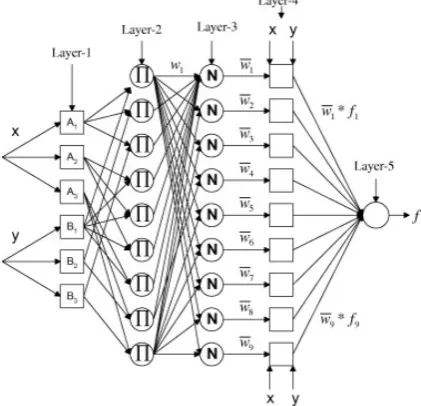
Figure 1: ANFIS architecture with two inputs and nine rules
4. ANFIS
ANFIS is a class of adaptive networks whose func-tionality is equivalent to a fuzzy inference system which
generates a fuzzy rule base and membership functions automatically [33]. ANFIS is an integration of neural network architectures with fuzzy inference system (FIS) to map a couple of inputs-output data patterns. An AN-FIS constructs a AN-FIS (if-thenrules) whose membership function parameters are adjusted using either backprop-agation algorithm or in combination with a least squares type of method [34, 35]. An ANFIS architecture con-sists of a fuzzy layer, product layer, normalized layer, defuzzy layer, and summation layer. A typical archi-tecture of ANFIS with two inputs (xandy), nine rules and one output (f) is depicted in Fig. 11. Among many FIS models, the 1st order Sugeno fuzzy model is the most widely applied adaptive technique with high in-terpretability and computational efficiency for different problems [28, 34]. For a 1st order of Sugeno fuzzy model, a typical rule set with two fuzzy if-then rules can be expressed as:
i f x is A1 and y is B1then f1 =p1x+q1y+r1 (1)
i f x is A2 and y is B2then f2 =p2x+q2y+r2 (2)
whereAiandBiare the fuzzy sets in the antecedent and
pi,qi, and ri are the linear output parameters that are
determined during the training process. As in Fig. 1, an ANFIS consists of five layers and nineif-thenrules as follows:
Layer-1: all the square nodes in this layer are adaptive nodes. The outputs of layer 1 are the fuzzy membership grade of the inputs, which are given by:
O1,i=µAi(x), f or i=1,2,3 O1,i=µBi−3(y), f or i=4,5,6
(3) where xandyare inputs to nodei, and Ai andBi are
linguistic labels for inputs.O1,iis the membership
func-tion of Ai and Bi. µAi(x) andµBi−3(y) can adopt any
fuzzy membership function. For instance, if a Gaussian membership function is employed:
µAi(x), µBi−3(y)=exp
" −(x−ci
ai
)2 #
(4)
whereciandaiare the parameter set of the membership
function. These parameters in this layer are referred to a premise parameters.
Layer-2:Every node in this layer is a fixed node with a
1Reprinted from Expert Systems with Applications, Vol 37/12,
circle node labelQ
which multiplies the incoming sig-nals and sends the product out. The output of this layer can be represented as:
O2,i=wi=µAi(x)×µBi−3(y), i=1,2,3, ...,9 (5)
Each node output represents the firing strength of a rule.
Layer-3: Every node in this layer is also a fixed circle node labeledN, indicating that they play a normaliza-tion role to the firing strengths from the previous layer. The outputs of this layer can be represented as:
O3,i=w¯i=
wi
(w1+w2+...+w9)
, i=1,2,3, ...,9 (6)
Layer-4: In this layer, the square nodes are adaptive nodes. The output of each node in this layer is the product of the normalized firing strength and a 1st or-der polynomial (for a 1st oror-der Sugeno model):
O4,i=w¯i. fi=wi.(pix+qiy+ri), i=1,2,3, ...,9 (7)
wherewi is the output of layer 3 and three parameters
{pi, qi, ri}are the parameter set which will be referred
to as consequent parameters.
Layer-5: The single node in this layer is a circle node labeledP(overall output) that performs the summation of all incoming signals:
O5,i= f =
X
i
¯ wifi=
P
iwifi
P
iwi
(8)
ANFIS has a hybrid learning rule algorithm which in-tegrates the gradient descent and the least squares meth-ods to train and adjust the premise and consequent pa-rameters [36]. The hybrid learning algorithm is com-posed of a forward pass and a backward pass. The least squares method (forward pass) is used to optimize the consequent parameters with the premise parameters fixed to minimize the measured error in layer 4. In the backward pass, the premise parameters are updated by the gradient descent method [33, 36].
5. An ANFIS-based cache replacement method for mitigating cache pollution attacks
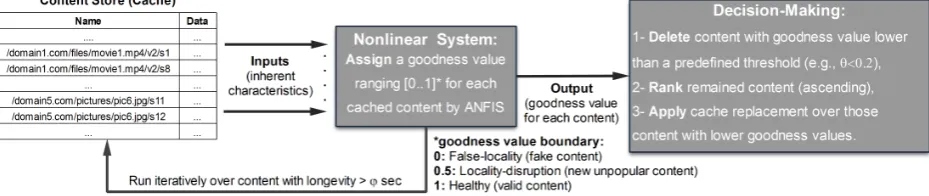
In this section, we design and construct the material of proposed ANFIS-based cache replacement method for mitigating cache pollution attacks in NDN. After-wards, we use simulation to evaluate the effectiveness of the proposed method in two considered NDN topolo-gies in Fig. 3. The proposed ANFIS-based cache re-placement architecture is depicted in Fig. 2. The detail of the method is proposed as follows.
5.1. Data preparation
The detection of cache pollution attacks is hard be-cause all requested content are uncorrupted. The tra-ditional detection methods usually observe and learn the legitimate users’ traffic patterns and detect attacks and anomalies when such patterns change. To address this challenge, we analyze the inherent characteristics of cache pollution attacks and design a nonlinear ap-proximation function through ANFIS to detect locality-disruption and false-locality attacks separately. In order to formulate the problem and construct an ideal method regarding the relationship between inputs (i.e., inherent characteristics of cached content) and output (i.e., con-tent type) data, we define a set of parameters that govern the proposed ANFIS-based cache replacement method. We extract the input parameters based on published re-search articles such as [19, 37, 38], our observation dur-ing the design, and experts’ opinion. The considered input parameters are defined as follows:
1. The cached content’s longevity (Longevity). This corresponds to the time that content has remained in the cache between the time of content being cached and the current time.
2. The cached content’s frequency access (Fre-quency). This corresponds to the estimation of content’s access frequency. An Exponentially Weighted Moving Average (EWMA) method is employed as a filter to obtain a recent estimate of the access frequency rate. It can also iden-tify the possible aberrant behavior of content’s ac-cess frequency. EWMA applies weighting fac-tors which decrease exponentially. The weighting for each older data decreases exponentially, giv-ing much more importance to recent observations while still not discarding older observations en-tirely [39]. The degree of weighting decrease is expressed as a constant smoothing factorβ, a num-ber between 0 and 1. EWMA formula is defined as:
µn=βµn−1+(1−β)xn (9)
whereµnis the exponentially weighted moving av-erage of the past measurements andxnis the
num-ber of content’s access frequency in then-th time interval. We apply the six recent time intervals (i.e., each 0.25 second) to calculate EWMA effi -ciently.
Figure 2: Schematic of the proposed ANFIS-based cache replacement method in NDN
(a) XC topology
(b) DFN topology
Figure 3: Considered network topologies
request distribution. The Std. of an uniform distri-bution is (close to) zero, while other types of dis-tribution such as normal and skewed are not (close to) zero.
4. The last access to the content (Last Retrieval). It corresponds to the time interval between the last time of content being used and the current time. 5. The percentage of cache hit (Hit Ratio). It
corre-sponds to the content cache hit vs. the total content cache hit in the recent time interval.
6. The variance of an entire population of repeated re-quests for a same content from the local interfaces (Interface turnout). The variance allows to detect distributed cache pollution attacks, when all local interfaces return the same content continuously. If all local interfaces return the similar rate of con-tent, the variance is close to zero.
The output of each data pattern is a goodness value which determines the type of content ranging [0..1]. The
boundary of assigned goodness value is defined as: 0 (false-locality or fake content), 0.5 (locality-disruption or new unpopular content), and 1 (healthy). We apply EWMA criterion in the last three time intervals to cal-culate the average goodness value for each content over a period of time.
[image:5.595.115.486.257.448.2]re-maining content is sorted in ascending order based on the goodness value for cache replacement when a new content enters and the cache has not enough space for storing. Thus, the proposed method can efficiently and accurately mitigate the false-locality (by removing the fake content) and the locality-disruption (by removing those content with the lower goodness value for cache replacement) attacks in a timely manner.
5.2. Materials of ANFIS
During the training process, ANFIS tries to minimize the training error between the target output (i.e., the type of cached content) and the actual output of the ANFIS. The input-output data samples are collected based on the section 5.1. In particular, we set cache size to in-finite to not to apply any cache replacement algorithm during the training process (see section 6).
In this work, ANFIS is established in MATLAB envi-ronment. The ANFIS has 6 inputs and one output. Be-fore the training process, data samples should be nor-malized into [0..1], when dealing with parameters of different units and scales [40, 41]. All variables of AN-FIS have ”gaussmf” membership function. The gaussmf is a kind of smooth membership functions, so the result-ing model has a high accuracy [42]. The ”and”, ”or” and ”defuzzification” methods in ANFIS are selected as ”product”, ”max” and ”center of gravity”, respectively. Fig. 4 shows the structure of the constructed ANFIS model as well as the number of fuzzy if-then rules. Be-fore training process, the ANFIS structure is initialized by the fuzzy c-mean method through the input-output data, and its parameters are optimized by least squares and gradient descent algorithms.
6. Experimental setup
This section describes the considered network topolo-gies, simulation environment, followed by the modeling of cache pollution attack strategies.
6.1. Simulation environment
We evaluate cache pollution attacks and countermea-sures discussed in this paper via simulations. We rely on open-source ndnSIM [43] package, a module for ns-3 developed at UCLA as part of the NDN project. The ANFIS-based cache replacement method was firstly im-plemented with MATLAB on an Intel Pentium 4 3.0 GHz CPU, 4 GB RAM running Windows 7 Ultimate. Then, it was compiled as a C++ shared library using the MATLAB compiler in order to integrated it with the ndnSIM environment.
The Experiments are performed over two topologies, as illustrated in Fig. 32: Xie-complex (XC) and the
German Research Network (DFN). The XC and DFN topologies have been identified in previous works as meaningful topologies for simulation [20, 44]. There are several commonly used symbols to identify the type of nodes in NDN networks (such as Fig. 3), including Cx,Px,Rx, andAxto representx-th consumer, producer, router and adversary nodes, respectively [20, 32]. In our configurations, we set nodes’ PIT size to [500..800] en-tries randomly. The Interest expiration time was also set to the default timeout of 4000 ms. We set the link delay and queue length parameters to fixed values for every node. In particular, we set delay and queue length to 10 ms and 500, respectively. The requests of regular con-sumers (we call themhonest consumers) follow a three types of pattern: Zipf-like, exponentially and batch (i.e., generating a specified number of Interests at specified points of simulation) distributions [43]. We also con-figure the pattern frequency of Interest packets ranging [100..800], where each honest consumer changes five times the frequency randomly. We apply randomly two different replacement policies in PIT table (i.e., perform different actions when limit on number of PIT entries is reached) including LRU and persistent policies. The nodes’ cache capacity was randomly set to [100..400] content. We set the low and medium size for cache capacity to evaluate the accuracy and robustness of the proposed ANFIS-based method sufficiently.
The simulation runs over two and a half hours. The collected input-output data pattern during the simula-tion is divided into three blocks as training (70%) to fit (train) the ANFIS model, the first testing (15%) and the second testing (remaining last 15%) to confirm the ANFIS accuracy after training. During the simulation, honest consumers request content based on the above-mentioned configurations. False-locality (see section 6.2) and locality-disruption (see section 6.3) attacks are issued by adversaries between 0s-30s and 50s-80s, re-spectively. Finally, the last thirty seconds between 100s-130s, adversaries launch both attacks at the same time to measure the effect of the proposed ANFIS-based cache replacement method in the simultaneous presence of the both attacks.
6.2. False-locality
We consider two types of content poisoning imple-mentation: proactive and active attacks. Firstly, we
con-2Reprinted from Computer Networks, Vol 57/16, Mauro Conti,
Figure 4: The structure of the proposed ANFIS
(a) Longevity (b) Frequency (c) Std.
(d) Last retrieval (e) Hit ratio (f) Interface Turnout
Figure 5: Final membership functions of the input data
sider a proactive content poisoning attack whereby ad-versaries anticipated a set of Interest packets for a set of valid content. Adversaries inject fake content into router caches. Assuming a consumer sends an Interest packet which is received by an intermediate router (Ri)
and an entry is added to its PIT table. When a router or producer satisfies the Interest packet with a fake content and returns back to theRi, all the intermediate nodes in
the way back as well asRiare polluted with a fake
con-tent. A range of honest consumers are not satisfied if an Interest returns a fake content. After receiving a fake content, they always send the same Interest packet until receive valid content. A range of adversaries behave in the opposite manner. They always ask for bogus con-tent. The adversaries request content according to the uniform distribution. Secondly, we consider an active content poisoning attack whereby adversaries ask some fake content during the simulation run.
We use simulation to measure how many honest
con-sumers can retrieve healthy (valid) content and how fast they can do so when the router caches are poisoned. For proactive scenarios, all routers are pre-populated with different rate of fake content objects, 50%, 80%, and 95% of all the content when the simulation runs. In ac-tive scenarios, adversaries request a series of fake con-tent in which intermediate routers are populated with fake content ranging 30%, 50%, and 70% of all the con-tent. We demonstrate that the proposed scheme outper-forms the most common policies as Least Frequently Used (LFU) and Least Recently Used (LRU) algorithms in terms of applied performance criteria.
6.3. Locality-disruption
[image:7.595.79.519.326.453.2]to the uniform distribution. This allows to explore the effects of low, moderate and high attacks, and whether the proposed ANFIS-based countermeasure is able to identify and mitigate them.
To summarize multiple statistics in the absence and presence of attacks, we define the metric similar to Deng et al. [22] as the key measure of the effectiveness of the attack as:
Hit damage ratio=1−HR(non−attack)−HR(attack) HR(non−attack)
(10) Where, HR(non−attack) and HR(attack) denote the hit ratio of honest consumers in the absence/presence of an attack, respectively. When theHit damage ratio is (close to) zero, the attack is completely ineffective, while it is (close to) one, the caching feature is com-pletely under attack. We then demonstrate that the pro-posed scheme outperforms the most common policies as LFU, LRU independently and in conjunction with CacheShield [17] in terms of applied performance crite-ria. Xie et al. in [17] introduce CacheShield, a method to shield NDN routers from locality disruption attacks.
7. Experimental results
In this section, we demonstrate through simula-tions that the proposed ANFIS-based cache replacement method satisfies in a much better way the applied perfor-mance criteria as compared to the preexisting methods. Our countermeasure is tested over the two considered topologies in Fig. 3. Each router implements the pro-posed ANFIS-based technique discussed in Section 5.
7.1. Results of ANFIS design
The training data used for constructing ANFIS model is the obtained statistical data (see section 6) from DFN topology. The constructed ANFIS model is used as a cache replacement method over both XC and DFN topologies in order to test its performance and robust-ness against cache pollution attacks.
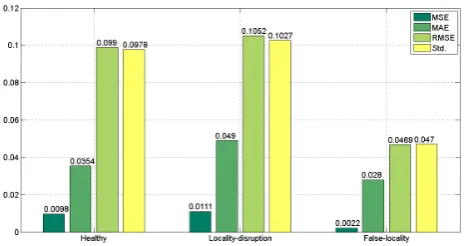
[image:8.595.310.544.110.231.2]Based on the hybrid training process in ANFIS through the number of constructed cluster centers by fuzzy c-mean clustering, there are seven fuzzy rules. The number of training epochs is 500 and the error tol-erance was set to the default value, which is zero. The initial step-size and the increase and decrease rates were set to 0.01, 0.8, and 1.2, respectively. These configura-tion settings in our applicaconfigura-tion are set up to cover a wide range of learning tasks, which lead to optimization of the training process. Fig. 5 illustrates the final member-ship functions of input data. To show the efficiency of
[image:8.595.310.544.270.393.2]Figure 6: The statistical results on training data set
Figure 7: The statistical results on 1st testing data set
Figure 8: The statistical results on 2nd testing data set
[image:8.595.311.544.431.552.2](a) Numerical results on training set (b) Numerical results on 1st testing set (c) Numerical results on 2nd testing set
Figure 9: Q-Q plot and statistical results
[image:9.595.88.505.279.405.2](a) 50% pre-populated (b) 80% pre-populated (c) 95% pre-populated
Figure 10: Results of different pre-populated fake content in XC topology (mean of 10 runs)
(a) 50% pre-populated (b) 80% pre-populated (c) 95% pre-populated
Figure 11: Results of different pre-populated fake content in DFN topology (mean of 10 runs)
7.2. Mitigating false-locality
We first evaluate the effectiveness of proposed ANFIS-based cache replacement method in a simple network topology using the XC network. Fig. 10 illus-trates the average behavior of three methods with diff er-ent pre-populated fake conter-ent rate within 10 runs. The proposed ANFIS-based cache replacement method is more accurate and outperforms other methods in terms of the faster full convergence.
After verifying the correct behavior of ANFIS-based
[image:9.595.85.506.443.570.2]re-(a) 5% locality-disruption (b) 50% locality-disruption (c) 90% locality-disruption
Figure 12: Results of Hit damage ratio for locality-disruption attack in XC topology (mean of 10 runs)
moving the fake content from the caches. Whereas, the proposed ANFIS-based method performs more ac-curate and efficient in removing the fake content from the caches and satisfies all the honest consumers in a timely manner.
7.3. Mitigating locality-disruption
Simulation results in Figs. 12 and 13 show that our cache replacement technique can quickly detect the content placed with the goal of performing locality-disruption attacks and replace them when a new content is added to a full cache. These figures show that routers using ANFIS-based cache replacement method success-fully outperforms four applied cache replacement algo-rithms in a timely manner. The most stunning result is the extreme vulnerability of the LRU and the LFU to pollution attacks.
The experimental results in Figs. 12a-12c and 13a-13c indicate that the ANFIS-based cache replacement technique is more resilient than the preexisting methods against locality-disruption attacks. Despite the fact that the hit damage ratio is still quite high by ANFIS-based technique in the early times of the simulation, the appli-cation of the ANFIS-based technique is quite effective and more reliable against low, middle, and high rate pol-lution attacks.
7.4. Mitigating combination of both attacks at the same time
Adversaries can launch both false-locality and locality-disruption attacks at the same time. For in-stance, the same set of attackers can launch false-locality attacks by pre-populating 50% of the total hon-est consumers’ Interhon-est requhon-ests, and at the same time they start locality-disruption attacks to interfere the con-tent locality by requesting the rest 50% of the honest consumers’ Interest requests in the caches.
According to the proposed ANFIS-based cache replace-ment method discussed in section 5, the existence of locality-disruption attacks will not affect the detection of false-locality attacks and vise versa. First, the pro-posed method tries to detect false-locality attacks by assigning goodness value close to zero, and once de-tected, they are removed from the caches. Then those content with the goodness value close to 0.5, detected as locality-disruption attacks, would be replaced sep-arately when a new content enters and cache space is full.
We vary the behavior of attackers for executing false-locality and false-locality-disruption attacks between 100 and 130 seconds of the simulation run. Figs. 14-16 and 17-19 are shown the results of mitigating both cache pollution attacks at the same time with different strate-gies in XC and DFN topolostrate-gies, respectively. Experi-mental results demonstrate that our proposed method is more resilient and more accurate than preexisting meth-ods to the mixture of attacks. The most stunning result is the extreme vulnerability of the LRU and LFU algo-rithms to the active false-locality attacks as compared to the proactive false-locality attacks. Thus, the proposed ANFIS-based cache replacement mechanism in the con-sidered simulation environments offers visibly promis-ing performance in presence of cache pollution attacks.
7.5. The overhead cost
In this section, we assess the overhead cost of our proposed method and preexisting schemes in presence of adversaries. In particular, we are interested in deter-mining the overhead of the average number of arrival data packets for legitimate users in routers and the op-eration overhead of the methods.
(a) 5% locality-disruption (b) 50% locality-disruption (c) 90% locality-disruption
Figure 13: Results of Hit damage ratio for locality-disruption attack in DFN topology (mean of 10 runs)
[image:11.595.114.474.283.415.2](a) Receiving valid content by 30% false-locality (b) The hit damage ratio by 70% locality-disruption
Figure 14: The results for 30% false-locality and 70% locality-disruption in XC topology (mean of 10 runs)
(a) Receiving valid content by 50% false-locality (b) The hit damage ratio by 50% locality-disruption
Figure 15: The results for 50% false-locality and 50% locality-disruption in XC topology (mean of 10 runs)
pollution attacks. Figs. 20 and 21 show the average of overhead of transmitted data packets in routers in the XC and DFN networks, respectively. We can observe that the our proposed method outperforms other
[image:11.595.115.473.479.613.2](a) Receiving valid content by 70% false-locality (b) The hit damage ratio by 30% locality-disruption
Figure 16: The results for 70% false-locality and 30% locality-disruption in XC topology (mean of 10 runs)
[image:12.595.114.474.314.447.2](a) Receiving valid content by 30% false-locality (b) The hit damage ratio by 70% locality-disruption
Figure 17: The results for 30% false-locality and 70% locality-disruption in DFN topology (mean of 10 runs)
(a) Receiving valid content by 50% false-locality (b) The hit damage ratio by 50% locality-disruption
Figure 18: The results for 50% false-locality and 50% locality-disruption in DFN topology (mean of 10 runs)
attacks. Our results also show that the overhead of trans-mitting data packets by LRU and LFU algorithms are
[image:12.595.115.475.511.642.2](a) Receiving valid content by 70% false-locality (b) The hit damage ratio by 30% locality-disruption
Figure 19: The results for 70% false-locality and 30% locality-disruption in DFN topology (mean of 10 runs)
Figure 20: The average of arrival data packets in XC topology
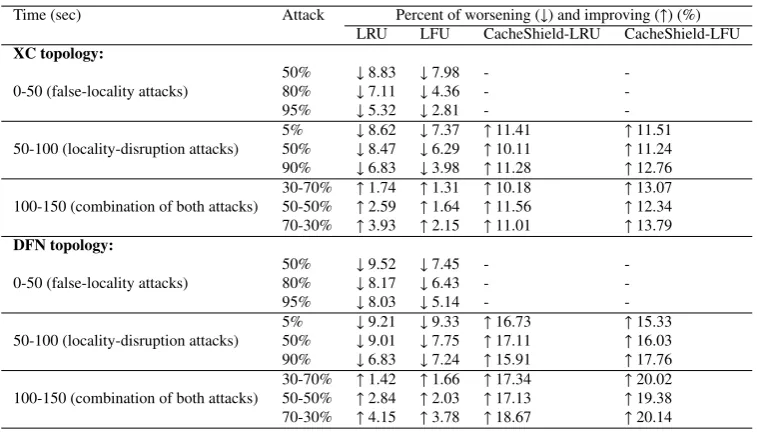
2. The operation overhead: This is the amount of pro-cessing time to execute the caching algorithms within operating system. Table 1 shows that the proposed method seems to be less time consuming than the other methods except LRU and LFU algorithms when attacks do not run simultaneously. The results in Table 1 in-dicate that the proposed approach can improve the per-formance as compared to LRU and LFU algorithms in terms of the operation overhead up to 3.93% and 2.15 %, and 4.15% and 3.78% in XC and DFN topologies respectively, when both cache pollution attacks are si-multaneously implemented. According to the obtained results, by increasing rate of attacks, the overhead of our proposed method is considerably decreased as com-pared to LRU and LFU. The results from Table 1 also
confirm that the our proposed method outperforms suf-ficiently the CacheShield-LRU and CacheShield-LFU methods in terms of the operation overhead up to 11.56% and 13.79%, and 18.67% and 20.14% in XC and DFN, respectively.
[image:13.595.124.475.318.493.2]Figure 21: The average of arrival data packets in DFN topology
Table 1: Comparing operation overhead achieved by the proposed scheme over other methods (mean of 10 runs)
Time (sec) Attack Percent of worsening (↓) and improving (↑) (%) LRU LFU CacheShield-LRU CacheShield-LFU
XC topology:
0-50 (false-locality attacks)
50% ↓8.83 ↓7.98 - -80% ↓7.11 ↓4.36 - -95% ↓5.32 ↓2.81 -
-50-100 (locality-disruption attacks)
5% ↓8.62 ↓7.37 ↑11.41 ↑11.51 50% ↓8.47 ↓6.29 ↑10.11 ↑11.24 90% ↓6.83 ↓3.98 ↑11.28 ↑12.76
100-150 (combination of both attacks)
30-70% ↑1.74 ↑1.31 ↑10.18 ↑13.07 50-50% ↑2.59 ↑1.64 ↑11.56 ↑12.34 70-30% ↑3.93 ↑2.15 ↑11.01 ↑13.79
DFN topology:
0-50 (false-locality attacks)
50% ↓9.52 ↓7.45 - -80% ↓8.17 ↓6.43 - -95% ↓8.03 ↓5.14 -
-50-100 (locality-disruption attacks)
5% ↓9.21 ↓9.33 ↑16.73 ↑15.33 50% ↓9.01 ↓7.75 ↑17.11 ↑16.03 90% ↓6.83 ↓7.24 ↑15.91 ↑17.76
100-150 (combination of both attacks)
30-70% ↑1.42 ↑1.66 ↑17.34 ↑20.02 50-50% ↑2.84 ↑2.03 ↑17.13 ↑19.38 70-30% ↑4.15 ↑3.78 ↑18.67 ↑20.14
the extensive analysis satisfies the objectives of the ex-periment in terms of the applied performance metric and ensure that the proposed ANFIS-based caching for mit-igating cache pollution attacks in NDN can yield high accuracy as compared to other methods without very much computational cost.
8. Conclusion
In this paper, we proposed a novel ANFIS-based cache replacement method to mitigate two generic
[image:14.595.109.488.360.576.2]objectives of the experiment and ensure that the pro-posed ANFIS-based caching for mitigating cache pol-lution attacks can yield high accuracy as compared to other methods without very much computational cost. Future work includes devising several improvements to the approach presented in this paper and its use in larger and more complex network topologies.
9. Acknowledgments
This work was partially supported by projects TIN2013-47272-C2-2 and SGR-2014-881.
References
[1] Jacobson, V., Smetters, D.K., Thornton, J.D., Plass, M.F., Briggs, N.H., Braynard, R.L.. Networking named content. In: Proceedings of the 5th international conference on Emerging networking experiments and technologies. ACM; 2009, p. 1 – 12.
[2] Zhang, G., Li, Y., Lin, T.. Caching in information centric networking: A survey. Computer Networks 2013;57(16):3128 – 3141.
[3] Sourlas, V., Flegkas, P., Tassiulas, L.. A novel cache aware routing scheme for information-centric networks. Computer Networks 2014;59:44 – 61.
[4] Karami, A., Guerrero-Zapata, M.. A fuzzy anomaly detection system based on hybrid pso-kmeans algorithm in content-centric networks. Neurocomputing 2015;149(Part C):1253 – 1269. [5] qing Wang, G., Huang, T., Liu, J., ya Chen, J., jie Liu,
Y.. Modeling in-network caching and bandwidth sharing perfor-mance in information-centric networking. The Journal of China Universities of Posts and Telecommunications 2013;20(2):99 – 105.
[6] Dannewitz, C., Kutscher, D., Ohlman, B., Farrell, S., Ahlgren, B., Karl, H.. Network of information (netinf) an information-centric networking architecture. Computer Communications 2013;36(7):721 – 735.
[7] Zhang, L., Estrin, D., Burke, J., Jacobson, V., Thornton, J., Smetters, D.K., et al. Named data networking (ndn) project. Tech. Rep. PARC TR-2010-3; Palo Alto Research Center; 2010. [8] Karami, A., Guerrero-Zapata, M.. A hybrid multiobjective rbf-pso method for mitigating dos attacks in named data networking. Neurocomputing 2015;151(Part 3):1262 – 1282.
[9] Chaabane, A., Cristofaro, E.D., Kaafar, M.A., Uzun, E.. Privacy in content-oriented networking: Threats and counter-measures. ACM SIGCOMM Computer Communication Review 2013;43(3):25 – 33.
[10] Acs, G., Conti, M., Gasti, P., Ghali, C., Tsudik, G.. Cache privacy in named-data networking. In: 33rd IEEE International Conference on Distributed Computing Systems (ICDCS). 2013, p. 41 – 51.
[11] Lee, H., Nakao, A.. User-assisted in-network caching in information-centric networking. Computer Networks 2013;57(16):3142 – 3153.
[12] Kim, Y., Yeom, I.. Performance analysis of in-network caching for content-centric networking. Computer Networks 2013;57(13):2465 – 2482.
[13] Carofiglio, G., Gallo, M., Muscariello, L.. On the perfor-mance of bandwidth and storage sharing in information-centric networks. Computer Networks 2013;57(17):3743 – 3758.
[14] Chai, W.K., He, D., Psaras, I., Pavlou, G.. Cache less for more in information-centric networks (extended version). Computer Communications 2013;36(7):758 – 770.
[15] Xylomenos, G., Ververidis, C.N., Siris, V.A., Fotiou, N., Tsilopoulos, C., Vasilakos, X., et al. A survey of information-centric networking research. IEEE Communications Surveys Tutorials 2013;:1 – 26.
[16] Lauinger, T., Laoutaris, N., Rodriguez, P., Strufe, T., Bier-sack, E., Kirda, E.. Privacy risks in named data networking: what is the cost of performance? ACM SIGCOMM Computer Communication Review 2012;42(5):54 – 57.
[17] Xie, M., Widjaja, I., Wang, H.. Enhancing cache robustness for content-centric networking. In: IEEE Proceedings on INFO-COM. 2012, p. 2426 – 2434.
[18] Park, H., Widjaja, I., Lee, H.. Detection of cache pollution attacks using randomness checks. In: IEEE International Con-ference on Communications (ICC). 2012, p. 1096 – 1100. [19] Ghali, C., Tsudik, G., Uzun, E.. Needle in a haystack:
Mitigat-ing content poisonMitigat-ing in named-data networkMitigat-ing. In: Proceed-ings of NDSS Workshop on Security of Emerging Networking Technologies (SENT). 2014,.
[20] Conti, M., Gasti, P., Teoli, M.. A lightweight mechanism for detection of cache pollution attacks in named data networking. Computer Networks 2013;57(16):3178 – 3191.
[21] Chen, H., Xiao, Y., Vrbsky, S.V.. An update-based step-wise optimal cache replacement for wireless data access. Computer Networks 2013;57(1):197 – 212.
[22] Deng, L., Gao, Y., Chen, Y., Kuzmanovic, A.. Pollution attacks and defenses for internet caching systems. Computer Networks 2008;52(5):935–956.
[23] Kaya, C.C., Zhang, G., Tan, Y., Mookerjee, V.S.. An admission-control technique for delay reduction in proxy caching. Decision Support Systems 2009;46(2):594 – 603. [24] Romano, S., ElAarag, H.. A neural network proxy cache
re-placement strategy and its implementation in the squid proxy server. Neural Computing and Applications 2011;20(1):59 – 78. [25] Ahmed, W.A., Shamsuddin, S.M.. Neuro-fuzzy system in par-titioned client-side web cache. Expert Systems with Applica-tions 2011;38:14715 – 14725.
[26] Bagheri, A., Peyhani, H.M., Akbari, M.. Financial forecasting using anfis networks with quantum-behaved parti-cle swarm optimization. Expert Systems With Applications 2014;41(14):6235 – 6250.
[27] Budyal, V., Manvi, S.. Anfis and agent based bandwidth and delay aware anycast routing in mobile ad hoc networks. Journal of Network and Computer Applications 2014;39:140 – 151. [28] G¨uneri, A.F., Ertay, T., Y¨ucel, A.. An approach based on
an-fis input selection and modeling for supplier selection problem. Expert Systems With Applications 2011;38:14907 – 14917. [29] Moayer, S., Bahri, P.A.. Hybrid intelligent scenario generator
for business strategic planning by using anfis. Expert Systems With Applications 2009;36:7729 – 7737.
[30] Guillaume, S.. Designing fuzzy inference systems from data: an interpretability-oriented review. IEEE Transactions on Fuzzy Systems 2001;9(3):426 – 443.
[31] Naderloo, L., Alimardani, R., Omid, M., Sarmadian, F., Javadikia, P., Torabi, M.Y., et al. Application of{ANFIS}to predict crop yield based on different energy inputs. Measure-ment 2012;45(6):1406 – 1413.
[32] Compagno, A., Conti, M., Gasti, P., Tsudik, G.. Poseidon: Mitigating interest flooding ddos attacks in named data network-ing. In: 38th Annual IEEE Conference on Local Computer Net-works (LCN). 2013, p. 630 – 638.
1993;23(3):665 – 685.
[34] Singh, R., Kainthola, A., Singh, T.. Estimation of elastic con-stant of rocks using an{ANFIS}approach. Applied Soft Com-puting 2012;12(1):40 – 45.
[35] Jiang, H., Kwong, C., Ip, W., Wong, T.. Modeling customer satisfaction for new product development using a pso-based
{ANFIS}approach. Applied Soft Computing 2012;12(2):726 – 734.
[36] Jang, J.S.. Neuro-fuzzy modeling: Architectures, analyses, and applications. Ph.D. thesis; University of California, Berkeley; 1992.
[37] Vakali, A.. Evolutionary techniques for web caching. Dis-tributed and Parallel Databases 2002;11(1):93 – 116.
[38] Gao, Y., Deng, L., Kuzmanovic, A., Chen, Y.. Internet cache pollution attacks and countermeasures. In: Proceedings of the 14th IEEE International Conference on Network Proto-cols (ICNP). 2006, p. 54 – 64.
[39] Shanbhag, S.. Design and implementation of parallel anomaly detection. 2007.
[40] Karami, A., Guerrero-Zapata, M.. Mining and visualizing un-certain data objects and named data networking traffics by fuzzy self-organizing map. In: In Proceedings of the Second Interna-tional Workshop on Artificial Intelligence and Cognition (AIC); vol. 1315. 2014, p. 156 – 163.
[41] Karami, A., Johansson, R.. Utilization of multi attribute deci-sion making techniques to integrate automatic and manual rank-ing of options. Journal of Information Science and Engineerrank-ing 2014;30(2):519 – 534.
[42] Jin, Y.. Multi-objective machine learning; vol. 16. Springer; 2006.
[43] Afanasyev, A., Moiseenko, I., Zhang, L.. ndnSIM: NDN simulator for NS-3. Technical Report NDN-0005; NDN; 2012. URLhttp://named-data.net/techreports.html. [44] Heckmann, O., Piringer, M., Schmitt, J., Steinmetz, R.. On