Soft Skills Implementation in Construction
Management Program: A Comparative Study
of Lecturers and Students Perspective
H.Mohd Affandi, F. Hassan, Z. Ismail and M.F. Mustaffa Kamal
Faculty of Architecture, Planning and Surveying, Universiti Teknologi MARA, 40450 Shah Alam, Malaysia
Abstract –
This study aimed to identify the soft skill implementation problems in Construction Management Program based on lecturers and students perception. A total of 95 construction management students and 44 construction management lecturers participated in this study. Data were collected using a questionnaire. Among the variable studies were the
understanding of terms and definition, soft skills and general attitudes. Result of the study shows that there is a mismatch between students and lecturers perception in soft skills
implementation. Future study need to be carried out confirm this mismatch in identifying the gap of soft skills in construction management program based on industry, lectures and students perspective.
Keywords : Soft Skills, Construction Management Program
INTRODUCTION The unique structure of the construction industry and its rapid changes in technological development [1], coupled with the challenges of global competitiveness, changing regulatory requirement [2]and have created the need for highly educated and competent construction management graduates[14].
Construction management was recognized as a professional discipline, undergraduate and postgraduate degree courses have proliferated into many universities curricular in countries such as Australia, Hong Kong, China, UK, USA and Singapore [2714]
A construction management curriculum is also a combination of engineering, technology, construction techniques and management [4714]. Harris(1996) as cited in [2] suggest that many of courses are teaching graduates subjects that they are unlikely to use until 10-15 years after they graduate, by which time the knowledge they have gained maybe out of date[14]. [1] in [14]
indentified the problems faced by the tertiary institution:
1. These programs are delivered in a period when industry is facing rapid changes in technological development and it is not always possible to included these changes
2. Industry expects graduates to immediately integrate into the industry, and is not always concerned with the broader education aims. Studies carried in other countries on the identification of necessary and skills attribute for construction management graduates identified mixed finding that industry employers
representatives suggest that education and training offered at universities do not always address the needs of industry [4,5,6 & 14].
The other claimed that the construction management graduates competencies are generally meeting the employers’ expectation and there are skills where graduates fell below the expectation of contracting organizations, for example, practical building knowledge, interpersonal,
time management, and ability to exercise
professional judgment but there is always a need to improve their skills level [7,2,3 & 8].
In Malaysia the government has introduced a soft skills development module as an action to be applied in the process of learning and teaching by the Malaysia’s higher education institutions. This action was taken for graduates to acquire balanced and comprehensive skills in terms of intellectual quality or soft skills which include aspects of behaviour and moral [9].
From the previous preliminary survey (Soft skills Implementation in Construction Management Programme: A survey of Malaysian Public
Universities) [14], the lecturers agreed that they have clearly explaining the student why it is important to learn soft skills and they believed that most of the students only want to learn the skills that are relevant on the job or industry they want to work in. This problem led to the question, does construction management students have attitudes problems towards soft skill? [14].What are the problems of soft skills implementation in Construction Management program? [14].This question will be answered in this survey.
A Objective of the Study
This study aimed to explore the construction management students’ and lecturers’ perception and understanding of soft skills implementation in Malaysian public universities.
METHODOLOGY
This study was extended from study by [14] and used a descriptive research design. Data were obtained through the administration of
questionnaires at 3 public universities in Malaysia (USM, UTHM and UiTM). In Malaysia, there are only 4 public universities offered the construction management courses for undergraduates. They are Universiti Teknologi MARA, Universiti Tun Hussein Onn Malaysia, Universiti Teknologi Malaysia and Universiti Sains Malaysia [14]. However, UTM was not participated in this research because the Faculty of Built Environment has just changed their curriculum from Building to Construction Management early of this year (2012)[14].
A Samples
This study employed a random sampling technique. Three hundred (n=300) copies of the questionnaires were distributed to the students by hand [14] and ninety one (n=91) copies of the questionnaires were distributed to the lecturers through online and by hand. However, only ninety five (n=95) forms were completed and returned to the researcher upon completion by students [14] and forty four (n=44) by lecturers. The respondents were chosen from final and third year students [14]. This is because, all the students experienced the curriculum changing from traditional to OBE in their study. The OBE was introduced by MOHE since 2006, however most of the universities started changing their curriculum since 2008 to 2010. Lecturers who participated in this survey were
teaching Construction Management program in USM, UiTM and UTHM.
B Instrumentation
This study used a modified version of a questionnaire developed by [10]. A few changes were done to the original instrument in order to suit this research context and purpose[14]. The forms distributed to the students and lecturers were written in English and contained the following parts[14]:
a) Demographic
b) Skills and skills development
c) Students’ and lecturers’ general attitudes towards soft skills
[image:2.595.326.529.325.464.2]The level of students’ expectation was measured by the mean score using a formula by [11] as shown in table 1.
Table 1 : Category of mean score based on [11]
The level of lecturers’ expectation for section c was measured by the mean score using a formula by [12] shown in table 2.
Table 2 : Means score interpretation based on [12]
Regions Importance
5.50 and above Strongly Agree
4.50 – 5.49 Agree
3.50 – 4.49 Slightly Agree
2.50 – 3.49 Slightly disagree
1.50 – 2.49 Disagree
1.49 and under Strongly Disagree
C Reliability of Instruments
[13] suggested that Cronbach Alpha value must be greater than 0.5. In this study, Cronbach Alpha values for the all variables are more than 0.7 which is beyond the value of reliability needed (see table 3) .
Mean score Interpretation Students and
Lecturers Students Section b Section c 1.00-2.00 Not Important Strongly
Disagree 2.01-3.00 Slightly
Important Disagree 3.01-4.00 Important Agree 4.01-5.00 Very
[image:2.595.308.529.542.666.2]Table 3 : Reliability of the instruments Cronbach Alpha value
Students 0.920
Lecturers 0.874
RESULTS A The participants’ profile
Part A helped construe the respondents’ demographic profile. All of the students and lecturers were from same course which is
Construction Management. Among the participants, there was significantly more female than male (see fig. 2). Students were chosen from third and final year (see fig. 3) and most of the students have passed their internship (see fig. 4). Source for students result were taken from [14].
Figure 1: Respondents’ university
Figure 2 : Respondents gender
Figure 3 : Students year of study
Figure 4 : Students internship
B. Skills and skills development
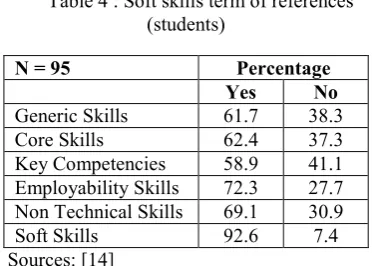
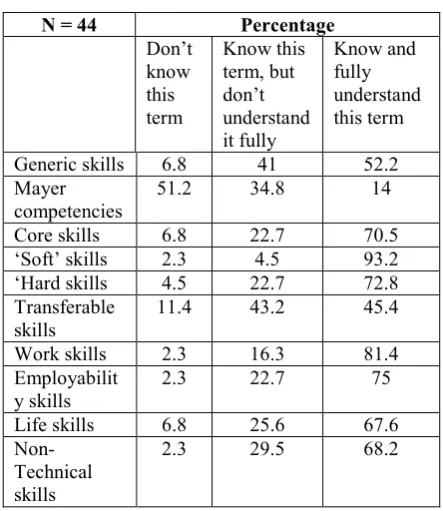
[image:3.595.338.528.75.182.2]Part B was constructed to determine students’ familiarity and lecturers understanding toward soft skills term of references used (See table 4 and 5 ).
Table 4 : Soft skills term of references (students)
N = 95 Percentage
Yes No
Generic Skills 61.7 38.3
Core Skills 62.4 37.3
Key Competencies 58.9 41.1 Employability Skills 72.3 27.7 Non Technical Skills 69.1 30.9
Soft Skills 92.6 7.4
Sources: [14]
From the result above, more than 50 % of students are familiar with the soft skills term of references used. 92.6% have heard the term soft skills, this is because these term is widely used by lecturers and researcher. There is a possibility that students heard the terms while attending their internship. Furthermore, they will finish their study in a year or less. Therefore, they have started the job hunting activities and in these processes, they will find new terms of references for soft skills.
40.90% 38.60%
20.50%
38.90% 31.60%
29.50%
UTHM UiTM USM
Respondents university Lecturers Students
43.20%44.20% 56.80%55.80%
Male Female
Gender Lecturers Students
52.60%
47.30%
Third year Final year
Year of Study
60%
40%
Yes No
[image:3.595.326.514.472.605.2]Table 5 : Soft skills term of references (lecturers)
N = 44 Percentage
Don’t know this term
Know this term, but don’t understand it fully
Know and fully understand this term
Generic skills 6.8 41 52.2
Mayer
competencies 51.2 34.8 14
Core skills 6.8 22.7 70.5
‘Soft’ skills 2.3 4.5 93.2
‘Hard skills 4.5 22.7 72.8
Transferable
skills 11.4 43.2 45.4
Work skills 2.3 16.3 81.4
Employabilit
y skills 2.3 22.7 75
Life skills 6.8 25.6 67.6
Non-Technical skills
2.3 29.5 68.2
Soft skills and generic skills terms have been introduced by the Ministry of Higher Education. It been used widely by the lecturers in developing their teaching and learning schedule[14]. Therefore, more than 90% of respondents know and understand the soft skills terms. However, almost half of the lecturers don’t know the generic skills term and know the generic skills term but don’t understand fully.
In the survey, respondents were asked to nominate from a list of twenty six soft skills, five skills that were being taught well, five were being taught poorly and five skills that were most important for their industry[14]. These soft skills elements were chosen by respondents (the most rated soft skills by respondent). From the result (see table 6,7 and 8) there were a similarity and differences in students and lecturers perception. Table 6: Soft skills that being taught poorly
Students Lecturers
Having customer focus Having customer focus Being able to use
mathematical ideas and techniques
Being able to complete task when there is incomplete information Able to challenge how
things are done Able to challenge how things are done Being able to solve
conflict Being able to solve conflict Having practical focus Having practical focus
[image:4.595.65.287.99.355.2]Source for students result: [14]
Table 7: Soft skills that being taught well
Source for students result: [14]
Table 8: Soft skills that were most important to the industry
Students Lecturers
Being able to collect, analyze and organize information
Being able to speak and communicate well with other people
Being able to work with
other people in teams Being able to work with other people in teams Being able to solve
problems Being able to solve problems Being able to use
information technology Being adaptable to change at work Being able to read, spell
and write well Being able to understand how ideas and system are linked to each other
Source for students result: [14]
C. Students’ and lecturers’ general attitudes towards soft skills.
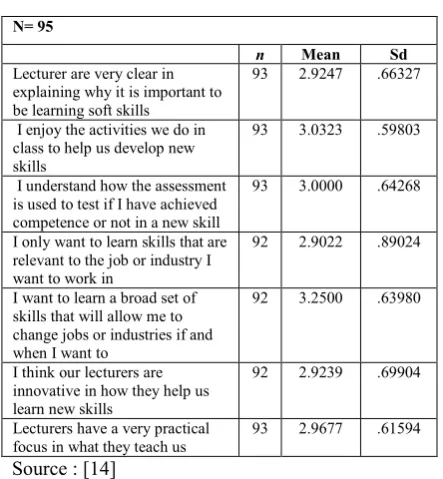
In this section, participants need to respond to each of the general attitudes statement. Based on the result (see table 9), most of the students were disagree with the statement (means score: 2.01 - 3.00: disagree (see table 1)). However, there are statements students agreed with, which are they enjoy the activities they do in class to help them develop new skills and they want to learn broad set of skills that will allow them to change jobs or industries if and when they want to.
There is a mismatch between lecturers and students expectation and assumption in each other attitude towards soft skills. Lecturer’s claims that their students were only want to learn certain skills and vice versa (see table 9 and 10).
Students Lecturers
Being able to speak and communicate well with other people
Being able to speak and communicate well with other people
Being able to collect, analyze and organize information
Being able to work with other people in teams
Being able to solve
problems Being able to solve problems Being able to use
information technology Being able to plan and organize activities Being able to read, spell
Table 9 ; Students general attitudes toward soft skills
N= 95
n Mean Sd
Lecturer are very clear in explaining why it is important to be learning soft skills
93 2.9247 .66327
I enjoy the activities we do in class to help us develop new skills
93 3.0323 .59803
I understand how the assessment is used to test if I have achieved competence or not in a new skill
93 3.0000 .64268
I only want to learn skills that are relevant to the job or industry I want to work in
92 2.9022 .89024
I want to learn a broad set of skills that will allow me to change jobs or industries if and when I want to
92 3.2500 .63980
I think our lecturers are innovative in how they help us learn new skills
92 2.9239 .69904
Lecturers have a very practical
focus in what they teach us 93 2.9677 .61594
[image:5.595.63.295.233.726.2]Source : [14]
Table 10 : Lecturers’ general attitudes toward soft skills
DISCUSSION AND CONCLUSION Results of the study indicate that there were mismatch between students and lecturers perception towards soft skills implementation.
While the students are familiar with terms, lecturers were having problems in understanding the soft skills terms of references. There is a percentage that lecturers don’t know the terms and know the terms but don’t understand it fully. Even the percentage is not high, the argument about the soft skills preparation before the implementation is arise. Universities should prepared the lecturers with seminar and training before the soft skills implementation and having continues and extra seminar in improving lecturers understanding towards soft skills.
The findings provided some significant insights that universities and industries were not attached together in improving the students’ soft skills. This is because, even half of the students have attended their internship and their perception toward what soft skills that was most important to the industry is difference with lecturers’ perception. Which soft skills are important to the industry, students’ perception, lecturers or both? In planning the curriculum, industries were invited to brainstorm the soft skills elements and curriculum. However, the needs of industries are kept changing by time to time and universities were just left behind [1]. Industries s and universities should always keep in touch, especially in discussing the needs of soft skills for students. The mismatch between respondents’ perception towards soft skills that being taught well and important to the industries shows that, the soft skills element need to be re-learnt in order to fulfil the industries needs.
Lecturers and students were having problems in soft skills implementation process especially in understanding the assessment. This problem led to the question, does lecturers assessment towards students soft skills were valid in previous semester? If they don’t really understand the assessment process, how do they assess their students?
There were negative perceptions from students towards lecturers’ attitudes in implementing soft skills. The mismatch arise when lecturers were agreed with what they doing right, somehow the students disagree with it. What are the problems between lecturers’ perception and students’ needs?
Further research will be carried out in identifying soft skills gap between, industries, academia and students.
N=44
n Mean Std
Deviation
I believe I am very clearly in explaining why it is important
to learn soft skills. 41 4.7805 1.03712 Students understand how the
assessment is being used to test if they have achieved competence in.
42 4.3571 1.07797
Students only want to learn the skills that they believe are relevant on the job or industry they want to work in.
43 5.0465 .87160
Students want to learn a broad set of skills that will allow them
to change jobs or industries. 43 4.2093 1.35503 My industry wants students
who have broad soft skills
rather than only specialist skills. 43 4.7674 1.17184 I assess and report on soft
skills. 43 3.9070 1.26893
Our program clearly describes
the soft skills required. 42 4.5714 1.03930 Our program does a good job in
embedding soft skills: - in content.
- in the processes described. - in the assessment.
42 41 41
4.5238 4.6341 4.4634
.96873 .96840 1.00244 Our program is helping to
produce graduates who are highly employable in a range of jobs in different industries.
43 4.6341 .88609
There are guidelines in our program that help me assess soft skills development in my students.
ACKNOWLEDGMENTS
This work was supported in part by the research Management Institute (RMI), grant number; 600-RMI/DANA5/3RIF (282/2012), Universiti Teknologi MARA.
REFERENCES
1] "Construction Management Graduates-Do M. Massyn, L. Mosime and J. Smallwood, They Have The Competencies That Industry Need?," in RICS COBRA research Conference, University of Cape Town, 2009.
2] "Construction Managers' Expectation and P. Love, N. S. Haynes and Z. Irani, Observations of Graduates.," Journal of Managerial Psychology, ., vol. 16, no. 8, pp. 579-593, 2001.
3] for Malaysian Higher Education, Kuala M. o. H. E. Malaysia, Soft Skills Module Lumpur: Universiti Putra Malaysia, 2006.
4] education and training teacher and student V. Callan, "Understanding vocational attitudes," NCVER, Adelaide, 2003.
5] York: McGraw-Hill, 1978. J. Nunnaly, Psychometric theory, New
6] operative Education Programmes for M. M. Bajunaid, "The Effectiveness of Co-Developing Students’ Awareness of the Importance of Generic Competencies," PhD Thesis, University of Glasgow, UK, 2008
7] Business: A Skill Building Approach (2nd . U. Sekaran, Research Methods for edition), New York: John Wiley & Sons, Inc., 2003.
8] the Educational Supply Chain," in K. Carter, "Construction Skills-the Role of Built Environment EducationAnnual Conference (BEECON 2006), London, UK, 2006.
9] Rowings, "Construction Engineering and O. Abudayyah, P. Russel, D. Johnson and J. Management Undergraduate Education," Jurnal of Construction Engineering and Management, pp. 169-175, 2000.
10] Finding Ways for Enhancing Postgraduate S. Huda, R. Farooqui and M. Saqib, ". Level in Construction Management in
Pakistan," in First International Conference on Construction in Developing
Countries(ICCIDC-I), Karachi: Pakistan, 2008.
11] Expectation of the Performance of H. Davies and L.K.Poon, "Employers' Construction Graduates," International Journal of Engineering Education, vol. 15, no. 3, pp. 191-198, 1999.
12] C. Tam, "Key Construction Management Skills P. Love, N. Haynes, A. Sohal, A. Chan and for Future Success," November 2002. [Online]. Available:
http://www.buseco.monash.edu.au/mgt/researc h/working-papers/2002/wp49-02.pdf>. [Accessed 8 November 2010].
13] Academia Perceptions of Construction C. Nicholas and C. H. Theo, "Industry and Management Education : the case of South Africa," Journal for Education in the Built Environment, vol. 2, no. 2, pp. 85-114 (30), October 2007.
![Table 1 : Category of mean score based on [11]](https://thumb-us.123doks.com/thumbv2/123dok_us/8777173.902104/2.595.308.529.542.666/table-category-mean-score-based.webp)