Bayesian Multiperiod Forecasting for Arma Model under
Jeffrey’s Prior
Zul Amry
1,*, Adam Baharum
21Department of Mathematics, State University of Medan, Indonesia 2School of Mathematical Sciences, Universiti Sains Malaysia, Malaysia
Copyright © 2015 by authors, all rights reserved. Authors agree that this article remains permanently open access under the terms of the Creative Commons Attribution License 4.0 International License.
Abstract
The main purpose of this study is to find the Bayesian forecast of ARMA model under Jeffrey’s prior assumption with quadratic loss function. The point forecast model is obtained based on the mean of the marginal conditional posterior predictive in mathematical expression. Furthermore, the point forecast model of the Bayesian forecasting compared to the traditional forecasting. The simulation shows that the forecast accuracy of Bayesian forecasting is better than the traditional forecasting and the descriptive statistics of Bayesian forecasting are closer to the true value than the traditional forecasting.Keywords
ARMA Model, Bayes Theorem, Jeffrey’s Prior, Multiperiod Forecast1. Introduction
The Bayesian approach in general requires explicit formulation of a model and conditioning on known quantities in order to draw inferences about unknown ones. The main difference between the Bayesian approach and the classical approach is that in the Bayesian approach, the parameters supposed as random variables, which are described by their probability density function, whereas the classical approach considers the parameters to be fixed but unknown. The classical forecasting has been developed by Box and Jenkins [4]. There are three steps are accomplished in the process of fitting the ARMA (p, q) model to a time series identification of the model, estimation of the parameters, and model checking to conclude whether the models obtained are adequate for forecasting. Several of works relating to Bayesian forecasting in the ARMA model are Fan & Yao [8] and Uturbey [13] using ARMA with normal-gamma prior. Kleibergen & Hoek [11], Liu [13], and Mohamed et al. [14] using ARMA model with Jeffrey's prior. This paper focuses on the Bayesian multiperiod forecasting for ARMA model using Jeffrey’s prior with quadratic loss function.
2. Materials and Methods
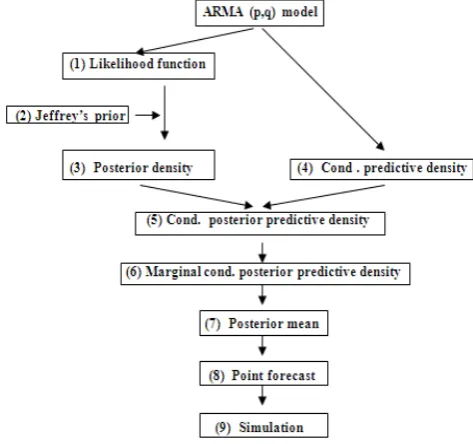
[image:1.595.312.549.421.643.2]The materials in this paper are a set time series data in the ARMA model for application and simulation. The method is study of literature by applying a set of theories of mathematical statistics such as the ARMA model, likelihood function, Jeffrey’s prior, posterior distribution, Bayes theorem, conditional predictive density, conditional posterior predictive density, marginal conditional posterior predictive density, posterior mean and point forecast. Stages of discussion are presented in Figure 1 as follows:
Figure 1. Stages of discussion
3. Results
3.1. Likelihood Function
The one−step−ahead point forecast of yn+1 based data is
by:
)
|
(
)
1
(
ˆ
E
y
n 1S
ny
=
+ (3.1)This case is expandable for the k−step−ahead point forecast of yn + k, that is:
)
|
(
)
(
ˆ
* n k nS
y
E
k
y
=
+ (3.2)where
S
*n= (y1, y2, …,yn+k-1)The ARMA (p, q) model defined by:
∑
∑
= − = −+
+
=
p i t qj j t j i
t i
t
y
e
e
y
1 1
q
φ
(3.3)where {et} is sequence of i i d normal random variables with
et∼N(0,t-1), t>0 and unknown, φi and qj are parameters.
Residuals are as:
∑
∑
= − = −−
−
=
p i qj j t j
i t i t
t
y
y
e
e
1 1
q
φ
(3.4)By conditioning the first p observations and letting
ep=ep-1=…= er = 0, where r = min(0, p+1−q), one may
approximate ( Box & Jenkins, [4] ), the likelihood function for Ψ=(φ1,φ2, … ,φp, q1, q2, …, qq) and t based
S
*n is :L (Ψ,t|
S
*n) ∝t((n+k--p)|2exp
−
−
−
∑
+ −∑
∑
+ = = − = − 1 1 2 1 12
k n p t qj j t j
p
i i t i
t
y
e
y
φ
q
t
(3.5)
The equation (3.5) can be expressed as:
L (Ψ,t|
S
*n) ∝t((n+k-1)-p)|2(
)
1
1 1
2 1 2
1 1 1
1
exp
2
2
t t
n k n k
T n k
t T
t p t p t
t p
y
y
B
t
+ − + − −+ −
= + = + −
= +
+
×
−
− Ψ
+
Ψ
∑
∑ ∑
B
(3.6)where Bt = (yt, yt-1, ..., yt+1-p, et, et-1, ..., et+1-q ) By allowing
U =
− − + − + − + − + − − + + − − + − + − − + + q k n q p q p k n p p k n p p p k n k n p p k n p pe
e
e
e
e
e
e
e
e
y
y
y
y
y
y
y
y
y
1 2 1 3 1 2 1 1 2 1 3 1 2 1ˆ
ˆ
ˆ
ˆ
ˆ
ˆ
ˆ
ˆ
ˆ
2
2
2
2
2
2
,x0=
− + + + 1 2 1 k n p py
y
y
, W=UUT and V=Ux 0
where
∑
∑
= − = −
−
−
=
p 1 i q 1 j j t j it i t
t
y
~
y
~
eˆ
eˆ
φ
q
, t = p+1, p+2, … , n,i
~
φ
andq
~
j are maximum likelihood estimator ofφ
i andj
q
,eˆ
t,
eˆ
t−1,
2
,
eˆ
t−q be obtained via:1
~
ˆ
=
−
T t−t
t
y
e
Ψ
B
(3.7) and the likelihood function can be expressed as:L(Ψ,t |
S
*n)∝t((n+k-1)-p)|2
+
−
−
∑
+ − + = 1 k n 1 p t T T 2t
2
V
W
y
2
exp
t
Ψ
Ψ
Ψ
(3.8)3.2. Posterior Distribution under Jeffrey’s Prior Assumption
Based the likelihood function in equation (3.8), the Jeffrey’s prior is:
1 1
Jeff
(
t
−)
∝
t
−π
(3.9)By applying the Bayes theorem to equation (3.8) and (3.9), the posterior of
Ψ
andt
−1 is:π(Ψ,τ−1|
* n
S
)∝ ( 1 2 ) 1 2n k p p
t
+ − − + −×
1 2 1
exp
2
2
n k T T t t pW
V
y
t
+ −= +
×
−
Ψ
Ψ − Ψ
+
∑
(3.10)3.3. Conditional Predictive Density
Based on
∑
∑
= − = − − − = p 1 i q 1 j j t j i
t i t
t y y e
e
φ
q
with et∼ N(0,t-1),be obtained:
(
)
[ ]
−
=
− − − 2 t 2 1 1 1 * nt
|
S
,
,
)
2
exp
2
e
e
(
f
Ψ
t
πt
t
, ifexpressed in yt as:
(
)
1* 1 1 2
2
1 1
( | , , )
2
exp
2
t np q
t i t i j t j
i j
f y S
y
y
e
t
πt
t
j
q
−
− −
− −
= =
Ψ
=
×
×
−
−
−
∑
∑
, suchthat the conditional predictive density of Yn+k based
Ψ
,
S
*(
)
1* 1 1 2
2
1 1
(
| , , )
2
exp
2
n k np q
n k i n k i j n k j
i j
f y
S
y
y
e
t
πt
t
j
q
−
− −
+
+ + − + −
= =
Ψ
=
×
×
−
−
−
∑
∑
∝
21t
+ − −∑
∑
= + − = + − + 2 p 1 i q 1 j j n k j ik n i k
n y e
y 2
exp
t
φ
q
(3.11)By changing
∑
∑
= + − = + −
+
p 1 i q 1j j n k j i
k n
i
y
q
e
φ
to:1 1 2 2
1 1 2 2
n k n k p n k p n k n k q n k q
y
y
y
e
e
e
j
j
j
q
q
q
+ − + − + −
+ − + − + −
+
+
+
+
+
+
+ +
2
2
=(
)
− + − + − + − + − + − + q k n 2 k n 1 k n p k n 2 k n 1 k n q 2 1 P 2 1 e e e y y y 22 φ q q q
φ
φ =
1 k n T
B
− +Ψ
where 1 1 2
1 2
,
, ,
,
,
, ,
n k n k n k p
n k
n k n k n k q
y
y
y
B
e
e
e
+ − + − + − + − + − + − + −
=
2
2
, theequation (3.11) can be written as:
)
,
,
S
|
y
(
f
* 1n k
n+
Ψ
t
−∝
t
212 1
exp
2
y
n k TB
n kt
+ + −
×
−
− Ψ
∝
t
21[
]
− − + + − +
+
Ψ
Ψ
Ψ
t
y 2 B y R2 exp T k n 1 k n T 2 k n (3.12)
where
B
B
TR
1 k n 1 k
n+ −
⊗
+ −=
and(
Ψ
TBn+k−1)
2 =Ψ
T RΨ
. 3.4. Conditional Posterior Predictive DensityBased equation (3.10) and equation (3.12) be obtained the conditional posterior predictive density:
)
,
,
S
|
y
(
f
* 1n k n
p +
Ψ
t
−∝
( 1 2 ) 1 1 2
n k p p
t
+ − − + + −×
1 1 2 2 1 1
(
)
exp
(
)
2
T Tn k n k
n k
T T
n k n k n k t
t p
Z
V B
y
V
B
y
y
y
t
+ − ++ −
+ − + +
= +
Ψ
Ψ − Ψ
+
−
×
−
+
Ψ +
+
∑
(3.13) where Z = W + R
3.5. Marginal Conditional Posterior Predictive Density The marginal conditional posterior predictive density of
Yn+k be obtained by integrating equation (3.13) with respect
to Ψ and t−1, that is:
)
S
|
y
(
f
* n k np + =0 0
f
(
y
|
S
,
Ψ
,
t
)
d
ψ
d
t
1 * n k n p
∫ ∫
∞ ∞ − +(
)
(
)
12 2 1
1 1
( 1 2 ) 1 1
1 2
0
exp
2
n k T
n k t n k n k n k n k
n k p p
t p
y
y
V B
y
Z V B
y
d
t
t
t
+ − − + + − + + − + ∞ + − − + + − = +
+
−
+
+
∝
− ×
∑
∫
(3.14)By using the formula of gamma-distribution, based equation (3.14) be obtained:
)
S
|
y
(
f
* n k np +
∝
(
) (
)
[
]
(
)
(
)
2 1 ) 1 ( 1 1 1 0 1 1 2 2 1 1 1 1 1 1 1 1 1 1 + − − + − − + − − + − + + = − − + − − + − − + + − − − + − − − + − − +∑
p k n k n T k n T k n p t t T k n k n T k n k n B Z B p k n V Z V y V Z B B Z B y p kn (3.15)
The marginal conditional posterior predictive density of Yn+k is a univariate student’s t−distribution on (n+k−1−p) degrees
of freedom with mean
(
1
B
Z
B
) (
B
TZ
1V
)
.
1 k n 1 1 k n 1 T 1 k
n + − −
3.6. Point Forecast
For quadratic loss function, the point forecast of Yn+k is the
posterior mean of the marginal conditional posterior predictive, that is:
(
)
(
) (
)
* 1
1 1
1 1 1
ˆ( )
|
1
n k n
T T
n k n k n k
y k
E Y
S
B
Z B
B
Z V
+
−
− −
+ − + − + −
=
=
= −
(3.16)4. Simulation
A simulation study was conducted to compare between the Bayesian forecasting and the traditional forecasting of the ARMA (1, 1) model with
φ
~
=0.93176 andq
~
=0.56909 for series lengths of 70, 90, 110, 130, 150, 180. 210, 240, 270 and 300 each to forecast the 10 steps ahead. The result of forecast by using the traditional method is:1 60 1 60
~
ˆ
ˆ
~
)
(
ˆ
k
=
y
+k−+
e
+k−y
φ
q
=60 1 60 1
ˆ
ˆ
0.93176
y
+ −k0.56909
e
+ −k=
+
(3.17)where
eˆ
k=
yˆ
k−
0
.
93176
yˆ
k−1−
0
.
56909
eˆ
k−1 ,k=1,2,3, …, 10.
4.1. Comparison of Forecast Accuracy and Descriptive Statistics
There are measures to determine the accuracy of a forecasting model. Assis [1] in their paper present four measures, namely Root Mean square Error (RMSE), Mean Absolute Error (MAE), Mean Absolute Percentage Error (MAPE) and U-statistic defined respectively as follows:
n
ESS
RMSE
=
(3.18)n
Y
Y
MAE
n
t t t
∑
=−
=
1ˆ
(3.19)
%
100
ˆ
1
x
n
Y
Y
Y
MAPE
n
t t
t t
∑
=−
=
(3.20)U-statistics=
∑
∑
= =
+
nt n
t
n
Y
n
Y
RMSE
1 2 1
2
ˆ
(3.21)where Yt = the factual value at time t,
Yˆ
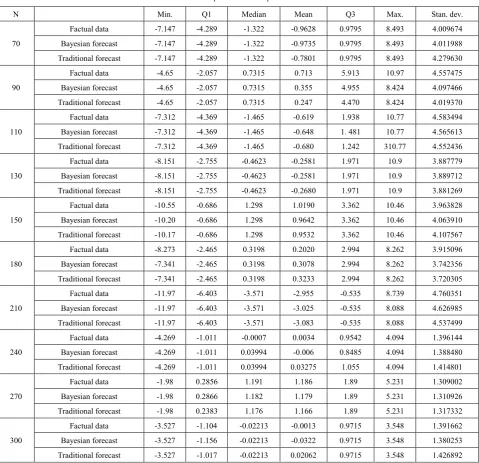
t= the forecast value at time t, n= the number of observations, and ESS = the error sum of square. [image:4.595.352.556.76.321.2]The comparison of forecast accuracy between Bayesian method in equation (3.16) with traditional method in equation (3.17) is presented in the Table 1. The comparison of descriptive statistics is presented in the Table 2, Columns 3 through 9 contain the minimum (Min), first quartile (Q1), median, mean, third quartile (Q3), maximum (Max), and standard deviation for N factual data, N-10 factual data and the result of Bayesian forecasting for the 10 steps ahead, and N-10 factual data and the result of traditional forecasting for the 10 steps ahead.
Table 1. Comparison of forecast accuracy
N Bayesian Traditional
Table 2. Comparison of descriptive statistics
N Min. Q1 Median Mean Q3 Max. Stan. dev.
70
Factual data -7.147 -4.289 -1.322 -0.9628 0.9795 8.493 4.009674 Bayesian forecast -7.147 -4.289 -1.322 -0.9735 0.9795 8.493 4.011988 Traditional forecast -7.147 -4.289 -1.322 -0.7801 0.9795 8.493 4.279630
90
Factual data -4.65 -2.057 0.7315 0.713 5.913 10.97 4.557475 Bayesian forecast -4.65 -2.057 0.7315 0.355 4.955 8.424 4.097466 Traditional forecast -4.65 -2.057 0.7315 0.247 4.470 8.424 4.019370
110
Factual data -7.312 -4.369 -1.465 -0.619 1.938 10.77 4.583494 Bayesian forecast -7.312 -4.369 -1.465 -0.648 1. 481 10.77 4.565613 Traditional forecast -7.312 -4.369 -1.465 -0.680 1.242 310.77 4.552436
130
Factual data -8.151 -2.755 -0.4623 -0.2581 1.971 10.9 3.887779 Bayesian forecast -8.151 -2.755 -0.4623 -0.2581 1.971 10.9 3.889712 Traditional forecast -8.151 -2.755 -0.4623 -0.2680 1.971 10.9 3.881269
150
Factual data -10.55 -0.686 1.298 1.0190 3.362 10.46 3.963828 Bayesian forecast -10.20 -0.686 1.298 0.9642 3.362 10.46 4.063910 Traditional forecast -10.17 -0.686 1.298 0.9532 3.362 10.46 4.107567
180
Factual data -8.273 -2.465 0.3198 0.2020 2.994 8.262 3.915096 Bayesian forecast -7.341 -2.465 0.3198 0.3078 2.994 8.262 3.742356 Traditional forecast -7.341 -2.465 0.3198 0.3233 2.994 8.262 3.720305
210
Factual data -11.97 -6.403 -3.571 -2.955 -0.535 8.739 4.760351 Bayesian forecast -11.97 -6.403 -3.571 -3.025 -0.535 8.088 4.626985 Traditional forecast -11.97 -6.403 -3.571 -3.083 -0.535 8.088 4.537499
240
Factual data -4.269 -1.011 -0.0007 0.0034 0.9542 4.094 1.396144 Bayesian forecast -4.269 -1.011 0.03994 -0.006 0.8485 4.094 1.388480 Traditional forecast -4.269 -1.011 0.03994 0.03275 1.055 4.094 1.414801
270
Factual data -1.98 0.2856 1.191 1.186 1.89 5.231 1.309002 Bayesian forecast -1.98 0.2866 1.182 1.179 1.89 5.231 1.310926 Traditional forecast -1.98 0.2383 1.176 1.166 1.89 5.231 1.317332
300
Factual data -3.527 -1.104 -0.02213 -0.0013 0.9715 3.548 1.391662 Bayesian forecast -3.527 -1.156 -0.02213 -0.0322 0.9715 3.548 1.380253 Traditional forecast -3.527 -1.017 -0.02213 0.02062 0.9715 3.548 1.426892
5. Conclusions
The results in the Table 2 shows that the forecast accuracy value of the Bayesian method is smaller than the traditional method, it is indicates that the forecast accuracy the Bayesian forecasting is better than the traditional forecasting. The results in the Table 3 shows that descriptive statistics of Bayesian forecasting is closer to the factual data as compared to traditional forecasting, so it can be concluded that Bayesian forecasting is better than traditional forecasting.
REFERENCES
[1] Assis, K, Amran, A. and Remali, Y. (2010). Forecasting Cocoa Bean Prices Using Univariate Time Series Models.
Journal of Arts & Commerce. ISSN 2229-4686, Vol.- I, Issue-I, 71-80
[2] Bain, L.J. and Engelhardt, M.(1992). Introduction to Probability and Mathematical Statistics, 2nd. Duxbury Press,
Belmont, California.
[3] Bijak, J. (2010). Bayesian Forecasting and Issues of Uncertainty. Centre for Population Change, University of Southampton, 1-19.
[4] Box, G.E.P. and Jenkins, G. M. (1976). Time Series Analysis: Forecasting and Control. Holden-Day, San Francisco. [5] Enders, W. (1995). Applied Econometric Time Series. John
Wiley & Son. Inc. New York.
[6] Faisal, F. (2012). Forecasting Bangladesh’s Inflation Using Time Series ARIMA Models. Paper.
Process and Its Application. International Business Research, 1(4), 49-55.
[8] Gelman, A. (2008), Objections to Bayesian statistics,
Bayesian Analysis 3(3), 445−450.
[9] Geweke, J and Whiteman, C., (2004), Bayesian Forecasting, Department of Economics, University of Iowa.
[10] Ihaka, R. (2005). Time Series Analysis. Statistics Department University of Auckland.
[11] Kleibergen, F. and Hoek, H. (1996). Bayesian Analysis of ARMA model Using Non informative Prior. Paper, Econometric Institute, Erasmus University, Rotterdam, 1−24
[12] Liu,S. I.(1995). Bayesian Multiperiod Forecasts for ARX Models. Ann. Inst. Statist. Math. Vol. 47, no.2,211-224.
[13] Liu,S.I.(1995). Comparison of Forecast sfor AR Models Between A Random Coefficient Approach and A Bayesian Approach. Commun Statist.- Theory Meth., 24(2), 319-333
[14] Mohamed, I., Zaharim, A. and Yahya M.S. (2002). Penganggaran Parameter bagi Model BL (p,0,1,1) dengan Pendekatan Bayesian. Matematika, jilid 18, bil. 2, hlm. 129-136, Jabatan Matematika UTM.
[15] Pole, A., West, M. and Harrison, J. (1994). Applied Bayesian Forecasting and Time Series Analysis. Chapman and Hall, New York.
[16] Ramachandran, K.M. and Tsokos, C.P. (2009).Mathematical Statistics with Applications, Elsevier Academic Press. San Diego, California.
[17] Salam, M.A., Salam, S., and Feridun, M. (2006). Forecasting Inflation in Developing Nations: The Case of Pakistan.
International Research Journal of Finance and Economics, ISSN 1450-2887, Issue 3, 138-159.
[18] Research Journal of Finance and Economics, ISSN 1450-2887, Issue 62, 111- 142
[19] Stovicek K. (2007). Forecasting with ARMA Models, The case of Slovenian Inflation, Prikazi in analize XIV/1, 23-45.
[20] Uturbey, W. (2006). Identification of ARMA Model by Bayesian Methods Applied to Streamflow Data. 9th International Conference on Probabilistic Method Applied to Power Systems KTH ( 11-15June 2006, Stockholm, Sweden ), 1-7