Journal of Chemical and Pharmaceutical Research, 2012, 4(10):4646-4650
Research Article
CODEN(USA) : JCPRC5
ISSN : 0975-7384
Syntheses, characterization and Thermal Studies of Cadmium (II) Complexes
of Some Heterocyclic Ligands
Nandababu Singh Laishram
Department of Chemistry, D. M. College of Science, Imphal (Manipur) - 795001
_____________________________________________________________________________________________
ABSTRACT
Cadmium (II) acetate complexes of some heterocyclic ligands like 2,2’ – bipyridine (bipy) and 1,10 – phenanthroline (phen)were synthesized. These complexes were characterized with the help of elemental analyses, i.r. spectral studies, molar conductance measurement and thermal analyses studies. They were found to have the formulae:
(
)
1
2 2
.2
2Cd L OAc
H O
and 22(
)
22
.
CCd L OA
H O
whereL
1=
2, 2 '
−
bipyridine(bipy),L
2=
1,10
−
phenanthrolile and OAc = acetate ion. From the thermal analyses, thermodynamic parameters such as
Ea
*
(activation energy),
∆
H
(enthalpy change) and∆
S
(entropy change) for the dehydration and decomposition reactions of the complexes, were evaluated using some standard methods. The order of stability of the anhydrous complexes, was found to be of the following increasing order:(
) (
2)
2(
) (
2)
2Cd phen
OAc
Cd bipy
OAc
<
Key words : Cadmium (II) acetate,heterocyclic ligands, elemental analyses, infrared spectra and thermal analyses.
_____________________________________________________________________________________________
INTRODUCTION
On extensive literature survey, it was found that works on 2,2’- bipyridine and 1,10 – phenanthroline complexes of cadmium (II) acetate, was very rare. To the best of my knowledge, no one had reported thermal investigations of thecadmium(II)acetate complexes of 2,2’–bipyridine and 1,10 – phenanthroline in detail. Besides this these two complexes were not reported except some similar types [1-11].
The present aim of the work is to synthesize cadinium (II) acetate complexes of 2,2’-bipydine and 1,10-phenanthroline and to carry out thermal investigations (both TGA and DTA) by pyrolyticheating of these complexes
under non- isothermal conditions and to evaluate thermodynamic parameters such as Ea* (activation energy),
∆
H
(enthalpy change) and∆
S
(entropy change) of dehydration and decomposition reaction of complexes using standard methods [12 -14].Thermalstability order of the complexes are to be compared.
EXPERIMENTAL SECTION
______________________________________________________________________________
Syntheses of Metal complexes:
(
) (
c
)
Cd bipy
2OA
2
.2H O(1) :
215 ml of ethanolic solution of 2,2’ – bipyridine (4 mmol) was added drop by drop to 25 ml of cadmium (II) acetate solution (8mmol) in ethanol with constant stirring. To the resulting mixture dry ether was added drop by drop with vigorous stirring and thereby white shiny complex separated out immediately. It was, then, filtered, washed with dry ether and dried over fused calcium chloride in a dessiccator. Yield: ca.80%.
(
) (
)
Cd phen
2OAc
2
.H O(2) :
2This complex was also prepared in the same way as that of complex (1) mentioned above. Here, the colour of the complex is also white.Yield :ca. 85%
Cadmium was estimated gravimetrically using the standard procedure [16]. C,H and N analyses were done by Perkin – Elmer 240C and Carlo Erba 1106 elemental analysers. Thermal investigations (both TGA and DTA) were carried out on a Shimadzu Thermal Analyzer DT-30 under a dynamic nitrogen atmosphere with a heating rate of 100C min-1 and
α
-alumina as the standard reference substance.Activation energy (Ea*) was evaluated from TGA curve using the equation of Horowitz and Metzger [12] and from DTA curve using that of Borchardt and Daniels [13].
∆
H
was evaluated from DTA curve using the relation [13],,
H
KA
∆ =
where K is the heat transfer co-efficient (cell constant or calibration constant, here the cell is platinum crucible and its constant, K was evaluated using indium metal as calibrant) and A is the total area under the particular DTA curve measured with a compensating planimeter with optical tracer of Fuji corona 027.∆
S
wascalculated from the relation [14],
S
H
Tm
∆
∆ =
, Tm being the DTA peak temperature in kelvin.Infrared and far i.r. – spectra were recorded with Beckmann IR20A and Perkin Elmer 783 Spectrometers in KBr and polythene powder discs. Conductivity measurements of the complexes in DMF at the concentrator of 10-3 M were recorded at room temperature with PC 510 PH and conductivity bench meter (Eutech).
RESULTS AND DISCUSION
The complexes (1) and (2) were not reported earlier. Both are white in colour. The complexes were characterized by elemental analyses, infrared spectral data, thermal analyses data and molar conductance measurements. They were
found to have the formulae:
(
) (
)
22 2
.2
0 (1)
Cd bipy
OAc
H
and(
) (
)
22 2
.
0 (2)
Cd
phen
OAc
H
respectively.
Elemental analyses data and Molar conductance values:
Elemental analyses data of complexes (1) and (2) (Table1) prove that both the heterocyclicligands – 2,2’– bipyridine(bipy) and 1,10–phenanthroline(phen) are coordinated with cadmium metal in their corresponding complexes.
TABLE – 1 : Elemental Analyses data and molar conductance values of 2,2’-bipyridine (bipy) and 1,10-phenanthroline (phen) Complexes of Cd(II).
Complex compounds Colour Yield (%)
Elemental Analyses:Found (Calcd.) %
M
Λ
(Ohm-1cm2mol-1) Cd C H N
(1) 12
(
)
22
.2
CdL
OAc
H O
White 80% 19.48(19.42) 49.80 (49.75)
4.42 (4.49)
9.70
(9.67) 10
(
)
Infrared Spectral Studies:
The key IR spectral data of complexes (1) and (2) are shown in table–2. In case of complexes (1) and (2), the
( )
OH
ν
bands appear at 3460cm-1 and 3420 cm-1 respectively (table-2), showing the presence of lattice water molecules [19].Presence of such lattice water molecules, is further supported by the appearance ofδ
(
HOH
)
bands at 1600 cm-1 and 1660 cm-1 for complexes (1) and (2) respectively.
ν
a(
COO
−)
for both the complexes (1)and (2) appear at 1715 cm-1and that of
ν
s COO
(
−)
appear at 1460 cm-1.TABLE – 2: Key IR Spectral bands (cm-1) of Metal Complexes
Metal Complexes
ν
( )
OH
δ(
HOH)
ν
a(
COO)
−
(
)
s COO
ν −
∆
ν
ν(Cd−N) ν(Cd−O)(1) 12
(
)
22
.2
CdL OAc
H O
3460(br) 1600(vs) 1715(s) 1460(s) 255 540 (w) 450(br)340 (w) 320 (w)
(2) 22
(
)
22
.
CdL
OAc
H O
3420(br) 1660(w) 1715(ms) 1460(s) 255 530 (w) 450(w)350 (w) 265 (w)
Here, v=very, s=strong, m=medium, w=weak, and br=broad.
The difference between
ν
a(
COO
−)
andν
s(
COO
−)
,i.e.,∆
ν
for each of the complexes is found to be 255 cm-1which is very high and establishes the fact that the acetato group
(
CH COO
3 −)
acts as unidentate ligand by linking one donor O-atom with cadmiumin both the complexes (1) and (2) respectively [19 -20].Further, appearance of
ν
(
Cd
−
N
)
bands for both the complexes (1) and (2) in the range 540 – 450 cm-1 supports the coordination of both 2,2’-bipyridine and 1,10-phenathroline with cadmium through their N-donor atoms in their corresponding complexes [21-22].Again, appearance of
ν
(
Cd
−
O
)
bands for both the complexes (1) and (2) in the range 350-265cm-1, proves thecoordination of acetato
(
CH COO
3 −)
group with cadmium through their O-donor atoms in their corresponding complexes [21].Thermal Analyses Studies:
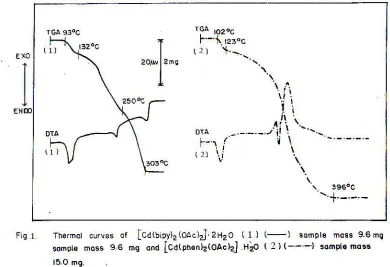
When complex (1) is heated under non-isothermal condition, mass loss in its TGA curve in thetemperature range 93-1320C (as shown in Fig.1) corresponds to the loss of two lattice water molecules forming the complex
(
) (
2)
2Cd bipy
OAc
(step 1(a)).For this step 1(a), DTA curve shows an endothermic peak at 1020C andvalues of
∆
H
and∆
S
are 44 KJmol-1 and 117JK-1mol-1respectively (as shown in table 3).On further heating
(
) (
)
2 2
Cd bipy
OAc
is converted intoCd(OAc)2via the intermediate
Cd bipy
(
)(
OAc
)2
______________________________________________________________________________
TABLE – 3: Thermal parameters of 2,2’-bipyridine (L1) and 1,10 – phenanthroline (L2) complexes of Cd(II) (values are to the nearest whole number)
Dehydration and Decomposition reactions of Metal complexes.
Temperature range (0C)
DTA peak temperature
(0C)
Ea* (KJmol-1)a
Enthalpya change
H
∆
(
1)
KJmol−
Entropya change
S
∆
(
1 1)
JK mol
− − Endo Exo TGA DTA1(a)
( )
( )
1 1
2 2 .2 2 2 2
Cd L OAc H O Cd L OAc
→
93-132 102 - - - 44 117
(b)
( )
( )
1 1
2 2 2
Cd L OAc
Cd L OAc
→
132-250 228 - 80 - - -(c) 1
(
)
(
)
2 2
Cd L OAc
Cd
OAc
→
250-303 300 - 206 - - -2(a)
( )
( )
2 2
2 2
.
2 2 2CdL OAc
HO
CdL OAc
→
102-123 113 - - - 24 62(b) 22
(
)
(
)
2 2
Cd L OAc
Cd
OAc
→
123-396 - 253 99 69 136 259a In some cases thermodynamic parameters are not possible to evaluate due to some irregular nature of the TGA and
DTA curves.
Ea* for this step 2 (b) are 99 and 69 KJmol-1 from TGA and DTA respectively. The corresponding values of
∆
H
and∆
S
for this step 2 (b) are 136 KJmol-1 and 259JK-1mol-1 respectively (table -3).From the above discussion, the less stability of the complex
(
) (
)
2 2
Cd phen
OAc
than(
) (
)
2 2
Cd bipy
OAc
, may be attributed to more pronounced steric effect (repulsive force) between acetato (CH3COO-) groups and more
bulkier phenanthroline groups around the large size cadmium ion.
CONCLUSION
Cadmium (II) acetate forms octahedral complexes with 2,2’-bipyridine and 1,10-phenanthroline respectively. And the thermal stability order of the anhydrous forms of cadmium (II) acetate complexes of 2,2’-bipyridine and 1,10 –
phenanthroline, follows the trend:
(
) (
)
(
) (
)
2 2 2 2
Cd phen
OAc
Cd bipy
OAc
<
.Acknowledgement
The author is very thankful to Department of Chemistry, Manipur University, Canchipur (Imphal) for some of the instrumental facilities provided for this research work. Lastly, the author is very much thankful to Prof. (Dr.) SamiranMitra, Department of Chemistry, Jadavpur University, Kolkata for his valuable helpand encouragement during the research work.
REFERENCES
[1] I.S. Ahuja; R. Singh; C.P. Rai.Journal of Molecular Structure, 1978,49(1), 201- 205.
[2] S.J. Black; F.W.D. Einstein; P.C. Hayes; R. Kwrar; D.G. Tuck.Inorg. Chem., 1986, 25, 4181-4184. [3] C. Airoldi; S.F. De Oliveira; S.G. Ruggiero: J.R. Lechat. Inorg.Chim.Acta.,1990, 174,103-108. [4] T. Aiba; A. Otsuka; K.-i.Tsunoda; H. Akaiwa.Anal. Sci.,1995, 11,63-66.
[5] V.W.-W. Yam; Y.-L.Pui; K.-K. Cheung. New J.Chem.,1999, 23, 1163 – 1169. [6] C.S. Lai; E.R.T. Tiekink.Appl.Organometallic Chem.,2003, 17,139-140.
[7] A.I. El- Said; A.A.M. Aly; M.S. El-Meligy (the late); M.A. Ibrahim.J. Argent. Chem. Soc.,2009, 97(2), 149-165. [8] X.-Q.Zhang;Q.Yu; H.-D.Bian; X.-G.Bao; H. Liang.J. Coord. Chem., 2009, 62 (13), 2108-2117.
[9] Q.-L.Wu; Z.-R.Luo; J.-C.Zhuang; X.-H.Yin.J.Chem.Crystallogr.,2011, 41,664-669. [10] S.-F.Wu; J.-Z.Liu; M.-X.Meng;W.-Q.Luo. Z. Kristallogr., 2012,NCS227, 163 – 164.
[11] A. Manohar; K. Ramalingam; K. Karpagavel; A. Kulandaisamy.Int. J. Chem Tech Res.,2012, 4(3), 1023 – 1032.
[12] H.H. Horowitz; G. Metzger.Anal.Chem.,1963, 35, 1464. [13] H.J. Borchardt; F. Daniel.J.Am. Chem., Soc., 1957, 79, 41-46. [14] L.K. Singh; S. Mitra.J.Chem, Soc., Dalton Trans., 1987, 2089-2094.
[15] A.I. Vogel. A Text Book of Practical organic Chemistry, 4th Edition, ELBS and Longmanns, London, 1980; 269-272.
[16] A.I. Vogel.A Text Book of Quantitative Inorganic Analysis, 3rd Edition, LEBS and Longmanns, London,
1968;495.
[17] S. Glasstone. An Introduction to Electrochemistry, 10th Printing, Affiliated East- West Press Private Limited, New Delhi,1942; 71.
[18] S.I. Habib; S. Shah N.N.; M.A. Baseer; P.A. Kulkarni.J. Chem. Pharm. Res.,2011, 3(1),788-792.
[19] K. Nakamoto. Infrared and Raman Spectra of Inorganic and Coordination Compounds (Part – B), 5th Edition, John Wiley and Sons Inc., New York, 1997; 54-62.
[20] P. Arya; S. Shrivastava; N. Singh; S. Chandra.J. Chem. Pharm. Res.,2010, 2(3), 626 – 630. [21] S. A. Aly.J. Chem. Pharm. Res.,2011, 3(6), 1028-1036.