LEARNING STYLES AND ACADEMIC ACHIEVEMENT AMONG BUILDING CONSTRUCTION STUDENTS
MIMI MOHAFFYZA BINTI MOHAMAD
A thesis submitted in fulfilment of the requirements for the award of the degree of
Doctor of Philosophy (Technical and Vocational Education)
Faculty of Education Universiti Teknologi Malaysia
ABSTRACT
This study is conducted to identify how learning styles (LS) influence the students’ academic achievement based on cognitive mastery and vocational elements in Building Construction Subject (BCS) involving the students and teachers of Building Construction Course (BCC) from three secondary vocational schools in Johor. Descriptive case study was applied with quantitative and semi-structured interview as supporting components in this study. The quantitative data were gathered based on Felder and Silverman Learning Styles Model (FSLSM), Felder-Soloman Index of Learning Styles (ILS) and vocational cognitive elements which consist of the aspects of knowledge, skills and problem solving were taken into account in constructing the question items. Purposive sampling was used to select the schools and stratified sampling procedure was applied in the selection of 128 students as research respondents. Purposive sampling was also chosen to select teachers as respondents for interview. The quantitative data was analyzed in descriptive and inferential statistic involving parametric test; Chi Square and
ABSTRAK
TABLE OF CONTENTS
CHAPTER TITLE PAGE
DECLARATION ii
DEDICATION iii
ACKNOWLEDMENT iv
ABSTRACT v
ABSTRAK vi
TABLE OF CONTENTS vii
LIST OF TABLES xi
LIST OF FIGURES xiv
LIST OF ABBREVIATIONS xvi
LIST OF APPENDICES xvii
1 INTRODUCTION 1
1.1 Introduction 1
1.2 Background of Problem 3
1.2.1 Identifying Learning Styles 5
1.2.2 Student Learning 11
1.3 Statement of Problem 17
1.5 Research Questions 19
1.6 Hypotheses 20
1.7 Research Conceptual Framework 23
1.8 Significant of Research 26
1.9 Research Assumption 28
1.10 Scope of the Research 28
1.11 Definition of Terms 29
1.12 Chapter Summary 37
2 LITERATURE REVIEW 39
2.1 Introduction 39
2.2 Learning Styles (LS) 40
2.2.1 Identifying Learning Styles 41
2.2.2 LS Models and Theories 44
2.2.3 Felder and Silverman Learning Styles Model (FSLSM)
53 2.3 Comparison between Learning Styles Model 61 2.4 Learning Styles in Vocational Education 62
2.5 Cognitive Perspectives 65
2.6 Cognitive Domain of Bloom’s Taxonomy Educational Objectives
70 2.7 Revision of Bloom’s Taxonomy- Anderson &
Krathwohl Taxonomy
74 2.8 Cognitive Learning in Vocational Education 78
2.9 Vocational Elements in BCS 83
2.10 Vocational Education 88
3 RESEARCH METHODS 93
3.1 Introduction 93
3.2 Research Design and Procedure 93
3.3 Research Respondents 99
3.4 Research Instruments 101
3.4.1 Felder Soloman Learning Styles Index (ILS)
101 3.4.2 Set of Questionnaires for Students’
Perception in Cognitive Learning (SPCL)
104 3.4.3 Cognitive Mastery Achievement Test
(CMAT)
107
3.4.4 Semi structured Interview 111
3.5 Reliability and Validity 113
3.5.1 Pilot Study 114
3.6 Methods of Data Analysis 127
3.6.1 Quantitative Data Analysis 127
3.6.2 Qualitative Data Analysis 128
3.7 Chapter Summary 130
4 DATA ANALYSIS 131
4.1 Introduction 131
4.8 Analysis of Research Question (vii) 147 4.9 Analysis of Research Question (viii) 150 4.10 Conclusion of quantitative analysis 152 4.12 Analysis of Research Question (ix) 153 4.13 Analysis of Research Question (x) 157
4.14 Conclusion of qualitative 161
4.15 Chapter Summary 163
5 DISCUSSION, RECOMENNDATION AND
CONCLUSION
164
5.1 Introduction 164
5.2 Research Overview 164
5.3 Research Discussion 168
5.3.1 Learning Styles (LS) 168
5.3.2 Cognitive Learning 174
5.4 Recommendations 186
5.4.1 Teachers 187
5.4.2 Students 188
5.4.3 Curriculum Designer 190
5.5 Cognitive Learning Styles Framework (C-LSF) 191 5.5 Recommendations for Future Research 195
5.6 Conclusion 196
REFERENCES 197
LIST OF TABLES
TABLE NO. TITLE PAGE
1.1 Result Analysis of Sijil Pelajaran Malaysia in Building Construction Technology 2006-2009
12 1.2 Analysis of Students Achievement in Building Construction
Modules
13
1.3 Types of Learners and Creative Thinking 15
1.4 Teachers Strategies for Student Performance 15
2.1 Families of Learning Styles 44
2.2 Dunn and Dunn’s Model and Instruments of Learning Style 45
2.3 Myers-Briggs Type of Indicator (MBTI) 47
2.4 Entwistle’s Approaches and Study Skills Inventory for Students
48
2.5 Honey and Mumford LSQ 49
2.6 Kolb’s Experiential Learning Model 51
2.7 Vermunt’s Inventory of Learning Styles 52
2.8 Semantic Groups associated with the ILS Questions 57
2.9 Test-Retest Correlation Coefficients 58
2.10 Cronbach Alpha Coefficients 58
2.11 ANOVA Results for Time Comparison 59
2.12 Learning Styles Model 61
2.13 General Education versus Vocational Education 62
2.14 Bloom’s Taxonomy Educational Objectives 73
2.15 The Knowledge Dimension 75
2.16 The Cognitive Process Dimension 77
2.17 Cognitive Learning Characteristics 80
2.18 Cognitive Level in Construction Material Module 82 2.19 Cognitive Level in Construction Technology Module 83
2.20 Knowledge Bases 85
3.1 Research Respondents 99
3.2 Selecting Research Respondents 100
3.4 Matrix Bloom Taxonomy 105
3.5 Items Construct 106
3.6 CMAT Items Construct 108
3.7 Construction Material Subject Specification 109
3.8 Construction Technology Subject Specification 110
3.9 Table of Specification for BCS CMAT 111
3.10 Interview Protocol 112
3.11 Rating Scale Instrument Quality Criteria 113
3.12 ILS Person Reliability 115
3.13 ILS Items Reliability 115
3.14 ILS Processing Dimension 116
3.15 ILS Perception Dimension 116
3.16 ILS Input Dimension 117
3.17 ILS Understanding Dimension 117
3.18 SPCL Items in Questionnaires 118
3.19 Person Measure of SPCL 118
3.20 Item Measure of SUCL 119
3.21 Knowledge Construct 119
3.22 Skills Construct 120
3.23 Problem Solving Construct 120
3.24 Percent-Agreement Items of SPCL 122
3.25 Person Measure CMAT 123
3.26 Item Measure CMAT 123
3.27 Knowledge Construct 124
3.28 Skills Construct 124
3.29 Problem Solving Construct 125
3.30 Percent-Agreement Items of CMAT 126
3.31 Methods of Quantitative Data Analysis 127
3.32 Methods of Qualitative Data Analysis 129
4.1 Descriptive Statistics of ILS 133
4.2 Categories of Learners 142
4.3 Semantic Group with ILS Questions 134
[image:9.595.122.517.66.757.2]4.5 Kruskal-Wallis Test Statistics 136
4.6 Marks Distribution in Achievement Test 139
4.7 School Grade System 139
4.8 Students’ Grade 140
4.9 Grading Criteria 141
4.10 Multivariate Test on Processing Dimension 142
4.11 Tests of Between-Subjects Effects Processing-Cognitive Learning
143 4.12 Analysis Processing Dimension Across-Cognitive Learning 143
4.13 Multivariate Tests on Perception Dimension 145
4.14 Tests of Between-Subjects Effects Perception-Cognitive Learning
146 4.15 Analysis Perception Dimension Across-Cognitive Learning 146
4.16 Multivariate Tests on Input Dimension 148
4.17 Tests of Between-Subjects Effects Input- Cognitive Learning
149 4.18 Analysis Input Dimension Across-Cognitive Learning 149 4.19 Multivariate Tests on Understanding Dimension 151 4.20 Tests of Between-Subjects Effects
Understanding-Cognitive Learning
151 4.21 Analysis Understanding Dimension Across-Cognitive
Learning
152
LIST OF FIGURES
FIGURE NO TITLE PAGE
1.1 The role of teaching to adapt students learning 6
1.2 Students’ Learning Styles in Hands-on Course 7
1.3 Students’ Learning Styles in Mixed Course 8
1.4 Students’ Learning Styles in Paper-Based Course 8 1.5 Pre-Service Teachers in Engineering Education
Learning Styles
9
1.6 Learning Styles among Major Subject 10
1.7 Research Conceptual Framework 25
2.1 Three Layer Onion Ring Model of LS by Curry 1993 45
2.2 Kolb’s Experiential Learning Model (ELM) 50
2.3 ILS Felder Soloman 56
2.4 Correlation between LS 60
2.5 Relationship of Cognitive, Affective and Psychomotor Domain
72
2.6 Learning Model and VET Students Preferences 81
2.7 Making Vocational Education Works 91
3.1 Stage 1 Research Procedure 96
3.2 Stage 2 Research Procedure 97
3.3 Stage 3 Research Procedure 98
3.4 ILS Felder-Soloman 102
3.5 A Visual Model of the Coding in Qualitative 129
4.1 Number of Respondents 132
4.2 Boxplot Graph of Knowledge Elements 136
4.3 Boxplot Graph of Skills Elements 137
4.4 Boxplot Graph of Problem Solving Elements 137
4.5 Distribution of Students’ Marks in Achievement Test 140
4.6 Summary of Qualitative 162
5.1 BCC students’ characteristic attributes 170
5.3 Connection between Active Learner and Problem Solving
180 5.4 Connection between Sensing Learner and Problem
Solving
182 5.5 Connection between Visual Learner with Skills and
Problem Solving
184 5.6 Connection between Sequential Learner with
Knowledge and Skills
185 5.7 Learning Styles and Significant factors in C-LSF 186
5.8 Applying Visual Styles in Skills 187
5.9 Applying Visual Styles in Problem Solving 188
LIST OF ABBREVIATIONS
AC - Abstract Conceptualization
AE - Active Experimentation
ASSIST - Approaches and Study Skills Inventory for Students
BC - Building Construction
BCC - Building Construction Course
BCI - Building Construction Industry
BCS - Building Construction Subject
CDC - Curriculum Development Center
CE - Concrete Experience
C-LSF - Cognitive Learning Style Framework
CMAT - Cognitive Mastery Achievement Test
ELM - Experiential Learning Style Model
FSLSM - Felder Silverman Learning Style Model
ILS - Index of Learning Styles
LS - Learning Styles
LSQ - Learning Styles Questionnaires
MANOVA - Multivariate Analysis of Variance
MBTI - Myer-Briggs Type Indicator
MOE - Ministry of Education
PLSPQ - Perceptual Learning Styles Questionnaire
RO - Reflective Observation
SPM - Sijil Pelajaran Malaysia
TVE - Technical Vocational Education
TVED - Technical and Vocational Education Division VAKT - Visual, Auditory, Kinesthetic and Tactile
LIST OF APPENDICES
APPENDIX TITLE PAGE
A Felder-Soloman Index of Learning Styles 212
B Inventori Gaya Pembelajaran 218
C Student Perception of Cognitive Learning 226
D Cognitive Mastery Achievement Test 231
E Interview Protocol 248
F Interview Transcription 249
G Letter of Approval (Ministry of Education) 265 H Permission using ILS- Dr. Richard M Felder 267
H Translation Approval 268
CHAPTER 1
INTRODUCTION
1.1 Introduction
Every year, the Malaysian Government spends a great deal of money on the improvement of the quality of education. Education is an expensive investment in the future of students, and much emphasis is placed on the curriculum and values of education to enable the students to meet the needs of the industry. Teaching and learning is the root of all advancement in all levels of education, namely, primary, secondary, college, and university. The difference between the levels is the level of difficulty that students face. The Taxonomy of Educational Objectives by Bloom (1956) classified learning into three major areas; cognitive, affective, and psychomotor.
and follow instructions. An awareness of the interaction between students, teachers, and teaching materials must also be present.
Student learning is often taken for granted. Students are assumed academically capable of understanding lessons and assignments. The majority of them do pass, but for those who fail, the blame falls on the academic standards or teaching methods. Little consideration is given to the ways that students learn and the students’ learning styles. Ideally, the way teachers teach should match the way students learn, as well as how they prefer to learn. Teachers must adapt their teaching approaches to suit the ways students learn and their learning styles.
The elements of learning styles (LS) appeared in the research literature as early as 1892 (Fatt, 2000). The term “learning styles” was probably first used by Thelen (Madeline et. al, 2003) who discovered group dynamics at work. LS may also be defined as the tendency to adopt a particular strategy of learning. Teachers, then, should have the ability to understand how students learn. According to Felder (1993), students and teachers may prefer one learning style in one subject but generally prefer one style for most subjects that they learn or teach. Therefore, teachers may use this information from Felder (1993) to make sure they utilize all different learning styles, and students can use this information by realizing how they like to receive information.
inventories that can identify what type of learner a student may be have been published. In a classroom where only one approach to learning is encouraged by a teacher, some students may possibly work and learn less effectively than others (Alan, 2009). For this reason, an awareness of learning styles is important for teachers.
Students in vocational education (VE) are exposed to an educational system that is oriented more towards getting a job, and their learning styles are different from students in academic fields. Thus, VE is possibly an educational pursuit oriented to provide the necessary knowledge and skills to perform a particular job, occupation, or professional activity in the labor market (International Labour Organization, 1995). VE is also connected to technology transfer, innovation, and development. In vocational teaching, as in many knowledge areas, identifying and understanding learner differences to adapt the institute’s needs to best suit the learning conditions and aptitudes of the students is important. The need to adapt teaching strategies to student learning styles and preferences is a reality in the classroom, which can be observed in real situations or in virtual approaches. However, these findings do not suggest that individual methods should be created for each student in a classroom. The best form of interaction for each of them should be identified by building groups of learners with common characteristics (Luciana et al., 2008).
1.2 Background of the Problem
requirements in a global context, and the demands of cognitive development (Tee et al., 2009). In their cognitive research, Johnson and Thomas (1992) summarized that learning does not automatically change and that understanding the learning content is difficult. Cognitive processes are not encouraged by passive learning.
VE students have their own learning preferences, considering they rely less on their cognitive abilities and more on their psychomotor talents, including physical movement, coordination, and use of motor skills (Bloom, 1956). They need to increase their cognitive abilities with a suitable approach so that they can be creative and innovative workers in order to do well in their work situation. The suitable approach in this case is perhaps the identification of the students’ learning styles that equal to VE characteristics to produce suggestions on overcoming the problems. Bloom (1989) also states that the ability of students to learn basic principles and their ability to apply knowledge or explained what they learned.
1.2.1 Identifying Learning Styles
Learning styles can be classified into various categories, for example, sensory, auditory, visual, and tactile. Dunn and Dunn (1992) reported that learning styles is an individual reaction to several environmental, emotional, psychological, and sociological factors. In vocational schools, the VE students have their own characteristics, according to Brennan (2003). They are verbal learners who watch and see rather than read and listen. They are hands-on and learn by doing and practicing. They learn in groups and are dependent learners who need instructor guidance for clear understanding. Considering that the characteristics of students in VE are more hands-on, and that they learn by doing, an understanding of this type of LS will help teachers provide a teaching delivery method that matches their students’ needs.
[image:20.595.149.471.84.365.2]
(Source: John, 1995)
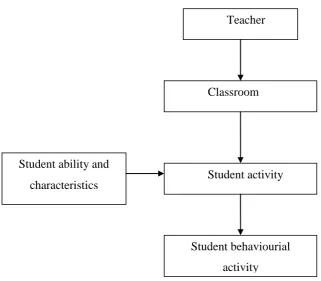
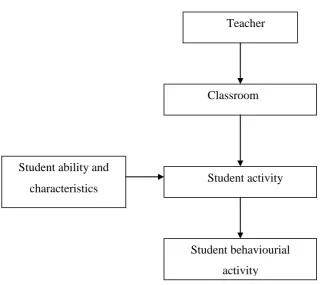
Figure 1.1 : Adapting to students learning
VE encompasses a wide range of courses or skills that help students prepare to enter an occupational-based employment or workplace (International Labour Organization, 2000). The concept behind VE is to bridge theory and practical components, such as lab- and workshop-oriented knowledge to workplace knowledge, with specific skills. As a result, vocational students have their own LS. In here research on learning strategies among vocational students, Briggs (2000) concluded that vocational students benefited from three types of courses, namely, “hands-on courses,” “mixed-courses,” and “paper-based courses.” She also classified the analysis of LS into visual, auditory, and kinesthetic (VAK) to create a basis for innovation in teaching and learning strategies.
A visual style relies on seeing and reading, auditory depends on listening and speaking, and a kinesthetic style focuses on touching and doing. Figure 1.2 shows the use of LS in hands-on courses. Hands-on courses refer to hairdressing, plumbing, professional craft catering, and painting. This group showed that their preference was for visual strategies. The figure illustrated three categories of students’ score as
Teacher
behaviour
Classroom
environment
Student ability and
characteristics Student activity
Student behaviourial activity
indicating strong, medium, and weak use of visual, auditory, and kinesthetic learning style strategies. The results show that the students most preferred visual learning strategies The results show that the highest number of students scored in visual strategies. This means that the students scored strongly in a range of visual strategies. Meanwhile, 20 students strongly used auditory learning strategies, and only 18 students strongly applied the kinesthetic approach to learning.
(Source: Briggs,2000)
Figure 1.2: Students’ Learning Styles in Hands-on Courses
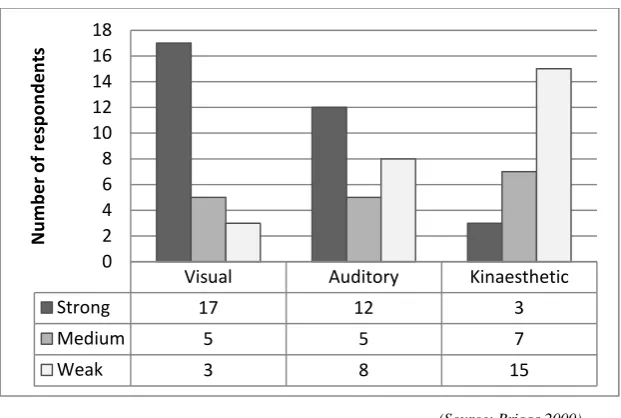
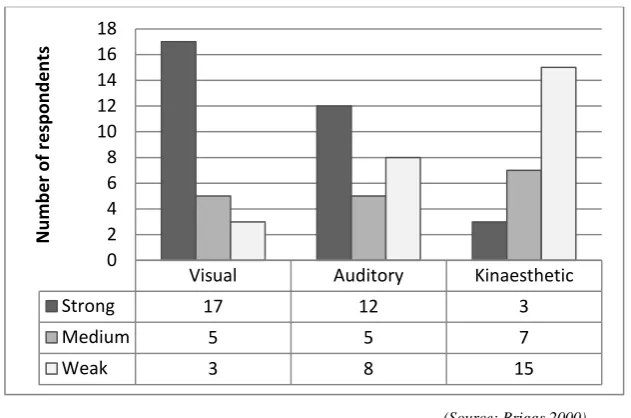
Briggs (2000) used the same method of using learning strategies for “mixed” courses. Mixed courses refer to courses that involve a mixture of paper-based and hands-on materials. Mixed courses represent the course related to engineering education and performing arts. The result showed that this group preferred visual strategies the most and kinesthetic strategies the least. Figure 1.3 shows that the students preferred visual learning styles (17 students) over both auditory (12 students) and kinesthetic styles (3 students).
Visual Auditory Kinaesthetic
Strong 30 20 18
Medium 10 15 10
Weak 15 10 27
0 5 10 15 20 25 30 35
N
u
m
b
e
r
o
f R
Esp
o
n
d
e
n
(Source: Briggs,2000)
Figure 1.3: Students’ Learning Styles in Mixed Courses
Figure 1.4 shows the profiles of LS for students in a paper-based course. The students investigated were involved in business, public service, and health science courses. The results showed a strong use of visual strategies among students in “paper-based” courses. Forty-five students preferred visual study approaches, 20 who preferred auditory, and 19 students who preferred kinesthetic. Generalizing course groups is difficult, even when they are aggregated. However, students in paper-based courses appeared to choose visual and auditory strategies more than students did in hands-on courses.
[image:22.595.194.484.493.674.2](Source: Briggs,2000)
Figure 1.4: Students’ Learning Styles in Paper-Based Courses
The concept of LS is understood by VE teachers as a legitimate way of expressing individual differences in the way their students learn. However, the
Visual Auditory Kinaesthetic
Strong 17 12 3
Medium 5 5 7
Weak 3 8 15
0 2 4 6 8 10 12 14 16 18 N u m b e r o f r e sp o n d e n ts
Visual Auditory Kinaesthetic
Strong 45 20 19
Medium 10 25 21
Weak 5 15 20
fundamental concept of LS is and understanding of the characteristics and dimensions of various learning strategies. Research conducted by Peter (2003) indicated that understanding students’ LS and preferences is very important for teachers. Peter also suggested an LS model among VE practitioners. A survey conducted by Muhammad et al. (2010) involved 48 pre-service Engineering teachers with a major in mechanical, electrical, or civil engineering to identify their learning styles. This study was designed to prepare students to become future teachers when they completed their degrees in Technical and Vocational Education. The pre-service teachers were students attending schools during their practicum. They taught engineering subjects containing both task theory and hands-on components. The characteristics of engineering education are similar to VE, meaning that the results could be used to represent how the pre-service teachers accommodated various learning styles and learning preferences. As future teachers, they needed to equip themselves with strong skills in behavioral, cognitive, and constructivist basics so that they will be able to accommodate students’ learning styles.
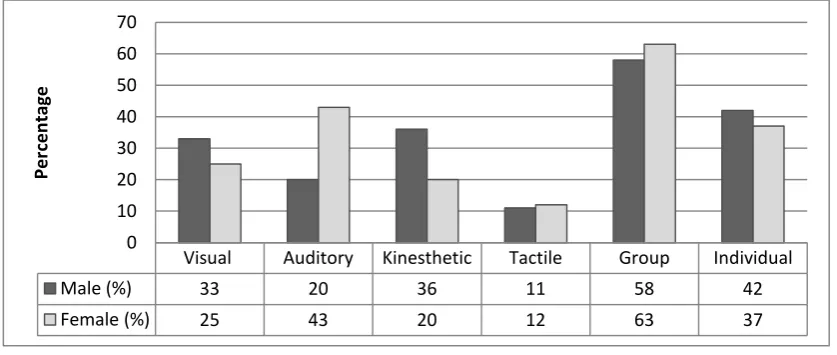
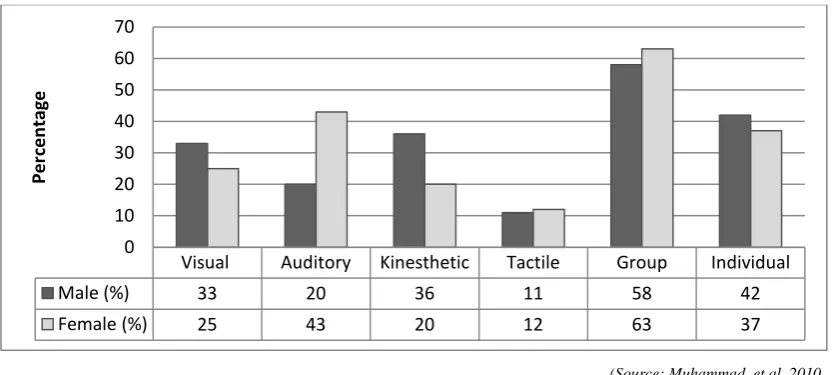
The study used Perceptual Learning Styles Questionnaires (PLSPQ) distributed to 48 students, 20 males and 28 females. The results are illustrated in Figure 1.5, which shows that male students preferred visual (33%) and kinesthetic (36%) learning, whereas female students were more likely to be auditory learners (43%). Both female (63%) and male students (58%) liked to learn in groups.
(Source: Muhammad, et.al, 2010
Figure 1.5: Pre-Service Teachers in Engineering Education Learning Styles Visual Auditory Kinesthetic Tactile Group Individual
Male (%) 33 20 36 11 58 42
Female (%) 25 43 20 12 63 37
0 10 20 30 40 50 60 70
Per
ce
n
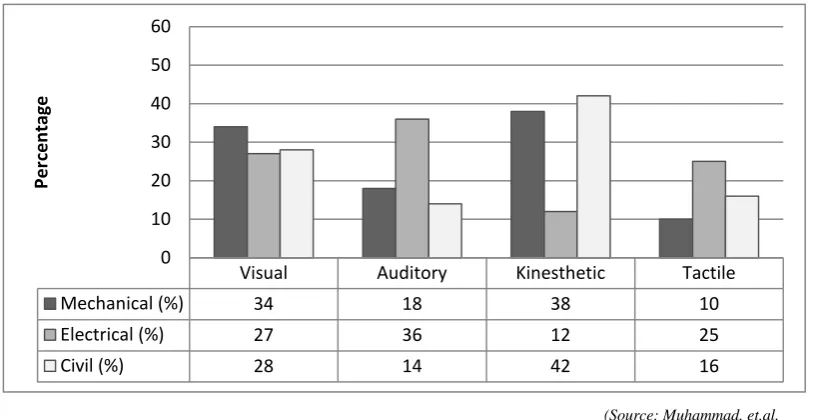
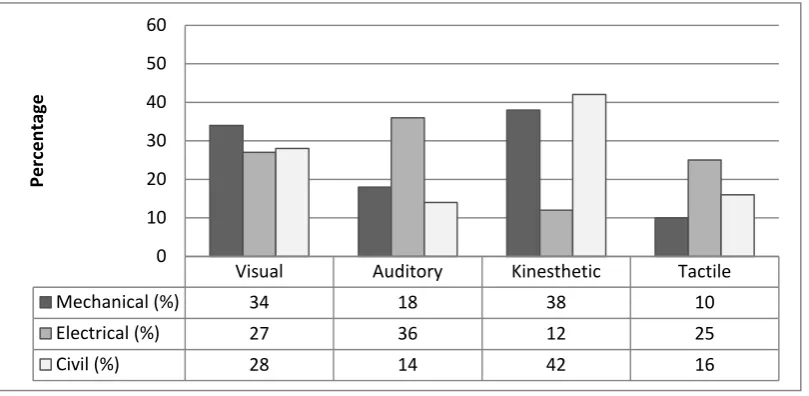
[image:23.595.115.534.548.725.2]Figure 1.6 presents the results from the study based on the students’ major. The results show that 38% of mechanical engineering students were kinesthetic learners, whereas 34% of them were visual learners. Electrical engineering students prefer auditory learning styles (36%) while civil engineering students scored the highest for kinesthetic learning style (42%).
(Source: Muhammad, et.al,
2010)
Figure 1.6: Learning Styles among Major Subject
Auditory learners learn better in a lecture class and by listening to someone. Many students also like to learn by doing exercises and drills in class. This is one of the characteristics of a kinesthetic learner. Tactile learners are the rarest of the other learning preferences. However, most students were undecided regarding tactile learning styles. The dominant learning style of engineering pre-service teachers was visual, and these teachers were comfortable with pictures, images, and graphs while studying and retaining information. Muhammad et Al. (2010) also showed that, in terms of visual learning, the majority of students agreed that when learning a new skill, they would rather watch someone demonstrate the skill than listen to someone talk about the skill.
Visual Auditory Kinesthetic Tactile
Mechanical (%) 34 18 38 10
Electrical (%) 27 36 12 25
Civil (%) 28 14 42 16
0 10 20 30 40 50 60
Per
ce
n
CHAPTER 1
INTRODUCTION
1.1 Introduction
Every year, the Malaysian Government spends a great deal of money on the improvement of the quality of education. Education is an expensive investment in the future of students, and much emphasis is placed on the curriculum and values of education to enable the students to meet the needs of the industry. Teaching and learning is the root of all advancement in all levels of education, namely, primary, secondary, college, and university. The difference between the levels is the level of difficulty that students face. The Taxonomy of Educational Objectives by Bloom (1956) classified learning into three major areas; cognitive, affective, and psychomotor.
awareness of the interaction between students, teachers, and teaching materials must also be present.
Student learning is often taken for granted. Students are assumed academically capable of understanding lessons and assignments. The majority of them do pass, but for those who fail, the blame falls on the academic standards or teaching methods. Little consideration is given to the ways that students learn and the students‟ learning styles. Ideally, the way teachers teach should match the way students learn, as well as how they prefer to learn. Teachers must adapt their teaching approaches to suit the ways students learn and their learning styles.
The elements of learning styles (LS) appeared in the research literature as early as 1892 (Fatt, 2000). The term “learning styles” was probably first used by Thelen (Madeline et. al, 2003) who discovered group dynamics at work. LS may also be defined as the tendency to adopt a particular strategy of learning. Teachers, then, should have the ability to understand how students learn. According to Felder (1993), students and teachers may prefer one learning style in one subject but generally prefer one style for most subjects that they learn or teach. Therefore, teachers may use this information from Felder (1993) to make sure they utilize all different learning styles, and students can use this information by realizing how they like to receive information.
identify what type of learner a student may be have been published. In a classroom where only one approach to learning is encouraged by a teacher, some students may possibly work and learn less effectively than others (Alan, 2009). For this reason, an awareness of learning styles is important for teachers.
Students in vocational education (VE) are exposed to an educational system that is oriented more towards getting a job, and their learning styles are different from students in academic fields. Thus, VE is possibly an educational pursuit oriented to provide the necessary knowledge and skills to perform a particular job, occupation, or professional activity in the labor market (International Labour Organization, 1995). VE is also connected to technology transfer, innovation, and development. In vocational teaching, as in many knowledge areas, identifying and understanding learner differences to adapt the institute‟s needs to best suit the learning conditions and aptitudes of the students is important. The need to adapt teaching strategies to student learning styles and preferences is a reality in the classroom, which can be observed in real situations or in virtual approaches. However, these findings do not suggest that individual methods should be created for each student in a classroom. The best form of interaction for each of them should be identified by building groups of learners with common characteristics (Luciana et al., 2008).
1.2 Background of the Problem
learning does not automatically change and that understanding the learning content is difficult. Cognitive processes are not encouraged by passive learning.
VE students have their own learning preferences, considering they rely less on their cognitive abilities and more on their psychomotor talents, including physical movement, coordination, and use of motor skills (Bloom, 1956). They need to increase their cognitive abilities with a suitable approach so that they can be creative and innovative workers in order to do well in their work situation. The suitable approach in this case is perhaps the identification of the students‟ learning styles that equal to VE characteristics to produce suggestions on overcoming the problems. Bloom (1989) also states that the ability of students to learn basic principles and their ability to apply knowledge or explained what they learned.
1.2.1 Identifying Learning Styles
Learning styles can be classified into various categories, for example, sensory, auditory, visual, and tactile. Dunn and Dunn (1992) reported that learning styles is an individual reaction to several environmental, emotional, psychological, and sociological factors. In vocational schools, the VE students have their own characteristics, according to Brennan (2003). They are verbal learners who watch and see rather than read and listen. They are hands-on and learn by doing and practicing. They learn in groups and are dependent learners who need instructor guidance for clear understanding. Considering that the characteristics of students in VE are more hands-on, and that they learn by doing, an understanding of this type of LS will help teachers provide a teaching delivery method that matches their students‟ needs.
[image:30.595.142.464.85.370.2]
(Source: John, 1995)
Figure 1.1 : Adapting to students learning
VE encompasses a wide range of courses or skills that help students prepare to enter an occupational-based employment or workplace (International Labour Organization, 2000). The concept behind VE is to bridge theory and practical components, such as lab- and workshop-oriented knowledge to workplace knowledge, with specific skills. As a result, vocational students have their own LS. In here research on learning strategies among vocational students, Briggs (2000) concluded that vocational students benefited from three types of courses, namely, “hands-on courses,” “mixed-courses,” and “paper-based courses.” She also classified the analysis of LS into visual, auditory, and kinesthetic (VAK) to create a basis for innovation in teaching and learning strategies.
A visual style relies on seeing and reading, auditory depends on listening and speaking, and a kinesthetic style focuses on touching and doing. Figure 1.2 shows the use of LS in hands-on courses. Hands-on courses refer to hairdressing, plumbing, professional craft catering, and painting. This group showed that their preference was for visual strategies. The figure illustrated three categories of students‟ score as
Teacher
behaviour
Classroom
environment
Student ability and
characteristics Student activity
Student behaviourial activity
indicating strong, medium, and weak use of visual, auditory, and kinesthetic learning style strategies. The results show that the students most preferred visual learning strategies The results show that the highest number of students scored in visual strategies. This means that the students scored strongly in a range of visual strategies. Meanwhile, 20 students strongly used auditory learning strategies, and only 18 students strongly applied the kinesthetic approach to learning.
(Source: Briggs,2000)
Figure 1.2: Students‟ Learning Styles in Hands-on Courses
Briggs (2000) used the same method of using learning strategies for “mixed” courses. Mixed courses refer to courses that involve a mixture of paper-based and hands-on materials. Mixed courses represent the course related to engineering education and performing arts. The result showed that this group preferred visual strategies the most and kinesthetic strategies the least. Figure 1.3 shows that the students preferred visual learning styles (17 students) over both auditory (12 students) and kinesthetic styles (3 students).
Visual Auditory Kinaesthetic
Strong 30 20 18
Medium 10 15 10
Weak 15 10 27
0 5 10 15 20 25 30 35
N
u
m
b
e
r
o
f R
Esp
o
n
d
e
n
(Source: Briggs,2000)
Figure 1.3: Students‟ Learning Styles in Mixed Courses
Figure 1.4 shows the profiles of LS for students in a paper-based course. The students investigated were involved in business, public service, and health science courses. The results showed a strong use of visual strategies among students in “paper-based” courses. Forty-five students preferred visual study approaches, 20 who preferred auditory, and 19 students who preferred kinesthetic. Generalizing course groups is difficult, even when they are aggregated. However, students in paper-based courses appeared to choose visual and auditory strategies more than students did in hands-on courses.
[image:32.595.188.481.496.680.2](Source: Briggs,2000)
Figure 1.4: Students‟ Learning Styles in Paper-Based Courses
The concept of LS is understood by VE teachers as a legitimate way of expressing individual differences in the way their students learn. However, the
Visual Auditory Kinaesthetic
Strong 17 12 3
Medium 5 5 7
Weak 3 8 15
0 2 4 6 8 10 12 14 16 18 N u m b e r o f r e sp o n d e n ts
Visual Auditory Kinaesthetic
Strong 45 20 19
Medium 10 25 21
Weak 5 15 20
fundamental concept of LS is and understanding of the characteristics and dimensions of various learning strategies. Research conducted by Peter (2003) indicated that understanding students‟ LS and preferences is very important for teachers. Peter also suggested an LS model among VE practitioners. A survey conducted by Muhammad et al. (2010) involved 48 pre-service Engineering teachers with a major in mechanical, electrical, or civil engineering to identify their learning styles. This study was designed to prepare students to become future teachers when they completed their degrees in Technical and Vocational Education. The pre-service teachers were students attending schools during their practicum. They taught engineering subjects containing both task theory and hands-on components. The characteristics of engineering education are similar to VE, meaning that the results could be used to represent how the pre-service teachers accommodated various learning styles and learning preferences. As future teachers, they needed to equip themselves with strong skills in behavioral, cognitive, and constructivist basics so that they will be able to accommodate students‟ learning styles.
The study used Perceptual Learning Styles Questionnaires (PLSPQ) distributed to 48 students, 20 males and 28 females. The results are illustrated in Figure 1.5, which shows that male students preferred visual (33%) and kinesthetic (36%) learning, whereas female students were more likely to be auditory learners (43%). Both female (63%) and male students (58%) liked to learn in groups.
(Source: Muhammad, et.al, 2010
Figure 1.5: Pre-Service Teachers in Engineering Education Learning Styles Visual Auditory Kinesthetic Tactile Group Individual
Male (%) 33 20 36 11 58 42
Female (%) 25 43 20 12 63 37
0 10 20 30 40 50 60 70
Per
ce
n
[image:33.595.109.529.550.737.2]Figure 1.6 presents the results from the study based on the students‟ major. The results show that 38% of mechanical engineering students were kinesthetic learners, whereas 34% of them were visual learners. Electrical engineering students prefer auditory learning styles (36%) while civil engineering students scored the highest for kinesthetic learning style (42%).
(Source: Muhammad, et.al, 2010)
Figure 1.6: Learning Styles among Major Subject
Auditory learners learn better in a lecture class and by listening to someone. Many students also like to learn by doing exercises and drills in class. This is one of the characteristics of a kinesthetic learner. Tactile learners are the rarest of the other learning preferences. However, most students were undecided regarding tactile learning styles. The dominant learning style of engineering pre-service teachers was visual, and these teachers were comfortable with pictures, images, and graphs while studying and retaining information. Muhammad et Al. (2010) also showed that, in terms of visual learning, the majority of students agreed that when learning a new skill, they would rather watch someone demonstrate the skill than listen to someone talk about the skill.
Richard and Stephen (1998) stated that two methods of assessing learning styles, self-reports and observed behavior, were used. Self-reports use the learning material preferred by the students. They will show whether a student‟s awareness is in line with that individual‟s actual performance.” Observed behavior requires the
Visual Auditory Kinesthetic Tactile
Mechanical (%) 34 18 38 10
Electrical (%) 27 36 12 25
Civil (%) 28 14 42 16
0 10 20 30 40 50 60
Per
ce
n
[image:34.595.110.515.199.397.2]teachers to give the students information in a variety of ways and observe what version the student picks. Both these methods contribute in assessing the learning style of the student. They are, however, not without their problems. One way of improving learning performance is to adapt the mode of each student‟s style. Research is needed to find the most efficient ways of doing this (Richard and Stephen, 1998).
1.2.2 Student Learning
Meeting the students‟ needs requires the teacher to identify several aspects about the students‟ learning, such as the individual learner characteristics, learner characteristics within the wider community, learning processes within the learning environment, and learning process within the curriculum (Richard & Stephen, 1998; Jones & Charlton, 1998). In Malaysia, the focus is on the learning process within the curriculum. The school curriculum contains core subjects and elective subjects based on the students‟ achievements and choices. The secondary school system consists of academic, technical, vocational, Islamic, and private schools. Every school in Malaysia has a different curriculum. In vocational schools, two curriculums are used: vocational courses and skill-based courses. Vocational courses are based on a major field, such as Building Construction, Electronics, Machine Shop Practice, Welding, and Office Technology Management, to name a few. The curriculum is divided into 45% academic subjects and 55% vocational subjects (Curriculum Department of Technical and Vocational, 2003). This study focused on Building Construction Subjects (BCS) to investigate the factors needed for students‟ learning and students‟ learning styles.
and have chosen it as their career path. BC is one of the vocational subjects in that students can choose to learn more about the construction process. Students‟ knowledge in both the theoretical and practical aspects is assessed. Some of the criteria evaluated in the main examination (Malaysian Examination Board 2003) were:
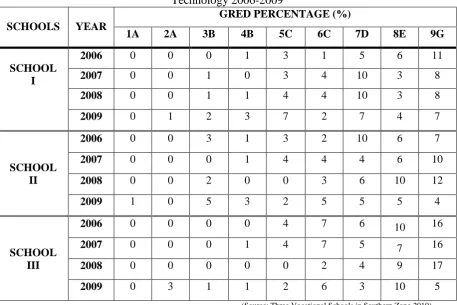
[image:36.595.88.546.449.754.2]The Malaysian Examination Board (2003) reported that students lack the ability to solve problems in Parts C and D. Based on the results analysis for “Sijil Pelajaran Malaysia” (SPM), the subject, BC Technology, showed the lowest level of achievement. Table 1.1 shows the results for three schools in Southern Zone Peninsular Malaysia. A large number of failures (9G) was shown over the years.
Table 1.1: Result Analysis of „Sijil Pelajaran Malaysia‟ in Building Construction Technology 2006-2009
SCHOOLS YEAR
GRED PERCENTAGE (%)
1A 2A 3B 4B 5C 6C 7D 8E 9G
SCHOOL I
2006 0 0 0 1 3 1 5 6 11
2007 0 0 1 0 3 4 10 3 8
2008 0 0 1 1 4 4 10 3 8
2009 0 1 2 3 7 2 7 4 7
SCHOOL II
2006 0 0 3 1 3 2 10 6 7
2007 0 0 0 1 4 4 4 6 10
2008 0 0 2 0 0 3 6 10 12
2009 1 0 5 3 2 5 5 5 4
SCHOOL III
2006 0 0 0 0 4 7 6 10 16
2007 0 0 0 1 4 7 5 7 16
2008 0 0 0 0 0 2 4 9 17
2009 0 3 1 1 2 6 3 10 5
(Source: Three Vocational Schools in Southern Zone,2010) i) Knowledge and theory understanding
An analysis of school-based assessment in BC Modules using the modular system shows that a few students were able to obtain good scores in Parts C and D. Table 1.2 presents the school-based assessment analysis.
Table 1.2: Analysis of Students Achievement in Building Construction Modules
PARTS MODULES
MARKS/PERCENTAGES
0-5 6-10 11-15 16-20 21-25 26-30 %SCORE
A
I 2.44 9.76 29.27 58.54 - - 87.81
II 2.50 5.00 50.00 45.00 - - 45.00
B
I - - 7.5 50.00 - - 95.00
II - - 2.50 10.00 52.50 35.00 97.50
C
I 17.50 50.00 27.50 5.00 - - 32.5
II 35.50 32.50 20.00 7.50 5.00 2.50 15.00
D
I 20.00 67.5 7.50 7.50 - - 15.00
II 10.00 55.00 32.50 5.00 - - 5.00
(Source: Vocational School in Southern Zone, 2010)
Teachers agree that one of the factors that influence students‟ learning is teaching style. Various inventories, questionnaires, and indexes were produced to identify the student‟s learning styles. One of the learning style models is the Felder and Silverman Learning Styles Model (FSLSM), which is designed to identify students‟ learning styles based on the information processing and dimensions that students acquire in their learning (Felder and Silverman, 1988). The original FSLSM was developed by Richard Felder and Linda Silverman to address the student learning in engineering education (Felder and Silverman, 1988). However, studies show that the usefulness of FSLSM has since extended to various subject disciplines, such as language, medical, science, and engineering-related disciplines (Chipo, 2007).
type of learner based on a 44-item questionnaire. Each dimension is associated with 11 forced-choice items, each either with an option (a) or (b) to match up to one or another category of the dimension. The details of ILS are further explained in the chapter on literature and research methods. FSLSM is a learning style model often used in other subject disciplines that can provide a more detailed description of LS. No specific model of is LS proposed to measure LS for vocational students, but FSLSM characteristics can be used. The dimension of FSLSM and the items in the Felder–Soloman Learning Styles Index are suitable for identifying students‟ learning styles in the BC Course (BCC).
In a related research, Muhammad et al. (2011) classified 68 vocational students into four learning types according to the Index of Learning Styles (ILS). The dimension of creative thinking in problem solving among students was also investigated. The results showed that the dominant type of learners was the visual learner. They also observed a significant difference between visual learners who used creative thinking in problem solving (p<0.05). Visual students choose to manipulate ideas as a creative problem solving skill. Other types of learners included active, sensing, and sequential learners. The result showed that the students who are active, sensing, and sequential learners are no different in terms of their problem-solving strategies because they used creative thinking elements.
Table 1.3: Types of Learners and Creative Thinking
(Source: Muhammadvet.al, 2011)
Standardized tests do not measure student achievement perfectly. Vocational students do not perform as well on standardized tests as academic students. Based on the analysis above, teachers from three schools were interviewed to discuss how they overcame the problem. They proposed a few techniques for teaching and learning. They concluded that because they must finish the syllabus, they were not able to spend more time helping the weaker students. A checklist showing the techniques used by the teachers to overcome weaknesses in their students is shown in Table 1.4 based on the interviews. This checklist is a modification of a checklist developed by Nurul (2003) and shows how teachers can cater to students‟ learning preferences. According to the table below, teachers have no specific way to determine student learning preferences and know of no other way to record their students‟ performances beside examination results. This is unfortunate, given teachers should know if their students have the ability to master certain cognitive levels in their lessons.
Table 1.4: Teachers Strategies for Student‟s Performance
Techniques Often Sometimes Rarely
Drilling style
Motivation camp
Small group discussion
Personal approach
Special workshop
Self learning approach
Memorizing
Knowing students preferences
Variety teaching method
(Source :Nurul,2003) Styles
Creative thinking in problem solving
p Manipulating
idea
Exploring knowledge
Identify the factors
Using logic
Mean SD Mean SD Mean SD Mean SD
Active 1.75 .35 1.89 .54 0.68 .58 0.68 .65 .577
Sensing 1.34 .39 0.98 .25 2.01 .68 0.67 .34 .609
Visual 2.39 .28 1.22 .45 1.01 .33 0.16 .65 .038
[image:39.595.114.520.610.767.2]According to the feedback from classroom observation (Ruth 1992), the vocational teachers did the following:
i. Used slightly more class time for instructional activities ii. Spent less time lecturing and explaining or presenting material iii. Worked more with students in small groups and individually iv. Used textbooks and worksheets less
v. Used a wider variety of tools
vi. Engaged students more in task or activities in which students exercised a degree of control, such as physical demonstrations, practice and performance, and role playing
vii. Used paper and pencil tests less and performance appraisals more
The basic element in measuring student achievement is the ability of students to master a subject. The cognitive domain is the root of learning. In BCS, the structure of the subjects is based on the cognitive level. Bloom‟s Taxonomy (1989) was used in the curriculum, and the specific needs of the vocation were considered. The elements proposed in the curriculum were knowledge, skills, and problem solving. This study merged Bloom‟s Taxonomy (1956) with a revised taxonomy by Anderson and Krathwohl (2001) to determine students‟ learning abilities in BCS. The elements measured were determined by the criteria evaluated by the SPM and structured from the Malaysian Examination Board (2003). The students‟ learning styles were also investigated to determine if there was a connection with the students‟ mastery of the subject.
in general education, engineering education, or vocational education. However, the majority of adaptive systems focusing on LS incorporate only some aspects of traditional LS models rather than an all-purpose model that shows how an LS can be used as guide for the cognitive, behavioral, and psychomotor skills of a student (Sabine & Silvia, 2007).
1.3 Statement of Problem
The learning process is an interaction between students, teachers, and teaching materials. The emphasis should always be on the process of student learning. Ideally, the way teachers teach should match the way students learn. Teachers should be concerned with the students‟ learning styles. Learning styles have a descriptive range, from the relatively fixed natural disposition of the student to the modifiable preferences for learning and studying. Learning styles are a component of the wider concept of personality. Since LS plays such a critical role in the learning process, teachers should not neglect to address how to relate the learning styles into the teaching and learning process, especially with how these factors can contribute the students‟ achievement.
Building Construction Course is one of the vocational courses offered in certain Vocational School in Malaysia. It encompasses many areas of study for the BC Industries, such as masonry, carpentry, plumbing, painting, and all areas related to building construction. Students learn both theory and practical skills in BC. The question is, how can they learn to become more effective in the theory portion of their classes if the typical vocational student prefers to learn by doing and practicing?
and related studies. The analysis of students‟ achievements, based on examinations for the BC subject from 2006 to 2009, showed a notable number of students who scored in grade 8E and 9G yearly. This study explores the possibility that one of the factors contributing to this is the students‟ learning styles. A few factors were investigated to identify how students in BCC use their LS and academic achievements through cognitive learning. This study was based on the body of existing knowledge on LS and their importance for both students and teachers. This study provided meaningful suggestions on overcoming the problem regarding LS for BCC students, which can be adapted to suit their cognitive learning needs to promote problem solving and generate new ideas, thereby increasing the students‟ academic achievements. This study also suggested a cognitive learning framework using LS in BCC to help teachers assess the LS of their students.
1.4 Research Objectives
i. To identify the learning styles of Building Construction students
ii. To identify the students‟ perception of their own cognitive learning in Building Construction
iii. To determine the cognitive mastery of students in Building Construction.
iv. To analyze the differences between Felder–Silverman Learning Styles dimensions and the mastery in cognitive learning of Building Construction students.
vi. To explore how teachers accommodate students‟ learning and cognitive mastery in Building Construction Subject?
vii. To produce a student learning framework for Building Construction Education based on the students‟ learning styles and cognitive learning.
1.5 Research Questions
i. What are the types of learners that represent Building Construction Students?
ii. What are the differences between each type of learner in Building Construction based on Felder and Solomon‟s Index of Learning Styles?.
iii. How do Building Construction students perceive their own cognitive learning?
iv. How do the students master their cognitive learning in Building Construction subjects?
v. What are the differences between processing dimension (active and reflective learning styles) and the students‟ mastery of cognitive learning?
vii. What are the differences between the input dimension (visual and verbal learning styles) and the students‟ mastery of cognitive learning?
viii. What are the differences between the understanding dimension (sequential and global learning styles) and the students‟ mastery of cognitive learning?
ix. How can teachers accommodate their students‟ learning styles in Building Construction Subject?
x. How do teachers accommodate students‟ learning styles in terms of cognitive mastery in Building Construction Subject?
xi. What are the learning framework elements based on the learning styles and cognitive learning of BC Education?
1.6 Hypotheses
Research Question (ii): What are the differences between each type of learner, in Building Construction, based on Felder & Solomon‟s Index of Learning Styles?
Ho: There is no significant difference between active, sensing, visual and sequential styles among BCC students.
Ha: There is significant difference between active, sensing, visual and sequential styles among BCC students.
Knowledge:
Ho: There is no significant difference between active and reflective processing dimensions.
Ha: There is a significant difference between active and reflective processing dimensions.
Skills:
Ho: There is no significant difference between active and reflective processing dimension
Ha: There is a significant difference between active and reflective processing dimension
Problem Solving abilities:
Ho: There is no significant difference between active and reflective processing dimensions
Ha: There is a significant difference between active and reflective processing dimensions
Research Question (vi) What are differences between perception dimension (sensing
and intuitive learning styles) and students‟ mastery of cognitive learning?
Knowledge:
Ho: There is no significant difference between sensing and intuitive learning styles.
Ha: There is significant difference between sensing and intuitive learning styles
Skills:
Ho: There is no significant difference between sensing and intuitive learning styles.
Problem Solving abilities:
Ho: There is no significant difference sensing and intuitive learning styles. Ha: There is a significant difference sensing and intuitive learning styles.
Research Question (vii): What are differences between input dimension (visual and
verbal learning styles) and students‟ mastery of cognitive learning?
Knowledge:
Ho: There is no significant difference between visual and verbal learning styles. Ha: There is a significant difference between visual and verbal learning styles.
Skills:
Ho: There is no significant difference between visual and verbal learning styles. Ha: There is a significant difference between visual and verbal learning styles.
Problem Solving abilities:
Ho: There is no significant difference visual and verbal learning styles Ha: There is a significant difference visual and verbal learning styles.
Research Question (viii What are differences between understanding dimension
(sequential and global learning styles) and students‟ mastery of cognitive learning?
Knowledge:
Ho: There is no significant difference between sequential and global learning styles
Ha: There is a significant difference between sequential and global learning styles
Skills:
Ho: There is no significant difference between sequential and global learning styles
Problem Solving abilities:
Ho: There is no significant difference sequential and global learning styles. Ha: There is a significant difference sequential and global learning styles.
1.7 Research Conceptual Framework
The framework provides all the parameters, conditions, and support various learning (Kuchi et al., 2003). A research conceptual framework was designed as a guideline to merge the theory, model, and factors to overcome research problems. This study is focused on the two factors investigated, namely, the learning styles and cognitive learning related to students‟ academic achievement in BC for Vocational Schools. The variables investigated include the dependent and independent variables concerned on the characteristics of each type of learner according to Felder and Silverman, as well as the level of cognitive learning measuring students‟ perception and mastery through their academic achievement. The cognitive learning focused on Bloom‟s Taxonomy (1956) and Anderson and Krathwohl‟s Taxonomy (2001).This study used BC modules, which focused more on the three major vocational elements, namely, knowledge, skills, and problem solving to measure the cognitive mastery.
Figure 1.7 illustrates the framework used in this study. This study applied the FSLSM (Felder, 1993), which classified learning styles into four dimensions: processing, perception, input, and understanding. Using the Index of ILS proposed by Felder and Soloman (1997), the dimensions were further divided into eight types of learners. These are active, reflective, sensing, intuitive, visual, verbal, sequential, and global. The ILS contains 44 questions to determine the learner type. A taxonomy was used to identify the factors of cognitive learning. The cognitive process was easy to describe using this taxonomy to investigate the differences between the students‟ learning styles and their cognitive abilities.
provided carefully developed definitions for each factor in the cognitive domain. The categories were ordered from simple to complex and from concrete to abstract (David, 2002). The levels in Bloom‟s Taxonomy are knowledge, comprehension, application, analysis, synthesis, and evaluation. Knowledge is the rote recall of previously learned materials, which includes facts and definitions. Comprehension is described as the ability to make sense of a material. Application is the ability to use learned material in new situations. Analysis is the ability to break a material into its component parts. Synthesis refers to the ability to put parts together and see the greater whole. Evaluation is the ability to judge the value of a material based on specific criteria.
Anderson and Krathwohl‟s revised taxonomy used the verb forms of the words used by Bloom in the cognitive dimension. The revised taxonomy contains the following categories: remember, understand, apply, analyze, evaluate, and create. Remember means retrieving relevant knowledge from long-term memory. Understand means determining the meaning of instructional messages. Apply means carrying out a procedure in a given situation. Analyze refers to breaking the material into its constituent parts. Evaluate means making judgments based on criteria. Create means putting elements together to form something new. The combination of the two taxonomies produced the matrix used to categorize the vocational elements in BCS proposed by the Ministry of Education (2006). The vocational elements are knowledge, skills, and problem solving.
REFERENCES
AB Aziz L, Ismail Y and Abdul Aziz A.B, (2006).Civil Engineering Studies Form 5.Dewan Bahasa dan Pustaka: Kuala Lumpur
Abu Bakar Nordin & Bhasah Abu Bakar (2008). Penaksiran dalam Pendidikan Sains Sosial. Tanjung Malim: Universiti Pendidikan Sultan Idris
Akhras, N,F and Self, A,J, Modeling The Process, Not The Product of Learning,
Computer As Cognitive Tool-No More Walls, pp 3-28
Alan, P. (2009). Ways of Learning ; Learning Theories and Learnig Styles in The Classroom 2nd Edition. University of Warwick, UK: David Fulton Publishers Almasa,M.Parilah Mohd Shah, Fauziah Ahmad (2009). Perceptual learning styles of
ESL students. European Journal of Social Science,7(3),pp 101-113
Anderson, L. W and Krathwohl, D. R. (2001). A Taxonomy for Learning, Teaching and Assessing: A Revision of Bloom’s Educational Objectives. Boston, MA: Allyn and Bacon
Analisis Peperiksaan Sijil Pelajaran Malaysia Kursus Binaan Bangunan; 2006-2009 Sekolah Menengah Vokasional Batu Pahat (2010).. Unit Peperiksaan SMV Batu Pahat, Johor
Analisis Peperiksaan Sijil Pelajaran Malaysia Kursus Binaan Bangunan; 2006-2009 Sekolah Menengah Vokasional Muar (2010).. Unit Peperiksaan SMV Muar, Johor
Analisis Peperiksaan Sijil Pelajaran Malaysia Kursus Binaan Bangunan; 2006-2009 Sekolah Menengah Vokasional Segamat, Johor (2010).. Unit Peperiksaan SMV Segamat, Johor
Ashcraft, M.H. (1994). Human memory and cognition (2nd Ed.). NY: Harper CollinsAsmussen, K.J., & Creswell, J. W. (1995). Campus Response to a student gunman. Journal of Higher Education, 66, pp 575-591
Azizi Hj. Yahaya, Yusof Boon, Shahrin Hashim, Wan Zuraidah Wan Hamid (2003).
Kajian Hubungan Gaya Pembelajaran Dengan Pencapaian Akademik Pelajar Tingkatan Empat Sekolah Menengah Teknik Negeri Sembilan. (Kertas kerja
Azrilah Abdul Aziz (2010). Rasch Model Fundamentals: Scale Construct and Measurement Structure. Kuala Lumpur: Integrated Advanced Planning Sdn.Bhd
Bandura, A. (1977). Social learning theory. In B. B. Wolman & L. R. Pomroy (Eds.), International encyclopedia of psychiatry, psychology, psychoanalysis, and neurology (Vol. 10). New York: Van Nostrand Reinhold.
Baroody, A.J (2003). The Development of Adaptive Expertise and Flexibility: The Integration of Conceptual and Procedural Knowledge, in A.J. Baroody A. Dowker (Eds). The Development of Arithmetic Concept and Skills : Constructing Adaptive Expertise. , Erlbaum, Hillsdale, NJ
Becker, G.S. (1964) Human Capital. New York: National Bureau of Economic Research.
Benke, Ralph L., Jr. and Hermanson, Roger H. (1988) “Measuring Quality Teaching -
II.” Management Accounting. Vol. (69:8), pp.40-41, February
Bloom, B.(1956). Taxonomy of Educational Objectives: The Classification of Educational Goals; Handbook I: Cognitive Domain. New York, Longmans. Bloom, B.S (Ed) (1989). Taksonomi Objektif Pendidikan. Buku Pedoman
1:Domain Kognitif. Terjemahan Abdullah Junus. Kuala Lumpur: Dewan Bahasa dan Pustaka
Bettina L.B. (1988). Learning Styles and Vocational Education Practice. Clearing House on Adult, Carreer and Vocational Education
Blaug, M. (1973) Education and the Employment Problem in Developing Countries.Geneva: International Labor Office.
Bobby O. (2008).Applying Piaget’s Theory of Cognitive Development to Mathematics
Instruction. The Mathematics Educator Journal.Vol.18, No 1, pp 26-30
Bond T.G & Fox C.M (2007). Applying the Rasch Model: Fundamental Measurement in The Human Sciences. London: Lawrence Erlbaum Associates
Brennan, P. (2003). An Analysis of The Relationship among Hemispheric Preference and Analytic/Global Cognitive Style, Two Elements of Learning Style, Method of Instruction, Gender and Mathematics Achievement. Doctoral Dissertation St John‟s University Jamaica. Dissertation Abstract International 45/11, 3271A
Briggs Ann.R.J (2000). Promoting learning styles among vocational students. Journal of Education and Training, 42 (1),pp 16-23
Brueer, J.T. (1997). Education and the Brain: A Bridge Too Far. Educational Research
Cano, J., & Martinez, C. (1991). The relationship between cognitive performance and critical thinking abilities among selected agricultural education students.
Journal of Agricultural Education, 32(1), pp 24-29.
Carr, Kathryn S.(1990). How Can We Teach Critical Thinking? ERIC Clearing House on Elementary and Early Childhood Education Urbana IL, Childhood Education. pp 69-73
Cassidy, S. (2004). Learning Styles: An Overview of theories, models and measure.
Educational Psychology Journal. Vol.24, No 4, August 2004: Taylor & Francis Ltd. Pp 420-433
Caviglioli, Oliver; Haris, Ian and Tindall, Bill (2004). Thinking Skills & Eye Q ;Visual Tools for Raising Intellgence. UK : Network Educational Press Ltd Chipo Tsvigu (2007). Students’ Experiences. Learning Styles and Understanding of
Certain Culculus Concepts: A Case of Distance Learning at Zimbabwe Open University. Doctorial Thesis University of the Western Cape South Africa Chappell, C. (2003) Researching Vocational Education and Training: Where to From
Here? In Journal of Vocational Education and Training, 55/1, pp. 21-32. Chua, Y, P (2006). Kaedah dan Statistik Penyelidikan. Asas Statistik Penyelidikan
Buku 2. Kuala Lumpur: McGraw Hill.
Clark-Thayer, S. (1987). The Relationship of The Knowledge of Student-Perceived Learning Style Preferences and Study Habits and Attitudes to Achievement of College Freshman in a Small Urban University. Doctoral Dissertation St John‟s University Jamaica. Annotated Bibliography, 1991. New York: The Learning Styles Network
Curriculum Development Center, Ministry of Education.(2003) The Structure of Vocational Education in Vocational School.: Kuala Lumpur
Curriculum Development Center, Ministry of Education.(2006) Curriculum of Construction Materials and Construction Technology for Building Construction Course : Kuala Lumpur
Cury, L (1983). An Organization of Learning Styles Theory and Constructs. ERIC Document Retrievel Service.
Coffield, F.; Moseley, D.; Hall, E.; Ecclestone, K. (Ed.) (2004): Learning Styles and Pedagogy in post-16 Learning: A Systematic and Critical Review. Wiltshire: Learning and Skills Research Centre.