Journal of Chemical and Pharmaceutical Research
__________________________________________________
ISSN No: 0975-7384 CODEN(USA): JCPRC5
J. Chem. Pharm. Res., 2011, 3(3):137-147
1, 3, 4-Oxadiazole as antimicrobial agents: An overview
Shivi Bhatia and Monika Gupta*
ASBASJSM College of Pharmacy, Bela, Punjab, India
_____________________________________________________________________________
ABSTRACT
Oxadiazole derivatives have been extensively studied in the past few decades. It is a five membered heterocyclic ring that exist in four isomeric forms. Out of its four isomers 1, 3, 4-oxadizole exhibited a wide range of biological activities which includes antibacterial, antitubercular, vasodialatory, antifungal, cytotoxic, antiinflammatory, analgesic, hypolipidemic, anticancer and ulcerogenic activities. The present review deals with the various chemical aspects of 1,3,4-oxadiazoles. It includes the a rigorous literature survey on method of preparation and physicochemical properties of the said moiety. The methods of preparation discussed in this review have an extra edge over the conventional method of the synthesis like small reaction time, higher yield and cleaner reactions. The 1,3,4,-oxadiazole have shown significant antimicrobial activity against a wide variety of microorganisms like fungi, Gram +ve and Gram –ve bacteria. Keeping this in mind the special emphasis is given on recently reported oxadiazoles possessing antimicrobial activity.
Keywords: Oxadiazole, Antimicrobial activity, Acid hydrazides.
______________________________________________________________________________
INTRODUCTION
the past few decades and found potent in various pharmacological and pathological conditions [4].Literature reveals that 1, 3, 4-Oxadiazole is a highly privileged structure the derivatives of which exhibit a wide range of biological activities including antibacterial [5], antitubercular [6], vasodialatory [7], antifungal [8], cytotoxic [9], anti-inflammatory and analgesic [10,11], hypolipidemic [12], anticancer [13] and ulcerogenic [14] activities. Oxadiazole derivatives have been found to possess broad spectrum antimicrobial activity and therefore are useful substructures for further molecular exploration [15]. Furamizole (Compound 1) is a compound which is based upon 1,3,4-oxadiazole ring and has strong antibacterial activity.
Compound 1
Physical Properties of Oxadiazole
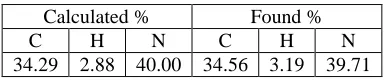
[image:2.595.204.415.191.306.2]Oxadiazole is a five membered heterocycle having two carbons, two nitrogens, one oxygen and two double bonds. The first monosubstituted 1,3,4-Oxadiazoles were reported in 1955 by two independent laboratories [ 16, 17]. Since 1955 other workers have extended this reaction 1, 3, 4-Oxadiazole boils at 150o C [18-20]. The percentage of C, H, N present in 1, 3, 4-Oxadiazole is given in table 1 [21].
Table: 1 Percentage of C, H, N present in 1, 3, 4-oxadiazole
Calculated % Found %
C H N C H N
34.29 2.88 40.00 34.56 3.19 39.71
The IR spectra of 1, 3, 4-oxadiazole is characterized by the bonds at 1640-1560 cm-1(C=N) and 1020 cm-1(C=O) [22]. The position of both protons of 1, 3, 4-Oxadiazole in 1H-NMR (דa) is 1.27.
The refractive index (n25D) of 1, 3, 4-Oxadiazole is 1.43 [21]. The mass spectra showed that the base peak is the molecular ion peak.
Chemistry of Oxadiazole
Ainsworth prepared 1, 3, 4-Oxadiazole in 1965 by the thermolysis of ethylformate formly hydrazine [Figure 1] at atmospheric pressure [21].
Figure 1: Synthesis of 1, 3, 4-oxadiazole
Oxadiazole exist in four isomeric forms as shown in Figure 2.
[image:2.595.210.404.432.473.2]
1, 3, 4-oxadiazole is a thermally stable molecule. Oxadiazole is a very weak base due to the inductive effect of the extra heteroatom. The 1, 3, 4-Oxadiazole undergoes number of reactions including electrophilic substitution, nucleophilic substitution, thermal and photochemical. The electrophilic substitution in oxadiazole ring is extremely difficult at the carbon atom because of the relatively low electron density on the carbon atom which can be attributed to electron withdrawing effect of the nitrogen atom. If oxadiazole ring is substituted with electron releasing groups then the attack of electrophiles occurs at nitrogen. Oxadiazole ring is generally resistant to nucleophilic attack. Halogen substituted oxadiazole, however, undergo nucleophilic substitution similarly as occurring at an aliphatic sp2 carbon atom [15].
Methods of Preparation
The most popular reported method for the synthesis of 1,3,4-Oxadiazole backbone is the reaction between the properly substituted acid hydrazide, carbon disulphide (CS2) and potassium
hydroxide (KOH) [23]. However the long reaction time is a limiting factor over the high and consistent yields obtained with this method. Various other synthetic methods have been reported in literature to overcome this limitation. We are hereby reporting some recent modification in the synthesis of the said nucleus.
From Isothiazole
Kiselyov et. al.; (2010); reported the synthesis of oxadiazole by refluxing isothiazole derivative
with neat hydrazine hydrate for 4 hrs. The hydrazide so obtained can be further reacted with isothiocynates followed by in situ cyclization of the intermediate thiosemicarbazides with DCC [Figure 3] to afford the key molecules [24].
Figure: 3 Synthesis of 1,3,4-Oxadiazole from Isothiazole
From Thiosemicarbazide
Barbuceanu et. al.; (2010); reported the synthesis of oxadiazole [Figure 4] by reacting N1
-[4-(4-bromophenylsulfonyl)benzoyl]-N4-(4-flourophenyl)-thiosemicarbazide [5] with (a) Mercuric Oxide (HgO) in ethanol media (b) I2/KI in NaOH solution media.
From N-acyl hydrazones
Prakash et. al.; (2010); reported the synthesis of a series of novel 2,5-disubstituted
1,3,4-oxadiazoles [Figure 5] by oxidative cyclization of pyrazolylaldehyde N-acyl hydrazones promoted by iodobenzene diacetate under mild conditions [8].
Figure: 5 Synthesis of Oxadiazole from N-acyl hydrazones
From acid hydrazides
The formation of 1,3,4 –oxadiazole via condensation of various alkyl hydrazides with substituted acids using various cyclodehydrogenating agents are reported in literature. A few of them are mentioned below.
Husain et. al.; (2010); reported the synthesis of 1,3,4-Oxadiazole [Figure 6] by reacting
4-oxo-4(biphenyl-4-yl)butanoic acid (fenbufen) with aryl acid hydrazides in phosphorous oxychloride [25].
Figure: 6 Synthesis of Oxadiazole using phosphorus oxychloride
Fuloria et. al.; (2010); reported the synthesis of 1-(2aryl-5-phenethyl-1, 3,
4-oxadiazol-3(2H)-yl)ethanones [Figure 7] by reacting N-(substituted benzylidene)-3-phenyl propionohydrazides with acetic anhydride [26].
From Chalcones
Kamble et. al.; (2010); reported the microwave assisted synthesis of 1, 3, 4-oxadiazole [Figure
8] from Chalcones. This microwave assisted synthesis lead to the cleaner reactions as well as afforded high yields and shorter reaction times. The chalcones underwent a rapid cyclisation with hydrazine hydrate using Polyethylene glycol (PEG 200) and formic acid as solvents. The Compound 2 on bromination and heating with acetic anhydride afforded the Oxadiazole derivatives (compound 3) [27].
Figure: 8 Synthesis of Oxadiazole from Sydnones
From acetic acid hydrazide
Kumar et. al.; (2010); reported the synthesis of
5-[(biphenyl-4-yloxy)-methyl]-2-substituted-1,3,4-oxadiazoles [Figure 8] by treatment of 2-(biphenyl-4-yloxy) acetic acid hydrazide with appropriate aromatic acid in presence of phosphorous oxychloride [28].
OXADIAZOLE AS ANTIMICROBIAL AGENTS
Farshori et. al.; (2010); synthesised
5-alkenyl/hydroxyalkenyl-2-phenylamine-1,3,4-Oxadiazoles (compound 4) and tested for in vitro antimicrobial activities by disc diffusion method.
Compond4
4a: R= 4b: R=
4c: R=
4d: R=
Among the synthesised compounds, compound 4b was found to be more active against fungal strain i.e Penicillium marneffei and was compared with greseofulvin as standard drug. Compound 4c, 4d was found to be more active against bacterial strains i.e Escherichia coli,
Staphylococcus aureus, Pseudomonas aeruginosa, Streptococcus pyogenes, Klebsiella pneumoniae and was compared with chloramphenicol as standard drug [3].
Kumar et. al.; (2010); synthesised some novel 2-substituted-5-[isopropylthiazole] clubbed
1,3,4-Oxadiazoles (Compound 5 and 6) and tested for antimicrobial activity by broth microdilution method. Among the various synthesised compounds 5 showed improved antibacterial activity against tested Gram-positive bacteria i.e Staphylococcus aureus,
Staphylococcus faecalis, Bacillus subtillis and compound 6b having p-methoxy substitution
showed excellent antifungal activity against Saccharomyces cerevisiae, Candida tropicalis,
Aspergillus Niger. Compound 6a exhibited good inhibition against Gram-positive bacteria. These
tested compounds were compared with standard drugs i.e Ciprofloxacin, Norfloxacin, Flucanozole [6].
Compound 5
Compound 6
6a: R= 4-ClC6H5 6b: R= 4-OCH3C6H5
Chandrakantha et. al.; (2010); synthesised some novel 1,3,4-Oxadiazole bearing
Compound 7
7a: R= 2-CH33-BrC6H5 7c: R= 2-Br5-ClC6H5 7b: R= 2,3,4-F3C6H5 7d: R= 5-methylisoxazole
Among the various synthesised compounds 7a, 7b showed excellent antibacterial activity against
Escherichia coli and Pseudomonas aeruginosa and 7c, 7d showed excellent antifungal activity
against Candida albicans. Compounds tested for antibacterial activity was compared with standard drug Furacin and for antifungal activity standard drug was Flucanazol [29].
Mishra et. al.; (2010); synthesised a series of Oxadiazole (Compound 8) and then final
compounds were tested for their antimicrobial activity by cup and plate method.
Compound 8
8a: R= 4-OCH3C6H5 8b: R= 4-NO2C6H5
Among the tested compound 8a showed promising antibacterial activity against Gram +ve bacteria i.e Streptococcus pneumonia and compound 8b showed promising antibacterial activity against Gram –ve bacteria i.e Escherichia coli as compared to standard drugs Ofloxacin and Levofloxacin [30].
Prakash et. al.; (2010); synthesised a series of novel unsymmetrical 2,5-disubstituted
1,3,4-Oxadiazoles (Compound 9) and then the final compounds were tested for their antibacterial and antifungal activities.
Compound 9
9: Ar = Ar’ = C6H5 9c: Ar = 4-NO2C6H5 Ar’= C6H5
9b: Ar = C6H5 Ar’= 4-NO2C6H5 9d: Ar = 4-NO2C6H5 Ar’= 4-OCH3C6H5
Among the tested compounds, compound 9a, 9b showed maximum antibacterial activity against
Staphylococcus aureus and was compared with ciprofloxacin as standard drug. Compound 9c, 9d
showed maximum inhibition against both of the fungi Aspergillus niger and Aspergillus flavus and was compared with Fluconazole as standard drug [8].
Rai et. al.; (2009); synthesized
2-[1-(5-chloro-2-methoxyphenyl)-5-methyl-1H-pyrazol-4-yl]-5-(substitutedphenyl)-[1,3,4-oxadiazole (Compound 10) and tested for their antibaterial activity. From the tested compounds, compound 10a which is unsubstituted showed significant activity against Bacillus subtilis and moderate activity against Escherichia coli, Staphylococcus aureus,
activity against both Gram +ve bacteria i.e Bacillus subtilis, Staphylococcus aureus and Gram – ve bacteria i.e against Escherichia coli, Klebsiella pneumonia. These compounds were compared with Ampicillin as standard drug [31].
Compound 10
10a: R = R’ = R”= H 10b: R = R” = H , R’ = F 10c: R = F , R’ = R” = H
Bhardwaj et. al.; (2009); synthesized 1,3,4-Oxadiazoles (Compound 11) and tested for their
antimicrobial activity on different strains. A total of four compounds were synthesized, out of those only three found to be active against bacterial strains i.e Bacillus subtilis, Staphylococcus
aureus, Escherichia coli, Bacillus subtilis, Pseudomonas aeruginosa and none of the compound
were found to be effective against fungal strains. Standard Drug used were Norfloxacin and Fluconazole [32].
Compound 11
11a: R= H 11c: R= 2-ClC6H5 11b: R= 3-ClC6H5 11d: R= C6H5
Karthikeyan et. al.; (2008); synthesized 2,4-dichloro-5-flourophenyl containing Oxadiazoles
(Compound 12 and 13) and then final compounds were tested for their antimicrobial activity. Among the tested compounds, compound 12a, 12b, 12c, 13a, 13b and 13c showed good inhibition against Staphylococcus aureus, Escherichia coli. Compounds 12a, 12b, 12c, 13b and 13c ehibited good antibacterial activity almost equal to the standard i.e Ciprofloxacian. Compound 12c showed good bactericidal activity against Staphylococcus aureus, Pseudomonas
aeruginosa and Klebsiella pneumoniae bacterial strains. Compound 12a, 12c, 13c showed good
inhibition agaist all the fungal strains. Compound 12c showed good fungicidal activity against
Candida albicans, Aspergillus fumigatus and Penicillium marneffei fungal strains and compared
with standard drug Greseofluvin[33].
Compound 12
Compound 13
13a: R= 2-Cl 13b: R= 4-Cl 13c: R= 2,4-Cl2
Liu et. al.; (2008); synthesized sulfoxide derivatives containing trimethoxyphenyl substituted
1,3,4-Oxadiazole moiety ( Compound 14) and tested for their antifungal activity. From the data it was obtained that introduction of 1,3,4-Oxadiazole in sulfoxide might improve their antifungal activities. Among the tested compounds, compound 14 was found to be more active against
Gibberella zeae, F. oxysporum and C. mandshurica than other ones. Hymexazol was used as
standard drug [34].
Compound 14
Chen et. al.; (2007); synthesized 5-(3,4,5-trimethoxyphenyl)-2-sulfonyl-1,3,4-oxadiazole
derivatives (Compound 15) and tested for their antifungal activity against Gibberella zeae,
Botrytis cinerea, Sclerotinia sclerotiorum. Among the tested compounds 15a and 15b ehibiting
promising antifungal activities even better than that of the commercial fungicide Hymexazol [35].
Compound 15
15a: R= CH3 15b: R= -CH2-CH3
Li et. al.; (2006); synthesized (E)-α-(methoxyimino)-benzeneacetate derivatives containig
1,3,4-Oxadiazole ring (Compound 16) and tested for their fungicidal activities. All the compounds 16a-16o showed potent fungicidal activities against Rhizoctonia solani, Botrytis cinereapers,
Gibbereapers zeae, Physalospora piricola and Bipolaris mayclis. The florinated compounds 16j
Compound 16
16a: R= H 16f: R= 2,4-Cl2 16k: R= 2-F-4-Br 16b: R= 4-OCH3 16g: R= 2,5-Cl2 16l: R= 2,3-F2 16c: R= 4-C6H5-CH2O 16h: R= 2,4-Cl2-5-F 16m: R= 4-CF3 16d: R= 3-Cl 16i: R= 2-F 16n: R= 2-I 16e: R=2,3-Cl2 16j: R=4-F 16o: R= 4-NO2
CONCLUSION
In present work an attempt has been made to discuss various aspects such as physicochemical properties, method of preparation and antimicrobial activity of 1,3,4-oxadiazole derivatives. The work concludes that although a number of methods are available for the synthesis of oxadiazole the most common method is condensation of various alkyl hydrazides with substituted acids using various cyclodehydrogenating agents like phosphorus oxycloride. This review has highlighted the use of Oxadiazole derivatives having antimicrobial activity. Furamizole is a compound which is based upon 1,3,4-oxadiazole ring and has strong antibacterial activity.
REFERENCES
[1] M. Tuncbilek; T. Kiper; N. Altanlar. Eur. J. Med. Chem., 2009, 44, 1024-1033.
[2] A. Burger. Burger’s Medicinal Chemistry and drug Discovery, 6th edition, John Wiley and Sons, New Jersy, 2003, 5, p. 539-543.
[3] N.N. Farshori; M.R. Banday; A. Ahmad; A.U. Khan; A. Rauf. Bioorg. Med. Chem. Lett.,
2010, 20, 1933-1938.
[4] S. Sharma; P.K. Sharma; N. Kumar; R. Dudhe. Der Pharma Chemica, 2010, 2(4), 253-263. [5] S.F. Barbucenu; G. Bancescu; O.D. Cretu; C. Draghici; A. Bancescu; M. Radu-Popescu.
Rev. Chem. (Bucuresti).61.Nr.2., 2010, 140-145.
[6] G.V.S. Kumar; Y. Rajendraprasad; B.P. Mallikarjuna; S.M. Chandrashekar; C. Kistayya.
Eur. J. Med. Chem., 2010, 45, 2063-2074.
[7] P.J. Shirote; M.S. Bhatia. Arab. J. Chem., 2010, doi: 10.1016/j.ara bjc.2010.07.004.
[8] O. Parkash; M. Kumar; C. Sharma; K.R. Aneja. Eur. J. Med. Chem., 2010,doi: 10.1016/j.ejmech.2010.06.023.
[9] V. Padmavathi; G.S. Reddy; A. Padmaja; P. Kondaiah; Ali-Shazia. Eur. J. Med. Chem.,
2009, 44, 2106-2112.
[10]M. Akhter; A. Husain; B. Azad; M. Ajmal. Eur. J. Med. Chem., 2009, 44, 2372-2378. [11]G.A. Idrees; O.M. Aly; G. El-Din; A.A. Abuo-Rahma; M.F.R. Shazia. Eur. J. Med. Chem.,
2009, 44, 3973-3980.
[12]B. Jayashankar; K.M.L. Rai; N. Baskaran; H.S.S. Shazia. Eur. J. Med. Chem., 2009, 44, 3898-3902.
[13]D. Kumar; S. Sundaree; E.O. Johnson; K. Shah. Bioorg. Med. Chem. Lett., 2009, 19, 4492-4494.
[15]R.R. Somani; P.Y. Shirodka. Der Pharma Chemica, 2009, 1 (1), 130-140. [16]E. Muller; D. Ludsteck. Chem. Ber., 1955, 88, 921.
[17]C. Anisworth. J. Am. Chem. Soc., 1955, 77, 1148.
[18]A.P. Grekov; O.P. Shvaika; L.M. Egupova. J. Gen. Chem. USSR, 1959, 29, 1996. [19]C. Runti; L. Sindellari; C. Nisi. Ann. Chim, 1959, 49, 1649.
[20]C. Runti; L. Sindellari; C. Nisi. Chem Abstr., 1960, 54, 22601.
[21]C. Anisworth; R.E. Hackler. J. Org. Chem., 1966, 31(10), 3442-3444. [22]M. Milone; E. Borello. Gazz. Chem. Ital., 1951, 81, 677.
[23]D.E. Horning; J.M. Muchowski. Can. J. Chem., 1972, 50, 3079-3082.
[24]A.S. Kiselyov; M.N. Semenova; N.B. Chernyshova; A. Leitao; A.V. Samet; K.A. Kislyi; M.M. Raihstat; T. Oprea; H. Lemcke; M. Lantow; D.G. Weiss; N.N. Ikizalp; S.A. Kuznetsov; V.V. Semenov. Eur. J. Med. Chem., 2010, 45, 1683-1697.
[25]A. Husain; A. Ahmad; M.M. Alam; Mohd. Ajmal; P. Ahuja. Eur. J. Med. Chem., 2009, 44, 3798-3804.
[26]N.K. Fuloria; V. Singh; M. Shaharyar and M. Ali. Molecules, 2009, 14, doi: 10.3390/ molecules 14051898, 1898-1903.
[27]R.R. Kamble; B.S. Sudha and D.G. Bhadregowda. J. Serb. Chem. Soc., 2008, 73 (2), 131-138.
[28]H. Kumar; S.A. Javed; S.A. Khan; M. Amir. Eur. J. Med. Chem., 2008, 43, 2688-2698. [29]B. Chandrakantha; P. Shetty; V. Nambiyar; N. Isloor; A.M. Isloor. Eur. J. Med. Chem.,
2010, 45, 1206-1210.
[30]M.K. Mishra; A.K. Gupta; S. Negi; M. Bhatt. Int. J. Pharma Sciences and Reserch, 2010, 1(3), 172-177.
[31]N.P. Rai; V.K. Narayanaswamy; S. Shashikanth; P.N. Arunachalam. Eur. J. Med. Chem.,
2009, 44, 4522-4527.
[32]N. Bhardwaj; S.K. Saraf; P. Sharma; P. Kumar. E-J. Chem., 2009, 6(4), 1133-1138.
[33]M.S. Karthikeyan; D.J. Parsad; M. Mahalinga; B.S. Holla; N.S. Kumari. Eur. J. Med.
Chem., 2008, 43, 25-31.
[34]F. Liu; X. Luo; B. Song; P.S. Bhadury; S. Yang; L. Jin; W. Xue and D. Hu. Bioorg. Med.
Chem., 2008, 16, 3632-3640.
[35]C. Chen; B. Song; S. Yang; G. Xu; P.S. Bhadury; L. Jin; D. Hu; Q. Li; F. Liu; W. Xue; P. Lu and Z. Chen. Bioorg. Med. Chem., 2007, 15, 3981-3989.