M E T H O D O L O G Y
Open Access
Is using multiple imputation better than
complete case analysis for estimating a
prevalence (risk) difference in randomized
controlled trials when binary outcome
observations are missing?
Mavuto Mukaka
1,2,3,4*, Sarah A. White
2,3, Dianne J. Terlouw
1,3, Victor Mwapasa
2, Linda Kalilani-Phiri
2and E. Brian Faragher
3Abstract
Background:Missing outcomes can seriously impair the ability to make correct inferences from randomized controlled trials (RCTs). Complete case (CC) analysis is commonly used, but it reduces sample size and is perceived to lead to reduced statistical efficiency of estimates while increasing the potential for bias. As multiple imputation (MI) methods preserve sample size, they are generally viewed as the preferred analytical approach.
We examined this assumption, comparing the performance of CC and MI methods to determine risk difference (RD) estimates in the presence of missing binary outcomes. We conducted simulation studies of 5000 simulated data sets with 50 imputations of RCTs with one primary follow-up endpoint at different underlying levels of RD (3–25 %) and missing outcomes (5–30 %).
Results:For missing at random (MAR) or missing completely at random (MCAR) outcomes, CC method estimates generally remained unbiased and achieved precision similar to or better than MI methods, and high statistical coverage. Missing not at random (MNAR) scenarios yielded invalid inferences with both methods. Effect size estimate bias was reduced in MI methods by always including group membership even if this was unrelated to missingness. Surprisingly, under MAR and MCAR conditions in the assessed scenarios, MI offered no statistical advantage over CC methods.
Conclusion:While MI must inherently accompany CC methods for intention-to-treat analyses, these findings endorse CC methods for per protocol risk difference analyses in these conditions. These findings provide an argument for the use of the CC approach to always complement MI analyses, with the usual caveat that the validity of the mechanism for missingness be thoroughly discussed. More importantly, researchers should strive to collect as much data as possible.
Keywords:Missing binary outcome, Risk difference, Complete case analysis, Multiple imputation, Missing completely at random, Missing at random, Missing not at random
* Correspondence:[email protected];[email protected]
1
Malawi-Liverpool-Wellcome Trust Clinical Research Programme, College of Medicine, University of Malawi, Box 30096, Blantyre 3, Malawi
2Department of Public Health, College of Medicine, University of Malawi, P/
Bag 360, Blantyre 3, Malawi
Full list of author information is available at the end of the article
Background
The randomized controlled trial (RCT) is considered the gold standard study design for evaluating the efficacy of a treatment or intervention in clinical and epidemio-logical research [1]. A well-designed and conducted RCT provides an efficient and unbiased estimate of ef-fect size when all observations required by the study protocol have been obtained [1, 2], but difficulties can arise if some observations are missing. Missing outcome observations can create a specific and often considerable challenge for the statistical analysis. Incorrectly handled, they can result in biased and inefficient estimates of ef-fect size, threatening the intrinsic strength of the RCT design and compromising the ability to draw valid infer-ences from the study findings [3].
Missing observations are least likely to occur at the baseline assessment, as many of the observations col-lected at this time are required not merely to provide a reference against which to measure efficacy but also to ensure that recruited participants meet the RCT inclu-sion/exclusion criteria. Missing observations tend to occur more frequently at follow-up assessments, when it is not uncommon for the primary outcome measure to be missing for some participants [4]. A considerable number of statistical methods have been, and continue to be, proposed for handling missing observations, but as yet universally accepted robust methods for handling missing data in RCTs do not exist [5].
Widely used analysis strategies include methods based on multiple imputation (MI), inverse probability weight-ing (IPW), doubly robust inverse probability weightweight-ing (DR-IPW) and maximum likelihood estimation (MLE). Despite the considerable body of literature on such methods, many researchers continue to use the simplest and most expedient approach of simply excluding from the statistical analyses all participants for whom the out-come measure is missing. This analytical method, com-monly referred to as complete case (CC) analysis, is the default approach in many statistical packages [2, 6, 7]. There is, however, well-documented evidence that a CC analysis may yield biased and inefficient estimates of ef-fect size, especially when the missing data levels are high, irrespective of the type and/or pattern of missing-ness [2, 8, 9].
The exact impact of a CC analysis on effect size esti-mates in different situations is poorly understood and has not been explored in detail [10]. This is a key gap in our knowledge. The choice of the most appropriate ana-lytical method for handling missing outcome data in any RCT is ideally informed by the mathematical properties of the different analysis methods available, the missing observation pattern present and an understanding of the mechanism(s) that led to the missing observations [11]. Furthermore, it cannot be assumed that increased
methodological complexity leads to less bias; there are known situations in which MI methods produce identi-cal bias levels to those of a CC analysis [7, 12].
Many RCTs use a binary outcome measure (survived/ died, outcome absent/present, treatment failure/success), in which case effect size is estimated using an odds ratio (OR), risk ratio (RR) or risk difference (RD) [13]. The RD is becoming increasingly popular due to its ease of inter-pretation. Several simulation studies have compared methods for handling missing binary outcome observa-tions when effect size is estimated using an OR [2, 12, 14], but we are not aware of any publications on how missing observation methods perform when effect size is esti-mated using an RD. As OR and RD modelling use differ-ent mathematical algorithms, the results from an OR model cannot necessarily be extrapolated to an RD model. In this paper, we use simulation methods to compare the performance of CC and MI to estimate effect size using the RD in RCTs with missing binary outcome ob-servations and explore which method is preferable for various missing observation patterns and effect size levels.
Methods
Simulated data sets were generated to compare the im-pact of CC and MI analytical approaches on effect size estimation in a two-group RCT with a binary outcome measure when some outcome observations are miss-ing, across a range of effect sizes and missing out-come levels as detailed below. The parameters used in each simulated data set were based on the results of a malaria efficacy RCT conducted in Malawi be-tween 2003 and 2006 [15].
For each effect size and missing outcome level com-bination examined, 5000 data sets were simulated. To reflect the parent malaria RCT, the sample size for each data set was 200 participants, with 100 subjects random-ized to the intervention and the control groups respect-ively. The binary outcome was generated using a logit model to achieve a range of effect sizes (treatment group differences); a random process was then used to delete a prespecified proportion of outcomes.
response). The matrices of parameters used to simulate the baseline covariate observations were:
X¼
logeðAgeÞ hb
logðWeightÞ logðParasitaemiaÞ
2 6 6 4 3 7 7 5; μ¼ 3:15 9:32 2:40 10:70
0 B B @ 1 C C Aσ¼
0:42 1:66 0:18 1:50
0 B B @ 1 C C Aandρ¼
1:00 0:09 0:16 0:02 0:09 1:00 0:40 0:20 0:16 0:40 1:00 0:05 0:02 0:20 0:05 1:00
0 B B @ 1 C C A where:
Xis a vector of the four covariates log(age), haemoglo-bin (hb), log(body weight) and log(parasitaemia);
μ and σ are vectors of the mean and standard
devi-ation values respectively for each of log(age), haemoglo-bin, log(body weight) and log(parasitaemia);
ρ is a matrix of the correlations between each pair
combination of the baseline covariates.
To maintain the skewness of these covariates found in the parent RCT, the lognormal generated variables were transformed (exponentiated) back into their original form prior to analysis. The model estimated the (binary) outcome as a function of treatment group, age and haemoglobin.
The binary outcome was then simulated for each of the two groups to achieve the desired efficacy (treatment success) rates using a Bernoulli (πi) distribution, where
πi is the mean proportion of subjects with treatment
success (efficacy) in groupi, fori= A, B. This resulted in simulated binary outcome data withπisuccess rate
(effi-cacy) in groupi.
The efficacies of treatments A and B respectively were generated using Bernoulli distributions as follows (Y = 1 denotes treatment success and T = treatment):
for response rates of 85 % in treatment A versus 60 % in treatment B
Y¼Bernoulli½PrðY¼1jT¼AÞ ¼0:85 ¼Bernoulli½PrðY¼1jT¼BÞ ¼0:60
for response rates of 98 % in treatment A versus 95 % in treatment B
Y¼Bernoulli½PrðY¼1jT¼AÞ ¼0:98 ¼Bernoulli½PrðY¼1jT¼BÞ ¼0:95
Four different imputation models were considered:
model 1: log(weight), haemoglobin, log(age) and log(parasitaemia) were used to simulate the missing outcome observations.
model 2: log(weight) was excluded leaving just haemoglobin, log(age) and log(parasitaemia). model 3: group membership was added to the covariates used in model 2.
model 4: all of log(age), haemoglobin, log(age), log(parasitaemia) and group membership were used.
Imputations were conducted using the chained equa-tions procedure [17]. Both 10 and 50 imputaequa-tions were used in each multiple imputation procedure to provide information on the potential impact of increasing imput-ation rate.
All simulations and statistical summaries were per-formed using the Stata for windows software (version SE/11; StataCorp, College Station, TX, USA).
Choice of effect size settings
Two different effect size settings were simulated.
1. 85 % for the treatment of interest (group A) and 60 % for the control treatment (group B).
This scenario is not as unrealistic as it might appear. Relatively large effect sizes of this or a greater magnitude are not uncommon in malaria RCTs (see e.g. Bell et al. (2008) [15]). Furthermore, resistance is often underestimated when designing such trials, so sample size calculations are based on smaller differences than are actually observed. Consequently, sample sizes can be over-estimated, producing statis-tically significant findings even if the (binary) out-come is missing for as much as 30 % of participants. This setting was selected primarily, however, to avoid the model convergence problems that can occur when either group returns an effect rate close to the boundary (either 0 % or 100 %).
2. 98 % for the treatment of interest (group A) and 95 % for the control treatment (group B).
For this second setting, both effect rates were deliber-ately set close to the boundary value of 100 %, as this is a common situation in malaria treatment trials compar-ing highly efficacious artemisinin-based combination therapies.
Choice of missing outcome settings
Consider an RCT with two treatment arms in which the primary outcome Y is a binary variable measured once, at the end of a fixed period of time of follow-up, for each patient. Let X denote the complete (uni- or multi-dimensional) covariate matrix, and let D be an indicator variable such that D = 1 if Y is missing and D = 0 if Y is observed.
Within this context, the following three missing data mechanisms defined by Rubin [18] were considered.
Outcome missing at random (MAR)
the observed covariates X but independent of the spe-cific value that theoretically should have been observed for that missing observation [18]. This is expressed mathematically as follows:
PrðD¼1jY;XÞ ¼PrðD¼1jXÞ
Outcome missing completely at random (MCAR)
An outcome observation was defined as MCAR if the probability of it being missing was independent of both the observed covariates X and the specific value that theoretically should have been observed for that missing observation [18]. This is expressed mathematically as follows:
PrðD¼1jY;XÞ ¼PrðD¼1Þ
Outcome missing not at random (MNAR)
An outcome observation was defined as MNAR if the probability of it being missing was dependent on the ob-served covariates X, the obob-served outcome values and the unobserved outcome values [18]. This is expressed mathematically as follows:
PrðD¼1jY;XÞ ¼PrD¼1jYobs;Ymis;X
where Yobs and Ymis are the observed and missing out-come values respectively.
Method used to simulate MAR, MCAR and MNAR scenarios
Three missing level settings were considered for each scenario: 5 %, 15 % and 30 %.
To generate binary outcome data that were MCAR, a random number with a uniform [0,1] distribution was generated for each participant in the simulated data set.
The p% of participants with the smallest random
num-bers were then coded as having their outcome
observa-tion missing, p taking the values 5 %, 15 % or 30 % as
appropriate.
The following logistic regression models were used to generate missing outcomes with MAR levels of 5 %, 15 % and 30 % respectively and which were dependent on group and weight:
logitð Þ ¼π ð0:872treatmentÞ þð0:099weightÞ−4:666 logitð Þ ¼π ð0:299treatmentÞ þð0:043weightÞ−2:409 logitð Þ ¼π ð0:148treatmentÞ þð0:022weightÞ–1:18
whereπis the probability of an outcome being missing. The models used to generate missing outcomes with MNAR levels of 5 %, 15 % and 30 % respectively were:
logitð Þ ¼π 2:99outcome;logitð Þπ
¼1:89outcome;logitð Þ ¼π 1:20outcome
The MAR and MNAR missing outcome indicators were thus generated with distributions:
Bernoulli 1½ =ð1þexp1Þfor MAR
Bernoulli 1½ =ð1þexpf−ðb3outcomeÞgÞfor MNAR
where b1, b2and b3are (regression) coefficients outlined
in the missing outcome data logit models above andπis the probability of an outcome being missing.
For MNAR, the models resulted in participants with a successful (positive) outcome being more likely to have their outcome missing, creating a greater proportion of missing outcomes in the high efficacy group than in the group with low efficacy, in turn resulting in differential proportions of missing outcomes between the two study groups. This is realistic in the context of malaria trials, as successfully treated participants may have less incen-tive to return for their final assessment, particularly if doing so would be costly or time-consuming.
To minimize the problems of model non-convergence when generated effect sizes are close to the boundary,
Cheung’s modified least squares method [19] was used
to estimate risk differences (RDs). This method, which uses ordinary least squares (OLS) estimation together with Huber-White (H-W) robust standard errors, is suit-able if interest is confined to the estimation of RDs but is not suitable theoretically if there is interest in predict-ing probabilities for individual patients, as estimated values can fall outside the probability range 0 to 1.
Data model and model assessment criteria
The outcome of interest was modelled as a function of age, hb and group using the following logistic regression model:
logit P Y½ ð ¼1jT¼t;hb;ageÞ
¼b0þb1 Tþb2 hbþb3 age;
where: t = A or B;
b0, b1, b2, b3 are estimates of intercept, treatment ef-fect, hb effect and age effect respectively.
Data model specification was identical for all scenar-ios; only the methods of handling cases that had missing outcomes were varied. For complete case analysis, all cases with missing outcomes were excluded from the statistical analyses.
Results
Consistent with the findings of Schafer and Rubin [20, 21], the results obtained using 10 and 50 imputa-tions were virtually identical, so only the results using 50 imputations are presented.
Missing outcome observations MAR, MCAR and MNAR: 60 % versus 85 % efficacy
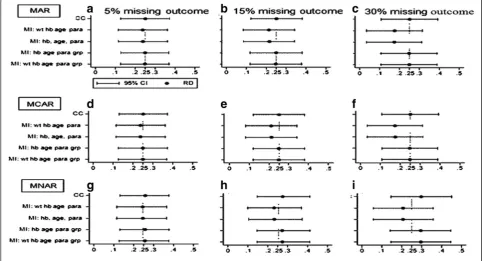
When the missing outcome setting was MAR, effect size estimates became increasingly inefficient as the propor-tion of missing outcome observapropor-tions increased. The RMSE values observed indicated that inefficiency levels were identical for both CC and MI methods. See Fig. 1.
Using CC methods, effect size estimates were un-biased for all assessed missing value levels. Using MI methods, when group membership was included in the imputation model, only a small degree of bias was observed in the effect size estimates. When group membership was excluded from the model, however, estimates were consistently negatively biased (i.e. effect size was consistently under-estimated), and the degree of bias increased as the proportion of missing outcome values increased.
Coverage was generally high for all models when missing value levels were small or moderate, but when the proportion of missing outcomes was extended to 30 %, coverage for the mis-specified MI models fell to around 88 % (detailed in Appendices 1, 2 and 3). In this
context, imputation models not containing both of the variables weight and group membership were technically mis-specified, as it was these two vari-ables that determined missingness. MI models con-taining both weight and group performed well for all missing outcome configurations, providing estimates that were only fractionally biased with good coverage of around 95 %, as did MI models that included group but excluded weight. MI models that included weight but excluded group, however, performed as badly as those MI models that included neither weight nor group.
With MCAR, the pattern of results was very similar to that for MAR. Coverage was generally high, remaining close to 95 % for all models at all missing value levels, except when the proportion of missing outcomes reached 30 %. At this point, as for MAR, coverage fell to around 88 % for mis-specified MI models, and increased levels of (negative) bias were observed.
Under the MNAR condition, RD estimates contained some degree of (usually but not exclusively positive) bias with both CC and MI methods, the degree of bias rising as the proportion of missing outcome observations in-creased. Coverage levels tended to be good, but with some deterioration at high missingness levels.
Detailed results for this scenario are provided in Appendices 1, 2 and 3 for MAR, MCAR and MNAR respectively.
[image:5.595.56.540.438.699.2]Missing outcome observations MAR, MCAR and MNAR: 95 % versus 98 % efficacy
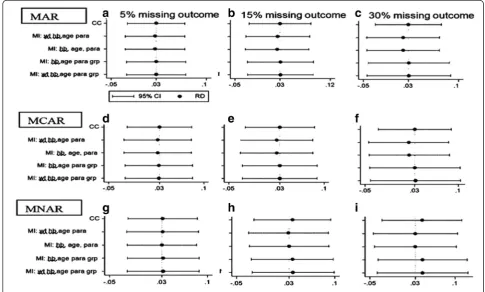
See Fig. 2. When both efficacy levels were close to the 100 % boundary, coverage was poorest when there was no missing data (0.939 compared to the set nominal level of 0.950). All complete case (CC) analyses converged (Appendix 4, 5 and 6), but a small proportion of imputed analyses failed to converge or produce output in Stata. Non-convergence occurred more frequently with increas-ing proportions of missincreas-ing outcome values (Appendix 4).
With these efficacy levels, all CC analyses converged while a small number of MI analyses failed to converge for all three missing data mechanisms (MAR, MCAR and MNAR). Non-convergence in MI analyses occurred more frequently with increasing proportions of missing outcome values. As the proportion of missing data increased, the standard errors of the effect size estimates increased and the efficiency of all analyses decreased in both CC and MI analyses, though this was less marked with the CC analyses. The estimates of effect size were unbiased for all miss-ing value levels usmiss-ing CC methods, and only small levels of bias were detected for those imputation models that included group membership for both MAR and MCAR missing data scenarios. For the MAR and MCAR miss-ing data mechanisms, the bias in the effect size estimates
was markedly greater using imputation models that did not incorporate group membership.
In the MNAR missing data mechanisms, for the 5 % missing level, all the models were generally unbiased with generally good coverage of around 95 %, but as missing levels increased, all models led to invalid inference of treatment effect. The level of bias increased with increas-ing missincreas-ing levels for the CC models and the MI models, even for those that included group membership. The mis-specified models had unbiased estimates but provided in-valid inference because the coverage was conservatively too high (close to 100 %) instead of the nominal 95 %.
Detailed results for this scenario are provided in Appendices 4, 5 and 6 for MAR, MCAR and MNAR respectively.
Discussion
When binary outcome observations are missing that can be assumed to be MAR or MCAR, CC analysis methods were found to perform as well as, and often better than, MI methods, consistently producing unbiased RD esti-mates. This finding is consistent with those reported by Groenwold [14], who examined missing binary outcomes in an RCT setting using odds ratio as the effect size esti-mate of interest. The efficient estiesti-mates obtained from
[image:6.595.54.540.411.703.2]CC compared to MI are a counter-intuitive and surpris-ing findsurpris-ing.
The loss of statistical efficiency in CC analyses is at-tributed directly to the reduction in the effective sample size that occurs with this method, as has been reported previously [8]. A surprising and unexpected finding, however, was that the loss in efficiency using CC analysis methods was consistently no worse than, and often bet-ter than, that observed using MI methods. Theoretically, MI methods are expected to yield unbiased standard er-rors, because sample size is maintained and the uncer-tainty in the imputed values is fully accounted for [8].
A plausible explanation for this unexpected efficiency finding is that the MI procedures also increase the vari-ability in the outcome values that inflates the standard error of the effect size estimate. This increase in variability is likely caused by the random component that is added to missing outcome values during the imputation process.
No convergence problems were experienced using CC analyses when missing binary outcomes could be as-sumed to be MAR or MCAR, although some problems were experienced when missingness was MNAR. In con-trast, convergence problems occurred under both the MAR and MCAR conditions when imputation models were used, particularly when both efficacy rates were close to the parameter boundaries. This was caused by all imputed values being occasionally allocated to the same outcome value across all imputations when efficacy levels in both groups are close to the boundary, which results in zero standard errors for the effect size esti-mate, a phenomenon referred to as ’perfect prediction’ [17]. Perfect prediction can arise in any generalized lin-ear model that has a categorical outcome [22]. The usual reason for perfect prediction in an MI analysis is that all imputed values take the same value for all participants across the imputations, resulting in zero between-imputation variance. In this situation the calculation of degrees of freedom would involve division by zero, which may result in non-convergence. White et al. have suggested that perfect prediction problems can be a re-sult of the flat likelihood [22].
This problem of perfect prediction can be drastically
reduced in Stata by using the command option ’
aug-ment’, which causes an augmented regression to be per-formed [22].
Another striking finding under the MAR and MCAR conditions was that the inclusion of treatment group membership in the imputation process played a crucial role in improving its performance. Excluding this vari-able from the imputation process produced biased esti-mates of the adjusted efficacy RD. If missingness is related to some covariates, the absence of those covari-ates in the imputation model appeared to have little im-pact on bias levels for the effect size estimate, provided
group was included in the imputation calculations. Less predictably, including treatment group membership would also appear to be paramount over all other fac-tors, even when this is not related to missingness.
Under the MNAR condition, when missingness is re-lated to treatment group membership and outcome, both CC and MI analyses produce biased estimates of ef-fect size. Furthermore, the inclusion of group in a mul-tiple imputation analysis will tend to lead to positive bias away from the null hypothesis. Thus, MNAR binary out-comes appear generally to over-estimate effect size, with the possible exception of mis-specified MI models, a counter-intuitive finding that requires further research. The results from the two mis-specified imputation models are presented in this paper to emphasize that, when assuming MI, care must be taken when selecting the imputation model, as using a poor imputation model can bias the effect size estimates.
This study has demonstrated that in the presence of missing binary outcome observations in an RCT with a single follow-up endpoint of interest, CC and MI analysis methods performed very similarly under the three miss-ingness assumptions examined, except when an inappro-priate imputation model was adopted, in which case the MI RD estimates obtained were generally inferior to those generated by a CC analysis. These findings indicate that MI methods offered no advantages over the much easier to apply CC method in the scenarios considered.
There are, however, other factors to be considered when analysing the findings of an RCT. The intention-to-treat principle (ITT) is now the standard procedure for the primary evaluation of an RCT. Under this principle, the use of MI methods may be preferable on the grounds that they retain all patients in the statistical evaluation, whereas the CC methods exclude all patients for whom the outcome measure could not be recorded.
A reasonable compromise might be to perform an MI analysis as the primary ITT analysis, following a rigorous exploration of the likely underlying reasons for the miss-ingness in the outcome measure. Inappropriate imput-ation models can lead to RD estimates that are inferior to
those from a CC analysis, so a ’non-parsimonious’
approach to this MI analysis is essential (i.e. as many co-variates as possible must be included in the imputation process). In addition, group membership must be included in the imputation model; otherwise, there is an increased risk of bias, even when missingness is not in fact related to group membership. A secondary CC analysis could then be performed as part of the per protocol analyses.
and thus have an important role both in sensitivity analyses and when the outcome of interest is collected at several points during a study. Unfortunately, the importance of sensitivity analyses is frequently under-valued [23].
From a reporting perspective, the general research community is likely to be skeptical of a statistical evalu-ation of an RCT that presents only a CC analysis in
which 15–30 % of outcome measures are missing. The
findings would most likely be perceived as potentially biased even when the mechanism of missingness is clearly MCAR, as in sample processing errors, a point that has been highlighted in these simulations.
Of course, for an RCT with efficacy levels away from the boundary, participants for whom the (binary) outcome measure is missing contribute nothing more than a collec-tion of baseline characteristics; imputing the missing out-comes does not provide any empirical information about the relation between the exposure and the outcome.
While these findings appear to strengthen the argument in favour of CC analyses, as has been suggested by Liublinska and Rubin [24], they do not prove that CC methods are necessarily appropriate in all situations. This paper considers just the case of an RCT with a single bin-ary outcome measurement and RD estimation (a common practical scenario in malaria studies of efficacy); in more complex study designs (for example, longitudinal or clus-ter randomized studies), and particularly when there are missing observations across many variables, MI methods remain superior to CC methodologies.
Conclusions
MI analyses must be the primary analyses for the intention-to-treat analyses. These findings provide an ar-gument for the use of the CC approach to always comple-ment MI analyses, with the usual caveat that the validity of the mechanism for missingness be thoroughly dis-cussed. The study also endorses CC methods for per protocol risk difference analyses under these conditions. Pragmatically, while the evidence favours the adoption of a CC analysis when (binary) outcome measures are miss-ing, the reality is that the compromise approach suggested above of a carefully considered primary MI analysis followed by a secondary (essentially sensitivity) CC ana-lysis may be most sensible in terms of getting the findings of such a RCT accepted, even in those situations in which the missing outcomes are’clearly’MCAR or MAR.
More importantly, researchers should strive to collect as much data as possible.
Limitations
Different coefficients were used for the treatment group and weight variables to generate different percentages of missing data. Some confounding is thus possible
between the impact of including/not including both group membership and weight in the MI analyses and the effect of increasing the percentage of missing data. A better approach might have been to fix the effects of treatment group and weight on the missing outcome
and then only to allow β0 to vary to achieve different
percentages of missing data. This was an oversight at the study design stage, and we are grateful to a reviewer for pointing out this potential interpretation issue. In addition, the effect size used for weight was small com-pared to that used for treatment group; it is possible that this may explain in part why including/excluding treat-ment effect from the imputation had a considerably greater impact than including/excluding weight.
We also acknowledge that the inflated RMSEs with MI analyses may well be due to the discrepancy between the imputation and analysis models. That fact that logistic re-gression was used to impute missing outcomes while the OLS regression was used to analyse binary outcome data might impact the size of the RMSEs in the MI analyses.
Appendices Appendix 1
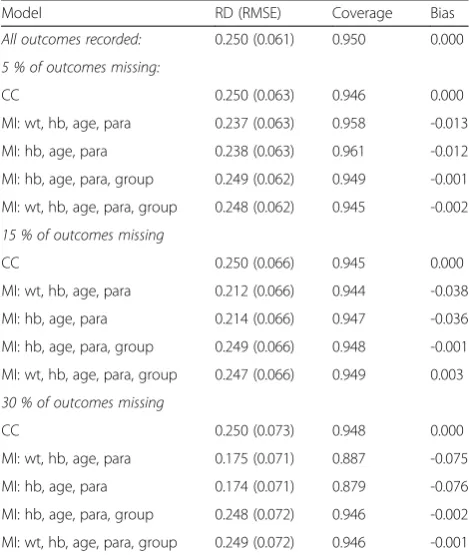
[image:8.595.304.539.452.730.2]MAR and efficacy rate 85 % versus 60 % (RD 0.250). The estimated efficacy differences, coverage and bias for 5 %, 15 % and 30 % averages of 5000 simulated data sets with 50 imputations are shown.
Table 1MAR and efficacy rate 85 % versus 60 % (RD 0.250): estimated efficacy differences, coverage and bias for 5 %, 15 % and 30 % averages of 5000 simulated data sets, 50 imputations
Model RD (RMSE) Coverage Bias
All outcomes recorded: 0.250 (0.061) 0.950 0.000 5 % of outcomes missing:
CC 0.250 (0.063) 0.946 0.000
MI: wt, hb, age, para 0.237 (0.063) 0.958 -0.013 MI: hb, age, para 0.238 (0.063) 0.961 -0.012 MI: hb, age, para, group 0.249 (0.062) 0.949 -0.001 MI: wt, hb, age, para, group 0.248 (0.062) 0.945 -0.002 15 % of outcomes missing
CC 0.250 (0.066) 0.945 0.000
MI: wt, hb, age, para 0.212 (0.066) 0.944 -0.038 MI: hb, age, para 0.214 (0.066) 0.947 -0.036 MI: hb, age, para, group 0.249 (0.066) 0.948 -0.001 MI: wt, hb, age, para, group 0.247 (0.066) 0.949 0.003 30 % of outcomes missing
CC 0.250 (0.073) 0.948 0.000
Appendix 2
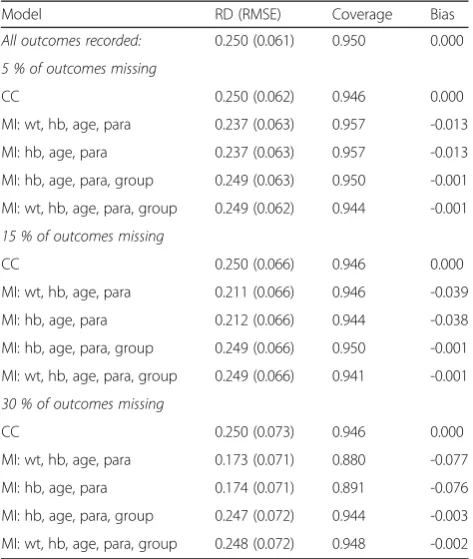
MCAR and efficacy rate 85 % versus 60 % (RD 0.250). The estimated efficacy differences, coverage and bias for 5 %, 15 % and 30 % averages of 5000 simulated data sets with 50 imputations are shown.
Appendix 3
[image:9.595.56.293.195.475.2]MNAR and efficacy rate 85 % versus 60 % (RD 0.250). The estimated efficacy differences, coverage and bias for 5 %, 15 % and 30 % averages of 5000 simulated data sets with 50 imputations are shown.
Table 2MCAR and efficacy rate 85 % versus 60 % (RD 0.250): estimated efficacy differences, coverage and bias for 5 %, 15 % and 30 % averages of 5000 simulated data sets, 50 imputations
Model RD (RMSE) Coverage Bias
All outcomes recorded: 0.250 (0.061) 0.950 0.000 5 % of outcomes missing
CC 0.250 (0.062) 0.946 0.000
MI: wt, hb, age, para 0.237 (0.063) 0.957 -0.013 MI: hb, age, para 0.237 (0.063) 0.957 -0.013 MI: hb, age, para, group 0.249 (0.063) 0.950 -0.001 MI: wt, hb, age, para, group 0.249 (0.062) 0.944 -0.001 15 % of outcomes missing
CC 0.250 (0.066) 0.946 0.000
MI: wt, hb, age, para 0.211 (0.066) 0.946 -0.039 MI: hb, age, para 0.212 (0.066) 0.944 -0.038 MI: hb, age, para, group 0.249 (0.066) 0.950 -0.001 MI: wt, hb, age, para, group 0.249 (0.066) 0.941 -0.001 30 % of outcomes missing
CC 0.250 (0.073) 0.946 0.000
MI: wt, hb, age, para 0.173 (0.071) 0.880 -0.077 MI: hb, age, para 0.174 (0.071) 0.891 -0.076 MI: hb, age, para, group 0.247 (0.072) 0.944 -0.003 MI: wt, hb, age, para, group 0.248 (0.072) 0.948 -0.002
Table 3MNAR and efficacy rate 85 % versus 60 % (RD 0.250): estimated efficacy differences, coverage and bias for 5 %, 15 % and 30 % averages of 5000 simulated data sets, 50 imputations
Model RD (RMSE) Coverage Bias
All outcomes recorded: 0.250 (0.061) 0.950 0.000 5 % of outcomes missing
CC 0.258 (0.063) 0.942 +0.008
MI: wt, hb, age, para 0.244 (0.064) 0.962 -0.006 MI: hb, age, para 0.245 (0.064) 0.958 -0.005 MI: hb, age, para, group 0.257 (0.063) 0.946 +0.007 MI: wt, hb, age, para, group 0.256 (0.063) 0.946 +0.006 15 % of outcomes missing
CC 0.274 (0.068) 0.932 +0.024
MI: wt, hb, age, para 0.231 (0.069) 0.975 -0.019 MI: hb, age, para 0.232 (0.069) 0.975 -0.018 MI: hb, age, para, group 0.272 (0.068) 0.931 +0.028 MI: wt, hb, age, para, group 0.273 (0.068) 0.928 +0.023 30 % of outcomes missing
CC 0.298 (0.078) 0.895 +0.048
[image:9.595.304.539.196.476.2]Appendix 4
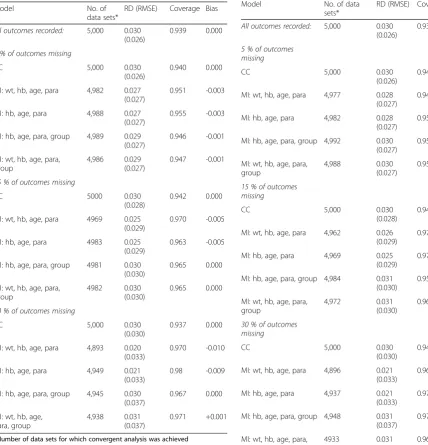
MAR and efficacy rate 98 % versus 95 % (RD 0.030). The estimated efficacy differences, coverage and bias for 5 %, 15 % and 30 % averages of number of simulated data sets that converged of the 5000 data sets, with 50 imputations, are shown.
Appendix 5
[image:10.595.63.492.221.667.2]MCAR and efficacy rate 98 % versus 95 % (RD 0.030). The estimated efficacy differences, coverage and bias for 5 %, 15 % and 30 % averages of number of simulated data sets that converged of 5000 data sets, with 50 im-putations, are shown.
Table 4MAR and efficacy rate 98 % versus 95 % (RD 0.030): estimated efficacy differences, coverage and bias for 5 %, 15 % and 30 % averages of number of simulated data sets that converged of the 5000 data sets, 50 imputations
Model No. of
data sets*
RD (RMSE) Coverage Bias
All outcomes recorded: 5,000 0.030 (0.026)
0.939 0.000
5 % of outcomes missing
CC 5,000 0.030
(0.026)
0.940 0.000
MI: wt, hb, age, para 4,982 0.027 (0.027)
0.951 -0.003
MI: hb, age, para 4,988 0.027 (0.027)
0.955 -0.003
MI: hb, age, para, group 4,989 0.029 (0.027)
0.946 -0.001
MI: wt, hb, age, para, group
4,986 0.029 (0.027)
0.947 -0.001
15 % of outcomes missing
CC 5000 0.030
(0.028)
0.942 0.000
MI: wt, hb, age, para 4969 0.025 (0.029)
0.970 -0.005
MI: hb, age, para 4983 0.025 (0.029)
0.963 -0.005
MI: hb, age, para, group 4981 0.030 (0.030)
0.965 0.000
MI: wt, hb, age, para, group
4982 0.030 (0.030)
0.965 0.000
30 % of outcomes missing
CC 5,000 0.030
(0.030)
0.937 0.000
MI: wt, hb, age, para 4,893 0.020 (0.033)
0.970 -0.010
MI: hb, age, para 4,949 0.021 (0.033)
0.98 -0.009
MI: hb, age, para, group 4,945 0.030 (0.037)
0.967 0.000
MI: wt, hb, age, para, group
4,938 0.031 (0.037)
0.971 +0.001
*Number of data sets for which convergent analysis was achieved
Table 5MCAR and efficacy rate 98 % versus 95 % (RD 0.030): estimated efficacy differences, coverage and bias for 5 %, 15 % and 30 % averages of number of simulated data sets that converged of 5000 data sets, 50 imputations
Model No. of data sets*
RD (RMSE) Coverage Bias All outcomes recorded: 5,000 0.030
(0.026)
0.939 0.000
5 % of outcomes missing
CC 5,000 0.030
(0.026)
0.940 0.000
MI: wt, hb, age, para 4,977 0.028 (0.027)
0.948 -0.002
MI: hb, age, para 4,982 0.028 (0.027)
0.957 -0.002
MI: hb, age, para, group 4,992 0.030 (0.027)
0.953 0.000
MI: wt, hb, age, para, group
4,988 0.030 (0.027)
0.951 0.000
15 % of outcomes missing
CC 5,000 0.030
(0.028)
0.944 0.000
MI: wt, hb, age, para 4,962 0.026 (0.029)
0.970 -0.004
MI: hb, age, para 4,969 0.025 (0.029)
0.970 -0.005
MI: hb, age, para, group 4,984 0.031 (0.030)
0.957 +0.001
MI: wt, hb, age, para, group
4,972 0.031 (0.030)
0.961 +0.001
30 % of outcomes missing
CC 5,000 0.030
(0.030)
0.940 0.000
MI: wt, hb, age, para 4,896 0.021 (0.033)
0.969 -0.009
MI: hb, age, para 4,937 0.021 (0.033)
0.978 -0.009
MI: hb, age, para, group 4,948 0.031 (0.037)
0.971 +0.001
MI: wt, hb, age, para, group
4933 0.031 (0.038)
0.967 +0.001
Appendix 6
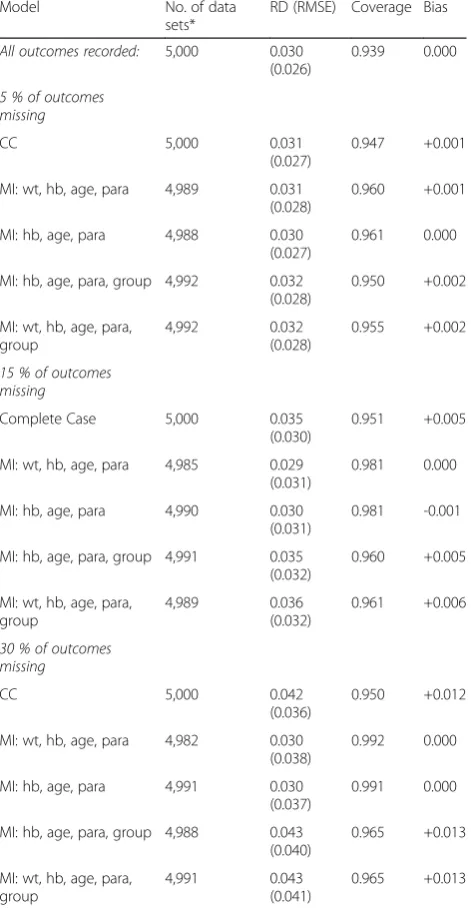
MNAR and efficacy rate 98 % versus 95 % (RD 0.030). The estimated efficacy differences, coverage and bias for 5 %, 15 % and 30 % averages of number of simulated data sets that converged of the 5000 data sets, with 50 imputations, are shown.
Abbreviations
CC, complete case (analysis); DR-IPW, doubly robust inverse probability weighting; hb, haemoglobin; H-W, Huber-White; IPW, inverse probability weighting; ITT, intention-to-treat; MAR, missing at random; MCAR, missing completely at random; MI, multiple imputation; MLE, maximum likelihood estimation; MNAR, missing not at random; OLS, ordinary least squares; OR, odds ratio; para, parasitaemia; RCT, randomized controlled trial; RD, risk difference; RMSE, root-mean-squared error; RR, risk ratio; wt, weight
Acknowledgements
We thank the reviewers for their comments, which helped improve the quality of this manuscript.
This work was supported by the European and Developing Countries Clinical Trials Partnership (EDCTP) grant number IP.2007.31060.03 and the Johns Hopkins University Center for AIDS Research (grant number IP30AI094189) from the National Institute of Allergy And Infectious Diseases.
Authors’contributions
MM provided substantial contributions to the conception and design and analysis and interpretation of data, drafted the article and gave final approval of the version to be published. SAW substantially contributed to the conception and design, and revised the article critically for important intellectual content and final approval of the version to be published. DJT substantially contributed to the conception and design, and revised the article critically for important intellectual content and final approval of the version to be published. VM provided substantial contributions to the conception and design and to critical revision of the article for important intellectual content and final approval of the version to be published. LK-P provided substantial contributions to the conception and design and to critical revision of the article for important intellectual content and final approval of the version to be published. EBF provided substantial contributions to the conception and design and interpretation of data, and drafted the article, revising it critically for important intellectual content and final approval of the version to be published.
Competing interests
The authors declare that there is no conflict of interest/financial disclosure on this work for all authors. We have not been paid any honoraria or otherwise to produce this work.
Author details
1Malawi-Liverpool-Wellcome Trust Clinical Research Programme, College of
Medicine, University of Malawi, Box 30096, Blantyre 3, Malawi.2Department
of Public Health, College of Medicine, University of Malawi, P/Bag 360, Blantyre 3, Malawi.3Liverpool School of Tropical Medicine, Pembroke Place,
L3 5QA Liverpool, UK.4Mahidol-Oxford Tropical Medicine Research Unit,
Mahidol University, 60th Anniversary Chalermprakiat Building, 3rd Floor, 420/ 6 Ratchawithi Rd, Bangkok 10400, Thailand.
Received: 30 July 2015 Accepted: 29 June 2016
References
1. Montori VM, Guyatt GH. Intention-to-treat principle. CMAJ. 2001;165:1339– 41.
2. Machekano RN, Dorsey G, Hubbard A. Efficacy studies of malaria treatments in Africa: efficient estimation with missing indicators of failure. Stat Methods Med Res. 2008;17:191–206.
3. Higgins JP, White IR, Wood AM. Imputation methods for missing outcome data in meta-analysis of clinical trials. Clin Trials. 2008;5:225–39.
4. Wood AM, White IR, Thompson SG. Are missing outcome data adequately handled? A review of published randomized controlled trials in major medical journals. Clin Trials. 2004;1:368–76.
5. Panel on Handling Missing Data in Clinical Trials, Committee on National Statistics Division of Behavioral and Social Sciences and Education, National Research Council. The prevention and treatment of missing data in clinical trials. Washington, DC: The National Academies Press; 2010.
6. Altman DG, Bland JM. Missing data. BMJ. 2007;334:424.
[image:11.595.57.293.226.681.2]7. Allison PD. Missing data. Quantitative applications in the social sciences. London, New Delhi: SAGE Publications; 2001.
Table 6MNAR and efficacy rate 98 % versus 95 % (RD 0.030): estimated efficacy differences, coverage and bias for 5 %, 15 % and 30 % averages of number of simulated data sets that converged of the 5000 data sets, 50 imputations Model No. of data
sets*
RD (RMSE) Coverage Bias
All outcomes recorded: 5,000 0.030 (0.026)
0.939 0.000
5 % of outcomes missing
CC 5,000 0.031
(0.027)
0.947 +0.001
MI: wt, hb, age, para 4,989 0.031 (0.028)
0.960 +0.001
MI: hb, age, para 4,988 0.030 (0.027)
0.961 0.000
MI: hb, age, para, group 4,992 0.032 (0.028)
0.950 +0.002
MI: wt, hb, age, para, group
4,992 0.032 (0.028)
0.955 +0.002
15 % of outcomes missing
Complete Case 5,000 0.035 (0.030)
0.951 +0.005
MI: wt, hb, age, para 4,985 0.029 (0.031)
0.981 0.000
MI: hb, age, para 4,990 0.030 (0.031)
0.981 -0.001
MI: hb, age, para, group 4,991 0.035 (0.032)
0.960 +0.005
MI: wt, hb, age, para, group
4,989 0.036 (0.032)
0.961 +0.006
30 % of outcomes missing
CC 5,000 0.042
(0.036)
0.950 +0.012
MI: wt, hb, age, para 4,982 0.030 (0.038)
0.992 0.000
MI: hb, age, para 4,991 0.030 (0.037)
0.991 0.000
MI: hb, age, para, group 4,988 0.043 (0.040)
0.965 +0.013
MI: wt, hb, age, para, group
4,991 0.043 (0.041)
0.965 +0.013
8. Donders AR, van der Heijden GJ, Stijnen T, Moons KG. Review: a gentle introduction to imputation of missing values. J Clin Epidemiol. 2006;59: 1087–91.
9. Altman DG. Missing outcomes in randomized trials: addressing the dilemma. Open Med. 2009;3:e51–3.
10. Kenward MGJC. Multiple imputation: current perspectives. Stat Methods Med Res. 2007;16:199–218.
11. Ibrahim JG, Molenberghs G. Missing data methods in longitudinal studies: a review. Test (Madr). 2009;18:1–43.
12. White IR, Carlin JB. Bias and efficiency of multiple imputation compared with complete-case analysis for missing covariate values. Stat Med. 2010;29: 2920–31.
13. Magder LS. Simple approaches to assess the possible impact of missing outcome information on estimates of risk ratios, odds ratios, and risk differences. Control Clin Trials. 2003;24:411–21.
14. Groenwold RH, Donders AR, Roes KC, Harrell Jr FE, Moons KG. Dealing with missing outcome data in randomized trials and observational studies. Am J Epidemiol. 2011;175:210–7.
15. Bell DJ, Nyirongo SK, Mukaka M, Zijlstra EE, Plowe CV, Molyneux ME, Ward SA, Winstanley PA. Sulfadoxine-pyrimethamine-based combinations for malaria: a randomised blinded trial to compare efficacy, safety and selection of resistance in Malawi. PLoS One. 2008;3:e1578.
16. Marshall A, Altman DG, Royston P, Holder RL. Comparison of techniques for handling missing covariate data within prognostic modelling studies: a simulation study. BMC Med Res Methodol. 2010;10:7. doi:10.1186/1471-2288-10-7.
17. Royston P, White IR. Multiple imputation by chained equations (MICE): Implementation in Stata. J Stat Softw. 2011;45:1–20.
18. Rubin DB. Inference and missing data. Biometrika. 1976;63:581–92. 19. Cheung YB. A modified least-squares regression approach to the estimation
of risk difference. Am J Epidemiol. 2007;166:1337–44.
20. Schafer JL. Analysis of incomplete multivariate data. London: CRC Press; 1997.
21. Rubin DB. Multiple imputation for nonresponse in surveys. New York: Wiley; 1987.
22. White IR, Daniel R, Royston P. Avoiding bias due to perfect prediction in multiple imputation of incomplete categorical variables. Comput Stat Data Anal. 2010;54:2267–75.
23. Rezvan PH, Lee KJ, Simpson JA. The rise of multiple imputation: a review of the reporting and implementation of the method in medical research. BMC Med Res Methodol. 2015;15:30.
24. Liublinska V, Rubin DB. Re: "dealing with missing outcome data in randomized trials and observational studies". Am J Epidemiol. 2012;176:357– 8. author reply 358–359.
• We accept pre-submission inquiries
• Our selector tool helps you to find the most relevant journal • We provide round the clock customer support
• Convenient online submission • Thorough peer review
• Inclusion in PubMed and all major indexing services • Maximum visibility for your research
Submit your manuscript at www.biomedcentral.com/submit