S T U D Y P R O T O C O L
Open Access
A multicenter randomized controlled trial
of surgery alone or surgery with atrial
natriuretic peptide in lung cancer surgery:
study protocol for a randomized
controlled trial
Takashi Nojiri
1,2,3*, Haruko Yamamoto
4, Toshimitsu Hamasaki
5, Kaori Onda
4, Kikuko Ohshima
5, Yasushi Shintani
2,
Meinoshin Okumura
2, Kenji Kangawa
1*on behalf of the Japan Human Atrial Natriuretic Peptide for Lung Cancer
Surgery (JANP Study) Group
Abstract
Background:Postoperative cancer recurrence is a major problem following curative surgery. In a previous retrospective study of lung cancer surgery, we reported that administration of atrial natriuretic peptide (ANP) during the perioperative period reduced postoperative recurrence. We demonstrated that ANP inhibited the adhesion of cancer cells to vascular endothelium as a vasoprotective action. The objective of this study is to evaluate the effects of ANP on the incidence of postoperative cancer recurrence in lung cancer surgery.
Methods/design:The present study is a multicenter, randomized trial with two parallel groups of patients with lung cancer comparing surgery alone and surgery with ANP administration for 3 days during the perioperative period. A total of 500 patients will be enrolled from 10 Japanese institutions. The primary endpoint is 2-year relapse-free survival (RFS). The secondary endpoints are 2-year cancer-specific RFS, 5-year RFS, overall survival, the incidence of postoperative complications, and the completion rate of ANP treatment.
Discussion:The principal question addressed in this trial is whether ANP with its vasoprotective action can reduce cancer recurrence following lung cancer surgery.
Trial registration:UMIN Clinical Trials Registry identifier: UMIN000018480. Registered on 31 July 2015. Keywords:Lung cancer surgery, Atrial natriuretic peptide, Perioperative care, Cancer recurrence
Background
Cancer recurrence following curative surgery is a major problem after most cancer treatments. More than 50% of patients with resectable non-small cell lung cancer (NSCLC) will have recurrence after curative surgery [1]. Although complete surgical resection is currently consid-ered the best option for cure in patients with most solid tumors, it is possible that surgical trauma itself influences the development of early recurrence [2–4]. First, handling
of the tumor during resection can provoke detachment of tumor cells, and the amount of circulating tumor cells is enhanced during resection of the primary tumor [5, 6]. We previously reported that the presence of circulating tumor cells in the pulmonary vein during lung cancer surgery could be a prognostic indicator for early cancer recurrence [7]. Second, surgical trauma provokes a severe inflamma-tory reaction. There is emerging evidence to suggest that systemic inflammation can accelerate the adhesion of circu-lating tumor cells to the vascular endothelium of distant organs, which is a first step during extravasation in hematogenous metastasis [8, 9]. Although most circulating tumor cells disappear rapidly [10], it is possible that residual * Correspondence:[email protected];[email protected]
1Department of Biochemistry, National Cerebral and Cardiovascular Center
Research Institute, 5-7-1, Fujishirodai, Suita-city, Osaka 565-8565, Japan Full list of author information is available at the end of the article
cancer cells could attach more efficiently to the vascular endothelium by the release of inflammatory cytokines dur-ing the perioperative period [8, 9]. Because no prophylactic strategy for cancer recurrence during the perioperative period has been established, the development of effective treatment is desirable.
We identified human atrial natriuretic peptide (ANP) as a diuretic/natriuretic and vasodilating hormone in 1984 [11]. ANP binds specifically to the guanylyl cyclase A re-ceptor and has biological functions, including diuresis and inhibition of the renin-angiotensin-aldosterone system, as well as anti-inflammatory and antifibrotic actions [12, 13]. In the clinical setting, ANP has been used to treat patients with acute heart failure in Japan since 1995. We have previously reported that the perioperative administration of ANP had a prophylactic effect on postoperative cardio-pulmonary complications by attenuating the operation-induced inflammation in patients who underwent curative surgery for lung cancer [14–16]. Recently, we showed that cancer recurrence after curative surgery was significantly lower in ANP-treated patients than in control patients (surgery alone) [17]. We found that ANP inhibited the adhesion of cancer cells to vascular endothelium by sup-pressing E-selectin expression induced by inflammation [17]. On the basis of our previous findings, we planned a multicenter, phase II randomized controlled trial to
confirm the effects of ANP on preventing postoperative recurrence following lung cancer surgery.
Methods/design Purpose
The purpose of the present study is to evaluate the effects of ANP on reducing postoperative cancer recurrence in patients with lung cancer undergoing curative surgery.
Study setting
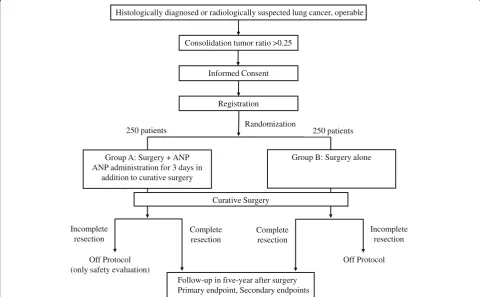
The study is an investigator-initiated, multi-institutional, two-arm, open-label, phase II randomized trial. The flow-chart of the trial is shown in Fig. 1. The Standard Protocol Items: Recommendations for Interventional Trials (SPIRIT) 2013 checklist is given in Additional file 1.
Endpoints
The primary endpoint of this study is the 2-year relapse-free survival (RFS) rate after curative surgery for lung cancer. The secondary endpoints are 2-year cancer-specific RFS, 5-year RFS, 5-year overall survival, the rate of patients who complete ANP treatment, and the incidence of postoperative complications.
Randomization
Histologically diagnosed or radiologically suspected lung cancer, operable
Follow-up in five-year after surgery Primary endpoint, Secondary endpoints
Registration
Group A: Surgery + ANP ANP administration for 3 days in
addition to curative surgery
Complete resection
Curative Surgery
Incomplete resection
250 patients 250 patients
Off Protocol (only safety evaluation)
Consolidation tumor ratio >0.25
Informed Consent
Group B: Surgery alone
Complete resection
Off Protocol Incomplete
resection
[image:2.595.57.538.414.711.2]Patient selection
The tumors are staged according to the seventh edition of the Union for International Cancer Control TNM Classification of Malignant Tumours [18, 19]. Inclusion criteria are as follows:
1. NSCLC is suspected.
2. Radiologically diagnosed invasive lung tumor with a consolidation/tumor ratio >0.25 is visualized by thin-section computed tomography (CT). 3. Complete resection including mediastinal lymph
node dissection is planned.
4. Patients must not have synchronous or
metachronous (within 5 years) malignancies, except for carcinoma in situ or mucosal tumors curatively treated with local therapy.
5. Patients must be aged 20 years or older.
6. Eastern Cooperative Oncology Group performance status must be 0–2.
7. Organ function must be sufficient (leukocyte count
≥1500/ml, platelet count≥1.0 × 10⁵/ml, hemoglobin
≥8.0 g/dl, total bilirubin≤1.5 mg/dl, aspartate aminotransferase≤100 IU/L, alanine
aminotransferase≤100 IU/L, peripheral arterial oxygen saturation on room air≥92%).
8. Written informed consent is provided by the patient.
Exclusion criteria
The exclusion criteria are as follows:
1. Dominant pure ground-glass opacity (GGO) lesion (radiological noninvasive lung tumor with consolidation/tumor ratio≤0.25 visualized by thin-section CT)
2. Active concurrent malignant diseases 3. Pregnant, lactating, or potentially pregnant 4. Mental disorders that may affect the ability or
willingness to provide informed consent or abide by the study protocol
5. Systemic steroids or immunosuppressive agent medication
6. Uncontrollable infectious disease, autoimmune disease, or other severe comorbidities
7. History of right ventricular infarction 8. Severe hypotension
9. Inappropriate for enrollment based on the judgment of the investigator
Registration
Eligible patients are registered and randomly assigned to either the surgery with ANP group or the surgery-alone group by the covariate-adaptive randomization method (Pocock-Simon procedure) including sex (male/ female), age (<70/≥70 years), clinical stage (IA/IB/≥II), CT
findings (including GGO/not including GGO), and insti-tution as covariates and strata. The randomization ratio is 1:1. Both patients and investigators are open to treatment allocation. The Clinical Study Data Collecting System is used for patient registration and randomization, and the Research Electronic Data Capture (REDCap™) system is used for data management. Enrollment was started in September 2015 and scheduled to continue for 2 years.
Treatment methods
Treatment flow is shown in Fig. 1. The patients enrolled in this study receive surgery alone or surgery with ANP (group A, curative surgery with ANP; group B, curative surgery alone).
In both groups, the surgical procedures undertaken include segmentectomy, lobectomy, or pneumonectomy with systematic node dissection in open thoracotomy or video-assisted thoracic surgery. Standard systematic node dissection (ND2) includes complete removal of the hilar and mediastinal nodes.
In group A, human ANP (Daiichi-Sankyo Pharmaceutical Inc., Tokyo, Japan) is continuously infused intravenously at 0.025 μg∙kg−1∙minute−1 for 72 h beginning more than 2 h before the start of surgery. In group B, there is no agent used in addition to curative surgery. The protocol treat-ment is to be stopped if curative surgery is not performed.
Follow-up
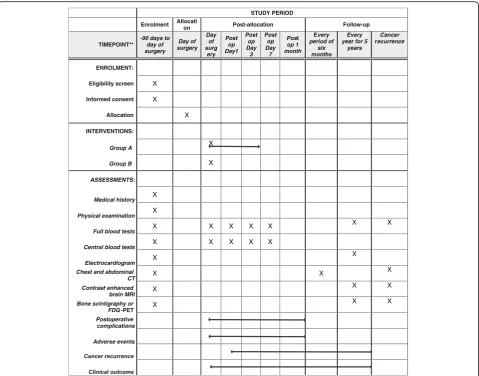
After curative resection, the information regarding post-operative complications within 30 days following surgery is recorded and sent to the data center. The incidence of postoperative complications is one of the secondary endpoints. All patients are followed with scheduled examinations, including a physical examination, serum biochemistry testing, chest x-ray, contrast-enhanced chest and abdominal CT, contrast-enhanced brain magnetic resonance imaging (MRI), and bone scintigraphy to detect postoperative recurrence for 5 years. Fluorodeoxyglucose-positron emission tomography (FDG-PET) can replace bone scintigraphy. Chest and abdominal CT are performed every 6 months following surgery. Brain MRI and bone scintigraphy or FDG-PET are performed every year follow-ing surgery. The schedule of this trial is shown in Fig. 2.
Radiological assessment
Statistical methods
The present study is a phase II randomized trial to evalu-ate the efficacy and safety of ANP administration during lung cancer surgery. This study is designed primarily to evaluate the 2-year RFS in both groups and to demon-strate whether ANP prevents postoperative recurrence within 2 years after curative surgery. In the previous study [17], the hazard ratio for the 2-year RFS was estimated to be 0.28 (95% confidence interval 0.09–0.87) in curative surgery with ANP compared with curative surgery alone. Because this previous observational study was retrospect-ive, we conservatively assumed the hazard ratio to be 0.50 in the present study as the upper limit of the 70% confi-dence interval of the previous study. To evaluate the superiority of curative surgery with ANP (group A) over curative surgery alone (group B), the total sample size was calculated as 409 patients (95 events in total are expected), assuming 70% RFS in group B with 90% power at a one-sided αlevel of 2.5% using a log-rank test, assuming an
expected accrual period of 2 years and a follow-up period of 2 years. A total of 500 patients will be recruited into the study, accounting for patients lost to follow-up, such as for benign tumors or incomplete resection.
Analyses will be done on the basis of the full analysis set (FAS). Based on the intention-to-treat (ITT) principle, the FAS includes all randomized subjects without major protocol violations. An ITT-based or per-protocol based analysis will be done to assess the robustness of the con-clusions derived from the FAS-based analysis. Patient demographic data will be analyzed descriptively; categor-ical variables will be assessed with the chi-square test or Fisher’s exact test, whereas continuous variables will be assessed with Student’st test or the Wilcoxon rank-sum test, as appropriate. The survival curves for 2-year RFS (primary endpoint) and the 2-year cancer-specific RFS, 5-year RFS, and overall survival (secondary endpoints) will be estimated using the Kaplan-Meier method and com-pared between the two groups by the log-rank test. The
[image:4.595.59.539.87.463.2]hazard ratio with its 95% confidence interval will be calcu-lated using a proportional hazards model. The propor-tional hazards assumption will be investigated graphically, with a test based on Schoenfeld residuals. Safety data will be analyzed descriptively for the treated set, which con-sists of all randomized patients who receive at least one study treatment. All reported P values will be two-sided. The statistical analysis plan, which includes more tech-nical and detailed elaboration of the principal features stated in the protocol, will be prepared separately and finalized before database-locking. All statistical analyses will be conducted at the data center in the National Cerebral and Cardiovascular Research Center.
Centralized monitoring and the Data and Safety Monitoring Committee
Centralized monitoring is conducted for early identification and mitigation of data quality risk issues that may com-promise the validity of the study results and for better as-sessment of patient safety. Also, the Data and Safety Monitoring Committee (DSMC) will independently review the report of trial monitoring regarding the efficacy and safety data derived from this study. On the basis of moni-toring, the DSMC could consider early termination of a treatment regimen if a treatment-related death were to occur in group A during enrollment. The protocol compli-ance, safety, and on-schedule study progress are also moni-tored by the DSMC.
Participating institutions
The participating institutions in the study are Osaka University Hospital, The University of Tokyo Hospital, Hokkaido University Hospital, National Cancer Center Hospital East, Yamagata University Hospital, Kobe University Hospital, National Hospital Organization Toneyama Hospital, Osaka Medical Center for Cancer and Cardiovascular Diseases, Osaka Prefectural Medical Center for Respiratory and Allergic Diseases, and Yamagata Prefectural Central Hospital.
Discussion
To the best of our knowledge, this study is the first multi-center randomized clinical trial to examine the vasoprotec-tive effects of ANP on cancer recurrence following curavasoprotec-tive surgery in patients with lung cancer. Surgical procedures may induce postoperative complications in the acute phase and cancer recurrence in the chronic phase after surgery by releasing inflammatory cytokines [2, 3]. Vascular endothe-lial cells that become inflamed during the perioperative period can easily adhere to immune cells or circulating tumor cells, resulting in postoperative complications or cancer recurrence [8, 9]. ANP has an anti-inflammatory ac-tion by reducing E-selectin levels in vascular endothelial cells [17]. In this study, we will be able to prospectively
evaluate the effects of ANP on preventing both postopera-tive complications in the acute phase and cancer recurrence in the chronic phase after surgery. Surgical specimen and blood samples during the perioperative period will be col-lected to evaluate the mechanism of the effects of ANP, in-cluding serum soluble E-selectin levels.
Because the target of ANP is considered to be the vascular endothelium, this treatment can be used for all types of cancer surgery in principle. Most chemotherapy cannot be used during the perioperative period to reduce the incidence of cancer recurrence, owing to cytotox-icity. However, ANP has been proven not to cause severe adverse effects or hypotension on the basis of its use in patients with acute heart failure in Japan for over 20 years [20]. The results of this study will provide clin-ically valuable information for future cancer treatment.
Trial status
We are in the process of recruiting patients.
Additional file
Additional file 1:SPIRIT 2013 checklist: recommended items to address in a clinical trial protocol and related documents. (DOC 121 kb)
Abbreviations
ANP:Atrial natriuretic peptide; CONSORT: Consolidated Standards of Reporting Trials; CT: Computed tomography; DSMC: Data and Safety Monitoring Committee; FAS: Full analysis set; FDG-PET: Fluorodeoxyglucose-positron emission tomography; GGO: Ground-glass opacity; ITT: Intention to treat; JANP: Japan Human Atrial Natriuretic Peptide for Lung Cancer Surgery Study; MRI: Magnetic resonance imaging; ND2: Standard systematic node dissection; NSCLC: Non-small cell lung cancer; REDCap: Research Electronic Data Capture; RFS: Relapse-free survival; SPIRIT: Standard Protocol Items: Recommendations for Interventional Trials
Acknowledgements
JANP Study Group members and participating centers:
1. Dr. Meinoshin Okumura, Osaka University Hospital, Osaka, Japan; [email protected]
2. Dr. Jun Nakajima, The University of Tokyo Hospital, Tokyo, Japan; [email protected]
3. Dr. Masahiro Tsuboi, National Cancer Center Hospital East, Chiba, Japan; [email protected]
4. Dr. Yasuhiro Hida, Hokkaido University Hospital, Hokkaido, Japan; [email protected]
5. Dr. Yoshimasa Maniwa, Kobe University Hospital, Hyogo, Japan; [email protected]
6. Dr. Hiroyuki Oizumi, Yamagata University Hospital, Yamagata, Japan; [email protected]
7. Dr. Masahiko Higashiyama, Osaka Medical Center for Cancer and Cardiovascular Diseases, Osaka, Japan; [email protected] 8. Dr. Yukiyasu Takeuchi, National Hospital Organization Toneyama Hospital, Osaka, Japan; [email protected]
9. Dr. Yoshihisa Kadota, Osaka Prefectural Medical Center for Respiratory and Allergic Diseases, Osaka, Japan; [email protected]
10. Dr. Satoshi Shiono, Yamagata Prefectural Central Hospital, Yamagata, Japan; [email protected].
Funding
had no role in the study design and implementation, the writing of the report, or the decision to submit the manuscript for publication.
Availability of data and materials
To avoid bias of the analysis, the dataset supporting the conclusions of this article will not be available until the final report of this trial is published.
Authors’contributions
TN conceived of the study and wrote the manuscript. HY and KOn conceived of and coordinated the study. TH and KOh performed statistical analysis and provided the biostatistical study design. YS and MO conceived of and supervised the study. KK conceived of and supervised the study and is the grant holder. All authors read and approved the final manuscript.
Competing interests
TN, MO, and KK have the filed patent related to ANP for the treatment of cancer metastasis with Shionogi & Co., Ltd., which has part of the right to apply for the patent transferred from one of the original applicants, Daiichi-Sankyo Pharmaceutical Inc. (PCT/JP2012/054841). Shionogi & Co., Ltd., was not involved in the study design and was not involved in the collection, analysis, or interpretation of data; in the writing of the manuscript; or in the decision to submit the manuscript for publication. The other authors declare that they have no competing interests.
Consent for publication
Not applicable.
Ethics approval and consent to participate
The final protocol was approved by the Japanese Advanced Medical Care B program in June 2015 (Japanese Advanced Medical Care B program number 60), and patient enrollment began in September 2015. Before enrollment of the patients, the study protocol was approved by each institutional review board of all participating centers. This study complies with the Declaration of Helsinki. Written informed consent will be obtained from all patients before they are recruited. Personal information about potential and enrolled participants will remain confidential, and data will be de-identified using participant numbers. This trial is registered in the UMIN Clinical Trials Registry with the identifier UMIN000018480 (http://www.umin.ac.jp/ctr/index-j.htm). The institutional review board of National Cerebral and Cardiovascular Center approved the protocol (M26-095). Before enrollment of the patients, this study was approved by the institutional review boards of Osaka University Hospital (14236-2), The University of Tokyo Hospital (P2015015-11X), Hokkaido University Hospital (015-0217), National Cancer Center Hospital East (2015-198), Yamagata University Hospital (101), Kobe University Hospital (270021), National Hospital Organization Toneyama Hospital (1523), Osaka Medical Center for Cancer and Cardiovascular Diseases (1509245094), Osaka Prefectural Medical Center for Respiratory and Allergic Diseases (732), and Yamagata Prefectural Central Hospital (24).
Publisher’s Note
Springer Nature remains neutral with regard to jurisdictional claims in published maps and institutional affiliations.
Author details
1Department of Biochemistry, National Cerebral and Cardiovascular Center
Research Institute, 5-7-1, Fujishirodai, Suita-city, Osaka 565-8565, Japan. 2Department of General Thoracic Surgery, Osaka University Graduate School
of Medicine, 2-2 (L5) Yamadaoka, Suita-City, Osaka 565-0871, Japan. 3Department of General Thoracic Surgery, National Hospital Organization
Toneyama Hospital, 5-1-1 Toneyama, Toyonaka-City, Osaka 560-8552, Japan. 4Center for Advancing Clinical and Translational Sciences, National Cerebral
and Cardiovascular Center, 5-7-1, Fujishirodai, Suita-city, Osaka 565-8565, Japan.5Department of Data Science, National Cerebral and Cardiovascular Center, 5-7-1, Fujishirodai, Suita-city, Osaka 565-8565, Japan.
Received: 11 January 2017 Accepted: 4 April 2017
References
1. Mountain CF. Revisions in the International System for Staging Lung Cancer. Chest. 1997;111(6):1710–7.
2. Ferri LE, Law S, Wong KH, Kwok KF, Wong J. The influence of technical complications on postoperative outcome and survival after esophagectomy. Ann Surg Oncol. 2006;13(4):557–64.
3. ten Kate M, Hofland LJ, van Grevenstein WM, van Koetsveld PV, Jeekel J, van Eijck CH. Influence of proinflammatory cytokines on the adhesion of human colon carcinoma cells to lung microvascular endothelium. Int J Cancer. 2004;112(6):943–50.
4. Andalib A, Ramana-Kumar AV, Bartlett G, Franco EL, Ferri LE. Influence of postoperative infectious complications on long-term survival of lung cancer patients: a population-based cohort study. J Thorac Oncol. 2013;8(5):554–61. 5. van den Tol PM, van Rossen EE, van Eijck CH, Bonthuis F, Marquet RL, Jeekel H. Reduction of peritoneal trauma by using nonsurgical gauze leads to less implantation metastasis of spilled tumor cells. Ann Surg. 1998;227(2):242–8. 6. Yamaguchi K, Takagi Y, Aoki S, Futamura M, Saji S. Significant detection of
circulating cancer cells in the blood by reverse transcriptase-polymerase chain reaction during colorectal cancer resection. Ann Surg. 2000;232(1):58–65. 7. Funaki S, Sawabata N, Nakagiri T, Shintani Y, Inoue M, Kadota Y, et al. Novel
approach for detection of isolated tumor cells in pulmonary vein using negative selection method: morphological classification and clinical implications. Eur J Cardiothorac Surg. 2011;40(2):322–7.
8. Giavazzi R, Foppolo M, Dossi R, Remuzzi A. Rolling and adhesion of human tumor cells on vascular endothelium under physiological flow conditions. J Clin Invest. 1993;92(6):3038–44.
9. McDonald B, Spicer J, Giannais B, Fallavollita L, Brodt P, Ferri LE. Systemic inflammation increases cancer cell adhesion to hepatic sinusoids by neutrophil mediated mechanisms. Int J Cancer. 2009;125(6):1298–305. 10. Stott SL, Lee RJ, Nagrath S, Yu M, Miyamoto DT, Ulkus L, et al. Isolation and
characterization of circulating tumor cells from patients with localized and metastatic prostate cancer. Sci Transl Med. 2010;2(25):25ra23.
11. Kangawa K, Matsuo H. Purification and complete amino acid sequence of
α-human atrial natriuretic polypeptide (α-hANP). Biochem Biophys Res Commun. 1984;118(1):131–9.
12. Kishimoto I, Tokudome T, Horio T, Garbers DL, Nakao K, Kangawa K. Natriuretic peptide signaling via guanylyl cyclase (GC)-A: an endogenous protective mechanism of the heart. Curr Cardiol Rev. 2009;5(1):45–51. 13. Kasama S, Furuya M, Toyama T, Ichikawa S, Kurabayashi M. Effect of atrial
natriuretic peptide on left ventricular remodelling in patients with acute myocardial infarction. Eur Heart J. 2008;29(12):1485–94.
14. Nojiri T, Yamamoto K, Maeda H, Takeuchi Y, Funakoshi Y, Inoue M, et al. Effect of low-dose human atrial natriuretic peptide on postoperative atrial fibrillation in patients undergoing pulmonary resection for lung cancer: a double-blind, placebo-controlled study. J Thorac Cardiovasc Surg. 2012; 143(2):488–94.
15. Nojiri T, Inoue M, Yamamoto K, Maeda H, Takeuchi Y, Funakoshi Y, et al. Effects of low-dose human atrial natriuretic peptide for preventing post-operative cardiopulmonary complications in elderly patients undergoing pulmonary resection for lung cancer. Eur J Cardiothorac Surg. 2012;41(6):1330–4. 16. Nojiri T, Inoue M, Maeda H, Takeuchi Y, Sawabata N, Shintani Y, et al. Low-dose
human atrial natriuretic peptide for the prevention of postoperative
cardiopulmonary complications in chronic obstructive pulmonary disease patients undergoing lung cancer surgery. Eur J Cardiothorac Surg. 2013;44(1):98–103. 17. Nojiri T, Hosoda H, Tokudome T, Miura K, Ishikane S, Otani K, et al. Atrial
natriuretic peptide prevents cancer metastasis through vascular endothelial cells. Proc Natl Acad Sci U S A. 2015;112(13):4086–91.
18. Goldstraw P, Crowley J, Chansky K, Giroux DJ, Groome PA, Rami-Porta R, et al. The IASLC Lung Cancer Staging Project: proposals for the revision of the TNM stage groupings in the forthcoming (seventh) edition of theTNM
Classification of Malignant Tumours. J Thorac Oncol. 2007;2(8):706–14. 19. Sobin LH, Gospodarowicz MK, Wittekind C, editors. TNM classification of
malignant tumours. 7th ed. Hoboken: John Wiley & Sons; 2010. 20. Nomura F, Kurobe N, Mori Y, Hikita A, Kawai M, Suwa M, et al. Multicenter