International Journal of Emerging Technology and Advanced Engineering
Website: www.ijetae.com (ISSN 2250-2459, ISO 9001:2008 Certified Journal, Volume 6, Issue 4, April 2016)
271
Development of Differential Pressure filtering System for
Servo-Hydraulic Random Sea Wave Generators
V. Prabhakarachary
1, R. S. Erande
2, M. D. Kudale
31Scientist-B, CWPRS, Pune-411024, 2ARO, CWPRS, Pune-411024, 3Additional Director, CWPRS, Pune-411024
Abstract—Servo-Hydraulic system experiences contamination, which deteriorate its performance and contribute to catastrophic failures. This paper describes the Random Sea Wave Generating Servo-Hydraulic System (RSWG), problems faced due to contamination, action to over -come and the standards/methods adopted for filtration of hydraulic oil. It presents a development of filtration system for achieving contamination control.
Keywords—contamination control, Patch kit, servo-hydraulics, significant wave height, wave generation.
I. INTRODUCTION
Servo-Hydraulic component malfunction/failures are mostly due to presence of contaminations in oil system. When contaminant‘s sizes exceed the working clearances of sensitive servo-hydraulic components such as Servo-Valve or Pumps, malfunctioning of the system and components, or catastrophic failures are the invited problems. This calls for the importance of clean oil in servo hydraulics. Contamination is a prime enemy of industrial hydraulic systems. Controlling it could mean elimination of more than half of all hydraulic system failures. Generally, the same basic principles of contamination control apply to both ordinary hydraulic control systems and servo systems. The difference comes in degree. As use of servo systems continue to grow in industry, the need for additional knowledge about effective contamination control will also increase. Contaminants in a hydraulic system may consist of solids, liquids, or gases, or combinations of these. Solid insoluble contaminants—grit, dust, metal particles—pose the greatest problem since they are the most prevalent and the most damaging. There are numerous sources of contamination, but they all fall into three basic categories— built-in, generated, and externally introduced. Built-in contamination is the largest single source, stemming largely from equipment manufacture. It may be caused by core sand from casting, weld spatter, metal chips, or lint and abrasive dust. Oxide scale may remain from heat treating or forging. In some cases, filter media particles may break loose and flow through the system. Varnish is a common problem of contamination, which results from high heat and the presence of black mineral salt compounds.
Generated contamination results from the tendency of the existing contamination to breed new contamination. External contaminants may enter a system in new hydraulic oil, new filters, piping compounds, lapping compounds and the like. Airborne particles can also infiltrate through breathers. Lint is a common problem, introduced during cleaning and maintenance. This paper describes an experience at Central Water and Power Research Station (CWPRS), Pune, indicating effects of contamination and methods employed to achieve control of contamination.
II. RANDOM SEA WAVE GENERATING SYSTEM (RSWG)
Random Sea Wave Generating Systems (RSWG) are used to simulate prototype sea conditions in laboratory flumes and Basins for study of maritime structures such as breakwaters, sea walls and port layouts [8]. A typical RSWG System is shown in fig.1. The wave board is moved by a closed loop servo-hydraulic control system. The servo controller receives analog command signal from the micro processor and generates error signal by comparing it with a feedback signal obtained from the displacement transducer. The error signal from servo amplifier is converted into a current suitable for driving a servo-valve, which in turn controls oil flow to the actuator and hence the displacement.
III. PROBLEM DESCRIPTION
When input signal was more than 15% of maximum in one direction, the piston showed unequal strokes around the reference point. This resulted in difficulties in obtaining required significant wave height and also in obtaining
match for power spectral density on a particular model test.
Several corrective actions such as charging of
accumulators, Gain adjustments in servo-controller, checking of position feedback system etc. were tried. However, these actions would marginally improve the performance.
IV. IDENTIFICATION AND RECTIFICATION OF PROBLEM
International Journal of Emerging Technology and Advanced Engineering
Website: www.ijetae.com (ISSN 2250-2459, ISO 9001:2008 Certified Journal, Volume 6, Issue 4, April 2016)
272 SERVO ACTUATOR SERVO VALVE
SERVO CONTROLLER
HYDRAULIC POWER SUPPLY
ANALOG FILTER
WAVE HEIGHT RECORDER PRINTER
COMPUTER
USB ADC/DAC
WAVE HEIGHT SENSOR
WAVE BOARD
Fig.1 : Typical arrangement of RSWG System.
Depending on the circumstances, some 70 - 80% of system failures are due to contamination. Cleanliness monitoring is essential in contamination control, as is selecting the right filtering methodology. The first step, however, understands the specific system requirements and local operating conditions. With the above experiences, RSWG System was designed with differential pressure filtering system. The degradation of system performance due to contaminated oil, subsequent improvement in the performance at the end of the successful implementation of subject filtering system is shown in fig.2. Effects of contamination, failures, causes were studied before finalizing effective filtering system for RSWG system.
V. COMPOUNDING OF CONTAMINANTS AND EFFECTS OF
CONTAMINATION
Contaminants tend to multiply in a chain reaction, compounding the problem. Two soluble substances may combine to form a gummy sludge or an acid that corrodes a port. Tiny grit may score off particles within the system. These in turn, grind off more. Uncontrolled, contamination multiplies rapidly. It is best to start with a very clean system and then maintain it to prevent the start of the
contamination generating cycle. Damage due to
contamination is costly and can endanger lives and equipment.
Often, it is difficult to monitor. Too often the first clue is failure. Many elements are susceptible to contamination like servo- valve, actuator, pressure compensated axial flow vane pump etc. Dirty oil can cause pumps to wear more quickly than normal and can cause solenoids to stick. Basically, contaminants cause trouble by wearing and clogging internal passages—detracting from system performance and serviceability [9]. Sizes of contaminants as well as their density are important. In fact, the smaller
particles Contamination Controloften do the most damage
International Journal of Emerging Technology and Advanced Engineering
Website: www.ijetae.com (ISSN 2250-2459, ISO 9001:2008 Certified Journal, Volume 6, Issue 4, April 2016)
273 Since RSWG System uses application of servo-valves to generate accurate movements without deviations, NAS Grade-6 was selected for the hydraulic oil used in this system.
Component failure is often an invisible process. In general three types of failure can be distinguished:
1) Catastrophic Failures: This failure occurs suddenly and without warning; it is of a permanent nature. It is often caused by larger sized particles entering a component and obstructing the relative movement between surfaces, resulting in seizure of the component.
2)Transient Failures: Generally speaking, this type of failure is short-lived and goes unnoticed, although the consequences rarely do. It is caused by particles that momentarily interfere with the function of a component. The particles lodge in a critical clearance between matching parts, only to be washed away during the next operation cycle. As a result, components become less predictable and thus unsafe. Valves stick and then break loose such that operation is intermittent.
3) Degradation Failures: The performance of the component degrades over time as surfaces wear, clearances increase, and leakage increases. Gradual deterioration in the performance of a component results in its eventual repair or replacement. This failure is caused by the effect of wear induced by contamination. Additional generated contamination can lead to a catastrophic failure. Failures or reduced system performance have a direct impact on the cost of ownership, the efficiency rate and the perceived quality perception of the end users. Proper selection, placement, and servicing of contamination control devices will eliminate an estimated 80% of all system failures. Maintaining system cleanliness is a key issue in the operation of all fluid power systems, and particularly high-pressure oil circuits such as RSWG.
VI. CHECKING OF CONTAMINATION LEVELS
Measuring contamination presents problems of its own. Generally, the particle count method gives the clearest picture and will probably form the basis for industry stan-dards. The method involves forcing a 100 ml sample through a porous membrane filter marked with grid liners. Counting particles by sized for one square and repeating this for other squares gives a representative contamination level for the entire system. The resulting distribution is then related to set standards to arrive at a cleanliness classification.
A patch kit method is being used at CWPRS for checking contamination levels. In this method oil is sucked through a 0.8 micron membrane. This membrane is compared with standard path kits to decide contamination class. The membrane test can also serve as a filtration quality check. Contamination level in the system should drop after the initial flush period. An increase might indicate inadequate filtration or a component failure. After several months operation, the contamination level will start to rise—indicating the need for filter change. Employing this technique can help to establish a filter change schedule.
Contamination levels: The contamination level is measured by counting the number of particles of a certain dimension per unit of volume of the fluid; this number is then classified in contamination Classes, according to international standards. Measuring is made with Automatic Particle Counters that can make the analysis on line (through sampling connectors put on the system for this purpose) or from sampling bottles. The calculations and sampling of the fluid must be done according to the specific ISO norms, to attest their validity. The most popular standard for Contamination Classes in the hydraulic systems is ISO 4406:1999; the standard NAS 1638 (under revision) is also quite used. Contamination class of NAS Grade-6 is maintained for applications involving servo-valves like RSWG Systems at CWPRS.
VII. DIFFERENTIAL PRESSURE FILTERING SYSTEM
International Journal of Emerging Technology and Advanced Engineering
Website: www.ijetae.com (ISSN 2250-2459, ISO 9001:2008 Certified Journal, Volume 6, Issue 4, April 2016)
274 1). Inlet filtering system: This filter is located on a suction
port of the pump or submerged in the reservoir and attached to the suction line leading to the pump.
The intention of a suction filter is to protect the pump from large particles found in the reservoir[2]. This filter is usually a coarse mesh filter or even a magnetic separator. High efficiency filters are usually not placed on the suction side as high differential pressure can cause pump failure. A fine filter on a pump suction side would require the filter to be very large which will handle the flow and have an extremely low pressure drop. Fine filters would also have a tendency to load quicker than coarse filters which allow the majority of small particles to pass.
International Journal of Emerging Technology and Advanced Engineering
Website: www.ijetae.com (ISSN 2250-2459, ISO 9001:2008 Certified Journal, Volume 6, Issue 4, April 2016)
[image:5.612.368.558.137.291.2]275
Fig 2: Differential Pressure Filtering System at MPWBH
Hence, the filtration is generally > 100µm.strainer filter element of mesh size 130µm is being selected. Usually a strainer Catches the nuts and bolts that are dropped into a reservoir. Larger sized particles are removed at initial stage leads use of finer filters in further stages. Suction filters shown in fig.2 In let filtering system can Causes cavitations, Increases risk of aeration due to weak shaft seals or worn bearings. Many are be very difficult to clean Many don‘t have a bypass for cold or dirty oil Filter would need to be size twice as large as a strainer
2). Pressure line filtering system: This filter is generally installed between the pump outlet and the rest of the components in a Hydraulic system. The idea here is to protect all components in a given system. This filter must withstand full system pressure and must be capable of handling the maximum flow of the pump[2]. For systems with a variable work load the filter must withstand fluctuating flow, pressure cycles and spikes. In most cases, this is usually the smallest filter but it is also the most expensive. High Pressure filters may be installed with or without a bypass valve. The purpose of the integral bypass is to allow a portion of the flow to bypass the filter during cold start conditions or when the filter element is heavily loaded with contaminant. If a pressure filter with bypass is selected it is critical that the element is changed immediately after indication or on a regular preventive maintenance schedule. If the components in the system are very sensitive to contamination (servo valves) a pressure filter with no bypass may be selected to ensure that all of the fluid entering the sensitive components is filtered. Filters with a bypass utilize elements that are classified as low collapse and can withstand differential pressures up to 450 psi or 30 bar.
Filters with no bypass utilize elements that are
International Journal of Emerging Technology and Advanced Engineering
Website: www.ijetae.com (ISSN 2250-2459, ISO 9001:2008 Certified Journal, Volume 6, Issue 4, April 2016)
276 3).Return line filtering system: Some systems have very
sensitive components that see only a fraction of the flow. It is very easy to filter the entire system to the required cleanliness level, or as an alternate a smaller filter with a fine filter media can be installed in the critical leg of a system and the balance of the system can be fitted with an appropriate coarser filter. This might sound like an added expense, but in the long run it is very economical for a system to have two filters rather than a large single filter with a fine filter media. With one filter the maintenance cost will be greater than the initial cost of installing two filters in a system. In all of the above instances it should be noted that whenever the filter element requires servicing, the system must be shut down, element replaced and the system re-started. Return filters may be installed either in-line or inside the reservoir (In-tank return filter). There are varieties of filters available for each style of assemblies. The designer of the system collects all flow from the system and directs it through the return line filter. Such an arrangement makes certain that the oil in the reservoir will be to desired ISO/NAS Grade specification. When a system contains several double acting cylinders it should be noted that the return flow from the blind end of a cylinder would usually be higher than the maximum flow of the pump. This filter must handle the maximum flow due to flow multiplication during cylinder discharge[2]. Return filters are fitted with internal /external bypass valves as a standard since they are subject to flow rates that may be higher than that of the maximum pump flow rate. The bypass valve protects the housing from bursting and the element from collapse failure. Over sizing the return filter is a common practice. This allows the flexibility to enhance the degree of filtration without creating excessively high differential pressure. Normally this is the largest and least expensive filter and a common filter. These filters are located in between actuator out let and oil tank in let. A typical arrangement of filters used in RSWG System is shown in figure 2. Since pressure drops and filteration of 10 µm are very small, Inexpensive. Contaminants may enter into the system during operation of actuator as it extends into atmosphere, Return line filters can filter oil returning from cylinders with poor wiper seals. Also filters contaminates that enter through the use of quick disconnects when they are connected. Helps to keep the reservoirs cleaner. Since the velocities vary greatly with large pressure spikes, two filters are provided in return line as shown figure 2 to achieve differential pressure filtration in RSWG System.
a).Schematic arrangement of generation of waves
c).Arrangement of CWHR for measurement of waves in wave basin
e). Patch kit test result of cleanliness level of oil
Theoretical Observed at Site Acquired
International Journal of Emerging Technology and Advanced Engineering
Website: www.ijetae.com (ISSN 2250-2459, ISO 9001:2008 Certified Journal, Volume 6, Issue 4, April 2016)
277
b). Differential Pressure filtering system used in RSWG
d).Wave spectrum
Fig.3: Experimental set up for testing of waves generated using Differential Pressure filtering system used in RSWG
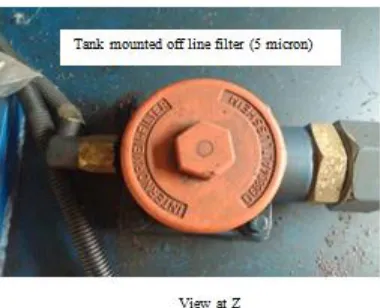
4). Off line filtering system: Awell designed hydraulic system should be fitted with adequate filtration but some cases external filtration and centrifuging may be necessary. Oil may be drawn from the reservoir while the system is in use, pumped through filters and returned to the reservoir. If a reservoir is suitably designed it may, in fact be scavenged while in use without opening. The external filtration is a portable unit similar to the oil transfer rig and comprises a motor driven pump, a large filter, a differential pressure guage to indicate the pressure drop through filter, and with quick action couplings for hose connection. This system is a self-contained filter system. It includes a pump-motor combination as a power source and a range of filtration flexibility to accomplish many desired results. It can easily be connected to a system reservoir.
This system can run 24/7 or intermittently. It can be fitted with a very fine filter element to clean the oil to several ISO codes below the required cleanliness. Multiple filters can be installed in series to remove fine particulate with the next or extend element life with a ―step down‖ approach to degree of filtration. When the filter element reaches its terminal drop, it is serviced without shutting down the main system.
VIII. EXPERIMENTAL SET UP AND TEST RESULTS
The wave board movement is controlled by command signal generated by Personal computer. The command signal in digital form is converted to Analog Voltage form by ‗Digital to Analog Converter‘ (DAC). This signal is smoothed by passing through Active Low Pass filter and then fed to the SCADA based Servo Controller. A position transducer running parallel to the actuator rod gives position feedback signal. The command and feedback signals are compared to compute error voltage signal which is given to the servo valve. The servo valve controls the opening of ports of the servo actuator which in turn controls the oil flow in the actuator to attain desired position of the wave board by moving the actuator rod. It is required to confirm that the simulated waves replicate the desired energy spectrum exactly. To achieve this capacitance type wave height sensors are deployed at various locations in the wave Basin/ Flume. The capacitance of the copper wire connected in the sensor varies with variation in the water level [7]. The resolution of the sensor is 1mm and frequency response is good enough to sense water level variation from 0.3 Hz to 3 Hz. The wave data is acquired from the sensors through Capacitance Wave Height Recorder (CWHR) unit and Analog to Digital Converter connected to USB port of the PC. The acquired wave data is analyzed to compute wave energy spectrum. The acquired energy spectrum from control point is compared with desired spectrum. The software for wave simulation and data acquisition, data analysis (frequency domain – spectral analysis, time domain - wave height analysis) and on-line / off-line data plotting has been developed in-house. The software comprises of modules for Simultaneous wave generation
and data acquisition and Current suitable for driving a
International Journal of Emerging Technology and Advanced Engineering
Website: www.ijetae.com (ISSN 2250-2459, ISO 9001:2008 Certified Journal, Volume 6, Issue 4, April 2016)
278 A capacitance wave height sensor is placed in front of wave board for recording generated waves as shown in fig.3c. This works on the principle that variation in the wave height changes the capacitance of water level sensor which in terms generates voltage proportional to variation in wave height at the output of wave height recorder .The voltage data is acquired by a personal computer through analog to digital convertor. It is further processed to computer design parameters viz. significant wave height, Peak frequency etc. Experimental set up for studying input waves verses generated waves is shown in fig.3.Software module for calibration of wave height sensors, Spectral Analysis, Data Plotting etc. developed in ‗C#‘ language using Visual Studio 2010. The program has a special feature i.e. real time display of superimposed acquired wave data plots from max 16 No. of sensors. This gives On-line instantaneous & simultaneous graphical picture of the wave pattern at various wave sensors installed in the wave basin. RSWG Facility using differential pressure filtering system is used for generation of waves in shallow basin for conducting physical model studies of Karwar, kollachal, Poompuhar port etc. SCOTT Wave spectrum was used for achieving significant wave height (Hs) 3m and peak frequency (Fp) of 0.1 Hz in Prototype. The same is shown in fig.3 (d).
IX. CONCLUSION
RSWG system is being utilized for random wave generation in a physical model, hydrostatic loading of structural models, tri-axial loading of soil samples, development of port layouts, marine structures etc. Closed loop servo hydraulic system employ high accuracy of controls within the frequency range from 0.3 to 3 Hz and maximum load velocity of 0.7 m/sec. The contaminants have been causing serious concern by clogging of servo-valves, wear of pumps and oil leakages. RSWG system with differential pressure filtering system has been implemented and has given expected results in terms of wave generation.
From fig 3 (d) it can be concluded that 97.08% of spectrum match was achieved. Oil cleanliness level was checked using patch kit test method and result is shown in fig.3(e). Since oil passes through pressure line filters at three stages before reaching servo valve and return line filters at two stages before reaching oil tank, this resulted oil cleanliness level of NAS-6 Grade which is required for servo applications. This type of filtering is best suited for application involving servo-valves. It is also noticed that no valve needed its calibration/replacement/ filter element change in the last couple of years. This filtering system has improved life of servo-hydraulic system.
Acknoledgement
The authors are thankful to Director, CWPRS for his kind consent to publish the paper.
REFERENCES
[1] Farel Bradbury- Hydraulic systems and Maintenance [2] Hydac-International- Filteration Hand book
[3] Ing.grade. A. Schmitt-The hydraulic trainer Volume1,Head of the Hydraulic Training Department, G.L.Rexroth GmbH, Lohr am Main [4] M. guillon – Hydraulic Servo System Analysis and Design
[5] M.Jelali and Kroll.A, Hydraulic servo systems: Modelling, Identification and Control
[6] R.B.Walters,C.ENG.,F.I.MECH.E – Hydraulic and Electro Hydraulic Control System
[7] R.S.Erande, S.J.Ghule, P.K.Goel, Capacitance wave sensor and data acquisition system for sea wave simulation in physical model, 18th
National Seminar on Physics and Technology of Sensors
[8] S.R.Swami, R.S.Erande, S.J.Ghule, P.K.Goel, Multi-purpose sea wave simulation facility for design of coastal structures, HYDRO 2011.
[9] T.Hunt and N.Vaughan- Hydraulic Hand book
[10] Walters, R., Some Hydraulic Servo Applications, Prof. Conf. on Oil Hydraulic Power Transmission and Control, 69(1961).