Non-linear time history analysis of tall structure for
seismic load using damper
Waseem Khan
*, Dr. Saleem Akhtar
**, Aslam Hussain
****
Assistant Professor, Department of Civil Engineering, University Institute of Technology, Rajiv Gandhi Proudyogiki Vishwavidyalaya, Bhopal . M.P. India
**
Professor & Head, Department of Civil Engineering, University Institute of Technology, Rajiv Gandhi Proudyogiki Vishwavidyalaya, Bhopal . M.P. India
*** Assistant Professor, Department of Civil Engineering, University Institute of Technology, Rajiv Gandhi Proudyogiki Vishwavidyalaya, Bhopal .
M.P. India
Abstract- This research paper describes the results of an extensive study on the seismic behavior of a structure with damper and without damper under different earthquake acceleration frequency like EQ Altadena , EQ Lucerne, EQ Pomona, EQ Smonica and EQ Yormo.
The proposed procedure is placed the dampers on the floors of the ninth-floor and five-floor of a ninth story building frame then compare the different performance of structure with damper up to Ninth-floors, damper up to Fifth-floors and without damper of ninth-story building frame using SAP2000 V15. As per IS-1893 2002 non-linear time-history analyses of frame structure indicate that maximum displacement, maximum base shear and maximum acceleration effectively reduce by providing the damper in building frame from base support to fifth- floor and base support to ninth-floor comparison to as usual frame.
Index Terms- Earthquake, Damper, Structures, Energy absorber.
I. INTRODUCTION
arthquakes are natural hazards under which disasters are mainly caused by damage or collapse of buildings and other man-made structures. Experience has shown that for new constructions, establishing earthquake resistant regulations and their implementation is the critical safeguard against earthquake-induced damage. As regards existing structures, it is necessary to evaluate and strengthen them based on evaluation criteria before an earthquake. Earthquake damage depends on many parameters, including intensity, duration and frequency, content of ground motion, geologic and soil condition, quality of construction. Damper is used in machines, car suspension system and clothes washing machine. Damping system in a building use friction to absorbs some of the force from vibrations.
A damping system is much larger and is also designed to absorb the violent shocks of an earthquake.
[image:1.612.330.558.235.355.2]During august-2007 Peru earthquake, many multistory buildings in urban areas was collapsed and suffered wide spread damages. Post-earthquake observations revealed many deficiencies in these structures including non-adoption of seismic engineering practices and lack of seismic resistant features. The seismic performance of a building can be improved by energy absorbing device, which may be active and passive in nature. Dampers are the energy dissipating devices will be coming up in large number in future times.
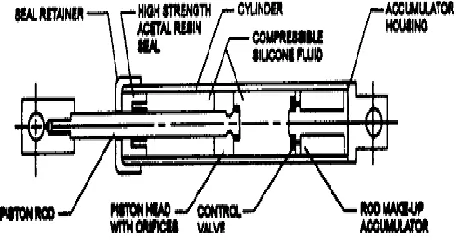
Figure 1.1 schematic diagram of a damper
In this regards nonlinear time history analysis are of paramount importance for seismic analysis. This motivation has led to this study on effect of dampers during earthquake for building frame, bridges, nuclear power houses etc. Various configurations of this damper profile layout have been considered along with various loading of earthquake acceleration as per IS 1893 (Part1):2002.
The objective in this research paper is to perform the non-linear time history analysis of nine-story building frame with and without damper considering different earthquake acceleration load.
Damper is one of the important device by which the seismic performance of a building can be improved, shown in figure 1.1. When dampers are applied to the structure the seismic forces as absolute acceleration, absolute displacement, absolute velocity and base shear are reduced.
Following are of the major objective of this study. 1.1 Modeling of building frame without damper. 1.2 Modeling of building frame with damper.
1.3 Nonlinear time history analysis of building frames without damper.
1.4 Nonlinear time history analysis of building frames with damper.
1.5 Critical study of results in terms of absolute acceleration, absolute displacement, and base shear.
II. METHODOLOGY
The study of the damper forces in the 9 story 2D frame is an important factor for the analysis. There are many research work reported on various damper aspects like linear and nonlinear Static and linear and nonlinear dynamic analysis of buildings frame.
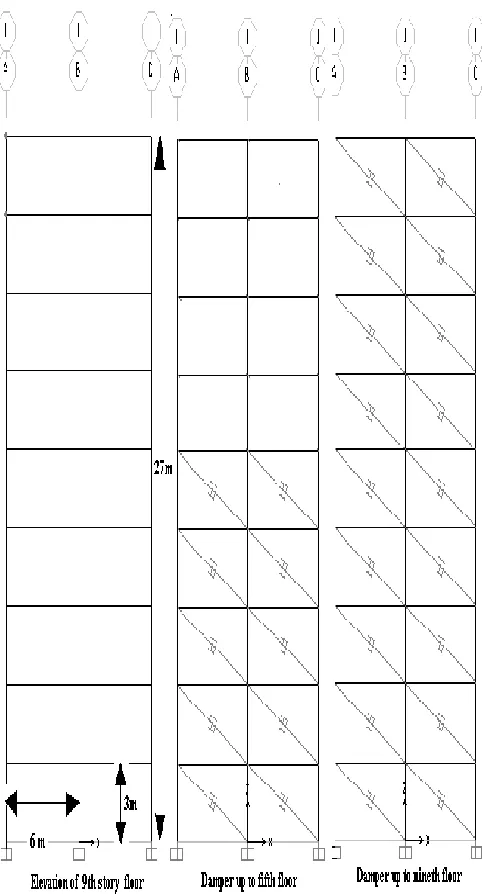
In this study we have provided the damper from bottom to ninth-floor and bottom to fifth-floor for seismic analysis as per IS 1893-2002. A comparison of time history analysis for ninth-story frame with damper and without damper has been carried out.The resultant forces are as absolute displacements, absolute acceleration, and base shear.
Step-1 Selection of building geometry, 2 bays and 9 story 2D frame.
Step-2 Define the material property of frame.
Step-3 Define the section property of frame beam and column. Step-4 Assign the joint pattern as fixed support.
Step-5 Define the dampers properties.
Step-6 Define the load pattern dead load and live load.
Step-7 Define the accelerogram file for earthquake load in SAP2000 V15.
Step-8 Define the analysis case. Step-9 Run analysis program.
[image:2.612.325.566.56.503.2]Step-10 A comparison in analysis results as absolute displacements, absolute acceleration, and base shear, maximum has been carried out as a result in this research paper.
Table 1.1 Damper properties
Damper Stiffness Damping coefficient
Damping Constant
Property 175126.85 KN /m 837.3188 0.5
III. TIMEHISTORYANALYSISOFBUILDINGFRAME
SAP is structural analysis programming software. With the help of SAP2000 nine- story building frame has been analysed for seismic loads without damper and with damper Linear as well as nonlinear time history analysis has been done. There are basically three methods for seismic analysis.
1. Linear and nonlinear Pushover analysis
2. Linear and nonlinear response spectrum analysis. 3. Linear and nonlinear time history analysis.
Following material properties and geometry have been considerd:-
Density of RCC : 25 kN/m3 Density of Masonry: 18.5 kN/m3
[image:2.612.47.290.403.453.2]The typical story height, floor to floor is 3.0m. The sections of columns are considered as 350mm x 350mm, and the section of beam is taken as 250mm x 350mm.
Figure 1.1.1 Elevation of Ninth-floor damper
IV. RESULTSANDDISCUSSION
In the present study seismic evaluation of the 9 story concrete building frame, analysis as per IS 1893-2000 has been carried out by 2D nonlinear time history analysis, for four load cases . Time history analysis results were tabulated in the form of base shear, absolute displacement, and absolute acceleration at top floor. It has been observed that there is significant variation in results based on the load case.
3.1Maximum Base Shear
compared to normal frame (Without damper) and from 23.79 % to 44.17% for different earth-quake load case when dampers are provided up to 9th floor , compared to normal frame (without damper) given in Table 1.3.
[image:3.612.320.570.56.139.2]
Table 1.2 Base shear
Load cases Base Reaction Without Damper(kN) Base Reaction With 5 Floor Damper(kN)
Base Reaction With 9 floor Damper(kN)
EQ
Altadena 31609.57 25623.99 24089.46 EQ
Lucerne 65340.05 45266.86 38838.17 EQ
Pomona 44954.89 28302.08 25099.61 EQ
Smonica 41221.04 25782.59 25202.36
Table1.3 Percentage reduction of Base shear compare to normal frame
Load cases
% reduction of Absolute Base Reaction With 5 Floor Damper
% 0f Base Reaction With 9 floor Damper EQ
Altadena 18.94 23.79
EQ
Lucerne 30.72 40.56
EQ
Pomona 37.04 44.17
EQ
Smonica 37.45 38.86
EQ
Yormo 31.20 31.54
3.2 Absolute Displacement
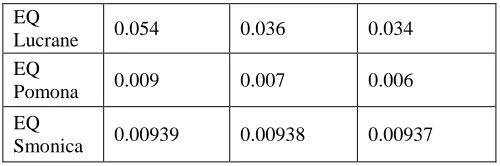
The maximum values of absolute displacement of 9 floor frame when damper is provided up to 5th floor and 9th floor from base for EQ Altadena , EQ Lucerne, EQ Pomona, EQ Smonica ,load are given in Table 1.4. It can be observed that absolute displacement reduces effectively from 0.41% to 31.79% for different earth-quake load case when dampers are provided up to 5th floor, compared to normal frame (Without damper) and from 0.42% to 36.25% for different earth-quake load case when dampers are provided up to 9th floor , compared to normal frame (without damper) given in Table 1.5
Table1.4 Absolute Displacement (mm)
Load case
Abs Dis Without Damper
Abs Dis With 5Floor Damper
Abs Dis With 9 floor Damper
EQ
Altadina 0.024 0.0209 0.018
EQ
Lucrane 0.054 0.036 0.034 EQ
Pomona 0.009 0.007 0.006
EQ
Smonica 0.00939 0.00938 0.00937
Table1.5 Percentage reduction of Absolute Displacement compare to normal frame
Load cases
% reduction of Absolute
Displacement With 5 Floor Damper
% reduction of Absolute
Displacement With 9Floor Damper
EQ Altadina 17.17 25.43
EQ Lucrane 31.79 36.25
EQ Pomona 19.85 34.79
EQ Smonica 0.41 0.42
3.3 Absolute Acceleration
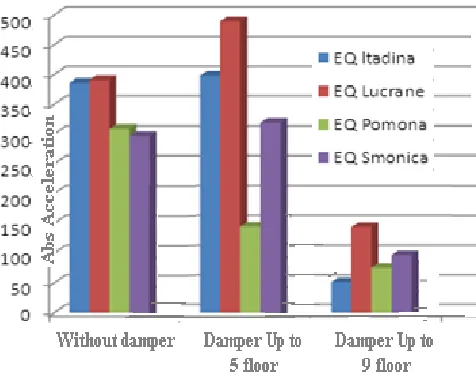
The maximum values of absolute displacement of 9 floor frame when damper is provided up to 5th floor and 9th floor from base for EQ Altadena , EQ Lucerne, EQ Pomona, EQ Smonica ,load are given in Table 1.6. It can be observed that absolute acceleration reduces effectively from 3.23% to 53% for different earth-quake load case when dampers are provided up to 5th floor, compared to normal frame (Without damper) and from 63.12% to 86.61% for different earth-quake load case when dampers are provided up to 9th floor , compared to normal frame (without damper) given in Table 1.7
Table1.6 Absolute Acceleration (mm/ )
Load case Abs Acceleration Without Damper Abs Acceleration With 5 Floor Damper
Abs
Acceleration With 9 floor Damper
EQ
ltadina 3859.88 3984.58 516.52
EQ
Lucrane 3910.02 4894.18 1441.76
EQ
Pomona 3089.39 1451.80 755.97
EQ
Table1.7 Percentage reduction of Absolute Acceleration compare to normal frame
Load case
% reduction of Absolute Acceleration With 5 Floor Damper
% reduction of Absolute Acceleration With 9 floor Damper
EQ ltadina 3.23 86.61
EQ Lucrane 25.17 63.12
EQ Pomona 53.00 75.53
EQ Smonica 7.69 67.31
[image:4.612.55.281.87.240.2]Figure 1.2 shows the Time history analysis graph for base shear.
[image:4.612.328.566.279.467.2]Figure 1.3 to Figure 1.5 shows the bar chart graph with respect to base shear, absolute displacement, absolute acceleration .
Figure 1.2 Non-linear Time history analyses Graph
Figure 1.3 Bar chart for Base shear (kN)
[image:4.612.50.288.318.476.2]Figure 1.4 Bar chart for Absolute displacement (mm)
Figure 1.5Bar chart for Absolute acceleration (mm/ )
Following are the salient conclusions of this study-
V. CONCLUSIONS
On the basis of present study and reviewed literature the following conclusions can be drawn:
1. Seismic performance of building can be improved by providing energy dissipating device (damper), which absorb the input energy during earthquake.
2. The frame is more safe when damper is provided up to top floor from base.
3. With the deployment of damper in the structure, the base shear effectively reduces.
1. Due to base shear reduction of making the structure cost effective
2. Due to absolute acceleration reduction the inertial forces also reduced.
[image:4.612.52.286.496.670.2]VI. FURTHER SCOPE OF STUDY
1. This present study considers to only nonlinear time history analysis. This may be extended to P-delta dynamic analysis and response spectrum dynamic analysis.
2. In future work more effective device developed to reduce the effect of all dynamic loading like wind load, bombard load, vibration load and also seismic load .
REFERENCES
[1] Sladek John R. and Klingner Richard E., (2004) Effect Of Tuned-Mass Dampers On Seismic Response , Journal of structural engineering , Vol. 109, No. 8, pp- 2004-2009.
[2] Hwang Jenn-Shin, Huang Yin-Nan and Hung Ya-Hui. (2005), Analytical And Experimental Study of Toggle-Brace-Damper Systems, Journal of structural engineering , Vol. 131, No. 7, pp.1035-1043.
[3] Chandra Ramesh and Masand Moti (2011), Friction damper for seismic control of La Gardena towers south city Gurgaon , India, Journal of American concrete institute, No. 3,Proceedings,Vol. 78,pp.187-193. [4] Dethariya M.K and Shah B.J (2011), Seismic response of building frame
with and without viscous damper with using SAP 2000 ,International journal of earth science and engineering ISSN 0974-5904,Volume 04 , No 06 SPL, October 2011, pp 581-585.
[5] Kurata M.R, Leon .T, Des Roches.R (2012), Rapid seismic rehabilitatin strategy concept and testing of cable bracing with couples resisting damper. Journal of structural engineering ,Vol. 138, No. 3, pp.354–362 . [6] Anil. K. Chopra, “Structural Dynamics”, Forth Edition, Prentice Hall 2006. [7] Pankaj .K. Agarval and Manish Shrikhande.“ Earthquake Resistant Design
of Structure” Fourth Edition, Prentice Hall 2006.
[8] Anil. K. Chopra, “Structural Dynamics”, Forth Edition, Prentice Hall 2006. [9] Beer, F. P. and Johnston Jr. E. R, 1962. Vector Mechanics for Engineers,
Statics and Dynamics, 5th Edition. McGraw-Hill Book Co. Inc. New York, NY.
[10] Bowles, J.E. 1982. Foundation Analysis and Design. McGraw-Hill Book Company.
[11] Clough, R., and J. Penzien. 1975. Dynamics of Structures. McGraw-Hill Book Company.
[12] Cook, R.D. and W.C. Young. 1985. Advanced Mechanics of Materials. Macmillan Publishing Company.
[13] Crandall, S. H. and Dahl. N. C. 1959. An Introduction to the Mechanics of Solids, McGraw- Hill Book Co. Inc. New York, NY.
[14] Scheller,J. and M.C. Constantinou. 1999. Response History Analysis of Structures with Seismic Isolation and Energy Dissipation Systems: Verification Examples for Program SAP2000. Technical Report MCEER-99-0002.University of Buffalo, State University of New York.
[15] Thomson, W. T. 1965. Vibration Theory and Applications. 2nd Printing, Prentice-Hall, Inc. Englewood Cliffs, NJ.
[16] Beer, F. P. and Johnston Jr. E. R, 1962. “Vector Mechanics for Engineers, Statics and Dynamics” 5th Edition. McGraw-Hill Book Co. Inc. New York, NY.
[17] Bowles, J.E. 1982. “ Foundation Analysis and Design”. McGraw-Hill Book Company.
[18] Harris, C.O. 1959. “ Introduction to Stress Analysis” The Macmillan Co. New York, NY.
[19] Debasis Sinha, “Seismic Retrofitting of existing Structure” IIT Roorkee , M.Tech Thesis, May 2002.
[20] Mohd Aarif Khan, “Seismic evolution of frame buildings using pushover and dynamic analysis” IIT Roorkee,M.Tech Thesis, June 2008.
[21] Mahesh Babu Addala “Performance based design of arc frame building with supplemental damping” IIT Roorkee, M.Tech Thesis, June 2011. [22] CSI Berkley SAP manual,IS-1893- 2002.
AUTHORS
First Author – Waseem Khan, Assistant Professor, Department
of Civil Engineering, University Institute of Technology, Rajiv Gandhi Proudyogiki Vishwavidyalaya, Bhopal . M.P. India, Email:[email protected]
Second Author – Dr. Saleem Akhtar, Professor & Head,
Department of Civil Engineering, University Institute of Technology, Rajiv Gandhi Proudyogiki Vishwavidyalaya, Bhopal . M.P. India, Email:[email protected]
Third Author – Aslam Hussain, Assistant Professor,