Marketing Dissertations Department of Marketing
12-13-2018
Marketing Insight: The Construct, Antecedents,
Implications, and Empirical Testing
Roberto Mora Cortez
Follow this and additional works at:https://scholarworks.gsu.edu/marketing_diss
This Dissertation is brought to you for free and open access by the Department of Marketing at ScholarWorks @ Georgia State University. It has been accepted for inclusion in Marketing Dissertations by an authorized administrator of ScholarWorks @ Georgia State University. For more information, please [email protected].
Recommended Citation
Mora Cortez, Roberto, "Marketing Insight: The Construct, Antecedents, Implications, and Empirical Testing." Dissertation, Georgia State University, 2018.
MARKETING INSIGHT: THE CONSTRUCT, ANTECEDENTS, IMPLICATIONS, AND EMPERICAL TESTING
BY
ROBERTO FELIPE MORA CORTEZ
A Dissertation Submitted in Partial Fulfillment of the Requirements for the Degree
Of
Doctor of Philosophy
In the Robinson College of Business
Of
Georgia State University
GEORGIA STATE UNIVERSITY ROBINSON COLLEGE OF BUSINESS
Copyright by
Roberto Felipe Mora Cortez
ACCEPTANCE
This dissertation was prepared under the direction of the Roberto Mora Cortez Dissertation Committee. It has been approved and accepted by all members of that committee, and it has been accepted in partial fulfillment of the requirements for the degree of Doctor of Philosophy in Business Administration in the J. Mack Robinson College of Business of Georgia State University.
Richard Phillips, Dean
DISSERTATION COMMITTEE
Wesley J. Johnston
S. Tamer Cavusgil
Ajay K. Kohli
Jeffrey Parker
ABSTRACT
MARKETING INSIGHT: THE CONSTRUCT, ANTECEDENTS, IMPLICATIONS, AND EMPERICAL TESTING
BY
ROBERTO FELIPE MORA CORTEZ
09/11/2018
Committee Chair: Wesley J. Johnston
Major Academic Unit: Marketing
ESSAY 1
What is a marketing insight?
Roberto Felipe Mora Cortez PhD in Marketing Thesis Department of Marketing J. Mack Robinson College of Business
Georgia State University PO Box 3991 Atlanta, GA 30302-3991
[email protected] 1.404.310.2805 (mobile)
“Innovation without insight is failure.” – Mark Simmonds
Experiencing the boom of big data and quantitative analytics, firms are seduced into hiring
computer scientists and implementing technological solutions for data processing in the search
for insights. Data analytics alone do not provide the market sensitivity required by companies.
Indeed, although a firm’s data and knowledge are rapidly growing, a firm’s actual insight is not
(Jaworski, Malcom, and Morgan 2016, p. 34). Understanding the concept of insight is relevant
for companies because there is no clear differentiation among data, knowledge, and insight
(Jaworski, Malcom, and Morgan 2016; Smith, Wilson, and Clark 2006). The term is becoming a
buzzword (Actionable 2017), and it lacks connection with the formal business processes of a firm
(Smith and Raspin 2008). Insight is turning into a prevalent concept for the marketing field
(Kumar 2015; Smith, Wilson, and Clark 2006). Because the current paradigm for marketing is
becoming an integral part of the firm’s decision-making framework (Kumar 2015), we use the
lens of marketing to conceptualize insight.
In this knowledge-based economy, fundamental changes in the social, legal, economic, political,
and technical environment are the basis for the recent interest in what is marketing insight (MI)
(Smith, Wilson, and Clark 2006). The current view in the literature is diffuse and mainly comes
from practitioner discussion (e.g., American Marketing Association 2016; Duffy 2008; UMI
2017), thus missing academic rigor. The focus has been on customer or consumer insight
(Jaworski, Malcom, and Morgan 2016), which is defined as “knowledge about customers which
meets the criteria of an organizational strength; that is, it is valuable, rare, difficult to imitate and
which the firm is aligned to make use of” (Smith, Wilson, and Clark 2006, p. 136). Thus, a static
resource-based view of insight has been assumed. To our knowledge, MI does not appear to be
conceptualization of this theoretical domain (Mora Cortez and Johnston 2017). Accordingly, the
first goal of this research is to provide an operational definition of the construct, identifying how
a firm knows when it has a valuable MI.
Building over the significant role of insight for the practice of marketing (Kumar 2015), it is
important to understand why some companies excel in insight generation while others show poor
results. A favorable transition from data to insight has been supported with anecdotal evidence;
thus, we know little about what drives the success or failure within an organization looking to
create impactful MIs. For example, a study indicates that data, information, knowledge, and
insight are part of an iterative-linear process without explaining the organizational conditions for
such evolvement (Smith, Wilson, and Clark 2006). Therefore, the second goal of this research is
to shed some light on the variables that drive a firm to generate MIs and the environmental
conditions that can enhance or mitigate their effect.
Although the path from insight to value is acknowledged by marketing literature (e.g., Smith and
Raspin 2008), there is limited empirical evidence to suggest that firms can benefit from the
process of insight generation. LaValle et al. (2011) is one of the few endeavors where
top-performing (i.e., higher economic returns in comparison with rivals) organizations are examined
in their ability to ignite insights to guide future strategies and day-to-day operations. Top
performers were twice as likely to use insights in comparison with lower performers. However,
these results draw in a descriptive approach (p. 22). Thus, the third goal of this research is
identifying the consequences of MI generation and the firm’s internal conditions that affect the
By answering these questions, we make three contributions to previous research. First, the study
reveals that, whereas extant literature relies on the resource-based view (e.g., Smith, Wilson, and
Clark 2006), firms conceptualize the properties (i.e., dimensions) of a MI from a unique
perspective, identifying five characteristics: (1) novelty, (2) actionability, (3) credibility, (4)
market relevance, and (5) commercial potential. This new view provides a basis for further
examination of the theoretical underpinnings related to MIs. Also, this finding reinforces the
validity of a firm’s market orientation (e.g., Kohli and Jaworski 1990) due to the explicit
connection between the customer’s benefits (i.e., market relevance) and potential economic
benefits (i.e., commercial potential) for an organization when creating valuable insights.
Second, we identify six firm characteristics that are key for successful MI generation. In line
with Tuli, Kohli, and Bharadwaj (2007), we do not aim to create an exhaustive list of antecedents
for the focal construct. Therefore, we focus on factors that are not extensively discussed in prior
marketing literature and provide stimulating ideas for future research (Kohli and Jaworski 1990),
such as reflection orientation and data integration capability. In addition, the study addresses the
fact that market turbulence and competitive intensity influence the ability to generate MIs.
Therefore, variables other than those under managers’ control affect the scenario for disruptive
learning.
Third, we extend prior knowledge by determining relevant measures a firm can manage to
strengthen the benefits of generating MIs. The study focuses on three different levels of an
employees. In particular, we relate these factors to outcomes previously validated for firm
performance, such as brand attitude (Homburg, Schwemmle, and Kuehnl 2015), innovation
performance (Bharadwaj and Menon 2000), and attitude toward change (Dunham et al. 1989).
We also connect these measures with traditional economic outcomes, such as sales revenue and
profitability, to reach a more enlightened comprehension of MI consequences. This
understanding fosters long-term financial sustainability of organizations (Morgan, Vorhies, and
Mason 2009).
METHODOLOGY
Considering the sparse academic literature on MI, we draw on a qualitative field study based on
in-depth interviews adopting a discovery-oriented, theory-in-use approach (e.g., Deshpandé
1983; Glaser and Strauss 2017) to develop a grounded model with robust conceptual themes
(Strauss and Corbin 1998). In the next section, we focus on the description of the qualitative
approach.
Sample and Data Collection
The sampling follows a theoretical procedure to identify practitioners across functions and
hierarchies from multiple industries with at least five years of job tenure in business (e.g.,
Challagalla, Murtha, and Jaworski 2014; Kohli and Jaworski 1990). The purpose of this focused
sampling was to engage participants who can provide a profound explanation of their
experiences and thoughts. We recruited participants from a large state university marketing
obtained was 35 respondents (see Table 1), a configuration consistent with the sample size
suggested for exploratory research (McCracken 1988). An important driver of the sample is the
idea of category saturation (Strauss and Corbin 1998), which means that researchers conducted
the interview guide until information redundancy was accomplished (Beatty and Willis 2007).
The interviewees were directly involved in market research, data analysis, organizational
learning, new idea development, and articulation of marketing strategy and, therefore, had
significant knowledge about what an insight means from an organizational level perspective.
Job Title Industry Experience
(years) Main Business Setting Interview duration (minutes)
Senior Director of Digital Marketing Beverages 24 B2C 55
VP of Business Development Food processing 35 B2B 57
Strategic Project Manager CPG 30 B2C 34
Director of Marketing Strategy Pulp and paper 14 B2B 57
Project Manager Finance 6 B2B 40
Commercial Excellence Leader Chemicals 20 B2B 40
Senior Manager Marketing Strategy Beverages 15 B2C 41
Senior VP Sales Communications 25 B2C 51
Director of Marketing Energy 34 B2B 45
VP Sales Operations & Development Air transportation 32 B2C 47
Marketing Operations Manager Energy 27 B2B 29
President Construction 36 B2B 33
Product and Sales Manager Pharmaceutical 25 B2B 46
Business Development Manager Engineering 23 B2B 37
Application Engineering Manager Electronics 21 B2B 35
Business Development Director Engineering 25 B2B 52
Sales Manager Insurance 15 B2C 36
Logistics Manager Consultancy 28 B2B 40
President & CEO Finance 22 B2B 41
President of Product Support Emergency
vehicles
35 B2B 47
Director of Innovation Pulp and paper 25 B2B 48
Senior Sales Manager Life sciences 25 B2B 46
Product Development Engineer Health care 9.5 B2B 47
Marketing Communications Manager Chemicals 32 B2B 47
Head of Marketing Intelligence Plastics 27 B2B 40
Sales and Marketing VP Packaging 30 B2B 40
Marketing Manager Packaging 16 B2B 42
Account Manager Software 5 B2B 36
CMO Entertainment 37 B2C 47
Market Research Manager Chemicals 34 B2B 35
President of Global Sales Operations Logistics 25 B2B 46
President and CEO Transportation 18 B2C 51
Marketing & Prod. Develop. Director Mining 20 B2B 38
CMO Chemicals 22 B2B 37
[image:12.612.60.557.73.156.2]*Consumer packaged goods
TABLE 1: SAMPLE CHARACTERISTICS (CHRONOLOGICAL ORDER)
We followed a structured interview process (e.g., Challagalla, Murtha, and Jaworski 2014)
regarding the MI concept (see the Appendix). We carefully worded the questions to avoid the
potential pitfalls of “active listening” (McCracken 1988, p. 21). In addition, we gave
practitioners the chance to share any other thought they considered relevant. We followed up
with two practitioners for clarification. All participants accepted the request of audiotaping the
interviews. The audiotapes were transcribed into 469 pages of text. We also took detailed notes
during the interviews to avoid missing incipient ideas or reflections (Saldaña 2015).
Furthermore, we included several types of archival data in the research process that were directly
provided by study participants. The material consisted of meetings content, internal
presentations, research procedures (e.g., surveys), consultants’ reports, and other documents that
contributed to our understanding of the MI construct and its nomological network. These data
provided valuable information on (1) the approach of firms to learning, (2) marketing
intelligence processes, (3) transformation of data to insight, (4) the relevance of the insight
concept for companies, and (5) type of MI.
To identify the distinctive themes around the focal construct, we followed Corbin and Strauss’s
(2014) procedure (i.e., open, axial, and selective coding). Several marketing studies have
implemented this approach successfully (e.g., Homburg, Wilczek, and Hahn 2014). First, two
researchers independently undertook a general open coding approach with the help of the
qualitative data analysis software NVivo (v.11). The main foundation of open coding is the
identification of concepts, assigning labels. We specifically selected in vivo codes (participants'
terms) to grasp the meaning of the topics (Charmaz 2014). If coding differences arose at this
stage, they were settled under theoretical agreement (i.e., review of conceptual definitions). To
complete the coding, a summary coding plan, displaying labels, definitions and representative
informants verbatim, was jointly developed (Homburg, Wilczek, and Hahn 2014; Ulaga and
Reinartz 2011).
Then, at the second stage, we applied axial coding that permits grouping similarly coded data,
reducing the number of initial codes developed while sorting and re-labeling them into
conceptual, more abstract categories (Saldaña 2015). We contextualized the first-order categories
with supplementary literature, analyzing the properties and dimensions of the constructs. We also
reassembled the data to investigate relationships between constructs (Charmaz 2014),
establishing connections between and among the first-order categories to develop second-order
categories. Finally, we conducted selective coding, defined as the refinement and consolidation
of the theory (Corbin and Strauss 2014). This stage allowed synthesizing antecedents, the focal
To ensure the trustworthiness of our results, we applied suggestions for data and researcher
triangulation. For data triangulation, we determined that most of our final categories were
transferable across respondents’ functions (e.g., innovation, marketing, sales), integrated
information from the archival data, and then compared the field data with associated research
topics. For researcher triangulation, we contacted two independent judges to verify the accuracy
and reliability of the key themes that emerged from the field data by having them code 15
randomly selected transcripts. The inter-rater reliability, assessed by the proportional reduction
in loss method, was .80, well above the .7 threshold recommended for exploratory research (Rust
and Cooil 1994). For content validity purposes, we contacted interviewees again with the general
results and asked for feedback, presented and discussed the results with a panel of five senior
marketing academicians, and conducted two independent practitioner workshops. Overall,
interviewees, other practitioners, and academicians expressed strong agreement with the
proposed framework. Their main criticism involved unclear definitions and, consequently, minor
adjustments in the wording of the definitions was executed. In the following sections, we discuss
the resultant perspective about MI, the antecedents of MI generation, the variables moderating
the relationship between the antecedents and MI generation, the consequences of MI generation,
and the variables moderating the relationship between MI generation and the consequences.
THE MARKETING INSIGHT (MI) CONSTRUCT
Our field study indicates that the concept of MI is understood as being synonymous with market
insight and it is loosely used by firms as a necessary step for organizational learning. Nowadays,
losing influence (Verhoef and Leeflang 2009). Many acknowledge that insights are created
through dedicated market-oriented people. Therefore, labeling as “marketing insight” gives
direction of responsibility about the marketing concept above and beyond the function of
marketing, but concentrates resources into one voice. For example, in a pulp and paper firm, the
area “in charge” of generating insights is market intelligence, which include practitioners called
“insight leaders.” However, this area responds to the marketing vice president (VP). In addition,
as one practitioner said: “One functional area has to own and represent the voice of the
customer...this needs to be marketing.”
Managers interpret an insight from different angles such as “understanding of the market
landscape,” “it is something that help us to relate to our customers,” and “new knowledge.” The
business development VP of a food processing firm refers to the concept as follows:
Marketing insight is about market trends that drive growth…(i)t is specific to answering
with ingenuity who buys, what is used, when is needed and bought, how different elements
of the company relates to give an answer, but mainly deep comprehension of the reason
why something is happening or will be happening in a particular market.
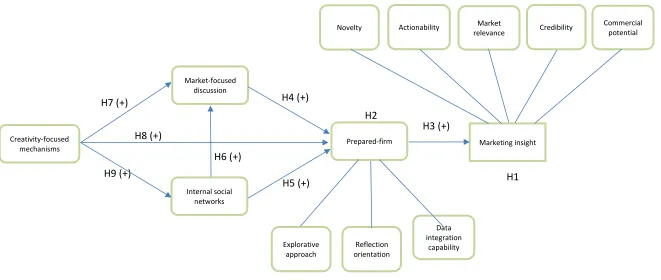
We summarize all different perspectives about MI from our field study in Table 2. The findings
suggest that a MI entails five key elements: (1) novelty, (2) actionability, (3) credibility, (4)
market relevance, and (5) commercial potential. Accordingly, MI is formally defined as a firm’s
shift in understanding about the market, leading to action, credible for its employees, providing
potential to create and capture value. Next, we elaborate on the five dimensions with more detail
First-order categories and informant quotes Second-order categories
Unknown Novelty
“Insight is the thing that people is missing. Most times they don’t know it” “In reality there are gaps, just in a perfect world you would work based on facts. Marketing insight helps to bridge these gaps”
Unique
“Insight is more specific than knowledge, it is a deeper dive that requires expertise. So, it is an exceptional state”
“Marketing insights are very special. The best insights are very granular” “It is something fresh, non-obvious”
Usability Actionability
“It means leveraging data to identify commonalities in the marketplace that can drive initiatives or projects”
“Marketing insight is combining data and information into something useful”
Transformation
“It is understanding that lead to change”
“It is a view on strategy to convert an idea to value, through implementation of a process”
Data-based Credibility
“It has to be valid for the organization…supported by data”
“Marketing insight comes from an analytical format based on surveys or interviews”
Logical
“An insight is rational according to a particular business context”
“It makes sense…it is coherent with the market. Ultimately, it is accurate”
Better understanding Market
relevance “It is about understanding the experience customers are looking for”
“Involves identifying what a consumer needs and has to be solved” Solution
“Marketing insight involves providing an answer to customer needs”
“Insight is about the reason why something is happening. It is the key to fix a problem or deliver better offerings for a group of customers”
Buying behavior Commercial
potential “Marketing insight would be to see a shift or defined direction on buying
patterns”
“Condition in our customer base that provide us an opportunity to sell” Value
“Allows you to go to the market with more confidence and it is more likely to close the deal. It delivers positive financial results”
“It means providing technical knowledge and cost saving ideas that would make our customer more profitable”
Novelty. The condition of newness for a MI is probably the closest to practitioners’
appeals. From psychological literature (e.g., Metcalfe and Wiebe 1987), insight is a personal
state of mind that can be transferred to others by learning. Therefore, insight comes from the
mind (Sternberg and Lubart 1996) and it is an internal condition for a business unit based on
“situated learning theory” (see Gherardi 2001). Three key phenomenological characteristics of
insight are (1) suddenness due to the abrupt and significant leap of understanding (Mayer 1992),
(2) spontaneity which indicates that insight is developed internally of its own accord (Davidson
1996), and (3) unexpectedness which explains that insight happens by surprise and in an
unpredictable form (Metcalfe and Wiebe 1987), support the dimension of novelty for a MI at the
organizational level. An insight is directional, and implies a shift in understanding about the
market. Formally, novelty is the magnitude of the shift in understanding based on the MI.
Therefore, the broader the turn, the more novel the insight. Many executives indicated that
novelty is an integral part of MI. For example, the Sales VP of a packaging firm stated that: “A
marketing insight brings something new to the table, it is ground breaking and should lead us to
questioning the status-quo…in simple words a good insight is novel and surprising.”
Novelty is the key distinctive feature of learning beyond understanding that is merely well
conceived based on existent knowledge (Mueller, Melwani, and Goncalo 2012; Senge 1990).
However, novelty can also promote a tension in evaluators' minds when they judge whether to
pursue an idea (Mueller, Melwani, and Goncalo 2012, p. 13). Certainly, practitioners have
them as inversely related (Ritzschel, Nijstad, and Stroebe 2009). Therefore, a MI requires
complementary dimensions in order to be valuable for companies.
Actionability. It is possible that a firm’s low performance is attributable to deficiencies to
respond effectively to the market, despite having clear insight into that market (Smith and Raspin
2008). A key component of a learning organization is the ability to modify its behavior to reflect
new knowledge and insights (Garvin 1993 p.80). Organizational responsiveness through concrete
actions has been recognized as relevant in prior marketing literature (e.g., Kohli and Jaworski
1990). An organization’s understanding of how things are done is referred to as theory in use
(Argyris and Schön 1978). As organizations learn, internal and external organizational actions
reflect the operationalization of changes in theory in use, because actions are both the ultimate
expression of learning and a means to facilitate new learning (Sinkula, Baker, and Noordewier
1997, p. 306-307). Therefore, the actionability property of a MI refers to the extent to which a
firm can modify its activities in response to an insight.
In many instances, interviewees explained that actionability represented a key characteristic of
MI. Actionability depends on firm features such as people, culture, and processes, because
insight is a consequence of those factors and is firm-based. Also, learning is depicted within the
boundaries of a domain of knowing and doing: a practice (Gherardi, 2001, p. 132). As one
participant mentioned:
The potential of an insight is zero if we cannot change our procedures or people behavior.
insight. Also, it tangibilizes the learning for our front-line people and amends the
willingness to follow up from detractors.
Credibility. Most study participants conceived credibility as a critical part of a MI. In the
words of the president & CEO at a firm in the finance industry: “A marketing insight is
believable, meaning that it is able to be clearly articulated and based on facts. Being a credible
insight is what give you the chance to mobilize managers.”
Credibility in the context of information processing has been defined as the perceived presence
or absence of particular traits in the source (Trumbo and McComas 2003, p. 344). Meyer (1988)
identified five dimensions of information believability through analyzing its source: fairness,
biasness, completeness, accuracy, and trust. Credibility for an insight is conferred when evidence
to support it is presented (Lyles and Mitroff 1980). From the interviewees’ perspective, a MI is
credible when it is backed up by appropriate information and immersed in data. In the words of a
CMO:
The first aha! moment was in 2014. Traditional wisdom was 80% of customers come
from X. Through research, only 40% of our market was X, 5% state level, and 55%
outside the state. Having these data delivered a huge insight and we turned to new
markets. All of that was quite a shock, thus supportive information was key in convincing
people to change our communications to digital.
Developing credibility for different hierarchical levels and different functional areas implies
perceived as more credible when it is tested and refined within a firm’s context (Challagalla,
Murtha, and Jaworski 2014, p. 9). Also, if the communicator is perceived as being biased or
having a beneficial outcome from the situation, the credibility of the insight will be diminished
(Lyles and Mitroff 1980).
Market relevance. Potential insights are plentiful, and unless a new understanding gets
external support from its originator, it is difficult to disseminate and implement it. Convincing
parties outside the insight nucleus about its merits is laborious; given the low success rate for
new developments, there must be something really compelling before external stakeholders are
convinced of the idea’s viability in a business setting (Der Foo, Wong, and Ong 2005). An
effective communicability of new ideas requires a balance in technical competence across
managers and explanation regarding how an insight involves a solution to a customer problem
(Goldenberg, Lehmann, and Mazursky 2001). This suggests that real MIs capture an existing
market need, which serves as a language homogenizer within the organization and connector
with customers. As a marketing strategy director at a pulp and paper firm pointed out:
Developing true, actionable, meaningful insight…it takes experience, time, resources,
knowledge, investments…. You need cues from customers and prospects. Marketing
insights are the true differentiation in the market. They are rooted in current market
needs, we validate them with our customers and as a result they want to do business with
us.
A strategic project manager of a CPG firm also emphasized market relevance as a key dimension
Moreover, it is clear the degree or magnitude of impact for a specific customer or market
segment.”
Commercial potential. Katsikeas et al. (2016) analyze how market-based activities can be
related to performance outcomes. In our study, interviewees stressed that MIs have foreseeable
influence for a company and, thus, can be subject to control. For example, the president of a
construction firm said:“When generating valuable insights from the market, at the end
everything converges to what is the real impact caused by an insight in benefit of our company.
It is decisive, then, that the results can be measured.”
Performance can be measured at different levels, from customer mindset (e.g., satisfaction) to
accounting and financial views (e.g., profit; see Katsikeas et al. 2016). Almost all executives
participating in this study noted that a critical element of MI is the economic benefit expected
from it. This is in line with current challenge of the marketing discipline to be more accountable
from a financial perspective (Hanssens and Pauwels 2016; Katsikeas et al. 2016). In modern
competitive markets, there is little space for failure and learning needs to be represented in
tangible forms of benefit for a firm. Success of an idea or new development in a free market
system is assessed in currency (e.g., dollars), so business-related actions are evaluated in
monetary terms (Lehmann, 2004 p. 73). As one manager stated: “Corporate is not so happy at the
moment of creating marketing insights itself...they are happier when they can see the
implications. Overall, in our business unit people are attracted to an insight when short-term or
long-term expectations are positive in the bottom line.”
Estimates of an insight’s commercial potential become objectives against which to compare the
subsequent actual results and determine whether it is successful or not, and to what degree (Page
1993). Next, we discuss how MI may differ from concepts that also pertain to organizational
learning and can create confusion.
Marketing Insight (MI) and Related Concepts
Extant literature has suggested that data, information, and knowledge are also intrinsically
related to organizational learning (e.g., Nonaka 1994; Bierly III, Kessler, and Christensen 2000).
Accordingly, we discuss the difference between marketing insight and these concepts in a
hierarchical structure (see Table 1).
Data. Webster (1961) argues that something given, granted, or admitted is data because it
is the root for argumentation or inferences. Therefore, data is a potential source or cause in
organizational learning. Data are representations whose meanings are dependent upon a coding
system (e.g., temperature in Celsius degrees versus Kelvin degrees; Likert scale five-point versus
seven-point). Data are raw facts and learning about data is the process of accumulating facts
about the market (Bierly III, Kessler, and Christensen 2000). Moreover, Smith, Wilson, and
Clark (2006, p. 136) define market data as the recording of transactions or interactions with
market players, quantitatively or qualitatively, explicitly or implicitly. Data-based learning is the
most basic approach to market understanding. The purpose of data is neutral, whereas the
purpose of MI is to better represent market needs and trends. Therefore, MI is a consequence
Information. Information is comprised of data that have been processed into a meaningful
form for the recipient and is of perceived value for decision-making (Bierly III, Kessler, and
Christensen 2000). Information is also defined as something (e.g., message) which can justify
change in a construct (e.g., plan; Webster 1961). Two dimensions of information have been
discussed in the literature: (1) syntactic, relative to the volume of information, and (2) semantic,
relative to the meaning of information. In terms of organizational learning, the semantic aspect of
information is more relevant (Nonaka 1994). From a market perspective, information is data
which have been organized into patterns (Smith, Wilson, and Clark 2006, p. 136). The
difference between data and information about a market is that the latter contains new meaning
(Nonaka 1994). Information requires a context in order to be interpreted and builds over data.
Thus, the recipient of information determines a pattern in data due to some existing knowledge.
Information-based learning is the next level to market understanding and implies giving form to
data (Bierly III, Kessler, and Christensen 2000). The key difference between information and
insight is that the former can be an instrument to generate insights. Information as much as data
possesses a neutral state, whereas MI leads to action in search of creating and capturing
economic benefits in the market.
Knowledge. Webster (1961) states: “In this sense, knowledge is a justified true belief”
(Nonaka 1994, p. 15). At the organizational level, a belief needs to be shared by employees and
its justification stabilizes the existence of such knowledge through time. However, from a
marketing perspective, knowledge is a dynamic human process relative to a firm’s aspiration for
the “truth” (Nonaka 1994). Knowledge as a “truth” about a market is non-neutral and has the
organization’s elements obtain knowledge and recognize it as potentially useful (Huber 1991).
Knowledge involves both knowing how, which relates to tacit knowledge, and knowing about,
which relates to explicit knowledge (Nonaka 1994). We recognize that no company is born at a
zero-level knowledge because people are knowledge carriers experiencing continuous interaction
with their environments. Ultimately, knowledge-based learning entails the analysis and synthesis
of information. Having a great flow of information and data processing does not mean that there
is a great deal of knowledge application (Bierly III, Kessler, and Christensen 2000). Herein lies
the difference between knowledge and MI; the latter involves concrete applications of
knowledge and will have a positive business impact for the firm. Knowledge represents a current
state of understanding about a market, while MI is an “update” to such understanding. In the
words of an interviewee:“You can have knowledge without insight, but you cannot have insight
without knowledge.”
Concept Novelty Actionability Credibility Market relevance
Commercial
potential Example
Marketing
Insight ✓ ✓ ✓ ✓ ✓
We have to modify our motor
design, including insulation X, for
distributors that sell our trucks to
end-users operating in Southeastern
Asia, India, Africa, Brazil,
and Central America and the
Caribbean. Normalizing the temperature of the
average annual fuel consumption,
increasing our market share in
2% and gross margin in 3%
Knowledge ✓ ✓ ✓
When is hot our motors decrease performance, consuming more
fuel due to the extra mechanical
effort
Information ✓ ✓ 98°F is hot
Data ✓ 98°F
TABLE 3: MARKETING INSIGHT AND RELATED CONCEPTS COMPARISON
ANTECEDENTS TO MARKETING INSIGHT (MI) GENERATION
MI provides an opportunity to reach competitive advantage by a substantive leap in market
understanding (Smith, Wilson, and Clark 2006). Therefore, it is important for firms to identify
what organizational factors drive or hinder the generation of MIs within a company. Our field
study and examination of the literature suggest that six firm-level characteristics are relevant in
this process: (1) market-focused discussion, (2) internal social networks, (3) creativity-focused
mechanisms, (4) explorative approach, (5) reflection orientation, and (6) data integration
capability. Accordingly, we discuss each antecedent and develop propositions. We define MI
generation as a complex non-automated organizational learning capability that represents the
Market-focused discussion. Discussing market-related themes among BU’s employees
emerged as one of the most relevant antecedents driving MI generation. Several study
participants acknowledged the importance of having an exchange of opinions about what is
happening in the market continuously. Discussing the market works as a priming channel for
practitioners, which makes them consider market-based issues consciously and unconsciously.
Through discussion, the market is emphasized as the core element in managing a business. For
example, a product development engineer in the health care industry declared: “We meet
periodically...we have a very fluid process of sharing information (formal and informal). It is not
about time; it is about real time…you need to meet when is relevant. (Market) knowledge
evolves through face-to-face discussion. It keeps you focused on the market.”
Prior literature has also stressed the role of employees’ discussions about the market. On the one
hand, Slater and Narver (1995) assert that the use of structured processes for discussion
generates exposure to new information, fostering multiple interpretations in a constructive
manner, and leading to learning in a positive atmosphere. Providing forums for information
exchange and discussion minimize the risk of knowledge dissipation. On the other hand, Gupta
and Govindarajan (1991) assert that more uncertain market opportunities or problems require a
more intense frequency and informality in the discussion patterns; this allows companies to be
timelier to market events. In other words, formal and informal market-based discussions are
essential to generating MIs. Thus:
P1: The more market-based discussion within an organization, the more likely it is to
Internal social networks. Internal social networks refer to the degree of interconnectivity
within an organization. Having dense social networks within a firm ensures that knowledge and
support are easily shared among all BU members (Mehra, Dixon, and Robertson 2006). Also,
social networks advocate for interpersonal trust within a firm. Practitioners can draw on this
trusted network to openly communicate and capture information about the market. Individuals
can behave less opportunistically in intense social networks, providing new ideas that contribute
to firm-level development because current and past behaviors are readily accessible by others
(Mehra, Dixon, and Robertson 2006). As one marketing operations manager noted:
Different people have different perspectives. Individuals cannot work in silos. It is needed
to make bridges internally to create more experiences and (learning) sources.
Interpersonal connections will develop a single organizational language, which facilitates
communication, balances knowledge across the organization, and people is more
preoccupied about the firm’s future. This generates a natural and healthy competition
towards the creation of strong marketing insights.
Organizational learning literature (e.g., Tsai 2001) suggests that social links enhance interunit
cooperation, stimulating the creation of new knowledge or critical insights. These links connect
practitioners vertically (i.e., across hierarchies) and horizontally (i.e., across functions). Social
networks facilitate the creation of new knowledge because a learning organization is
characterized by motivated units intimately connected to one another (Huber 1991). To the
extent that functional areas foster a high absorptive capacity, common meanings are developed
and new ideas arise within a firm. A network of social links provides channels for knowledge
actions (Tsai 2001). An organization with intense internal social networks is prompt to produce
more MIs. Hence:
P2: The denser internal social networks within a firm, the more likely it is to generate
MIs.
Creativity-focused mechanisms. Creativity relates to actions, processes, and programs that
are meaningfully novel relative to existing practices (Bharadwaj and Menon 2000). Accordingly,
we define creativity-focused mechanisms as the extent to which explicit and implicit systems for
generating new relevant ideas are established in a firm. A MI must be novel and appropriate in
the same line as any creative output. Generating insights as new ideas requires considerable
effort, time, and ability to remain focused on the topic being addressed (Andrews and Smith
1996). Therefore, encouraging creativity within a firm is likely to motivate people to have the
courage to deviate from the status quo. As one senior marketing strategy manager in a beverage
company stated, “Generating marketing insights is hard. If not, everyone would do it. We need
time and space to think out-of-the-box….Creativity and insight are interlinked. In order to create
marketing insights, you need to think data and the context in a very creative way.”
Firms such as 3M have acknowledged that putting in place mechanisms to foster creative
thinking is key to pursuing promising opportunities and developing richer insights (Govindarajan
and Srinivas 2013). 3M uses a “15% rule,” which gives people 15% of their time to be free to
look for fresh ideas. The logic is “to encourage experimental doodling. If you put fences around
people, you get sheep. Give people the room they need” (p. 8). This organizational
marketing literature (e.g., Slater and Narver 1995; Andrews and Smith 1996). MI is facilitated if
traditional perspectives and routine ways of doing things are flexibilized and challenged (Sethi,
Smith, and Park 2001). Thus, we expect that:
P3: The more creativity-focused mechanisms are established within a firm, the more
likely it is to generate MIs.
Explorative approach. Explorative approach refers to the extent to which a firm has a
querying disposition towards markets. Having curiosity might be the key to the underlying
foundation that stimulates learning and the willingness to be exposed to information (Harvey et
al. 2007). An explorative approach can lead to discovering areas of customer thought and action
that are not yet well understood (McQuarrie 1991). A firm with a high level of explorative or
inquiring attitude is intrinsically motivated to generate MIs. If new information does not fit
within an existing decision model, the firm is stimulated to seek information to reduce the
perceptual tension that was created due to the lack of fit (Leonard and Harvey 2007). The more
explorative a firm is, the more information it acquires. The more information a firm acquires, the
more knowledge gaps it experiences. Hence, the more knowledge gaps a firm has, the more
explorative it becomes and the more information it seeks and so forth (Harvey et al. 2007). This
situation leads companies to develop MIs in order to avoid a permanent loop in searching for
new information and fulfill the knowledge gap through concrete actions with potential financial
benefits. As a senior director of digital marketing in a beverage firm declared:
Our company relies on being an inquisitive organization about search for knowledge. We
are always observing and looking our customers in a continuous process. Without an
market gives you chance to find things that customers don’t even know that they need. It
can be hidden….You can be stepping on the base for your next marketing insight.
When employees across units in a firm have an explorative approach, there is ground for
acquiring knowledge, leading to an increase in attention allocated to adapt to novel and
challenging stimuli (Leonard and Harvey 2007). This is important because MIs are a response to
gaps in a firm’s market approach and perceived market events. It is argued that organizations
with high levels of explorative approach will be more likely to actively pursue and take
advantage of varied opportunities to gain and process information, and ultimately learning about
the market (Leonard and Harvey 2007). Thus:
P4: The higher explorative approach in an organization, the more likely it is to
generate MIs.
Reflection orientation. Nowadays, managers need to stop and think, to step back and
reflect thoughtfully on their experiences (Gosling and Mintzberg 2003). Accordingly, reflection
orientation refers to the extent to which a firm executes inward thinking to analyze and
scrutinize its market practices. It is important because it allows firms to critique
taken-for-granted assumptions, so that it can become receptive to alternative ways of reasoning and
behaving (Gray 2007). In our context, it is likely to help companies to better understand the
reason why something is happening in the market. As a participant argued:
Current market hostility and corporate pressure keep you going and going. If we can’t
that contributes to firm growing? If you think about what you are doing, more ways to go
will be analyzed and maybe you will turn the wheel.
As firms examine the justifications for their actions, the more chances for discovery are set.
Through reflection, meaning is understood, but at the same time, it serves as catalyst for new
paths to be developed. Action and experience do not necessarily lead to learning. Practitioners
build up a mental model of how the market works; if experiences conform to this structure,
mindsets can remain unaltered and no learning takes place (Gray 2007). Reflection can lead to
insight generation while questioning market-based operations, because the space between
experience and explanation is where firms find connections (Gosling and Mintzberg 2003).
Thus:
P5: The higher reflection orientation in an organization, the more likely it is to
generate MIs.
Data integration capability. Data integration capability refers to the extent to which a
firm relates several data points from the market. This includes connecting dots from competitors’
behaviors, internal market practices, front-line feedback, environmental changes, political
maneuvers, industry trends, and top management actions involved in organizational learning.
The integration of market data points serves a tool for managing the complexity of the market
without individual or unit bias. It is a channel for getting the big picture of a market. For
example, as the marketing and product development director at a mining supplier asserted:
One of the key elements of a marketing insight is its broad scope about the business. It
you have to see from and capture several perspectives of the market to have a positive
likelihood in generating an insight.
Data integration also gets more acceptance from different functional areas towards learning. It
creates face validity for the organization as whole, because the output of a unit effort is
connected to another piece of effort, especially for functional units traditionally rivals (e.g.,
manufacturing and marketing; Dougherty 1992). It affects managers’ behaviors, the processes,
and the results produced by individuals experiencing a firm in collaboration, in comparison to
those working individually (Shah and González-Ibáñez 2011). Furthermore, data integration
capability helps ensure the creation of synergic effects from data, producing a learning result that
is greater than the sum of the individual data points. In turn, this enables the firm to understand
hidden factors in customers’ responses to market-based activities and visualize business
opportunities. Thus:
P6: The higher data integration capability in an organization, the more likely it is to
generate marketing insights.
Moderation Effects of Environmental Context
Environmental uncertainty has been related to the recognition of performance gaps that
subsequently lead to creative thinking and behavior in an organization (Woodman, Sawyer, and
Griffin 1993). Uncertainty can create the “right” tension for MIs to emerge (Govindarajan and
Srinivas 2013). Accordingly, we explore the moderation effects of two external environmental
factors (i.e., market turbulence and competitive intensity) on the antecedents-MI generation
Market turbulence. Market turbulence refers to the degree of change in the composition
of customers and their preferences (Kohli and Jaworski 1990). Rapid change can make prior
understandings obsolete, so that it cannot be used in new settings and can also deny the time
needed for MI to emerge. However, market turbulence can provoke tension to some extent that
managers are not collapsed. On the one hand, low levels of market turbulence can create
behavioral inertia due to the lack of modification in stable markets. On the other hand, high
levels of market turbulence can create saturation and stress that immobilize managers’
imagination (Gray, 2007), reducing a firm’s ability to generate MIs. This indicates that the
“right” tension from market turbulence follows an inverted U shape. Thus:
P7: As market turbulence increases to an optimal level, there is a stronger relationship
between the antecedents and MI generation. After that optimal level, the
relationship between the antecedents and MI generation is weakened.
Competitive intensity. Competitive intensity refers to the degree of rivalry in an industry
(Kohli and Jaworski 1990). Similar to market turbulence, this context also provides tension
within a firm. On the one hand, a low level of competitive intensity retains managers in a
comfort zone guided by organizational inertia (Challagalla, Murtha, and Jaworski 2014). On the
other hand, a high level of competitive intensity pushes managers to personal crisis and anxiety,
which serves to hinder MI generation (Gray 2007). This also indicates that the “right” tension
from competitive intensity follows an inverted U shape. In the words of the director of
We are careful with the competitive context. When competitors are weak due to their
own issues, managers tend to be overconfident about our capabilities and adopt an
automatic pilot mindset that is hard to shake off. Competitors recover, push hard…and
many times we are surprised and freeze insight generation. We act to survive. From my
experience, there is a golden situation…finding that time window…(where) there is a
mid-range of hostility, it is when more revolutionary ideas and insights are cultivated.
Thus:
P8: As competitive intensity increases to an optimal level, there is a stronger
relationship between the antecedents and marketing insight generation. After that
optimal level, the relationship between the antecedents and marketing insight
generation is weakened.
CONSEQUENCES OF MARKETING INSIGHT (MI) GENERATION
MI generation yields a shift in the understanding about a market with potential benefits for both
customers and the focal supplier. From an insight generation firm perspective, such valuable
learning provides the basis for improvement in decision-making towards a market, reinforcing
the meaningfulness of MI. The senior sales manager of a life sciences firm pointed out the
primary benefit of having such leap in understanding: “Marketing insight offers support to
generate more insights in a virtuosic cycle within the firm.”
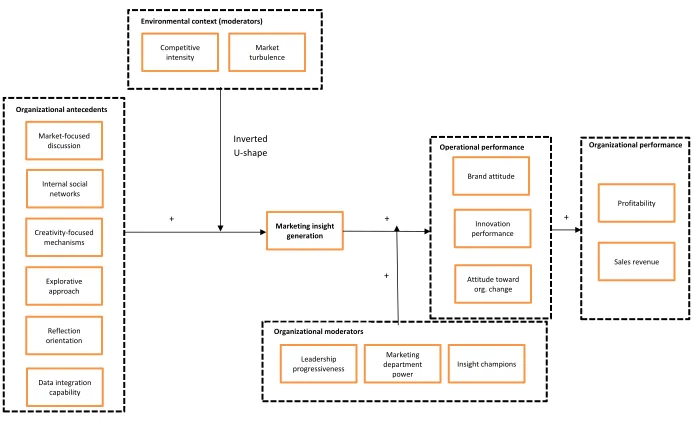
The result of our fieldwork indicates that, beyond its contribution to self-enhancement of the
concept, MI generation directly influences (1) brand attitude, (2) innovation performance, and
Figure 1). We derive propositions to examine the relationship between MI generation and the
three direct outcomes. Subsequently, we draw propositions for three firm-level variables that
moderate the effect of MI generation on the outcome variables.
Brand attitude. Brand attitude refers to the degree of liking from psychological
predispositions toward an object (Schmitt, 2012; Homburg, Schwemmle, and Kuehnl 2015). The
attitude represents affect toward the object (Faircloth, Capella, and Alford 2001). In our context,
MI generation works as a signal and can help customers to build a positive heuristic toward the
corporate brand. Interviewees mentioned that MIs are at least partially validated with customers
prior to implementation, which creates positive expectations about the supplier firm. This works
as preannouncements of new developments for the market, which can familiarize potential
beneficiaries from the insight, supporting a favorable attitude toward the firm (Liao and Cheng
2014). As the CMO of a food services firm stated:
With the generation of marketing insights, customers will feel heard and validated. The
customers reward if they are being heard. They will go to social media being supporters
of your firm….It will create emotional value. The emotional relationship will be
stronger…and you will have a healthier brand.
Also, the novelty feature of MIs raises sentiments in a market. Prior marketing research (e.g.,
Cox and Locander 1987) shows that novel stimuli increase the amount of arousal (affective
reaction), which can be captured by favorable brand attitude. In this regard, the CMO at an
customers and the surprise factor clings emotions.” Such arousal distinguishes the brand from
competitors (Faircloth, Capella, and Alford 2001). Thus:
P9: The higher MI generation in an organization, the more likely it is to improve
corporate brand attitude.
Innovation performance. The objects of innovation are classified as goods (products and
services), or as changes in the processes to create and deliver goods (Assink 2006). Accordingly,
innovation performance refers to the extent to which a firm exhibits non-routine behavior in
offering development and related processes. MI generation can be conductive to innovative
activity for two reasons. First, MIs are developed with an outside-in approach (i.e., strategy starts
with the market; Day 2014). A key feature of insight is its ability to capture stated and unstated
market needs (i.e., market relevance), representing a shift in understanding. Firms that are open
to its external environment can improve its innovative performance (Laursen and Salter 2006). In
this sense, MIs are a channel for better market representation, culminating in practical learning.
As the VP of sales operations and development of an air transportation firm noted:“A substantial
benefit of generating marketing insight is improving our capability to innovate. Key insights rise
from deep exploration of the market, allowing new combinations of knowledge or gaining access
to knowledge sources for developing new products.”
Second, as MI generation requires a dense internal network and insight itself assures some
degree of credibility, managers are likely to behave in a collaborative manner, facilitating
collaboration drives better innovation results due to open behavior. As a head of marketing
intelligence declared:
We have accelerated our capacity to develop and launch better solutions to the market
because when marketing insights are available…market sense making is a priority for
everyone, nobody wants to get behind, people ask about implications and ramifications,
and are willing to collaborate further.
Thus:
P10: The higher the MI generation in an organization, the more likely it is to improve
innovation performance.
Attitude toward organizational change. Attitude toward organizational change refers to
the degree to which an organization feels comfortable breaking the status-quo (Dunham et al.
1989). As markets are dynamic and their structure is shifting through time, organizational change
is required to survive. As firms learn about the market, change in their activities or task serves as
validation of the gained understanding. Indeed, the account manager at a software firm suggested
that change is a challenge for her company even when it is in a continuous learning process:
Our firm invests in training and different other forms of learning. Actually, we have more
training than ever…and don’t get me wrong, it is much appreciated. But being honest,
people in general keep doing the same whether it is not a mandate or a formal change in
procedures. We say we need to change, though…(w)e need to be more receptive to
The aversion to change is commonly based on the perceived negative consequences that
managers anticipate change can create (Dent and Goldberg 1999). Thus, more than a rejection of
change, managers are afraid of change. MI provides actionability in a context of market
relevance and potential value captured from a market, whether the change is achieved. When
managers understand that behavioral change comes from a market-based insight, they are more
likely to appreciate it and implement modifications to their activities. Furthermore, because MI is
Inverted U-shape + + + Organizational performance
FIGURE 1: CONCEPTUAL FRAMEWORK Data integration capability Explorative approach Marketing insight generation Innovation performance Creativity-focused mechanisms Internal social networks Competitive intensity Market turbulence Reflection orientation Leadership progressiveness Market-focused discussion Marketing department power Insight champions Brand attitude Attitude toward org. change Sales revenue Profitability Organizational antecedents +
Environmental context (moderators)
Organizational moderators
P11: The higher MI generation is in an organization, the more likely it is to have a
positive attitude toward organizational change.
Finally, we acknowledge that brand attitude, innovation performance, and attitude toward
organizational change are operational performance outcomes because they relate to value-chain
activity areas of a firm (Katsikeas et al. 2016). Interviewees indicated that the ultimate impact of
MI on a firm relates to increasing sales revenue and profitability, which are organizational
performance outcomes (Katsikeas et al. 2016).
Moderation Effects of Organizational Factors
Based on our field research, we explore the moderation effects of three types of organizational
factors that will ensure that MIs are supportive of firm performance. First, at the corporate level,
we discuss leadership progressiveness. Second, at the unit level, we discuss marketing
department power. Finally, at the front-line level, we discuss insight champions.
Leadership progressiveness. Leadership progressiveness refers to the extent to which a
top management team is committed to push forward new ideas. Prior literature has recognized
that leadership is a particularly important influence on reaching firm goals, when employees’
efforts require transformation (Rasulzada and Dackert 2009). MI leads to new challenges, which
needs support from the organization. A leader can positively influence the implementation of
MIs, reinforcing and participating in change/development-oriented activities (Rasulzada and
Dackert 2009). When leadership progressiveness is high, managers are more comfortable
Munshi, and Walumbwa 2009). This leadership feature is important because employees expect to
see leaders as role models, and MI involves transforming ideas and potential into reality. In
contrast, when leadership progressiveness is low, there is more risk associated with the process
of implementing insights due to detriments in case of failure. Thus, we expect that:
P12: As leadership progressiveness increases, there is a stronger positive relationship
between MI generation and operational performance outcomes.
Marketing department power. Marketing department power refers to the extent to which
the marketing department is perceived as an important influencer within a firm (Moorman and
Rust 1999; Verhoef and Leeflang 2009). In firms with an influential marketing department, it can
be ensured that necessary investments are made to build intangible assets (Lehmann 2004;
Homburg et al. 2015). MI is an intangible asset of a firm. Changes in intangible assets are not
immediately represented in short-term performance outcomes, requiring resources and power
from managers for implementation. The logistics manager at a consulting firm referred to this
issue:
(M)arketing insight in nature is abstract, you see it but cannot touch it…the marketing
department should be the source of strength to disseminate such insights. They embrace
marked-based learning and marketing people is close to particular insights, so it is only
logic that they can bring that extra help to reach the claimed benefits…someone needs to
be responsible.
Thus:
P13: As marketing department power increases, there is a stronger positive relationship
Insight champions. Insight champions refers to the extent to which a firm has liaison staff
for the dissemination and support of market-based insights. Literature has shown that champions
are people who possess three characteristics: (1) adopting a project as their own, (2) contributing
by generating support from other practitioners in the firm, and (3) advocating a project beyond
job requirement (Markham, 1998 p. 491). Interviewees noted that MI due to its intangible
condition and outside-in approach requires front-line support to ensure its correct application.
This is in line with research on innovation suggesting that reaching out to different groups and
gaining advocates with different perspectives is crucial for new idea implementation (Schon
1963). Thus:
P14: As insight champions increases, there is a stronger positive relationship between
MI generation and operational performance outcomes.
DISCUSSION
Theoretical Implications
This study offers three major implications for theoretical advancement in marketing and
organizational learning domains. First, it provides a comprehensive conceptualization of five
elements of MI: novelty, actionability, credibility, market relevance, and commercial potential.
We enrich prior academic endeavors on MIs by moving away from a traditional resource-based
view of the firm (cf. Smith, Wilson, and Clark 2006), where market-based insight is evaluated as
any other asset within a firm. Our theory-in-use approach represents a foundation for the
framework, bridging the gap regarding the scarce consideration of academic work to the
generation and management of market-based insight (Said et al. 2015). Also, MI proposes a new
approach for organizational learning, taking advantage of today’s data-rich environments. The
properties of MI provide clear guidance to reach a new, higher order market understanding,
avoiding the trap of information overload.
Second, prior research has highlighted the need to migrate from data analytics to insight
analytics and acknowledged the insight domain as one of the seven big problems in marketing
(Jaworski, Malcom, and Morgan 2016). We propose that the generation of MIs is driven by six
organizational antecedents (e.g., market-focused discussion, reflection orientation). The study
outlines that those factors are affected by the levels of surrounding market tension. Our results
suggest that competitive intensity and market turbulence can create an optimal level of tension
for which MI generation is maximized. Managers are motivated by challenge but can reach
saturation whether a tolerance threshold is surpassed. As insight comes from the mind,
independent of the sophistication degree of information technology and software owned by a
firm, managers need particular conditions to seek unscripted opportunities (Govindarajan and
Srinivas 2013). Our findings help to identify organizational patterns to prompt a practitioner’s
mind toward MI. Also, we have proposed that MI is not necessarily “knowing something your
competitors don’t know and that you can use to your advantage” (see Marketing Journal 2016).
Two rival firms can generate two competing MIs about industry trends and consciously choose
one over the other, stepping into implementation (e.g., Airbus A350 vs. Boeing 787 Dreamliner).
procedures suggested by market-based organizational learning (e.g., Sinkula, Baker, and
Noordewier 1997).
Third, the decline in the marketing department power and the prevalence of the market
orientation concept within firms call for direction of a firm’s focus on tasks involving
accountability and innovativeness (Homburg et al. 2015; Moorman and Rust 1999; Verhoef and
Leeflang 2009). MI generation responds to both dimensions. Also, MI, as a creative output in
market-based organizational learning, offers a path to how a marketing department can regain
more influence with creativity, as previously requested (e.g., Verhoef and Leeflang 2009).
Therefore, MI is a good representation of how to bridge “intangible” elements (i.e., creativity)
with “tangible” elements (i.e., accountability and innovativeness) to improve operational and
organizational firm performance. When top management realizes the compatibility of both
systems, the chances for marketing to be a valuable function for an organization is higher.
Limitations and Further Research
As is the case for all empirical studies, our research has some limitations that provide avenues
for future research. We did not test the propositions, creating a natural opportunity for
quantitative studies in the field. Our sample was characterized with relatively large companies in
the supplier side of the market. It could be helpful to validate the proposed outcomes with small
and middle size firms’ data. Researchers could also investigate the profile and specific activities
that insight champions represent. It would be interesting to shed some light on what makes an
insight champion different from other champions in a firm. Some companies have created a unit
of an insight unit and investigate the activities executed. Also, our data come from U.S.
managers. Future research could evaluate whether our framework is sustained in an international
setting.
Managerial Implications
Our study, deriving from its conceptual nature, provides several implications for managers. First,
a sound definition of MI offers practitioners an operational representation and deep
understanding of insight and why it constitutes the next level of market-based organizational
learning. Defining MI helps managers to clearly identify what is an insight and what is not,
avoiding confusion and subjective judgements. Also, having a common definition helps to
homogenize language and facilitates communications across hierarchies and functions, vital for
the current knowledge economy.
Second, establishing that MI is composed of five key elements: (1) novelty, (2) actionability, (3)
credibility, (4) market relevance, and (5) commercial potential, expands a practitioner’s common
thought about an insight. Traditional wisdom converges to characterize it as “the aha or eureka
moment!” Western societies have interpreted the insight concept as a fortuitous series of events,
sudden burst of inspiration, and emerging relief after a moment of discovery, focusing on factors
such as unexpectedness and satisfaction (Shanker 1995). However, our research shows that this
perspective is deficient at least from a firm-level market-based learning approach. Consequently,
Finally, beyond our conceptualization of MI as comprising five dimensions, it has different
levels of operationalization. Building over our findings about operational performance outcomes:
(1) brand attitude, (2) innovation performance, and (3) attitude toward organizational change; we
offer a managerial typology for MI. We suggest three general categories of insights based on the
depth of firm activities transformation as shown in Fig. 2. Indeed, an executive expressed
support for this typology, acknowledging that “there are levels of insight from the tactical and
[image:46.612.140.510.290.497.2]more specific to the strategic and more general.”
FIGURE 2: TYPOLOGY OF MARKETING INSIGHT
Communicational. When MI has a more tactical scope, it involves a promotional
approach. We categorize these insights as communicational. At this level, MI is more beneficial
for branding and communications. For example, an insight can call for modifying the claim,
restructuring communication channels, appealing to new concepts, transforming advertising and
media, redefining messages, or developing new sponsorships or co-branding alliances. This type
Change
Innovation
Brand
Singular / Short-term Holistic / Long-term
• Institutional marketing insight
• Developmental marketing insight