0095-1137/11/$12.00 doi:10.1128/JCM.00142-11
Copyright © 2011, American Society for Microbiology. All Rights Reserved.
NOTES
Comparison of Etest Method with Reference Broth Microdilution
Method for Antimicrobial Susceptibility Testing of
Yersinia pestis
䌤
David R. Lonsway,
1* Sandra K. Urich,
2Henry S. Heine,
3† Sigrid K. McAllister,
1Shailen N. Banerjee,
1Martin E. Schriefer,
2and Jean B. Patel
1Division of Healthcare Quality Promotion, Centers for Disease Control and Prevention, Atlanta, Georgia 303331; Division of
Vector-Borne Infectious Diseases, Centers for Disease Control and Prevention, Ft. Collins, Colorado 805212; and
United States Army Medical Research Institute of Infectious Diseases (USAMRIID), Ft. Detrick, Maryland 217023
Received 24 January 2011/Returned for modification 22 February 2011/Accepted 8 March 2011
The utility of Etest for antimicrobial susceptibility testing ofYersinia pestiswas evaluated in comparison with
broth microdilution and disk diffusion for eight agents. Four laboratories tested 26 diverse strains and found
Etest to be reliable for testing antimicrobial agents used to treatY. pestis, except for chloramphenicol and
trimethoprim-sulfamethoxazole. Disk diffusion testing is not recommended.
Yersinia pestis is the etiologic agent of the plague and has potential for use as a biological weapon (1, 13, 17–20, 23). Because of this, it is important that emerging drug resistance, whether natural or engineered, should be detectable using standardized methods that are easily implemented in multiple laboratories. The Clinical and Laboratory Standards Institute (CLSI) describes a reference broth microdilution (BMD) method for antimicrobial susceptibility testing ofY. pestisand provides MIC interpretive guidelines for eight antimicrobial agents (6). BMD uses cation-adjusted Mueller-Hinton broth (CAMHB) and requires incubation at 35°C for 24 h with an option for incubation for 48 h when growth at 24 h is insuffi-cient for endpoint interpretation. Unfortunately, reference BMD is difficult to incorporate in many laboratories because it is relatively costly and laborious and requires the storage of panels in a frozen or dehydrated format. Several alternative susceptibility testing methods exist, including the disk diffusion and Etest methods. However, before these methods can be employed for a species, they must be evaluated and compared to BMD to determine correlations between the results ob-tained by comparisons of the methods.
Y. pestisisolates are fastidious and may grow more slowly on artificial media than other common species of Enterobacteria-ceae, and so susceptibility testing methods for Y. pestis have been difficult to standardize. Several methods are described in the literature. Disk diffusion testing has generally been per-formed on Mueller-Hinton agar (MHA), typically using 48 h of incubation at 35°C, but methodological descriptions are some-times lacking in detail (10, 16, 24). The Etest method was employed by Wong et al. (25) using MHA with 5% sheep
blood, incubation at 35°C, and an inoculum matching a no. 1 McFarland instead of the 0.5 McFarland standard used in most disk or Etest diffusion studies. Agar dilution, using MHA in-cubated at 27° to 30°C for 48 h, is the most common method reported in the literature (7, 8, 11, 12, 22). Broth macrodilution and microdilution methods have also been used with various incubation temperatures (2, 21).
There are several attributes of disk diffusion and Etest meth-ods that make them attractive alternative methmeth-ods for suscep-tibility testing, including ease of storage and a long shelf life for the disks and strips. Also, these are agar-based methods and the endpoints can be easier to read than those of BMD. The Etest has the added benefit of producing an MIC result. In this report, we present results of a multicenter study comparing Etest and disk diffusion methods with the CLSI reference BMD method for susceptibility testing ofY. pestis.
(This report was presented in part at the 107th General Meeting of the American Society for Microbiology, Toronto, Canada, 21 to 25 May 2007.)
Twenty-six diverse Y. pestis strains from the Centers for Disease Control and Prevention (CDC) and U.S. Army Med-ical Research Institute of Infectious Diseases (USAMRIID) collections were tested by both the Etest and BMD methods at four test sites and additionally by disk diffusion at two of these sites. Six strains were biovar Antiqua, seven were biovar Me-dievalis, and 12 were biovar Orientalis; one atypical isolate could not be assigned to any biovar. The antimicrobial agents were tested by both BMD and Etest (bioMe´rieux, Durham, NC), and their corresponding ranges were as follows for BMD and Etest, respectively: for chloramphenicol, 0.03 to 64g/ml and 0.016 to 256g/ml; for ciprofloxacin, 0.03 to 64g/ml and 0.002 to 32g/ml; for doxycycline, 0.03 to 64g/ml and 0.016 to 256g/ml; for gentamicin, 0.03 to 64g/ml and 0.016 to 256 g/ml; for levofloxacin, 0.06 to 64g/ml and 0.002 to 32g/ml; for streptomycin, 0.03 to 64g/ml and 0.016 to 256g/ml; for tetracycline, 0.03 to 64g/ml and 0.016 to 256g/ml; and for trimethoprim-sulfamethoxazole, 0.015/32 to 16/304g/ml and * Corresponding author. Mailing address: Division of Healthcare
Quality Promotion, Centers for Disease Control and Prevention, Mail-stop G08, 1600 Clifton Rd., Atlanta, GA 30333. Phone: (404) 639-2825. Fax: (404) 639-1381. E-mail: [email protected].
† Present address: Ordway Research Institute Inc., Albany, NY. 䌤Published ahead of print on 16 March 2011.
1956
on May 16, 2020 by guest
http://jcm.asm.org/
0.002/0.038 to 32/608g/ml. Because the ranges for the BMD testing of some drugs did not encompass the lower concentra-tions obtainable by the Etest, essential agreement (⫾ 1 log2
dilution) between methods was considered to be off the scale for some result comparisons (e.g., a BMD levofloxacin MIC of
ⱕ0.06g/ml and an Etest MIC of 0.03g/ml). At CDC, 96-well MIC trays were prepared using 100l of CAMHB (BBL, Sparks, MD) per well; trays were kept frozen at⫺70°C and shipped to participating laboratories. Testing was performed by CLSI standard methods for BMD and disk diffusion (4–6). Inocula were prepared from 18- to 24-h aerobic cultures grown on 5% sheep blood agar plates (BBL) by the direct colony suspension method in Mueller-Hinton broth (MHB) (Remel, Lenexa, KS) to equal a 0.5 McFarland turbidity standard (4); the same inocula were used to inoculate 150-mm-diameter MHA plates for Etest and disk diffusion tests. Immediately after inoculation, at least two random colony counts were per-formed at each test site with the positive BMD growth control well in order to assess inoculum size. No more than four Etest strips were applied to a plate. For disk diffusion, commercial disks (BBL) were applied with a self-tamping multidisk dis-penser (BBL). BMD panels and MHA plates for both Etest and disk diffusion were incubated at 35°C and read at 24- and 48-h time periods. Etests were read as directed according to the Etest package inserts as follows: chloramphenicol, doxycy-cline, tetracydoxycy-cline, and trimethoprim-sulfamethoxazole were read at 80% inhibition for the intersection point; ciprofloxacin, levofloxacin, gentamicin, and streptomycin were read at 100% inhibition. For data analyses, Etest MICs were rounded up to the nearest log2 dilution. Escherichia coli ATCC 25922 and
Pseudomonas aeruginosaATCC 27853 were used for BMD and Etest quality control. MICs for quality control strains were determined by incubation for 16 to 20 h. Acceptable BMD quality control ranges for streptomycin were previously estab-lished at the CDC (unpubestab-lished data). Quality control of the chloramphenicol Etest was performed by testing Escherichia coliATCC 25922 and applying the acceptable range for the CLSI BMD.
To measure agreement between the Etest and BMD results, the distribution of differences in the log2 dilution MICs was examined and the percentage of MIC determinations that yielded identical values (essential agreement within the accu-racy limits of the reference method [⫾1 log2 dilution]) was
calculated for each drug. Also, to determine whether the Etest method produced significantly lower or higher MICs than the reference method, we performed a Wilcoxon signed-rank test with the log2dilution MICs of the two tests by the use of SAS statistical software (SAS Institute Inc., Cary, NC); MICs within⫾1 log2dilution were regarded as identical for this test. Comparison of interpretative category results (susceptible, in-termediate, and resistant) was done by calculating rates of minor, major, and very major errors.
In general, MIC endpoints were more easily discernible by BMD than by Etest at 24 h (data not shown). At three test sites (A, B, and C), nearly all BMD and Etest MICs were readable at 24 h of incubation; a single Etest result was the exception. Site D reported readable BMD MICs at 24 h for all but one strain. There was insufficient growth to read 24-h Etest MICs for eight strains at site D. The numbers of Etest MICs that were unreadable due to inadequate growth at 24 h by drug were as follows: for chloramphenicol,n⫽6; for ciprofloxacin,
n ⫽ 4; for doxycycline, n ⫽ 3; for gentamicin, n ⫽ 2; for levofloxacin,n ⫽5; for streptomycin,n⫽5; for tetracycline,
n⫽4; and for trimethoprim-sulfamethoxazole,n⫽4. All test sites were able to read all results at 48 h. Therefore, 48-h results were used in the comparison. Colony counts demon-strated that inoculum densities in the BMD wells were within acceptable limits for all four test sites; the averages for the sites ranged from 1.1⫻105CFU/ml to 4.2⫻105CFU/ml.
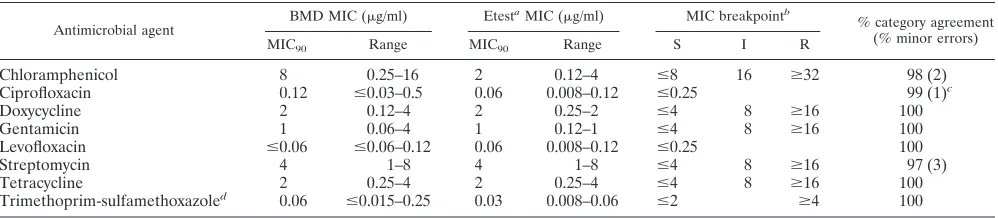
The MIC90and the MIC range for each antimicrobial agent
were compared by method (Table 1). For all drugs except chloramphenicol, the MIC90s for all of the methods were the
same or within ⫾ 1 log2 dilution of one another. Category agreement between the Etest and BMD methods for all drugs was excellent at 97% to 100%; all errors were minor (Table 1). All BMD and Etest MICs were within the susceptible range after 24 h of incubation (data not shown). At 48 h, most MICs were within the susceptible range except for the following nonsusceptible results: chloramphenicol (n⫽2); ciprofloxacin (n⫽1); and streptomycin (n⫽5). Most of the nonsusceptible results were from the BMD method rather than Etest (Fig. 1). The two methods are best compared by analyzing essential agreement (the percentages of MICs within⫾1 log2dilution for the two methods [Table 2]). Essential agreement for all sites combined (including off-scale MICs) wasⱖ90% for cip-rofloxacin, doxycycline, levofloxacin, streptomycin, and tetra-TABLE 1. MIC90, MIC range, and interpretive category agreement for 48-h Etest and 48-h broth microdilution MICs for eight antimicrobial
agents tested against 26Y. pestisisolates at four test sites (104 test results)
Antimicrobial agent
BMD MIC (g/ml) EtestaMIC (g/ml) MIC breakpointb
% category agreement (% minor errors)
MIC90 Range MIC90 Range S I R
Chloramphenicol 8 0.25–16 2 0.12–4 ⱕ8 16 ⱖ32 98 (2)
Ciprofloxacin 0.12 ⱕ0.03–0.5 0.06 0.008–0.12 ⱕ0.25 99 (1)c
Doxycycline 2 0.12–4 2 0.25–2 ⱕ4 8 ⱖ16 100
Gentamicin 1 0.06–4 1 0.12–1 ⱕ4 8 ⱖ16 100
Levofloxacin ⱕ0.06 ⱕ0.06–0.12 0.06 0.008–0.12 ⱕ0.25 100
Streptomycin 4 1–8 4 1–8 ⱕ4 8 ⱖ16 97 (3)
Tetracycline 2 0.25–4 2 0.25–4 ⱕ4 8 ⱖ16 100
Trimethoprim-sulfamethoxazoled 0.06 ⱕ0.015–0.25 0.03 0.008–0.06 ⱕ2 ⱖ4 100
a
Etest MICs rounded up to correspond to log2broth microdilution (BMD) series.
b
S, susceptible; I, intermediate; R, resistant.
c
One Etest MIC⫽0.06g/ml (susceptible); BMD MIC⫽0.5g/ml (nonsusceptible).
d
Only the trimethoprim portion of the 1:19 combination is displayed.
on May 16, 2020 by guest
http://jcm.asm.org/
[image:2.585.43.542.90.199.2]FIG. 1. Numbers of MIC results obtained by using 48-h Etest and 48-h broth microdilution (BMD) for eight antimicrobial agents tested against 26Y. pestisisolates at four test sites (n⫽104). The lowest dilution tested by BMD is indicated for cases in which the value was different from the lowest dilution on thexaxis. Trimethoprim-sulfamethoxazole MIC values indicate the trimethoprim portion only.
on May 16, 2020 by guest
http://jcm.asm.org/
cycline. The values for essential agreement for gentamicin, trimethoprim-sulfamethoxazole, and chloramphenicol were lower, at 88%, 78%, and 35%, respectively. Except for chlor-amphenicol and trimethoprim-sulfamethoxazole, there was generally little or no variation in essential agreement between sites for each drug (Table 3). For chloramphenicol and tri-methoprim-sulfamethoxazole, essential agreement between MIC methods at individual sites ranged from 4% to 81% and from 58% to 96%, respectively.
The gentamicin and doxycycline Etest MICs were signifi-cantly (P⫽0.03) higher than the corresponding BMD MICs (Table 2); however, the values for essential agreement between methods for each drug were still good at 88% and 93%, re-spectively (Table 2). Chloramphenicol, ciprofloxacin, and tri-methoprim-sulfamethoxazole Etest MICs were, on average, significantly (P⬍0.001) lower than their corresponding BMD MICs, and only ciprofloxacin had an essential agreement of
ⱖ90%. For levofloxacin, streptomycin, and tetracycline, no statistical differences were seen between Etest and BMD MICs.
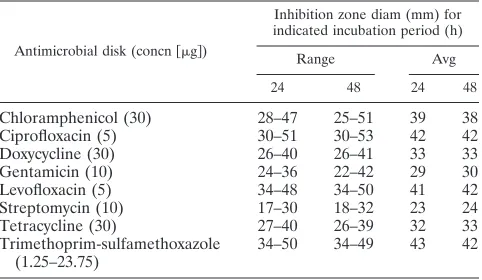
For disk diffusion, all antimicrobial disks except the
strep-tomycin disks produced large-diameter zones; some zones ex-ceeded 40 to 50 mm in diameter (Table 4) and overlapped one another on the MHA plate. Zone margins for drugs producing these large zones were often fuzzy or indistinct. Two isolates at one test site had unreadable zones for all drugs due to poor growth at 24 h. Chloramphenicol and trimethoprim-sulfame-thoxazole disks occasionally produced a double-zone effect with a lighter inner margin of growth, possibly due to the static activity of the drug with this slowly growing organism. Strep-tomycin disks produced the lowest (23- to 24-mm-diameter) average disk zone inhibition size and the most distinct, read-able zones. Zone sizes of the other disk types averaged 30 to 42 mm in diameter at 48 h, and their diameters were more difficult to read.
[image:4.585.44.541.92.206.2]In general, there was good essential agreement between the Etest method and the reference BMD method for antimicrobial susceptibility testing. However, essential agreement rates between Etest and BMD for chloramphenicol, gentamicin, and tri-methoprim-sulfamethoxazole were lower than the 90% minimum that is recommended by the U.S. Food and Drug Administration TABLE 2. Comparison of 48-h Etest with 48-h broth microdilution MICs for eight antimicrobial agents tested against 26Y. pestisisolates at
four test sites (104 test results)
Antimicrobial agent
No. of results with indicated MIC log2dilution differences between
Etest and BMD reference methoda % essential agreementb
(% including off-scale MICs) Pvalue
d
ⱕ⫺3 ⫺2 ⫺1 0 ⫹1 ⫹2 ⱖ⫹3
Chloramphenicol 25 43 27 8 1 35 ⬍0.001
Ciprofloxacinc 4 6 39 53 2 87 (90) ⬍0.001
Doxycycline 1 14 48 35 6 93 0.03
Gentamicin 1 2 18 47 26 5 5 88 0.03
Levofloxacinc 6 98 100 (100) N/Ae
Streptomycin 25 72 7 100 N/A
Tetracycline 2 26 47 27 2 96 0.5
Trimethoprim-sulfamethoxazolec 3 20 61 20 78 (78) ⬍0.001
a⫺
1, Etest MIC is 1 log2dilution lower than broth microdilution (BMD) MIC;⫹1, Etest MIC is 1 log2dilution higher than BMD MIC; 0, no difference between
Etest MIC and BMD MIC, etc. Etest MICs were rounded up to correspond to log2BMD dilution series.
b
Values represent percent essential agreement when the Etest MIC was within⫾1 log2dilution of the corresponding BMD MIC; on-scale MICs used for calculation.
c
Drug had off-scale Etest MICs less than or equal to the lowest tested corresponding BMD MIC. Ciprofloxacin, levofloxacin, and trimethoprim-sulfamethoxazole had 27, 96, and 1 off-scale MICs, respectively; the other drugs had no off-scale results.
d
Pvalues represent the probabilities obtained with Wilcoxon signed-rank test (a difference of⫾1 log2dilution is assumed to represent a difference of zero);
differences were significant whenPⱕ0.05. (For example, 10 ciprofloxacin Etest MICs were more than 1 log2dilution lower than their corresponding BMD MICs, while
none were more than 1 log2dilution higher than the BMD MIC; this difference was significant关P⬍0.001兴.)
e
N/A, not applicable.
TABLE 3. Comparison of essential agreement at four test sites between 48-h Etest MICs and 48-h broth microdilution MICs for
eight antimicrobial agents tested against 26Y. pestisisolates
Test site(s) % essential agreement
a
CHL CIP DOX GEN LVX STR TET SXT
A 4 85 100 81 100 100 100 85
B 4 92 96 77 100 100 100 73
C 81 100 85 96 100 100 92 96
D 50 85 92 96 100 100 92 58
All sites 35 90 93 88 100 100 96 78
a
Values represent percent essential agreement when the Etest MIC was within⫾1 log2dilution of the reference broth microdilution MIC; data include
[image:4.585.301.542.577.717.2]off-scale results for CIP, LVX, and SXT. There were 26 MICs per site for each drug (total,n⫽104 for all sites combined). CHL, chloramphenicol; CIP, cipro-floxacin; DOX, doxycycline; GEN, gentamicin; LVX, levocipro-floxacin; STR, strep-tomycin; TET, tetracycline; SXT, trimethoprim-sulfamethoxazole.
TABLE 4. Disk diffusion results for tests performed using Mueller-Hinton agar and 26Y. pestisisolates at two sitesa
Antimicrobial disk (concn关g兴)
Inhibition zone diam (mm) for indicated incubation period (h)
Range Avg
24 48 24 48
Chloramphenicol (30) 28–47 25–51 39 38
Ciprofloxacin (5) 30–51 30–53 42 42
Doxycycline (30) 26–40 26–41 33 33
Gentamicin (10) 24–36 22–42 29 30
Levofloxacin (5) 34–48 34–50 41 42
Streptomycin (10) 17–30 18–32 23 24
Tetracycline (30) 27–40 26–39 32 33
Trimethoprim-sulfamethoxazole (1.25–23.75)
34–50 34–49 43 42
a
Two of the 26 isolates had unreadable growth at 24 h at one site.
on May 16, 2020 by guest
http://jcm.asm.org/
[image:4.585.43.283.596.677.2](FDA) for use of a new method in clinical testing (http://www.fda .gov/downloads/MedicalDevices/DeviceRegulationandGuidance /GuidanceDocuments/ucm071462.pdf).
Differences in lighting intensity in the biological safety cab-inet at each test site may be a contributing factor for endpoint determination. We have found that reading an Etest endpoint is easier when a reading lamp is placed in the cabinet to supplement the light source. All sites except site D utilized this extra light source to enhance readability of the susceptibility tests. Tetracycline and doxycycline Etests, like those of chlor-amphenicol and trimethoprim-sulfamethoxazole, were also read at an 80% endpoint, but no double ellipses were notice-able and the essential agreement wasⱖ90% for both tetracy-cline-class drugs, so it appears that this Etest phenomenon varies by drug class forY. pestis.
For gentamicin, the overall essential agreement was 88%, just below the recommended 90% agreement cutoff. Two sites demonstrated high (96%) essential agreement, but the agree-ment was lower (77% and 81%) for the other two sites. The reason for this variability is unknown. However, overall MIC distributions for Etest and BMD MICs are similar (Fig. 1). It has been suggested that, for new susceptibility methods that are performed with slowly growing or fastidious organisms, testing should be less rigidly held to this standard and that a lower essential agreement is permissible (14). This logic ap-pears appropriate for the gentamicin Etest, since the essential agreement was 88%. The acceptability of the trimethoprim-sulfamethoxazole Etest at 78% essential agreement is unclear. A limitation of this study was that no isolates with known resistance were included. Access to the Madagascar drug-re-sistant strains (3, 9–11) is restricted. Other reports of drug resistance inY. pestisare rare, and resistant strains are not well characterized (15, 16, 24). Therefore, we could not evaluate the ability of the Etest method to detect known resistance inY. pestis.
The disk diffusion method is not recommended forY. pestis
because of the difficulty in reading the poorly defined zones of inhibition and large zone diameters encountered with most of the drugs tested. Streptomycin disk testing may warrant further study if streptomycin-resistant isolates become accessible, be-cause the zone sizes were smaller and more distinct than those obtained with other disks.
In summary, in a comparison of two MIC methods for Y.
pestissusceptibility testing, results for all antimicrobial agents correlated well between Etest and BMD except for chloram-phenicol and trimethoprim-sulfamethoxazole, for which end-points were difficult to determine by Etest. There was also greater site-to-site variability for chloramphenicol and tri-methoprim-sulfamethoxazole than for the other drugs. The Etest method appears to be an acceptable alternative to BMD for ciprofloxacin, doxycycline, gentamicin, levofloxacin, strep-tomycin, and tetracycline but not for chloramphenicol and trimethoprim-sulfamethoxazole. SinceY. pestisgrew slowly on MHA, 48 h of incubation is recommended for Etest. However, as we were unable to include any drug-resistantY. pestisstrains in our study, it is also recommended that nonsusceptible Etest MICs be confirmed by a reference BMD MIC test. We also advise that confirmatory BMD testing be performed on anyY.
pestisisolate with a ciprofloxacin or levofloxacin Etest MIC of 0.25g/ml, an MIC at the high end of the susceptible range, as it is unknown whether emerging resistance can be detected for these two drugs by the Etest method.
We thank Jana Swenson for her editorial assistance in preparation of the manuscript and Brandon Kitchel for making the figure graphics. The findings and conclusions in this report are those of the authors and do not necessarily represent the official position of the Centers for Disease Control and Prevention.
Use of trade names and commercial sources is for identification purposes and does not constitute endorsement by the Public Health Service or the U.S. Department of Health and Human Services.
REFERENCES
1.Bossi, P., et al.2004. Bichat guidelines for the clinical management of plague and bioterrorism-related plague. Euro. Surveill.9:E5–E6.
2.Byrne, W. R., et al.1998. Antibiotic treatment of experimental pneumonic plague in mice. Antimicrob. Agents Chemother.42:675–681.
3.Chanteau, S., et al.2000. Current epidemiology of human plague in Mada-gascar. Microbes Infect.2:25–31.
4.Clinical and Laboratory Standards Institute.2006. Methods for dilution antimicrobial susceptibility tests for bacteria that grow aerobically, 7th ed., vol. 26, no. 2. Approved standard M7-A7. CLSI, Wayne, PA.
5.Clinical and Laboratory Standards Institute.2006. Performance standards for antimicrobial disk susceptibility tests, 9th ed., vol. 26, no. 1. Approved standard M2-A9. CLSI, Wayne, PA.
6.Clinical and Laboratory Standards Institute.2009. Performance standards for antimicrobial susceptibility testing: 19th informational supplement, vol. 29, no. 3. M100-S19. CLSI, Wayne, PA.
7.Frean, J., K. P. Klugman, L. Arntzen, and S. Bukofzer.2003. Susceptibility ofYersinia pestisto novel and conventional antimicrobial agents. J. Antimi-crob. Chemother.52:294–296.
8.Frean, J. A., L. Arntzen, T. Capper, A. Bryskier, and K. P. Klugman.1996. In vitro activities of 14 antibiotics against 100 human isolates ofYersinia pestisfrom a southern African plague focus. Antimicrob. Agents Chemother.
40:2646–2647.
9.Galimand, M., E. Carniel, and P. Courvalin.2006. Resistance ofYersinia pestis to antimicrobial agents. Antimicrob. Agents Chemother.50:3233– 3236.
10.Galimand, M., et al.1997. Multidrug resistance inYersinia pestismediated by a transferable plasmid. N. Engl. J. Med.337:677–680.
11.Guiyoule, A., et al.2001. Transferable plasmid-mediated resistance to strep-tomycin in a clinical isolate ofYersinia pestis.Emerg. Infect. Dis.7:43–48. 12.Hernandez, E., M. Girardet, F. Ramisse, D. Vidal, and J. D. Cavallo.2003.
Antibiotic susceptibilities of 94 isolates ofYersinia pestisto 24 antimicrobial agents. J. Antimicrob. Chemother.52:1029–1031.
13.Inglesby, T. V., et al.2000. Plague as a biological weapon: medical and public health management. Working Group on Civilian Biodefense. JAMA283:
2281–2290.
14.Jorgensen, J. H.1993. Selection criteria for an antimicrobial susceptibility testing system. J. Clin. Microbiol.31:2841–2844.
15.Louis, J.1967. In vitro sensitivity ofYersinia pestisto some antibiotics and sulfonamides. Med. Trop. (Marseille)27:313–317. (In French.)
16.Marshall, J. D., Jr., et al. 1967. Plague in Vietnam 1965–1966. Am. J. Epidemiol.86:603–616.
17.McGovern, T., and A. Friedlander.1997. Medical aspects of chemical and biological warfare, p. 479–502.InTextbook of military medicine. Office of the Surgeon General, Bethesda, MD.
18.Perry, R. D., and J. D. Fetherston.1997.Yersinia pestis—etiologic agent of plague. Clin. Microbiol. Rev.10:35–66.
19.Robinson-Dunn, B.2002. The microbiology laboratory’s role in response to bioterrorism. Arch. Pathol. Lab. Med.126:291–294.
20.Rollins, S. E., S. M. Rollins, and E. T. Ryan.2003.Yersinia pestisand the plague. Am. J. Clin. Pathol.119(Suppl.):S78–S85.
21.Russell, P., et al.1998. Efficacy of doxycycline and ciprofloxacin against experimentalYersinia pestisinfection. J. Antimicrob. Chemother.41:301– 305.
22.Smith, M. D., et al.1995. In vitro antimicrobial susceptibilities of strains of
Yersinia pestis. Antimicrob. Agents Chemother.39:2153–2154.
23.Wheelis, M.2002. Biological warfare at the 1346 siege of Caffa. Emerg. Infect. Dis.8:971–975.
24.Williams, J. E., et al.1978. Atypical plague bacilli isolated from rodents, fleas, and man. Am. J. Public Health68:262–264.
25.Wong, J. D., J. R. Barash, R. F. Sandfort, and J. M. Janda.2000. Suscep-tibilities ofYersinia pestisstrains to 12 antimicrobial agents. Antimicrob. Agents Chemother.44:1995–1996.