Diagnostics, taxonomy, nomenclature and distribution of perennial Sesuvium... 45
Diagnostics, taxonomy, nomenclature and distribution
of perennial
Sesuvium
(Aizoaceae) in Africa
Alexander P. Sukhorukov1, Maya V. Nilova1, Andrey S. Erst2,3, Maria Kushunina4, Cláudia Baider5, Filip Verloove6, Marcos Salas-Pascual7, Irina V. Belyaeva8,
Anastasiya A. Krinitsina1, Peter V. Bruyns9, Cornelia Klak9
1 Department of Higher Plants, Biological Faculty, Lomonosov Moscow State University, Leninskie gory 1/12, Moscow 119234, Russia 2 Central Siberian Botanical Garden SB RAS, Zolotodolinskaya st. 101, Novosibirsk 630090, Russia 3 Tomsk State University, Laboratory of Phylogeny and Systematics, Lenin st. 36, Tomsk 634050, Russia 4 Department of Plant Physiology, Biological Faculty, Lomonosov Moscow State University, Le-ninskie gory 1/12, Moscow 119234, Russia 5 The Mauritius Herbarium, RE Vaughan Building, Agricultural Services, Ministry of Agro-Industry and Food Security, Réduit, 80835, Mauritius 6 Botanic Garden of Meise, Nieuwelaan 38, B-1860 Meise, Belgium 7 Institute for Environmental Studies and Natural Resources (i-UNAT), University of Las Palmas de Gran Canaria (ULPGC), Las Palmas de Gran Canaria, Gran Canaria, Canary Islands, Spain 8 Royal Botanic Gardens, Kew, Richmond, Surrey TW9 3AE, UK 9 Bolus Herbarium, Department of Biological Sciences, University of Cape Town, Rhodes Gift, 7707 South Africa
Corresponding author: Alexander P. Sukhorukov ([email protected])
Academic editor:A. Sennikov | Received 13 November 2017 | Accepted 4 January 2018 | Published 15 January 2018
Citation: Sukhorukov AP, Nilova MV, Erst AS, Kushunina M, Baider C, Verloove F, Salas-Pascual M, Belyaeva IV, Krinitsina AA, Bruyns PV, Klak C (2018) Diagnostics, taxonomy, nomenclature and distribution of perennial Sesuvium
(Aizoaceae) in Africa. PhytoKeys 92: 45–88. https://doi.org/10.3897/phytokeys.92.22205
Abstract
The taxonomy of perennial Sesuvium species in Africa has been poorly investigated until now. Previously five perennial species of Sesuvium were recognised in Africa (S. congense, S. crithmoides, S. mesembryan-themoides, S. portulacastrum, and S. sesuvioides). Based on the differing number of stamens, S. ayresii is accepted here as being distinct from S. portulacastrum. Field observations in Angola also led the authors to conclude that S. crystallinum and S. mesembryanthemoides are conspecific with S. crithmoides. A new subspecies, Sesuvium portulacastrum subsp. persoonii, is described from West Africa (Cape Verde, Gambia, Guinea-Bissau, Mauritania, Senegal). The molecular phylogeny indicates the position of S. portulacastrum
subsp. persoonii within the “American lineage” as a part of the Sesuviumportulacastrum complex which needs further studies. A diagnostic key and taxonomic notes are provided for the six perennial species of
Sesuvium found in Africa and recognised by the authors (S. ayresii, S. congense, S. crithmoides, S. portu-lacastrum subsp. portulacastrum, S. portulacastrum subsp. persoonii, S. verrucosum and the facultatively
PhytoKeys 92: 45–88 (2018) doi: 10.3897/phytokeys.92.22205 http://phytokeys.pensoft.net
Copyright Alexander P. Sukhorukov et al. This is an open access article distributed under the terms of the Creative Commons Attribution License (CC BY 4.0), which permits unrestricted use, distribution, and reproduction in any medium, provided the original author and source are credited.
RESEARCH ARTICLE
Launched to accelerate biodiversity research
short-lived S. sesuvioides). The distribution of S. crithmoides, previously considered to be endemic to An-gola, is now confirmed for the seashores of Republic of Congo and DR Congo. The American species S. verrucosum is reported for the first time for Africa (the Macaronesian islands: Cape Verde and the Canar-ies). It is locally naturalised in Gran Canaria, being a potentially invasive species. These findings as well as new records of S. verrucosum from Asia and the Pacific Islands confirm its proneness to transcontinental introduction. Lectotypes of S. brevifolium, S. crithmoides, S. crystallinum and S. mesembryanthemoides are selected. The seed micromorphology and anatomy of the perennial African species is studied. Compared to the seeds of some annual African Sesuvium investigated earlier, those of perennial species are smooth or slightly alveolate. The aril is one-layered and parenchymatous in all species and usually tightly covers the seed. The aril detachments from the seed coat that form a white stripe near the cotyledon area easily distinguish S. verrucosum from other species under study.
Keywords
Africa, Aizoaceae, molecular phylogeny, new subspecies, Sesuvium, Sesuvieae, Sesuvioideae, taxonomy
Introduction
Sesuvium L. is one of the most widespread genera of Aizoaceae occuring in many sub-tropical and sub-tropical regions of the world (Bohley et al. 2017). The perennial Sesuvium
species often form mono- or oligodominant plant communities in coastal areas (e.g. Oliver 1871, Sauer 1982, Nellis 1994). Sesuvium portulacastrum (L.) L. is considered to be the species with the widest distribution pattern on all continents compared to the other representatives of the genus (Bogle 1970, Lonard and Judd 1997, Bohley et al. 2015). During the last decades the number of recognised species changed from eight (Bogle 1970) to twelve (Hartmann 1993) and reached fourteen after the inclusion of three American species of Cypselea Turpin (Bohley et al. 2017).
In its current circumscription, Sesuvium includes perennial or annual herbs with prostrate or ascending, often rooting at the nodes, glabrous or vesiculose stems (ad-ditionally with stout warts when dry; Sukhorukov et al. 2017); opposite, more or less succulent leaves with short or hardly visible petioles, which bear two semi-amplexi-caulous, membranous or hyaline, entire or fimbriate, marginally concrescent stipules; axillary, bracteolate, pedicellate or sessile flowers; five, bi-coloured (green dorsally and pink or white ventrally) perianth lobes; five to numerous pink stamens; ovary consist-ing of two to five carpels; circumscissile capsule with the central column bearconsist-ing 5–50 black or reddish, smooth or diversely sculptured seeds completely or partially covered with thin and hyaline aril.
Diagnostics, taxonomy, nomenclature and distribution of perennial Sesuvium... 47
found the monotypic Anisostigma Schinz to be closely related to Tribulocarpus (Klak et al. 2017a), which together are now recognised as the tribe Anisostigmateae Klak (Klak et al. 2017b). The Sesuvioideae therefore now consists of two tribes, the Anisostig-mateae (two genera) and the Sesuvieae comprising Sesuvium (including Cypselea), Tri-anthema L. and Zaleya Burm.f. Sesuvium is divided into two subclades, the American lineage with C3 photosynthesis (S. portulacastrum, S. verrucosum Raf., S. maritimum
(Walter) Britton, Sterns & Poggenb., as well as the species formerly included in Cypse-lea) and the African lineage comprising the native African species with a C4 photosyn-thetic pathway (Bohley et al. 2017). The species of each lineage are characterised by several types of leaf anatomy and are distinguished by the shape of the epidermal cells and by the mesophyll structure (Bohley et al. 2015). In the previous paper (Sukhoru-kov et al. 2017), the annual species of Sesuvium in Africa were revised. Instead of one (e.g. Jeffrey 1961, Hartmann 2002) or two (Bohley et al. 2017) species, four native species were accepted (S. digynum Welw., S. hydaspicum (Edgew.) Gonç., S. nyasicum
(Baker) Gonç. and S. sesuvioides (Fenzl) Verd.) based on morphological and carpologi-cal characters. A new taxonomic treatment of the entire genus (Bohley et al. 2017) sug-gested the presence of five perennial species of Sesuvium in Africa: S. congense Welw., S. crithmoides Welw., S. mesembryanthemoides Wawra, S. portulacastrum and S. sesuvioides
(also as a perennial species). All perennial taxa usually grow on the seashores of tropical Africa. One of them – S. portulacastrum – is considered to be a widespread species on the continent (Hutchinson and Dalziel 1927, Jeffrey 1961, Lonard and Judd 1997), whereas three others – S. congense, S. crithmoides and S. mesembryanthemoides – have been documented for Angola only (Welwitsch 1859, Oliver 1871, Bohley et al. 2017). However, Bohley et al. (2017) acknowledged that some of their taxonomic conclusions have been tentative and that further more detailed studies would be required to estab-lish species limits within Sesuvium (e.g., S. crithmoides). Hereby, the results of such a study are published.
The authors’ own field investigations, revision of relevant herbarium material and further taxonomic studies revealed a greater diversity of the perennial Sesuvium in Africa in contrast to the latest revision of the genus worldwide (Bohley et al. 2017). Additionally, the fine seed traits (micromorphology and anatomy) of perennial Sesu-vium have been studied for the first time and some new samples have been added to the molecular analysis. Based on this, an improved taxonomy and phylogeny have been presented and the distribution of the perennial Sesuvium in Africa has been discussed.
Methods
Field studies and revision of the herbarium material
Salas-Pascual (2016) and Filip Verloove (March–April 2017) in the Canary Islands (Spain) and by Cornelia Klak and Peter Bruyns in Angola (December 2016–January 2017). Additionally, the first author (AS) examined herbarium specimens in the herbaria B (on loan in Mainz, Germany), BM, BR, E, G, K, L (incl. U and WAG, but the African material in WAG was on loan), LE, LY, LYJB, M, MHA, MSB, MW, P, WIND; Filip Verloove identified the material in LPA; Cláudia Baider revised the specimens in MAU and Cornelia Klak in BOL, LUBA and PRE. In addition, some material of Sesuvium portulacastrum (leaves and seeds) collected by AS in Grenada (Lesser Antilles, Caribbean Islands) and Israel (as a cultivated plant in the Dead Sea area) was also used for anatomical and molecular studies.
To assess the conservation status of each taxon as per the IUCN Red List, past and present distribution data from herbarium specimens were collated. When the original specimen label did not give the precise location, a geographical point centred in the locality of the collection cited was used. This information was then assessed based on available ecological data or review of threats to allow insights into understanding the current population and distribution trends useful in defining the IUCN Red List Categories and Criteria (IUCN 2017). The extent of occurrence (EOO) and area of occurrence (AOO) were calculated using GeoCAT ver. β, with a cell of 2 × 2 km2
(Bachman et al. 2011). These assessements were not sent to the respective SSC IUCN groups prior to the publication of this article.
Leaf anatomy
The leaves of Sesuvium portulacastrum subsp. persoonii were collected by AS in Au-gust 2015 in Cape Verde (Sal Island, near Santa Maria village) and soaked in a 70% alcohol solution. The sections were made by hand and stained with 0.2% aqueous toluidin blue. For the description of the leaf anatomy, the terminology by Bohley et al. (2015) was followed. The leaf structure was photographed with a Nikon DS-Vi1 camera (Nikon Corporation, Japan) at the Department of Higher Plants, Lomonosov Moscow State University.
Seed morphology and anatomy
Seed micromorphology was observed using a scanning electron microscope (SEM) JSM–6380 (JEOL Ltd., Japan) at 15 kV after sputtercoating with gold-palladium in the laboratory of Electron Microscopy at Lomonosov Moscow State University. No dehydration of the seeds was required prior to SEM observation due to the absence of soft tissues (e.g. papillae or trichomes) on their surface.
Diagnostics, taxonomy, nomenclature and distribution of perennial Sesuvium... 49
Lomonosov Moscow State University. Before sectioning, the seeds were soaked in water:alcohol:glycerin (1:1:1) solution, dehydrated in ethanol dilution series and em-bedded in the Technovit 7100 resin (Heraeus Kulzer, Germany).
The list of specimens used for SEM (perennial species) and anatomical investiga-tions (both annual and perennial taxa) is given below. For seed morphology of the annual Sesuvium taxa, see Sukhorukov et al. (2017).
Sesuvium ayresii Marais: Ilot Marianne, 18 Jan 1975, Lorence1059 (K);
S. congense Welw.: Angola, Lengue, 19 Dec 1932, Grossweiler 9715 (BM); Angola, Porto Alexandre, Aug 1937, H. Humbert16375 (BM);
S. crithmoides Welw.: Angola, Kabinda, 30 Nov 1957, Lebrun111905 (K); Angola, Luanda, 12 Jun 1858, Welwitsch2386 (BM000839897) as S. crystallinum Welw.;
S. digynum Welw.: Angola, Mossamedes [Namibe], 8 May 1963, A. De Menezes409 (K);
S. hydaspicum (Edgew.) Gonç.: Saudi Arabia, South Hijag, 29 Mar 1979, J.S. Collenette 1153 (K);
S. nyasicum (Baker) Gonç.: [Malawi] Nyassa [Lake Malawi], Monkey Bay, Aug 1896,
A. Whytes.n. (K000076291); Namibia, Hardap Region, 2 Mar 2017, A. Sukhoru-kovs.n. (MW);
S. portulacastrum (L.) L. subsp. portulacastrum: 1) [Mexico, Colima State] Revilla-gigedo Island, 23 Mar 1932, J.T. Howell 8353 (K); 2) Grenada, St.-George’s, 1 Dec 2016, A. Sukhorukov684 (MW);
S. portulacastrum (L.) L. subsp. persoonii Sukhor.: Senegal, St. Louis, 23 Jul 1960, J.D. Kesby20 (K); Cape Verde, Sal Island, Santa Maria, 30 Aug 2015, A. Sukhorukov 59 (MW);
S. sesuvioides (Fenzl) Verd.: Angola, Mossamedes [Namibe], Praia Amelia, 28 Dec 1955, E.J. Mendes1172 (BM);
S. verrucosum Raf.: USA, California, San Joaquin co., 4 Jul 1934, E. Lee 963
(H1283635); USA, Nevada, Pershing co., 31 Aug 2000, A. Thielim13396 (M).
DNA extraction and PCR
Total DNA was extracted from silica gel-dried or fresh material of S. portulacastrum
(collected in Israel and Grenada), S. portulacastrum subsp. persoonii (Cape Verde) and
S. nyasicum (Namibia). The DNA from fresh material was extracted according to Krin-itsina et al. (2015) and that from dry leaves was extracted using DiamondDNA Plant kit (DiamondDNA, Russia) with further purification using AMPure Beads (Beckman Coulter, USA) (for details see Krinitsina et al. 2015).
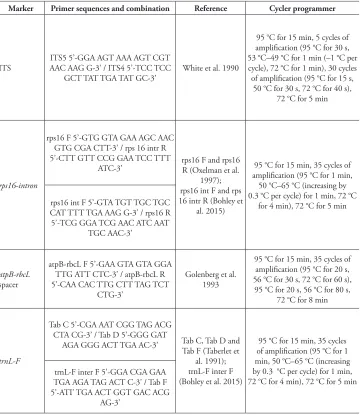
1 μM of each primer, 200 μM of each dNTP and 0.5 U hot start TagF polymerase (AmpliSens, InterLabService, Russia). PCR products were checked on 1.2% agarose gels and purified using AMPure Beads (Beckman Coulter, USA) according to the man-ufacturer’s protocol. AMPure Beads suspension was mixed with a solution containing PCR-product at the ratio 1.2:1 (for ITS and atpB-rbcL primer pairs) or 1.4:1 (for all other primer pairs). The sequencing was performed at Genome centre, Engelhardt Institute of Molecular Biology (Moscow, Russia) on Applied Biosystems 3730 DNA Analyser using ABI PRISM® BigDye™ Terminator v.3.1 Cycle Sequencing Kit.
Table 1. Primers and cycler programmes used for the molecular analysis.
Marker Primer sequences and combination Reference Cycler programmer
ITS AAC AAG G-3’ / ITS4 5’-TCC TCC ITS5 5’-GGA AGT AAA AGT CGT
GCT TAT TGA TAT GC-3’ White et al. 1990
95 °C for 15 min, 5 cycles of amplification (95 °C for 30 s, 53 °C–49 °C for 1 min (–1 °C per cycle), 72 °C for 1 min), 30 cycles of amplification (95 °C for 15 s,
50 °C for 30 s, 72 °C for 40 s), 72 °C for 5 min
rps16-intron
rps16 F 5’-GTG GTA GAA AGC AAC GTG CGA CTT-3’ / rps 16 intr R 5’-CTT GTT CCG GAA TCC TTT
ATC-3’ rps16 F and rps16 R (Oxelman et al. 1997); rps16 int F and rps 16 intr R (Bohley et
al. 2015)
95 °C for 15 min, 35 cycles of amplification (95 °C for 1 min,
50 °C–65 °C (increasing by 0.3 °C per cycle) for 1 min, 72 °C
for 4 min), 72 °C for 5 min rps16 int F 5’-GTA TGT TGC TGC
CAT TTT TGA AAG G-3’ / rps16 R 5’-TCG GGA TCG AAC ATC AAT
TGC AAC-3’
atpB-rbcL
spacer
atpB-rbcL F 5’-GAA GTA GTA GGA TTG ATT CTC-3’ / atpB-rbcL R 5’-CAA CAC TTG CTT TAG TCT
CTG-3’
Golenberg et al. 1993
95 °C for 15 min, 35 cycles of amplification (95 °C for 20 s, 56 °C for 30 s, 72 °C for 60 s),
95 °C for 20 s, 56 °C for 80 s, 72 °C for 8 min
trnL-F
Tab C 5’-CGA AAT CGG TAG ACG CTA CG-3’ / Tab D 5’-GGG GAT
AGA GGG ACT TGA AC-3’ Tab C, Tab D and Tab F (Taberlet et al. 1991); trnL-F inter F (Bohley et al. 2015)
95 °C for 15 min, 35 cycles of amplification (95 °C for 1 min, 50 °C–65 °C (increasing by 0.3 °C per cycle) for 1 min, 72 °C for 4 min), 72 °C for 5 min trnL-F inter F 5’-GGA CGA GAA
TGA AGA TAG ACT C-3’ / Tab F 5’-ATI’ TGA ACT GGT GAC ACG
Diagnostics, taxonomy, nomenclature and distribution of perennial Sesuvium... 51
Sequence alignment and phylogenetic reconstruction
The raw forward and reverse sequences were checked and combined in BioEdit se-quence alignment editor v. 7.0.5.3 (Hall 1999). The sese-quences were aligned using Muscle algorithm and MEGA6.0 software package (www.megasoftware.net; see Ta-mura et al. 2013). Two data sets were assembled: (1) consisting of three chloroplast markers and (2) the nuclear (ITS) gene region. These data sets were first analysed separately and then in combination using the Maximum Likelihood (ML) method in MEGA 6.0 (Tamura et al. 2013) and Bayesian Inference (BI) in BEAST (Bouckaert et al. 2014). A bootstrapping of 1,000 replicates for ML analysis was processed to esti-mate the confidence probabilities on each branch of the phylogenetic trees construct-ed. An initial tree (ML) for the heuristic search was obtained by applying the Neigh-bour-Joining method to a matrix of pairwise distances estimated using the Maximum Composite Likelihood approach. All positions containing gaps were treated as missing data. Bayesian analyses were run for 20,000,000 generations with four MCMC chains in two independent runs. The first 2,000,000 samples from each run were discarded as burn-in. Convergence was assessed by comparing standard deviation of split frequen-cies between different runs (MCMC Trace Analysis Tool (Tracer) version v1.6.0; Ram-baut et al. 2014). For ML and BI analyses, optimal models of molecular evolution for combined matrices were identified using jModelTest2 (Darriba et al. 2012) (optimal model is GTR + G). Voucher information and GenBank accession numbers are listed in Table 2.
Results and discussion
Leaf anatomy
The leaf anatomy of a new subspecies S. portulacastrum subsp. persoonii (Fig. 1) was investigated.
Description: Leaves terete, of lenticular shape in cross-sections, very succulent, leaf thickness ~4.2 mm; epidermis of the adult leaves mamillate (with slightly convex outer cell walls); hypodermis absent; mesophyll with palisade and water storage cells; palisade cells forming chlorophyll-containing tissue arranged in 3–7 layers below the epidermis (~0.6–0.7 mm from each leaf side), with abundant druses; the cells of in-nermost palisade layer and adjacent cells of water storage tissue with abundant starch grains (looking like dark stripes: Fig. 1); water storage cells arranged in numerous lay-ers; one or rarely two main vascular bundles in the centre of the leaf are present, with numerous lateral vascular bundles.
Table 2. Voucher information and GenBank accession numbers for perennial Sesuvium species and out-groups included in the phylogenetic analysis. The newly sequenced samples are highlighted in bold.
Species Voucher information (country, year, herbarium acronym and number)
GenBank accession number
rps 16
intron
atpB-rbcL
intergenic spacer
trnL-trnF
intergenic
spacer ITS
Sesuvium congense Angola, 2009 (PRE849008.8) KJ848244.1 KJ848148.1 KJ848291.1 KJ848196.1
S. crithmoides Angola, 2009, (PRE849042.0) KJ848247.1 KJ848151.1 KJ848294.1 KJ848199.1
S. humifusum
(ex-Cypselea humifusa) USA (MJG014141) KJ848241.1 KJ848145.1 KJ848288.1 KJ848193.1
S. hydaspicum Burkina Faso, 1996 (MO055896) KJ848230.1 KJ848136.1 KJ848277.1 KJ848181.1
S. hydaspicum Burkina Faso, Madsen 5264 (S) – – – AJ937561.1
S. maritimum Mexico, 1999 (BRIT) – – – KJ848178.1
S. maritimum USA, Louisiana, 103258 (NY)Thomas et al. – – – AJ937562.1
S. maritimum USA, Texas, Walker1673 (NY) – – – AJ937563.1
S. maritimum USA, [North Carolina], 1998 (BRIT) KJ848228.1 KJ848134.1 KJ848275.1 KJ848179.1
Sesuvium sp. Namibia, 1996 (MO5667010) – – – KJ848190.1
Sesuvium sp. Angola, 2009 (PRE849020) KJ848246.1 KJ848150.1 KJ848293.1 KJ848198.1
S. nyasicum Namibia, 2017, s.n. (MW)Sukhorukov MG209774 MG209769 MG209777 MG495932
S. portulacastrum Israel, Dead Sea, s.n. (MW)Sukhorukov MG209775 MG209772 MG762002 MG461526
S. portulacastrum Grenada, St.-George’s, 2016, Sukhorukov684 (MW) MG209776 MG209771 MG209779 –
S. portulacastrum Morocco, 2012 (MJG014142) KJ848232.1 KJ848138.1 KJ848279.1 KJ848183.1
S. portulacastrum Saint Kitts and Nevis, 1994 (MO5158713) KJ848236.1 KJ848141.1 KJ848284.1 KJ848188.1
S. portulacastrum Mexico, 2010 (MJG014143) KJ848240.1 KJ848144.1 KJ848287.1 KJ848192.1
S. portulacastrum USA, Florida, 2013 (MJG014144) KJ848243.1 KJ848147.1 KJ848290.1 KJ848195.1
S. portulacastrum Taiwan, 2003 (MO6268738) – – – KJ848185.1
S. portulacastrum Venezuela (ex cult., (HBG))Thiedes.n. – – – AJ577758.1
S. portulacastrum Bolivia, 1998 (MO5903990) – – – KJ848184.1
S. portulacastrum India, anonym (RK402) – – – FJ784241.1
S. portulacastrum India, [without herbarium voucher] – – – KC185421.1
S. portulacastrum India, anonym (AUFMS260) – – – KF848298.1
S. portulacastrum
subsp. persoonii
Cape Verde, Sal Island,
Sukhorukov59 (MW) MG209773 MG209770 MG209778 MG495933
S. sesuvioides Namibia, 1988 (HBG910260) KJ848231.1 KJ848137.1 KJ848278.1 KJ848182.1
S. sesuvioides Angola, 2009 (PRE8499750) KJ848245.1 KJ848149.1 KJ848292.1 KJ848197.1
S. sesuvioides Namibia, MSJB020Van Slageren & Brand (WAG) – – – AJ937583.1
Diagnostics, taxonomy, nomenclature and distribution of perennial Sesuvium... 53
S. verrucosum Mexico, 2004 (MEXU 1237208) KJ848237.1 KJ848142.1 KJ848285.1 KJ848189.1
S. verrucosum USA, [Nevada], 2013 (MJG014145) KJ848242.1 KJ848146.1 KJ848289.1 KJ848194.1
S. verrucosum Saudi Arabia, Fayeds.n. (UBT) – – – AJ937564.1
S. verrucosum Hartmann & HartmannUnited Arab Emirates, Dubai, 34761
(HBG) – – – HE585045.1
S. verrucosum Mexico, 1998 (MEXU1231179) – – – KJ848191.1
Portulaca oleracea
(outgroup)
South Korea, Jeollanam-do prov., Gisan-ri, 2013
(JKTM1000081) – – – KM051437.1
Phytolacca dioica
(outgroup) Garden material, South Africa, 2002, Klak988 (BOL) AJ532733.1 AJ532612.1 KM261955.1 –
Figure 1. Leaf anatomy of S. portulacastrum subsp. persoonii. Abbreviations: CHL chlorenchyma EP ep-idermis CR crystals (druses) ST starch grains in the palisade cells VB vascular bundles WST water stor-age tissue. Scale bar: 1 mm.
some individuals of S. portulacastrum with papillate leaves) and the “Sesuvium portu-lacastrum type” (glabrous forms of S. portulacastrum and S. maritimum) appears to lie only in the presence or absence of papillae (bladder cells) on the leaf epidermis (Bohley et al. 2015). Therefore, the authors propose to unite these two types of leaf anatomy into the “Sesuvium portulacastrum type”.
Flower, fruit and seed characters
cup. The insertion of the stamens seems to be near the top of the hypanthium. How-ever, the ovary itself is situated above the point where the other floral parts are inserted and it should therefore be considered superior as in other Sesuvioideae (Bogle 1970). The perigynous flowers and superior position of the ovary are very characteristic traits for the Sesuvioideae as the basal-most lineage within the Aizoaceae.
The fruit in Sesuvium is a circumscissile capsule. The capsule is usually shorter than or rarely almost equal to the tepals, especially in some annual species. The reproduc-tive diaspore type is a seed. The mode of seed dispersal in Sesuvium has not yet been investigated, but it was suggested that the seeds might be dispersed by water (Marais 1990, Tomlinson 2016). Taking into account the coastal habitats where almost all per-ennial species of the genus are found, this assumption seems to be reasonable. All plant parts of perennial Sesuvium in coastal areas are grazed by cattle (Burkill 1985) and thus endozoochory may also be an important mode for dispersal. The thick seed coat protects the embryo against long-lasting water impact or digestion, as in many other species of Caryophyllales with similar dispersal facilities requiring embryo protection (e.g. Netolitzky 1926, Sukhorukov 2008, Sukhorukov and Zhang 2013, Sukhorukov et al. 2015).
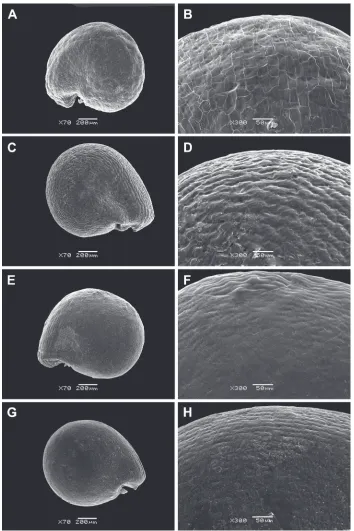
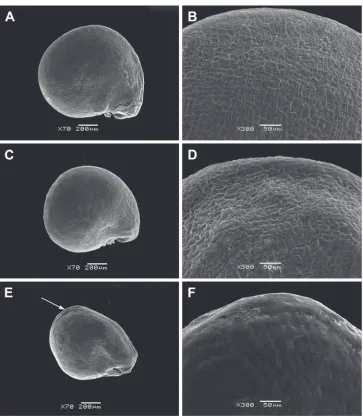
The seeds of all perennial Sesuvium under study are roundish, 0.9–1.1 mm in diameter and slightly flattened (Figs 2 and 3). The aril is one-layered, whitish, ca. 1–2 μm thick in cross-section and consists of thin-walled cells. It tightly adheres to the seed coat. However, S. verrucosum is distinguished by the small detachments of the aril from the seed coat forming a distinctive fold in the cotyledon area (Fig. 3E). The aril usually covers the seed completely (Figs 2, 3A–D), but in some seeds of S. portulacastrum, it is only partially present. An aril covering up to half the seed surface is not common in S. portulacastrum (or any other Sesuvium) mentioned by Hassan et al. (2005a). The presence of a tiny aril apparently does not provide any protective function and its role in seed dispersal or germination is unclear.
The seed coat of perennial Sesuvium is smooth or slightly wavy, often with small, radially elongated striae. Hardly noticeable pits were found only in S. verrucosum
(Fig. 3F). In cross-section, the testal layer is much thicker than the 1–3 endotegmal layers. In almost all species, the testa thickness ranges from (25–)30 to 50 μm (Fig. 4), but the testa of a S. portulacastrum specimen from Grenada studied for comparison was found to measure between 70 and 80 μm. The outer periclinal wall of the testa cells is clearly thicker than the inner periclinal wall and the protoplast is usually clearly visible. The walls and protoplast of the testa cells are completely filled with tannins, especially the external areas of the outer cell walls, which appear dark brown. The “stalactites” in the outer cell walls are not prominent in comparison to other representatives of the core Caryophyllales (Takhtajan 1991, Sukhorukov and Zhang 2013, Sukhorukov et al. 2015). The thickness of the tegmen layers is 2–8 μm (each layer has an average thick-ness of 3 μm). The embryo is annular and the perisperm is copious.
Diagnostics, taxonomy, nomenclature and distribution of perennial Sesuvium... 55
Figure 3. SEM micrographs of Sesuvium seeds (covered with an aril). A, BS. portulacastrum subsp.
persooniiC, DS. portulacastrum subsp. portulacastrumE, FS. verrucosum. Magnification: A, C, E: 70×; B, D, F: 300×. Arrow on image E indicates the detachment of the aril from the seed coat forming a dis-tinctive fold in the cotyledon area.
coty-Diagnostics, taxonomy, nomenclature and distribution of perennial Sesuvium... 57
ledon area, clearly distinguishes S. verrucosum from other taxa encountered in Africa. This character is added to the diagnostic key as a taxonomically important trait. Apart from S. verrucosum, this peculiarity is also observed in the North American annual S. maritimum and South American S. parviflorum DC., a forgotten name of a species that is often identified as S. portulacastrum or S. sessile Pers. (Sukhorukov et al., in prep.).
S. verrucosum and S. maritimum appear closely related to each other according to the molecular data (Bohley et al. 2015). Other American species previously considered within the genus Cypselea and recently transferred to Sesuvium based on the molecular phylogeny (Bohley et al. 2017) – Sesuvium humifusum (Turpin) Bohley & G.Kadereit,
S. mezianum (K.Müll.) Bohley & G.Kadereit and S. rubriflorum (Urb.) Bohley & G.Kadereit – have much smaller, reddish seeds with a thin seed coat (Sukhorukov, pers. observ.). The seeds of these three species (~0.2 mm across) are amongst the small-est in the large “Globular Inclusion” clade (core Caryophyllales: Cuénoud et al. 2002) along with tiny seeds of some Molluginaceae (Sukhorukov et al., in press).
Many African taxa with an annual or perennial life history (S. congense, S. crithmoides, S. crystallinum, S. digynum, S. sesuvioides) possess an indistinctly striate seed surface (Figs 2 and 3; see also Sukhorukov et al. (2017)). Smooth seeds of Sesuvi-um sesuvioides or indistinctly wrinkled seeds of S. digynum have relatively thin (20–30 μm) testa. However, thickness varies considerably in S. hydaspicum (from 20 to 50 μm) and especially in S. nyasicum (from 20 to 100 μm) due to the presence of protruding “wrinkles” originating from the testa. The testa is thinner between the wrinkles and much thicker in wrinkled areas.
Molecular phylogeny
Several new samples were added to the molecular phylogeny including S. nyasicum, S. portulacastrum and the new subspecies S. portulacastrum subsp. persoonii. In both ITS and chloroplast trees (Figs 5 and 6), as well as in the combined tree (Fig. 7), Sesuvium is divided into two clades referred to as the “African” and the “American” lineages (Bohley et al. 2015). Although the relationships within the “African lineage” are still not resolved, this clade contains the species native to Africa. In contrast, the “American lineage” con-sists of the species originating in America, including samples of S. portulacastrum col-lected in Asia and Africa. In all trees, Sesuvium portulacastrum is not monophyletic. The African Sesuvium portulacastrum subsp. persoonii is nested within the “American lineage” as a part of the Sesuvium portulacastrum complex, either as a sister lineage to S. portulac-astrum (the sample from Grenada) in the chloroplast tree (Fig. 5) or amongst the Central American samples of Sesuvium portulacastrum complex (Fig. 6). Due to its well-defined distribution range, this new taxon with clearly petiolate, shorter and thicker leaves is con-sidered here as a subspecies of S. portulacastrum. However, the taxonomic status of S. por-tulacastrum subsp. persoonii needs further studies for the following reasons: (1) the lack of material from the Indian subcontinent, especially S. repens Willd. and S. portulacastrum
Diagnostics, taxonomy, nomenclature and distribution of perennial Sesuvium... 59
Figure 5. Phylogenetic relationships of perennial Sesuvium species from ML analysis of combined plastid sequences (rps 16 intron, trnL-trnF, atpB-rbcL, 1377 bp in total). The tree is drawn to scale, with branch lengths measured in the number of substitutions per site. ML bootstrap support/BI posterior probabilities are specified at the branch nodes (not shown when <50%).
Figure 7. Phylogenetic relationships of perennial Sesuvium species inferred from combined analysis of plastid (rps 16 intron, trnL-trnF, atpB-rbcL) and ITS sequences. The tree is drawn to scale, with branch lengths measured in the number of substitutions per site. ML bootstrap support/BI posterior probabilities are specified at the branch nodes (not shown when <50%).
of the exact relationships of all taxa within the large “American lineage” and (2) Sesuvium portulacastrum is still considered a highly variable species distributed worldwide (Bohley et al. 2017). However, some “strange” forms of this species in Asia (especially in the large biogeographical region of Malesia) are present in the European herbaria in a very limited quantity and were not included in the molecular analysis. The preliminary morphological studies (Sukhorukov et al., in prep.) suggest that at least two species need to be reinstated to species rank (S. parviflorum DC. and S. microphyllum Willd.) and some new taxa from South and Central America are yet to be described.
Taxonomy of perennial Sesuvium in Africa
One American species (S. verrucosum) and one new subspecies (S. portulacastrum
Diagnostics, taxonomy, nomenclature and distribution of perennial Sesuvium... 61
Gonçalves 1970, Sukhorukov et al. 2017) can be a facultatively short-lived perennial herb. In total, six perennial species in Africa (S. ayresii, S. congense, S. crithmoides, S. portulacastrum, S. verrucosum and the facultatively short-lived S. sesuvioides) and one subspecies of S. portulacastrum mentioned above have been accepted.
Diagnostic key to perennial Sesuvium in Africa
1 Stems and leaves densely papillate (plants grayish); flowers sessile or with short (up to 3 mm) pedicels ...2
– Stems and leaves glabrous (younger leaves may be papillate); flower sessile or pedicellate (pedicels up to 15 mm) ...4
2 Each flower surrounded by 4(–6) bracteoles ...S. crithmoides – Each flower with 2 bracteoles ...3
3 Old stems stout, hardened; leaves linear to lanceolate (lower leaves often spat-ulate); perianth cup (concrescent part of the segments) roundish; aril tightly adherent to the seed coat ...S. congense – Old stems not hardened; leaves oblong; perianth cup turbinate; aril peeling off the
seed coat near the cotyledon area (appearing as a white fold) ...S. verrucosum 4 Leaves up to 25(28) mm long; flowers sessile or shortly pedicellate (pedicels
up to 3.5 mm) ...5
– Leaves usually longer; pedicels 7–12(20) mm long ...6
5 Perennial; leaves terete or semi-terete; flowers sessile or shortly pedicellate (pedicels up to 3.5 mm), white or pink ...S. ayresii – Short-lived perennial or annual; leaves conduplicate; flowers sessile, mauve .... ...S. sesuvioides 6 Ramification not rampant; leaves clearly petiolate (petioles 5–10 mm long),
usually less than three times longer than wide (all blades including those of upper leaves ovoid or oblong, 20–40 × 10–15 mm), and very fleshy (3–9 mm thick) ...S. portulacastrum subsp. persoonii – Ramification rampant; leaves shortly petiolate (petioles up to 3 mm long),
more than three times longer than wide (all blades oblong-spatulate or oblan-ceolate, 20–60 × 5–10(12) mm) and thinner (1.5–4 mm) ... ...S. portulacastrum subsp. portulacastrum
Synopsis of perennial Sesuvium in Africa
Sesuvium ayresii Marais, Kew. Bull. 32(2): 483 (1978)
Fig. 8
Figure 8.Sesuviumayresii: A the only species growing on the islet (Ile aux Fous, Mauritius, 1 August 2007) B clumps on sandy beach (Ilot Gabriel, Mauritius, 6 August 2007) C an individual clump on calcarenite (Ile de la Passe, Mauritius, 3 February 2007) D close-up of a flower (Rivulet Terre Rouge Bird Sanctuary, Mauritius, 1 September 2017). Photographs by F.B.V. Florens.
Description. The description of S. ayresii was provided by Marais (1978). The most indicative characters of this species are small (up to 25–28 mm long, but usually smaller) terete or semi-terete leaves and (sub)sessile flowers (see Marais 1978, Hart-mann 2002). Additionally, Marais (1978) reported a smaller number of stamens (12– 20) that have never been observed in S. portulacastrum (stamens more than 30). The smaller seed size (~1 mm) of S. ayresii compared with S. portulacastrum (Marais 1978) seems to be an insignificant diagnostic trait. Leaf shape and leaf size are very variable, sometimes within a given individual.
Ecology. Sesuvium ayresii usually grows on coral rocks, basalts or calcarenites (Marais 1978), but it also can be encountered on sandy seashores, like many other species of the genus. The records of Sesuvium from the calcarenite islets of Les Bénit-iers (Johnston 1894) and Rochers des Oiseaux (Johnston 1895) probably belong to S. ayresii. Sesuvium ayresii is reported as the only member of the genus in the Mascarenes (Marais 1990).
Diagnostics, taxonomy, nomenclature and distribution of perennial Sesuvium... 63
0012461); Cap Malheureux, 26 Apr 2004, Pynee s.n. (MAU 0017803); Albion, 10 Nov 2011, Pynee s.n. (MAU 0009004); Rivulet Terre Rouge Bird Sanctuary, 01 Sep 2017, Baider CB 2729 & V. Florens (MAU 0023815); Mauritius [islets] Island: Gunner’s Quoin or Quoin de Mire, 1871, Horne 129 (K); 06 Aug 2007, Baider CB 677 & V. Florens (MAU 0023819); 07 Aug 2007, Baider CB 701A & V. Florens
(MAU 0023820); 07 Aug 2007, Baider CB 701B & V. Florens (MAU 0023821); Ile de la Passe, 26 Oct 1888, Johnston s.n. (E00651982); 29 Nov 2003, Baider CB 588 & V. Florens (MAU 0023826); Ile aux Fouquets, 4 Nov 1962, Rountrees.n. (MAU 0017798); Ilot Marianne, east coast, 13 May 1956, Vaughans.n. (MAU 0017796); 18 Jan 1975, D. Lorence 1059 (K, MAU 0017800); 28 Nov 2007, Baider CB 551 & V. Florens (MAU 0023822); 31 Jul 2007, V. Florens s.n. (MAU 0023823); Ilot Sancho, south coast, 15 Aug 1974, D. Lorence943 (K, MAU 0017799); Ile D’Ambre, 21 Dec 2003, BaiderCB 783A & V. Florens (MAU 0023827); 21 Dec 2003, Baider CB 783B & V. Florens (MAU 0023828); Ilot Bernache, 21 Dec 2003, Baider CB 814 & V. Florens (MAU 0023829); Ilot Gabriel or Gabriel Islet, 20 Apr 2006, Pynee s.n. (MAU 0017804, MAU 0017805), 06 Aug 2007, Baider CB 1942, V. Florens & D. Hammond (MAU 0023825); Ile aux Fous, 01 Aug 2007, V. Florens & D. Hammond s.n. (MAU 0023824); Rodrigues [main] Island: Plaine Coral, Jul 1970,
CadetRO218/2604 (MAU 0017807); 1874, Balfours.n. (E00651981, K); Rodrigues [islets] Island: Frigate Island, Jan 1963, Staubs.n. (MAU 0017806); Ile Gombrani, 10 Jan 2004, Baider CB 932 & V. Florens (MAU 0023817); Ile aux Crabes, 13 Jan 2004, Baider CB 1036 & V. Florens (MAU 0023818); Ile aux Cocos, 15 Jan 2004, V. Florens s.n. (MAU 0023816).
General distribution. Endemic to the Mascarenes.
Conservation status. The species should be considered Near Threatened (NT) according to the IUCN red list criteria (IUCN 2017). This assessment is based on the species’ EOO of 24,241 km2 and AOO of 68 km2; together with other factors
includ-ing the species’ habitat beinclud-ing restricted to seashores affected by salt spray, fragmenta-tion of the populafragmenta-tions and a high probability of losing sites in the near future due to habitat transformation (construction of hotels, improvement of seashores by removal of vegetation, dumping of refuse in the coastal belt), especially on mainland Mauritius. Only a few of the populations are located in areas with some degree of protection such as Nature Reserves or National Parks (one on Rodrigues; nine on Mauritius), most of them being on small islets. Some records are over 50 years old and need to be updated to determine any decline in its geographic distribution. Competition with invasive alien plants seems not to be a serious problem for this species, although sea-level rise is reducing the area of suitable habitat.
Sesuvium congense Welw. in Oliver, Fl. Trop. Afr. 2: 586 (1871)
frequent in mountainous and gravelly places along the estuary of the river Onço in Mosul] fl. & fr. Nov 1853, Welwitsch2382 (LISU214650 – photo! isolectotypes – BM000839899!, BM001209754! K000076293! LE!, P04602200!)
Nomenclatural notes. A specimen in LISU has been wrongly stated to be the holotype by Gonçalves (1965) and then by Bohley et al. (2017). Indeed, the sheets of
S. congense with the same label and collection number are present in several herbaria, as are many other specimens of Welwitsch’s material from Angola (Albuquerque et al. 2009). No specimens and herbarium were cited in the protologue (Welwitsch in Oliver 1871) except the location “Lower Guinea, Congo [Angola as a part of Kongo Kingdom], Ambriz”. The lectotype selected here is in accordance with Art. 9.9 of ICN (McNeill et al. 2012). The synonymisation of S. congense with S. portulacastrum (Ad-amson 1962) is incorrect.
The epithet “congense” probably refers to the “Kingdom of Kongo”, a West Af-rican kingdom that united the territories of northern Angola (incl. Bengo and Zaire provinces) and the western part of DR Congo, as well as portions of Republic of Congo and Gabon.
Description. The morphological description of the species is provided in Oliver (1871), Gonçalves (1970) and Bohley et al. (2017). This species is sometimes confused with branched S. sesuvioides (especially when the upper parts of the branches are col-lected) with similar smooth seeds. In contrast to S. congense or related S. crithmoides,
S. sesuvioides is glabrous, with turbinate or balustriform flowers (without a rounded perianth cup).
Additional specimens examined. ANGOLA: Benguela prov.: Lengue, 19 Dec 1932, Grossweiler9715 (BM); 20 km W of Benguela, Baia Azul, 1 Apr 1973, P. Bamps & S. Martins 4372 (BR0000013827366); 74 km S of Benguela along road to Cuio, 74 m alt., 25 Dec 2016, C. Klak2557 (BOL); Namibe prov.: Maiombo river, Oct 1859,
Welwitsch 2395 (BM); Mossamedes [Namibe], valley of Rio Mukungo, Aug 1937,
H. Humbert 16407 (BM); Mossamedes [Namibe], Porto Alexandre, 26 May 1937,
A.W. Exell & F.A. Mendonça 2294 (BM); Mossamedes [Namibe], Porto Alexandre, Aug 1937, H. Humbert16375 (BM); ca. 22 km NE of Namibe, 18 Jan 2009, Winter 7683 (PRE); road to Baba from Lucira road, 23 Jan 2009, Winter 7779 (PRE); Na-mibe, 9.7 km S of airport turn-off, 23 Jan 2009, Winter 7762 & 7766 (PRE); 27 km E of Namibe, 252 m, 19 Dec 2016, C. Klak2554 (BOL).
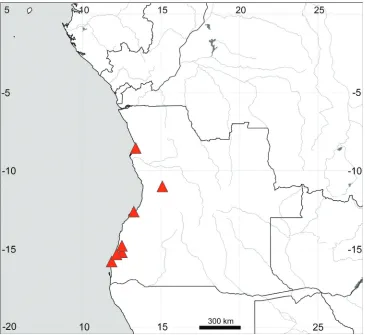
General distribution (Fig. 9). Coastal sandy areas in Angola, from Bengo to Na-mibe provinces, recorded at altitudes between 74 and 252 m a.s.l. (Gonçalves 1965).
Conservation status. Sesuvium congense has an estimated EOO of 54,340 km2
(which would place the species in LC) and AOO of 36 km2 (which would place it
Diagnostics, taxonomy, nomenclature and distribution of perennial Sesuvium... 65
Figure 9. Distribution map of Sesuvium congense.
Sesuvium crithmoides Welw., Ann. Conselho Ultramar. ser. 1: 586 (1859)
Figs 10, 11
Lectotype (designated here by Sukhorukov). ANGOLA, distr. Loanda [Luanda], in arenosis maritimis de Ilha de Loanda [on sandy seashores of Loanda Island], 12 Jun 1858, Welwitsch 2386 (BM000839897! specimen on the left; isolectotypes – BM001209752! BM001209753! K000076292! P04602195! COI00070549! [photo seen], LISU031837! [photo seen]).
Figure 10. General view of Sesuvium crithmoides (incl. S. crystallinum) on the dunes of Rio dos Flamingos, Angola. Photographs by C. Klak and P.V. Bruyns (December 2016).
Figure 11. Parts of the plant of Sesuvium crithmoides: A reproductive shoots B close-up view of flowers. Photographs by C. Klak and P.V. Bruyns (at the mouth of Rio dos Flamingos, south of Namibe, Angola, December 2016).
–Sesuvium mesembryanthemoides Welw., Ann. Conselho Ultramar. ser. 1: 557 (1859), nomen nudum
Diagnostics, taxonomy, nomenclature and distribution of perennial Sesuvium... 67
=Sesuvium mesembryanthemoides Wawra in Wawra & Peyr., Sitzungsber. Acad. Wien, Math.-Nat. 38: 564 (1860).
Lectotype (designated here by Sukhorukov). [ANGOLA] Benguela, Dr Wawra210 (LE!).
Note. Interestingly, Wawra collected the same species in Angola independently from Welwitsch and used the same epithet “mesembryanthemoides” for his new Sesu-vium. Unfortunately, the original sheets of S. mesembryanthemoides Wawra cited in the protologue (“in littore maris prope Benguelam, Wawra 210”: Wawra and Peyritsch 1860) were destroyed in B, W or WU (Bohley et al. 2017; Johannes Walter, pers. comm.). Wawra and Peyritsch (1860) reported the presence of four to six bracteoles in the flowers of S. mesembryanthemoides and it therefore evidently differs from S. con-gense (with similar narrow leaves), which has flowers with two bracteoles only. Bohley et al. (2017) have designated the lectotype of S. mesembryanthemoides Wawra in the herbarium LISU (with isolectotypes in BM, BR, C, COI, K, LE) based on Welwitsch’s specimens (“Mossamedes [Namibe], seashore, 1 Jul 1859, Welwitsch 2389”). However, the material collected by Welwitsch in Namibe province of Angola is not mentioned in the protologue of S. mesembryanthemoides Wawra and does not belong to the origi-nal material. Therefore, this lectotypification cannot be accepted. A lectotype using a Wawra’s specimen (syntype) seen in LE has been selected.
=Sesuvium crystallinum Welw. in Oliver, Fl. Trop. Afr. 2: 586 (1871).
Lectotype (designated here by Sukhorukov): [ANGOLA] Mossamedes [Namibe],
hab.[itat] in arenosis maritimis pr.[ope] Mossamedes [on sandy seashores near Mos-samedes], Jul 1859, Welwitsch2389 (BM000839898! isolectotypes – C, COI, G! K! LE! LISU).
Two locations (“Mossamedes” and “Benguela”) were indicated in the protologue. The lectotype of Sesuvium crystallinum is selected here from the specimens collected by Welwitsch with the number 2389 which were located in different herbaria including LISU (“holotype” in Bohley et al. (2017); not correctable to “lectotype” under Art. 7.10).
Taxonomic and nomenclatural notes. The type material of S. crithmoides com-prises the plant fragments with narrow (linear or lanceolate) leaves reaching 8 cm in length. The leaf length and shape is a single character used for its delimitation from the closely related S. crystallinum (Gonçalves 1970) and S. mesembryanthemoides Wawra (Bohley et al. 2017). Both species are considered to have shorter (up to 5 cm) and broader leaves. However, the authentic material and protologue of S. mesembryan-themoides clearly state that this plant was described as a remarkable species with subtri-quetrous-terete (narrow) leaves (Wawra in Wawra and Peyritsch 1860). Therefore, the use of S. mesembryanthemoides as a priority name against S. crystallinum (Hartmann 2002, Figueiredo and Smith 2008, Bohley et al. 2017) with broader and shorter leaves cannot be accepted. In all characters, including leaf length and shape, S. crithmoides
The authors propose to merge the broad-leaved individuals (S. crystallinum) with
S. crithmoides for the first time. Observations by the authors in Angola (C. Klak and P. Bruyns) did not confirm the separate existence of “short-leaved” or “long-leaved” plants. Other morphological and carpological characters are the same in both S. crithmoides and S. crystallinum. Only S. crithmoides (Winter 7786 (PRE) from Baba, Angola) was included in the molecular analysis (Bohley et al. 2017).
Sesuvium crithmoides was considered as an endemic to Angola, although with pos-sible records in coastal areas of the DR Congo (Bohley et al. 2017). One collection of S. crithmoides from the DR Congo (see also Hauman 1951, sub S. mesembryan-themoides) has been found and was also identified for the Republic of Congo for the first time (previously wrongly labelled as Sesuvium portulacastrum). All specimens seen from the Republic of Congo or the DR Congo have long and narrow leaves.
Additional specimens examined. ANGOLA: Benguela prov.: Benguela, [with-out date] H. Vanderyst 13141 (BR0000013827410); near Benguela, Lobito Bay, 1 Sep 1906, H. Bolus 12453 (BOL); S of Benguela, seashore at Cuio village, 25 Dec 2016, C. Klak 2558 (BOL); Cabinda prov: Landana, 9 Aug 1895, A. Dewevre 231
(BR0000013827380), Landana, 15 Aug 1913, Bequaert 616 (BR000000871151); Cabinda, Sumba village, 30 Nov 1957, Lebrun11195 (BR0000013827441; K); Cuan-za Sul prov.: Praia de Sousa, 11°36'S 13°47'E, 3 Feb 1975, J.D. Ward82 (K, WIND);
Luanda prov.: Luanda, Welwitsch 2380 (LE), the same place, 13 Sep 1955, J. Leb-run 10905 (BR0000013827403); Namibe prov.: Cabo Negro, Sep 1859, Welwitsch 2387 (BM); Cabo Negro, Aug 1937, H. Humbert16391 (BM); the same place, 15 Apr 1973, P. Bamps et al.4519 (BR0000013827465); Mossamedes [Namibe city], 1937,
L.W. Carrisso and F. Sousa 218 (BM); Mossamedes, 21 Sep 1955, J. Lebrun 10926
(BR0000013827472); Baba, 23 Jan 2009, P.J.D. Winter7786 (LUBA, PRE); seashore at mouth of Rio dos Flamingos, 17 Dec 2016, C. Klak2551 (BOL); DEMOCRAT-IC REPUBLDEMOCRAT-IC OF CONGO: Kongo Central prov.: Banana, [without date] Gillet s.n. (BR0000013827434); [Nature Reserve] Luki-Mayumbe, 1959, Flamigni 10773
(BR0000013827427); REPUBLIC OF CONGO(new records): Kouilou, 5 Sep 1962,
L. Makany63 (P04602222); Djeno Region [Pointe-Noire], 26 Jan 1966, C. Farron4795
(P04602197 & P04602199); Pointe-Noire, Dec 1958, J. Koechlin5528 (P04602193).
General distribution (Fig. 12). Angola, Democratic Republic of Congo, Republic of Congo. Sesuvium crithmoides has been introduced to USA (Georgia, Glynn county, Brunswick, on ballast, 15 Aug 1902, R.M. Harper1524 (BM!); see also Small (1933)), probably as casual and not naturalised species (Ferren 2003). The specimen seen also has long and narrow leaves.
Conservation status. Sesuvium crithmoides has an estimated EOO of 177,271 km2 and AOO of 56 km2. It was found to be common in two localities in Angola (C.
Diagnostics, taxonomy, nomenclature and distribution of perennial Sesuvium... 69
Figure 12. Distribution map of Sesuvium crithmoides.
Sesuvium portulacastrum (L.) L., Syst. Nat., ed. 10(2): 1058 (1759).
≡Portulaca portulacastrum L., Sp. Pl. 1: 446 (1753).
Lectotype (Wijnands 1983). Hermann (1698), Icon. 212 [112, a typographic error], as “Portulaca corassavica …”.
Two subspecies of S. portulacastrum growing in Africa have been accepted.
Sesuvium portulacastrum subsp. portulacastrum Fig. 13
=Sesuvium brevifolium Schumach. & Thonn. in Schumacher, Beskr. Guin. Pl.: 233 (1827).
Figure 13. Parts of the plant of Sesuvium portulacastrum subsp. portulacastrum: A vegetative shoots B re-productive shoots. Photographs by M. Salas-Pascual (Gran Canaria, Canary Islands, Spain, July 2017).
The lectotype is chosen due to inclusion of two elements in the protologue (Schu-macher 1827), a specimen cited and a drawing (Table 216, Fig. 1).
Taxonomic notes. The autonymous subspecies is of American origin and is known in many parts of tropical Africa and other continents, especially in regions with a hot and humid climate. According to the lectotypification undertaken by Wijnands (1983), the “true” S. portulacastrum is present in Central America (including the Car-ibbean Islands). The following characters distinguish this subspecies: rampant ramifi-cation, glabrous stems and adult leaves with mamillate epidermis, petioles up to 3 mm, oblong-spatulate leaves of 20–60 × 5–10(12) mm and 1.5–4 mm thick, conspicuous (7–12 mm) pedicels, flowers 10–15 mm in diameter and slightly elongated seeds. This description makes sense, because the species is non-uniform in its morphological char-acters (e.g. leaf length, presence of papillae on stems and leaves, seed ornamentation) and is corroborated by the molecular phylogeny (Bohley et al. 2017). Although S. portulacastrum is considered to have numerous synonyms (Bohley et al. 2017), at least some of them need further studies due to the presence of morphological differences, e.g. S. microphyllum Willd. (Caribbean Islands), S. sessile Pers. (South America?) or populations growing in Southeast Asia. In addition, Sesuvium is represented in Central America by at least six taxa (Sukhorukov et al., in prep.) and two of them have to be described as new species.
From humid coastal parts of West Africa, only one perennial species was described,
S. brevifolium Schumach. & Thonn. (Schumacher 1827). This species has spatulate or oblong leaves with very short petioles, the characters being typical of Sesuvium por-tulacastrum. For this reason, S. brevifolium is merged with S. portulacastrum subsp.
portulacastrum, this being in agreement with other accounts (Hooker 1849, Welwitsch in Oliver 1871, Bohley et al. 2017).
Diagnostics, taxonomy, nomenclature and distribution of perennial Sesuvium... 71
regions of the Old World are not clear. It can be partially explained by the cultivation of S. portulacastrum in some areas for ornamental purposes, but mostly by transporta-tion of its seeds in the sand ballast of ships sailing between America and other parts of the world in the 15th–17th centuries. The examination of the herbarium specimens
indicates that S. portulacastrum was sometimes collected in the same places as native
Sesuvium (S. congense or S. crithmoides), e.g. on seashores of Kongo-Central province (DR Congo) and Angola.
Additional specimens examined. ANGOLA: Luanda, Praia do Bispo, Dec 1858,
Welwitsch2385 (BM); [Bengo prov.] Ambriz, [no date] Welwitsch 2383 (K); [Bengo prov.] Dande River, 17 Sep 1955, J. Lebrun10908 (BR0000013828103); Mossamedes [Namibe], 10 Jan 1956, E.J. Mendes 1250 (BM); [Namibe prov.] Cabo Negro, 15 Apr 1973, P. Bamps et al.4522 (BR0000013828097, K, LE); Kwanza Sul prov., 10°51'S 13°48'E, 2 Feb 1975, C.J. Ward and J.D. Ward 68 (K); BENIN: Cotonou beach,
22 Mar 1970, L.A. Assi 11134 (G); DEMOCRATIC REPUBLIC OF CONGO:
[Kongo Central prov.] Banana, 16 Jul 1915, Bequaert 8014 (BR0000013828165); Bula-Bemba, 2 Sep 1958, J. Wagemans 1982 (BR0000013828172); GABON: Es-tuaire prov., 22 Feb 1985, A.M. Louis 1728 (BR0000013828028); GHANA: Se-kondi, 3 Oct 1925, H. Howes 980 (K); nr Tema harbor, 20 Sep 1960, J.O. An-krah 20547 (K); Accra, 12 Aug 1958, J. Lebrun 11334 (BR0000013828042); Greater Accra Region, Ambassador Beach, 26 Feb 1977, A.J.M. Leeuwenberg11123
(BR0000013828035); GUINEA: Conakry, Aug 1954, H. Jacques7002 (LE); [Boké Region] Boffa pref., Bel-Air, 5 Feb 1979, S. Lisowski51828 (BR0000013827567); GLORIOSO ISLANDS: Iles aux Crabes (C. Fontaine, obs.; image seen!); KENYA: Kilifi distr., Malindi, 3 Dec 1961, R. Polhill and S. Paulo895 (BR0000013828059, K, P04602215); Mikindani distr., Mtwara, 12 Mar 1963, H.M. Richards17861 (K); Mombasa, 13 Dec 1969, Bally 13736 (G); Tana River distr., Tana delta, Shekiko Camp, 25 Apr 1990, S.A. Robertson 6121 (K); MADAGASCAR: [no exact loca-tion and date] herb. Petit-Thouarss.n. (P04600013); MOROCCO: Skhirat, 10 Jun 1937, J. Gattefosse138 (G, P05196618); MOZAMBIQUE(selected specimens): De-lagoa [Maputo] Bay, 1890, H. Junod 258 (G); Komati river, 15 Jul 1922, C.E. Moss 7040 (BM); Lorenço Marques, 31 Aug 1959, R. Watmaugh 313 (M); Maputo, 3 Jun 1970, M.F. Correla and A. Marques 1630 (E00651988); Sofala province, Beira, 26 Feb 1972, M.F. Correla and A. Marques 2812 (M); Maputo, 8 Mar 1979, P.A. Schäfer6707 (K); Inhambane prov., Massinga, Pomene, 20 Jun 1980, J. de Koning 8197 (WAG1408388); Maganja da Costa, Praia Maraga, 15 Nov 1996, A.R. Torre and M.F. Correia 14693 (BR0000013828134, M); [Massinga distr.] Pomene, 24 Sep 1980, P.C.M. Jansen 7521 (BR0000013828110); SÃO TOMÉ & PRÍNCIPE: São Tomé [Island], Apr 1916, A. Cortesãos.n. (BM); SENEGAL: [Oussouye Dept.] Basse Casamance National Park, Kabrousse, 22 Dec 1976, C. Van den Berghen1582
121 (K); Farquhar Group, St Pierre Island, 4 Oct 1941, P.O. Wiehe 1681 (MAU 0023813, MAU 0023814); SIERRA-LEONE: Samu chiefdom, 22 Mar 1930, R.R. Glanville251 (BM, K); SOMALIA: Kodei village, 1°1'S 41°58'E, 29 Jun 1983, J.B. Gillett et al. 5116 (K); SPAIN: Canary Islands (selected specimens): Lanzarote, Playa Honda, 24 Mar 2011, F. Verloove 9276 (BR); La Laja beach, Las Palmas de Gran Canaria, 28°03'38.70"N, 15°25'12.28"W, 31 Jul 2017, M. Salas-Pascuals.n. (MW); Beach of El Águila, San Bartolomé de Tirajana, 27°46'38.80"N, 15°31'38.50"W, 31 Jul 2017, M. Salas-Pascual s.n. (MW); El Veril beach, San Bartolomé de Tirajana, 27°45'36.78"N, 15°33'50.77"W, 31 Jul 2017, M. Salas-Pascual s.n. (BR, MW); Edge of the Charca de Maspalomas, San Bartolomé de Tirajana, 27°44'24.96"N, 15°35'43.79"W, 31 Jul 2017, M. Salas-Pascuals.n. (MW); TANZANIA: Tanga, Tan-ga Bay, 4 Nov 1929, Greenway1853 (K); Zanzibar, Marahubi Beach, 22 Apr 1961,
H. Faulkner2814 (BR0000013828073); Dar es Salam, 26 Aug 1968, M. Batty284
(K); TUNISIA: pers. comm. R. El Mokni (photo!).
General distribution. The subspecies seems to be widely distributed on the sea-shores of the tropics, but some populations from tropical America and SE Asia are distinct in their morphological characters. The distribution of Sesuvium portulacastrum
subsp. portulacastrum in Africa is presented in Fig. 14.
Figure 14. Distribution map of Sesuvium ayresii (stars) and S. portulacastrum subsp. portulacastrum
Diagnostics, taxonomy, nomenclature and distribution of perennial Sesuvium... 73
Sesuvium portulacastrum subsp. persoonii Sukhor., subsp. nov.
urn:lsid:ipni.org:names:77174974-1
Sesuvium pedunculatum sensu Sieber (in herb.) non Pers.
Diagnosis. Differs from the autonymous subspecies by the absence of rampant ramifi-cation, clearly petiolate leaves (petioles 5–10 mm long) that are usually less than three times as long as wide (all blades including those of upper leaves ovoid or oblong, 20–40 × 10–15 mm) and 3–9 mm thick.
Holotype. Republic of Cape Verde, Sal Island, 2 km W of Santa Maria town, 16.590246, -22.924272, sandy depressions near the sea, 30 Aug 2015, A.P. Sukhoru-kov59 (MW0595660! iso – BR, G, K).
Description. Sprawling glabrous perennial herb (the shoots are often partially buried by sand and appear to be separate plants) with ramification not rampant; stems rooted or not, roundish, greenish or more often red (Fig. 15A, B), 3–5 mm in diam-eter, ascendent (not creeping); leaves opposite, petiolate; petioles 5–10 mm, reddish or green, broadened basally, leaf blades oblong, 20–40 mm long (the leaves on the shortened shoots are smaller), 10–15 mm wide, 3–9 mm thick, entire, green or reddish (Fig. 15C); flowers solitary in the leaf axils (each node bears one flower from one of the opposite leaves), ~10 mm in diameter, with two hyaline glabrous bracteoles; pedicels 3–5 mm, accrescent at fruiting stage up to 10(15–20) mm long; perianth bifid, apically acutish, green abaxially and pink adaxially (Fig. 15D), without prominent red glands at the tip of the segments; stamens ~50, pink, slightly shorter than perianth, filaments 5 mm long, anthers 0.4–0.6 mm long; ovary turbinate, with (2)3–4 stigmas; seeds ~20, black, roundish, ~1 mm across, completely covered with a funicular aril; seed surface smooth or slightly uneven.
Etymology. The subspecies is named after Christiaan Hendrik Persoon (1761–1836), botanist and mycologist, who described several Sesuvium species.
Ecology. Sandy beaches near the sea and seasonally flooded, saline plains on the landward side of the coastal dune belt.
Flowering and fruiting. All year round, but most abundantly from September to May (at least in the Cape Verde Islands).
Taxonomic and nomenclatural notes. Franz Wilhelm Sieber labelled his Sesu-vium collections from Senegal as S. pedunculatum Pers. The use of this name for the African material is very confusing but explained here.
Figure 15.Sesuvium portulacastrum subsp. persoonii: A general view of the plant (of red colour) in saline depressions near the seashore, together with the subshrub Arthrocaulon franziiBS. portulacastrum subsp.
persoonii on the seashore dunes C closer look at an individual D close-up of the flower. Photographs by A. Sukhorukov (A–C Sal Island, Cape Verde, August 2015) and A. Konstantinova (D Sal Island, Cape Verde, January 2016).
In Leiden (L), where the largest collection of Persoon’s types is deposited, one sheet with two different plant fragments and without any information about their locality (L1693369) was found with the label “Sesuvium pedunculatum Lam.” (!) (Fig. 16). Lamarck’s authorship of this species is clearly wrong (see Lamarck 1817: 141). The plant fragment on the left side of the herbarium sheet shows typical characteristics of the leaf shape found in S. portulacastrum subsp. persoonii, but it is named by Ch. H. Persoon as S. portulacastrum. The right fragment on the sheet belongs to the autony-mous subspecies of S. portulacastrum. According to Persoon’s identification, his new species (S. pedunculatum Pers.) is indeed a synonym of the typical S. portulacastrum
that has been recorded in India at least since the 17th century, probably as an alien
Diagnostics, taxonomy, nomenclature and distribution of perennial Sesuvium... 75
Figure 16. A specimen kept in Leiden (L1693369) and probably seen by Persoon, containing both
was chosen as the lectotype of S. pedunculatum by Hartmann (2002) and it is treated by her as a synonym of S. portulacastrum. Her opinion was accepted by Bohley et al. (2017). The authors also agree with Hartmann (2002) and Bohley et al. (2017) about the merger of S. pedunculatum with S. portulacastrum [subsp. portulacastrum].
Sesuvium portulacastrum subsp. persoonii is morphologically similar to S. repens
Willd., a species found in coastal areas of the Indian subcontinent (E! G! K!). Both species possess distinctly petiolate leaves, but the latter species has much smaller (usu-ally up to 20 mm long) leaves and shortly pedicellate flowers (pedicels at fruiting stage up to 6 mm long). Sesuvium portulacastrum always has tapered leaves with indistinct petioles up to 3 mm long. Additionally, the leaf thickness in S. portulacastrum subsp. persoonii varies from 3 to 9 mm and the leaves are especially thick (terete, almost roundish) in plants growing in saline depressions. In contrast to that, S. portulacas-trum subsp. portulacastrum plants seen in the wild or in cultivation possess thinner (1.5–4 mm) leaves, in accordance with previous measurements (Bohley et al. 2017). Besides, plants with clearly petiolate leaves (S. repens and S. portulacastrum subsp. per-soonii) have never been found in the Americas.
Additional specimens examined (Fig. 17). CAPE VERDE: São Nicolau Island, Praia Branca, 1851, C. Bolles.n. (E00651990); Sal Island, Santa Maria, 19 Oct 1934,
M. Dinklage3192 (BM, BR0000013828158); Sal Island, 1934, A. Chevalier44288
(P04602231); Boa Vista Island, Santa Monica beach, 15.981955, -22.831910, 10 Jan 2016, A. Sukhorukov s.n. (MW); GAMBIA: [Upper River Region] Keneba, Sep 1952, D.S. Bertrams.n. (K); GUINEA-BISSAU: Cacheu Region, S. Domingos sector, Candemba, 15 Apr 1997, M.A. Diniz & A.E. Gonçalves 1777 (K); MAURITANIA: [Dakhlet Nouadhibou Region] Cape Arguin, Dalmas, 5 May 1895, herb. E. Drake 6
(P04602228); Cansado, 1901, A. Gruvel s.n. (P04602226); Port Etienne [Nouadhi-bou], 12 Apr 1908, anonyms.n. (P04602227); SENEGAL: [without exact location] 1825, Sieber19 (E000651984; G00660404; K; LE; M; P05196607); [without exact location and year] Sieber112 (LE); [without exact location] 1859, Perrotet366 (G); St. Louis, 1902, A. Chevalier3469 (P04602206); Dakar, Hann beach, common, 23 May 1947, J.T. Baldwin5754 (K); St. Louis, 23 Jul 1960, J.D. Kesby20 (K); St. Louis, 14 Nov 1984, P. Bamps 7642 (BR0000013827533); Poumekhor, saline depression, com-mon, 2 Feb 1966, J. Audru3200 (P04602214); Joal-Fadiouth, 25 Jun 1973, P. Geissler 6538 (G).
General distribution. The authors are still not sure whether this overlooked sub-species is native to West Africa. Plants with such habit are known from the seashores near Chennai, India (Anand Kumar, pers. comm., with an image sent to AS), but are not represented in any herbaria. One sheet from “Peninsula Indiae Orientalis” (herb.
Wight 963, L1693577) corresponds to the African specimens of S. portulacastrum sub-sp. persoonii (labelled as “S. portulacastrum var.”) in leaf shape.
Reports of the occurrence and frequency of S. portulacastrum subsp. persoonii in West Africa until the early 20th century are inconsistent. The first reference for West
Diagnostics, taxonomy, nomenclature and distribution of perennial Sesuvium... 77
Figure 17. Distribution map of Sesuvium portulacastrum subsp. persoonii (circles) and S. verrucosum
(stars).
doubtful, because this plant was not mentioned by other travellers. However, Hooker (1849) reported Sesuvium as a common plant on seashores of the adjacent Senegal. F.W. Sieber was the first to collect the specimens of S. portulacastrum subsp. persoonii
(collections from Senegal in early 19th century, identified as S. pedunculatum). Other
specimens, named as S. portulacastrum and collected in mid-19th century in Cape
Verde (São Nicolau Island) and Senegal (without exact location), are stored in the herbaria E and G, respectively. Sesuvium portulacastrum subsp. persoonii (under the names S. pedunculatum or S. portulacastrum) had not been reported amongst the most common plants in the checklists for West African plants until the early 20th century
(e.g. Engler 1910). Chevalier (1920) cited Sesuvium portulacastrum subsp. persoonii
(sub S. portulacastrum) for West Africa (Mauritania and Senegal), with subsequent re-cords for Santiago and Sal Islands (Cape Verde), where it grows spontaneously on the seashores and in saline depressions (Chevalier 1935). M. Dinklage (collections from 1934, kept at BM!) noted the common and abundant Sesuvium populations on sandy beaches in Santa Maria village (Sal Island, Cape Verde). Recently, S. portulacastrum