R E S E A R C H
Open Access
Coverage of overdose prevention programs for
opiate users and injectors: a cross-sectional study
Elisabet Arribas-Ibar
1, Albert Sánchez-Niubò
1, Xavier Majó
2, Antònia Domingo-Salvany
1*and Maria Teresa Brugal
3Abstract
Background:The use of opiates, particularly heroin, remains an important cause of morbidity and mortality. Half of the deaths among heroin consumers are attributed to overdose. In response to this problem, overdose prevention programs (OPPs) were designed. The objective of our study was to assess coverage of OPPs among the target population in a specific Spanish region (Catalonia) and to identify characteristics related to attendance. Methods:A cross-sectional survey recruited individuals from outpatient treatment centers (OTCs), therapeutic communities (ThCs), and harm reduction facilities (HRFs) in Catalonia. From 513 participants, 306 opiate users and/ or injectors were selected for this study. Coverage was calculated as the proportion of subjects who declared having participated in an OPP. A Poisson regression with robust variance was used to assess factors (socio-demographic aspects and psychoactive substance use patterns) associated to OPP participation, taking into account recruitment strategy.
Results:Average age of the 306 subjects was 39.7 years (s.d.: 7.7); 79% were male; 79.2% lived in urban areas and
56.3% were unemployed or had never worked. Overall OPP coverage was 43.5% (95% CI: 37%–49%). Training was
received mostly in HRF (60%), followed by OTC (24.4%), prison (19%), and ThC (16%). OPP sessions were attended by 41% of Spanish-born study participants and by 63.3% of foreigners; 92.2% of the participants lived in urban areas. The Poisson regression analysis adjusted by age, sex, and type of recruitment center showed that OPP participation rates were higher for individuals with foreign nationality (PR = 1.3; 95% CI: 1.04–1.72), for those living in municipalities with more than 100,000 inhabitants (PR = 2.0; 95% CI: 1.37–2.81) or the Barcelona conurbation (PR = 2.5; 95% CI: 1.68–3.77), and for those having ever been in prison (PR = 1.6; 95% CI: 1.41–1.81) and had first consumption when they were less than 12 years old (PR = 1.2; 95% CI: 1.06–1.45).
Conclusion:Coverage as a whole can be considered high. However, in Catalonia, new strategies ought to be developed in order to attract opiate users and injectors not currently participating, by expanding OPP offer to services and regions where coverage is poor.
Keywords:Coverage, Drug injectors, Harm reduction program, Heroin overdose, Opiates users, Drug and overdose prevention program
* Correspondence:[email protected] 1
Research group of drug abuse epidemiology, IMIM—Institut Hospital del Mar d’Investigacions Mèdiques, Doctor Aiguader 88, E-08003 Barcelona, Spain Full list of author information is available at the end of the article
Abstract
Antecedentes:El uso de opiáceos, sobre todo heroína, sigue siendo una causa importante de morbilidad y mortalidad. La mitad de las muertes entre consumidores de heroína se atribuyen a sobredosis. Como respuesta a este problema, se desarrollaron los Programas de Prevención de Sobredosis (PPS). El objetivo fue evaluar la cobertura de PPS e identificar las características relacionadas con la asistencia.
Métodos:Estudio transversal de consumidores reclutados en Centros de Tratamiento (CT), Comunidades Terapéuticas (CoT) y Centros de Reducción de Daños (CRD) en Cataluña (España). A partir de 513 participantes, se seleccionaron 306 consumidores de opiáceos y/o inyectores. La cobertura fue calculada como la proporción de sujetos que declararon haber participado en un PPS. Se realizó una regresión de Poisson con varianza robusta para evaluar los factores (aspectos socio-demográficos y patrones de consumo de drogas), asociados a la participación en PPS teniendo en cuenta la estrategia de reclutamiento.
Resultados:La edad media fue de 39.7 años (de: 7.7); 79% eran hombres; 79.2% vivían en zonas urbanas y 56.3% eran desempleados o que nunca habían trabajado. En general, la cobertura de PPS fue del 43.5% (IC 95%: 37%-49%). La mayoría de los programas se realizaron en CRD (60%), seguido por CT (24.4%), cárcel (19%) y CoT (16%). El 41% de los participantes nacidos en España participaron en un PPS mientras que lo hicieron un 63.3% de los extranjeros; el 92.2% de los participantes vivían en zonas urbanas. Se realizó regresión de Poisson para el análisis, ajustado por edad, sexo y centro de reclutamiento. Se obtuvieron mayores tasas de participación en PPS en personas nacidas en el extranjero (RP = 1.3; 95% IC: 1.04-1.72), residentes en municipios con más de 100.000 (RP = 2.0; 95% IC: 1.37-2.81) y Barcelona conurbación (RP = 2.5; 95% IC: 1.68-3.77), en aquellos que habían estado alguna vez en la cárcel (RP = 1.6; 95% IC: 1.41-1.81) y en los que hicieron el primer consumo con menos de 12 años (RP = 1.2; 95% IC: 1.06-1.45).
Conclusión:La cobertura puede ser considerada alta, sin embargo en Cataluña nuevas estrategias deben ser desarrolladas con el fin de atraer consumidores de opiáceos y/o inyectores que no participan, mediante la ampliación de la oferta de PPS en los centros y las regiones donde la cobertura es deficiente.
Background
Currently, substance abuse remains a huge public health problem worldwide, despite different measures having been undertaken in terms of prevention and treatment for legal and illegal drugs [1]. It is estimated that globally, over 27 million people are affected by problematic consumption of some kind of substance (0.6%). In numerous developed countries, illicit drug use rates are alarming, opiates being one of main sub-stances involved [1-4]. The European Commission and the EU drugs agency (EMCDDA) have estimated that in 2010, there were over 1.3 million active opiate users in Europe [5] and the average prevalence of problem-atic use is estimated to be between 3.9 and 4.4 individuals per 1,000 persons aged 15–64 years [2]. Furthermore, heroin has been classified as the second most harmful psychoactive drug, taking into account harm to self and others [6], and remains an important cause of morbidity and mortality [2]. Different studies have estimated that around half of the deaths of her-oin consumers may be attributed to overdose [7], even though a cohort study in Barcelona found that 34.7% were due to opiate overdose, probably in relation to the high AIDS-related mortality there [8]. However, it has been estimated that only around 2%–3% of heroin overdoses are fatal [9]. On the other hand, studies have
shown that the annual prevalence of non-fatal overdose episodes is 9%–32% [9,10]. Even when non-fatal, they can still have serious health consequences [10,11].
Circumstances and consequences of consumption are almost always involved in heroin-related deaths [12]. The risk of heroin overdose, whether fatal or non-fatal, is related to factors such as parenteral route of administration [13] and polydrug use [2,7], espe-cially with central nervous system depressors (e.g. alcohol, benzodiazepines) [10,14,15]. Using heroin when alone and using heroin after a period of abstin-ence have been established as risk factors for fatal opi-ate overdose [12,16].
overdose. Harm reduction programs were created to re-duce fatal and non-fatal consequences of heroin use. They include needle exchange programs, safe injection sites, naloxone distribution, and overdose prevention programs (OPPs) [14].
Accidental overdoses usually occur in the company of peers whose immediate help may be critical to as-sist the overdose victim. Furthermore, as death from overdose usually occurs within 1–3 h after heroin in-jection [14,18], there is time to act in order to avoid the opiate poisoning being fatal. This fact led to the development of overdose prevention programs (OPPs), special courses designed [14,18] to teach opiate users how to avoid suffering an overdose and train them in treating those of their peers [19]. The OPP consist of explaining the risks and consequences of opiate use, as well as teaching participants to recognize signs of overdose, how to deal with an overdose step by step, and instruction in cardiopulmonary resuscitation tech-nique and naloxone administration [14,19-21]. Nalox-one as an opiate antagonist is very useful to reverse an opiate overdose and as several feasibility studies have demonstrated its effectiveness [22], training in its ad-ministration has been incorporated into OPP. Prior studies have shown that drug users trained in OPP are very effective in recognizing overdose signs and in re-ducing overdose deaths [23].
In Catalonia (Spain), opiate use by injection con-tinues to be prevalent [24]. The region has been iden-tified as having a high mortality rate for opiate overdose [25]. Many treatment and prevention pro-grams started first in Barcelona and subsequently expanded, mainly to other urban areas. Implementa-tion of OPP appears to have followed a similar pattern until their systematic application started, first in cen-ters where harm reduction programs are offered (2009), followed by therapeutic communities (2010) and outpatient treatment centers (2011) [XM, per-sonal communication]. These programs last around 1 h and participants receive an economic reward. Coverage of these programs needs to be evaluated in order to guarantee their adequacy [23]. In this sense, the main aim of the present study was to assess cover-age of OPPs among the target population and to iden-tify characteristics related to attendance.
Methods
Study design and sample
The sample for this cross-sectional study was recruited in treatment and prevention centers in Catalonia (Spain) between April and June 2012. A total of 48 centers were selected: 26 outpatient treatment centers (OTCs), 12 therapeutic communities (ThCs), and 10 harm reduction facilities (HRFs). Sampling was planned to cover the
whole territory, each center was required to recruit a number of participants determined based on their activ-ity, over-sampling the smallest selected centers, espe-cially HRF. In OTC, this was done only for those having more than 45 annual patients; and in each OTC, a convenience sample was selected, taking into account whether first treatment and time in treatment. Approval for the study was obtained from the IMIM (Hospital del Mar Medical Research Institute) ethics committee, and ethical procedures were followed for data collection. Participants were informed of the purpose of the study, and HRF clients were rewarded with 10€.
From a sample of 513 drug users (N approached = 564; participation rate: 91%), the target population was selected for the present study, consisting of 312 opiate (i.e. heroin, methadone) users and/or injectors. Partici-pants answered a 78-item questionnaire involving single or multiple-choice answers and different levels of com-plexity. It was clearly structured and asked for informa-tion about socio-demographic aspects, drug patterns, illegal drug market activities, violence, health status, and evaluation of prevention programs. Most questionnaires were administered by a previously trained interviewer; a minority of participants completed the questionnaires themselves. Only four participants did not answer ques-tions about participation in OPPs and two didn’t know about participation (1.9% of the target population). Therefore the final sample consisted on 306 opiate users and/or injectors.
The coverage of OPPs was calculated for the total sample, by recruitment center, region, and municipal-ities, as the proportion of subjects who declared having participated in an OPP. Variables of interest for OPP participation analysis were recruitment center, socio-demographic aspects (sex, age, country, municipality, level of education, employment status, and sentenced to prison), and psychoactive substance use patterns (age at first drug use, first drug used, parenteral ad-ministration, heroin and cocaine use, alcohol risk consumption, and binge drinking). Alcohol risk con-sumption was assessed through the AUDIT, short version [26]. Other variables of interest were those re-lated to OPPs (type of training center and when they had attended OPP).
Statistical analyses
Poisson regressions (bivariate) for each variable, taking non-attendance in OPP as the reference category. Later, those variables with p-value <0.2 were included in a multiple Poisson regression. Final model was fitted using a backward procedure. Statistical significance was set at
p-value <0.05. All analyses were performed using PASW Statistics version 18.
Results
Among the 306 participants, 68.3% were opiate users and injectors, 28.4% were only opiate users, and 3.3% only injectors. The majority of participants were male (79.2%). The average age was 39.7 years (s.d.: 7.7) (range: 20–71). Only 24% had high school or university degree. Over half of the participants had never worked or were unemployed (56.3%), 26.2% received a pension or had some permanent disability, and 12% were currently working; 57.3% of participants had a prison history. Re-garding drug use patterns, alcohol risk consumption was observed in 45.4% of study participants; 18% started il-legal drug use when they were under 13 years old; and in 76.3%, the first illegal drug used was cannabis.
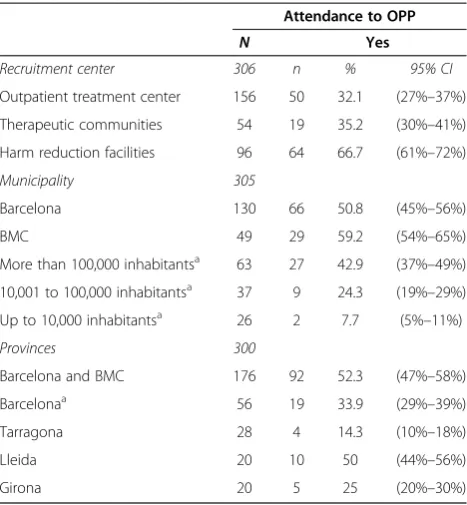
One hundred thirty-three study participants had par-ticipated in some OPPs (43.5%; 95% CI: 37%–49%). No significant differences were found in the distribution of OPP participation by either sex (men 44.6% vs women 39%) or age (mean age of OPP participants: 39.4 years s. d.: 7.1); 66.7% of participants recruited in HRF had attended an OPP, while only around one-third of indi-viduals recruited in OTC and ThC had done so (Table 1). OPP coverage by geographical area shows that people living in Barcelona city or Barcelona metropolitan con-urbation (BMC) had the highest participation (52.3%) (Table 1). Related to time of attendance, 63.4% had attended within the last 2 years, 19.1% between 2–5 years ago, and 17.6% more than 5 years ago. Among 131 OPP participants reporting where they had received training, 60% did so in HRF, 24.4% in OTC, 19% in prisons, and 16% in ThC (note that they could have attended an OPP several times).
Regarding the associations in the bivariate analyses, between OPP participation and other individual vari-ables (Table 2), socio-demographic characteristics found to be significantly associated to OPP attendance were: being a foreigner (PR = 1.5; 95% CI: 1.12–2.03); municipality, as residents from Barcelona and towns of more than 100,000 habitants had a higher participa-tion; employment status as individuals with permanent disability or receiving a pension were more likely to have attended an OPP and also prison as persons who had ever been sentenced to prison declared a higher participation. Regarding drug use-related variables, we found that partic-ipants aged 12 years or under when they first used drugs
were more likely to have enrolled in OPP (PR = 1.4; 95% CI: 1.19–1.75).
The multiple Poisson regression analysis showed that being a foreigner was associated to a greater chance of participating (PR = 1.3; 95% CI: 1.04–1.72), as was resid-ing in a town with more than 100,000 habitants (PR = 2.0; 95% CI: 1.37–2.81) or the Barcelona conurbation (PR = 2.5; 95% CI: 1.68–3.77); also, individuals ever sen-tenced to prison were more likely to have participated in OPP (PR = 1.6; 95% CI: 1.41–1.81), as were subjects whose first drug use was when they were 12 years old or under (PR = 1.2; 95% CI: 1.06–1.45).
Discussion
Participation in overdose prevention programs by the target study population was high, 43.5%. Coverage was higher in Barcelona city and its conurbation. Character-istics of participants associated to higher participation in OPP in Catalonia were: residing in metropolitan areas, being a foreigner, having been in prison, and starting consumption at age 12 years or under.
In this study, an attempt was made to achieve maximum representativeness of the target population, selecting participants from all over Catalonia, but as recruitment was only done in health centers, results can at most be representative of drug users in healthcare settings. We need to assume that the interviewed users are similar to their peers. Injectors not reporting opiate use were also
Table 1 Overdose prevention program (OPP) coverage by recruitment center and geographical area
Attendance to OPP
N Yes
Recruitment center 306 n % 95% CI
Outpatient treatment center 156 50 32.1 (27%–37%)
Therapeutic communities 54 19 35.2 (30%–41%)
Harm reduction facilities 96 64 66.7 (61%–72%)
Municipality 305
Barcelona 130 66 50.8 (45%–56%)
BMC 49 29 59.2 (54%–65%)
More than 100,000 inhabitantsa 63 27 42.9 (37%–49%) 10,001 to 100,000 inhabitantsa 37 9 24.3 (19%–29%)
Up to 10,000 inhabitantsa 26 2 7.7 (5%–11%)
Provinces 300
Barcelona and BMC 176 92 52.3 (47%–58%)
Barcelonaa 56 19 33.9 (29%–39%)
Tarragona 28 4 14.3 (10%–18%)
Lleida 20 10 50 (44%–56%)
Girona 20 5 25 (20%–30%)
BMCBarcelona metropolitan conurbation.
a
Table 2 Socio-demographic and psychoactive substance use patterns associated to participation in overdose prevention programs (OPPs)
Attendance to OPP Bivariate poisson Multiple poisson
Regressiona Regressiona
N Yes PR 95% CI PR 95% CI
n %
Socio-demographic characteristics
Country of origin 306
Spain 273 112 41 1 1
Other countriesb 33 21 63.6 1.5 (1.12–2.03)* 1.3 (1.04–1.72)*
Municipality 305
Less than 100,000 inhabitants; not BMC 63 11 17.5 1 1
More than 100,000 inhabitants; not BMC 52 20 38.5 2.2 (1.49–3.23)* 2.0 (1.37
–2.81)*
Barcelona and BMC 190 102 53.7 3.1 (1.98–4.84)* 2.5 (1.68
–3.77)*
Level of education 306
High school/university degree 73 26 35.6 1
Secondary education 121 55 45.5 1.3 (0.87–1.81)
Primary/elementary 112 52 46.4 1.3 (1.01–1.89)*
Employment status 302
Working 36 7 19.4 1
Never worked/unemployed 170 77 45.3 2.4 (0.95–6.02)
Permanent disability/pensioner 79 40 50.6 2.9 (1.23–6.60)*
Student/sporadic work/working at home 17 8 47.1 2.6 (0.67–10.10)
Ever sentenced to prison 304
No 131 36 27.5 1 1
Yes 173 95 54.9 2.0 (1.78–2.30)* 1.6 (1.41–1.81)*
Psychoactive substance use patterns
Age at first drug use 305
≥13 years 249 100 40.2 1 1
≤12 years 56 33 58.9 1.4 (1.19–1.75)* 1.2 (1.06
–1.45)*
First drug used 304
Cannabis (marijuana, hashish) 232 101 43.5 1
Cocaine, heroin, her-coca, crack 48 23 47.9 1.1 (0.88–1.44)
Other drugsc 24 8 33.3 0.8 (0.40–1.43)
Parenteral administration 306
No 87 31 35.6 1
Yes 219 102 46.6 1.3 (1.03–1.70)*
Heroin use 306
No 16 7 43.8 1
Yes 290 126 43.4 1.0 (0.70–1.47)
Alcohol risk consumptiond 306
No 167 73 43.7 1
Yes 139 60 43.2 0.9 (0.75–1.24)
CIconfidence interval,PRprevalence ratio,BMCBarcelona metropolitan conurbation. *p<0.05.
a
Poisson regression with robust variance adjusted by age and sex, using generalized estimated equations to control correlation within recruitment center.
b
Other countries: rest of Europe, America, Asia, and North Africa.
c
Other drugs: include tranquilizers, mushrooms, LSD, and ketamine.
d
considered target population because intravenous illegal drug use in Catalonia is strongly associated with heroin use [24]. Nevertheless, the resulting sample might be too small to assess coverage precisely or to ascertain the asso-ciation of some variables. Another limitation would be re-lated to information and recall biases as reporting could be influenced by desirability responses. However, some drug user studies have shown that cross-sectional results are valid despite being self-reported [28].
To our knowledge, no other studies have investigated the coverage of overdose prevention programs in a given geographical area. Coverage of other harm reduction strategies in Spain was ascertained by Barrio et al., con-cluding that implementation of such strategies arrived late [29]. OPP could not be examined at that point but as, in Catalonia, their systematic implementation did not begin until 2009, we can affirm that they also arrived late. However, in the present study, estimated mean coverage was above 40%, considered high by WHO, UNODC, and UNAIDS Technical Guide for clients of harm reduction programs receiving information, educa-tion, and communication [30]. Nevertheless, in this study, we found that some non-systematic provision of such programs took place in our region before 2009. In this respect, we would like to emphasize the importance of systematic implementation of these programs as al-most two-thirds (63%) of the study participants had done so in the years when it was systematic. In 2009, programs were regulated in terms of education materials (e.g. videos) and professional training; however, data from the present study reflects the progressive incorpor-ation of HRF, ThC, and OTC, participincorpor-ation being high only in HRF.
OPP coverage by regions and municipalities was un-equal. It was much higher in large cities, not only Barce-lona city and conurbation; as other cities with more than 100,000 inhabitants had a coverage of nearly 43% which could be considered high. In Catalonia, HRF are mainly located in large metropolitan areas. As in other places [31], the higher concentration of drug users in large urban areas prompted the setting up of these preventive interventions there. Starting OPP in HRF may also be considered coherent with the perceived need of OPP there, as such facilities take care of users currently using the drug. Nevertheless, such interventions should also be offered in OTC, ThC, and prisons in order to prevent, and provide the skills to assist, unexpected overdoses when resuming after a period of abstinence [32,33]. The fact that more of our subjects recruited in HRF declared having participated in OPP and that HRF were the facilities where higher OPP attendance was reported by participants is a consistent finding (the type of center where subjects had received the OPP was correlated with recruitment center, data not shown).
OPP is considered an important support tool for over-dose prevention policies which aim at reducing or avoid-ing deaths or health consequences. Previous studies have looked at the effectiveness of OPP, evaluating knowledge, skills learned, and drug prescription among attendants [22,34,35]. Different studies indicate that the vast major-ity of participants are ready to cope with an overdose after having participated in an OPP [36,23]. One study found that 96% of drug users who were trained to iden-tify overdose risk symptoms and administer naloxone treatment reported positive outcomes, such as avoiding death, coma, and brain damage [37]. Naloxone training is considered a very effective preventive measure within OPPs [23,19]. Other studies have found that over half of the participants acquired knowledge and skills sufficient to perform rescue breathing in an overdose situation [37,38]. The satisfaction of participants in OPP has been also assessed in some studies, finding them enthusiastic about these training programs [39] and that they feel grateful for and comfortable using the skills and tools acquired [18]. Unfortunately, in our region, there has been no evaluation of how many overdoses may have been prevented after OPP implementation.
In Catalonia, between 2009 and 2011, a total of 2,681 drug users participated in OPPs. It is interesting to note that in this study, people born abroad, with prison ante-cedents and those who initiated consumption early (aged under 13), reported more participation in OPP. Nearly half of the OPP participants in this study were recruited in HRF, and although recruitment center was controlled for in the regression analysis, participants’characteristics are more similar to clients from HRF. Taking into ac-count that HRF started OPP earlier, they are located in large cities, and most of them are open all day; such re-sults were not unexpected. Some of the services offered in these centers, such as the so-called‘calor-café,’tend to attract drug users with social problems or other hard-ship, by allowing them to remain on the premises for a while, thus favoring their enrollment in preventive pro-grams. This population may include immigrants and people who have been in prison. HRFs may be the first point of contact with healthcare centers and treatment for people born abroad [40,41]. They may also be rele-vant for released prison inmates who learnt about the importance of harm reduction strategies while in prison [16,33,42]. As a whole, according to these results, so far OPPs have mainly focused on the needs of the most so-cially excluded, attracted by HRF, than on those of indi-viduals having more theoretical risk (for example, drug users in OTC).
Conclusions
considered high, less densely populated areas have a medium-poor coverage. Characteristics of OPP attenders paralleled those of HRF users, as subjects recruited there were more prone to have participated. New strategies would need to be developed to attract the target popula-tion by offering more OPP in services and regions where participation is poor and assessing why Spaniards have lower involvement in these programs.
Abbreviations
BMC:Barcelona metropolitan conurbation; CI: Confidence interval; HRF: Harm reduction facilities; OPP: Overdose prevention programs; OTC: Outpatient treatment centers; PR: Prevalence ratio; ThC: Therapeutic communities; UNAIDS: United Nations and AIDS; UNODC: United Nations Office on Drugs and Crime; WHO: World Health Organization.
Competing interests
The authors declare that they have no competing interests.
Authors’contributions
All authors participated in the study design. EAI and ASN conducted the statistical analysis. EAI together with TB and ADS interpreted the results. EAI drafted the first manuscript that was subsequently revised and approved by all authors. All authors read and approved the final manuscript.
Acknowledgements
Funding for this study was provided by the Spanish Government Grant:
Instituto de Salud Carlos III-FIS PI11/01358. Further financial support was provided by theAgència de Gestió d’Ajuts Universitaris i de Recerca(AGAUR 2009 SGR 718) and FIS-Redes de investigación cooperativa RD12/0028/0018. We give our thanks to the participants, the collaborating centers, and their professionals. We are also grateful to Dave Macfarlane for editing and English revision.
Author details
1Research group of drug abuse epidemiology, IMIM—Institut Hospital del Mar d’Investigacions Mèdiques, Doctor Aiguader 88, E-08003 Barcelona, Spain.2Public Health Agency of Catalonia, Edifici Salvany, Roc Boronat 81-95, 08005 Barcelona, Spain.3Public Health Agency of Barcelona, Pl. Lesseps 1, 08023 Barcelona, Spain.
Received: 31 October 2013 Accepted: 7 November 2014 Published: 22 November 2014
References
1. European Monitoring Centre for Drugs and Drug Addiction:Annual Report 2009. The State of the Drug Problem in Europe.Luxembourg: Publications Office of the European Union; 2009.
2. European Monitoring Centre for Drugs and Drug Addiction:Annual report 2012: The state of the drugs problem in Europe.Luxembourg: Publications Office of the European Union; 2012.
3. United Nations Office on Drugs and Crime:World drug report 2012.Vienna; 2012. 4. United Nations Office on Drugs and Crime:World drug report 2013.Vienna; 2013. 5. Strang J, Groshkova T, Metrebian N:Insights.Lisbon: New heroin
assisted-treatment. Recent evidence and current practices of supervised injectable heroin treatment in Europe and beyond. European Monitoring Centre for Drugs and Drug Addiction; 2013.
6. Nutt DJ, King LA, Phillips LD:Drug harms in the UK: a multicriteria decision analysis.Lancet2010,376:1558–1565.
7. Darke S, Hall W:Heroin overdose: research and evidence-based intervention.
J Urban Health2003,80:189–200.
8. Brugal MT, Domingo-Salvany A, Puig R, Barrio G, de Garcia OP, de la Fuente L:Evaluating the impact of methadone maintenance programmes on mortality due to overdose and aids in a cohort of heroin users in Spain.
Addiction2005,100:981–989.
9. Darke S, Ross J, Hall W:Overdose among heroin users in Sydney, Australia: II. Responses to overdose.Addiction1996,91:413–417.
10. Brugal MT, Barrio G, De LF, Regidor E, Royuela L, Suelves JM:Factors associated with non-fatal heroin overdose: assessing the effect of fre-quency and route of heroin administration.Addiction2002,97:319–327. 11. Gossop M, Griffiths P, Powis B, Williamson S, Strang J:Frequency of
non-fatal heroin overdose: survey of heroin users recruited in non-clinical set-tings.BMJ1996,313:402.
12. Cami J, Domingo-Salvany A:Factores de riesgo en la muerte por heroína. The risk factors in death from heroin.Med Clin (Barc)1995,105:455–456. 13. Miller PG:Safe using messages may not be enough to promote
behaviour change amongst injecting drug users who are ambivalent or indifferent towards death.Harm Reduct J2009,6:18.
14. Sporer KA:Strategies for preventing heroin overdose.BMJ2003, 326:442–444.
15. Sporer KA:Acute heroin overdose.Ann Intern Med1999,130:584–590. 16. Binswanger IA, Blatchford PJ, Mueller SR, Stern MF:Mortality after prison
release: opioid overdose and other causes of death, risk factors, and time trends from 1999 to 2009.Ann Intern Med2013,159:592–600. 17. Torrens M, Fonseca F, Castillo C, Domingo-Salvany A:Methadone maintenance
treatment in Spain: the success of a harm reduction approach.Bull World Health Organ2013,91:136–414.
18. Seal KH, Downing M, Kral AH, Singleton-Banks S, Hammond JP, Lorvick J, Ciccarone D, Edlin BR:Attitudes about prescribing take-home naloxone to injection drug users for the management of heroin overdose: a survey of street-recruited injectors in the San Francisco Bay area.J Urban Health
2003,80:291–301.
19. Neira-Leon M, Barrio G, Bravo MJ, Brugal MT, de la Fuente L, Domingo-Salvany A, Pulido J, Santos S, Project Itinere Group:Infrequent opioid overdose risk reduction behaviours among young adult heroin users in cities with wide coverage of HIV prevention programmes.Int J Drug Policy2011,22:16–25. 20. Heller DI, Stancliff S:Providing naloxone to substance users for secondary
administration to reduce overdose mortality in New York City.Public Health Rep2007,122:393–397.
21. Maxwell S, Bigg D, Stanczykiewicz K, Carlberg-Racich S:Prescribing naloxone to actively injecting heroin users: a program to reduce heroin overdose deaths.J Addict Dis2006,25:89–96.
22. Dettmer K, Saunders B, Strang J:Take home naloxone and the prevention of deaths from opiate overdose: two pilot schemes.BMJ2001,322:895–896. 23. Wagner KD, Valente TW, Casanova M, Partovi SM, Mendenhall BM, Hundley
JH, Gonzalez M, Unger JB:Evaluation of an overdose prevention and response training programme for injection drug users in the Skid Row area of Los Angeles, CA.Int J Drug Policy2010,21:186–193.
24. Observatorio Español de la Droga y las Toxicomanías:Informe 2011. Situación y tendencias de los problemas de drogas en España. Delegación del Gobierno para el Plan Nacional sobre Drogas.Madrid: Ministerio de Sanidad y Política Social; 2011.
25. Bargagli AM, Hickman M, Davoli M, Perucci CA, Schifano P, Buster M, Brugal T, Vicente J, COSMO European Group:Drug-related mortality and its impact on adult mortality in eight European countries.Eur J Public Health
2006,16:198–202.
26. Contel M, Gual A, Colom J:Test para la identificacion de trastornos por uso de alcohol (AUDIT): traduccion y validacion del AUDIT al catalan y castellano.Addicciones1999,11:337–347.
27. Coutinho LM, Scazufca M, Menezes PR:Methods for estimating prevalence ratios in cross-sectional studies.Rev Saude Publica2008, 42:992–998.
28. Maisto SA, McKay JR, Connors GJ:Self-report issues in substance abuse: state of the art and future directions.Behav Assess1990,12:117–134. 29. Barrio G, Bravo MJ, Brugal MT, Diez M, Regidor E, Belza MJ, de la Fuente L,
Itinere Working Group:Harm reduction interventions for drug injectors or heroin users in Spain: expanding coverage as the storm abates.Addiction
2012,107:1111–1122.
30. World Health Organization, United Nations Office on Drugs and Crime, United Nations AIDS:Technical Guide for countries to set targets for universal access to HIV prevention, treatment and care for injecting drug users.Geneva; 2009. 31. World Health Organization:Effectiveness of sterile needle and syringe
programming in reducing HIV/AIDS among injecting drug users.Geneva; 2004. 32. Davoli M, Bargagli AM, Perucci CA, Schifano P, Belleudi V, Hickman M,
Salamina G, Diecidue R, Vigna-Taglianti F, Faggiano F, VEdeTTE Study Group: Risk of fatal overdose during and after specialist drug treatment: the VEdeTTE study, a national multi-site prospective cohort study.Addiction
33. Hakansson A, Berglund M:All-cause mortality in criminal justice clients with substance use problems—a prospective follow-up study.Drug Alcohol Depend2013,132:499–504.
34. Green TC, Heimer R, Grau LE:Distinguishing signs of opioid overdose and indication for naloxone: an evaluation of six overdose training and naloxone distribution programs in the United States.Addiction2008, 103:979–989.
35. Piper TM, Rudenstine S, Stancliff S, Sherman S, Nandi V, Clear A, Galea S: Overdose prevention for injection drug users: lessons learned from naloxone training and distribution programs in New York City.Harm Reduct J2007,4:3.
36. Frisher M, Baldacchino A, Crome I, Bloor R:Preventing Opioid Overdoses in Europe: A Critical Assessment of Known Risk Factors and Preventative Measures.EMCDDA, Lisbon: European Monitoring Centre for Drugs and Drug Addiction Technical paper; 2012.
37. Bennett AS, Bell A, Tomedi L, Hulsey EG, Kral AH:Characteristics of an overdose prevention, response, and naloxone distribution program in Pittsburgh and Allegheny County, Pennsylvania.J Urban Health2011, 88:1020–1030.
38. Enteen L, Bauer J, McLean R, Wheeler E, Huriaux E, Kral AH, Bamberger JD: Overdose prevention and naloxone prescription for opioid users in San Francisco.J Urban Health2010,87:931–941.
39. Marchand KI, Oviedo-Joekes E, Guh D, Brissette S, Marsh DC, Schechter MT: Client satisfaction among participants in a randomized trial comparing oral methadone and injectable diacetylmorphine for long-term opioid-dependency.BMC Health Serv Res2011,11:174.
40. Anton JI, de Munoz BR:Health care utilisation and immigration in Spain.
Eur J Health Econ2010,11:487–498.
41. Saigi N, Espelt A, Folch C, Sarasa-Renedo A, Castellano Y, Majo X, Meroño M, Brugal MT, Casabona J, REDAN Group:Differences in illegal drug consumption between native and immigrants in a large sample of injected drug users in Catalonia (Spain).Adicciones2014,26:69–76.
42. Huang YF, Kuo HS, Lew-Ting CY, Tian F, Yang CH, Tsai TI, Gange SJ, Nelson KE:Mortality among a cohort of drug users after their release from prison: an evaluation of the effectiveness of a harm reduction program in Taiwan.Addiction2011,106:1437–1445.
doi:10.1186/1477-7517-11-33
Cite this article as:Arribas-Ibaret al.:Coverage of overdose prevention programs for opiate users and injectors: a cross-sectional study.Harm Reduction Journal201411:33.
Submit your next manuscript to BioMed Central and take full advantage of:
• Convenient online submission
• Thorough peer review
• No space constraints or color figure charges
• Immediate publication on acceptance
• Inclusion in PubMed, CAS, Scopus and Google Scholar
• Research which is freely available for redistribution