PhD Dissertation
International Doctorate School in Information and
Communication Technologies
DISI - University of Trento
M
ANAGING
U
BIQUITOUS
S
CIENTIFIC
K
NOWLEDGE
O
BJECTS
Hao Xu
Advisor:
Prof. Fausto Giunchiglia
Abstract
Scientific discourse, as the basic unit of dissemination and exploitation of
research results, has steadily enhanced their accessibility and reusability in response to the advancement of web technologies. A highly semantic
enriched publication always makes its information and data much easier to search, navigate, disseminate and reuse, whereas most online articles
today are still electronic facsimiles of linear structured papers, with shallow metadata descriptions, lacking in semantic knowledge and
interlinked relationships between elementary modules of content.
In this dissertation, we propose a Scientific Knowledge Objects (SKO)
framework in terms of a theory of structural knowledge- SKO Types, a methodology for scientific discourse representation- SKO Patterns, a tool
for semantic authoring and annotation- SKO TeX, and an application of SKO management- the Conference of the Future, in the context of the
emerging Social Web and Semantic Web.
Keywords
Knowledge Management, Scientific Publishing, Digital Library, Metadata
Contributions and Publications
This work has been gasified, liquefied and solidified in collaboration with many other people as the publications indicate and in particular with Prof. Fausto Giunchiglia, Ronald Chenu, Denys Babenko and Aliaksandr Birukou.
This dissertation makes the following contributions:
• A detailed survey on the state of the art of metadata schemas, discourse representation models and publishing platforms in the scientific domain.
• Proposing an entity-oriented theory, namely SKO Types, for representing and linking Scientific Knowledge Objects by defining entities, relationships between entities, and the attributes of each entity in the scientific domain.
• Design and development of a general discourse representation model, namely SKO Patterns, especially for knowledge management in the emerging Social Web and Semantic Web.
• Design and development of a semantic editing tool - SKO TeX - along with sets of implemented macros and processors for IJCAI (International Joint Conference on Artificial Intelligence) project.
• Launching the Conference of the Future Initiative, along with its high-level prototype and interface implementations.
Part of the material of this thesis has been published as journal papers, conference papers and technical reports (in order of appearance):
[30] Hao Xu. Managing Ubiquitous Scientific Knowledge on Semantic Web. Lecture Notes in Computer Science, Volume 6059: 421-430, Springer, AST/UCMA/ISA/ACN 2010, Miyazaki, Japan, 2010
[80] Giuseppe Veltri, Matteo Turrini, Luc Schneider, Jordi Sabater-mir, Diego Ponte, Nardine Osman, Matus Medo, Ronald Chenu, Aliaksandr Birukou, Marcos Baez, Joseph Rushton Wakeling, Hao Xu. State of the Art in Scientific Knowledge Creation, Dissemination, Evaluation and Maintenance. E-Print, University of Trento, Italy, Technical Report #
DISI-09-067, 2009
http://eprints.biblio.unitn.it/archive/00001773/01/LiquidPub_D1-1_Tech Rep.pdf
[82] Fausto Giunchiglia, Ronald Chenu, Hao Xu, Aliaksandr Birukou, Enzo Maltese. Design of the SKO Structural Model and Evolution Version 2. LiquidPub Project Deliverable 1.2, 2010 https://dev.liquidpub.org/svn/liquidpub/papers/deliverables/LP_D1.2v2. pdf
[84] Fausto Giunchiglia, Ronald Chenu-Abente, Hao Xu, Uladzimir Kharkevich. A Metadata-Enabled Scientific Discourse Platform. E-Print, University of Trento, Italy, Technical Report # DISI-10-069, 2010 http://eprints.biblio.unitn.it/archive/00001939/01/069.pdf
[94] Hao Xu. A Semantic Pattern for Scientific Discourse Representation. Journal of Computational Information Systems. Volume 6(13): 4223-4228, 2010
Acknowledgement
In an instant, the 22 years of my student life is coming to the end. It was the beginning with me dragging luggage through the Trento train station four years ago that remains still fresh in my memory. Now, however, I am feeling as excited and proud as the first time I walked into this beautiful campus with longing and expectation.
I would like to express the greatest gratitude to my supervisor Professor Fausto Giunchiglia. I can still remember all my tension the first time I met this internationally renowned scientist, in an unfamiliar environment, facing brand-new technologies. I will never forget those countless weekends, numerous early mornings, many nights, in which we continued the discussion about projects and papers. Your dedication with regard to research not only helped me learn the true meaning of science, but also brought me into the temple of science. Thank you for showing me how to be patient whenever I showed fickleness, and for teaching me persistence whenever I faced a setback. By your words and deeds, and careful guidance, I felt the great and proud feeling of being "on the shoulders of giants”.
Casati, Professor Maurizio Marchese, Professor Marco Ronchetti, Professor Niculae Sebe, Professor Enrico Blanzieri, Professor Paris Avgeriou, Professor Jin Ying, Professor Zhang Jingying and Doctor Yao Yuchun, I wish to show my sincere gratitude to you all.
My appreciation also goes to all my colleagues and friends ever stood by my side in Trento. Accompanied by you, I became stronger and no longer lonely in a foreign country. Zhou You, Sun Caitang, Liu Xin, Li Kainuo, Wang Kangping, Wang Zhe, Zhang Rui, Gao Wenjuan, Zhou Xu, Wu Chunguo, Huang Lan, Sun Shuyang, Yang Bin, Song Jia, Ma Da, Liu Fangfang, Chen Xin, Gao Wenzheng, Jin Ran, Zhang Chen, Du Wei, Peng Tao, Huang Xiaojuan, Jiang Ye, Chang Jian, Zhang Yan, Ouyang Ruochuan, Dong Sa, Ai Yang, Huang Haifeng, Yu Yang, Liu Huaxiao, Ren Yanjiao, Meng Xiangyu, Niu Bingshuai, Sun Youcheng, Zhang hanyu, Liu Qinan, Xu Guoshan, Yue Yanchao, Jia Mofei, Fang Enzhu, Ronald Chenu,
Aliaksandr Birukou, to all of you, I would like to show my sincere thanks. I owe the deepest gratitude to my dearest parents and beloved. Thank you for your eternal love for me. My great appreciation to you! I believe that I eventually learned how to cherish your love by being apart and through missing you.
Thank you all, the ones who love me and whom I love.
Last but not least, I am grateful to the China Scholarship Council,
the East Web European Project, the Bridging The Gap European Project
Contents
Chapter 1 Introduction ... 1
1.1 The Context ... 1
1.2 The Problem ... 3
1.3 The Solution ... 6
1.4 Structure of the Thesis ... 8
Chapter 2 State of the Art ... 11
2.1 Scientific Metadata Schemas ... 11
2.1.1 Dublin Core ... 14
2.1.2 Learning Object Metadata ... 15
2.1.3 BibTeX ... 17
2.1.4 Schema.org ... 17
2.1.5 Google Scholar ... 19
2.2 Scientific Discourse Representation ... 20
2.2.1 Harmsze Model ... 21
2.2.2 ABCDE Format ... 23
2.2.3 SALT ... 24
2.3 Scientific Publishing ... 26
2.3.1 Article of the Future ... 26
2.3.2 PLoS ONE ... 28
2.3.3 Nature Precedings ... 29
2.3.4 Liquid Publications ... 30
Chapter 3 SKO Types ... 33
3.1 SKO, SKO Set and SKO Node ... 34
3.1.2 SKO Set ... 36
3.1.3 SKO Node... 39
3.1.4 SKO-related Entites ... 41
3.2 Relationships ... 42
3.2.1 Syntactic Relationships ... 43
3.2.2 Content relationships ... 44
3.2.3 Part/Whole Relationships ... 50
3.2.4 Rhetorical relationships ... 51
3.2.5 Entity relationships ... 51
3.2.6 Family of SKOs: An Example ... 52
3.3 Attributes ... 53
3.3.1 Abstract Model ... 54
3.3.2 Attribute Specification ... 55
3.4 SKO Types and Previous Formalizations ... 60
3.5.1 SKO Types and Dublin Core ... 61
3.5.2 SKO Types and LaTeX ... 63
3.5.3 SKO Types and BibTeX ... 64
Chapter 4 SKO Patterns... 67
4.1 Scientific Method and Scientific Writing ... 69
4.2 Pattern ... 71
4.3 A Typical Pattern for a Scientific Paper ... 73
4.3.1 Context ... 73
4.3.2 Problem ... 73
4.3.3 Solution ... 73
4.3.4 Examples ... 75
4. 4 SKO Patterns ... 76
4.4.1 Context ... 76
4.4.2 Problem ... 76
4.4.3 Forces ... 76
4.4.4 Solution ... 77
4.4.6 Benefits ... 88
4.4.7 Liabilities ... 89
4.4.8 Examples ... 89
4.5 Discussion ... 92
Chapter 5 SKO TeX ... 97
5.1 SKO TeX Entries ... 99
5.2 Use Cases ... 102
5.2.1 Cite Article Collections ... 103
5.2.2 Cite Authors ... 104
5.2.3 Cite SKOnode ... 105
5.2.4 Cite Dataset ... 106
5.2.5 Rhetorical Structure... 108
5.3 SKO TeX for IJCAI ... 110
5.3.1 Architecture ... 110
5.3.2 Implementation ... 112
Chapter 6 Conference of the Future... 119
6.1 Current Models ... 120
6.2 Current Problems ... 123
6.3 The New Conference ... 124
6.3.1 Submission Format and Types ... 125
6.3.2 Review Process ... 127
6.3.3 Conference Structure... 129
6.4 Discussion ... 130
6.5 Current Implementation ... 131
Chapter 7 Conclusion ... 139
List of Figures
Figure 2.1 A Schematic Representation of the Hierarchy of Elements
in the LOM Data Model ... 16
Figure 2.2 Type hierarchy of Schema.org ... 18
Figure 2.3 HarmszeModel ... 22
Figure 2.4 SALT Model ... 25
Figure 2.5 The "Data" of an Article with Presentation by "Article of Future" Format ... 26
Figure 2.6 PLoS ONE Platform ... 28
Figure 2.7 Nature Precedings ... 29
Figure 2.8 Four-layer Structure of SKO ... 30
Figure 3.1 Entity Types in an SKO Hierarchy ... 35
Figure 3.2 Review ... 36
Figure 3.3 Thesis ... 36
Figure 3.4 SKO set types and subtypes ... 37
Figure 3.5 SimpleQuery ... 38
Figure 3.6 Conference call for papers ... 38
Figure 3.7 SKO node types and subtypes ... 40
Figure 3.8 Abstract ... 41
Figure 3.10 Syntactic Relationships ... 43
Figure 3.11 Hyperlink Relationships ... 44
Figure 3.12 Equivalent Relationship ... 45
Figure 3.13 Derivative Relationships ... 46
Figure 3.14 Descriptive Relationships ... 47
Figure 3.15 Accompanying Relationships ... 48
Figure 3.16 Sequential Relationships ... 49
Figure 3.17 Shared Characteristic Relationships ... 49
Figure 3.18 A Concrete Example of Part-Whole Relationships ... 50
Figure 3.19 Entity Relationships ... 52
Figure 3.21 Family of SKOs ... 53
Figure 3.22 The Abstract Model for SKO Types ... 55
Figure 4.1 Parallel Hourglass Model for Scientific Method and Scientific Writing ... 69
Figure 4.2 A Typical Paper Pattern ... 74
Figure 4.3 SKO Pattern ... 78
Figure 4.4 Deductive Method and Deductive Pattern... 84
Figure 4.5 Inductive Method and Inductive Pattern ... 86
Figure 4.6 Abductive Method and Abductive Pattern ... 87
Figure 4.7 E-R Diagram for SKO Patterns ... 95
Figure 5.1 SKOTeX Entries Management in JabRef ... 102
Figure 5.2 Cite Article Collections ... 103
Figure 5.4 Cite SKOnode ... 106
Figure 5.5 Cite Dataset ... 107
Figure 5.6 Rhetorical Structure ... 109
Figure 5.7 Architecture of SKO TeX for IJCAI ... 111
Figure 5.8 Original Tex file of “IJCAI-11 Formatting Instructions” ... 113
Figure 5.9 ijcai.tex ... 114
Figure 5.10 ijcai.bib ... 115
Figure 5.11 ijcai’.bib ... 116
Figure 5.12 ijcai’.tex ... 117
Figure 5.13 Comparison between ijcai.pdf and ijcai’.pdf ... 118
Figure 6.1Discourse Composition ... 127
Figure 6.2 Bibliographic Information ... 132
Figure 6.3 Annotation ... 133
Figure 6.4 Comment ... 134
Figure 6.5 Reference Set ... 134
Figure 6.6 State of the Art ... 135
Figure 6.7 Management of Rhetorical Structure ... 136
List of Tables
Table 2.1 Dublin Core Metadata Element Set (DCMES) ... 15
Table 2.2 BibTeX Metadata Schema... 17
Table 2.3 Property of “Scholarly Article” defined in Schema.org ... 19
Table 2.4 Google Scholar Metadata Schema ... 20
Table 3.1 Attribute Specification: General ... 58
Table 3.2 Attribute Specification: Lifecycle ... 59
Table 3.3 Attribute Specification: Relational ... 59
Table 3.4 Attribute Specification: Technical ... 60
Table 3.5 Attribute Specification: Rights ... 60
Table 3.6 Attribute Specification: Meta-metadata ... 60
Table 3.7 Comparison between SKO Types and Dublin Core ... 63
Table 3.8 Comparison between SKO Types and LaTeX ... 64
Table 3.9 Comparison between SKO Types and BibTeX ... 65
Table 4.1 Component Mapping between Scientific Method and Scientific Writing ... 71
Table 4.2 Comparison between Typical Pattern and SKO Pattern ... 93
Table 4.3 Functionality Comparison between Typical Pattern and SKO Pattern ... 94
Chapter 1 Introduction
Chapter 1
Introduction
1.1 The Context
Scientific publishing is currently undergoing significant paradigm shifts, as it makes the transition from print to electronic format [1], from subscribers only to open access [2,3] and from static information to a dynamic (collaborative) knowledge space [4,5]. Although the processes of scientific publishing, including submission format, review and distribution, vary greatly from journal to journal, conference to conference, publisher to publisher and field to field, we believe that the development of information and communication technology becomes one of the most underlying drivers which is leading its trends and revolutions.
Chapter 1 Introduction
discovery and dissemination, especially on information retrieval [15,16], knowledge sharing [17,18], web mining [19,20] etc. More importantly, it allows users to participate in the content management. Users are now becoming contributors of metadata, e.g. tagging and annotating, instead of only being consumers. Of course, an ideal way of gaining metadata is to generate it automatically by computers in the form of Semantic Web [21], in which describing things can be understood by machines and ubiquitous data can be linked together [22].
A major concern in the scientific publication research community today is the continued improvement of semantics during the entire lifecycle of scientific artifacts [23], i.e. creation, dissemination, evaluation, publication and reuse. The concept of externalization [24] has been investigated intensively in recent years. Externalization represents the process of articulating tacit knowledge into explicit concepts which was proposed by Nonaka [25]. Cognitive externalization makes scientific publications much easier to disseminate, navigate, understand and reuse in research communities. In the last decade, a handful of models [24] targeting the externalization of the rhetoric and argumentation captured within the discourse of scientific publications were proposed based on Cognitive Coherence Relations [26] or the Rhetorical Structure Theory [27].
Chapter 1 Introduction
1.2 The Problem
To date, prestigious publishers always provide a highly recognizable format and form of presentation for their published papers. However, most of them haven't changed much over several decades. In the mid-1990s, the advent of the Internet offered amazing opportunities for scientific journals. Online publishing thoroughly revolutionized searchability and information discovery, tremendously increased the breadth and ease of access, and gradually allowed for the dissemination of supplementary materials such as large data sets, comments and some related citation links online, which could not be obtained in traditional printed publications. However, few have tackled the problem of how best to bring the magic of the new ICT technologies, especially of Web 2.0 and Semantic Web technologies, to bear on the structure, representation, organization and presentation of the article itself. Thus, for most publishers, the online publication of today remains an electronic copy of the traditional print paper. Cell1 has made a successful attempt to promote the direction of “the Article of Future”, but it is restrained respectively by its narrow discipline and types of literature, which is difficult to apply to all kinds of scientific publications, certainly for more general potential readers.
The initial motivating example comes from the narrative of writing a PhD qualifying paper. To start with, the student uses Google Scholar, Citeseer and DBLP to accumulate his background knowledge to arrive at the state of the art in his field and to generate a tentative gas idea. Subsequently, he discusses it with his supervisor and colleagues face to face or via email. Meanwhile, he attends interesting seminars, courses, related workshops and conferences, and begins to draft his liquid paper.
1
Chapter 1 Introduction
After several iterations, he finishes organizing and writing the qualifying paper using LaTex, and then sends the solid PDF2 file to the committee. He gets feedbacks from the reviewers and checks the review forms, item by item, in terms of his paper in order to make final modifications.
Although some technical progress has been made in such a scenario, at least several obstacles must be overcome before a semantic framework can be realized. Firstly, how to write a PhD qualifying paper. Essentially, what the structure of a qualifying paper should be, and how to prepare both background knowledge and writing skills for it, are practical questions for every doctoral student. Although some experienced students have achieved a degree of expertise from previous courses or practices, an empirical pattern is generally appreciated. Secondly, the state-of-the-art tools are not efficient enough for collaborative work in this use case. Since the qualifying paper itself evolves and changes during its lifecycle in a distributed production environment, several versions are generated, and various comments and reviews are mixed. A supervisor could give some general comments by email, while commenters and reviewers might suggest several detailed critiques or referenced materials with un-unified formats of files. There is still no standard schema and container to describe, comment on, and review SKOs in order to facilitate collaboration, version management and metadata sharing. Thirdly, when the student hunts for background knowledge about his research topic, it frequently happens that he wants to check particularly interesting references for further in-depth reading directly, such as the result of an evaluation experiment, a definition of a novel concept, an impressive figure, etc. To date, scientific publications are always applied as basic indivisible units such as a PDF document, which needs a specific modularity for the SKO's rhetorical structure and
2
Chapter 1 Introduction
interlinked knowledge representation. Fourthly, when the student finds some interesting related works, e.g. a reference, a relevant project, or even a researcher mentioned in a paper, he has to input their titles or names to the search engines in order to begin a time-consuming navigation. Using such an approach, months of work might only result in a 10-page paper, which will dramatically benefit others in the event of sharing. Instead of such a paper disappearing from view, marking them up as entities and annotating them with Uniform Resource Identifiers (URI)3, along with sets of attributes, could definitely facilitate the efficiency for SKO search and navigation. Enriching papers semantically is still a difficult problem, yet to be adequately resolved. Papers always lack semantics both during authoring and during the post-publication period. To help readers attain a rhetorical block which describes background, contribution or discussion easily and intuitively, is another research issue that has yet to be tackled [30].
Within the scope of this thesis, the four prime issues that we focus on can be summarized:
1. Current scientific metadata schemas focus on describing data, but not entities. They are descriptive, but few of them are structural and administrative. They provide a rare mechanism for linking entities and describing relationships between them.
2. Modularity patterns for semantically modelling different kinds of SKOs are needed, for both reading and writing purposes.
3. Existing editing tools for SKOs such as LaTex and Microsoft Office are not fit for semantic authoring and annotating.
4. Current review models have been heavily criticized in various
3
Uniform Resource Identifiers (URI):
Chapter 1 Introduction
scientific communities in terms of, for example, superficial reviews, a lack of social connectedness, comments and discussions about papers which can hardly be kept track of, etc.
Developments to tackle the above difficulties are real challenges faced by researchers.
1.3 The Solution
In this dissertation, we propose a Scientific Knowledge Objects (SKO) framework in terms of a theory, a methodology, a tool, and an application for SKO management, in the context of the emerging Social Web and Semantic Web. The main contribution of this research can be summarized as follows:
1. SKO Types: A Theory - From Linked Data to Linked Entity
SKO Types specifies sets of bibliographically related entities, relationships, attributes and services, intended to describe ubiquitous scientific knowledge objects semantically, and to facilitate their dissemination, collaboration, evolution and reuse. It comprises six categories of attributes. The general category groups the general information that describes the SKO as a whole. The lifecycle category
groups the characteristics associated to the history and current status of this SKO, and those who have affected this SKO during its evolution. The
relational category groups features that define the relationship between
the SKO and other entities. The technical category groups the technical requirements and technical characteristics of the SKO. The rights category groups the intellectual property rights, authorship, copyrights and conditions of use for the SKO. Finally, the meta-metadata category
Chapter 1 Introduction
2. SKO Patterns: A Methodology - From Linear Structure to Rhetorical Structure
We propose the Scientific Knowledge Object Patterns (SKO Patterns) in terms of a general discourse representation model, especially for the purpose of knowledge management in the emerging Social Web and Semantic Web. Such model not only draw on the essence of the existing rhetorical structured models, but also extend the capabilities of semantic annotation, semantic search, and strategic authoring, grounded on logical reasoning (i.e. deduction, induction, and abduction). We modularize a scientific paper by the logical functions of the information, and reorganize it by rhetorical structure as our pattern solution for discourse representation. Above all, we divide a discourse into Metadata and Data parts. Herein, the Metadata consists of bibliographic information, abstracts, reference sets, annotations, etc., while the Data is the main body of the paper that is constructed using the general scientific method.
Chapter 1 Introduction
contribution and skip to the section they are interested in. The writing at the syntax level in SKO TeX will be compatible with regular LaTex commands. In addition, the specific annotation commands are proposed as a mark-up language. All these commands provide the support for creating rhetoric elements, creating implicit and explicit visual annotations and for inserting arbitrary annotations in SKOs. In fact, semantic annotation creates a bridge between the actual SKO and its metadata.
4. Conference of the Future: An application - From Open Access to Open Science
The “Conference of the Future” Initiative aims to establish a new way to submit, evaluate, revise, publish, comment on and reuse, in future papers, the contents of the papers published in a conference. Such conferences enable researchers to communicate much more interactively, while the live presentation is only one stage of the interaction, even if the most important, in terms of what happens before and after the conference. The referee feedback is provided as part of the reviewing process. For those papers which are initially accepted, the reviewing, shepherding, commenting on and revision process keeps going until after the conference, when the paper is finalized. Even after publication, the papers can be commented upon and become the topic of online discussion leading eventually to the submission of new papers.
1.4 Structure of the Thesis
The remainder of this thesis is organized as follows:
Chapter 1 Introduction
Chapter 3 proposes an entity-oriented theory, namely SKO Types, for representing and linking Scientific Knowledge Objects by defining entities, relationships between entities, and the attributes of each entity in the scientific domain.
Chapter 4 describes SKO Patterns in terms of a general discourse representation model, especially for knowledge management in the emerging social and semantic webs.
Chapter 5 presents a semantic editing tool - SKO TeX - along with sets of implemented macros and processors for IJCAI4.
Chapter 6 launches the Conference of the Future Initiative, along with its high-level prototype and interface implementations.
Chapter 7 concludes the consideration of SKO theory and its applications, and points out our future trajectory.
4
Chapter 2 State of the Art
Chapter 2
State of the Art
In this chapter, we first introduce the metadata schemas applied in scientific publishing with the context of Web 2.0 and Semantic Web. We summarize the predominant existing metadata schemas and illustrate how metadata facilitates the evolution of scientific publishing, along with well-known applications, being enriched with features of semantic technologies. Following this, we investigate a handful of models targeting the externalization of the rhetoric and argumentation captured within the discourse of scientific publications. We will then discuss several tremendously promising online publishing systems and projects as intuitive case studies.
2.1 Scientific Metadata Schemas
Metadata is generally defined as "data about data" or "information about data"[7], which is used to facilitate resource discovery, e-resources
organization, interoperability, digital identification, archiving and preservation. There are three main types of metadata, i.e. descriptive metadata, structural metadata, and administrative metadata [31].
Chapter 2 State of the Art
libraries include Dublin Core5, EAD (Encoded Archival Description) [32], MARC (Machine Readable Catalogue) bibliographic records [33], METS (Metadata Encoding and Transmission Standard) 6 [ 34 ], PREMIS (PREservation Metadata: Implementation Strategies) schema7 [ 35 ], OAI-PMH (Open Archives Initiative - Protocol for Metadata Harvesting)8 [36], CIDOC-CRM (The CIDOC conceptual reference module) [37], FRBR (Functional Requirements for Bibliographic Records) [38], etc. Moreover, FOAF (Friend of a Friend)9 defines an open, decentralized technology and metadata schema for connecting social web sites, and the people they describe. LOM (Learning Object Metadata) [39] focuses on learning objects, digital or non-digital, and their management, location and evaluation. In addition to this, major search engines, such as Google10, Yahoo11 and Bing12, also provide their own metadata schemas for archiving and searching. Those aforementioned standards constitute the metadata foundation for scientific publication management.
Meanwhile, metadata promotes the evolution of semantic technologies, e.g. ontology, mark-up language, semantic search, semantic matching and so forth. Ontology is a formal representation of a set of concepts. It focuses on a specific domain and the relationships between concepts within it, which is applied to reason about the metadata of that domain or to define the domain [40]. In the field of scientific publications, a set of bibliographic ontologies have been proposed to support information retrieval and text mining, e.g.
Chapter 2 State of the Art
Bibliographic Ontology [ 41 ], FaBiO (the FRBR-aligned Bibliographic Ontology) [42], MarcOnt13 [43], etc. A mark-up language is an artificial language comprising metadata, markup and data content [44]. It is used to describe the information in relation to the structure of text or its display, which has already been popularly used in annotating a text, such as HTML (Hypertext Markup Language) [45], XML (Extensible Markup Language) [46], RDF (Resource Description Framework)14 [47] and OWL (Web Ontology Language)15[48], etc. Additionally, semantic matching [49,50,51,52,53,54] and semantic searches [55,56,57] have improved the search process by leveraging XML, RDF and OWL data to produce highly relevant results. The essential difference between a semantic search and a traditional search is that a semantic search is based on semantics, while a traditional search is mainly resulted by keywords mapping.
Recently, applications of scientific publication search engines have proliferated, examples include Google Scholar16, Citeseer17, DBLP18 and so on. With the advent of semantic browsers [58,59,60] , semantic wiki [61,62,63] and semantic digital libraries [64,65], users may enjoy more conveniences brought by semantic web and social network services. In this section, we delve into five state-of-the-art metadata schemas that are widely used in scientific publishing areas and most related to our research, i.e. Dublin Core, LOM, BiBTeX, Schema.org and Google Scholar.
13
MarcOnt Specification: http://semdl.info/books/2/appendices/G
14
http://www.w3.org/RDF/
15
http://www.w3.org/2004/OWL/
16
http://scholar.google.com
17
http://citeseer.ist.psu.edu/
18
Chapter 2 State of the Art
2.1.1 Dublin Core
In March 1995, the Online Computer Library Center (OCLC)19, located in Dublin, State Ohio, United States, proposed a metadata element set to describe online information, which, in fact, means to be able to describe all objects on the web. This metadata is named Dublin Core (DC). After 10 years of development, Dublin Core has been popularized as a metadata standard by Dublin Core Metadata Initiative (DCMI)20 and has widely been adopted around the world. Furthermore, it is the most widely used metadata standard in libraries, museums, governmental agencies and commercial organizations.
DCMI specification [66] provides a one-stop source of up-to-date definitions on metadata terms, including the classic Dublin Core Metadata Element Set [67] and the DCMI Type Vocabulary and Resource Classes [68] used as formal domains and ranges. The Dublin Core Metadata Element Set contains fifteen elements which are broad and generic in order to describe a wide range of resources as follows:
Term Name Definition
Title A name given to the resource.
Creator An entity primarily responsible for making the resource.
Subject The topic of the resource.
Description An account of the resource.
Publisher An entity responsible for making the resource available.
Contributor An entity responsible for making contributions to the resource.
Date A point or period of time associated with an event in the
lifecycle of the resource.
Type The nature or genre of the resource.
Format The file format, physical medium, or dimensions of the
resource.
Identifier An unambiguous reference to the resource within a given
19
http://www.oclc.org/
20
Chapter 2 State of the Art
context.
Source A related resource from which the described resource is
derived.
Language A language of the resource.
Relation A related resource.
Coverage The spatial or temporal topic of the resource, the spatial applicability of the resource, or the jurisdiction under which the
resource is relevant.
Rights Information about rights held in and over the resource.
Table 2.1 Dublin Core Metadata Element Set (DCMES)21
So far, Dublin Core has been adopted by a large number of prestigious scientific publishers, e.g. Oxford Universty Press22, Nature Publishing23, Sage24, HighWire Press25, Sciencemag26, Ingenta27 and Biomedcentral28, etc.
2.1.2 Learning Object Metadata
Learning Object Metadata (LOM) is an internationally recognized open standard developed by IEEE working group29 for describing learning objects and similar digital resources used to support learning, education and training. The purpose of LOM is to facilitate the reusability, discoverability and interoperability of learning objects.
As shown in Figure 2.1, LOM comprises a hierarchy of grouped elements. At the first level there are nine categories, i.e.
Chapter 2 State of the Art
(1) General (2) Life Cycle
(3) Meta-Metadata (4) Technical
(5) Educational (6) Rights (7) Relation (8) Annotation (9) Classification
And each of them contains several sub-elements.
Chapter 2 State of the Art
2.1.3 BibTeX
BibTeX30, mostly in conjunction with LaTeX31, works as a tool and a file format for processing reference entries. By separating the bibliographic contents from its format, BibTeX simplifies the process of citing. This is similar to LaTeX’s function of separating the information and the format of information.
BibTeX also becomes to be a de facto metadata schema (Table 2.2) since it is widely used and provided by both authors and digital libraries.
Entry Types
Article, Book, Conference, Inbook, Incollection, Inproceedings, Manual, Mastersthesis, Misc, Phdthesis, Proceedings, Techreport, Unpublished
Bibliography Items
Address, Annote, Author, Booktitle, Chapter, Crossref, Edition, Editor, Eprint, Howpublished, Institution, Journal, Key, Month, Note, Number, Organization, Pages, Publisher, School, Series, Title, Type, Url, Volume, Year
Table 2.2 BibTeX Metadata Schema
2.1.4 Schema.org
Supported by the three major search engines, i.e. Google, Yahoo! and Bing, Schema.org32 is a joint effort to improve web searches by creating a shared structured data markup schema that helps optimize the display of search results and effective navigation for web users. On-page markup enables search engines to improve their understanding of the information on web pages, and provide more accurate, heuristic and richer search results.
30
http://www.bibtex.org/
31
http://www.latex-project.org/
32
Chapter 2 State of the Art
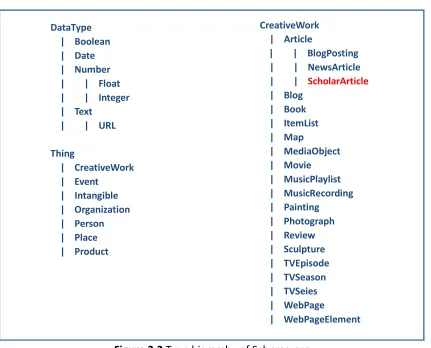
Schema.org maintains a collection of markup vocabularies, where schemas are a set of “types”, each associated with a set of properties. Figure 2.2 illustrates the type hierarchy.
Figure 2.2 Type hierarchy of Schema.org
The data model used by Schema.org is generic, extensible [70] and easily mapped into RDF Schema33.
(1) Types are arranged in a multiple inheritance hierarchy where each type may be a sub class of multiple types.
(2)Each property may have one or more types as its domains, while this property may be used for instances of any of these types. Each
property may have one or more types as its range, while value(s) of this
33
http://www.w3.org/TR/rdf-schema/
DataType | Boolean | Date | Number | | Float | | Integer | Text
| | URL
Thing
| CreativeWork | Event
| Intangible | Organization | Person | Place | Product
CreativeWork | Article
| | BlogPosting | | NewsArticle | | ScholarArticle
| Blog | Book | ItemList | Map
| MediaObject | Movie | MusicPlaylist | MusicRecording | Painting
| Photograph | Review | Sculpture | TVEpisode | TVSeason | TVSeies | WebPage
Chapter 2 State of the Art
property should be instances of at least one of these types [71]. Table 2.3 presents an example of property of “Scholarly Article” defined in Schema.org. For the full description of Scholarly Article properties, please refer to [72].
Hierarchy Property
Properties from “Thing” description, image, name, url Properties from
“CreativeWork”
about, aggregateRating, audio, author, awards, contentLocation, contentRating, datePublished, editor, encodings, genre, headline, inLanguage, interactionCount, isFamilyFriendly, keywords, offers, publisher, reviews, video
Properties from “Article” articleBody, articleSection
Table 2.3 Property of “Scholarly Article” defined in Schema.org
2.1.5 Google Scholar
Google Scholar34 is the most commonly used search engine in today's field of science. It helps users find academic literature, including journal articles, dissertations, books, preprints, abstracts and technical reports. The content covers the natural sciences, humanities, social sciences and other disciplines. Google Scholar’s literature rank is in strict accordance with the article’s academic value, the reference factors, which includes the authoritative of literature, authors and publishers and the reference frequency. Generally, the first choice of a reader who uses network resources to fulfill his or her information needs is to use search engines, such as Google, to do large-scale searches, followed by the use of specialized academic databases and finally the reading of academic journals. This sequence has formed a social habit. Therefore, more and more publishers and authors have begun to focus on Google Scholar's metadata schema in order to make their article more accurately indexed
34
Chapter 2 State of the Art
by Google Scholar.
The following table is an official Google Scholar metadata tagging schema. It also supports Eprints35, Digital Commons36, DSpace37 and many other formats.
Meta tag name Description
title The paper title
date The official publication date
online_date The online publication date
author An author name. Multiple occurrencees of this tag
are allowed
pdf_url The full paper
conference_title The conference name or the proceedings title (for
conference and workshop papers)
journal_title The journal name (for journal papers)
volume The volume (for journal papers)
issue The issue number (for journal papers)
issn The journal ISSN (for journal papers)
isbn ISBN number
firstpage The first page of the article
lastpage The last page of the article
dissertation_institution The university name (for master's and Ph.D. thesis)
technical_report_institution The institution name (for technical reports)
technical_report_number The technical report number (for technical reports)
Table 2.4 Google Scholar Metadata Schema [73]
2.2 Scientific Discourse Representation
This subchapter presents a succinct review of existing dominant scientific publication representation models and projects. Conceptually, all of them share a similar representation form with the features of coarse-grained rhetorical structure, fine-grained rhetorical structure,
Chapter 2 State of the Art
relations, domain knowledge and shallow metadata support [24]. Specifically, the ScholOnto (Scholarly Ontologies) project [74] and the SWAN (Semantic Web Applications in Neuromedicine)38 project focuses more on modeling the argumentation. However, in this thesis, we are more interested in some of the approaches to modeling the rhetorical structure of publications, i.e. Harmsze Model, ABCED and SALT.
2.2.1 Harmsze Model
In 2000, Harmsze from the University of Amsterdam proposed a modularized structure to represent electronic papers on experimental sciences in her doctoral dissertation [75]. This is one of the first comprehensive models of rhetorical structure representation. Harmsze’s model comprises of two parts: the Modules and the Links.
Modules
A module is a self-contained functional information unit. Its composition does not depend on its length but is decided by the consistency and integrity of the information it contains. Similarly, the relationship between the modules can not only be achieved through the links but also through the complex modules. Here we can make an analogy: the equivalent of a basic module is an atomic entity, and they can be used to form more complex modules, which is the molecular entity.
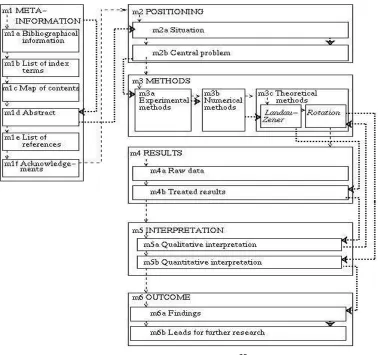
At the same time, two different types of complex modules need to be distinguished: compound module and cluster module. As shown in Figure 2.3, in a compound module, the relevant module will set into a higher level module. For example: "Experimental methods" is consisted of a number of lower level modules. The cluster module is a
38
Chapter 2 State of the Art
generalization of concepts. Module "Raw Data" is a cluster module. The division of modules is mainly based on the characteristics of the information and the conceptual function, which include Positioning, Methods, Results, Interpretation, Outcome and Meta-Information.
Figure 2.3 HarmszeModel39
Links
In the traditional hypertext links, the relationship between the reader’s linked objects is often unclear. Readers can only judge a standard hyperlink with impressions. For example, we know that a blue font and underlined text often provides us with a hyperlink.
In the Harmsze model, an author may define two categories of
39
Chapter 2 State of the Art
relationship, i.e.
(1) The organizational relations: Hierarchical, Proximity-based, Range-based, Administrative, Sequential and Representational.
(2) The scientific discourse relations: communicative function and content relations.
2.2.2 ABCDE Format
ABCDE Format is proposed by De Waard et al. in 2006, which provides an open standard and widely reusable format for creating rich semantic structures for the articles during writing. The "ABCDE" is an abbreviation which represents the following terms: Annotation, Background, Contribution, Discussion and Entities [76]. Using this format, people can easily mark papers semantically, especially in the LaTeX editing environment. To be specific,
Annotation: Every article contains a set of metadata which can be used for retrieval, classification and so on. The most familiar one for us is the Dublin Core standard, which is also widely used in library management. For example, the article title, creator, identifier, date etc. They tend to be a part of the text of the article, but can also be relatively independent.
Chapter 2 State of the Art
and the subsequent conclusions etc.
Discussion: This part is mainly used to evaluate the work described in the article. It allows the article to be compared to similar research articles and discusses the impact of this institute and the direction of the research.
Entities: throughout the whole text we will find that a large number of entities exist in the content of any article. The clearest examples of an entity are the references, as well as the names mentioned in the article, the project's website and so on. These entities are often found in footnotes, endnotes or references modalities. Usually, we can convert these entities to RDF format through data mining algorithms. In these cases, the RDF can include entity name, entity URI and the type of entity (such as reference, person or project).
De Waard et al. believe that any article is composed by the five ABCDE elements described above. Here, abstract is considered as a stress sentence. This set of sentences should come from the content that is covered by BCD. We can provide readers with the summary and general ideas of articles through the way of mark.
Meanwhile, De Waard et al. also conducted a study of semantic annotation. They developed an ABCDE structured style file and successfully applied it to Springer's LaTeX template (llncs.cls)40.
2.2.3 SALT
SALT (Semantically Annotated LaTeX)41 is developed by the Digital Enterprise Research Institute (DERI)42. It provides a semantic authoring
40
http://www.springer.com/computer/lncs
41
http://salt.semanticauthoring.org/
42
Chapter 2 State of the Art
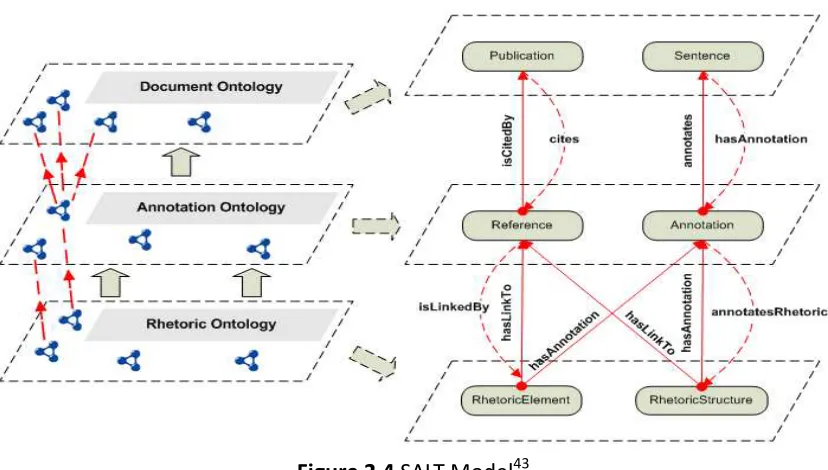
framework which aims to enrich scientific publications with semantic annotations and could be used during the authoring and post-publication process. It consists of three ontologies, i.e. Document Ontology, Rhetorical Ontology and Annotation Ontology [77], which deal with annotating linear structure, rhetorical structure and metadata of the document respectively.
Figure 2.4 SALT Model43
In Figure 2.4, we can also see the relations defined in the SALT model. For example, in Rhetoric Ontology, "Rhetoric Element" and "Rhetoric Structure" exists, and the "Rhetoric Element" has a "hasLinkTo" relationship with the "Reference" found within Annotation Ontology. It also has a "hasAnnotation" relationship with the "Annotation" in Annotation Ontology. Similarly, "Reference" has a "isCitedBy" relationship with the "Publication" found in the Document Ontology; "Annotation" has a "annotates" relationship with the "Sentence" also found in Document Ontology. The various relationships between the definition achieve the three links of ontology.
43
Chapter 2 State of the Art
2.3 Scientific Publishing
In this section, we introduce four online publishing platforms which represent significant development and change. "Article of the Future" is dedicated to breaking the traditional linear reading of the paper structure. PLoS ONE focuses on "Publish first, Judge later". Nature Precedings create a pre-publication of the "post" platform to ensure the real author gets a wider range of comments and feedback before publishing the paper. The Liquid Publication Project mainly investigates the life cycle management of Scientific Knowledge Objects.
2.3.1 Article of the Future
From the first issue in 2010, the journal of Cell44 began to launch a new format for online presentation of all research articles. The "Article of the Future" initiative aims to evolve the concept of a scientific publication in step with the development of new technologies and functionalities.
Figure 2.5 The "Data" of an Article with Presentation by "Article of Future" Format45
44
Cell: http://www.cell.com 45
Chapter 2 State of the Art
The Cell journal aims to develop an online format which breaks from the restraints of traditional linear structured paper and allows individual readers to create a personalized path through the discourse's content based on one's own interests or needs. "Article of the Future" proposed a new approach to organizing the traditional sections of the article by moving away from a strictly linear structure, required by print, towards a more integrated and linked structure. Tabbed and hyperlinked navigation through the Summary, Introduction, Results, Discussion, Experimental Procedures, Data, References, Supplemental Information, Related Information and Comments allows subject-area researchers to quickly access in-depth information on a specific experiment result, while providing more general readers a choice to gain the conceptual insights without being overwhelmed by additional details.
Chapter 2 State of the Art
2.3.2 PLoS ONE
PLoS ONE46 is an open-access, peer-reviewed, online journal published by Public Library of Science (PLoS)47, which is the most prominent publisher in the open-access movement. PLoS ONE covers all disciplines within science and medicine, and the key idea of it is to “Publish first, judge later” [78]. This journal is built in a conceptually different way in comparison to traditional peer-reviewed scientific publishing.
Figure 2.6 PLoS ONE Platform48
Every paper submitted to PLoS ONE is reviewed by at least one editorial board member. The decision of acceptance or rejection is not assessed by the perceived importance and significance of a paper, instead, PLoS ONE only evaluates whether technical methods were conducted rigorously. It leaves future verification to the community-based peer review, following its online publication, which involves annotation, discussion and rating.
The PLoS ONE online platform provides features such as Online
46
http://www.plosone.org/
47
http://www.plos.org/ 48
Chapter 2 State of the Art
Discussions, Ratings, Trackbacks49, Open-access50, Fast publication times, Post-publication tools, indicating quality and impact, Community-based dialogue on articles and Worldwide media coverage, etc.
2.3.3 Nature Precedings
Nature Precedings51 is a permanent, citable, open-access repository for pre-publication research and preliminary findings in the fields of biomedical sciences, chemistry and earth sciences. Copyrights of publications submitted to Nature Precedings are retained by authors. It is an express channel for publishing findings at its beginning stage to distribute preliminary results, seek community opinions and prove originalities of findings. It complements the traditional review models and allows easier access to the content for citing, sharing and archiving. [79]. (Figure 2.7)
Figure 2.7 Nature Precedings52
49
For example, if you link to a PLoS ONE article in your post, that article will display a link back to your blog post.
50
Freely accessible online, authors retain copyright
51
http://precedings.nature.com/ 52
Chapter 2 State of the Art
2.3.4 Liquid Publications
The Liquid Publication (LiquidPub) European Project53 proposes a paradigm shift in the way scientific knowledge is created, disseminated, evaluated and maintained. This shift is enabled by the notion of Liquid
Publications [80] which are evolutionary, collaborative and composable
scientific contributions [81]. In 2009, Prof. Giunchiglia et al. proposed a formal model of Scientific Knowledge Object (SKO) and its associated structures [ 82 ]. Being a theoretical foundation of LiquidPub, the approach they presented is based on three organization levels (SKOnode, SKO and SKOset), three states (Gas, Liquid, and Solid), and four layers (File, Semantic, Serialization and Presentation, see Figure 2.8) that regulate the metadata and operations allowed at each level [83].
Figure 2.8 Four-layer Structure of SKO54
The term of Liquid borrows the concept of a physical liquid. As is known, the physical state of an object includes gas, liquid and solid. We can metaphor the generated knowledge and the text in the process of scientific publishing in the same way. We believe that the article's argumentations, research methods and research objectives are not quite clear in the process of our envisioning a paper, and we consider this
53
http://liquidpub.org/
54
Chapter 2 State of the Art
period as gas. Similarly, when we start drafting a document or developing a project or a software product, we will first have a variety of drafts and then there will be a series of test versions. The entire article or products are constantly upgraded and improved before issuing. We call this phase liquid. After the articles are published, we cannot re-modify the article content. At this time, copyrights will be transferred to the publishers from the author. We call this the state of solid.
Chapter 4 SKO Types
Chapter 3
SKO Types
SKO Types is an entity-oriented theory for representing and linking Scientific Knowledge Objects by defining entities, relationships between entities, and attributes of each entity in the scientific domain. In SKO management, SKO Types serve as the basis for relating entities, entity components, aggregated entities, relationships and attributes to various tasks, e.g. linked entity, rhetorical structuring, strategic reading, semantic annotating, etc., that users may perform when consulting ubiquitous SKOs.
This chapter is organized as follows:
Section 3.1 defines the entity types used in SKO Types and elaborates on their nature and scope, including SKO, SKO Set, SKO Node, and SKO-related entities such as Researcher, Conference, Institution, and
Project.
Section 3.2 delineates the relationships that operate between entities (or specific instances of entities), such as Syntactic Relationships,
Content Relationships, Rhetorical Relationships, Part/Whole
Relationships and Entity Relationships.
Chapter 4 SKO Types
Section 3.4 maps SKO Types to some prominent bibliographic metadata standards that we intend to support and interoperate with.
3.1 SKO, SKO Set and SKO Node
The entity types that have been defined for SKO Types represent the key objects of bibliographically related data in a scientific domain, including SKO, SKO Set, SKO Node, and SKO-related entities.
3.1.1 SKO
An SKO, an abbreviation for Scientific Knowledge Object, is a type of entity of intellectual and artistic endeavour, which is defined as:
SKO = < T, {A}, {R}, {S} > where
• T is one of the entity types in an SKO hierarchy.
• {A} is a non-empty set of attributes A, while there are several mandatory attributes, e.g. URI.
• {R} is a set of relationships R.
Chapter 4 SKO Types
Figure 3.1 Entity Types in anSKO Hierarchy
Figure 3.1 illustrates the entity types in an SKO hierarchy. SKO, as an entity type, has been divided into two subtypes, i.e. MonoSKO and
MultiSKO. MonoSKO comprises Paper and Monograph, while MultiSKO
consists of Journal Issue, Proceedings and Article Collections. Furthermore, Paper contains subtypes of Article, TechReport, Comment, and Review. Monograph includes Book, Booklet and Thesis.
In this hierarchy tree, the father entities are more generic than the children entities. In addition, the lattice makes the children nodes inherit all the attributes, relationships and services that their ancestors have. Figure 3.2 and Figure 3.3 show a Review and a Thesis as instances of SKOs.
Article
SKO
MonoSKO
MultiSKO
Thesis Booklet
Book Review Comment TechReport Paper
Chapter 4 SKO Types
Examples
• Review
Figure 3.2 Review55
• Thesis
Figure 3.3 Thesis56
3.1.2 SKO Set
The SKO Types model permits us to represent aggregated SKOs as a whole, i.e. SKOset, and the component SKO as an integral unit, i.e. SKOnodes, in the same way as we present SKOs.
From a logical perspective, SKO sets and SKO nodes share the same characteristics as SKOs. For example, they express scientific knowledge, and they also have subject, author/editor, publisher, etc.
55
http://www.semantic-web-journal.net/content/s-match-open-source-framework-m atching-lightweight-ontologies
56
Chapter 4 SKO Types
An SKO set is a set of SKOs whose attributes answer a query, and it is defined as:
SKO Set = < N, {T}, Q, {R}, {S} > where
• N is the name of the SKO set.
• {T} is a set of entity types that the elements in this SKO set must belong to.
• Q is the query Q = < {A} > where {A} is a set of attributes.
• {R} is a set of relationships R.
• {S} is a set of services S.
Figure 3.4 SKO set types and subtypes
As shown in Figure 3.4, we define three types of SKOsets at the first level, i.e. Liquid Journal57, Conference Call for Papers, and Simple Query, where Simple Query can be done using Topics or Categories.
Figure 3.5 and Figure 3.6 illustrate a SimpleQuery and a Conference
Call for Papers as instances of SKOsets.
57
A research area of Liquid Publications European Project:
http://project.liquidpub.org/research-areas/liquid-journal
Categories SKOSet
Liquid Journal
Conference Call for Papers
SimpleQuery
Chapter 4 SKO Types
Examples:
• SimpleQuery
Figure 3.5 SimpleQuery58
• Conference call for papers
Figure 3.6 Conference call for papers59
58
http://scholar.google.com/scholar?hl=en&q=semantic+matching&as_sdt=1%2C5 &as_ylo=2004&as_vis=0
59
Chapter 4 SKO Types
3.1.3 SKO Node
An SKO node is a component entity encapsulated in SKOs that semantically represent scientific knowledge as an integral unit.
An SKO node is defined as:
SKO node = < N, T, {A}, {R}, {S} > where
• N is the name of the SKO node.
• T is the type of SKO that the SKOnode belongs to.
• {A} is a set of attributes.
• {R} is a set of relationships R.
• {S} is a set of services S.
Figure 3.7 describes the types of SKO nodes. The first level includes
TextChunk, Video, Audio and Data. TextChunk can be further divided into
two groups, namely Syntactic Partition and Rhetorical Partition. Syntactic Partition comprises Chapter, Section, Paragraph, Sentence, Figure,
Formula and Table. Rhetorical Partition comprises State of the Art,
Problem Statement, Solution, Discussion, Methods, Material, Results and
Evaluation.
An SKO node is the smallest object in SKO Types that:
• Has a unique identifier. • Was created independently. • Can be cited independently. • Can be reused autonomously.
Chapter 4 SKO Types
Figure 3.7 SKO node types and subtypes
Figure 3.8 and Figure 3.9 give two SKOnode instances of Abstract
and Video.
SKOnode
TextChunk
Video
Audio
Data
Problem Statement
Solution State of the Art
Table
Discussion Methods
Material Formula Figure Sentence
Section Paragraph Chapter
Syntactic Partition
Rhetorical Partition
Chapter 4 SKO Types
Examples:
• Abstract
Figure 3.8 Abstract60
• Video
Figure 3.9 Video61
3.1.4 SKO-related Entites
In the scientific universe, there are several other entities which are tightly related to SKOs, SKOsets, or SKOnodes, that are responsible for the production, dissemination, or custodianship of knowledge such as
Researcher, Conference, Institution and Project.
Note that the full definitions of these SKO-related entities are not the main scope of this thesis, although such entities may appear throughout this thesis.
60
http://www.springerlink.com/content/vhu9mfhql6dveu94/fulltext.pdf 61
Chapter 4 SKO Types
Generally speaking, an entity can be defined as: Entity= < T, {A}>
where
• T is one of the entity types.
• {A} is a set of attributes A.
Actually, Researcher is a role of Person, Conference and Project are subtypes of Event, while Institution is a subtype of Organization. Full specifications should refer to the tech report of Entitypedia Project62 conducted by the KnowDive group63.
3.2 Relationships
Relationships abound in the scientific world. These may be educational, economic, social, legal, and so on. The relationships addressed herein are restricted to those involved in the representation and management of SKOs, including:
• Syntactic relationships: text structure, hyperlink.
• Content relationships: equivalent, derivative, descriptive, sequential, accompanying, shared characteristic.
• Whole/part relationships: whole-whole, whole-part, part-whole, part-part.
• Rhetorical relationships: state of the art, problem statement, solution, discussion, material, methods, results, evaluation.
• Entity relationships: relationships between SKO and SKO-related
62
Entitypedia: http://entitypedia.org/
63
Chapter 4 SKO Types
entities.
Note that these five categories are not necessarily mutually exclusive, and we have endeavoured to attain and keep alignment with other relevant terminology systems such as FRBR64, SPAR65, etc. In SKO Types, we view a relationship as a particular kind of attribute, i.e. a relational attribute. In this subchapter, we describe these relationships accompanying sets of concrete instances, while the formal definition of (relational) attributes are proposed in Chapter 3.3.
3.2.1 Syntactic Relationships
• Text Structure relationships: these capture the linear document structure. For example (Figure 3.10), a paper may consist of some sections, and a section may have subsections, paragraphs, tables, algorithms or sentences. We use several relational attributes to describe this kind of syntactic structure relationship, such as hasTextChunk, hasChapter, hasSection, hasParagraph, hasSentence, hasStartPointer, hasEndPointer and so on.
Example:
Figure 3.10 Syntactic Relationships
64
Functional Requirements for Bibliographic Records:
http://www.ifla.org/publications/functional-requirements-for-bibliographic-records
65
The Semantic Publishing and Referencing Ontologies:
Chapter 4 SKO Types
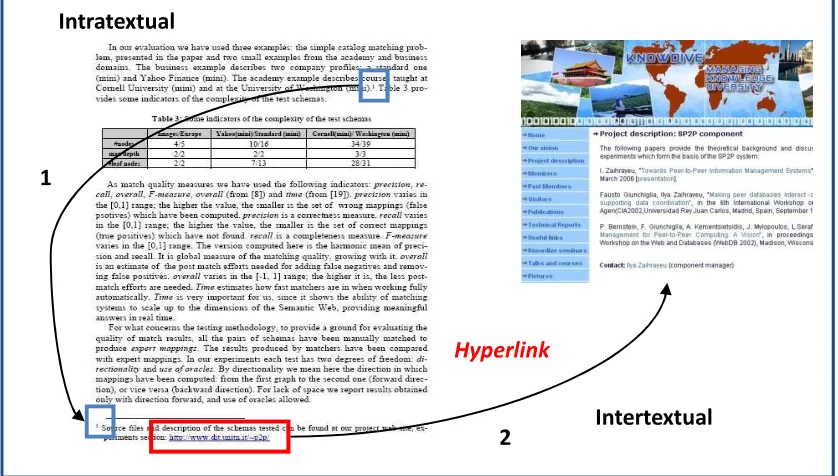
• Hyperlink Relationships: there are two types of hyperlinks, i.e. intratextual and intertextual. As the names imply, an intratextual hyperlink connects the source and target in the same SKO/ SKOset (Link1, Figure 3.11), while an intertextual hyperlink is a link between different SKOs/SKOsets/SKOnodes (Link2, Figure 3.11).
Example:
Figure 3.11 Hyperlink Relationships
3.2.2 Content relationships
The definitions of content relationships in SKO Types are derived from Tillett’s dissertation (1987) [84], while the explanations are expressed in the context of the SKO Model introduced in Chapter 2.
• Equivalent Relationships, which hold between entities having (1) same data
(2) same semantics
Hyperlink
Intertextual Intratextual
1
Chapter 4 SKO Types
(3) same serialization (4) different presentations
Example:
Figure 3.12 Equivalent Relationship
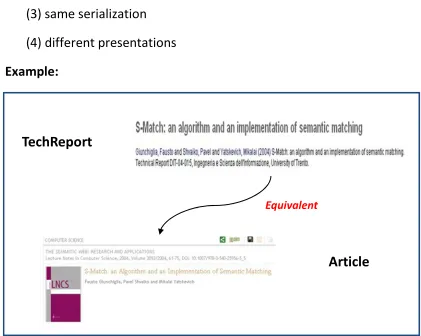
When submitting an article to a conference or a journal, we always formulate the manuscript as a tech report for internal or wider discussion, distribution and citation. This tech report may have the same data, the same semantics, and even the same serialization as a final publication in a conference or a journal, while it allows them having differences such as typesetting format or bibliographic metadata (e.g. publication date, publisher, etc.). In Figure 3.12, the DISI tech report “S-Match: an algorithm and an implementation of semantic matching” is
Equivalent to a conference paper published in ESWC 2004 with the same
title.
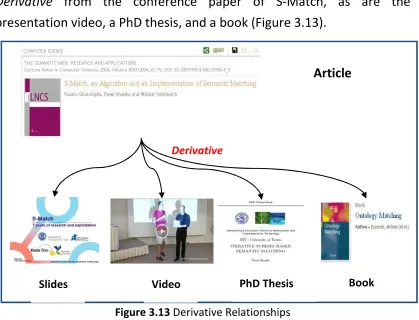
• Derivative Relationships. These hold between entities having the (1) same data
TechReport
Article
![Figure 2.1 A Schematic Representation of the Hierarchy of Elements in the LOM Data Model [69]](https://thumb-us.123doks.com/thumbv2/123dok_us/788293.2074671/36.595.96.509.346.610/figure-schematic-representation-hierarchy-elements-lom-data-model.webp)