PhD Dissertation
International Doctorate School in Information and Communication Technologies
DIT - University of Trento
A Semi-supervised Approach for Improving
Search, Navigation and Data Quality in
Autonomous Digital Libraries
Mikalai Krapivin
Advisor:
Prof. Maurizio Marchese
Universit`a degli Studi di Trento
Abstract
The current rapid uptake of Autonomous Digital Libraries [56] (both in scholarly and generalist domains) has driven the need for automated pro-cedures for extracting, processing and representing the digital information contained in these digital repositories. Concurrently, the development of Web 2.0 technologies and applications has provided new opportunities and challenges for web-based information system and user interactions: novel features of social interactions as well as new usability and visualization model are having an impact on how people search, navigate and rank dig-ital objects (being multimedia content like music or movies or - as in the case of Autonomous Digital Libraries - digital publications): as an example a simple quick glance at a user-based “cloud of tags” for a given Journal may now provide us a lot of information about its content and/or the way that the specific Journal is perceived by the people reading it.
In this thesis we have tackled two open research dimension in state-of-the-art Autonomous Digital Libraries, namely:
1. Automated key-phrases/tags extraction from digital scientific contri-butions (papers): the ever increasing dimensionality of modern ADLs does not permit realistic manual documents processing and needs effi-cient and high quality methods for automatic or semi-automatic key-phrases extractions.
number of objects present in modern ADL.
Moreover, we have implemented a prototype for a Digital Library in-terface capable to integrate the tools developed on the base of the results obtained in the above research directions. The prototype supports the user: (1) in the search of documents related to a topic - using the novel semi-automatic key-phrases extractions techniques proposed in this work; and (2) in the navigation and identification of “relevant” documents for a given topic based on a number of user-selectable relevance metrics.
The first challenge we met in our work has been the lack of large, high quality and publicly available document datasets containing both the full text and human (experts) assigned key-phrases to be used for analytical assessment. Thus we constructed one from available public content sources and curated metadata repositories. Our dataset (named in the following as Trento Computer Science (TCS) dataset) consists in a subset of 2000 sci-entific papers published within 2003 and 2006 in Computer Science domain in the ACM Digital Library. The TCS dataset consists of the full text of papers, curated metadata (authors, title, affiliations, references etc.) and human (both authors and curators) assigned key-phrases. The original pa-per type (typically PDF, PS or LATEX) has been processed and transformed
into a textual format with the support of commercial pdf-to-text transfor-mations tool and refined with the support of maximum entropy machine learning in order to improve the final quality of the full-texts.
For the semi-supervised key-phrases/tags extraction task we have com-pared several Machine Learning techniques - namely, Random Forest, Sup-port Vector Machines a novel Fast Local Kernel SVM and the Naive Bayes learning-based system KEA on the same TCS dataset. In particular, we have performed a number of experiments and explored in details the ef-fect of including in the chosen feature sets linguistic and domain specific knowledge. In our experiments, Random Forest has been identified as the
most precise method outperforming KEA (used as baseline for key-phrases extraction) by 36% when using a novel feature sets including linguistic and domain specific knowledge. Moreover, compared with the other Machine Learning techniques, Random Forest is the best trade-off between accuracy and computational speed.
The second task taken on by this thesis navigation and ranking -relates to the large dimensionality of current ADL. In fact, in the presence of a huge quantity of documents connected to a specific topic, it is hard to navigate and find “interesting” contributions. The challenge here is to be able to identify the most important set of papers in a specific topic or for a particular author. A number of used metrics are available for this task, namely citation count for papers and Hirsch-index for authors. We have applied them as well as novel metrics based on the PageRank metric, named PaperRank, Focused PaperRank and PaperRank hindex, that captures -where data is available - more information present in complete citation graphs. As part of our analysis, we have developed methods and tools for qualitatively and quantitatively analyzing metrics that evaluate content and people. We have used them to explore the differences between various metrics as well as to understand in more details what do they measure. We also believe, that these methods and tools could successfully be used to compare rankings in different domains (search engine, review processes, etc.). We have carried out an extensive investigation of the various ranking metrics on the dataset of over 266,000 scientific papers, and related citation graphs. We discovered that the difference in ranking results is indeed very significant for the different metrics and investigated in details the reasons of this difference.
Although initially this research has started as an independent line of research, it has found a significant number of important interactions with
the European FET-Open project LiquidPub 1. A specific prototype of plug-in used for tagged search and ranking has been incorporated in the LiquidPub portal2 that allows the tagged search and ranking over the whole collection of 266,000 papers.
Keywords:
Page Rank based Indexes, Automated Keyphrases Extraction, Autonomous Digital Libraries, Standard Dataset Preparation.
1Grant number 213360, acronym LiquidPublication under THEME 3: FP7-ICT-2007-C FET OPEN. 2http://demo.liquidpub.org:8081/ResevalGUI/
Acknowledgments
I would like to express my gratitude to people who was supporting me, helping me and making me so sure I will do it and defend my PhD. First of all I would like to thank Professor Maurizio Marchese for continuous help and support during all my thesis steps, starting from comprehensive exam and finishing with the structure of the final thesis. I want to thank Professor Marchese for giving me support in different life situations, for helping me to buy a car, translating from Italian and many other things, for his patience and for encouraging me.
My appreciate to Professor Fabio Casati, Professor Fausto Giunchiglia, Professor Enrico Blanzieri, Professor Raymond Ng, Mr. Andrei Yad-rantsau, Mr. Nicola Segata, Mr. Aliaksander Autaeu for many useful discussions.
I want to kindly thank my good friend Viktor Pravdin for discussing many non work related situations, drinking wine and successful fishing together!
Huge thanks to my wife Tania and my brother Viktor who have been inspiring me all time since I left my home country. Also great thanks to all russian language speaking people in Trento, specially Uladzimir Kharkevich (my ”twin brother”), Andrej Somov, Ivan Minakov, Ivan Tankoev, Max Khadkevich, Alexander Birukou, Volha Bryl and Aliaksandr Autaeu for fruitful and interesting work together.
Contributions and publications
This Thesis has been done in collaboration with various researchers, in par-ticular all papers are written with participation of Prof. Maurizio March-ese, part about scientometric research impact indicators is done in tight collaboration with Ptof. Fabio Casati. The text mining chapters are com-plete with help of Andrei Yadrantsau, Aliaksander Autayeu, Prof. Enrico Blanzieri and Dr. Nicola Segata. And in general this work is inspired by various discussions with Prof. Lee Giles and Prof. Fausto Giunchiglia.
Below we list major finding and innovative aspects of the present Thesis. First, regarding to the data mining for Autonomous Digital Libraries:
1. Innovative method of combination of Machine Learning (in particular Random Forrest [8], Support Vector Machines [4], FaLK-SVM [80, 79]) with Natural Language Processing techniques: POS (Part-of-Speech) tagging [94] and parsing dependencies [67] is proposed.
2. Large Dataset for Keyphrases Extraction is prepared [47] and freely shared in my web-page3. This dataset consist of 2000 of scientific pa-pers with fulltexts and according meta data. We believe it may set a ground for the future comparison of different techniques for keyphrases extraction. Since each paper in the dataset is converted from PDF, texts contained a lot of “garbage”: pieces of LATEXformulae, pieces of
tables, figures etc. We have developed and implemented text refine-ment procedure based on Maximum Entropy [74, 73] Machine Learn-ing method. It showed 97% of precision in cleanLearn-ing of garbage.
3. 50% improvement of precision recall and F-measure [97] comparing
3
with KEA [102] baseline method.
For ranking of objects in Autonomous Digital Libraries part we can enumerate the following innovative aspects:
1. We have proposed adaptation of a wellknown PageRank algorithm to the problem of ranking of items in scientific citations graphs. Such adaptation called PaperRank is simpler for computation and easy for embedding into a Digital Library.
2. Tradeoff between PageRank and Citation Count named Focused Page Rank has been proposed for scientific citing.
3. We have proposed how to compute analogue of popular author related metrics – Hirsch Index based on PageRank, or PageRankHircsh.
4. New method of comparison between several ranking schemas called divergence has been proposed.
5. New experimental visualization techniques have been created specially to visualize divergence of several ranking schemas. We apply it to put hundreds thousands of ranked scientific papers in one plot.
6. The visual and theoretical explanations of differences between Cita-tion Count and Paper Rank are done.
Part of the material of the Thesis is published as papers in some con-ferences, workshops and journals, namely:
Journal papers
1) [53] Mikalai Krapivin and Maurizio Marchese and Fabio Casati, Explor-ing and UnderstandExplor-ing Citation-based Scientific Metrics, Advances in Complex Systems (ACS) Journal 2010, accepted for publication Dec 14, 2009.
Conference papers
1) [49] Mikalai Krapivin, Aliaksandr Autayeu, Maurizio Marchese, Enrico Blanzieri and Nicola Segata, Keyphrases Extraction from Scientific Doc-uments: Improving Machine Learning Approaches with Natural Lan-guage Processing, ICADL 2010, Gold Coast, Australia.
2) [52] Mikalai Krapivin and Maurizio Marchese and Fabio Casati, Explor-ing and UnderstandExplor-ing Scientific Metrics in Citation Networks, COM-PLEX 2009, ps. 1550–1563, 4, Shanghai, China.
3) [50] Mikalai Krapivin and Maurizio Marchese, Focused Page Rank in Scientific Papers Ranking, International Conference on Asian Digital libraries 2008, ps. 144–153, 5, Bali, Indonesia.
4) [45] M. Krapivin and M. Marchese and A. Yadrantsau and Yanchun Liang”, Automated key-phrases extraction from scientific papers using domain and linguistic knowledge, International Conference on Digital Information Management. ICDIM 2008, ps. 105-112, London, GB.
Workshop papers
1) [46] Mikalai Krapivin,Focused Page Rank Application for Scientific Pa-pers Ranking in Digital Libraries6, European Conference on Digital Li-braries/Very Large Digital Libraries Workshop 2008, Aarhus, Denmark.
4http://dx.doi.org/10.1007/978-3-642-02469-6_35 5http://dx.doi.org/10.1007/978-3-540-89533-6_15
Technical reports, DISI University of Trento
1) [51] Mikalai Krapivin, Maurizio Marchese, Fabio Casati, Exploring and Understanding Citation-based Scientific Metrics, Technical Report DISI-08-022, DISI, University of Trento, Italy, May 20087.
2) [48] Mikalai Krapivin and Aliaksandr Autayeu and Maurizio Marchese and Enrico Blanzieri and Nicola Segata, Improving Machine Learning Approaches for Keyphrases Extraction from Scientific Documents with Natural Language Knowledge, Technical Report DISI-10-003, DISI, Uni-versity of Trento, Italy, 20088.
3) [47] Mikalai Krapivin and Aliaksandr Autayeu and Maurizio Marchese,
Large Dataset for Keyphrases Extraction, Technical Report DISI-09-055, DISI, University of Trento, Italy, 20099.
Submitted papers
1) Mikalai Krapivin, Aliaksandr Autayeu, Maurizio Marchese, Enrico Blanzieri and Nicola Segata,Improving Machine Learning Approaches for Keyphrases Extraction from Scientific Documents with Natural Language Knowl-edge, TKDE “Knowledge and Data Engineering”http://www.computer. org/portal/web/tkde/topics Journal.
7
http://eprints.biblio.unitn.it/archive/00001426/01/022.pdf
8
http://eprints.biblio.unitn.it/
9
http://eprints.biblio.unitn.it/archive/00001671/01/disi09055-krapivin-autayeu-marchese. pdf
Contents
1 Introduction 1
1.1 Open Issues in
Modern Digital Libraries . . . 1 1.1.1 Examples of Autonomous
Digital Libraries . . . 3 1.2 Problem Statement . . . 5
1.2.1 Automatic and Semi-Automatic
Information Extraction in ADL . . . 5 1.2.2 Ranking metrics in ADL . . . 7 1.2.3 Availability of a large and high quality document
dataset . . . 10 1.3 Structure of the Thesis . . . 10
2 Trento Computer
Science (TCS) Dataset Preparation 13
2.1 Introduction . . . 14 2.2 Existing State-of-the-art
Datasets . . . 14 2.2.1 Problems with existing datasets . . . 16 2.2.2 Related work . . . 17 2.3 TCS
Dataset Description . . . 17
2.4 TCS
Dataset Preparation . . . 18
2.4.1 Garbage cleaning . . . 19
2.4.2 Correctness and completeness, preliminary evaluation 22 2.5 Discussion . . . 22
3 Automatic Keyphrases or Tags
Extracting in ADL 25
3.1 State-of-the-art . . . 26 3.2 TCS Dataset
Characterization and
Linguistic Processing . . . 32
3.2.1 TCS Dataset Characterization . . . 32 3.2.2 Linguistic Analysis
of Keyphrases . . . 34 3.2.3 Text processing . . . 35
3.3 Enhancing
Machine Learning with
Natural Language Processing . . . 38
3.3.1 Features selection . . . 38
3.3.2 Machine Learning Methods used for comparison . . 39 3.3.3 Training with unbalanced class cardinalities . . . . 41
3.3.4 Result assessment methodology . . . 42 3.4 Experimental evaluation . . . 43
3.4.1 Dataset splitting . . . 43
3.4.2 Experiment 1. Comparison of ML Methods Enhanced by NLP . . . 44
3.4.3 Experiment 2. Training set size analysis . . . 46
3.4.4 Experiment 3. NLP features analysis . . . 47
3.5 Comparative analysis of extracted keyphrases . . . 48
3.6 Discussion . . . 54
4 Ranking of Objects in ADL 57 4.1 State-of-the-art . . . 57
4.1.1 Scientometrics: state-of-the-art ranking metircs . . 57
4.1.2 PageRank metric: definition, computation and evo-lution . . . 61
4.2 Proposed Approach . . . 62
4.2.1 Data set description and data preprocessing . . . . 62
4.2.2 Page Rank description . . . 64
4.2.3 PageRank computation, simple cases . . . 66
4.2.4 Paper Rank: PageRank Metric in the Digital Library Context . . . 68
4.2.5 PR-Hirsch . . . 69
4.3 Exploring the Differences in Paper Matrics . . . 71
4.3.1 Plotting the difference between paper metrics . . . 71
4.3.2 Divergence . . . 75
4.3.3 Understanding the difference . . . 77
4.4 Focused PaperRank . . . 83
4.4.1 Focused Surfer . . . 84
4.4.2 Evaluation, comparison with normal PR . . . 85
4.4.3 Understanding the difference between PR and FPR 86 4.5 Exploring Author Metrics . . . 86
4.5.1 Plotting the difference between author metrics . . . 86
4.5.2 Divergence . . . 88
4.5.3 Divergence between other indexes . . . 89
4.6 Discussion . . . 90
5 ResEval+: Embedding Improved Search, Navigation and Rank in ADL 93 5.1 PageRank in ResEval tool . . . 93
5.2 ResEval+ tool . . . 96
6 Conclusion 103 6.1 Discussion of results . . . 103
6.2 Future work . . . 106
6.2.1 Data mining part . . . 106
6.2.2 Ranking . . . 106
Bibliography 107
List of Tables
2.1 POS taggers performance, precision per token, %. . . 21
3.1 Keyphrase candidates extracted by the heuristic. . . 36
3.2 Original and stemmed forms . . . 37
3.3 The adopted Feature Set, i ∈ [1..3] . . . 39
3.4 The results for SVM, FaLK-SVM, RF and KEA. Best values in bold . . . 45
3.5 KEA results for different threshold q values. The best pre-cision, recall and F-Measure among all q values are in bold. 45 3.6 Comparison between Found/Not found keyphrases counts for the best results. . . 49
3.7 Examples of top results for RF+NLP approach . . . 50
3.8 Examples of bad results for RF+NLP approach . . . 52
4.1 Comparison of citation count and random surfers count math-ematical expectation values for all papers in graph. . . 71
4.2 Mapping of band number to the actual value of CC or aver-age actual value for PR. . . 74
4.3 Deviation of papers around main diagonal. . . 74
4.4 Experimentally measured divergence for the set of ACM pa-pers. . . 77
4.5 Deviation of authors around main diagonal. . . 87
4.6 Divergence between P RH and H, n = 100. . . 88
4.7 Divergence for the different indexes in %, n= 100 (for
sim-plicity the Div() notation is omitted). . . . 89
List of Figures
2.1 PDF converted to plain text. . . 19
2.2 Cleaned plain text. . . 20
2.3 Garbage and overall detection precision for incremental train-ing. . . 21
3.1 Distributions of unique assigned keyphrases per document. 33
3.2 POS tags distributions for normal text and keyphrases. . . 35
3.3 Chunk types distributions for normal text and keyphrases. 36
3.4 Dependencies distribution for normal text and keyphrases. 37
3.5 F-Measure behavior with dataset size growth. . . 46
3.6 F-Measure behavior with feature count growth. . . 47
3.7 Comparison of KEA and ML+NLP distributions of correctly
extracted keyphrases per document. . . 51
3.8 Comparison of KEA and ML+NLP distributions of
incor-rectly extracted keyphrases per document. . . 51
4.1 Distribution of papers by Citation Count. . . 64
4.2 CC vs PR. X axis plots CC bands, Y axis plots PR mirror-banded by CC. The color corresponds to the number of pa-pers within a band. (For actual values of PR and CC for
each band see Table 4.2). . . 73
4.3 Average potential weight for all papers in a square The color in the Z-axis denotes the weight X axis plots CC bands, Y
axis plots PR mirror-banded by CC. . . 78 4.4 Average dispersed weight for all papers in a square The color
in the Z-axis denotes the weight X axis plots CC bands, Y
axis plots PR mirror-banded by CC. . . 79 4.5 “Gem” and “popular paper” (or “stone”) relative positions. 80 4.6 One of the “hidden gem” in the dataset, paper of E. Levien
and M. E. Maron (in the center). Arrows refer to incoming citations. The digits near the papers refer to the quantity
of outgoing links. . . 81 4.7 “Popular paper” (in the center): relatively highly cited but
not very well-ranked. . . 82 4.8 Diversity of PR a), FPR b) and Citation Count CC. White
and black points in the bottom-left corner does not mean absence of papers. This is a gray-scale of colored map, where the major quantity of papers has small number of CC, and since lie exactly in the bottom-left corner and it is nearly
the same for the both plots. . . 91 4.9 The gradient of Hirch and PRHirch in log scale. Author’s
density is plotted with colors: authors’ number goes from 1
to 149170 of authors per square. PR-Hirch has been rounded. 92
5.1 ResEval home. . . 94 5.2 ResEval tool: with several indexes computed for an author. 95 5.3 Enhanced ResEval tool: “advanced search” screen. The new
features are marked with red asterisk. . . 99 5.4 Enhanced ResEval tool: all new parts are marked with red
asterisk. . . 100
Chapter 1
Introduction
In this thesis we have addressed two open issues in state-of-the-art Au-tonomous Digital Libraries (ADL), namely:
1. Semi-supervised key-phrases/tags extraction from digital scientific con-tributions (papers)
2. Exploration of current metrics and proposal of novel metrics for rank-ing of digital objects in order to improve the navigation within a large number of objects present in modern ADL.
In this Chapter, we first present some current examples of of-the-art ADLs. Then we provide a first brief presentation of the problem state-ment considered in our work and a brief description on the main related open issues.
1.1
Open Issues in
Modern Digital Libraries
In the present time, as information storages getting cheaper and bigger, it seems that all humankind knowledge can be stored and preserved in digital format. A large number of various kind of so-called Digital Libraries are
1.1. OPEN ISSUES IN
MODERN DIGITAL LIBRARIES CHAPTER 1. INTRODUCTION
appearing, from well-established, reputed and commercial publishers like Elsevier and Springer to more web-based and community-driven endeavors like Google Scholar [17] Citeseer [30], CiteSeerX [31], Rexa [61].
This PhD Thesis is focused to some open problems present in the sec-ond type of Digital Libraries – also named Autonomous Digital Libraries and at present mainly devoted to scientific publishing. With the continu-ous growth of Autonomcontinu-ous Digital Libraries, the problem of management of autonomous knowledge accumulation, warehousing and dissemination is getting more and more actual. One of the most popular knowledge accu-mulation methods is web crawling [29, 20, 34]. In fact very popular public digital libraries like CiteseerX, GoogleScholar and Rexa have been created exactly in this way. Crawling is a fully automated process that may be en-hanced with heuristics. Crawler or “Spider” system starts from a number of “seeds” web sites and then it browses the “adjacent” sites following the links inside web-pages. When crawling millions of journal articles, book chapters, proceedings papers, Master and PhD thesis manuscripts, it is impossible to handle all the information processing (i.e. metadata extrac-tion) manually. That is one of the reasons, people started referring to these type of crawling-based Digital Libraries as “Autonomous Digital Li-braries”. “Autonomous” stands for absence (or limited presence) of human supervision.
More recently, a number of initiatives (LiquidPub [12], CiteULike [84], Menedeley [90]) are tackling the problem of curating a very large number of digital documents by exploiting the power of the large number of users in social networks, where the whole community of users is involved in the process. Although this kind of community-based improved documents can be partly handled manually, it also can use appropriate automatic procedures of information extraction and retrieval in order to facilitate search and navigation.
CHAPTER 1. INTRODUCTION
1.1. OPEN ISSUES IN MODERN DIGITAL LIBRARIES
1.1.1 Examples of Autonomous Digital Libraries
Let us briefly present few examples of real-world public scientific Au-tonomous Digital Libraries currently available in the Web.
The most comprehensive initiative at present is Google Scholar [17]: it possesses the largest collection of available internet papers making use of the outstanding performance and coverage of the Google crawler. After being collected by the crawler, papers are analyzed and indexed by the Google search engine. Google Scholar proposes an “user interface” where the user can perform free-text search, or use more advanced search criteria like by author, venue, date and others. The user can also choose to filter by subject area within the following major categories:
1. Biology, Life Sciences, and Environmental Science
2. Business, Administration, Finance, and Economics
3. Chemistry and Materials Science
4. Engineering, Computer Science, and Mathematics
5. Medicine, Pharmacology, and Veterinary Science
6. Physics, Astronomy, and Planetary Science
7. Social Sciences, Arts, and Humanities
1.1. OPEN ISSUES IN
MODERN DIGITAL LIBRARIES CHAPTER 1. INTRODUCTION
reports, communication notes. To the other end, incomplete information occurrence is possible, for instance Google Scholar cuts authors names, venues, descriptions or title of a paper when they are too long. Names and surnames of authors are not disambiguated in Scholar, so simple query like “John Smith” causes 2,560,000 of results in responce.
A second interesting initiative is CiteseerX [30, 31]: a public Scientific Digital Library initially developed at NEC Research Institute and later at Pennsylvania State University. Initially (under the name Citeseer) the site was focused on Computer Science domain. At present, CiteseerX is rapidly growing in other domains and includes contributions from Chem-istry (ChemSeer) and Physics. The coverage of CiteseerX is not so broad as GoogleScholar in terms of quantity of terabytes of information it owes, but it has a wider spectrum of services for users, like presence of bibtex files, relative papers, disambiguated search, extraction of information from tables and figures.
Another interesting ADL example is Rexa [61], a library which is smaller than Google Scholar or CiteseerX in coverage, but has a simple (and thus attractive) but powerful queries mechanism, including search by generic topics (not just few fixed broad categories like Google Scholar proposes). in this regard Rexa is similar to the idea proposed in this thesis.
CHAPTER 1. INTRODUCTION 1.2. PROBLEM STATEMENT
1.2
Problem Statement
1.2.1 Automatic and Semi-Automatic Information Extraction in ADL
How can we cope with the exponential increase in the number of digital documents and artifacts? How do we find the relevant and related doc-uments? These issues are central to current information age and have a central role in the Digital Libraries domain. Modern Digital Libraries need automated procedures of texts refinements, text meta information (like au-thorship, affiliations etc.) extraction, indexing and disambiguation.
Classifications have been used for centuries with the goal of cataloguing and searching large sets of objects. Before some document can be classified, a set of keywords/keyphrases must be defined or retrieved. There are a set of real-world digital libraries that use keyphrases to give a quick impression about a content, for instance free digital library Google Books http://
books.google.com/ has automatically extracted keyphrases in the quick book description. Commercial DL, Amazon http://www.amazon.com/, also provides keyphrases when searching a book. However the definition of natural language keyphrases is a time-consuming task for human experts and show its limitations when one tries to scale the process to the very large number of current digital objects.
in-1.2. PROBLEM STATEMENT CHAPTER 1. INTRODUCTION
formation extraction, classification and categorization processes, machine learning techniques are often used [80, 101, 70, 69].
More specifically, the domain of information extraction from scholarly papers contains two broad classes of tasks:
• recognition of structural information which is present inside the paper body (like authors, venues, title, abstract, text parts like sections, tables, figures, author assigned keyphrases (the ones that follow after word “Keywords:” from a new line in a header);
• extraction of information which is only implicitly present, such as generic keyphrases or tags, which are not explicitly assigned by the authors or editors.
First task is well-investigated and state-of-the-art extraction precision is very high (up to 97% obtained by two groups: Giles [37] with help of Sup-port Vector Machines and McCallum [62, 70] with help of Hidden Markov Models or Conditional Random Fields, on a benchmarking dataset taken from Rexa [61] scientific crawler). The second type of extraction (implicit information) is a very different problem and most of the approaches applied to the extraction of explicit information are not suited for it.
In this thesis work, we have focused on the second, more challenging task of extraction of implicit information. Specifically, we analyze the effect of the use of Natural Language Processing (NLP) techniques and the use of specific NLP-based heuristics on the improvement of current Machine Learning (ML) approaches.
CHAPTER 1. INTRODUCTION 1.2. PROBLEM STATEMENT
The present work extends and improves on a current state-of-the-art approaches and methods, namely:
1. We extend the use of state-of-the-art NLP tools [65] for the extraction, definition and use of linguistic-based features such as part of speech and syntactic relations extracted by dependency parsers [67].
2. We apply the proposed NLP-based approach to a number of differ-ent ML methods namely traditional SVM, innovative Local SVM and Random Forests.
3. We analyze in details the effect of different NLP features and dataset size on the overall quality of extracted keyphrases.
4. We perform a comparative analysis of the computed quality measures and obtained keyphrases with the various ML techniques (enhanced with NLP) and the popular Bayesian learning system KEA.
1.2.2 Ranking metrics in ADL
The “curse of dimensionality” causes another interesting problem. There are a lot of scientific domains, which hold many thousands of documents (for instance Google Scholar proposes 21,500 of papers for the “PageRank computation” query). How to recognize the most important papers? How to cut the long tail in this “crowd” of papers? This question leads to the problem of applying different ranking schemas to score research papers or other scientific contributions according to their impact.
The area of scientific metrics (metrics that assess the quality of scientific productions) is an emerging area of research aiming at the following two objectives:
1.2. PROBLEM STATEMENT CHAPTER 1. INTRODUCTION
studying a given field, as opposed to browsing a sea of papers; and
2. measuring individual contributions, to determine the impact of a sci-entist and to help screen and identify candidates for hiring or promo-tions in both industry Research and Development labs and academia.
Until only 20 years ago, the number of researchers and of conferences was relatively small, and it was relatively easy to assess papers and peo-ple by looking at papers published in international journals. With small numbers, the evaluation was essentially based on looking at the paper themselves. In terms of quantitative and measurable indexes, the number of publication was the key metric (if used at all). With the explosion of the number of researchers, journals, and conferences, the “number of pub-lications” metric progressively lost meaning. On the other hand, this same explosion increased the need for quantitative metrics at least to “filter the noise”. For example, a detailed, individual, qualitative analysis of hun-dreds of applications typically received today for any job postings becomes hard without quantitative measures for at least a significant preliminary filtering. Recently, the availability of online databases and Web crawling made it possible to introduce and compute indexes based on the number of citations of papers (citation count and its variations or aggregations, such as the impact factor and the h and g indexes [36]) to understand the im-pact of papers and scientists on the scientific community. More and more, Universities (including ours) are using these indexes as a way to filter or even decide how to fill positions by “plotting” candidates on charts based on several such indexes.
In this thesis, we have performed an experimental study of scientific metrics (and, in particular, citation-based metrics) with the goal of
CHAPTER 1. INTRODUCTION 1.2. PROBLEM STATEMENT
• understanding the reasons behind these differences. Besides “tradi-tional” metrics, we also present and discuss metrics for papers and authors inspired at how the significance of Web pages is computed (essentially by considering papers as web pages, citations as links, and applying a variation of PageRank). PageRank-based metrics are emerging as important complement to citation counts as they incor-porate the “weight” (the reputation or authority) of the citing paper and its density of citations (how many other papers it references) in the metric. In addition, the fact that they have been working very well for the Web suggests that they may be insightful for papers as well.
Besides the introduction of the PageRank-based index and its computation algorithm, the main contributions of this thesis lie:
• in the experimental analysis of metrics, so that people and developers in “ranking” papers and people are aware of how much choosing dif-ferent indexes results in different versions of the truth, and why this is the case, and
• in the identification of a generally applicable analysis method and of a set of indicators to assess the difference between ranking algorithms for papers and people.
We performed the analysis on a dataset consisting of over 266K ACM publications. The analysis was conducted by
1. computing the various citation-based indexes;
2. analyzing the extent of the differences in ranking of papers and people depending on the metric,
1.3. STRUCTURE OF THE THESIS CHAPTER 1. INTRODUCTION
4. using these exploration indexes to derive conclusions of when and why page rank and citation measures differ and what to make of this difference.
1.2.3 Availability of a large and high quality document dataset Although state-of-the-art approaches for keyphrases extraction is quite ex-tensive, it is very hard to compare different methods because:
• there are no publicly available standard data sets of proven quality;
• the majority of reported experiments refer to manually collected pa-pers/news with manually-assigned keyphrases by the same persons conducting the experiments (see Chapter 2);
• the size of a current data sets is limited and usually varies from 10 to 500 documents.
Since supervised or unsupervised Machine Learning is very set-dependent task, it would be very useful to have in this domain a publicly available dataset (like the TREC [16] dataset in the Information Retrieval commu-nity) in order to test the various approaches and compare their perfor-mances on the same data. In order to perform our experiments - both on key phrases extraction and ranking - we prepared a large and high quality dataset of scientific documents - all in computer science domain - including independent expert-assigned key phrases. We named this dataset Trento Computer Science (TCS) dataset and have publish it [47] for the use of the community.
1.3
Structure of the Thesis
CHAPTER 1. INTRODUCTION 1.3. STRUCTURE OF THE THESIS
1. Chapter 1 presents short introduction to the context and the problem statement of the thesis work.
2. Chapter 2 is devoted to the description of the definition and prepara-tion of a large and high quality data set of scientific documents to be used as the standard set for the subsequent experiments.
3. Chapter 3 introduces the state-of-the-art in keyphrases extraction and presents the proposed methodology - based on the use of Natural Lan-guage Processing - to enhance state-of-the-art machine learning ap-proaches. For the evaluation we have uses the data set defined in the previous chapter. Evaluation shows interesting results that out-perform state-of-the-art Bayesian learning system KEA improving the average F-Measure from 22% (KEA) to 30% (Random Forest) on the same dataset without the use of controlled vocabularies. Finally, we report a detailed analysis of the effect of the individual NLP features and data set size on the overall quality of extracted keyphrases.
4. Chapter 4 introduces the state-of-the-art in the problem of ranking of scientific documents in citation networks and presents a detailed description and analysis of novel approaches.
5. Chapter 5 describes a prototype system that provides an interface for querying scientific publications using the extracted key phrases and the investigated different ranking metrics.
Chapter 2
Trento Computer
Science (TCS) Dataset Preparation
This chapter is devoted to a large dataset construction with the aim to use it for the machine learning-based automatic keyphrase extraction task. The constructed dataset has a high quality and contains 2,000 scientific papers from Computer Science domain, all published by ACM [26]. Each paper has several keyphrases assigned by the authors and verified by the reviewers. Different parts of papers, such as title and abstract, are sep-arated, enabling extraction based on a part of text. The content of each paper is converted from PDF to plain text. The pieces of formulae, tables, figures and LATEX mark up were removed automatically. For removal we
have used Maximum Entropy Model based machine learning and achieved 97.04% precision. Preliminary investigation with help of the state-of-the-art keyphrase extraction system KEA shows keyphrases recognition accu-racy improvement for refined texts.
2.1. INTRODUCTION
CHAPTER 2. TRENTO COMPUTER SCIENCE (TCS) DATASET PREPARATION
2.1
Introduction
Modern Digital Libraries like CiteSeerX[31] or Google Scholar[17] contain millions of documents. Typically, the crawler downloads a document, con-verts it to a plain text format and then extracts all necessary information. For instance automatic extraction of keyphrases is one of the challenges in information extraction task. The state-of-the-art contains complaints about absence of standard benchmarking sets for keyphrase extraction val-idation and methodology proof [66].
We claim that our dataset is characterized by the following features, necessary for any good automatically crawled dataset [32]:
• Correctness, that is the dataset should be correct and of high quality;
• Complexity or “hardness”, which addresses the fact that state-of-the-art mining systems mine differently.
Below we will argue in favor of these points regarding to our dataset.
2.2
Existing State-of-the-art
Datasets
Let us briefly mention some previous works about keyphrases extraction from the point of view of benchmarking set usage. Chronologically the pioneer in successful keyphrase extraction was Peter Tourney [95]. He proposed very detailed investigation of decision trees based algorithms and several links to freely available datasets. For instance, NEXOR1, FIPS2 and others [95]. However, that was more than decade ago and all those links are no longer available and we have failed to find any of the proposed datasets
CHAPTER 2. TRENTO COMPUTER SCIENCE (TCS) DATASET PREPARATION
2.2. EXISTING STATE-OF-THE-ART DATASETS
in internet. Later work which is one of the most valuable in the domain is KEA3 [102]. Its algorithm is based on Naive Bayes classifier. KEA is a free software and can be downloaded through KEA website, but there are no standard datasets in the download package. KEA inventors mention that they obtained Tourney dataset directly from the author. Nguen et al [66] directly pointed out to the impossibility to find any proper datasets and used their own dataset constructed from 250 crawled documents.
We emphasize that most of the datasets used in state of the art belong to the area of scientific papers. For instance, Tourney [95] used 75 scien-tific papers from different domains: Neuro Science, Behavorial and Brain Science and Chemistry on one hand. He also used 311 email messages and up to 140 of web pages from different domains. Dataset of a similar size was mentioned in [24]. In the more recent work Tourney proposed 500 of scientific papers from Physics domain taken from arXiv.org e-Print archive4. Papers were taken in PostScript (PS) format and author did not mention neither how they converted them to text nor what is the con-version quality. In the [99] authors proposed a dataset consisting of 160 scientific papers without mentioning particular domains. Annette Hulth [39] took 198 pieces of short Swedish texts related to social activities. In previous work she proposed commercial dataset from Inspec5 [38].
We have recently proposed a novel method combining state of the art Support Vector Machines learning in combination with Stanford NLP Parser [45] upon 400 of scientific papers in Computer science domain published in ACM.
3http://www.nzdl.org/Kea/ 4http://arxiv.org/
2.2. EXISTING STATE-OF-THE-ART DATASETS
CHAPTER 2. TRENTO COMPUTER SCIENCE (TCS) DATASET PREPARATION
2.2.1 Problems with existing datasets
Let us summarize major dataset related problems in the state-of-the-art. Apart from already mentioned complexity and correctness, we point out the following:
• Dataset size is one of the biggest problems of any keyphrase extrac-tion research papers. To the best of our knowledge no one used dataset containing more than 500 scientific papers. We think this is caused by the difficulties in dataset construction and further results evalua-tion. Most of the trials were done manually, which is extremely time consuming. However, increasing the dataset size may lead to signifi-cant improvements in precision and recall of tasks based on supervised machine learning methods.
• Availability and sustainability are the main problems for most of the datasets considered in the state of the art. It is really hard to compare new algorithms and methodologies with previous work because the results may vary from dataset to dataset drastically. Even taking papers from the same storage and nearly same domain may change the results depending on machine learning method.
In the present chapter we address all these issues:
• we propose the largest dataset in the state-of-the-art (about 2000 doc-uments with full texts);
• the dataset has high quality;
CHAPTER 2. TRENTO COMPUTER SCIENCE (TCS) DATASET PREPARATION
2.3. TCS DATASET DESCRIPTION
2.2.2 Related work
Creation of benchmarking sets is not a new field. There are some datasets well-known in Information Retrieval. For example, Reuters Dataset6, pre-pared by David Lewis. This dataset carries thousands of short news texts with labels and helps to evaluate classification algorithms. Another exam-ple is a large dataset called TREC [16] 7. TREC collection is dedicated to web mining, indexing and query answering. It fits well to semantic search community tasks and has been used in different semantics and Natural Language Processing-based evaluations. There is the dataset constructed by Giunchiglia et. al. [32] by crawling (as we do here) for ontology match-ing. And there are many more samples of datasets available in web.
2.3
TCS
Dataset Description
The dataset we present contains papers from Computer Science domain published by ACM [26] in the period from 2003 to 2005. All these papers are written in English and stored in UTF-8 text encoding. Each text has clearly indicated:
• Title.
• Abstract.
• Body.
• References (recognized by our method [41]).
• References crawled from ACM portal.
2.4. TCS
DATASET PREPARATION
CHAPTER 2. TRENTO COMPUTER SCIENCE (TCS) DATASET PREPARATION
• References to citing papers (also taken from ACM).
The separation of the parts enables to use them as an additional training material for training text part recognition. Moreover, they can be used to restrict search for a keyphrase to a part of the text. For example, search can be restricted to abstract and references only [45, 99]. This is convenient for computationally expensive methods like SVM [99].
Each file holds full text of a paper and has the name like “[id].txt” where “[id]” is a valid ACM8 document id, for instance “1005858.txt” cor-responds to a real paper with id “1005858”. One may find this paper at http://portal.acm.org and make sure it is a paper “A framework for ar-chitecting peer-to-peer receiver-driven overlays” with attached keyphrases “congestion control, peer-to-peer streaming”. Keyphrases for particular file are located in file “[id].key”. This format is common for machine
learning community and used in KEA [102]. Dataset contains 2304 papers freely available in internet9. It is not separated into a training set and a test set, so we presume applying of cross-validating procedure (see for example [68]). The papers full texts were downloaded from CiteSeerX Autonomous Digital Library.
2.4
TCS
Dataset Preparation
We took the papers in PDF format from CiteseerX, skipping all corrupted or “unconvertible” PDFs (such as PDF stored as image). Meta-information like titles, references and abstracts was taken from ACM portal. We have mapped ACM meta-information to Citeseer texts on the bases of crawled id mappings and information kindly shared with us by professor Lee Giles,
8http://www.acm.org/
CHAPTER 2. TRENTO COMPUTER SCIENCE (TCS) DATASET PREPARATION
2.4. TCS DATASET PREPARATION
creator of Citeseer and CiteseerX digital libraries. Then we converted PDF to plain text using a commercial system, then information was processed step by step as described in [41]. While doing this we have found some “garbage”, or lexically meaningless pieces of information, which trapped into texts as a result of double conversion: from LATEX to PDF and then
from PDF to text. While using Natural Language Processing tools may improve keyphrase recognition rate [45, 38] this “garbage” decreases the precision of Natural Language Processing tools. We have used Maximum Entropy Model based tool to eliminate the “garbage”.
2.4.1 Garbage cleaning
PostScript and PDF formats are current standard of presenting scientific papers. While they have many advantages of allowing rich formatting, complex formulas and figures to be used, for many tasks requiring natural language processing this presents an additional challenge of extracting plain text out of a PDF document.
Many tools address the issue of PDF to plain text conversion. However, the resulting plain text document often contains remains of LATEX markup,
various extra punctuation symbols, clusters of brackets. For example, Fig-ure 2.1 shows the example of a “garbage” remaining in plain text after the conversion from PDF.
Figure 2.1: PDF converted to plain text.
a linear system Ax = b, in which
satisfy k = (M \Gamma1 N), so the iteration
2.4. TCS
DATASET PREPARATION
CHAPTER 2. TRENTO COMPUTER SCIENCE (TCS) DATASET PREPARATION
Figure 2.2 shows how cleaned text looks like. Cleaned in this way text eliminates failures in NLP tools and allows them to achieve better results.
Figure 2.2: Cleaned plain text.
a linear system b, in which satisfy, so the iteration
Due to the large size of the dataset, manual cleaning will take a lot of time and is unfeasible. Our approach is to use supervised machine learning. The task of identifying the garbage in a text could be seen as deciding for each token its category, which could be either “text” or “garbage”.
We annotate a small sample of the dataset, consisting of 6 documents containing together about 53,000 tokens. To each token we attach a tag identifying whether it is a “text” token or a “garbage”. The task of clas-sifying text tokens into different categories is well-known in NLP as part-of-speech tagging.
We train and evaluate two state-of-the art part-of-speech taggers, Stan-ford POS tagger [94] and OpenNLP tools [65] POS tagger on our annotated dataset. Both of them are based on Maximum Entropy Models [74]. We tried several combinations of options available in taggers, however the best performance was achieved using default settings.
For tagging we use approach described in [73]. We use our own very small tag set of 2 tags, namely T for text and G for garbage. We extract and use the following features to make tagging decisions:
• up to 4 prefixes made of first 4 characters
• up to 4 suffixes made of last 4 characters
CHAPTER 2. TRENTO COMPUTER SCIENCE (TCS) DATASET PREPARATION
2.4. TCS DATASET PREPARATION
• presence of initial capital letter in a token
• presence of digits inside a token
• 2 previous words and their tags
• 2 successive words and their tags
We evaluate both taggers using 10-fold cross-validation on our annotated sample. Table 2.1 summarizes taggers performance.
Table 2.1: POS taggers performance, precision per token, %. Overall Garbage
Stanford 95.55 83.19
OpenNLP 97.04 87.21
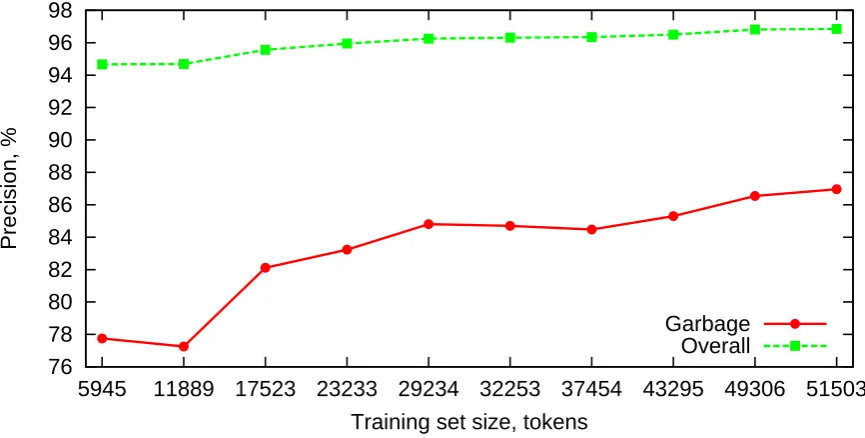
For the better performing OpenNLP POS tagger Figure 2.3 shows pre-cision improvement during incremental training.
76 78 80 82 84 86 88 90 92 94 96 98
5945 11889 17523 23233 29234 32253 37454 43295 49306 51503
Precision, %
Training set size, tokens
Garbage Overall
2.5. DISCUSSION
CHAPTER 2. TRENTO COMPUTER SCIENCE (TCS) DATASET PREPARATION
Note the stabilization of the overall precision curve of the POS tagger around 97%. While the overall precision stabilizes, we note that solid line showing precision per tag G, which indicates “garbage” to remove, is not stable yet. This precision might be improved further by increasing the size of our manually annotated training set.
2.4.2 Correctness and completeness, preliminary evaluation We evaluated proposed set for KEA [102], and Machine Learning + Natural Language Processing method, recently proposed in [45, 48]. Evaluation shows that both methods, very different by their nature, have the overlap of true positive extracted keyphrases of about 55%. This indicates that different systems mine different keyphrases, so the dataset is “hard” or complete [32].
From other point of view the dataset is “naturally” correct, because it has editor assigned keyphrases of proven quality, and at least one keyphrase appears in each text at least once.
We perform preliminary evaluation with KEA, carrying out the exper-iments for keyphrases recognition using refined full texts and not refined ones. We see small but stable (c.a. 4%) improvement in keyphrases recog-nition using refined full texts. This is not major aim of the present work, to evaluate the effect of cleaning, moreover, since KEA does not use syntactic knowledge, it cannot improve too much with refined texts. But, since we have removed all “garbage” KEA has less chance to extract linguistically senseless information like piece of tag or formula.
2.5
Discussion
CHAPTER 2. TRENTO COMPUTER
SCIENCE (TCS) DATASET PREPARATION 2.5. DISCUSSION
• It is at least 5 times bigger than any of previously used datasets.
• It is a set of full texts of scientific papers, which is typical for the keyphrase extraction domain.
• It has author assigned and editor corrected keyphrases.
• It is verifiable and reproducible, because all presented information may be found through CiteseerX and ACM portal.
• It is public and available for use by researchers.
• It is refined for better NLP processing to get more syntactical and semantical knowledge.
• The dataset is hard because it presents different challenges for different state-of-the-art machine learning systems.
2.5. DISCUSSION
Chapter 3
Automatic Keyphrases
or Tags
Extracting in ADL
In this chapter we study the use of Natural Language Processing (NLP) techniques to improve different machine learning approaches (Support Vec-tor Machines (SVM), Local SVM, Random Forests), to tackle the problem of automatic keyphrases extraction from scientific papers. For the assess-ment we used a large high quality dataset: 2000 ACM papers from the Computer Science domain (see Chapter2). Evaluation shows promising re-sults that outperform state-of-the-art Bayesian learning system KEA im-proving the average F-Measure from22% (KEA) to30% (Random Forest) on the same dataset without the use of controlled vocabularies. The assess-ment is performed by comparison with expert assigned keyphrases. Finally, we report a detailed analysis of the effect of the individual NLP features and data sets size on the overall quality of extracted keyphrases.
extrac-3.1. STATE-OF-THE-ART
CHAPTER 3. AUTOMATIC KEYPHRASES OR TAGS EXTRACTING IN ADL
tion methodology (that we name hereafter ML+NLP), specific feature set, text processing tasks and result assessment methodology. In Section 3.4 we present the results of all four approaches, Bayesian Learning (KEA), Support Vector Machine, Fast Local Kernel Machine and Random Forrest training. In Section 3.5 we present a quantitative comparative analysis of the obtained quality measures as well as a qualitative analysis of the extracted keyphrases. Section 3.6 is devoted to the conclusions.
3.1
State-of-the-art
Exponential growth of information in web era made autonomous digital libraries very popular. Autonomy means automatic information harvest-ing, processharvest-ing, classification and representation and it brings several chal-lenges.
A specific challenge lies in the domain of scholarly papers [37], accumu-lated in autonomous digital libraries [20, 29, 56] like CiteSeerX1[31], Google Scholar2[17] or Rexa3[61]. Library spider crawls the web for scientific pa-pers. Having retrieving the paper, the crawler must convert it into a text format. Then it extracts relevant metadata (like title, authors, citations) and finally documents are properly analyzed (classified, identified, ranked, stored). Metadata helps to categorize or classify papers, simplifying and enhancing users’ searches, but often metadata is not available explicitly.
Information extraction from scholarly papers contains two broad classes of tasks:
• recognition of structural information which is present inside the paper body (like authors, venues, title, abstract, text parts like sections,
1http://citeseer.ittc.ku.edu 2
http://scholar.google.com
CHAPTER 3. AUTOMATIC KEYPHRASES OR TAGS
EXTRACTING IN ADL 3.1. STATE-OF-THE-ART
tables figures, author assigned keyphrases (the ones that follow after word “Keywords:” from a new line in a header) and extraction of it;
• mining of information which is only implicitly present, such as generic keyphrases or tags, which are not explicitly assigned by the authors (which happens quite frequently, specially for the earlier publications).
First task is well-investigated and accomplished with extremely high (up to 97% of F-Measure) performance by two groups in parallel: Lee Giles [88] did it with help of Support Vector Machines and Andrew McCallum performed the same task with help of Hidden Markov Models usage [62] first, and with Conational Random Fields [70] later (the winner method), on a benchmarking dataset taken from Rexa scientific spider system. We emphasize that extraction of implicit information is very different problem, where methods like Conditional Random Fields are unapplicable. But SVM is very universal and fits most of known learning tasks, so it might be adopted to the keyphrases extraction problem.
In this Chapter we focus on the task of extraction of implicit informa-tion, which we believe is more challenging. We analyze the effect of the use of Natural Language Processing (NLP) techniques and the use of specific NLP-based heuristics on the improvement of current Machine Learning (ML) approaches.
3.1. STATE-OF-THE-ART
CHAPTER 3. AUTOMATIC KEYPHRASES OR TAGS EXTRACTING IN ADL
Let us briefly outline text classification problem and show how keyphrases may help in it. The most common and primitive method of classification is bag-of-word plus vector space representation [76], where a document is converted into a vector of very large dimensionality (typically 5-10 thou-sands) where component equal to 1 if word presents in document and 0 if not. So distinct quantity of words in a set of documents we want to classify is the dimensionality of a vector space (so-called features space) we work with. Assuming that basis of the feature space is orthogonal, the scalar product of two vectors (documents) indicates how similar documents are. So categorization is simply a similarity between category vector and doc-ument vector. In this primitive approach we cannot deal with keywords or keyphrases. But if we will consider phrases as instead of simple tokens, and weight each phase more if it is a keyphrase we will get more accurate classification [33, 78]. So as we see, keyphrases are indeed useful for text categorization task.
The most popular state-of-the-art system for keyphrases extraction is KEA [102]. It uses Na¨ıve Bayes classificator and few heuristics, namely fil-tering out keyphrases that are subphrases of more narrow keyphrases, using particular stemmer, creative text tokenization algorithm and taking into account frequent keyphrases only. The best results reported by KEA team show about 18% of F-Measure [102] in the extraction of keyphrases from generic web pages. Usage of domain specific vocabularies may improve the result up to 28.3% for Recall and 26.1% for Precision [63].
disad-CHAPTER 3. AUTOMATIC KEYPHRASES OR TAGS
EXTRACTING IN ADL 3.1. STATE-OF-THE-ART
vantage: mining the Web for information and parsing the responses is a time and resource consuming operation. This is inconvenient for Digital Libraries with millions of documents. In this approach the author mea-sures the results by the average number of correctly found phrases vs. total number of extracted phrases ratio.
Recent works by A. Hulth et al. took into account domain [38] and linguistic [39] knowledge to search relevant keyphrases. In particular, con-tribution [39] used thesauri trying to get domain knowledge. Recall re-ported in this work is very low, namely 4-6%. The approach proposed in [38] introduced a heuristic related to part-of-speech usage, and proposed training based on the three standard KEA features plus one linguistic fea-ture. Authors reported relatively good results (F-Measure up to 33.9%). However, it is hard to compare their results with the others due to the strong specificity of the used data set: short abstract with on average 120 tokens where around 10% of all words in the proposed set were keyphrases.
A recent interesting work with regard to the application of linguis-tic knowledge to the specific problem is reported in [24]. The authors used WordNet[25] and “lexical chains” structures based on synonyms and antonyms. Then they applied decision trees as a ML part on about 50 journal articles as the training set and 25 documents as the testing set. They reported high precision, up to 45%, but did not mention recall. This makes difficult any comparison with other techniques, and, as it will be investigated below, we think that such dataset is too small and biased for comparison.
Other ML technique, Least Square SVM [99] shows 21.0% Precision and 23.7% Recall in the analysis of web-mined scientific papers. Also in this case the described experiments are limited to a very small testing dataset of 40 manually collected papers, which is again very small set.
3.1. STATE-OF-THE-ART
CHAPTER 3. AUTOMATIC KEYPHRASES OR TAGS EXTRACTING IN ADL
paper [58], they are:
1. Word clustering: here the basic idea is to cluster words using unsuper-vised clustering method, for example [86]. Than, after the phrases are clustered, we induce an additional weight to a phrase’s TF, making it proportional to summarized TF’s of all phrases in a cluster.
2. Using the sentence salience score [72] as a feature. This score is a weight of sentence in which a phase is located. It based on the notion of vector space, where we represent each sentence in a document or cluster of documents as a vector, and than compute the inner product between each pair of vectors. Having linear combination of scholar vector product, position of a sentence in a document and centroid score (the measure of centrality of a sentence in a single document or cluster of documents) we denote a notion of salience score as it is defined in [72]. Salience score is also used for keyphrases mining in [57].
3. Graph-based score is also may give an additional weighting, here we exploit the idea that important phrases are connected into a graph, such graphs may be constructed with help of iterative reinforcement algorithm [98]. Same statement is valid for sentences which are also bound in a graph. Reinforcement algorithm is the iterative method that recomputes the weight of a node (single word or sentence) in a graph until convergence. So it may be employed as an additional weighting.
CHAPTER 3. AUTOMATIC KEYPHRASES OR TAGS
EXTRACTING IN ADL 3.1. STATE-OF-THE-ART
less) with what we have obtained, but it is done on the smaller manually tagged by volunteers annotators set of meeting notes.
There is another way of machine learning: unsupervised learning or learning without a trainer. Such kind of training does not require any training set (while, for sometime it may use some “seeds” which are not necessary). For supervised keyphrases extraction problems there is just one publicly available system that may be used without any additional preparations: KEA [102]. For unsupervised learning (without necessity to have training set) there is also just one publicly available 4 keywords ex-traction system: Leximancer [35]. To the best of our knowledge there are no any other systems which may be used as a “blackbox”, working by the following scheme: 1) input text, 2) push the button and 3) get keyphrases. Leximancer system [83, 100] designed and developed for completely un-supervised keyword extraction. We say keyword instead keyphrases since Leximancer is able to extract merely one-token phrases. This limitation is caused by the nature of a method. For information extraction Leximancer team uses so-called context based analysis, i.e. each word considered within context, the piece of text around a word. This methodology came from ear-lier works of David Yarowsky [105, 106] dedicated to the problem of statis-tical word-sense disambiguation. We believe that context-based analysis with combination of proposed int the present Thesis methodology may improve keyphrases extraction and make a first step towards keyphrases assignment, where keyphrase is not presented in text, but assigned to it due to analysis of set of “similar” texts.
This chapter extends and improves on a preliminary work describing our initial concepts and presenting initial results [45] obtained using standard SVM approaches, namely:
1. We extend the use of state-of-the-art NLP tools [65] for the extraction,
3.2. TCS DATASET
CHARACTERIZATION AND LINGUISTIC PROCESSING
CHAPTER 3. AUTOMATIC KEYPHRASES OR TAGS EXTRACTING IN ADL
definition and use of linguistic-based features such as part of speech and syntactic relations extracted by dependency parsers [67].
2. We apply the proposed NLP-based approach to a number of differ-ent ML methods namely traditional SVM, innovative Local SVM and Random Forests.
3. We define and publish a large high quality dataset of 2000 documents [47], available through internet, with experts assigned keyphrases in Computer Science field.
4. We analyze in details the effect of different NLP features and dataset size on the overall quality of extracted keyphrases.
5. We perform a comparative analysis of the computed quality measures and obtained keyphrases with the various ML techniques (enhanced with NLP) and the popular Bayesian learning system KEA.
3.2
TCS Dataset
Characterization and
Linguistic Processing
3.2.1 TCS Dataset Characterization
The dataset presented [47] contains a set of papers published by the ACM in the Computer Science domain in 2003-2005 years. The documents are included in the ACM portal5 and their full texts were crawled by Cite-SeerX digital library as PDFs, but we place them to internet as the text files. These text files names are unique ACM ids, so dataset may be easily verified online through ACM portal. In our pre-processing tasks, we sep-arated different parts of papers, such as title and abstract, thus enabling
5http://portal.acm.org; available also at
CHAPTER 3. AUTOMATIC KEYPHRASES OR TAGS
EXTRACTING IN ADL
3.2. TCS DATASET CHARACTERIZATION AND LINGUISTIC PROCESSING
extraction based on a part of an article text. Formulae, tables, figures and eventual LATEX mark up were removed automatically. We share this
dataset and welcome interested communities to use it as a benchmarks set for information extraction approaches.
For our investigations we separate existing keyphrases into two cate-gories:
• author assigned: located inside each document in the header sections after the prefix “Keywords:”, we removed them;
• editor assigned: manually assigned by human experts in a particular domain.
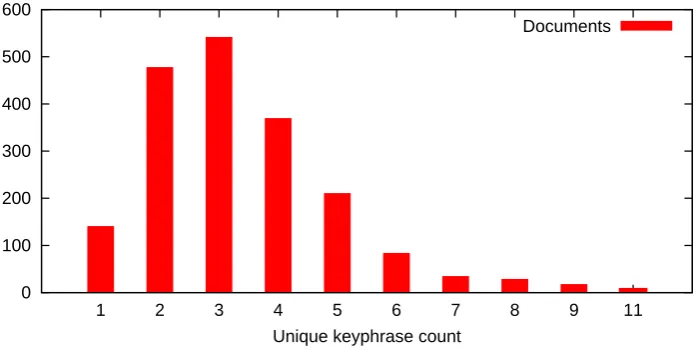
Our experimental dataset consists of 2000 documents with keyphrases assigned by ACM editors. It is important to note that in our preparation of the above dataset, we have selected only papers that contain at least one expert assigned keyphrase in the full text of a document. So we are not in the more challenging case of completely implicit extraction. In our dataset, each document has on average about 3 unique human assigned keyphrases (see Figure 3.1).
0 100 200 300 400 500 600
1 2 3 4 5 6 7 8 9 11
Unique keyphrase count
Documents
3.2. TCS DATASET
CHARACTERIZATION AND LINGUISTIC PROCESSING
CHAPTER 3. AUTOMATIC KEYPHRASES OR TAGS EXTRACTING IN ADL
3.2.2 Linguistic Analysis of Keyphrases
We performed a NLP analysis of the keyphrases to study their linguistic properties. This is the base for the proposal of heuristics and the defini-tion of the features used in the machine learning step. This improves the quality of generated keyphrase candidates while simultaneously reducing their quantity.
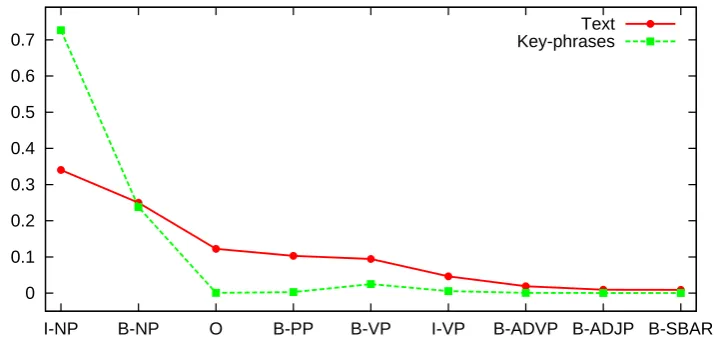
We analyzed a sample of 100 random documents using OpenNLP tools. We applied tokenizer, Part of Speech (POS) tagger and chunker to explore differences between POS tags and chunk types for normal text documents and the corresponding keyphrases set. Fig. 3.2 shows POS tag distributions for the most common POS tags, such as nouns: NN, NNP, NNS; preposi-tions: IN, adjectives: JJ and verbs: VBN, VBP, VBG, VBD. Fig. 3.3 shows distributions for chunk types, such as noun phrases: B-NP, I-NP; preposi-tional phrases: B-PP; verbal phrases: B-VP, I-VP. To improve readability we have omitted values close to zero.
One can note from the figures that the distributions differ significantly between normal text and keyphrases sets. The major differences in POS tags distribution confirm that the majority of keyphrases consist of nouns, singular as well as plural, and adjectives. The difference in chunk types distribution also confirms and reinforces this hypothesis, adding to it that the overwhelming majority of keyphrases are noun phrases.
CHAPTER 3. AUTOMATIC KEYPHRASES OR TAGS
EXTRACTING IN ADL
3.2. TCS DATASET CHARACTERIZATION AND LINGUISTIC PROCESSING
0 0.1 0.2 0.3 0.4 0.5
NN IN JJ NNP NNS VBN VBP VBG VBD
Text Key-phrases
Figure 3.2: POS tags distributions for normal text and keyphrases.
3.2.3 Text processing
Before any extraction task, text needs to be pre-processed to assure a rea-sonable quality of extraction [103]. Modern scientific papers are mostly available in PDF format, thus first we need to convert them to plain text. Further preprocessing includes sentence boundary detection, tokenization, POS tagging, chunking, parsing, stemming and recognizing separate blocks inside the article, such as Title, Abstract, Section Headers, Reference Sec-tion, Body.
We used OpenNLP suite [65] to do standard steps of text processing. Namely, we apply sentence boundary detector, tokenizer, part of speech tagger and chunker consequently. Then we apply a heuristic, inspired by the previous linguistic analysis of keyphrases.
ex-3.2. TCS DATASET
CHARACTERIZATION AND LINGUISTIC PROCESSING
CHAPTER 3. AUTOMATIC KEYPHRASES OR TAGS EXTRACTING IN ADL
0 0.1 0.2 0.3 0.4 0.5 0.6 0.7
I-NP B-NP O B-PP B-VP I-VP B-ADVP B-ADJP B-SBAR
Text Key-phrases
Figure 3.3: Chunk types distributions for normal text and keyphrases.
Table 3.1: Keyphrase candidates extracted by the heuristic.
Sentence Therefore, the seat reservation problem is an on-line problem, and a competitive analysis is appropriate.
Candidates
seat, seat reservation, seat reservation problem, reservation, reservation problem,
problem, on-line problem, analysis, competitive analysis
tracted keyphrase candidates. This heuristic extracts for further analysis only linguistically meaningful keyphrase candidates.
CHAPTER 3. AUTOMATIC KEYPHRASES OR TAGS
EXTRACTING IN ADL
3.2.

![Table 3.3: The adopted Feature Set, i ∈ [1..3]](https://thumb-us.123doks.com/thumbv2/123dok_us/823547.2077500/61.595.112.517.169.286/table-adopted-feature-set-i.webp)