T
T
o
o
w
w
a
a
r
r
d
d
A
A
M
M
e
e
t
t
h
h
o
o
d
d
o
o
l
l
o
o
g
g
y
y
F
F
o
o
r
r
M
M
a
a
n
n
a
a
g
g
i
i
n
n
g
g
I
I
n
n
f
f
o
o
r
r
m
m
a
a
t
t
i
i
o
o
n
n
S
S
y
y
s
s
t
t
e
e
m
m
s
s
I
I
m
m
p
p
l
l
e
e
m
m
e
e
n
n
t
t
a
a
t
t
i
i
o
o
n
n
:
:
A
A
S
S
o
o
c
c
i
i
a
a
l
l
C
C
o
o
n
n
s
s
t
t
r
r
u
u
c
c
t
t
i
i
v
v
i
i
s
s
t
t
P
P
e
e
r
r
s
s
p
p
e
e
c
c
t
t
i
i
v
v
e
e
Suprateek Sarker
Washington State University
[email protected]Abstract
This paper argues that our approach to managing the implementation of information technologies is often dependent on how we frame the implemen-tation problem. The paper first traces the dominant ways of framing the implemenimplemen-tation problem that are evident in the literature, and through this historical analysis, identifies the Leavitt’s diamond for representing organizations as the integrative conceptual model underlying much of the cur-rent implementation literature. Next, by drawing on the notions of objective and subjective realities from the arena of sociology of knowledge, the paper further develops the diamond model and uses it as a frame for informing the implementation of code-generators in a hypothetical organization. The richer understanding enabled by the enhanced diamond model proposed in the paper leads to the formulation of some broad guidelines for man-aging the implementation of “interpretively flexible” information technologies. These guidelines are summarized in four steps: 1) self-understanding through self-reflection, 2) identification and understanding of all important stakeholder groups, 3) identification of stakeholders who are likely to resist, and 4)modifying the objective or subjective realities as appropriate.
Keywords: Information systems, implementation, stakeholders’ world-views, social construction, code generators, hypothetical case study.
Introduction And Review
of the Implementation Literature
Implementation of information systems has been a topic of considerable interest to practitioners as well as academic re-searchers for over two decades. In a broad sense, implementa-tion refers to all that must be done by a specific organization for it to be able to harness the capabilities of a particular in-formation technology as envisioned. A number of prominent operations research/management science (OR/MS) and infor-mation systems (IS) researchers have recognized that behav-ioral issues rather than technological issues seem to be at the root of problems related to implementation (Schultz and Slevin, 1975; Ginzberg, 1978; Lyytinen and Hirschheim, 1987; etc.). Consequently, much of the research on implemen-tation in the fields of OR/MS and IS has focused on the re-lated human aspects.
Different scholars have tried to address the problem of
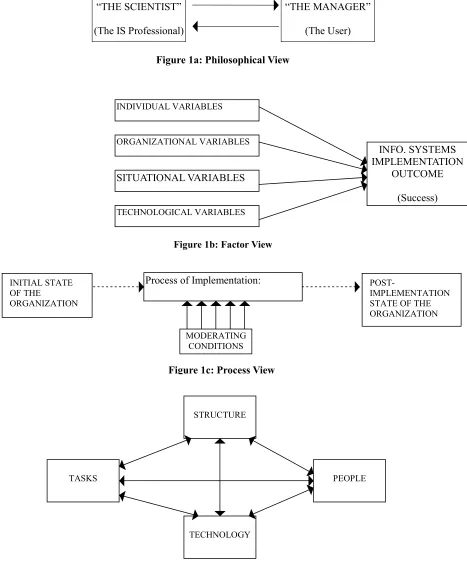
im-plementation in different ways, thus deriving different insights and prescriptions for successful implementation. Among the first to analyze implementation were Churchman and Schain-blatt (1965), who viewed implementation as "the problem of determining what activities of the scientist and the manager are most appropriate to bring about an effective relationship between the two". They recommended a relationship of “mu-tual understanding” between that scientist (i.e., the IS profes-sional) and the manager (i.e., the user) wherein each would come to understand the other through a dialectical process (see Figure 1a). While Churchman and Schainblatt’s approach was a novel and useful way of framing implementation, it had at least three serious limitations: first, the approach com-pletely ignored the system (technology) that was to be imple-mented; second, it provided almost no guidance on how to achieve the state of mutual understanding; and third, the ap-proach did not incorporate the fact that "scientists" and "man-agers" do not (and cannot) operate isolated from the context of implementation.
The next wave of research (Lucas, 1975; Schultz, Ginzberg and Lucas, 1984; DeSanctis, 1984; Leonard-Barton, 1988) thus focused on identifying a broad range of factors that affect implementation outcome (see Figure 1b). Factors identified are classified as:
Figure 1a: Philosophical View
“THE SCIENTIST”
(The IS Professional)
“THE MANAGER”
(The User) Nature of Relationship
between the two parties
Figure 1b: Factor View INDIVIDUAL VARIABLES
ORGANIZATIONAL VARIABLES
SITUATIONAL VARIABLES
TECHNOLOGICAL VARIABLES
INFO. SYSTEMS IMPLEMENTATION
OUTCOME
(Success)
Figure 1d: Socio-technical View
TECHNOLOGY STRUCTURE
TASKS PEOPLE
Figure 1c: Process View
Process of Implementation:
MODERATING CONDITIONS INITIAL STATE
OF THE
ORGANIZATION
POST-IMPLEMENTATION STATE OF THE ORGANIZATION
197
• individual variables such as needs, cognitive style, per-sonality, demographics, decision-style, and expectancy contributions;
• organizational variables such as differentiation/ integra-tion, extent of centralizaintegra-tion, autonomy of unit, culture, group norms, reward systems, and power distributions;
• situational variables such as user involvement, nature of analyst-user communication, organizational validity, and the existence of critical mass; and
• technological variables which include the type of tech-nology (MIS, TPS, CASE tools, EMS, etc.), and charac-teristics of technology such as transferability, implemen-tation complexity, divisibility, and cultural content.
As scholars started understanding the role of different factors, they came to the realization that implementation was not a static phenomenon as implicitly assumed by those conducting
factors research, and that implementation would be better understood as a process mediated by certain conditions such as project management, presence of a champion and top man-agement support (see Figure 1c). While some scholars adopt-ing the “process view” saw implementation as diffusion of innovation, most viewed it as a process of changing the insti-tutionalized way of doing things within an organization (Ginzberg, 1978; Galbraith, 1979), and thus, existing process models of organization change (e.g. Lewin/Schein model, Kolb/Frohman model) were often used to conceptualize the implementation of information systems.
The process view of implementation was further developed by scholars influenced by the “socio-technical” school of thought (e.g., Bostrom and Heinen, 1977; Markus, 1983; Robey, 1987), and this "interactionist" approach arguably remains the dominant one for the study of implementation of IS in organi-zations (see Figure 1d). Within this perspective, the organiza-tion is implicitly conceptualized as a "diamond," a model originally proposed by Leavitt (1965), consisting of interact-ing components: people, tasks, technology, and structure. In-troduction of an IS involves changing the organization’s tech-nology component which automatically triggers changes in the other components of the organization.
Implementation essentially refers to anticipating and strategi-cally managing the impacts of the change of the technology component (Robey, 1987) such that the IS becomes "organiza-tionally valid" (Schultz and Slevin, 1975; Markus and Robey, 1983) as the organization comes to a post-implementation steady-state. Scholars usually focus on one or more edges of the diamond at a time and recommend organizational impact management strategies such as job/task redesign (Slocum and Sims, 1980), retooling the "people component" through resis-tance management strategies such as training or education (Bronsema and Keen, 1983), or changing the structure through redesign of the incentive and accountability systems (Nichols, 1981; Orlikowski, 1992).
Clearly, the perspectives discussed above represent consider-able progress made by researchers in the area. Unfortunately, the diamond model, which appears to be the foundation for much of the current understanding of IS implementation, fails to reflect sufficiently the political underpinnings of implemen-tation (Keen, 1981; Markus, 1983) and institutional realities such as symbols (Hirschheim and Newman, 1991) and frames (Orlikowski, 1992). It is argued in this paper that such issues cannot be satisfactorily addressed without taking into consid-eration the “subjective realities” that exist in the minds of the actors.
Also, given the recognition of the importance of conceptual devices and frameworks in informing management practice (Astley and Zammuto, 1992), and more specifically, of an organizational model in informing implementation manage-ment (Bostrom and Heinen, 1977), it is surprising that schol-ars have not attempted to improve or extend the diamond model by incorporating concepts (such as subjective realities) that can help analyze political or institutional issues.
This paper, thus, attempts to enrich the existing organizational model based on insights from Berger and Luckmann's work (1966) in the arena of sociology of knowledge, and through the application of this enriched model, hopes to contribute to the stream of socio-technical literature on IS implementation.
The basic thesis of the paper is that prior conceptualizations of organizations have recognized only "objective realities" which has led to an incomplete understanding of implementa-tion; by including the analysis of "subjective realities" in the organization, a better understanding of political and institu-tional forces and of organizainstitu-tional resistance arising from them may be gained.
The following section (Section 2) develops the organizational model. Thereafter, in Section 3, the model is illustrated using a hypothetical case of code generator implementation. Section 4 presents guidelines for implementation management derived using the proposed model. The final section (Section 5) con-cludes with the limitations of the proposed model and future research directions.
Reconceptualizing Organizations
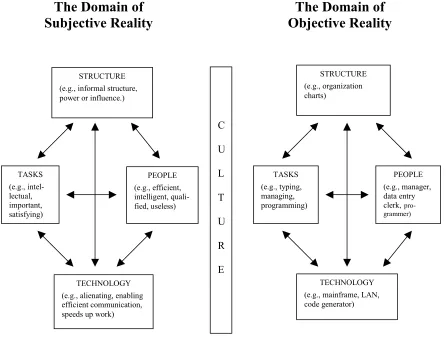
Another fundamental source of ideas for the model proposed is the vigorous ontological debate between the functionalist and interpretive scholars about the "reality" of organizations (Burrell and Morgan, 1979; Orlikowski and Baroudi, 1991). While functionalist scholars see every aspect of organizations as objective reality, the interpretive scholars embrace the as-sumption of nominalism, maintaining that reality is "socially constructed." The model presented (Figure 2a) is based on the position (derived from the work of Berger and Luckmann, 1966) that organizations are entirely socially constructed, with some aspects seen as "objectively real" and others as "subjec-tively real".
According to Berger and Luckmann (1966, p. 54), "institu-tionalization occurs whenever there is a reciprocal typification of habitualized action". Over time, these humanly produced institutions, resulting from the reification of patterns of acting and interacting in recurrent situations, are experienced as taken-for-granted objective realities, that are external to but persistently confronting an individual, similar to the realities of the natural world (Ritzer, 1992). In an organization, all in-stitutionalized entities: tasks (such as managing, program-ming, and accounting), structures (such as bureaucratic
hier-archies and reward systems), technologies (such as computer technology and well-defined organizational procedures), and individuals (who are believed to be partly "formed" through the definition of others (Meltzer, 1993)) are experienced as objective realities by organizational members in their every-day life.
Subjective reality refers to the reality "as apprehended in the individual consciousness rather than on reality as institution-ally defined" (Berger and Luckmann, 1966, p. 147). Subjec-tive reality is of utmost importance in organizational analysis because self-determined human action is believed to follow a stage of examination and deliberation of this reality (Thomas, 1993). It must be emphasized here that the word "subjective" does not pejoratively intend to convey the idea of being arbi-trary or opinionated but instead refers to the meaning held by the human subjects of the world they experience around them (Lee, 1991).
Members of the complex modern society (and organizations) play specialized roles, and are thus required to acquire role-specific knowledge through secondary socialization. Roles mediate between “the macroscopic universes of meaning
ob-STRUCTURE (e.g., informal structure, power or influence.)
TECHNOLOGY (e.g., alienating, enabling efficient communication, speeds up work) TASKS
(e.g., intel-lectual, important, satisfying)
PEOPLE (e.g., efficient, intelligent, quali-fied, useless)
TECHNOLOGY (e.g., mainframe, LAN, code generator)
C
U
L
T
U
R
E
The Domain of
Subjective Reality
The Domain of
Objective Reality
STRUCTURE (e.g., organization charts)
TASKS (e.g., typing, managing, programming)
PEOPLE (e.g., manager, data entry clerk, pro-grammer)
199 jectivated in a society and the ways in which these universes
are subjectively real to individuals” Berger and Luckmann, 1966, p. 79). In other words, the role specific knowledge acts as a lens through which a socialized individual subjectively experiences the world that is taken-for-granted as objective in the larger society. An individual’s socialization into a particu-lar role is often differentiated by geographical, organizational or occupational factors, and this involves the "internalization of (differential) semantic fields structuring routine interpreta-tions and conduct within an institutional area" (p. 138). Con-sequently, individuals socialized into different occupations and roles, and belonging to different cultural and interest groups tend to experience the same “objective reality” as dif-ferent “subjective realities”.
The Proposed Model
The two realities discussed above form the basis of the two domains of the organization: the domain of objective reality and the domain of subjective reality (see Figure 2a). Organ-izational culture occupies a pivotal position in the model pro-posed, mediating between the domains of objective and sub-jective reality. Culture (including sub-cultures) may be seen as a socially constructed objective reality that provides
organiza-tional members with ideas and beliefs, value orientations and significations through which situations are interpreted (Blumer, 1993), and it is through the medium of culture that a common sense of social reality is experienced subjectively, articulated, objectified, and reproduced (Berger and Luck-mann, 1966; Coombs, Knights and Wilmott, 1992; Powell and DiMaggio, 1991).
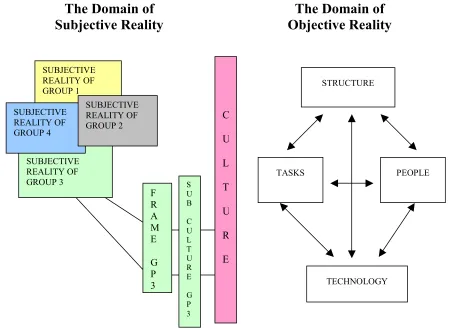
Based on the previous discussion of the different building blocks of the organizational model, it is not difficult to see that corresponding to each organizational component in the domain of objective reality, there exists a subjectively real component that an organizational member sees as a superim-position of images through at least two lenses that continu-ously interact with each other: the first lens depends on the roles and responsibilities of the member in the organization, and the nature of role-specific knowledge acquired by the member through/during secondary socialization; and the sec-ond lens is provided by the organizational sub-culture to which the member belongs. It is important to note that the first lens (referred to as “frame”) is a cognitive structure or a mental model that is held by individuals and sometimes shared among them. In contrast, the second lens (the “sub-culture”) refers to the objectified product of historical action
SUBJECTIVE REALITY OF GROUP 1
SUBJECTIVE REALITY OF GROUP 3 SUBJECTIVE REALITY OF GROUP 4
SUBJECTIVE REALITY OF
GROUP 2 C
U
L
T
U
R
E
The Domain of
Subjective Reality
The Domain of
Objective Reality
F R A M E
G P 3
S U B
C U L T U R E
G P 3
TASKS PEOPLE
TECHNOLOGY STRUCTURE
(by the relevant group) that has assumed a life of its own in-dependent of the current members of the relevant group (Or-likowski and Gash, 1994).
Since several organizational members go through similar sec-ondary socialization, occupy positions with similar roles and responsibilities, and encounter similar sub-cultures, it is likely that they will experience similar subjective realities for a given objective reality. It follows that other members who differ significantly with respect to secondary socialization or sub-cultures or assigned roles and responsibilities are ex-pected to experience dissimilar subjective realities for a given objective reality (see Figure 2b). If we adopt the Parsonsian view that organizational members act so as to maximize their utilities (Powell and DiMaggio, 1991) as defined by their or-ganizational roles, subcultures and socialization experiences, and that their actions follow an examination and evaluation of their subjective realities (Thomas, 1993), it is clear that a negative evaluation may result in the concerned organiza-tional members mentally rejecting an existing (or a projected) state of objective reality. The same analysis would apply if we assume utility satisficing rather than utility maximizing be-havior of organizational members. This rejection of the tar-get/projected post-implementation state of objective realityis manifested in attitudes or actions that are often recognized as
resistance to implementation (Hirschheim and Newman, 1988).
A Hypothetical Case Study
The previously described notions of objective and subjective realities in organizations may be briefly illustrated through the following hypothetical example. While some simplifying as-sumptions in the hypothetical case study (e.g., data-entry op-erators report to programmers) may seem somewhat artifi-cial/unrealistic, the central issues highlighted in the case are fairly representative of “real” IT implementation, and, in fact, similar concerns regarding CASE tools have been docu-mented in the literature (e.g., Orlikowski, 1989). The device of a hypothetical example is deliberately utilized to illustrate the model and develop a management approach, since it is likely that any real case would introduce additional organiza-tional peculiarities/complexities that would unnecessarily dis-tract the reader away from the model being illustrated.
The domain of objective reality
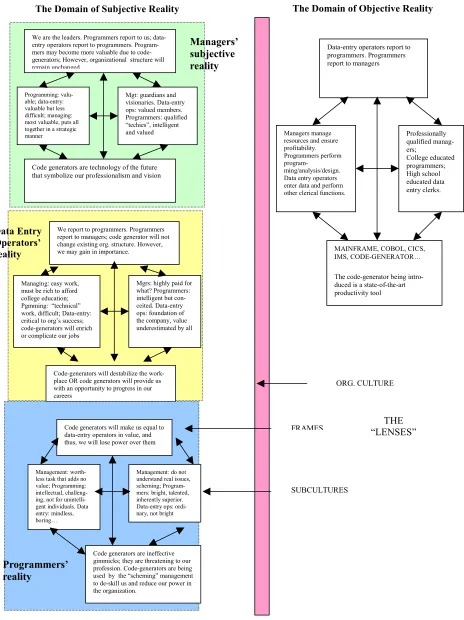
The setting is that of an Information Systems Development and Processing company with primarily three groups of em-ployees: data-entry operators who report to the program-mers, who, in turn, report to the management. The (pre-sumed) goal of all three groups of employees is to ensure the success of the company (say, by maximizing productivity and thus, profitability).
The managers and programmers have college degrees, and many of them hold graduate qualifications. The data-entry operators, on the other hand, are high-school graduates with some vocational and on-the-job training. The managers are involved in the management of the company’s resources, in-cluding the human resources (i.e., programmers and data-entry operators). Programmers are involved in the develop-ment and maintenance of information systems written primar-ily in COBOL, CICS, and IMS. The data-entry operators are involved in data-entry and other clerical activities.
Within this context, assume that the management has decided to implement a sophisticated "code generator" in the organiza-tion. Code generators have been defined as “special-purpose computing tools that have been developed to generate rea-sonably good code from specifications, saving an organization time and money” (Hoffer, George and Valacich, 1996, p. 17). Code-generators, such as the one selected for implementation in this organization, have been recognized in the overall IT industry (in trade journals, by noted speakers in IS Manage-ment conferences, etc.) as the "state-of-the-art" software tech-nology that has tremendous potential to enhance the produc-tivity of software development companies, which, in most instances, are significantly understaffed, and thus, unable to meet committed deadlines. This view is what we may think of as the “objective view” regarding code generators.
The domain of subjective reality
201
Data-entry operators report to programmers. Programmers report to managers
Managers manage resources and ensure profitability. Programmers perform
program-ming/analysis/design. Data entry operators enter data and perform other clerical functions.
Professionally qualified manag-ers;
College educated programmers; High school educated data entry clerks.
MAINFRAME, COBOL, CICS, IMS, CODE-GENERATOR…
The code-generator being intro-duced is a state-of-the-art productivity tool
The Domain of Objective Reality The Domain of Subjective Reality
We are the leaders. Programmers report to us; data-entry operators report to programmers. Program-mers may become more valuable due to code-generators; However, organizational structure will remain unchanged
Programming: valu-able; data-entry: valuable but less difficult; managing: most valuable, puts all together in a strategic manner
Mgt: guardians and visionaries. Data-entry ops: valued members. Programmers: qualified “techies”, intelligent and valued
Code generators are technology of the future that symbolize our professionalism and vision
Managers’ subjective reality
We report to programmers. Programmers report to managers; code generator will not change existing org. structure. However, we may gain in importance.
Managing: easy work, must be rich to afford college education; Pgmming: “technical” work, difficult; Data-entry: critical to org’s success; code-generators will enrich or complicate our jobs
Mgrs: highly paid for what? Programmers: intelligent but con-ceited. Data-entry ops: foundation of the company, value underestimated by all
Code-generators will destabilize the work-place OR code generators will provide us with an opportunity to progress in our careers
Data Entry Operators’ reality
Code generators will make us equal to data-entry operators in value, and thus, we will lose power over them
Management: worth-less task that adds no value; Programming: intellectual, challeng-ing, not for unintelli-gent individuals. Data entry: mindless, boring…
Management: do not understand real issues, scheming; Program-mers: bright, talented, inherently superior. Data-entry ops: ordi-nary, not bright
Code generators are ineffective gimmicks; they are threatening to our profession. Code-generators are being used by the “scheming” management to de-skill us and reduce our power in the organization.
Programmers’ reality
ORG. CULTURE
SUBCULTURES
THE “LENSES” FRAMES
The programmers, on the other hand, see a completely differ-ent image of the objective reality. They view the technology as "threatening" to change their task from "intellectual" pro-gramming to "mindless" specifications or data entry, which even the “lowly” data-entry operators could undertake with
little training. Their subjective reality, in sharp contrast to that of the managers, equates code-generator implementation as "deskilling" their “technical” tasks, resulting in a loss of their importance and power in the organization and contributing to a negative impact on "their conception of self.” Within this reality, the programmers see management as their enemy de-liberately scheming to undermine their (the programmers’) position in the organization. Clearly, resisting implementation appears absolutely rational from the point of view of the pro-grammers.
Finally, the data-entry operators are divided in their views, depending on whether they value stability more than they value the opportunity to advance by learning to use new tech-nologies. Those valuing stability (and no change in their envi-ronment) would resist the implementation of code-generator while those with a curiosity about technologies would invite the implementation (see Figure 3). It may be noted that either group of data-entry operators may not be even aware of issues that are of concern to the programmers (power, deskilling) and the managers (profitability, professionalism) just as the programmers and managers may not be aware of the data-entry operators’ concerns regarding the code-generators.
In this context, how can an implementation manager, who is entrapped in her own subjective view, effectively approach the implementation of the code-generator? (The hypothetical scenario is especially relevant to the implementation of tech-nologies that have a high degree of “interpretive flexibility” (Orlikowski, 1992b)). Such technologies are “appropriated in diverse ways and come to have different meanings and effects for different users” (p. 408).The next section provides an out-line of the proposed approach.
Implications For
Managing Implementation
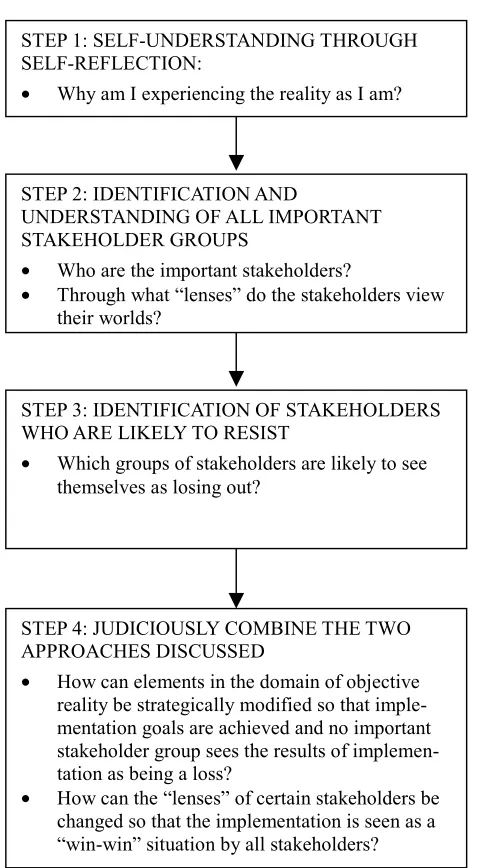
Implementation involves the smooth integration of an infor-mation system in an organization. A number of guidelines for implementation planning emerge merely by framing imple-mentation within the context of the organizational model pre-viously described (see Figure4):
1. The first step for an implementation manager is to under-stand herself. She must appreciate that her view of the or-ganization is shaped by her "lens" derived from her posi-tion in the organizaposi-tion, its (sub)culture as well as her previous socialization experiences, and that her view may or may not be shared by other (groups of) members in the
organization. Through a process of self-reflection, she must attempt to unstack her assumptions, biases, and self-interests that are embedded in her "lenses" and to dis-cover why she experiences her "subjective reality" the way she does - especially with respect to issues such as the current state in the organization, the technology that must be introduced, desired modifications in the "domain of objective reality" of the organization, and the state of the organization after implementation is complete.
2. The second step is to identify and understand all the im-portant stakeholders of the technology to be implemented.
Stakeholders may be individuals or groups who have any interest in the system or are likely to experience an im-pact due to the implementation of the system. A heuristic for determining the order of importance of the stake-holders is their relative power in the organization. Under-standing stakeholders requires the implementation man-ager to be nothing less than an organizational ethnogra-pher whose goal is to obtain a hermeneutic reconstruction of the "lenses" through which stakeholders see their im-ages. Agar (1986), Geertz (1983), Van Maanen (1988), and Harvey (1997), among others, provide detailed dis-cussions on ethnographic techniques and experiences.
3. The implementation manager is advised to proceed with the assumption that stakeholders know what they are do-ing, which is a fundamental premise in hermeneutic un-derstanding(Lee, 1991). In other words, the manager must suspend any negative or stereotypical beliefs about the stakeholders and firmly uphold the assumption that the stakeholders, like most other human beings, act ra-tionally according to their own utilities (Powell and Di-maggio, 1991). Thus, what might initially appear irtional to the implementation manager may indeed be ra-tional from the point of views of certain stakeholders.
The third step involves the identification of stakeholders
whose "subjective realities" are such that their evaluations of the realities are likely to indicate that they are "losing out." This negative evaluation is likely to provide the stakeholders with an incentive to resist the changes (Beer, 1988).
203 the group to new symbolic media, values, and roles that
get enacted, objectified and, over time, incorporated into the group's "lenses." Such resocialization may be at-tempted through indoctrination conducted in long-term educational and training programs, rewarding certain be-haviors and symbolisms (use of certain vocabulary), "stakeholder-involvement" in early phases of
implementation planning (which would also enable the manager to develop a better understanding of the stakeholders), and top management involvement for legitimization of certain beliefs, values, and symbols. However, it must be recognized that “the already internalized reality has a tendency to persist. Whatever new contents are now to be internalized must somehow be superimposed upon this already present reality…. The
present reality…. The problem may be more or less diffi-cult of solution in different cases" (Berger and Luckmann, 1966, p. 140). Another difficulty is that internalization of symbolic media, values, and roles often takes more time than what an organization may have available.
The fourth step in implementation involves combining the two approaches described above. Sometimes it is im-possible to implement a system without having at least one group of dissatisfied stakeholders (Markus, 1983; Davenport, 1993). Under such circumstances, the man-ager could choose "to offend" the least powerful stake-holders and may attempt to forcibly "define reality," dis-band or reorganize groups that are likely to resist, or
pro-STEP 1: SELF-UNDERSTANDING THROUGH SELF-REFLECTION:
• Why am I experiencing the reality as I am?
STEP 2: IDENTIFICATION AND
UNDERSTANDING OF ALL IMPORTANT STAKEHOLDER GROUPS
• Who are the important stakeholders?
• Through what “lenses” do the stakeholders view their worlds?
STEP 3: IDENTIFICATION OF STAKEHOLDERS WHO ARE LIKELY TO RESIST
• Which groups of stakeholders are likely to see themselves as losing out?
STEP 4: JUDICIOUSLY COMBINE THE TWO APPROACHES DISCUSSED
• How can elements in the domain of objective reality be strategically modified so that imple-mentation goals are achieved and no important stakeholder group sees the results of implemen-tation as being a loss?
• How can the “lenses” of certain stakeholders be changed so that the implementation is seen as a “win-win” situation by all stakeholders?
actively protect the organization from any strategic moves of resistance made by the relevant group of stakeholders. Sometimes, based on the analysis of the sub-cultures, frames, and subjective realities of different stakeholders, the manager may even find it prudent not to implement a particular technology.
Conclusion
The proposed organization model based on Leavitt's "dia-mond model" and Berger and Luckmann's notion of "the so-cial construction of reality" represents a preliminary effort toward a richer and more integrative comprehension of IS implementation. In attempting to create a richer and integra-tive understanding of implementation, the paper makes at least three important contributions:
• It draws on well-respected sociological tradition to fur-ther develop the organizational model that appears to un-derlie much of the implementation literature;
• It integrates multiple levels of analysis (individual, group, organizational levels) and demonstrates the im-portance of considering the dual nature of reality for the purpose of analyzing information technology implemen-tation in organizations;
• It attempts to make “scholarly” concepts such as social construction of reality, objective and subjective realities, self-reflection, hermeneutics, ethnography, and frames accessible to practitioners involved in the management of implementation.
However, like most other papers, this paper too makes as-sumptions that may be questioned. The proposed approach takes for granted: first, the utility maximization behavior of shareholders that has been criticized in the literature; and sec-ond, the mastery of IS implementation managers over the dis-ciplined practice of self-reflection, hermeneutics or other eth-nographic techniques. (This paper refers to utility maximiza-tion in this context as involving bounded ramaximiza-tionality since the utility itself is not based on a rational process but is a result of the individual’s position and interests in the organization, the individual’s group’s subculture, the individual’s secondary socialization as well as the organizational culture.)It may be argued that the first assumption of "bounded rationality" is indeed a realistic approximation of how organizational actors decide on their course of action; and the second assumption may be satisfied if organizations realize how important these interpretive capabilities are in implementation, and select im-plementation managers accordingly. The validity of the sec-ond assumption has enormous implications for academic pro-grams in the area of IS Management. The potential impor-tance of interpretive capabilities for implementation managers suggests that providing IS students with propositional knowl-edge (Astley and Zammuto, 1992) regarding the implementa-tion process or of factors that affect it will no longer be
suffi-cient. Educational programs will, in addition, have to impart
conceptual and symbolic knowledge (Astley and Zammuto, 1992) through the use a well-designed socialization processes to develop necessary conceptual, self-reflective, interpretive abilities and a sense of ethical responsibilities in students.
The organizational model proposed in this paper may also be criticized for being biased towards “subjectivity”. While such criticism may be valid, it may be argued that the bias (inher-ited from the phenomenological approach of Berger and Luckmann (1966) is actually useful in countering the overly objectivist orientation in the arenas of IS management schol-arship and practice today. Future research on further enhanc-ing the proposed model may be directed to integratenhanc-ing the role of social structures in the model (Ritzer, 1992), and further clarifying the concepts of culture, sub-culture and frames in the context of the proposed organizational model.
Finally, the paper may be criticized for not providing empiri-cal illustration or validation of the model/guidelines. Such a criticism is valid not only for this paper but also for every other conceptual paper. The hypothetical case presented in this paper was created to partially address this concern in that it attempts to provide the reader with a plausible and illustra-tive scenario in which the proposed approach may be applied. Future research may involve designing laboratory experi-ments that test hypotheses regarding the effectiveness of the approach in "simulated" IS implementation projects in aca-demic settings, or conducting action-research/ deductive case studies on "live" implementation projects in organizations in order to evaluate the approach proposed in this paper.
References
Agar, M. (1986). Speaking of Ethnography. Beverley Hills: Sage Astley, W. G., & Zammuto, R. F. (1992). Organization Science,
Manag-ers, and Language Games. Organization Science, 3, 443-460. Beer, M. (1988). Leading change, HBS note, 9-488-037.
Berger, P. L., & Luckmann, T. (1966). The Social Construction of Real-ity. New York: Doubleday.
Blumer, H. (1993). Society as symbolic interaction, in Byers, B. (ed.),
Readings in Social Psychology, Needham Heights: Allyn and Ba-con, 36-43.
Bostrom, R. P., & Heinen, G. (1977). MIS problems and failures: A socio-technical perspective. MIS Quarterly, 1, 17-32.
Bronsema, G. S., & Keen, P. G. W. (1983). Educational intervention and implementation in MIS. Sloan Management Review, Summer, 35-43.
205
Churchman, C. W., & Schainblatt, A. H. (1965). The researcher and the manager: A dialectic of implementation. Management Science, 11, 69-87.
Coombs, R., Knights, D., & Wilmott, H. C. (1992). Culture, control and competition: towards a conceptual framework for the study of in-formation technology in organizations. Organization Studies, 13, 51-72.
Davenport, T. (1993). Process Innovation: Reengineering Work Through Information Technology. Boston: Harvard Business School.
DeSanctis, G. (1984). A Micro Perspective of Implementation. Man-agement Science Implementation – Applications of ManMan-agement Science, Supplement 1, 1-27.
Galbraith, J. R. (1979). A change process for the introduction of MIS: a successful case. TIMS Studies in Management Science, 13, 219-233.
Geertz, C. (1983). From the native’s point of view: On the nature of anthropological understanding, in: Geertz, C. (ed.), Local Knowl-edge, New York: Basic Books, 55-70.
Ginzberg, M. J. (1978). Steps towards more effective implementation of MS and MIS. Interfaces, 8, 57-63.
Hirschheim, R., & Newman, M. (1991). Symbolism and information systems development: myth, metaphor and magic. Information Sys-tems Research, 2, 29-62.
Hirschheim, R., & Newman, M. (1988). Information systems and user resistance: theory and practice. The Computer Journal, 31, 398-407.
Hoffer, J. A., George, J. F., & Valacich, J. S. (1996). Modern Systems Analysis and Design. Menlo Park: Benjamin/Cummings. Keen, P. (1981). Information systems and organizational change.
Com-munications of the ACM, 24, 24-33.
Leavitt, H. J. (1965). Applied organizational change in industry: struc-tural, technical and humanistic approaches, in March, J. G. (ed.),
Handbook of Organizations, 1144-1170.
Lee, A. S. (1991). Integrating positivist and interpretivist approaches to organizational research. Organization Science, 2, 342-365. Lee, S. (1991). The impact of office information systems on potential
power and influence. Journal of MIS, Fall, 135-151.
Leonard-Barton, D. (1988). Implementation characteristics of organiza-tional innovations. Communications Research, October, 603-631. Lucas, H. C. (1975). Why Information Systems Fail. New York:
Colum-bia University Press, New York.
Lyytinen, K., & Hirschheim, R. (1987). Information systems failures – a survey and classification of the empirical literature. Oxford Surveys of IT, 4, 257-309.
Markus, M. L. (1983). Power, politics and MIS implementation, Com-munications of the ACM, 26, 430-444.
Markus, M. L., & Robey, D. (1983). The organizational validity of man-agement information systems, Human Relations, 202-226. Meltzer, B. N. (1993). The social psychology of George Herbert Mead,
in Byers, B. (ed.), Readings in Social Psychology, Needham Heights: Allyn and Bacon, 83-94.
Nichols, M. L. (1981). A behavioral analysis for planning MIS imple-mentation. MIS Quarterly, March, 57-65.
Orlikowski, W. J. (1989). Division among the ranks: The social implica-tions of CASE tools for systems developers. Proceedings of the Tenth International Conference on Information Systems, 199-210. Orlikowski, W. J. (1992). The duality of technology: rethinking the
concept of technology in organizations. Organization Science, 3, 398-427.
Orlikowski, W. J. (1992). Learning from Notes: organizational issues in groupware. Proceedings of the ACM Conference on CSCW . Orlikowski, W. J., & Baroudi, J. J. (1991). Studying information
tech-nology in organizations. Information Systems Research, 2, 1-25. Orlikowski, W. J., & Gash, D. (1994). Technological frames: making sense of information technology in organizations. ACM Transac-tions on Information Systems, 12, 174-207.
Powell, W. W., & DiMaggio, P. J. (1991). The New Institutionalism in Organizational Analysis. Chicago: University of Chicago Press. Ritzer, G. (1992). Sociological Theory. New York: McGraw-Hill. Robey, D. (1987). Implementation and the organizational impacts of
information systems, Interfaces, 17, 72-84.
Schultz, R. L., Ginzberg, M. J., & Lucas, H. C. (1984). A structural model of implementation, in Management Science Implementation – Applications of Management Science, Supplement 1, 55-87. Schultz, R. L., & Slevin, D. P. (1975). A program for research in
im-plementation, in Schultz, R. L. and Slevin, D. P. (eds.), Implement-ing Operations Research/Management Science, New York: Ameri-can Elsevier.
Scott, W. R. (1992). Organizations: Rational, Natural and Open Sys-tems. Englewood Cliffs: Prentice Hall.
Slocum, J. W., & Sims, H. P. (1980). A typology for integrating tech-nology, organization and job design, Human Relations, 33, 193-212.
Thomas, W. I. (1993). The Definition of the Situation, in Byers. B. (ed.),
Readings in Social Psychology, Needham Heights: Allyn and Ba-con, 173-174.