R E V I E W
Open Access
Axonal degeneration in multiple sclerosis: can we
predict and prevent permanent disability?
Jae Young Lee
1, Kasra Taghian
2and Steven Petratos
1*Abstract
Axonal degeneration is a major determinant of permanent neurological impairment during multiple sclerosis (MS). Due to the variable course of clinical disease and the heterogeneity of MS lesions, the mechanisms governing axonal degeneration may differ between disease stages. While the etiology of MS remains elusive, there now exist potential prognostic biomarkers that can predict the conversion to clinically definite MS. Specialized imaging techniques identifying axonal injury and drop-out are becoming established in clinical practice as a predictive measure of MS progression, such as optical coherence tomography (OCT) or diffusion tensor imaging (DTI). However, these imaging techniques are still being debated as predictive biomarkers since controversy surrounds their lesion-specific association with expanded disability status scale (EDSS). A more promising diagnostic measure of axonal degeneration has been argued for the detection of reduced N-acetyl aspartate (NAA) and Creatine ratios via magnetic resonance spectroscopic (MRS) imaging, but again fail with its specificity for predicting actual axonal degeneration. Greater accuracy of predictive biomarkers is therefore warranted and may include CSF neurofilament light chain (NF-L) and neurofilament heavy chain (NF-H) levels, for progressive MS. Furthermore, defining the molecular mechanisms that occur during the neurodegenerative changes in the various subgroups of MS may in fact prove vital for the future development of efficacious neuroprotective therapies. The clinical translation of a combined Na+and Ca2+ channel blocker may lead to the establishment of abona fideneuroprotective agent for the treatment of progressive MS. However, more specific therapeutic targets to limit axonal damage in MS need investigation and may include such integral axonal proteins such as the collapsin response mediator protein-2 (CRMP-2), a molecule which upon post-translational modification may propagate axonal degeneration in MS. In this review, we discuss the current clinical determinants of axonal damage in MS and consider the cellular and molecular mechanisms that may initiate these neurodegenerative changes. In particular we highlight the therapeutic candidates that may formulate novel therapeutic strategies to limit axonal degeneration and EDSS during progressive MS.
Keywords:Axonal degeneration, Multiple sclerosis, Biomarkers, NF-L, N-Acetyl aspartate (NAA)/Creatine ratio, Microglia, Sodium channels, Collapsin response mediator protein 2, Calpain
Introduction
Destructive, inflammatory demyelinating multiple sclerosis (MS) lesions can occur throughout the central nervous system (CNS) with preferential anatomical patterns form-ing. Clinical symptoms in an MS patient may manifest as a range of neurological deficits, including paresthesia, dysesthesia, weakness, or visual disturbances such as blur-ring or greying of vision and black spots in the visual field (scotoma, a consequence of optic neuritis). There have
been several risk factors postulated for the development of MS, namely genetic, inadequate exposure to Vitamin D, smoking, Epstein Barr virus infection early in life and geo-graphical in relation to latitude gradient [1]. In approxi-mately 90% of cases, the disease manifests with an initial primary phase characterized by a relapsing-remitting pres-entation (RRMS) where the patient experiences alternating episodes of neurological impairment, followed by recovery [2]. The secondary phase involves the transformation of a relapsing-remitting presentation into a secondary progres-sive MS (SPMS), which involves a persistent neurological decline [2]. In contrast, 10% of patients undergo primary progressive MS (PPMS) where the course of the disease * Correspondence:[email protected]
1
Department of Medicine, Central Clinical School, Monash University, Prahran, Victoria 3004, Australia
Full list of author information is available at the end of the article
adopts a steady decline in neurological function without any periods of recovery [2]. The prognosis of MS can also vary from complete and lasting remission to eventual par-alysis, loss of bowel and bladder control and blindness [3], and even death in the case of the most aggressive form of the disease, acute rapid progressive MS [3].
Therefore, MS is considered a heterogeneous condi-tion where disease features may vary from one patient to another. Despite the different histopathologically charac-terized lesions of MS, they share common hallmarks that include areas of focal demyelination with inflammatory infiltrating immune cells, along with axonal injury. Con-trary to the original focus of research on the auto-immune mechanisms that are operative in MS, there is now clear evidence that axonal damage/loss is the major determinant of profound neurological deficit in MS suf-ferers. In light of the variable course of the disease and different prognostic outcomes we discuss the possibility that in some subgroups of MS, molecular mechanisms may initiate axonal degeneration as a primary event, pre-ceding inflammatory destruction of myelin, leading to variable capacity for repair and thus variable patient presentation.
This review focuses primarily on why MS may pro-gress to permanent disability. The discussion covers clin-ical, pathologclin-ical, cellular and molecular mechanisms, which govern axonal pathology in progressive MS, the etiology of permanent neurological disability. The recent advances in biomarkers and possible molecular mecha-nisms driving axonal dysfunction through ion channel and axonal transport defects will be highlighted with an emphasis on therapeutic targeting in an attempt to halt axonal pathology and hence progression of the disease.
Axonal indicators in the neurology clinic
Currently there is no clinical, laboratory, imaging or pathological sign of MS that is pathognomonic for the disease. At present, the diagnosis of MS is based on the two McDonald criteria [3]. The first being that there should be evidence of at least two demyelinating lesions in the CNS that are separated both spatially and tempor-ally. The second criterion is that all other alternative diagnoses are ruled out by clinical investigation. There-fore, the diagnosis of MS essentially remains one of ex-clusion from the clinical evidence provided and so the need for diagnostic biomarkers is warranted in particular to personalize therapeutic regimes.
Defining axonal damage during MS, a prediction of progression, has proven somewhat problematic since conventional magnetic resonance imaging (MRI) does not provide clinicians with an accurate interpretation of the underlying pathology. Despite numerous biomarkers of axonal damage being recently reported to be superior in their diagnostic and eventual prognostic capacities for
MS progression, limitations still exist for their utility in isolation.
Current imaging techniques
Further revision of the McDonald criteria in 2010 has led to a more simplified version of MS diagnosis which now include those patients that present with CIS, either as monofocal or multifocal demyelinating lesions, with involvement of the optic nerve, brainstem and cerebel-lum, spinal cord and cerebral deep white matter tracts [4]. Such slow expanding lesions on progression, can be absent by T1-weighted MRI inspection following gado-linium (Gd) enhancement [2].
(mfVEP) amplitude loss at 12 months. Therefore, the ar-gument for the use of axial diffusivity measures as a pre-dictor of poorer visual outcomes in patients is justified and may in fact be an excellent biomarker for neuropro-tective therapies in MS that limit axonal degeneration.
Another non-conventional MRI approach utilized to study axonal degeneration is the magnetization transfer ratio, which has been demonstrated to show strong cor-relations with the degree of myelin content, therefore serving as an indicator of axonal degeneration [22]. Re-cently, accurate imaging of axonal degeneration in vivo has been established through optical coherence tomog-raphy (OCT), which measures the thickness of the RNFL [23]. It has been well established that Wallerian degener-ation along retinal ganglion cell axonal fibers inevitably reaches the RNFL, which is unmyelinated and so axonal degeneration alone can be measured [24]. Given that optic neuritis is a prevalent initial clinical finding in MS, Klistorner et al., [24] have focused the clinical assess-ment of the disease by imaging the optic nerve. These investigators have shown a direct correlation between decreased amplitude and increased latency (markers of demyelination), measured with the newly developed mfVEP and the reduction in RNFL thickness (markers of axonal degeneration/loss). By performing these measure-ments on patients either suspected to have MS or those newly diagnosed post-acute optic neuritis, these investi-gators showed that axonal degeneration/loss was a prevalent finding in the context of neuroinflammation and demyelination [24]. A very recent study by these in-vestigators has shown that the temporal RNFL is thinned in MS patients without previously presenting with optic neuritis and this was correlated with inflammatory le-sions in the optic radiations, detected by DTI [25]. Such technology can provide high-resolution reconstruction of the retina (an anatomical site targeted during the early neurodegenerative process of MS). Therefore, OCT may be a plausible method to predict axonal degener-ation and hence neurological impairment in MS patients with the added feature of studying the efficacy of neuro-protective therapies during the course of the disease. However, prospective multicenter studies have advocated for strict quality control criteria be implemented since boundary line errors due to poor scan quality and ring scan de-centration are common issues of clinical dis-agreement [26,27]. This has sparked the implementa-tion of essential quality control criteria, identifiable as
“OSCAR IB” (see [26]) and brought about debate of its clinical validity as an imaging biomarker purely on protocol and generation of artefacts. The clinical validity of OCT relies heavily on its inability to be the arbiter of CNS tissue injury and in particular since there still exist contradictory findings related to its ability in differentiat-ing between the various subtypes of MS [27].
A means by which the degree of axonal degeneration may be studied involves the use of magnetic resonance spectroscopic (MRS) imaging. MRS allows for the detec-tion of changes in metabolites such as N-acetyl aspartate (NAA), a marker of axonal integrity [28]. Reduced levels of NAA can be interpreted as potentiated axonal damage during the course of neurological diseases that involve axonopathy [28]. Whole brain MRS has successfully shown significant reduction in NAA and NAA/Creatine (NAA/Cr) ratio in CIS and RRMS compared with nor-mal healthy controls [29-31]. However, these changes were not correlated with EDSS, limiting the clinical util-ity of these data. Reduction in NAA and NAA/Cr ratio was found in normal appearing white matter (NAWM) of RRMS and SPMS and interestingly, these changes were correlated with EDSS [32-39]. Importantly, it was found that the reduction in NAA levels demonstrated within NAWM of frontal and parietal brain areas were more evident in progressive manifestations of MS than RRMS [39]. Furthermore, studies have demonstrated that the reduction in NAA levels was more significant in T1 hypointense Gd-unenhancing lesions than acute le-sions and no significant relationship between T2 hyper-intense lesions with NAA levels [35-38]. These studies reflect the clinical relevance in measuring altered NAA levels during the course of MS as a biomarker for axonal damage in NAWM and both acute and chronic inflam-matory lesions.
plummeting levels of NAA [45]. Therefore, outside the added technical issues of accurate measurement [46], its pathobiological relevance as a predictive biomarker is still in question partly due to the heterogeneity of patient co-horts and the limited multicenter assessments performed.
However, these imaging techniques have also been used to study cortical adaptive functions in patients with RRMS, SPMS and PPMS [47,48]. In the initial disease presentation (RRMS), there seems no (or slight) reduction in NAA levels, however, a prominent reduction in NAA levels can be captured during progressive MS [47,49]. In accordance with progressive MS, changes in NAA levels within cortical grey matter were correlated with EDSS, auditive selective attention and cognitive performance [48,50,51]. Overall, changes in NAA in both NAWM and cortical grey matter can be strongly linked with physical disability. Indeed, a longitudinal therapeutic study of glatiramer acetate (FDA-approved disease modifying drug, Copaxone) treatment for RRMS, demonstrated par-tial recovery of NAA/Cr ratio [52]. Furthermore, an amal-gamation of DTI and MRS using a 7 tesla magnet allowed for a more sensitive measurement of axonal damage within NAWM regions of the corpus callosum, demon-strating a clear reduction of NAA/Cr ratio, thereby sup-porting NAA reduction as a biomarker for to axonopathy during the course of MS [53].
As axonal degeneration can directly correlate with dis-ease progression, a reliable prognostic biomarker for MS must target the detection of clear, reproducible axonal changes. Even though demyelination is a pathognomic feature of MS, a recent study has identified patients that exhibit a normal baseline MRI but present clinic-ally with optic neuritis, have eventuclinic-ally manifested CDMS [54]. Demyelinating lesions, as detected through imaging techniques, cannot be a reliable diagnostic tool for MS. Although the levels of NF-H in the CSF, along with MRS measurement of NAA, are promising bio-markers of axonal damage during the clinical progression of MS, a combination of MRI (to detect demyelinating le-sions) and MRS (detection of axonal changes) can be a powerful diagnostic and prognostic tool for nascent MS findings and progressive disease.
Molecular biomarkers: we are not there yet
Detecting the presence of neuron-specific proteins in the CSF can be a powerful diagnostic/prognostic tool during MS, only if these proteins are shown to be dir-ectly correlative to the pathological sequelae of progression, beyond a causal association. Although lumbar puncture is considered as a safe method of obtaining CSF samples, its invasive nature, with requisite continuous sampling, is a limitation for the development of potential prognostic bio-markers of its incorporation in any clinical research study [55]. Despite this limitation, studies that have implemented
CSF collection from patients during the progression of their MS have uncovered elevated levels of NF-L, a po-tential biomarker for axonal damage and a possible prognostic measure of progressive MS (Figure 1) [56]. The major drawback of these studies is the disparity in findings amongst specific patient groups with variable neurological presentations and tissue injury, bringing in to question the reproducibility of CSF NF-L levels as phenotypic biomarker.
As neurofilament is an integral protein that forms the axonal cytoskeleton, detection of neurofilament and its breakdown peptides within the CSF or serum can pre-dict definitive axonal damage in situ. For instance, ele-vated levels of NF-L have been detected in CSF samples from individuals presenting with CIS which have subse-quently progressed to CDMS [57]. More specifically in CIS, NF-L levels were increased when compared with control CSF samples obtained from patients with neuro-psychiatric diseases of non-inflammatory etiology [58]. These elevated NF-L levels in the CSF were observed to be even greater in progressive MS or during relapse than those present in stable RRMS [59,60]. Circulating NF-L antigens in the CSF have also been postulated to trigger further autoimmunity against axons [61,62], experimen-tally illustrated through the immunization of mice with NF-L, which developed a progressive form of MS (pre-dominant axonal damage with increased grey matter pathology) (Figure 1) [61,62].
The other major isoform, neurofilament heavy chain (NF-H), has also been found to be elevated in the CSF of all clinical MS types compared with normal healthy con-trols [63]. In particular, elevated levels have been reported in CIS with direct comparisons to neuropsychiartric dis-eases of non-inflammatory etiology [58], and these changes were correlated with declining EDSS [63]. These results emphasize that the level of NF-H in the CSF may relate to clinical disability. In comparison to NF-L, change in the CSF level of NF-H would appear to be more prominent in progressive MS [56]. However, again the major problem here is the confounding variable nature of the immuno-assay results detecting NF-H levels observed from varying patient groups and different laboratories, rendering the data as possibly spurious [56].
clinically relevant studies are that both the L and NF-H levels are stable molecules with excellent predictive na-ture of clinical outcome with regard to progression and quite possibly ongoing axonal damage following disease modifying therapeutic interventions. Despite this enthusi-asm, MS patients on natalizumab still progress and the cerebral volume measurements in the lamotrigine trial did not advocate for neuroprotection, suggesting that we still await definitive evidence that NF-L and/or NF-H are clin-ically relevant biomarkers of axonal damage and predictive of MS progression.
Mechanisms of axonal injury and degeneration during MS Energy-dependent mechanisms of axonal degeneration
Following demyelination, the substantial energy demands placed upon axons, increase the stationary size of mito-chondria and the speed of their transport along axonal mi-crotubules [68]. Recent live in vivo imaging techniques applied in MOG35–55-EAE-induced mice revealed func-tional defects in intra-axonal mitochondria occurring even before prominent demyelination. This suggests that axonal mitochondria may be undergoing substantial damage prior
to demyelination, indicating that an energy imbalance in axons may be the driver of the axo-glial degenerative phase. Recently, comprehensive reviews have covered the experiments that outline the unique mitochondrial deficits along with the generation of reactive oxygen species (ROS) and reactive nitrogen species (RNS) during the dis-ease course of EAE leading to compromised axonal integ-rity [69,70] and so will not be discussed here.
Of particular importance to cortical atrophy attributed to MS pathology, whole-genome microarray analysis performed on post-mortem motor cortex tissue obtained from individuals who had exhibited SPMS, have demon-strated the down-regulation of neuronal-specific mito-chondrial and cox genes, which encode for functional mitochondrial complex I and III activity [71]. In accord-ance with this finding, cortical chronic-active grey mat-ter lesions also exhibited decreased complex IV activity along with multiple deletions of mitochondrial DNA [72]. On the other hand, in chronic-inactive lesions, in-creased complex IV activity was found [73], collectively indicating that there may be compensatory mechanisms during oxidative damage in cortical neurons [74]. This is
in keeping with the increased mitochondrial density and complex IV activity observed in remyelinated axons from MS shadow plaques and in an ethidium bromide model of demyelination/remyelination [75] when compared with normally myelinated axons [75]. What this study highlights is that demyelination may cause delayed action potential propagation, possibly increasing axonal energy demand. However, when this energy demand exceeds axonal ATP production, it may undergo hypoxic-like axonal degeneration. Response to this state of hypoxia in axons may manifest as mitochondrial dysfunction due to an increase in NADPH oxidase or iNOS [2].
Dysregulation of mitochondrial transport can also se-verely impact the energy balance in axons, which may drive axonal degeneration. One scenario by which axonal degen-eration may be initiated through mitochondrial dysfunc-tion can be derived from the alteradysfunc-tions exhibited in the histone deacetylases (HDACs). For the past decade, many groups have reported that HDAC inhibition was neuropro-tective in MS (for review, see [76]). It was demonstrated that intraperitoneal administration of trichostatin A, a glo-bal inhibitor of HDACs, during MOG35–55-induced EAE could reduce disease severity. Furthermore, immunohisto-chemical analysis revealed that a higher axonal density in lumbo-sacral spinal cords could be demonstrated only in the trichostatin A treated group [77]. The molecular mech-anism behind HDAC-mediated axonal degeneration was partially revealed by Kim et al., [78] who suggested that cuprizone-induced axonal damage can be triggered by Ca2+-dependent export of class I HDAC1 to the neur-onal cytosol. This caused binding of HDAC1 with α -tubulin and kinesin motor proteins (KIF2A and KIF5), which were only detected in demyelinated areas, leading to an impairment of mitochondrial transport in neurons [78]. The same group also demonstrated a co-localization of cytosolic HDAC1 and SMI-32 in axons within demyeli-nated white matter, observed in human MS brain tissue [78]. As HDAC recruitment was found to be essential dur-ing remyelination upon lysolecithin-induced demyelination [79], the molecular mechanisms underlying HDAC inhib-ition mediated neuroprotection during neuroinflammation must be thoroughly characterized prior to clinical transla-tion since they may target the myelin repair process.
Sirtuins (SIRT), class III family members of HDAC, have been raised as one of the candidate molecules that may serve as a therapeutic target to treat axonal degen-eration in MS. Intravitreal administration of SIRT1 acti-vator, SRT647 and SRT501, was shown to ameliorate retinal ganglion cell loss in PLP139–151-induced EAE within the SJL/J mouse model [80]. The same group also administered an oral dose of resveratrol, another SIRT1 activator and demonstrated neuroprotection in the same EAE model. Normal retrograde vesicular transport within retinal ganglion cell axons in mice treated with resveratrol
was confirmed by fluorogold uptake assay and there was no modulation of neuroinflammatory or remyelina-tion mechanisms upon resveratrol treatment [81]. Fur-ther investigation of the mechanism responsible for axonal integrity suggested that the neuroprotection ex-hibited by resveratrol in retinal ganglion cells during neuroinflammation may have been derived through the attenuation of oxidative stress by increasing the expres-sion of the mitochondrial enzyme, succinate dehydro-genase and promoting deacetylation of the peroxisome proliferator activated receptor co-activator 1-α (PGC-1α) [82]. Overexpression of human SIRT1 in neurons of MOG35–55-induced EAE mice demonstrated neuropro-tection with reduced inflammation and demyelination. Increase in brain-derived growth factor (BDNF) was seen in SIRT1 overexpressed neurons, which may indi-cate that SIRT1 overexpression can restore BDNF func-tion, subsequently facilitating axonal protection [83]. Although SIRT1 activation or overexpression in neu-rons can be neuroprotective during neuroinflammation, possible effects of SIRT1 on other cell types during de-myelination or neuroinflammation must be vigilantly investigated.
A plausible reason to investigate other neural lineages may be as a result of the recent study by Rafalski et al., [84] which implied that SIRT1 inactivation specifically in neural stem cells, shown using a nestin -Cre/loxP-sirt1 transgenic model, can improve remyelination upon lysolecithin-induced experimental demyelination as well as during MOG35–55-induced EAE [84]. As plasma levels of SIRT1 were found to be increased in MS patients when compared with non-neurological disease controls, it is also postulated that soluble/circulating SIRT1 is an adaptive response during MS and it may play an important role in disease pathogenesis [85]. Therefore, a more comprehen-sive understanding of the molecular mechanism governing axonal preservation achieved through the activity of SIRT1 must be achieved to classify it as a neuroprotective agent of therapeutic potential.
Current ion channel theory in axonal damage
in axonal membrane potential oscillations [88], thereby potentiating neurotoxic levels of intra-axonal Ca2+, cul-minating in axonal degeneration [89]. ROS and RNS have been known to exert damage to axonal mitochondria with the consequential diminished energy supply to the axon [74]. This energy failure involves the accumulation of large quantities of Na+ within the axon due to the failed Na+ channels and persistent currents [90]. In response to this, the Na+-Ca2+ exchanger, which normally facilitates Na+ influx, instead functions in reverse mode to offset the ris-ing levels of Na+within the axon. However, the elevation of intracellular Ca2+levels, a consequence of the failure in the ion exchanger, leads to the activation of a common pathway precipitating axonal degeneration [90] (Figure 2). Despite this tantalising hypothesis, no direct experimental evidence exists for this ion channel mechanism to be op-erative during the progression of MS symptoms.
Over the past few years, Stephen Waxman and col-leagues have led the field in identifying how Na+ chan-nels can initiate axonal degeneration in white matter tracts of the spinal cord of murine EAE models [91,92]. Notably, they have shown that the increased expression of Nav1.6 and Na+/Ca2+ exchanger is localized along damaged and demyelinated axons within many spinal cord tracts of EAE mice [89]. Mitochondrial dysfunction has been implicated in the reduction of axonal ATP levels, thereby rendering the Na+, K+-ATPase defective, compromising the ability for the axon to set up appro-priate Na+transmembrane gradients and inevitably initi-ating the axonal degenerative process [93]. Blocking Na+ channels through the use of low dose TTX, phenytoin, lidocaine and flecainide, or blocking the Na+/Ca2+ ex-changer through the use of bepridil has been successful in limiting the neurotoxicity after the induction of EAE
[92,94-97]. These neuroprotective regimes tested in EAE suggest that one of the major mechanisms involved in axonal degeneration during neuroinflammatory diseases, is the persistent influx of Na+ into the axon ultimately leading to neurotoxic levels of Ca2+(for review see [86]). Not surprisingly, the therapeutic rationale for the treat-ment of neurodegenerative mechanisms associated with the acute and chronic sequelae of MS is gaining momen-tum, particularly since the outcome is to limit disability. Limiting axonal degeneration has the added benefit of possibly prohibiting the spread of further oligodendro-cyte and myelin damage proximal and distal to the initial axonal lesion due to the maintenance of reciprocal growth factor-dependent mechanisms, with the potential for profound neurological benefit [2]. These mechanistic dissections of Na+channel blockers during neuroinflam-matory disease have provided an evidence-based recruit-ment of patients in either PPMS, SPMS or RRMS for clinical phase trials in the US and the UK [98].
Another ion-channel blocking strategy set out to target Acid-sensing ion channel-1 (ASIC1), which is permeable to Na+ and Ca2+and can contribute to the excessive ac-cumulation of intracellular ions. Both genetic knockout and pharmacological blockade of this ion channel was shown to be neuroprotective in EAE-induced mouse spinal cord tissue [99]. As this ion channel was upregu-lated in MS lesions, in particular degenerative axons overexpressingβAPP [100], these studies have thus lead to the clinical translation of amiloride (blocker of ASIC1), with the PPMS treatment group achieving neuroprotec-tion, confirmed by DTI and MRI [101]. This approach is promising and it is now currently in a phase II clinical trial for optic neuritis in the UK (ClinicalTrials.gov identifier: NCT01802489). However, the data is preliminary with a very small patient group analysed and loose criteria set as biomarkers for axonal damage such as axial diffusivity and altered rates in brain atrophy measured in treated patients over time. Furthermore, the data did not exclude a re-duction in inflammation as the primary mechanism of neuroprotection again without achieving discrimination whether the amelioration of injurious intracellular axonal levels of Na+ and Ca2+ were the targets of amiloride treatment.
Although ion channel blockade holds substantial prom-ise to limit axonal damage in MS, studies have reported significant worsening of disease upon withdrawal of spe-cific ion channel blockers, a potentially fatal contraindica-tion [96,98]. For example, it was demonstrated that administration of Na+ channel blockers during EAE sig-nificantly reduce clinical EAE scores, however, upon with-drawal of these drugs, marked increase in clinical severity were observed which were associated with a burst of in-flammatory infiltrates within the CNS [96]. This may be a result of the drug modulating the Na+ channels immune
cells, thereby exerting its neuroprotective effects via immunomodulation and not directly upon CNS axons as hypothesized. Furthermore, the Phase II clinical trial for lamotrigine (Na+channel blocker), on secondary progres-sive MS patients showed exacerbation in motor function abnormalities, which were reverted upon a reduction in the lamotrigine dose [98]. These results clearly indicate the need for a sophisticated understanding of exact mech-anism of action for such ion channel blockers. As other cell types do express ion channels, distinction of the mod-ulatory effects of these partial blockers in immune cells and neurons would provide a more comprehensive under-standing for their mechanisms of action. A very recent study by Al-Izki et al., [102] demonstrated a novel Na+ channel blocker (CFM6104) specifically targeted the early lesion (inflammatory penumbra) during EAE chal-lenge in Biozzi ABH mice possibly through changes in p-glycoprotein [103], which was shown to be reduced both in EAE and MS lesions [102]. This novel drug re-duced maximum severity of EAE disease score and im-proved motor-function during remission [102]. The authors have also found that there was no significant immunosuppression with this drug during EAE [102]. Although this study differentiated immunomodulation and neuroprotective drug actions, one should not over-look its possible rebound effects [96]. Furthermore, in the MOG35-55EAE model a direct immunosuppressive role for the non-specific Na+channel blocker Phenytoin highlighted caution for its use in Clinical Trials as the specific cellular target remains clearly unresolved [96]. Therefore, thorough basic science studies are required to clearly distinguish the mechanisms of drug action and to identify possible side/rebound effects before its clinical translation.
Cortical demyelination and atrophy–mechanisms governing progressive MS
animals with long-term treatment of cuprizone [109]. MOG35–55-induced EAE within a cohort of thy1-YFP reporter mice revealed that significant reductions in in-hibitory neurons along with pre-synaptic puncta ob-served within demyelinating grey matter throughout the hippocampus may be the reason for the reduced spatial learning exhibited by these mice [110]. These animal experiments have led to clinicopathological in-vestigations of cortical demyelination and ensuing neu-rodegeneration in MS patients. Significant neuronal loss and reduction in size of neuronal somata were re-ported to present within the chronic demyelinated hip-pocampal grey matter of progressive MS brain tissue [106]. Moreover, a microarray-based gene expression study of demyelinated hippocampi revealed that there was a significant decrease in genes that are involved in axonal transport [108]. A profound deficit in antero-grade axonal transport has been postulated from data generated in this study which demonstrated reduced mRNA levels of the kinesin gene family; KIF1A, KIF3A, KIF15, KIF5B, KIF5C and kinectin (KTN1) in demyelinat-ing hippocampi of MS patients [108]. Decreased immuno-staining of KIF1A was also documented for these lesions and may suggest a reduced learning enhancement/plasticity associated with hippocampal degeneration/synaptic integ-rity [111]. In addition, a potential impairment of retrograde transport was reflected by the alteration of mRNA levels of dynein molecules; DYNC1L12, DCTN1 and DNAH17 [108]. These results strongly advocate for a correlation be-tween cortical demyelination and neurodegeneration, po-tentially representing memory deficits in MS patients.
Concerning the mechanisms of cortical demyelination in MS, the literature provides several likely hypotheses. Bruce Trapp’s group support the contention that alteration in glutamate uptake from hippocampal demyelination can cause neuronal energy imbalance thereby potentiating neurodegeneration [108]. A whole genome microarray ap-proach revealed to these investigators that a decreased ex-pression of glutamate receptors such as AMPA1, AMPA2 and AMPA3 in demyelinating hippocampi, may indicate an alteration of glutamate homeostasis [108]. Further bio-informatics analysis by the same group revealed that there were increased miR-124 levels, encoding for AMPA2 and AMPA3 in demyelinated hippocampi of MS pa-tients. These changes could be reverted upon remyeli-nation, hence, supporting the idea that myelin can influence glutamate homeostasis and demyelination can drive secondary neurodegeneration [112].
There exists evidence to suggest that the initiation of an autoimmune response can occur via the recognition of the glycoprotein autoantigen, contactin 2, on/near the endothelial cells of the grey matter by autoantibodies, type 1 helper T cells (Th1) and type 17 helper T cells (Th17) [113]. It is this process which enables the opening of the
BBB, thereby allowing anti-myelin antibodies to gain ac-cess to the grey matter. Studies of PPMS have established a correlation between the degree of meningeal inflamma-tion and cortical demyelinainflamma-tion. This inflammatory state is believed to comprise increased concentrations of myelino-toxic and neuromyelino-toxic substances which in turn drive sub-pial pathology and demyelination, resulting in a greater disease severity [114]. Moreover, these investigators noted that monitoring brain atrophy over a 2-year period was an accurate prognostic indicator of disease progression. Fur-ther evidence of an immune response in the meninges as a pathophysiological mechanism of grey matter pathology is the presence of ectopic B cell follicle-like structures at these sites [115]. The extra-parenchymal structures are most commonly situated in the deep in-foldings of the cerebral sulci, and their numbers/extent are purported to be proportional to the size of cortical lesions present [116]. A large percentage of antigen experienced B cell clones present in the meningeal aggregates of 2/3 of MS brains have also been observed to be present in the corre-sponding parenchymal infiltrates [117]. The follicles are comprised of aggregates of B cells, immunoglobulins (IgA and IgG) and IgM-positive plasma cells. Identified by im-munohistochemical staining for proliferating B cells, these follicles vary in size and distribution throughout the brain [115]. The study by Magliozzi and colleagues reveal the cytotoxic effects that these B cell aggregates have on cor-tical tissue. Essentially the follicles contain CD8-positive T-cells expressing interferon-gamma (IFN-γ) which cause cortical pathology either directly by cytotoxicity or indir-ectly by the induction of microglial cell activation [118]. Furthermore, it is evident that the CD8-positive cells in these follicles have the capacity to cause greater damage than those in the grey matter itself [118]. In a very recent development an animal model mimicking meningeal in-flammation and cortical demyelination has been achieved through the stereotactic injection of tumor necrosis factor (TNF) and IFN-γ into the subarachnoid space following recombinant MOG immunization [119]. The data from this particular study implicates meningeal inflammation as a plausible initial pathology during neuroinflammation [119]. However, a relationship between meningeal inflam-mation and axonal pathology remains to be verified.
Integral axonal proteins: the role of microtubule transport in MS/EAE
axonal vesicular transport within long myelinated fibers of the CNS in MS patients is a candidate mechanism for the induction of axonal degeneration possibly sharing this feature with other neurodegenerative conditions. The theory gathers momentum when one investigates a clas-sical histopathological marker of axonal damage, the accu-mulation of βAPP, which is normally not detectable by immunostaining as it is transported fast enough along axons if their integrity is maintained. Immunohistochemi-cal staining ofβAPP however is intense in swollen axons of chronic-active MS lesions and is now widely accepted as marker for impaired axonal transport to demonstrate axonal damage in MS [122].
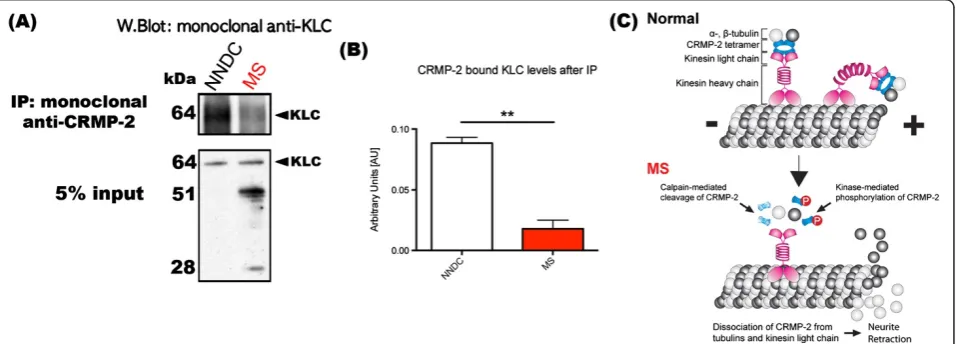
Collapsin response mediator proteins (CRMPs)CRMPs are a family of neuronal phosphoproteins [123] which regulate microtubule assembly as well as anterograde vesicular transport of important growth-related molecu-lar cargo along neuronal microtubules [124,125]. CRMP-2 (the most well defined of the CRMPs) has already been shown to be phosphorylated by Cdk-5 at Ser522 [126,127], determined as the priming kinase, glycogen synthase kinase 3β (GSK-3β) at Thr514/509/Ser 518 [128,129] and also Rho kinase at the Thr555 position [130,131], all of which can mediate neurite retraction. Such phosphorylation disrupts the association of CRMP-2 with tubulin heterodimers so that tubulin is not able to be
transported to the plus ends of microtubules for assembly, impeding directional growth of the neurite [125] (Figure 3). Importantly, phosphorylation of CRMP-2 reduces its binding to the kinesin-1 microtubule-related motor protein [132]. Since kinesin-1 is involved in anterograde vesicular axonal transport of molecules important for synaptic integrity and plasticity (e.g. BDNF receptor, TrkB) at the distal ends of axons [132], phosphorylation of CRMP-2 is expected to alter microtubule dynamics.
In terms of a pathogenic role attributed to the phos-phorylated forms of CRMP-2, there is a clear link with the neurodegenerative processes of Alzheimer’s disease (Aβ-mediated phosphorylated CRMP-2) [133,134]. Re-cently, our lab showed that a Rho kinase II- specific phosphorylated form of CRMP-2 has profound import-ance in EAE disease progression, where substantial in-crease in the degeneration of axons within the spinal cord and optic nerve could be observed. We found that the pThr555CRMP-2 form demonstrated during the peak stage of EAE can be reduced through the adminis-tration of a function blocking antibody against Nogo-A (potent neurite outgrowth inhibitor) or alternatively, through the overexpression of the phosphomutant form of CRMP-2 by using an adeno-associated virus serotype 2 gene delivery system, could individually reduce the markers of degenerative axons appearing [135]. Our la-boratory is now specifically targeting the phosphorylation
of CRMP-2, which may be a plausible therapeutic regime in the treatment of progressive MS.
Calpains as de-stabilizers of the neuronal cytoskeleton in the MS model
Calpain-mediated cleavage of integral myelin proteins, including myelin basic protein, has been proposed as a prominent pathological mechanism leading to profound demyelination during EAE disease onset and progression [136]. Indeed, translational expression and activity of calpain have been reported to increase in inflammatory cells, activated microglia and astrocytes at the time of onset of clinical signs during EAE [137,138]. More im-portantly, targeted calpain inhibition in the nervous system has been shown to reduce inflammation and de-myelination in the CNS as well as the clinical signs of EAE [139], suggested to be the result of attenuating the peripheral immune response to the CNS [140].
Calpains are members of the highly conserved calcium-dependent proteases capable of cleaving a vast array of cellular proteins [141]. Calpains are of specific interest in neurodegenerative disease since they can cleave cytoskeletal-related proteins such as the spectrin [142], tau [143], tubulin proteins and the CRMPs [144]. Since Ca2+-influx and the release of intracellular Ca2+ stores are plausible mechanisms by which axonal degeneration is potentiated during CNS injury and disease [141], the refractory transient increase in the deleterious calpains can potentially cause cleavage of cytoskeletal proteins and thus the collapse and degeneration of axons af-fected by these intracellular changes.
Two major isoforms of calpains exist namely, calpain-I (μ-calpain) activated at micromolar concentrations, and calpain-II (m-calpain) activated at up to millimolar con-centrations [145]. In EAE, calpain is increased in axons due to the alteration of Na+ and subsequently Ca2+ in-flux. The sustained activation of calpain can lead to axonal degeneration, a hallmark of the pathophysiology of EAE [146]. Preservation of axonal integrity in EAE has been achieved by the administration of calpain-specific inhibitors such as CYLA [139]. This inhibitor can be synthesized by addition of cysteic acid (which can be actively transported into the brain through those mechanisms utilized by taurine to the leucyl-argininal of leupeptin), effectively crossing the blood–brain bar-rier [147]. Hassen and co-workers, [139], have recently shown that administration of intraperitoneal CYLA (2 mg daily) resulted in reduced levels ofβAPP-positive and Nav1.6-positive axons (markers of axonal degener-ation) in spinal cords of MOG35–55-induced EAE mice [139]. These data correlated with abrogated clinical scores in the CYLA-treated EAE mice and argue for the utilization of calpain inhibitors to limit axonal
degeneration during neuroinflammatory CNS lesion for-mation, commonly characterized during MS pathogenesis.
Calpain and CRMP-2
There is now a more comprehensive argument for the provision of calpain inhibitors in MS and related neuro-logical conditions. CRMP-2 has been identified as a common substrate for calpain-I during Wallerian de-generation in vitro, and calpain-mediated cleavage of CRMP-2 (Figure 3) may lead to its autophagic process-ing [148]. Calpain is reported to cleave CRMPs follow-ing ischemic brain injury in mice [149]. It cleaves CRMP-4 in primary rat cortical cultures as a result of either NMDA-induced excitotoxic insult or H2O2-induced oxidative stress [150]. Zhang and colleagues [151], have demonstrated calpain-mediated proteolysis of CRMP-1, −2 and−4 following neurotoxin treatment of primary cortical neurons and also following trau-matic brain injury in the rat [151]. Hou and colleagues [152], have also found that calpain cleaves CRMP-3 fol-lowing excitotoxic insult in vitro and cerebral ischemia in vivo. Interestingly, these investigators have shown that the cleaved product of CRMP-3, translocates to the nucleus and induces not only axonal retraction but also neuronal death [152]. This group has subsequently studied the expression patterns of all isoforms of CRMP (CRMP-1 to 5) and the proteolytic activity of calpain on CRMPs in ischemic brain injury, discovering that all CRMPs were highly expressed in apoptotic neurons [149]. Furthermore, synaptosomal CRMPs were found to be more susceptible to calpain cleavage than cyto-solic CRMPs [149]. The physiological significance of this finding is unclear. However, it is possible that upon cleavage, synaptosomal CRMPs in particular, play a sig-nificant role in neuronal death with tantalizing implica-tions to grey matter pathology in MS and clinical progression [153].
Conclusion
are limited in their ability to reduce relapses and in many ways ineffective during SPMS or PPMS, future therapies must be designed to halt the progression of clinical sever-ity. From pre-clinical and clinical data, it is becoming evi-dent that axonal injury is directly related to clinical progression. Therefore, ameliorating axonal damage dur-ing MS can limit the severity of disease to enhance the quality of life for MS sufferers. However, the mechanisms of potential therapy targeting axonal degeneration must be clearly defined with the potential effects upon non-neuronal cells, documented to ensure disease stage speci-ficity without contraindications for MS patients.
Abbreviations
MS:Multiple sclerosis; RNFL: Retinal nerve fiber layer; OCT: Optical coherence tomography; DTI: Diffusion tensor imaging; CNS: Central nervous system; NAA: N-acetyl aspartate; NF-L: Neurofilament light chain; NF-H: Neurofilament heavy chain; SPMS: Secondary progressive multiple sclerosis; PPMS: Primary progressive MS; CRMP-2: Collapsin mediator protein-2; RRMS: Relapsing-remiting multiple sclerosis; MRI: Magnetic resonance imaging; Gd: Gadolinium; EAE: Experimental autoimmune encephalomyelitis; mfVEP: Multifocal visual evoked potential; MRS: Magnetic resonance spectroscopy; NAA/Cr: NAA/Creatine; NAWM: Normal appearing white matter; ROS: Reactive oxygen species; RNS: Reactive nitrogen species; HDAC: Histone deacetylase; SIRT: Sirtuin; PGC-1α: Peroxisome proliferator activated receptor co-activator 1-α; BDNF: Brain-derived growth factor; ASIC1: Acid-sensing ion channel-1; Th1: Type 1 helper T cells; Th17: Type 17 helper T cells; IFN-γ: Interferon-gamma; TNF: Tumor necrosis factor;
βAPP: Amyloid precursor protein; GSK-3β: glycogen synthase kinase 3β.
Competing interest
The authors declare that they have no competing interest.
Authors’contributions
JYL, KT and SP all wrote major sections of the manuscript. SP conceived the review and its structure. JYL constructed the Figures. SP edited the manuscript. All authors read and approved the final manuscript.
Acknowledgments
JYL supported by Multiple Sclerosis Research Australia Postgraduate Scholarship and Trish Multiple Sclerosis Research Foundation; KT supported by a Multiple Sclerosis Research Australia Student Vacation Scholarship; SP supported by National Multiple Sclerosis Society Project Grant #RG4398A1/1.
Author details
1Department of Medicine, Central Clinical School, Monash University, Prahran,
Victoria 3004, Australia.2Melbourne Medical School, Faculty of Medicine, Dentistry and Health Sciences, University of Melbourne, Parkville, Victoria 3010, Australia.
Received: 5 August 2014 Accepted: 6 August 2014 Published: 27 August 2014
References
1. Ascherio A, Marrie RA (2012) Vitamin D in MS: a vitamin for 4 seasons. Neurology 79(3):208–210
2. Dutta R, Trapp BD (2011) Mechanisms of neuronal dysfunction and degeneration in multiple sclerosis. Prog Neurobiol 93(1):1–12
3. Calabresi PA (2004) Diagnosis and management of multiple sclerosis. Am Fam Physician 70(10):1935–1944
4. Polman CH, Reingold SC, Banwell B, Clanet M, Cohen JA, Filippi M, Fujihara K, Havrdova E, Hutchinson M, Kappos L, Lublin FD, Montalban X, O’Connor P, Sandberg-Wollheim M, Thompson AJ, Waubant E, Weinshenker B, Wolinsky JS (2011) Diagnostic criteria for multiple sclerosis: 2010 revisions to the McDonald criteria. Ann Neurol 69(2):292–302
5. Hauser SL, Oksenberg JR (2006) The neurobiology of multiple sclerosis: genes, inflammation, and neurodegeneration. Neuron 52(1):61–76
6. DeBoy CA, Zhang J, Dike S, Shats I, Jones M, Reich DS, Mori S, Nguyen T, Rothstein B, Miller RH, Griffin JT, Kerr DA, Calabresi PA (2007) High resolution diffusion tensor imaging of axonal damage in focal inflammatory and demyelinating lesions in rat spinal cord. Brain 130(Pt 8):2199–2210 7. Sbardella E, Tona F, Petsas N, Pantano P (2013) DTI Measurements in
Multiple Sclerosis: Evaluation of Brain Damage and Clinical Implications. Mult Scler Int 2013:671730
8. Pierpaoli C, Jezzard P, Basser PJ, Barnett A, Di Chiro G (1996) Diffusion tensor MR imaging of the human brain. Radiology 201(3):637–648 9. Filippi M, Iannucci G, Cercignani M, Assunta Rocca M, Pratesi A, Comi G
(2000) A quantitative study of water diffusion in multiple sclerosis lesions and normal-appearing white matter using echo-planar imaging. Arch Neurol 57(7):1017–1021
10. Horsfield MA, Larsson HB, Jones DK, Gass A (1998) Diffusion magnetic resonance imaging in multiple sclerosis. J Neurol Neurosurg Psychiatry 64(Suppl 1):S80–S84
11. Filippi M (2001) Magnetic resonance imaging findings predicting subsequent disease course in patients at presentation with clinically isolated syndromes suggestive of multiple sclerosis. Neurol Sci 22(Suppl 2):S49–S51 12. Preziosa P, Rocca MA, Mesaros S, Pagani E, Stosic-Opincal T, Kacar K, Absinta M,
Caputo D, Drulovic J, Comi G, Filippi M (2011) Intrinsic damage to the major white matter tracts in patients with different clinical phenotypes of multiple sclerosis: a voxelwise diffusion-tensor MR study. Radiology 260(2):541–550 13. Fink F, Klein J, Lanz M, Mitrovics T, Lentschig M, Hahn HK, Hildebrandt H
(2010) Comparison of diffusion tensor-based tractography and quantified brain atrophy for analyzing demyelination and axonal loss in MS. J Neuroimaging 20(4):334–344
14. Griffin CM, Chard DT, Ciccarelli O, Kapoor B, Barker GJ, Thompson AI, Miller DH (2001) Diffusion tensor imaging in early relapsing-remitting multiple sclerosis. Mult Scler 7(5):290–297
15. Benedetti B, Rocca MA, Rovaris M, Caputo D, Zaffaroni M, Capra R, Bertolotto A, Martinelli V, Comi G, Filippi M (2010) A diffusion tensor MRI study of cervical cord damage in benign and secondary progressive multiple sclerosis patients. J Neurol Neurosurg Psychiatry 81(1):26–30 16. Liu Y, Duan Y, He Y, Yu C, Wang J, Huang J, Ye J, Parizel PM, Li K, Shu N
(2012) Whole brain white matter changes revealed by multiple diffusion metrics in multiple sclerosis: a TBSS study. Eur J Radiol 81(10):2826–2832 17. Giorgio A, De Stefano N (2010) Cognition in multiple sclerosis: relevance of
lesions, brain atrophy and proton MR spectroscopy. Neurol Sci 31(Suppl 2): S245–S248
18. Onu M, Roceanu A, Sboto-Frankenstein U, Bendic R, Tarta E, Preoteasa F, Bajenaru O (2012) Diffusion abnormality maps in demyelinating disease: correlations with clinical scores. Eur J Radiol 81(3):e386–e391
19. Ciccarelli O, Wheeler-Kingshott CA, McLean MA, Cercignani M, Wimpey K, Miller DH, Thompson AJ (2007) Spinal cord spectroscopy and diffusion-based tractography to assess acute disability in multiple sclerosis. Brain 130(Pt 8):2220–2231
20. Reich DS, Smith SA, Zackowski KM, Gordon-Lipkin EM, Jones CK, Farrell JA, Mori S, van Zijl PC, Calabresi PA (2007) Multiparametric magnetic resonance imaging analysis of the corticospinal tract in multiple sclerosis. Neuroimage 38(2):271–279 21. van der Walt A, Kolbe SC, Wang YE, Klistorner A, Shuey N, Ahmadi G, Paine
M, Marriott M, Mitchell P, Egan GF, Butzkueven H, Kilpatrick TJ (2013) Optic nerve diffusion tensor imaging after acute optic neuritis predicts axonal and visual outcomes. PLoS One 8(12):e83825
22. Moll NM, Rietsch AM, Thomas S, Ransohoff AJ, Lee JC, Fox R, Chang A, Ransohoff RM, Fisher E (2011) Multiple sclerosis normal-appearing white matter: pathology-imaging correlations. Ann Neurol 70(5):764–773 23. Kallenbach K, Frederiksen J (2007) Optical coherence tomography in optic
neuritis and multiple sclerosis: a review. Eur J Neurol 14(8):841–849 24. Klistorner A, Arvind H, Nguyen T, Garrick R, Paine M, Graham S, O’Day J,
Grigg J, Billson F, Yiannikas C (2008) Axonal loss and myelin in early ON loss in postacute optic neuritis. Ann Neurol 64(3):325–331
25. Klistorner A, Sriram P, Vootakuru N, Wang C, Barnett MH, Garrick R, Parratt J, Levin N, Raz N, Van der Walt A, Masters L, Graham SL, Yiannikas C (2014) Axonal loss of retinal neurons in multiple sclerosis associated with optic radiation lesions. Neurology 82(24):2165–2172
26. Tewarie P, Balk L, Costello F, Green A, Martin R, Schippling S, Petzold A (2012) The OSCAR-IB consensus criteria for retinal OCT quality assessment. PLoS One 7(4):e34823
Vermersch P, Villoslada P, Wolf S, Petzold A (2014) Quality control for retinal OCT in multiple sclerosis: validation of the OSCAR-IB criteria. Mult Scler, doi:10.1177/1352458514538110
28. Teunissen CE, Dijkstra C, Polman C (2005) Biological markers in CSF and blood for axonal degeneration in multiple sclerosis. Lancet Neurol 4(1):32–41
29. Filippi M, Bozzali M, Rovaris M, Gonen O, Kesavadas C, Ghezzi A, Martinelli V, Grossman RI, Scotti G, Comi G, Falini A (2003) Evidence for widespread axonal damage at the earliest clinical stage of multiple sclerosis. Brain 126(Pt 2):433–437
30. Gonen O, Moriarty DM, Li BS, Babb JS, He J, Listerud J, Jacobs D, Markowitz CE, Grossman RI (2002) Relapsing-remitting multiple sclerosis and whole-brain N-acetylaspartate measurement: evidence for different clinical cohorts initial observations. Radiology 225(1):261–268
31. Rovaris M, Gambini A, Gallo A, Falini A, Ghezzi A, Benedetti B, Sormani MP, Martinelli V, Comi G, Filippi M (2005) Axonal injury in early multiple sclerosis is irreversible and independent of the short-term disease evolution. Neurology 65(10):1626–1630
32. De Stefano N, Narayanan S, Francis SJ, Smith S, Mortilla M, Tartaglia MC, Bartolozzi ML, Guidi L, Federico A, Arnold DL (2002) Diffuse axonal and tissue injury in patients with multiple sclerosis with low cerebral lesion load and no disability. Arch Neurol 59(10):1565–1571
33. Fu L, Matthews PM, De Stefano N, Worsley KJ, Narayanan S, Francis GS, Antel JP, Wolfson C, Arnold DL (1998) Imaging axonal damage of normal-appearing white matter in multiple sclerosis. Brain 121(Pt 1):103–113 34. Ruiz-Pena JL, Pinero P, Sellers G, Argente J, Casado A, Foronda J, Ucles A,
Izquierdo G (2004) Magnetic resonance spectroscopy of normal appearing white matter in early relapsing-remitting multiple sclerosis: correlations between disability and spectroscopy. BMC Neurol 4:8
35. Srinivasan R, Sailasuta N, Hurd R, Nelson S, Pelletier D (2005) Evidence of elevated glutamate in multiple sclerosis using magnetic resonance spectroscopy at 3 T. Brain 128(Pt 5):1016–1025
36. Simone IL, Tortorella C, Federico F, Liguori M, Lucivero V, Giannini P, Carrara D, Bellacosa A, Livrea P (2001) Axonal damage in multiple sclerosis plaques: a combined magnetic resonance imaging and 1H-magnetic resonance spectroscopy study. J Neurol Sci 182(2):143–150
37. Pascual AM, Bisbal MC, Bosca I, Valero C, Coret F, Martinez-Granados B, Marti-Bonmati L, Mir A, Celda B, Casanova B (2007) Axonal loss is progressive and partly dissociated from lesion load in early multiple sclerosis. Neurology 69(1):63–67
38. Oh J, Pelletier D, Nelson SJ (2004) Corpus callosum axonal injury in multiple sclerosis measured by proton magnetic resonance spectroscopic imaging. Arch Neurol 61(7):1081–1086
39. Sarchielli P, Presciutti O, Pelliccioli GP, Tarducci R, Gobbi G, Chiarini P, Alberti A, Vicinanza F, Gallai V (1999) Absolute quantification of brain metabolites by proton magnetic resonance spectroscopy in normal-appearing white matter of multiple sclerosis patients. Brain 122(Pt 3):513–521
40. Cader S, Johansen-Berg H, Wylezinska M, Palace J, Behrens TE, Smith S, Matthews PM (2007) Discordant white matter N-acetylasparate and diffusion MRI measures suggest that chronic metabolic dysfunction contributes to axonal pathology in multiple sclerosis. Neuroimage 36(1):19–27 41. Blamire AM, Cader S, Lee M, Palace J, Matthews PM (2007) Axonal damage
in the spinal cord of multiple sclerosis patients detected by magnetic resonance spectroscopy. Magn Reson Med 58(5):880–885
42. Parry A, Corkill R, Blamire AM, Palace J, Narayanan S, Arnold D, Styles P, Matthews PM (2003) Beta-Interferon treatment does not always slow the progression of axonal injury in multiple sclerosis. J Neurol 250(2):171–178 43. Tiberio M, Chard DT, Altmann DR, Davies G, Griffin CM, McLean MA, Rashid
W, Sastre-Garriga J, Thompson AJ, Miller DH (2006) Metabolite changes in early relapsing-remitting multiple sclerosis. A two year follow-up study. J Neurol 253(2):224–230
44. Zaaraoui W, Rico A, Audoin B, Reuter F, Malikova I, Soulier E, Viout P, Le Fur Y, Confort-Gouny S, Cozzone PJ, Pelletier J, Ranjeva JP (2010) Unfolding the long-term pathophysiological processes following an acute inflammatory demyelinating lesion of multiple sclerosis. Magn Reson Imaging 28(4):477–486 45. Bates TE, Strangward M, Keelan J, Davey GP, Munro PM, Clark JB (1996)
Inhibition of N-acetylaspartate production: implications for 1H MRS studies
in vivo. Neuroreport 7(8):1397–1400
46. Narayana PA, Wolinsky JS, Rao SB, He R, Mehta M, Group PRTM (2004) Multicentre proton magnetic resonance spectroscopy imaging of primary progressive multiple sclerosis. Mult Scler 10(Suppl 1):S73–S78
47. Sarchielli P, Presciutti O, Tarducci R, Gobbi G, Alberti A, Pelliccioli GP, Chiarini P, Gallai V (2002) Localized (1)H magnetic resonance spectroscopy in mainly cortical gray matter of patients with multiple sclerosis. J Neurol 249(7):902–910 48. Sastre-Garriga J, Ingle GT, Chard DT, Ramio-Torrenta L, McLean MA, Miller
DH, Thompson AJ (2005) Metabolite changes in normal-appearing gray and white matter are linked with disability in early primary progressive multiple sclerosis. Arch Neurol 62(4):569–573
49. Adalsteinsson E, Langer-Gould A, Homer RJ, Rao A, Sullivan EV, Lima CA, Pfefferbaum A, Atlas SW (2003) Gray matter N-acetyl aspartate deficits in secondary progressive but not relapsing-remitting multiple sclerosis. AJNR Am J Neuroradiol 24(10):1941–1945
50. Gadea M, Martinez-Bisbal MC, Marti-Bonmati L, Espert R, Casanova B, Coret F, Celda B (2004) Spectroscopic axonal damage of the right locus coeruleus relates to selective attention impairment in early stage relapsing-remitting multiple sclerosis. Brain 127(Pt 1):89–98
51. Christodoulou C, Krupp LB, Liang Z, Huang W, Melville P, Roque C, Scherl WF, Morgan T, MacAllister WS, Li L, Tudorica LA, Li X, Roche P, Peyster R (2003) Cognitive performance and MR markers of cerebral injury in cognitively impaired MS patients. Neurology 60(11):1793–1798
52. Khan O, Shen Y, Bao F, Caon C, Tselis A, Latif Z, Zak I (2008) Long-term study of brain 1H-MRS study in multiple sclerosis: effect of glatiramer acetate therapy on axonal metabolic function and feasibility of long-term H-MRS monitoring in multiple sclerosis. J Neuroimaging 18(3):314–319 53. Wood ET, Ronen I, Techawiboonwong A, Jones CK, Barker PB, Calabresi P,
Harrison D, Reich DS (2012) Investigating axonal damage in multiple sclerosis by diffusion tensor spectroscopy. J Neurosci 32(19):6665–6669 54. Marques IB, Matias F, Silva ED, Cunha L, Sousa L (2014) Risk of multiple sclerosis after optic neuritis in patients with normal baseline brain MRI. J Clin Neurosci 21(4):583–586
55. Evans RW, Armon C, Frohman EM, Goodin DS (2000) Assessment: prevention of post-lumbar puncture headaches: report of the therapeutics and technology assessment subcommittee of the american academy of neurology. Neurology 55(7):909–914
56. Teunissen CE, Khalil M (2012) Neurofilaments as biomarkers in multiple sclerosis. Mult Scler 18(5):552–556
57. Kuhle J, Plattner K, Bestwick JP, Lindberg RL, Ramagopalan SV, Norgren N, Nissim A, Malaspina A, Leppert D, Giovannoni G, Kappos L (2013) A comparative study of CSF neurofilament light and heavy chain protein in MS. Mult Scler 19(12):1597–1603
58. Khalil M, Enzinger C, Langkammer C, Ropele S, Mader A, Trentini A, Vane ML, Wallner-Blazek M, Bachmaier G, Archelos JJ, Koel-Simmelink MJ, Blankenstein MA, Fuchs S, Fazekas F, Teunissen CE (2013) CSF neurofilament and N-acetylaspartate related brain changes in clinically isolated syndrome. Mult Scler 19(4):436–442
59. Madeddu R, Farace C, Tolu P, Solinas G, Asara Y, Sotgiu MA, Delogu LG, Prados JC, Sotgiu S, Montella A (2013) Cytoskeletal proteins in the cerebrospinal fluid as biomarker of multiple sclerosis. Neurol Sci 34(2):181–186 60. Malmestrom C, Haghighi S, Rosengren L, Andersen O, Lycke J (2003)
Neurofilament light protein and glial fibrillary acidic protein as biological markers in MS. Neurology 61(12):1720–1725
61. Huizinga R, Heijmans N, Schubert P, Gschmeissner S, t’Hart BA, Herrmann H, Amor S (2007) Immunization with neurofilament light protein induces spastic paresis and axonal degeneration in Biozzi ABH mice. J Neuropathol Exp Neurol 66(4):295–304
62. Huizinga R, Gerritsen W, Heijmans N, Amor S (2008) Axonal loss and gray matter pathology as a direct result of autoimmunity to neurofilaments. Neurobiol Dis 32(3):461–470
63. Kuhle J, Leppert D, Petzold A, Regeniter A, Schindler C, Mehling M, Anthony DC, Kappos L, Lindberg RL (2011) Neurofilament heavy chain in CSF correlates with relapses and disability in multiple sclerosis. Neurology 76(14):1206–1213 64. Gunnarsson M, Malmestrom C, Axelsson M, Sundstrom P, Dahle C, Vrethem
M, Olsson T, Piehl F, Norgren N, Rosengren L, Svenningsson A, Lycke J (2011) Axonal damage in relapsing multiple sclerosis is markedly reduced by natalizumab. Ann Neurol 69(1):83–89
65. Axelsson M, Malmestrom C, Gunnarsson M, Zetterberg H, Sundstrom P, Lycke J, Svenningsson A (2014) Immunosuppressive therapy reduces axonal damage in progressive multiple sclerosis. Mult Scler 20(1):43–50
67. Gnanapavan S, Grant D, Morant S, Furby J, Hayton T, Teunissen CE, Leoni V, Marta M, Brenner R, Palace J, Miller DH, Kapoor R, Giovannoni G (2013) Biomarker report from the phase II lamotrigine trial in secondary progressive MS - neurofilament as a surrogate of disease progression. PLoS One 8(8):e70019 68. Kiryu-Seo S, Ohno N, Kidd GJ, Komuro H, Trapp BD (2010) Demyelination
increases axonal stationary mitochondrial size and the speed of axonal mitochondrial transport. J Neurosci 30(19):6658–6666
69. Friese MA, Schattling B, Fugger L (2014) Mechanisms of neurodegeneration and axonal dysfunction in multiple sclerosis. Nat Rev Neurol 10(4):225–238 70. Witte ME, Mahad DJ, Lassmann H, van Horssen J (2014) Mitochondrial
dysfunction contributes to neurodegeneration in multiple sclerosis. Trends Mol Med 20(3):179–187
71. Dutta R, McDonough J, Yin X, Peterson J, Chang A, Torres T, Gudz T, Macklin WB, Lewis DA, Fox RJ, Rudick R, Mirnics K, Trapp BD (2006) Mitochondrial dysfunction as a cause of axonal degeneration in multiple sclerosis patients. Ann Neurol 59(3):478–489
72. Campbell GR, Ziabreva I, Reeve AK, Krishnan KJ, Reynolds R, Howell O, Lassmann H, Turnbull DM, Mahad DJ (2011) Mitochondrial DNA deletions and neurodegeneration in multiple sclerosis. Ann Neurol 69(3):481–492 73. Mahad DJ, Ziabreva I, Campbell G, Lax N, White K, Hanson PS, Lassmann H,
Turnbull DM (2009) Mitochondrial changes within axons in multiple sclerosis. Brain 132(Pt 5):1161–1174
74. van Horssen J, Witte ME, Ciccarelli O (2012) The role of mitochondria in axonal degeneration and tissue repair in MS. Mult Scler 18(8):1058–1067 75. Zambonin JL, Zhao C, Ohno N, Campbell GR, Engeham S, Ziabreva I, Schwarz
N, Lee SE, Frischer JM, Turnbull DM, Trapp BD, Lassmann H, Franklin RJ, Mahad DJ (2011) Increased mitochondrial content in remyelinated axons: implications for multiple sclerosis. Brain 134(Pt 7):1901–1913
76. Faraco G, Cavone L, Chiarugi A (2011) The therapeutic potential of HDAC inhibitors in the treatment of multiple sclerosis. Mol Med 17(5–6):442–447 77. Camelo S, Iglesias AH, Hwang D, Due B, Ryu H, Smith K, Gray SG, Imitola J,
Duran G, Assaf B, Langley B, Khoury SJ, Stephanopoulos G, De Girolami U, Ratan RR, Ferrante RJ, Dangond F (2005) Transcriptional therapy with the histone deacetylase inhibitor trichostatin A ameliorates experimental autoimmune encephalomyelitis. J Neuroimmunol 164(1–2):10–21 78. Kim JY, Shen S, Dietz K, He Y, Howell O, Reynolds R, Casaccia P (2010)
HDAC1 nuclear export induced by pathological conditions is essential for the onset of axonal damage. Nat Neurosci 13(2):180–189
79. Shen S, Sandoval J, Swiss VA, Li J, Dupree J, Franklin RJ, Casaccia-Bonnefil P (2008) Age-dependent epigenetic control of differentiation inhibitors is critical for remyelination efficiency. Nat Neurosci 11(9):1024–1034 80. Shindler KS, Ventura E, Rex TS, Elliott P, Rostami A (2007) SIRT1 activation
confers neuroprotection in experimental optic neuritis. Invest Ophthalmol Vis Sci 48(8):3602–3609
81. Shindler KS, Ventura E, Dutt M, Elliott P, Fitzgerald DC, Rostami A (2010) Oral resveratrol reduces neuronal damage in a model of multiple sclerosis. J Neuroophthalmol 30(4):328–339
82. Khan RS, Fonseca-Kelly Z, Callinan C, Zuo L, Sachdeva MM, Shindler KS (2012) SIRT1 activating compounds reduce oxidative stress and prevent cell death in neuronal cells. Front Cell Neurosci 6:63
83. Nimmagadda VK, Bever CT, Vattikunta NR, Talat S, Ahmad V, Nagalla NK, Trisler D, Judge SI, Royal W 3rd, Chandrasekaran K, Russell JW, Makar TK (2013) Overexpression of SIRT1 protein in neurons protects against experimental autoimmune encephalomyelitis through activation of multiple SIRT1 targets. J Immunol 190(9):4595–4607
84. Rafalski VA, Ho PP, Brett JO, Ucar D, Dugas JC, Pollina EA, Chow LM, Ibrahim A, Baker SJ, Barres BA, Steinman L, Brunet A (2013) Expansion of
oligodendrocyte progenitor cells following SIRT1 inactivation in the adult brain. Nat Cell Biol 15(6):614–624
85. Pennisi G, Cornelius C, Cavallaro MM, Salinaro AT, Cambria MT, Pennisi M, Bella R, Milone P, Ventimiglia B, Migliore MR, Di Renzo L, De Lorenzo A, Calabrese V (2011) Redox regulation of cellular stress response in multiple sclerosis. Biochem Pharmacol 82(10):1490–1499
86. Waxman SG (2008) Mechanisms of disease: sodium channels and neuroprotection in multiple sclerosis-current status. Nat Clin Pract Neurol 4(3):159–169
87. Moll C, Mourre C, Lazdunski M, Ulrich J (1991) Increase of sodium channels in demyelinated lesions of multiple sclerosis. Brain Res 556(2):311–316 88. Kapoor R, Li YG, Smith KJ (1997) Slow sodium-dependent potential
oscillations contribute to ectopic firing in mammalian demyelinated axons. Brain 120(Pt 4):647–652
89. Craner MJ, Newcombe J, Black JA, Hartle C, Cuzner ML, Waxman SG (2004) Molecular changes in neurons in multiple sclerosis: altered axonal expression of Nav1.2 and Nav1.6 sodium channels and Na+/Ca2+ exchanger. Proc Natl Acad Sci U S A 101(21):8168–8173
90. Rush AM, Dib-Hajj SD, Waxman SG (2005) Electrophysiological properties of two axonal sodium channels, Nav1.2 and Nav1.6, expressed in mouse spinal sensory neurones. J Physiol 564(Pt 3):803–815
91. Black JA, Newcombe J, Trapp BD, Waxman SG (2007) Sodium channel expression within chronic multiple sclerosis plaques. J Neuropathol Exp Neurol 66(9):828–837
92. Black JA, Liu S, Hains BC, Saab CY, Waxman SG (2006) Long-term protection of central axons with phenytoin in monophasic and chronic-relapsing EAE. Brain 129(Pt 12):3196–3208
93. Persson AK, Kim I, Zhao P, Estacion M, Black JA, Waxman SG (2013) Sodium channels contribute to degeneration of dorsal root ganglion neurites induced by mitochondrial dysfunction in anin vitromodel of axonal injury. J Neurosci 33(49):19250–19261
94. Bechtold DA, Yue X, Evans RM, Davies M, Gregson NA, Smith KJ (2005) Axonal protection in experimental autoimmune neuritis by the sodium channel blocking agent flecainide. Brain 128(Pt 1):18–28
95. Craner MJ, Damarjian TG, Liu S, Hains BC, Lo AC, Black JA, Newcombe J, Cuzner ML, Waxman SG (2005) Sodium channels contribute to microglia/ macrophage activation and function in EAE and MS. Glia 49(2):220–229 96. Black JA, Liu S, Carrithers M, Carrithers LM, Waxman SG (2007) Exacerbation
of experimental autoimmune encephalomyelitis after withdrawal of phenytoin and carbamazepine. Ann Neurol 62(1):21–33
97. Brand-Schieber E, Werner P (2004) Calcium channel blockers ameliorate disease in a mouse model of multiple sclerosis. Exp Neurol 189(1):5–9 98. Kapoor R, Furby J, Hayton T, Smith KJ, Altmann DR, Brenner R, Chataway J,
Hughes RA, Miller DH (2010) Lamotrigine for neuroprotection in secondary progressive multiple sclerosis: a randomised, double-blind, placebo-controlled, parallel-group trial. Lancet Neurol 9(7):681–688
99. Friese MA, Craner MJ, Etzensperger R, Vergo S, Wemmie JA, Welsh MJ, Vincent A, Fugger L (2007) Acid-sensing ion channel-1 contributes to axonal degeneration in autoimmune inflammation of the central nervous system. Nat Med 13(12):1483–1489
100. Vergo S, Craner MJ, Etzensperger R, Attfield K, Friese MA, Newcombe J, Esiri M, Fugger L (2011) Acid-sensing ion channel 1 is involved in both axonal injury and demyelination in multiple sclerosis and its animal model. Brain 134(Pt 2):571–584
101. Arun T, Tomassini V, Sbardella E, de Ruiter MB, Matthews L, Leite MI, Gelineau-Morel R, Cavey A, Vergo S, Craner M, Fugger L, Rovira A, Jenkinson M, Palace J (2013) Targeting ASIC1 in primary progressive multiple sclerosis: evidence of neuroprotection with amiloride. Brain 136(Pt 1):106–115
102. Al-Izki S, Pryce G, Hankey DJ, Lidster K, von Kutzleben SM, Browne L, Clutterbuck L, Posada C, Edith Chan AW, Amor S, Perkins V, Gerritsen WH, Ummenthum K, Peferoen-Baert R, van der Valk P, Montoya A, Joel SP, Garthwaite J, Giovannoni G, Selwood DL, Baker D (2014) Lesional-targeting of neuroprotection to the inflammatory penumbra in experimental multiple sclerosis. Brain 137(Pt 1):92–108
103. Browne L, Lidster K, Al-Izki S, Clutterbuck L, Posada C, Chan AE, Riddall D, Garthwaite J, Baker D, Selwood DL (2014) Imidazol-1-ylethylindazole voltage gated sodium (Na) channel ligands are neuroprotective during optic neuritis in a mouse model of multiple sclerosis. J Med Chem 57(7):2942–2952
104. Pomeroy IM, Jordan EK, Frank JA, Matthews PM, Esiri MM (2010) Focal and diffuse cortical degenerative changes in a marmoset model of multiple sclerosis. Mult Scler 16(5):537–548
105. Gray E, Rice C, Nightingale H, Ginty M, Hares K, Kemp K, Cohen N, Love S, Scolding N, Wilkins A (2013) Accumulation of cortical hyperphosphorylated neurofilaments as a marker of neurodegeneration in multiple sclerosis. Mult Scler 19(2):153–161
106. Papadopoulos D, Dukes S, Patel R, Nicholas R, Vora A, Reynolds R (2009) Substantial archaeocortical atrophy and neuronal loss in multiple sclerosis. Brain Pathol 19(2):238–253
107. Wegner C, Esiri MM, Chance SA, Palace J, Matthews PM (2006) Neocortical neuronal, synaptic, and glial loss in multiple sclerosis. Neurology 67(6):960–967 108. Dutta R, Chang A, Doud MK, Kidd GJ, Ribaudo MV, Young EA, Fox RJ,