DRTC – ICT Conference on Digital Learning Environment 11th –13th January 2006 DRTC, Bangalore
Paper: G
Components of the Digital Learning Environment
G. Dhanasegaran
Dr.T.P.M.Library, Madurai Kamaraj University, Madurai, Tamil Nadu.
Abstract
2
1. Introduction
Information technology is having a profound effect on education by opening the whole world of knowledge and allowing teaching and learning to take place beyond the traditional boundaries. The exponential growth of internet and the use of online communication for Digital Learning warrants for equipping every one with new mechanism such as computer networks, search engines, multimedia, content portals, electronic libraries and web enabled class rooms. Many teaching programmes incorporate the tools and techniques of Digital Learning. The Digital Learning environment provides the learners with an interactive mode in a successful way.
2. Digital Learning - What?
Digital Learning (1) means electronic education and training online. Digital Learning is Internet – enabled learning, the components of which include:
• Content delivery in multiple formats
• Management of the learning experience and
• A Networked community of learners, context developers and experts
3. Digital Learning Environment – characteristic features
The Digital Learning Environment provides an integrated learning environment based on digital library technology. Learning materials are explicitly organized, accessed, and presented in a way that shows objective scientific concepts and their interrelationships. The Digital Learning Environment lets the teacher create, use, and re-use learning materials in different fields of science and in various learning environments, including classroom, laboratory, and self-guided environments. The Characteristic features of Digital Learning environment are:
1. Tools for teaching and learning are portable 2. Teaching and learning anywhere any time
3. Alternative models for paying for education will evolve 4. Students will be consumers with substantive amount of choice 5. Increased level of student activities
6. Degrees may be obtained with a much increased level of institutional mix
7. Learning is moving off the campus to home, workplace, and field
4. Why Digital Learning?
Digital learning is important in this ICT era due to the following reasons: • Learning is self- paced and gives students a chance to learn
according to their own capabilities • Learning is self-directed
• Digital learning allows students to choose content and tools appropriate to their varying interests, need and skill levels.
• Accommodates multiple learning styles. • Geographical barriers are eliminated
• 24 / 7 accessibility makes scheduling easy and allows a greater number of people to attend classes.
• Travel time is reduced or eliminated. • Overall student costs are less.
4
• Enhances computer and Internet skills.
5. How to Initiate Digital Learning?
In India digital learning (2) is in the infant stage full of problems, brimming with exciting prospects, a growing population of enthusiasts, and a continuing arrogance of the non-believers whose number is getting smaller. In spite of this, Digital Learning can be initiated by:
1. Exploring the vital role of different information technologies (print, audio, visual and digital)
2. Sharing policies, strategies, experiences and tools in harnessing technologies for knowledge dissemination, effective learning and efficient education sources.
3. Reviewing the latest systems and products of technologies of today.
4. Exchanging information about resources and knowledge networks.
6. Modes of Digital Learning
Digital learning can be offered in two modes namely: 6.1 Online mode
6.2 E-correspondence mode
6.1 Online Mode
• Access to virtual classroom in the website for collaborative learning experience
• Semester wise Interactive course ware CDs
• Optional short term contact programme in each semester • Facility to order the course ware books
• Access to latest information about the students Admission status, course ware, payment details, examination and certification details • Access to online library providing links to digital libraries
6.2 E-correspondence mode
Under this mode, the learners are entitled to the following benefits: • Semester wise interactive courseware CD
• Courseware books.
• E-mail facility for interacting with the faculty members
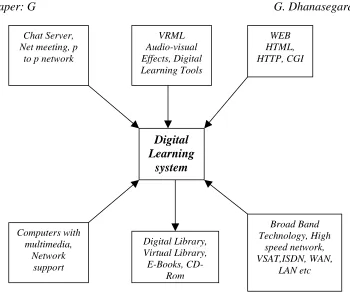
7. Digital Learning Environment Components
(3)
The Web is based on a 3-part architecture such as:
• HTML- Hyper Text Markup Language, the format for web pages provides both formatting and hyper-linking
• HTTP-Hyper Text Transfer Protocol, the protocol to communication between web servers and browsers
• CGI-The Common Gateway Interface, the interface for invoking programs from web servers
6
Chat Server, Net meeting, p
to p network
WEB HTML, HTTP, CGI VRML Audio-visual Effects, Digital Learning Tools Digital Learning system Digital Library, Virtual Library, E-Books, CD-Rom Broad Band Technology, High speed network, VSAT,ISDN, WAN, LAN etc Computers with multimedia, Network support
Fig. 1 Digital Learning Architecture
The other tools for Digital learning environment include a suite of software tools to make it easy to catalog the digital assets, create concepts, and build structured lectures. These tools include:
• Cataloging Tools - create textual and geospatial item-level metadata
about library objects
• Concept System - creates concepts and relationships between
concepts in a knowledge base, and displays the concepts graphically
• Lecture Composer - creates structured lectures using concepts from
the knowledge base and objects from the Digital Library
8. Digital Learning in LIS education
the year 1993 by Syracuse University, New York. 12 LIS schools accredited to ALA. In India many Library and Information Science schools are in the process of introducing Digital Learning as a tool for continuous learning.
9. Digital Learning in India
(4)
The main reason why Digital Learning has not taken off in India, is the fact that Digital Learning packages are mainly in English, while most of the population in India is conversant with vernacular languages. The digitalized text has to come in vernacular languages as well, to make it successful.
In India, National Institute of Science Communication and Information Resources (NISCAIR) has electronically connected all the libraries together through ATC network.
The Melur Taluk in Madurai District, Tamil Nadu would probably the first one in the country where Digital Learning would take off soon in seven schools through the project “Sustained Access to Rural India”. The important Digital Learning project initiatives in India are:
• Digital Learning front in Kerala • E- Seva in Andhra Pradesh • E- gurucool.com
10. Conclusion
8
11. References
1. Neeraj kumar Chaurasia and Ganesh Kumar. E-Education: an online perspective. In Road Map to New Generation of Libraries using Emerging Technologies. Ahmedabad: INFLIBNET Centre, 2004. 432-437.
2. Kannan. S, Bharadwaj, R S, Ravinder, D. E-Education in Modern Era. In Road Map to New Generation of Libraries using Emerging Technologies. Ahmedabad: INFLIBNET Centre, 2004. 438-442. 3. Duggan, E. E-education, its virtually here. http://bizournal.com 4. Shiva Kanaujia, Satyanarayana, N R. E-Education in India: pace of