VOLUME 38, ARTICLE 14, PAGES 321
,
334
PUBLISHED 24 JANUARY 2018
http://www.demographic-research.org/Volumes/Vol38/14/ DOI: 10.4054/DemRes.2018.38.14
Descriptive Finding
Shocks and migration in Malawi
Philip Anglewicz
Tyler W. Myroniuk
© 2018 Philip Anglewicz & Tyler W. Myroniuk.
This open-access work is published under the terms of the Creative Commons Attribution 3.0 Germany (CC BY 3.0 DE), which permits use, reproduction, and distribution in any medium, provided the original author(s) and source are given credit.
1 Introduction 322
2 Data and methods 323
2.1 Data 323
2.2 Measures 324
2.3 Analytic methods 325
3 Results 325
4 Discussion 330
5 Acknowledgements 331
Descriptive Finding
Shocks and migration in Malawi
Philip Anglewicz1Tyler W. Myroniuk2
Abstract
BACKGROUNDResearch on the relationship between shocks and migration has primarily focused on large shocks, such as natural disasters or economic crises. Far less is known about smaller shocks, despite the fact that these shocks are common and often have a large impact on individuals and households, particularly in developing settings.
OBJECTIVE
We examine whether rural Malawians move after experiencing different types of small-scale shocks and examine if this relationship differs by gender and the number of shocks experienced.
METHODS
We use longitudinal panel data and measure shock exposure in 2008 and migration by 2010, which permits us to identify the order of events between migration and shock experience. We use multivariate logistic regression models to examine the relationship between shock experience and migration.
RESULTS
Those who experienced shocks in 2008 are significantly more likely to migrate. Men are more likely to move after environmental/economic shocks, while women are more likely to move after household shocks. While experiencing one shock does not lead to migration, those experiencing multiple shocks are more likely to migrate.
CONCLUSIONS
Small-scale shocks appear to force many rural Malawians to move residences. But the exact relationship between shocks and migration varies by gender and the number of shocks experienced.
1 Department of Global Community Health and Behavioral Science, School of Public Health and Tropi-cal Medicine, Tulane University, New Orleans, USA. Email:[email protected].
CONTRIBUTION
Although seldom examined in research, our results demonstrate that small-scale shocks can lead to migration. These results suggest that, contrary to a common assumption that migrants are often better-off than their nonmigrant peers, migrants may be a vulnerable population in some settings and circumstances.
1. Introduction
Residents of resource-deprived settings, like rural Malawi, are frequently exposed to various types of shocks. These shocks can be environmental, such as floods or droughts; economic, such as famines, and fluctuating prices for agricultural products; or filial, such as the death of household members (Gray and Bilsborrow 2013; Foresight 2011; IPCC 2014; Unite Nations 2015). The persistent, underlying threat of environmental, economic, or household shocks influence rural Malawians’ livelihood strategies; individuals create a bastion of large and small sources of financial and nonfinancial support networks to access in times of crisis (Kohler et al. 2012; Myroniuk, Prell, and Kohler 2017).
Existing research on shocks and migration has typically examined large-scale shocks that affect a large population or geographic area, such as economic crisis (Curran, Meijer-Irons, and Garip 2016; Green and Winters 2010; Martin 2009) or natural disasters like Hurricane Katrina or the 2004 Indian Ocean tsunami (Fussell, Sastry, and VanLandingham 2010; Groen and Polivka 2010; Nobles, Frankenberg, and Thomas 2015). This research often focuses on differences in shock responses by socioeconomic status (e.g., Curran, Meijer-Irons, and Garip 2016; Green and Winters 2010; Martin 2009; Nobles, Frankenberg, and Thomas 2015). For instance, evidence from the Irish famine in the 1840s shows that those who had the financial means to emigrate to the United States and mainland Europe survived at remarkably higher rates than those who remained in Ireland (Ó Gráda and O’Rourke 1997).
and filial shocks differentially push individuals to move. There could also be differences in shocks and migration by gender, since some research has shown that men and women in developing settings move for different reasons (Anglewicz 2012).
In this paper, we use longitudinal panel data from rural Malawi to examine whether individuals move after experiencing different types of small-scale shocks. We have four goals in this paper, which are to examine: (1) whether individuals experiencing various types of shocks are more likely to migrate; (2) if the relationship between shocks and migration differs for men and women; (3) whether there is a dose–effect relationship between the number of shocks and migration; and (4) among those experiencing shocks, what are the differences between individuals who migrate and those who remain?
2. Data and methods
2.1 DataData for this study comes from the Malawi Longitudinal Study of Families and Health (MLSFH), a longitudinal panel survey that has taken place in three regions of rural Malawi since 1998. In 1998, the MLSFH began collecting data for 1,532 women and 1,065 of their spouses from approximately 120 villages in three regions in Malawi: Balaka (southern region), Mchinji (central), and Rumphi (northern) (Kohler et al. 2015). The MLSFH study has followed these men and women over time, collecting data in 2001, 2004, 2006, 2008, and 2010. A detailed description of the MLSFH survey instrument, sample, and analysis of population characteristics can be found in Kohler et al. (2015).
In all waves of MLSFH data collection, the most common reason for noninterview is migration. The MLSFH keeps track of respondents who move by registering ‘migrants,’ or individuals who friends and/or family members report have permanently moved outside of the village. For our analysis in this research, we identify migrants as those who were interviewed in 2008 but were reported to have permanently moved to another location in 2010 MLSFH by friends and family members who remained in the MLSFH village.
2.2 Measures
The longitudinal nature of our data is central to our analysis. To examine whether those who experienced shocks are more likely to move, we need to be sure that the shock definitively preceded the move. We establish the order of events in our analysis by utilizing the longitudinal MLSFH data.
Our shocks measures come from the 2008 MLSFH survey. We examine the six shocks listed above and create two summary measures of shocks: 1) environmental/economic (including poor crop yield, changes in the price of grain, and damage to houses due to fire or flood); and 2) family (death or serious illness of family members, loss of sources of income, and breakup of households). Although the MLSFH asks about shock experience for each of the past five years, we focus only on experiencing shocks in 2008. Previous research has shown no association between shocks prior to 2008 and migration by 2010, suggesting that if shocks indeed induce rural Malawians to move, those experiencing shocks in the more distant past may have already moved by the time of interview in 2008 (Anglewicz and Myroniuk 2017). Because MLSFH interviews took place between the beginning of May and end of July in 2008, our indicator for experiencing shocks in 2008 only covers half of the year. Consequently, this is a conservative measure of experiencing shocks. The MLSFH interview took place after the rainy season in Malawi, which lasts from November to April and is also when food shortages are most severe (Kohler et al. 2015).
2.3 Analytic methods
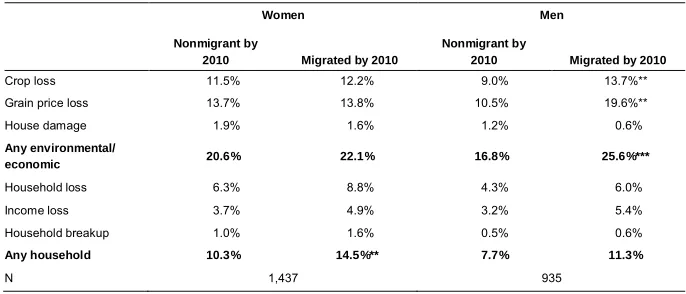
We begin by tabulating the percentages of all respondents experiencing each type of shock (1) during the past five years since the time of the survey (from 2003 to 2008) and (2) in 2008. Next, we examine differences in shocks and migration by gender by comparing the percentage experiencing each type of shock for those moving and not moving separately for men and women.
We then perform several multivariate analyses to identify factors associated with shocks and migration. We examine whether those who experienced shocks are relatively more likely to migrate, controlling for other factors that may impact migration and shock exposure. To do so, we run logistic regressions where the dependent variable is migration by the 2010 wave of MLSFH, and independent variables are all measured prior to migration, from 2008, which ensures that the shocks occurred before the moves took place. In these regressions, we control for factors found to be associated with migration in Malawi (Anglewicz 2012; Anglewicz et al. 2017) and shocks (Fussell, Sastry, and VanLandingham 2010; Gray and Mueller 2012), including age, region of residence (northern, central, southern), level of education, marital status (married, divorced, widowed, never married), a household economic status index based on durable good ownership, and HIV-positive status. The key independent variables of interest in these regressions are experiencing economic and family shocks in 2008. We run these models separately for men and women to acknowledge differences by gender in shock-related behaviors (Hunter, Hatch, and Johnson 2004).
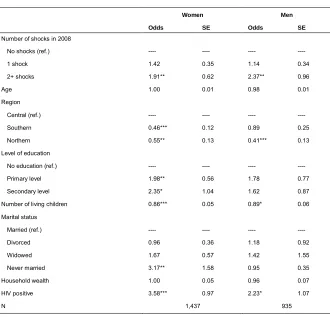
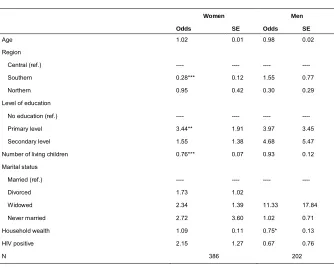
Next, we examine if there is a positive relationship between the number of shocks experienced in 2008 and the likelihood of migrating by 2010. These regressions include the same control measures as above, but the shocks measure is separated by those experiencing one shock in 2008 and two or more shocks, compared to those not experiencing shocks in 2008. Finally, we limit the sample to only men and women who experienced shocks of any kind in 2008 and compare the characteristics of those who migrated with those who did not.
3. Results
(34.8%) and household breakups (8.6%). Although the percentages of those experiencing shocks are lower in 2008 than the previous five years (2003‒2008), there are still non-negligible percentages of respondents experiencing shocks, at 20% experiencing environmental/economic shocks and approximately 10% with household shocks.
Table 1: Shock experience among MLSFH men and women, 2008 MLSFH Survey measure Measure abbreviation % experiencing
in past five years (2003‒2008)
% experiencing in 2008
Environmental/economic shocks
Poor crop yields, loss of crops due to disease or pests, loss of livestock due to theft or disease, or loss of coupon
Crop loss 73.9% 11.2%
Big change in price of grain Grain price loss 66.2% 12.9%
Damage to house due to fire, flood, or other
unexpected event House damage 11.8% 1.5%
Experience any environmental/economic shock Any environmental/economic 91.2% 20.0%
Household shocks
Death or serious illness of an adult member or someone who provides support for yourself or your family
Household loss 42.9% 5.6%
Loss of source of income – such as loss of employment, business failure, someone who had been assisting the household stopped their support
Income loss 34.8% 3.4%
Breakup of household, such as a divorce Household breakup 8.6% 1.0%
Experience any family/household shock Any family 64.5% 9.6%
Table 2: Differences in migration and shock by gender, MLSFH men and women
Women Men
Nonmigrant by
2010 Migrated by 2010
Nonmigrant by
2010 Migrated by 2010
Crop loss 11.5% 12.2% 9.0% 13.7%**
Grain price loss 13.7% 13.8% 10.5% 19.6%**
House damage 1.9% 1.6% 1.2% 0.6%
Any environmental/
economic 20.6% 22.1% 16.8% 25.6%***
Household loss 6.3% 8.8% 4.3% 6.0%
Income loss 3.7% 4.9% 3.2% 5.4%
Household breakup 1.0% 1.6% 0.5% 0.6%
Any household 10.3% 14.5%** 7.7% 11.3%
N 1,437 935
Notes: *p ≤ 0.10; **p ≤ 0.05; ***p ≤ 0.01.
Table 3: Logistic regression results for the relationship between 2008 shocks and migration by 2010, MLSFH men and women
Family shock Environmental/economic shock
Women Men Women Men
Odds SE Odds SE Odds SE Odds SE
Household shock 1.62* 0.43 1.02 0.40 ---- ---- ----
----Environmental/economic
shock ---- ---- ---- ---- 1.49* 0.36 1.81** 0.50
Age 1.00 0.01 0.98 0.01 1.00 0.01 0.98 0.01
Region
Central (ref.) ---- ---- ---- ---- ---- ---- ----
----Southern 0.50*** 0.12 0.97 0.26 0.48*** 0.12 0.88 0.24
Northern 0.55** 0.13 0.41*** 0.13 0.56** 0.14 0.42*** 0.13
Level of education
No education (ref.) ---- ---- ---- ---- ---- ---- ----
----Primary level 1.97** 0.56 1.79 0.77 2.04** 0.58 1.76 0.76
Secondary level 2.52** 1.10 1.58 0.85 2.68** 1.17 1.57 0.85
Number of living children 0.86*** 0.05 0.90* 0.06 0.86*** 0.05 0.89* 0.06
Marital status
Married (ref.) ---- ---- ---- ---- ---- ---- ----
----Divorced 0.95 0.35 1.14 0.89 0.98 0.37 1.09 0.85
Widowed 1.65 0.56 1.50 1.63 1.69 0.57 1.40 1.54
Never married 3.03** 1.51 0.97 0.36 2.84** 1.41 0.96 0.36
Household wealth 0.99 0.05 0.95 0.07 0.99 0.05 0.95 0.07
HIV positive 3.45*** 0.93 2.26* 1.08 3.47*** 0.93 2.32* 1.11
N 1,437 935 1,437 935
Notes: *p ≤ 0.10; **p ≤ 0.05; ***p ≤ 0.01.
Table 4: Logistic regression results for the relationship between total number of 2008 shocks and migration by 2010, MLSFH men and women
Women Men
Odds SE Odds SE
Number of shocks in 2008
No shocks (ref.) ---- ---- ----
----1 shock 1.42 0.35 1.14 0.34
2+ shocks 1.91** 0.62 2.37** 0.96
Age 1.00 0.01 0.98 0.01
Region
Central (ref.) ---- ---- ----
----Southern 0.46*** 0.12 0.89 0.25
Northern 0.55** 0.13 0.41*** 0.13
Level of education
No education (ref.) ---- ---- ----
----Primary level 1.98** 0.56 1.78 0.77
Secondary level 2.35* 1.04 1.62 0.87
Number of living children 0.86*** 0.05 0.89* 0.06
Marital status
Married (ref.) ---- ---- ----
----Divorced 0.96 0.36 1.18 0.92
Widowed 1.67 0.57 1.42 1.55
Never married 3.17** 1.58 0.95 0.35
Household wealth 1.00 0.05 0.96 0.07
HIV positive 3.58*** 0.97 2.23* 1.07
N 1,437 935
Notes: *p ≤ 0.10; **p ≤ 0.05; ***p ≤ 0.01; we combine all individuals with more than two shocks into the 2+ category due to small numbers of individuals experiencing more than two shocks.
Table 5: Regression results for the factors associated with migration by 2010 among those experiencing shocks in 2008, MLSFH men and women
Women Men
Odds SE Odds SE
Age 1.02 0.01 0.98 0.02
Region
Central (ref.) ---- ---- ----
----Southern 0.28*** 0.12 1.55 0.77
Northern 0.95 0.42 0.30 0.29
Level of education
No education (ref.) ---- ---- ----
----Primary level 3.44** 1.91 3.97 3.45
Secondary level 1.55 1.38 4.68 5.47
Number of living children 0.76*** 0.07 0.93 0.12
Marital status
Married (ref.) ---- ---- ----
----Divorced 1.73 1.02
Widowed 2.34 1.39 11.33 17.84
Never married 2.72 3.60 1.02 0.71
Household wealth 1.09 0.11 0.75* 0.13
HIV positive 2.15 1.27 0.67 0.76
N 386 202
*p ≤ 0.10; **p ≤ 0.05; ***p ≤ 0.01.
4. Discussion
Environmental/economic and family shocks are common in rural Malawi and often lead to migration. Even after controlling for other factors that influence migration and shocks, we still find that those experiencing shocks are more likely to move by 2010. However, this pattern is not consistent by gender: Women’s migration appears to be more strongly linked to family shocks, whereas men who experience environmental/economic shocks are more likely to migrate. We also find that the number of shocks matters: While households may be able to withstand one shock, those experiencing two or more are significantly more likely to move.
are likely other factors related to both migration and shocks that we do not control for in our models. Also, rural Malawian households may have predetermined responses to shocks, although they cannot know the exact shock that will occur or when it will happen, and their vulnerability varies across the year. Further, we cannot externally validate self-reporting of our shocks since they are smaller in scale. Another challenge in this research is the categorization of shocks. For example, we cannot distinguish between environmental and economic shocks since some types of shocks, like famine, may be environmental only, economic only, or a mix of both.
Overall, these findings depict an image of migrants that is different than often found in the literature. Research often portrays migrants as better-off: The ‘healthy migrant hypothesis,’ for example, suggests that migrants are healthier than their peers at both origin and destination (Jasso et al. 2004; Landale, Oropesa, and Gorman 2000; Lu 2008; Palloni and Morenoff 2001), due in part to considerations of challenges involved in moving (Palloni and Morenoff 2001). In contrast, we find that migrants may be a vulnerable group, one that is more likely to experience shocks than those who do not move. This vulnerability may apply more to men than women: Among those experiencing shocks, men with greater household wealth are less likely to move, but women with more education and fewer children are more likely to move.
5. Acknowledgements
References
Anglewicz, P. (2012). Migration, marital change, and HIV infection in Malawi.
Demography49(1): 239‒265. doi:10.1007/s13524-011-0072-x.
Anglewicz, P. and Myroniuk, T. (2017). Moving to escape? Shocks and migration in rural Malawi. Paper presented at the Population Association of America Annual Meeting, Chicago, April 2017.
Anglewicz, P., VanLandingham, M., Manda-Taylor, L., and Kohler, H.-P. (2016). Migration and HIV infection in Malawi. AIDS 30(13): 2099–2105.
doi:10.1097/QAD.0000000000001150.
Anglewicz, P., VanLandingham, M., Manda-Taylor, L., Kohler, H.-P. (2017). Cohort profile: Internal migration in sub-Saharan Africa: The Migration and Health in Malawi (MHM) study. BMJ Open 7(5): e014799. doi:10.1136/ bmjopen-2016-014799.
Chirwa, W.C. (1997). Migrant labour, sexual networking and multi-partnered sex in Malawi.Health Transition Review 7(S3): 5‒15.
Curran, S.R., Meijer-Irons, J., and Garip, F. (2016). Economic shock and migration.Sociology of Development 2(2): 119‒157. doi:10.1525/sod.2016. 2.2.119.
Foresight (2011). Migration and global environmental change: Future challenges and opportunities. London: Government Office for Science (Final project report).
Fussell, E., Sastry, N., and VanLandingham, M. (2010). Race, socioeconomic status, and return migration to New Orleans after Hurricane Katrina.
Population and Environment 31(1‒3): 20‒42. doi:10.1007/s11111-009-0092-2.
Gray, C. and Bilsborrow, R. (2013). Environmental influences on human migration in rural Ecuador. Demography 50(4): 1217‒1241. doi:10.1007/s13524-012-0192-y.
Gray, C. and Mueller, V. (2012). Drought and population mobility in rural Ethiopia.
World Development 40(1): 134‒145. doi:10.1016/j.worlddev.2011.05.023. Green, T. and Winters, L.A. (2010). Economic crises and migration: Learning from
the past and the present.The World Economy 33(9): 1053‒1072.
Groen, J.A. and Polivka, A.E. (2010). Going home after Hurricane Katrina: Determinants of return migration and changes in affected areas.Demography
47(4): 821‒844. doi:10.1007/BF03214587.
Hunter, L.M., Hatch, A., and Johnson, A. (2004). Cross-national gender variation in environmental behaviors. Social Science Quarterly 85(3): 677–694.
doi:10.1111/j.0038-4941.2004.00239.x.
Hyder, A., Behrman, J.R., and Kohler, H.-P. (2015). Negative economic shocks and child schooling: Evidence from rural Malawi. Development Southern Africa
32(4): 458‒476. doi:10.1080/0376835X.2015.1039707.
IPCC (2014). Summary for policymakers. In: Field, C.B., Barros, V.R., Dokken, D.J., and Mach, K.J. (eds.).Climate change 2014: Impacts, adaptation, and vulnerability. Part A: Global and sectoral aspects. Working group II contribution to the fifth assessment report of the Intergovernmental Panel on Climate Change. Cambridge: Cambridge University Press: 1‒32.
doi:10.1017/CBO9781107415379.003.
Jasso, G., Massey, D.S., Rosenzweig, M.R., and Smith, J.P. (2004). Immigrant health: Selectivity and acculturation. In: Anderson, N.B., Bulatao, R.A., and Cohen, B. (eds.). Critical perspectives on racial and ethnic differences in health in late life. Washington, D.C.: National Academies Press: 227–266. Kohler, H.-P., Watkins, S., Behrman, J.R., Anglewicz, P., Kohler, I.V., Thornton,
R.L., Mkandawire, J., Honde, H., Hawara, A., Chilima, B., Bandawe, C., Mwapasa, V., Fleming, P., and Kalilani-Phiri, L. (2015). Cohort profile: The Malawi Longitudinal Study of Families and Health (MLSFH). International Journal of Epidemiology44(2): 394–404. doi:10.1093/ije/dyu049.
Kohler, I.V., Kohler, H.-P., Anglewicz, P., and Behrman, J.R. (2012). Intergenerational transfers in the era of HIV/AIDS: Evidence from rural Malawi. Demographic Research 27(2): 775‒834. doi:10.4054/DemRes.20 12.27.27.
Landale, N.S., Oropesa, R.S., and Gorman, B.K. (2000). Migration and infant death: Assimilation or selective migration among Puerto Ricans? American Sociological Review 65(6): 888–909. doi:10.2307/2657518.
Martin, P. (2009). Recession and migration: A new era for labor migration?International Migration Review 43(3): 671‒691. doi:10.1111/ j.1747-7379.2009.00781.x.
Mtika, M.M. (2007). Political economy, labor migration, and the AIDS epidemic in rural Malawi.Social Science and Medicine 64(12): 2454‒2463. doi:10.1016/ j.socscimed.2007.04.006.
Myroniuk, T.W., Prell, C., and Kohler, H.-P. (2017). Why rely on friends instead of family? The role of exchanges and civic engagement in a rural sub-Saharan African context. African Studies 76(4): 579‒596. doi:10.1080/00020184. 2017.1390911.
Nobles, J., Frankenberg, E., and Thomas, D. (2015). The effects of mortality on fertility: population dynamics after a natural disaster.Demography 52(1): 15‒38. doi:10.1007/s13524-014-0362-1.
Ó Gráda, C. and O’Rourke, K.H. (1997). Migration as disaster relief: Lessons from the Great Irish Famine. European Review of Economic History 1(1): 3‒25.
doi:10.1017/S1361491697000026.
Palloni, A. and Morenoff, J.D. (2001). Interpreting the paradoxical in the Hispanic paradox: Demographic and epidemiologic approaches. Annals of the New York Academy of Sciences 954(1): 140–174. doi:10.1111/j.1749-6632.2001. tb02751.x.
Reniers, G. (2003). Divorce and remarriage in rural Malawi. Demographic Research S1(6): 175‒206. doi:10.4054/DemRes.2003.S1.6.
Schatz, E. (2005). ‘Take your mat and go!’: Rural Malawian women's strategies in the HIV/AIDS era.Culture, Health and Sexuality 7(5): 479‒492. doi:10.108 0/13691050500151255.