University of New Orleans University of New Orleans
ScholarWorks@UNO
ScholarWorks@UNO
University of New Orleans Theses and
Dissertations Dissertations and Theses
Fall 12-18-2015
An Examination of Voter Groups That Make Up the Emerging
An Examination of Voter Groups That Make Up the Emerging
Democratic Majority Thesis
Democratic Majority Thesis
Jason Waguespack [email protected]
Follow this and additional works at: https://scholarworks.uno.edu/td Part of the American Politics Commons
Recommended Citation Recommended Citation
Waguespack, Jason, "An Examination of Voter Groups That Make Up the Emerging Democratic Majority Thesis" (2015). University of New Orleans Theses and Dissertations. 2117.
https://scholarworks.uno.edu/td/2117
This Dissertation is protected by copyright and/or related rights. It has been brought to you by ScholarWorks@UNO with permission from the rights-holder(s). You are free to use this Dissertation in any way that is permitted by the copyright and related rights legislation that applies to your use. For other uses you need to obtain permission from the rights-holder(s) directly, unless additional rights are indicated by a Creative Commons license in the record and/ or on the work itself.
An Examination of Voter Groups That Make Up the Emerging Democratic Majority Thesis
A Dissertation
Submitted to the Graduate Faculty of the University of New Orleans in partial fulfillment of the requirements for the degree of
Doctor of Philosophy in
The Department of Political Science
by
Jason Waguespack
B.A.,University of New Orleans, 2003 M.A.,University of New Orleans, 2007
TABLE OF CONTENTS
ABSTRACT ... iv
INTRODUCTION ... 1
CHAPTERS 1. A HISTORY OF REALIGNMENT LITERATURE...6
2. HYPOTHESES AND METHODS...28
3. VOTING FOR PRESIDENTIAL CANDIDATES: ANALYSES AND FINDINGS...69
4. VOTING FOR CONGRESSIONAL CANDIDATES: ANALYSES AND FINDINGS...96
5. PARTY IDENTIFICATION:ANALYSES AND FINDINGS...136
6. THE STATES: ANALYSES AND FINDINGS...166
7. FINAL CONCLUSIONS AND CONTRIBUTIONS...185
APPENDIX A ... 200
APPENDIX B ... 201
REFERENCES ... 203
ABSTRACT
In 2002, John Judis and Ruy Teixeira published The Emerging Democratic Majority, a book that
postulated that the United States was in the beginning of a political realignment that would spell
the end of the Reagan-era coalition that gave Republicans an electoral advantage on the
presidency. The authors claimed an electorate that would favor the Democratic Party would
emerge to take its place. Since Senator Barack Obama’s victory in the 2008 presidential election
was powered by a coalition that looked much like the one Judis and Teixeira described, it
appeared the authors’ thesis was being borne out by actual election results. However, the events
of the 2000s and early 2010s have lent both credibility and doubt to this possible realignment,
and have drawn attention to the problems of regular realignment theory. Exploring the premise
laid out by Judis and Teixeira from their work, The Emerging Democratic Majority, as well as
observations about the changing composition of the American electorate, I analyze key groups in
the American electorate to determine if these groups are trending more Democratic in
presidential and congressional races since the 1988 presidential election. Findings showed
several of these groups regularly supported Democratic candidates but did not consistently trend
to the Democrats from year to year. Changes across time often depended on match-ups of
nonconsecutive years, with Democrats in the year 2008 drawing especially strong support from
hypothesized voter groups. While Democrats can count on the support of groups such as voters
who achieve high levels of college education or voters with secular outlooks on life, their success
still depends highly on candidate quality and advantage on issues and cannot be taken for
granted.
INTRODUCTION
History was made in the year 2008 when Barack Obama was elected President of the
United States, the first African-American to attain the highest office in the country. Obama’s
coattails were also formidable, sweeping in eight Democratic Senators and twenty-one
Democratic congressmen. History was made a second time, in a smaller fashion, when Obama
was elected in 2012. Not since Andrew Jackson had a president been elected and then
re-elected with a smaller popular vote percentage. While the 2010 midterm elections signaled a
backlash against the Democratic Party, it did not presage an ultimate rejection of the Obama
administration itself. In fact, Democrats gained two seats in the Senate and eight in the House
during the 2012 congressional elections.
The Republicans’ poor showing among Hispanic voters in 2012 became instantly noted
as a continuing sign that the Republican Party was hitting a firewall with minority voters
(Rodriguez 2012; Cillizza 2013). The wide gender gap, where women voted in greater numbers
for Obama over Republican Mitt Romney, while men gave Romney a winning margin, was also
noted (Jones 2012).
What led up to this historic re-election? Was it due to a durable coalition of voters that
could not be pierced by a Republican party seen as catering only to whites? Such a coalition was
postulated by John Judis and Ruy Teixeira in their 2002 book The Emerging Democratic
Majority. With Republican woes in presidential races linked to underperformance among some
of the very groups the authors discuss, an examination of their premise is even timelier.
The concept of realignment in American politics has separated periods of governance into
different party systems, building from an initial concept put forth by V.O. Key that a critical
electoral cycles. Many political scientists and scholars concur that five party systems have
existed in American political history, the fifth being the New Deal system that stemmed from the
election of Franklin Roosevelt. Much work and speculation has focused on determining the
existence and composition of the party system that has followed the New Deal coalition, if one in
fact emerged at all. In his book The Emerging Republican Majority (1970), published during the
first term of the Nixon administration, Kevin Philips envisioned the New Deal coalition would
break apart and a new party system that favored the Republican Party would take its place. This
sixth party system is often identified with the victories of President Ronald Reagan in the 1980s
and Republican congressional successes in the 1990s.
In recent years, political pundits and analysts suggest that a seventh party system has
taken shape in the U.S. electorate. If the sixth party system consisted of a Republican majority
that included winning most presidential elections, thanks to Republican strongholds in the South
and the West, the seventh is seen as a Democratic majority coalition based upon affluent voters
with socially liberal attitudes, white working class voters that previously voted Republican, and
professionals such as teachers, nurses, and engineers, many of whom may have earned graduate
or post-graduate degrees. This coalition was postulated by John Judis and Ruy Teixeira in their
2002 book The Emerging Democratic Majority.
The events of the 2000s and early 2010s have lent both credibility and doubt to this
possible realignment. At the time of the publication of Judis and Teixeira’s book, Republicans
were about to make gains in the first midterm election of the George W. Bush presidency, so this
pronouncement seemed ill-timed. The Democratic victories in both houses of Congress in 2006,
however, reinvigorated the idea of a Democratic majority, and Senator Barack Obama’s victory
and Teixeira described. According to the CNN exit poll, Obama carried 58 percent among those
with post-graduate degrees, his second highest in the education category just below those with no
high school education. While Obama won with large margins among those on the lower end of
the income scale, he also won a majority of those who made $200,000 or more. Finally, McCain
won white voters 55%-43%, but Obama won African-American, Hispanic, Asian, and other
races by landslide margins, and together these groups made up 27 percent of the voting public,
an increase from 23 percent in 20041.
But the elections of 2009 and 2010 seemed to cast some doubt on the “Emerging
Democratic Majority” concept. Republican Bob McDonnell won the 2009 Virginia’s governor’s
race 59%-41%, just a year after Obama carried the state by a 53%-47% margin. At the same
time, the Republican candidate in New Jersey, Chris Christie, beat sitting governor Jon Corzine
in New Jersey, a state Obama easily carried and which had never voted Republican since 1988.
Then, in a shocking development, Republican Scott Brown won the Massachusetts senate seat
opened up by the death of Ted Kennedy in a special election held in early 2010. That same year
was capped by Republicans winning back the House of Representatives and cutting into
Democratic margins in the Senate. The 2014 midterms also added a second Republican victory
that reduced Democratic margins further in the House and gave Republicans control of the
Senate.
These back-and-forth shifts between the parties call into question whether this emergence
of a Democratic majority in the electorate had occurred at all, or whether the two parties are still
1 CNN.com Election 2004 Exit Poll,
http://www.cnn.com/ELECTION/2004/pages/results/states/US/P/00/epolls.0.html CNN.com Election 2008 Exit Poll,
very strong and very capable of winning the presidency, the Congress, and many state offices
with no side having an overriding advantage. Perhaps in the lead up to President Obama’s
historic victory, a large-scale shift over time among key voter groups actually did not take place.
It is the aim of this work to answer this question. In examining the voting trends over time
among key voting groups that Judis and Teixeira identify as the foundation for the Emerging
Democratic Majority, I will follow the premise of the authors that these key groups will vote
more Democratic over time, starting from the election of George H.W. Bush in 1988 and
progressing to 2008 with the first election of Barack Obama. My analysis shall answer whether
members of this possible new coalition, such as voters with high incomes, graduate and
post-graduate degrees, and working class whites, have been trending more to the Democratic Party in
presidential and congressional races in the past two decades.
If these hypotheses had been fully supported, my study would have given support to the
assertion that a new realignment in American politics succeeds the Republican realignment of
the late twentieth century, perhaps enough to withstand occasional Republican resurgences and
allow Democrats concrete advantages in future elections. However, the end result of my analysis
finds no evidence of steady, growing Democratic support among these voter groups. While I
have tracked surges of Democratic support from one election to another, they tend to be between
non-consecutive years, showing that the individual circumstances of election years, specifically
the candidates running and the issues involved, are having greater impacts on voting decisions
for my hypothesized voter groups, and that Democratic gains are not inevitable.
In their 2007 book Divided America, Black and Black concluded that the country was in
the midst of a permanent power struggle between two evenly balanced political parties in which
coalition. In practice, both parties are minority parties (259-260). In a sense, the findings of this
dissertation will answer a question similar to the one Stanley and Niemi proposed after the 1992
presidential election. “…do changing patterns of party support suggest the beginning of a new,
long-lasting form of coalitional behavior that will support continued Republican domination, or
do they at least indicate competitive elections in which the majority in a series of elections shifts
back and forth between the parties?” (Stanley and Neimi 1999, 387). For the moment, that
CHAPTER 1
A HISTORY OF REALIGNMENT LITERATURE
The concept of realignment in American politics has its roots in a seminal article written
by V. O. Key, Jr., “A Theory of Critical Elections” (1955). These realignments were described
by Key as elections in which electoral involvement and voter concern had increased, and partisan
coalitions changed as some groups shifted their party loyalties or became newly mobilized.
Furthermore, the electoral results were so decisive that they would persist for a period of
succeeding elections (Key 4). Succeeding authors have expanded upon Key’s concept (Burnham
1970; Sundquist 1983; Kleppner, et al 1981; Ladd and Hadley 1973; Ladd 1981). Part of this
expansion of realignment literature involves grouping segments of American political history
into party systems.
Party Systems
First, I will describe what is meant by “party system.” The term refers to a system of
government by political parties in a democratic country. This can refer to a one party system,
multi-party systems, or non-partisan systems. The United States has had for its history, largely
due to the Electoral College, the first-past the post system, and lack of public campaign finance,
two dominant political parties, so the country has what can be called a two-party system.
Developing along with the concept of realignment is the view that the United States has
been divided into distinct eras of political competition. Typically, one party will dominate the
other in most elections, with some degree of variation; the opposition party could still win the
White House on occasion. Scholars generally agree that five party systems have existed in
American history, with the New Deal party system being the last one that generates wide
1987; Stanley and Neimi 1995; Aldrich and Neimi 1995). These divisions are separated by
critical or realigning elections, marked by social turmoil or other factors.
The First Five Systems
The first five numbered party systems are easily defined. (Burnham 1967; Sternsher
1975). The first system spans the period from 1796 to 1816. This period grew out of political
divisions that arose during George Washington’s administration. Members of Washington’s
cabinet split on ideology. Secretary of State Thomas Jefferson favored a less active role for
government and formed the Democratic-Republican Party. By contrast, the Secretary of Treasury
Alexander Hamilton believed in a more active role for the executive branch, and the Federalist
Party drew considerable influence from his ideas. After the 1800 Presidential election, the
Democratic-Republicans gained major dominance for the next twenty years, and the Federalists
slowly died off.
The second party system developed after the collapse of the Federalist Party. The
Democratic-Republicans split into a faction that supported Andrew Jackson and became the
present day Democratic Party, while the anti-Jackson faction broke off and started the Whig
Party. The two sides competed from 1840 to 1856, with neither side being dominant. The issue
of slavery caused great friction between both parties and eventually tore the Whig Party apart.
The third party system encompasses the period from the Civil War up to 1896. The
country was divided between a Democratic-dominated South and the North, with the exception
of some political machines, dominated by the Republicans. This era was dominated in its first
half by Reconstruction and as a whole by issues of tariffs and political corruption but had little
Presidential elections were often close, but Republicans generally won the White House with the
exception of Grover Cleveland’s two non-consecutive wins.
The fourth party system started from 1896 and lasted until 1932. Unlike the last system,
the two parties became strongly polarized over economic issues. Democrats embraced a platform
of populist initiatives including backing currency with silver and a close relationship with a
growing labor union movement, while Republicans vigorously opposed those policies while
remaining identified with business and industry (Sundquist 149-159). This period is
characterized by Republican dominance in presidential races, kicked off by President
McKinley’s victory in 1896, only interrupted by Woodrow Wilson’s two victories, the first due
to Theodore Roosevelt splitting the GOP vote with Taft, the second a narrow victory over
Charles Hughes in a fiercely contested race. This party system is notable because, a century later,
political strategist Karl Rove hoped George W. Bush could emulate McKinley’s victory as the
start of a new Republican-dominated system (Ruy and Texieria 145).
The next party system began from the 1932 election, coinciding with the election of
Franklin Roosevelt. The major switch occurred in the industrial cities in the north, among the
working class and minority groups including unions, Catholics, African-Americans, and Jews.
Black voters began leaving the Republican Party in 1934, but would not post Democratic
majorities until after 1936 (Sundquist 214-219).
The time period that covers a possible “sixth party system,” after the New Deal is said to
be a Republican-dominated system (Kleppner, et al 1981) or a period in which the electoral
system is more competitive and the outcomes more uncertain (Jensen 1981; Aldrich and Neimi
1995; Stanley 1988; Stanley and Neimi 1999). Despite these differences, it is generally agreed
Democratic “Solid South” gave way to Republican dominance in presidential and later local
elections.
A New Democratic Majority
Even as a sixth party system was being contemplated, scholars speculated on voter
patterns that may follow even after the sixth system. It was in Walter Dean Burnham’s book
Critical Elections and the Mainsprings of American Politics (1970) that he discovered the
possible seeds of a new Democratic majority, though they seemed to have only long range
potential at the time. In examining voting behavior in the city of Baltimore in elections from
1960 to 1966, Burnham found that the 1966 city Democratic vote united an electoral alliance of
middle to upper-middle class whites along with African-American and Jewish voters. “The
Baltimore data in particular suggest the possibility of a pro-Democratic realignment among
middle- and upper-income groups as the economic cleavages of yesteryear become increasingly
subordinated to other issues” (Burnham 158). Although this alliance seemed less pronounced in
1968, Burnham suggested, “…they tend to support the thesis that a certain kind of realignment
may be in the offing, one in which the Democratic Party may come to be increasingly the party
of the technologically competent and technologically superfluous strata…while the Republican
party may become more and more explicitly the partisan vehicle for the defense of white
“middle-America” (Burnham 158).
In examining communities where college or university education is a dominant industry,
Burnham found sharp realignment toward the Democrats (159). However, he remained
somewhat skeptical about this coalition’s immediate chances to produce a Democratic majority.
In examining the success of Liberal Party candidate John Lindsey in winning the New York
was still a plurality of the vote, reflecting what was still a minority force in politics. However,
Burnham speculated that such a coalition could be in the offing “decades hence,” for a majority
party system that could conceivably succeed the Republicans’ majority (165). “The long-range
prospects that a top-bottom coalition could construct enough heterogeneous appeal to win
national elections are probably good, since both appear to be growing at the expense of the
middle” (166).
Such movements were also noted by Kevin Phillips in The Emerging Republican
Majority. He specifically cited “Yankees, Megalopolitan silk-stocking voters and Scandinavians
from Maine across the Great Lakes to the Pacific” as likely GOP defectors as the party’s new
western-southern coalition took form (465). However, areas of the country that supported Nixon
and gave George Wallace a healthy share of the vote were growing faster than the cities or the
silk-stocking suburbs, leaving no real threat to immediate Republican prospects.
In the decades since scholars foretold of a Republican realignment, the political
landscape has experienced a drastic if uneven change. The Watergate scandal reversed
Republican gains, bringing a large class of new Democrats to Congress in the 1974 midterms
that have been since dubbed the “Watergate babies.” The scandal also assisted Georgia Governor
Jimmy Carter in winning the White House in 1976. The turbulence of this period cast doubt on
the idea of realignment, causing some to suggest that the country was experiencing dealignment
in its place (Stanley 1988; Wattenberg 1991; Neimi and Weisberg 1993). However, the Reagan
victories of 1980 and 1984 and George H. W. Bush’s victory in 1988 suggested that the
Republican majority had at last emerged, at least as far as the Electoral College was concerned.
The Republican dominance was limited to the White House and from 1980 to 1986, the U.S.
a problem for realignment theory, and analysts sought to retool the theory to explain the
Republican lock on the White House but a failure to win control of the Congress (Rosenof 134).
Instead, analysts spoke of a “presidential” realignment, a “partial” realignment, or a realignment
still “in progress” (Rosenof 135).
At the same time, the possibility of a Democratic realignment began to take hold. Kevin
Phillips, who had authored the best known thesis for a sixth party system, began to speculate that
the Democrats could capitalize on economic middle-class resentment produced by an economic
downturn, a contrast to the cultural resentment the middle class experienced in the 1970s
(Rosenof 147). As far back as 1982, Phillips believed that the global market would introduce
economic turmoil that would render the old socioeconomic order defunct and in turn bring an
end to the typical sequence of 28 to 36-year political realignments. Thus, even in the wake of the
Reagan victory in 1980, Phillips was not optimistic that a long term Republican dominance was
in the making (Phillips 1982 xv, xvi). The 1992 defeat of Bush and the victory of Bill Clinton
seemed to spell an end to Republican dominance and confirm this thesis. Kevin Phillips noted
the plunge in suburban support for the GOP ticket, particularly in areas hardest hit by the
recession, and also the increasing political role of women and minorities in the 1992 election
(Phillips 1994 248). However, he did not take the Democratic trends for granted, cautioning, “the
favorable trends could dissipate quickly if the new administration failed to revitalize and sustain
the economy” (Phillips 1994 249).
However, the 1994 congressional midterms put Republicans in control of Congress for
the first time in forty years, and set the political community scrambling back to the idea of
realignment. “To many analysts the 1994 contest was indeed a “critical election” signaling
since as a subject of realignment (Ladd 1995; Campbell 2006; Bullock, Hoffman, and Gaddie
2006). This continued even after the 1996 presidential election that saw both Clinton and a
Republican Congress re-elected. The inability of the Democrats to win control of Congress back
even as they held on to the presidency helped spark a period of competing theories for what was
occurring in the electorate. Some thought that realignment was occurring, while others believed
that a partisan deadlock had occurred by which neither party had much of an advantage (Ladd
1997).
Still, the idea of a Democratic Party-dominated seventh party system did not disappear.
Even in the wake of Republican successes for the presidency the early 2000s, this idea was not
without its merits. The 1988 election was the last time Republicans ever won a substantial
Electoral College victory, and the last time a Republican candidate had carried substantially
populated states in the North and on the West Coast, such as California, Illinois, Pennsylvania,
New Jersey, and Michigan. Both the 2000 and 2004 GOP victories were conspicuously narrow,
with 2000 especially fiercely contested with the Florida recount and George W. Bush not even
winning the popular vote. Those two Republican victories were owed to the South, the West,
Midwestern states such as Kansas and Nebraska, and even the long-time Democratic voting state
of West Virginia. However, George W. Bush’s coalitions also lacked the big electoral prizes of
California, virtually any of the northeastern metro bloc2, or the upper Midwest states of Michigan
and Illinois. Despite the Republicans winning the Congress in 1994, their majorities in each
2 George W. Bush won New Hampshire in 2000 but lost it to Democratic Senator John Kerry in
2004, the only state Bush carried in 2000 that flipped to the Democrats in 2004. Source: Presidential General Election Results Comparison – New Hampshire.
chamber remained small and easily threatened, as evidenced by the brief fifty-fifty split in the
Senate after 2000, and finally expiring in the 2006 midterm elections.
In 2002, political analysts John Judis and Ruy Teixeira penned a book that created the
popular conception of an emerging Democratic majority. This work, called The Emerging
Democratic Majority, claimed that the 1992 presidential election was the counterpart to the 1968
election, in which a third party candidate split the traditional Republican coalition, providing an
outlet for disaffected voters to not vote for the Republicans but not vote Democrat, either. In this
case, Judis and Teixeira assert that the discontent caused by the economy caused the Republican
coalition to fracture, particularly white working-class Democrats and professional Republicans,
and over time, these voters moved to the Democratic Party (Judis and Teixeira 4). Furthermore,
they also claimed that the culture war would ultimately send many high-income professionals
from the Republicans to the Democratic Party due to their more liberal stands on social issues.
Also, the gains Republicans made among the “Reagan Democrats” would subside and even
reverse themselves. Finally, the increase in the Hispanic vote would also bolster Democratic
gains. As the country became more diverse, the Democratic Party would be the beneficiaries of
the influx of new Hispanic voters. In short, the Democrats could benefit from economic
upheavals that would send the Reagan Democrats back to their ancestral party, the culture war
would alienate social moderates from the Republicans, and the diversification of America would
see a growing number of Hispanic votes for the Democratic Party (Judis and Teixeira 55, 57,
62-63).
The shifts among affluent voters and among the working class are two important
components of this possible seventh party system, but the literature in the 2000s suggests
among the white working class to the Republican Party, and a possible shift back, has been the
subject of study for decades, and the 2000s was no exception. For example, a 2008 study by
Teixeria along with political scientist Alan Abramowitz claimed that the working class is
shrinking and the upper middle class is rising, and both categories feature problems for the
Republicans, as both are becoming more socially liberal, the working class because of the
younger entrants, and the upper middle class because of professionals (Abramowitz and Teixeria
2008). Voter shifts among the white working class could be the product of attitudes or perhaps,
as some studies suggest, the product of location.
Sorting of the Electorate
Larry Bartels’ 2008 book Unequal Democracy suggests that Republican performance
among the white working class was uneven, with the New Deal coalition dissolved almost
entirely because of the Republican resurgence in the South, and that Republican and Democratic
voter identification in the North among low-income whites is no different in 2008 than it was in
1952 (Bartels 76). Conversely, Republicans enjoyed a greater surge among the affluent and
middle class than among the working class in the years between 1952 and 2004, with a greater
disparity between the two categories in the non-Southern states (76). If anything, Bartels claims
the white working class outside the South has become more loyal to the Democratic Party in the
1952-2004 period. “Republican gains have come not among “poorer folks” but among middle-
and upper-income voters--and even those gains have been concentrated almost entirely in the
South” (78). Bartels’ conclusions lead to a regional explanation of the disparities in the working
class vote, which actually may support some of the seventh party thesis, as the working class in
However, Bartels does not hold to the notion that Republicans are losing the affluent, nor
does Andrew Gelman’s 2008 book Red State Blue State Rich State Poor State. Gelman analyzed
states by income and found that the wealthy still were more likely to vote Republican in
presidential elections. Rather, states with a higher average income are more likely to support a
Democratic presidential candidate, whereas the Republicans will win the poorer states, but on the
votes of the wealthiest in those states. At the poorest end of the income scale, Republicans win
Mississippi. On the affluent end, Democrats win Connecticut. In the middle of the scale is Ohio,
which swings back and forth between the two parties (Gelman 16-17). According to Gelman, this
pattern has become even stronger over time. However, Gelman concludes that rich voters in
Democratic-leaning states are still less likely to vote Republican than the wealthy in the poorer,
so-called “red” states (167). Gelman answers that the two political parties have become more
polarized ideologically, and this is causing the wealthier states, namely the Midwest, the West
Coast, and Northeast, those that were more liberal to begin with, to simply begin voting more in
line with the party that is closest to them ideologically, namely the Democrats (168).
The movement of like-minded individuals to a particular community can also serve to
bolster the voting strength of a party in that community. Bill Bishop and Robert Cushing’s The
Big Sort (2008) explores how likeminded Americans are seeking communities that reinforce
their beliefs. This mass movement has the effect of creating more landslide party victories in
counties for one party or another. The authors make an observation of this “big sort” in action in
the state of Colorado. According to the authors, the fast-growing counties around Denver
received a greater influx of newcomers from Democratic areas of the country than the
Republican-leaning areas of Colorado received from Republican-leaning states (Bishop and
legislative contests in 2004 and elected a Democratic governor in 2006, and also went for Obama
in 2008. Bishop and Cushing attribute at least part of this to the Democratic newcomers.
Barack Obama’s victory in the typically Republican states of North Carolina and Virginia
was partially explained by migration (Hood and Mckee 2010). Those two states, along with
Florida, received an influx of residents from the northeast, a more Democratic enclave, and thus
brought voting habits that leaned less Republican than their native-born neighbors (Mckee 2009,
193). On North Carolina, Hood and Mckee conclude, “[o]ur claim is not that North Carolina is
now a Democratic state in presidential politics, but rather because of population change through
a continuing and substantial influx of migrants born outside the South, these voters are pushing
the state in a competitive direction—essentially making it a swing state, or to stick with the
colorcoded language, we contend that North Carolina has become a purple state in presidential
elections” (Hood and Mckee 2010, 291). Their article, however, showed that the southern states
with a large number of northeastern-born residents, namely Florida, North Carolina, and
Virginia, were more likely than the rest of the South to be swing states. “…the three Peripheral
South states Obama won, have the largest percentage of residents born in the Northeast—the
bluest region in the United States” (Hood and Mckee 2010, 293).
The 2008 Election
The initial analysis of the 2008 election led to some declaring that the new Democratic
realignment had occurred. John Judis declared in a New Republican piece “The Democratic
majority: It emerged!” (Judis 2008). In the aftermath of Obama’s victory, Judis speculated that
this realignment could be lasting and enduring.
“Will the Democratic realignment of 2008 be hard or soft?
it began in fits and starts—Clinton’s victory in 1992 was
comparable to Richard Nixon’s victory in 1968, with Ross Perot playing the schismatic role that George Wallace had played in 1968. The Democratic trend was slowed by the Clinton scandals and interrupted by September 11. By this measure, 2008 seemed to be more analogous to 1980 than to 1932 or 1896. But the onset of the financial crisis may have changed this. The coming economic downturn may more closely resemble the depression of the 1930s than the relatively shallow recessions of 1980 or 1991. There are, sad to say, striking resemblances between the circumstances that led to the Great Depression and those that led to the current emergency.” (Judis 2008)
The recession brought about in the late 2000s would seem to conform to the theory
advanced by Kevin Phillips and others that economic turmoil would work to the Democrats’
advantage, but the severe nature of the recession of the late 2000s could possibly cause a
longer-lasting political effect than the shorter recessions of the 1990s, and thus fully realize what
Phillips and company have speculated. The outcome of the 2016 presidential elections, however,
may mitigate this theory, if the policies of the Obama administration are not seen as solving the
economic problems that repelled voters from Republicans in the first place.
Democratic gains among younger people have also been conspicuous in the exit polls
from the 2000, 2004 and 2008 presidential elections3. Strong support among the younger
generation is considered key because political socialization theories hold that political
identification can be developed at a younger age. The fact that Obama performed very well
3 CNN.com: Election 2000 Exit Poll.
http://web.archive.org/web/20080430015935/http://www.cnn.com/ELECTION/2000/epolls/US/ P000.html
CNN.com: Election 2004 Exit Poll.
http://www.cnn.com/ELECTION/2004/pages/results/states/US/P/00/epolls.0.html CNN.com: Election 2008 Exit Poll.
among the younger vote was noted by Weisberg and Devine in their recent study, and as the
authors note, could portend a realignment (Weisberg and Devine 2010). They compare it to the
strong Republican performance among young people during the Reagan years, and theorize that
the strong Democratic performance could persist as they get older. However, they also point out
that the stronger shift for the Democrats was actually among 30-44 and 45-64 year olds.
Open Field Politics
Still, do these developments portend a real “Emerging Democratic Majority” or is it just
an illusion? The elections of 2009 and 2010 seemed to throw the brakes on the “Emerging
Democratic Majority” concept, or at least cast some doubt on it. Republican Bob McDonnell
won the 2009 Virginia’s governor’s race 59%-41%, just a year after Obama carried the state by a
53%-47% margin. At the same time, the Republican candidate in New Jersey, Chris Christie,
beat sitting governor Jon Corzine in New Jersey, a state Obama easily carried and had never
voted Republican since 1988. Then, in a shocking development, Republican Scott Brown won
the Massachusetts senate seat opened up by the death of Ted Kennedy in a special election held
in early 2010. That same year was capped by Republicans winning back the House of
Representatives and cutting into Democratic margins in the Senate.
The affluent suburbs that trended away from the Republicans in the 2006 and 2008
elections seemed much friendlier to them in 2009 and 2010. In Virginia, Republican
gubernatorial candidate Bob McDonnell carried the three counties that make up the Northern
contrast, carried the county 60%-39% just a year earlier.4 In 2010, the Democrats lost more
House seats than either party had lost in a single election in seventy-two years (Trende xii).
An alternative to the seventh party system has been voiced by Michael Barone, who
opined that the country post-2006 entered a period of “Open Field Politics” where both parties
have equal chances to acquire a significant majority in the electorate (Barone 2007), a position
he affirmed after the 2010 midterm elections (Barone 2011). Other opinions hold that the
Emerging Democratic Majority is part of a theory that is faulty. In Sean Trende’s The Lost
Majority, he agreed with David Mayhew’s stand on realignment and contended that realignments
do not exist (182-183) and the certainty that possible components of the Emerging Democratic
Majority will come together are dubious at best (141-150). Also, he claims multi-ethnic
coalitions are fickle and can break up, citing the differing racial coalitions in New York City and
Los Angeles that powered various Republican and Democratic candidates to victory (155-159).
The fact that Democrats may gain among certain groups does not mean their pre-existing base of
support will necessarily remain in place.
However, even if Trende’s assertion that the country is not in the making of a new
Democratic-realignment is correct, that does not preclude the importance of these voter groups to
the Democratic Party. It can be said, as a general rule in modern elections, that white
evangelicals are heavily Republican, while African-Americans are heavily Democratic.
Coalitions can still be reproduced in successive elections. A look at elections when presidents
have won election and then won re-election show similar patterns in the re-election contests.
Reagan won 51 percent and 59 percent, respectively, while the Democratic vote remained frozen
at 40 percent in both contests. Clinton won two elections with under 50 percent of the popular
4 David Leip Virginia 2009
vote and with almost the same states, with the exceptions of swapping out Colorado, Georgia,
and Montana for Florida and Arizona. The 1896 and 1900 elections of William McKinley, often
cited by Karl Rove as an example of the kind of realignment he wished to pursue for George W.
Bush (Traub 2006), were strikingly similar, a 51 percent victory against the same opponent,
William Jennings Bryan, in both races5.
The question of whether realignment theory remains valid will not be solved in this
study. In any case, the importance of voter coalitions remains valid, and this study will be
devoted to examining those components that might help Democrats in the future.
In sum, observations in the 2000s have centered on whether voting patterns for the two
parties in Congress and the presidency are an effect of income, education, mobility of citizens,
ethnicity and increasing demographic change. The possibility of this new party system consists
of some, if not all, of the following ingredients. Affluent citizens and those with graduate and
post-graduate degrees will shift from voting for Republican candidates for president to the
Democratic Party. Those identified as working-class Americans will also begin to trend back to
the Democratic Party, but the quantity of their movement remains unclear. A slight trend back to
the Democrats is likely, but a mass movement of these voters to the Democrats may be possible
in the future. Nonetheless, it is a sign of the dissolution of the Reagan coalition. The question I
seek to answer is whether the Democratic realignment is in fact happening, or whether the nation
is experiencing a state of fierce competition between two sides that are moving further away
from each other, in which case a durable majority for one party or another presently does not
exist.
5David Leip 1896, http://uselectionatlas.org/RESULTS/national.php?year=1896&off=0&f=1
A REVIEW OF PARTY IDENTIFICATION
Origins
The predominant view of party identification in the early years of voting behavior
research was provided by the social psychological or “Michigan” model of electoral choice. The
Michigan model was formulated by Angus Campbell, Philip E. Converse, Warren E. Miller, and
Donald E. Stokes in The American Voter. This model postulated that voters were heavily
influenced by party identification. In their study, they postulated that voters developed their voter
identification early in life through interaction with their families. Voters develop their party ID
before they can actually vote, and largely through families who have an active identification
already. Formulated by Campbell et al., the Michigan model emphasizes "the [prominent] role of
enduring partisan commitments in shaping attitudes toward political objects" (1960, 135). For
Campbell et al. (1960) and the work that has adopted their perspective (e.g., Goldberg 1966;
Kelley and Mirer 1974; Miller and Shanks 1996), party identification is an “unmoved mover,” a
deeply held psychological attachment that largely does not change over time and acts as a filter
through which citizens view and interpret new political information. From this perspective, party
identification shapes policy preferences and other political attitudes, but is largely unchanged by
them.
But Campbell, et al, do not assume that all voters will retain their partisan label
throughout life. They examine such factors as a change in one’s personal circumstances, or social
milieu, or great cataclysmic shifts in the country itself. Such exogenous events can cause voters
to re-evaluate their partisan allegiance. They cite the 1932 New Deal realignment as an example.
These events can cause a realignment among younger voters, who will enter the electorate
primarily from younger voters, not defecting Republicans. Party ID change may also occur as
one gets older. Older voters tend to be more intense about their identification than younger
voters, but this will depend on the intensity the person has held on party ID throughout their life.
Challenges and Revisions
The view that party identification is principally unmoved has been challenged since the
model’s inception. Scholars have argued that party identification is shaped by other political
attitudes and evaluations. Party ID is more of a running tally of citizen evaluations of other
political objects and events (Fiorina 1981; Achen 1992). While party identification might be
quite stable from one election to the next, it also may change over time in response to policy
preferences, candidate evaluations, evaluations of party performance, and even voting decisions
(Brody and Rothenberg 1988; Fiorina 1981; Franklin 1984; Franklin and Jackson 1983; Jackson
1975; Page and Jones 1979; Markus and Converse 1979). Policy issues, particularly emotional or
salient ones, may move individuals to change party ID.
While this stream of research acknowledges that childhood socialization may make
partisan identification long-term (Achen 2002; Fiorina 1981), that partisanship may shape
expectations of future party performance (Fiorina 1981), or that party identification may cause
policy preferences as well as be caused by them (Franklin 1984; Jackson 1975; Markus and
Converse 1979; Page and Jones 1979), its overall conclusion is that partisanship is more a
summary of other political attitudes than a shaper of them. Fiorina characterizes the revisionist
view of party identification as "an evolving indicator of an individual's relationship to the
parties" (2002, 98). As Bartels notes, such a “running tally may be a convenient accounting
Dealignment
Years after the Michigan model was formulated, the theory emerged that party ID is
actually in decline and voters are abandoning party labels to become independents (Stanley
1988; Wattenberg 1991; Neimi and Weisberg 1993). This theory of dealignment stems largely
from the 1960s-1970s, during the turmoil of the Vietnam War and the Watergate scandals. The
theory suggeststhat as people become disillusioned with the two parties, they will increasingly
choose to affiliate with neither one, referred to as the decline of the parties (Wattenberg 1986).
Reaffirmation
The dealignment theory fell into question in the 1980s and 1990s when studies by Miller,
Bartels, etc, asserted that American voters, instead of falling away from the major parties, were
experiencing a prolonged period of partisanship (Miller 1991; Bartels 2000). Miller’s piece
postulated that partisan identification remained stable outside the South. Bartels documented that
party loyalty was as strong as ever in 1984 and 1988, and that partisan loyalty rebounded from
the mid-1970s. Furthermore, party unity has been just as stable in the 1980s and 1990s as it was
in the period studied in The American Voter.
Scholars have offered a few reasons for the decline of dealignment theory. First, the
country has been experiencing a period of realignment in the South, where white men have been
voting more Republican and blacks have been voting Democratic. The realignment has been
from weak identifying Democrats to strongly voting Republicans, while Democratic partisans
have remained unchanged (Stanley 1988; Miller 1991).
Secondly, Bartels argued that party voters have been taking cues from party leaders. As
party leaders have grown more partisan, this behavior from political elites has trickled down to
1981, with the election of Ronald Reagan, and 1994, with the partisan Republican Congress led
by House Speaker Newt Gingrich (Bartels 2000). Conversely, periods where partisanship was
the weakest occurred in the 1960s and 1970s, when partisanship in Washington was not as high.
As the parties sorted themselves out over the years, partisan ties increased. The dealignment
theory is explained away by Bartels as being birthed at a time when parties were at their nadir,
but that time has passed.
The conclusion of the works of Green and his colleagues holds that party identification is
analogous to religious identification (Green and Palmquist 1990, 1994; Green, Palmquist, and
Schickler 2002) and affirms that partisanship serves as a deeply rooted social identity that does
not depend on other political evaluations, and that most citizens will hold to a political identity.
Green and colleagues do depart from one key component of the Michigan perspective. They
argue that Democratic and Republican identifiers update their political evaluations in similar
ways, thus rejecting the idea that party identification serves as a perceptual screen which shapes
the evaluation of new political information (Gerber and Green 1999; Green, Palmquist, and
Schickler 2002).
Independents
The role of independents in the American political system is contested. During the 1960s
and 1970s there was a precipitous rise in independents which helped fuel the notion of
dealignment. As I previously mentioned, scholars have called this the decline of the parties.
Independents are seen as a transition point between parties. When the country is said to be
experiencing factors that lead to realignment, voters of one major party may become
independents but not crossover to the other major party. Other studies have made some
(Carmines, McIver and Stimson 1987), an assertion that was contested as not being
representative of most independents (Mattei and Niemi 1991).
On the surface, the rise of independents would seem to show a disillusionment with the
two major political parties. However, scholars have disputed that the growth of independent
voters means that voters are growing more nonpartisan. The seven-point scale used by the
Michigan model divides independents into three categories: pure independents, those who lean
Republican, and those who lean Democratic. The Myth of the Independent Voter asserted that
independents who describe themselves as leaners are partisans and not true “neutrals” in the
political spectrum (Keith, Magleby, et al. 111).Also, the growth in independents has not actually
translated to a growth in pure independents. Voters in that category have tended to make up only
ten percent of voters in presidential elections (Keith, Magleby, et al. 64).
In sum, the literature has debated independents but the vast majority of scholars attribute
some form of partisanship to many of them. To this day, independents are sought after by both
parties and are often cited as a difference maker in elections. Citizens may also identify as
independents because it has civic value (Keith, Magleby, et al. 109). The “independent” label can
even extend to politicians themselves in their campaign rhetoric or policy positions, often to
distance themselves from their parties or to provide a reputation that is appealing to
self-identified independents. It is ironic that even independent leaners may in fact be more partisan
than self-identified weak partisans (Keith, Magleby, et al. 65). This tells us that a
partisan-leaning independent voter should not be regarded as being weak for his or her party.
Conclusions
Looking at decades’ worth of political literature shows that American citizens take their
background, ethnicity, race, gender, income level, education, and so on, with one alone or
perhaps several mixing together to create a voting decision that the two major political parties
sink millions of dollars to identify each election cycle. They try to identify those swing voter
groups such as “security moms” that might swing a presidential race, and of course the
oft-discussed registered independents, that, as the literature has shown, can be as partisan as
registered members of both parties. It is the contention of the authors of The Emerging
Democratic Majority and other scholars and pundits that out of this mass of citizen cues, a few
have come together to create an electorate that will advantage the Democrats in their pursuit of
the White House. Since the authors identify shifts in the 1990s and early 2000s that claim to
support this assertion, I test this theory by looking at the key voter groups they identify and look
at this time period to see if there is a build up of support for the Democratic Party leading up to
Obama’s first election to the presidency.
Since Judis and Texieria specifically point out white voters among several categories,
such as the working class (62-64), white working women (55) and urban whites (66), and as I do
not expect large partisan shifts among minority populations, I have decided to restrict the voter
groups in my hypotheses to white voters, although I do look at how increasing numbers of
minorities will affect the fifty states. So the voter groups I identify in the individual-level
analyses are all white, and since whites constitute the largest racial group in the United States (72
percent as of the 2010 census)6 shifts among these voters will be very consequential.
Due to the liberal cultural shifts Judis and Texieria identify (29-32; 54) among specific
voter groups, I hypothesize that the composition of the Democratic-advantage realignment will
be composed of voters with higher incomes, secular voters, voters who have earned graduate or
6 This information is sourced from the 2010 Census Briefs:
post-graduate degrees. In addition, due to assertions that Democrats will retain an advantage
among younger voters, my analysis shall single out voters who first became eligible to vote
during each presidential election year I examine, to determine if these voters are more inclined to
Democrats. Judis and Texieria claim economic concerns will drive white working class to the
Democrats (62-64). For white female voters, I single out working women and single women
specifically, but will also use all previous variables to measure the strength of the gender gap in
the Democrats’ favor. This means I examine high income white women, college-educated white
women, and so on.
However, since the American president is not chosen by a popular vote of the voters but a
composition of electors chosen by the states, I choose to look at how certain characteristics affect
the state electorates. Some will follow the lead from variables used in analyses of the individual
respondents, such as median income, percentage of state residents that attain a graduate or
professional degree. The remaining variables look at how the economy and population shifts
affect the states. Since Judis and Texieria put emphasis on post-industrialism, I calculate how
much of a state’s economy is post-industrial. In addition, my analysis examines how states are
CHAPTER 2
HYPOTHESES AND METHODS
Hypotheses
My examination of the literature surrounding what Judis and Teixeira consider to be an
emerging Democratic realignment has led me to break down voter groups among different
hypotheses. To reiterate, I refer to the changes in the electorate as a Democratic-advantage
realignment rather than a seventh party system, since the literature does not firmly establish the
existence of a sixth party system; however, I am operating off the assumption espoused by Judis
and Teixeira that a Republican advantage existed in presidential elections that reached its end in
1992. Therefore, I would expect that growing Democratic trends in the electorate will begin in
the 1992 presidential election. This assumption will be applied to all of my hypotheses. Also,
since partisan strength can be measured by more than just a vote for that party’s candidate for
president, I will also measure Democratic partisan strength by an individual’s vote for a
Democratic member of Congress and an individual’s identification with the Democratic Party.
Also, in examining the makeup of the fifty states that may influence their electorates to vote for a
Democratic presidential candidate, I will determine levels of Democratic support among state
electorates. By taking such a broad sweep, I intend to look for nuances in a possible
Democratic-advantage alignment that just voting for a Democrat for president will not show.
Each hypothesis will draw upon points made by The Emerging Democratic Majority or
similar observations about a possible Democratic-favoring realignment made by other pundits
and concluding with the election of Barack Obama in 20087. The first set of hypotheses concerns
groups of voters that will be analyzed on the national level. This set of analyses will examine
trends in both presidential and congressional voting. As realignment literature speculates that
trends in presidential elections generally precede changes in congressional voting behavior, a
similar trend may manifest itself in this possible Democrat-advantage realignment.
The Top-Bottom Coalition
The importance of the “top-bottom” coalition to the 2008 Obama victory was observed
by Michael Barone, co-author of the biannual The Almanac of American Politics. Barone’s
analysis of the coalition that propelled Obama to victory seemingly confirms the forecasts
Burnham and Phillips made in the 1970s.
Second, Obama created a top-and-bottom coalition. He carried voters with household incomes under $50,000 and those with household incomes over $200,000, while narrowly losing the 56 percent of voters with incomes in between. Fully 26 percent of voters reported incomes over $100,000, and they were split 49 percent to 49 percent, an astonishing result for those of us old enough to remember when high earners voted heavily Republican. In the 1980s and early 1990s, high earners' opposition to tax increases led them to vote Republican by large margins. By the mid-1990s, cultural issues led many of them to vote Democratic. (Barone 2009)
This “top bottom” coalition should be the first component of the Democratic-advantage
realignment to be analyzed. My first two hypotheses will deal with the “top” and the “bottom”
respectively.
7 Except for analyses of the states, which will look at 1992 to 2008, due to limits of relevant data,
The “Top” - High Income Voters
My first hypothesis is that the likelihood of higher income earners to vote for Democratic
presidential candidates will increase starting from the 1992 presidential election. The possibility
that higher income voters may trend Democrat was detected early on by Burnham and Phillips,
and has been discussed frequently by scholars and analysts, so detecting movement toward the
Democrats in this voter category, even if it is not as far as analysts believe, will be very
important.
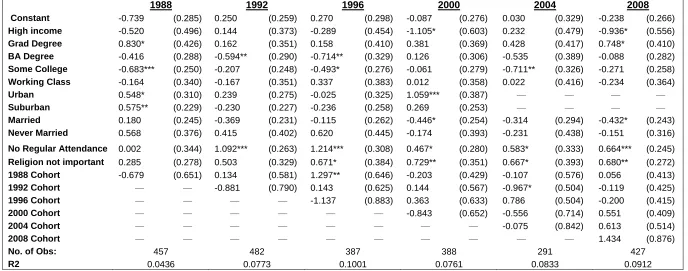
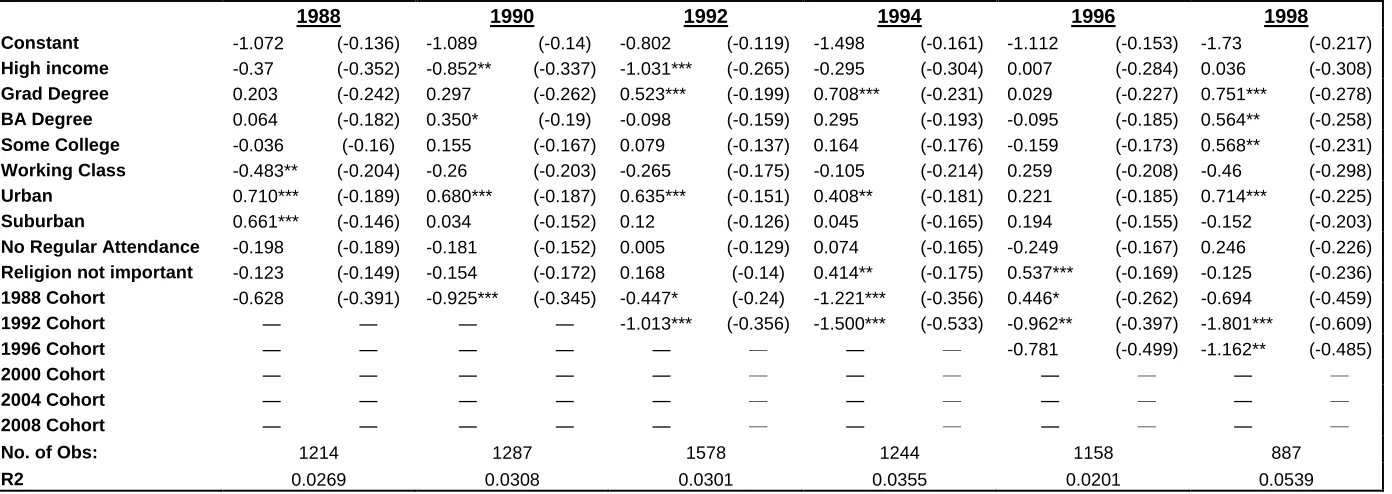
Hypothesis 1: Starting from the 1992 presidential election, white voters in presidential elections on the higher income scale will be more likely to vote in a Democratic direction, evidenced by an increase in coefficients in successive election years.
Hypothesis 2: Starting from the 1992 presidential election, white voters in congressional elections on the higher income scale will be more likely to vote in a Democratic
direction, evidenced by an increase in coefficients in successive election years.
The “Bottom” - The White Working Class
Democratic dominance among low-income minority groups has been well documented,
so I do not expect there will be a significant change in their voting habits over the examined time
period. However, elections have seen variations in the votes of lower income whites, and this is
what my hypothesis and subsequent analysis will focus on.
The Republican coalition in the 1980s was fueled in part by the movement of the white
working class, sometimes referred to as “Reagan Democrats” because of their support for
President Reagan in the 1980 and 1984 elections. Judis and Teixeria chronicle a movement of the
white working class to the Republicans in the 1980s, but many of those voters shifted back to the
Although Vice President Gore saw some erosion in this category from Clinton’s performance,
the Democrats saw an overall gain in their votes for Democrats from 1988 to 2000 in this group
(2002, 62-64). If this is the case, it suggests that the white working class is no longer as strong
for the Republicans as it had been in the 1980s, potentially endangering their electoral chances in
states with a significant white working class populace.
Hypothesis 3: Starting from the 1992 presidential election, the white working class will be more likely to vote Democratic in presidential elections from 1988 to 2008, evidenced by an increase in coefficients in successive election years.
Hypothesis 4: Starting from the 1992 presidential election, the white working class will be more likely to vote Democratic in congressional elections from 1988 to 2008, evidenced by an increase in coefficients in successive election years.
Urban Residency
Judis and Teixeria also claim there is a pro-Democratic shift of white voters who reside
within urban areas. The authors cite Gore’s success among these voters by winning them 49-46
percent in 2000, a huge uptick from Dukakis’ losing 44-57 percent to George H. W. Bush in
1988 (2002, 66). The ANES survey does include a question that breaks down respondents into
urban, suburban, or rural areas. However it is only used up to 2000. Still, even with the exclusion
of election years after 2000, this variable may be useful in detecting even the beginnings of a
pro-Democratic trend.
Hypothesis 6: Starting from the 1992 presidential election, white residents who live in urban areas will be more likely to vote Democratic in congressional elections from 1988 to 2000, evidenced by an increase in coefficients in successive election years.
Education
Voters who have received graduate or post-graduate degrees are another vital component
of a Democratic-focused realignment. These voters were also cited by Burnham and Phillips as
possible components of a new Democratic system, and Judis and Teixeira explicitly identify
them as increasingly Democratic voters.
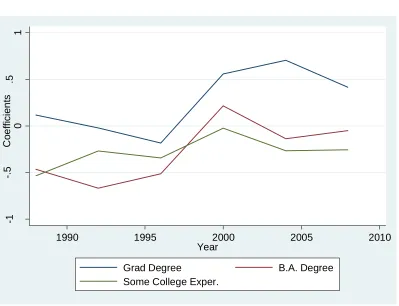
Hypothesis 7: Starting from the 1992 presidential election, voters with graduate and post-graduate degrees will be more likely to vote Democratic in presidential elections from 1988 to 2000, evidenced by an increase in coefficients in successive election years.
Hypothesis 8: Starting from the 1992 presidential election, voters with graduate and post-graduate degrees will be more likely to vote Democratic from 1988 to 2000 in
congressional races, evidenced by an increase in coefficients in successive election years.
Generations
The success of President Obama among younger voters has fueled speculation that
Democrats will have an electoral majority that will last through the next generation. Democratic
Party activists see the great potential for Democratic dominance, notably James Carville, who
was one of President Clinton’s top strategists. Shortly after Obama’s victory, he had declared
that Democrats will own the next generation of voters because of their support for Democratic
presidential candidates in recent years (Carville 2009).
Carville’s assertion draws its inspiration from the school of voting behavior popularized
by The American Voter, which suggests that voting behavior is acquired in youth and steadily
challenged, with the advent of the Vietnam War, the rise of independents, and the concept of
“dealignment.” Some literature has suggested changes in party ID with age (Abramson 1974;
Knoke and Hout 1974; Converse 1976) while others have disputed this (Glenn 1976). Some
literature suggests that adults retain consistent voting habits from their youth (Sears and Funk
1999) while others claim party ID is subject to varying factors (Franklin 1984; Niemi and
Jennings 1991; Fiorina 1996). Since the possible Democrat-advantage realignment rests so
heavily on younger voters bringing their voting habits with them as they age, this may be one of
the most important variables I will analyze.
The events that shape the formative experiences of each generation will likely differ,
resulting in different voting preferences among generations. Such divisions are usually broken
down into cohorts. A cohort is defined as “people born during a particular time span who,
because of their social and historical contexts, may develop values and behaviors that separate
them from people born in preceding and succeeding birth years” (Frenk 2008, 3). These values
and behaviors may induce a majority of the cohort to favor one party over another. Literature on
the subject has shown that various cohorts will vote for one party over another (Converse 1976;
Braungart and Braungart 1990; Wattenberg 1991; Geer 1991; Alwin and Krosnick 1991; Green
et al 2002; Binstock 2005; Binstock 2006; Frenk 2008; Binstock 2009) and that cohorts can have
a significant effect on vote choice (Frenk 2008; Binstock 2009). Such cohorts can be named for
the defining experiences of the time they came of voting age. For example, Frenk used
historically or culturally defined names for cohorts in his analysis, such as “Depression Kids” or
“War Babies.” (Frenk 2008, 16).
Finally, while the literature suggests that these cohorts likely retain their voting
Furthermore, cohort voting behavior may also change somewhat over time. Frenk discovered
that as cohorts aged, they would become more conservative in their voting habits (Frenk 2008).
Binstock has also explored whether cohorts would become more cohesive due to age-related
issues like Social Security and Medicare, but such indications have not arisen yet (Binstock
2009). In sum, while cohorts may retain a partisan edge depending on their formative
experiences, their voting habits cannot be taken for granted.
The 2008 election is too recent to determine whether President Obama has helped create
a Democratic shift in the electorate, but I can go back to the 1992 election. According to Judis
and Teixeria, Clinton’s 1992 victory formed the rudiments of a coalition that would intensify in
the 1996 election, when Clinton won wealthier voters in places that had supported Republicans
previously (29-32). If the 1992 presidential election heralded a shift toward a
Democrat-advantage realignment, then the voters who came of age in this election may have retained
Democratic voting habits in the succeeding elections. Counting 1992, there have been five
presidential elections up until the writing of this paper, so the voting habits of this cohort can be
measured.
This stage of the analysis will track the voting habits of those that came of age in the
1992 and 1996 elections, the only elections in my timespan that produced Democratic victories
that have cohorts that can be tracked in future years in my scale, and determine if a steady
pro-Democratic voting pattern emerges. The boundaries of our age cohorts will be determined by the
age they became eligible to vote for that election year, so they will be defined by those that were
eighteen to twenty-one years old during that year. This will also serve to examine Frenk’s
Hypothesis 9: Starting from the 1992 presidential election, voters of cohorts that came of age during Democratic administrations will be more likely to vote Democratic in
presidential elections from 1988 to 2008, evidenced by an increase in coefficients in successive election years.
Hypothesis 10: Starting from the 1992 presidential election, voters of cohorts that came of age during Democratic administrations will be more likely to vote Democratic in congressional elections from 1988 to 2008, evidenced by an increase in coefficients in successive election years.
Religiosity
The power of socially conservative voters has been cited as important in Republican
breakthroughs in the South, fueled by the political power of evangelical groups and other
conservative religious organizations. However, these developments have been seen as a
detriment in the Northeast and in other sectors of the country where outward social conservatism
is not popular.
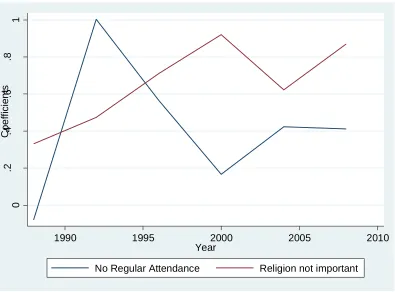
Religiosity is generally defined in the literature as individuals who frequently attend
religious or worship services or are otherwise frequent practioners of religious duties. A more
secular outlook on life is defined by a lack of such practices. Instead of looking at Catholics,
Protestants, or Jews, this dichotomy groups members from all denominations together by
frequency of religious attendance (Campbell 2002; Claassen and Povtak 2010). This way,
Americans are measured by religious practice, regardless of what religion they actually belong
to.
The rise of this conservative religious segment has been examined and analyzed by
scholars (Hertzke 1988, Wald 1992, Wilcox and Larson 2006), including how conservative
Christian groups persuade voters how to vote (Regnerus, Sikkink and Smith 1999). Important