Geschke Center
Master's Theses Theses, Dissertations, Capstones and Projects
Winter 12-18-2015
Evolution of a Nation after a Dictatorship: How
Law, Politics and Society of the 1973 Dictatorship
in Uruguay and of the Subsequent Return of
Democracy in 1985, Potentially Helped Evolve the
Nation of Today.
Jonathan A. Fein Proaño [email protected]
Follow this and additional works at:https://repository.usfca.edu/thes
Part of theComparative Politics Commons,Constitutional Law Commons,Educational Sociology Commons,Education Law Commons,International Humanitarian Law Commons,
International Law Commons,Latin American Studies Commons,Models and Methods Commons,
Political Theory Commons, and thePolitics and Social Change Commons
This Thesis is brought to you for free and open access by the Theses, Dissertations, Capstones and Projects at USF Scholarship: a digital repository @ Gleeson Library | Geschke Center. It has been accepted for inclusion in Master's Theses by an authorized administrator of USF Scholarship: a digital repository @ Gleeson Library | Geschke Center. For more information, please [email protected].
Recommended Citation
Fein Proaño, Jonathan A., "Evolution of a Nation after a Dictatorship: How Law, Politics and Society of the 1973 Dictatorship in Uruguay and of the Subsequent Return of Democracy in 1985, Potentially Helped Evolve the Nation of Today." (2015).Master's Theses. 166.
EVOLUTION
OF A NATION
AFTER A
DICTATORSHIP
How law, politics and society of the 1973 dictatorship in Uruguay and of the subsequent return of democracy in 1985, potentially helped evolved the nation of today.Jonathan Ari Fein Proaño
Adviser: Prof. Olivier Bercault
Master of Arts in International Studies December 1st, 2015
Signature Page
Evolution of a Nation after a Dictatorship
In Partial Fulfillment of the Requirements for the Degree
MASTER OF ARTS
In
INTERNATIONAL STUDIES
By
JONATHAN A. FEIN PROAÑO
December 1, 2015
UNIVERSITY OF SAN FRANCISCO
Under the guidance and approval of the committee, and approval by all the members, this thesis project has been accepted in partial fulfillment of the requirements for the degree.
APPROVED:
___________________________________ __________________
Advisor Date
___________________________________ __________________
Academic Director Date
___________________________________ __________________
ABSTRACT
Jonathan A. Fein Proaño: Evolution of a Nation after a Dictatorship
(Under the direction of Olivier Bercault)
In 1973, Uruguay’s president authored a coup d’état with the military and changed the
history and fabric of Uruguay. Once democracy returned to Uruguay in 1985, it was a
chance to see if an evolution of the law, politics and society would occur. This thesis
aims to analyze and understand the patterns of change and de-evolution or evolution that
happened during the dictatorship and then over the last 30 years. I break down the
process of changes that happened legally and politically, how the dictatorship and its
leaders used law to destroy rule of law, and how society changed.
This thesis assesses the multiple historical aspects and points of view of what happened
during the dictatorship, and what happened from 1985 until today. Finally, I presents an
alternate approach to the potential evolution that Uruguay underwent by looking at the
Table of Contents
Page
Signature Page……… i
Abstract……….. ii
Table of Contents/List of Tables and Figures………... iii
Acknowledgments……….. iv
Dedication………...v
CHAPTER 1- Introduction………. 6
CHAPTER 2- Methodology………... 11
CHAPTER 3- Literature and Theory Review……… 15
CHAPTER 4- History (Mid 1800’s to 1973)………. 25
CHAPTER 5- The Changes that Occurred: The Dictatorship (1973 to 1984)……... 35
CHAPTER 6- The Evolution of Law and Politics Since 1985………...56
CHAPTER 7- The Evolution of Society since 1985……….. 66
CHAPTER 8- A Pattern Worth Noting: The Evolution of Memory……….. 72
CHAPTER 9- Conclusion/Findings………... 79
BIBLIOGRAPHY……….. 86
Tables and Figures Page Table 1: Laws and Constitution of Uruguay regarding the 1973 Dictatorship……. 9
Table 2: Alternative political parties to the traditional parties……….. 27
Figure 1: Scope of State Functions (Fukuyama)………... 16
Figure 2: Model of Relation between Society and State………... 23
Acknowledgments
This thesis and its research would have not been possible without the support and help of my family and mentors. To mother Martha and my brother Oliver, who not only encouraged me to continue and pursue this topic even when I felt like giving up, but also
put up with my endless talk and questioning of my work. To my Aunt Maria de los Angeles “Magela” Fein, who shared her wisdom, knowledge and passion about this topic
and who helped me navigate Montevideo in search of more information for this thesis, while in Uruguay. To my sister Analia and my brother Julio Cesar, who gave me their unconditional love and support and invaluable help in Uruguay. To my advisor and mentor, Prof. Olivier Bercault who helped me in managing the data and knowledge of this thesis and who showed interest and academic curiosity about the intricacies of this topic. Lastly, to all those at the National Archives and National Library in Uruguay, the staff and director at the Museo de la Memoria, the leadership board at CRYSOL and the faculty of Universidad de la Republica- Facultad de Ciencias Sociales who gave me all
I dedicate this thesis to my dad, Julio Cesar Fein Garcia, who inspired me to research and understand what happened to the country he so much loved. His love for Uruguay gave
CHAPTER 1- INTRODUCTION
Asking if a country has evolved or not, may pose a question to you as the reader. A
country can develop and a country can grow, but evolve? Indeed, it is something that we
can ask when looking at a democracy. Democracies are more than just a constitution and
the capacity to it. It is a process involves government, law, economy and society. It as a
process of governing and order, of coexistence and respect, of rule of law and rights that
must be actively respected by the population “it serves” and those who, having been
elected, protect it. A democracy, by this approach is then also a catalyst for change and
growth, of potential evolution.
However, there are instances, in which a democracy, however, is tested in its
process. A dictatorship becomes the means by which the country is tested in its framework.
It tests the political system, the legal system, the economic system and the society. The
evolution process can then be seen as stagnant or of de-evolution. Dictatorships then are
shaped during the period of change-dictatorship- and when order returns. We must then
look at what events lead to democracies to be shaped the way they are (before and after the
dictatorship) and what levels of a democracy, can push for this evolution. The three
elements or variables that can show this are political/legal institution, economic institutions
and social institutions. To answer these questions and comprehend whether or not politics,
law and society have provided for democratic evolution, we focus on the case of Uruguay,
the dictatorship and the 30 years that followed when democracy returned.
In the 1960’s, Latin America underwent a process of change under
authoritarian/dictatorial regimes. The Southern Cone particularly, suffered the most.
Military dictatorships took hold of Argentina, Brazil, Chile and Uruguay. Their
communism, from groups that threatened the stability of the region and to promote a new
approach to neoliberal economic policies (Yafee, 2010) and governance. Of the four
Southern Cone countries, Uruguay, although small, suffered greatly and to a larger scale
than the rest (in comparison to population size). The tactics used by the dictatorship to
control its population, and the economic and social policies that the government used,
changed Uruguay’s democratic landscape.
It challenged the population’s sense of traditionalism (Bertoni, 2015) and imposed
authoritarianism as the only solution to Uruguay’s “plight” (General Bolentini in EL
DIARIO, March 15, 1973). After 1985, Uruguayans were faced with a country that was
re-entering (back) into democracy. It was a country that had to “re-build” its system and assess
what changes were made to its institutions and what changes needed to happen.. It is this
stage that we want to understand whether an evolution process happened. The goal with
this research and this thesis is to then understand whether the history and the past of the
dictatorship, shaped and allowed for a process of evolution to happen in Uruguay. Politics,
law and society are analyzed to understand what happened in its past and how it shaped its
future (what is its present today). In short the research question and hypothesis is: Has
Uruguay evolved in its politics, laws and society over the last 30 years?
This question and approach to this rationale is taken by looking at a series of, what
we belief to be, interconnected variables. We look to focus particularly on the politics and
laws of Uruguay, the economic reality and policies, and the societal aspect of Uruguay.
These variables will be then looked at under two timeframes: the dictatorship period
(1967-1985) and the period of restoration/reconciliation (1985-2015), and will all be tied together
defined in this thesis as the evolution of the state, its institutions and society and the
subsequent changes that occur. It is an approach can point in what direction this evolution
is heading. There are two variables we approach to see state institutional evolution:
political/legal institutions and society.
Analyzing as a first variable is the history and the legal/economic framework under
which the changes that Uruguay underwent happened, and what followed 1985. This
variable is composed of two aspects: first, the constitution itself and second, the laws
enacted (either as emergency measures or as executive/parliamentary measures). The
constitution which Uruguay was under in 1973 was the same document that was still valid
in 19851. This document then becomes crucial in providing evidence to the question and
hypothesis, as it allows us to use reference point to what legal language the authoritarian
government and then the democratic government were holding themselves to. We briefly
analyze the laws that where enacted before 1973, those during the dictatorship and then
those following the return to democracy (from 1985 until today). The laws we potentially
look at are:
Law Number Title
Constitution (1996)
Constitución de la República Oriental del Uruguay Ley Nº 14.068 Ley de Seguridad del Estado y del Orden Interno 2 Ley Nº 15.737 Ley De Amnistía3
Ley Nº 15.738 Ley de Actos legislativos dictados por el consejo de estado4
1 It is the same constitution today. Uruguay’s current constitution is the “1967 constitution with the
plebiscitary changes made in November 26th, 1989, November 26th, 1994, December 8th, 1996 and
October 31st, 2004” (Constitucion de la Republica, 2014).
2 Law on the Security of the State and Internal Order (Law 14.068, 1972) 3 Amnesty Law (Law 15.737, 1985)
Ley Nº 15.739 Ley de Emergencia para la Enseñanza5
Ley Nº 15.848 Funcionarios Militares y Policiales- Se Reconoce Que Ha Caducado El Ejercicio De La Pretensión Punitiva Del Estado Respecto De Los Delitos Cometidos Hasta El 1ro De Marzo De 19856(Ley de Caducidad)
Ley Nº 18.596 Actuación ilegítima del estado entre el 13 de junio de 1968 y el 28 de febrero de 1985; reconocimiento y reparación a las víctimas7
Ley Nº 18.831 Pretensión Punitiva Del Estado- Restablecimiento Para Los Delitos Cometidos En Aplicación Del Terrorismo Del Estado Hasta El 1ro De Marzo De 19858
Table 1: Laws and Constitution of Uruguay regarding the 1973 Dictatorship
These laws will allow understanding how, why and to what effect the actions of the state,
were effective (or ineffective) in helping the state evolve. It also allows us to see the
contradictions within the Uruguayan legal system (constitution vs. enacted emergency laws
and decrees) and to contrast it to the reality that was faced on the ground by the military
operatives and the population.
A particular aspect that will also be the focus on, and that will be a thread through
the thesis is the actual effect of the laws and the violations they had on the population. The
massive arrests, disappearances, torture and exile that took place were a result of laws and
policies of the dictatorship, that sought to take control over the state. This analysis
coincides with the social aspect of the research because a country depends on its population
to thrive and develop. In so, looking at the “social impact” of the laws permits us to
understand the mechanism by which the population helped or hindered the state in its
evolution (during and after the dictatorship). In looking at the political and economic
evolution that potentially occurred, we will analyze Francis’ Fukuyama’s approach to state
5 Emergency Law for Education (Law 15.739, 1985)
6 Law on the expiry of the punitive capabilities of the state towards military and police personnel for acts
committed until March 1st, 1985 (Law 15.848, 1986)- Expiry Law
7 Law in recognition of the illegitimate acts perpetrated by the state from [1968] until [1985]; recognition
for reparations to victims (Law 18.896, 2009)
8 Law reestablishing the punitive capabilities of the state for crimes committed during the sanctioned
building and how democracies should be structured (including the legal and political
implications that come with that. It will provide a framework to understand how the
functions of a state are distributed. It will also provide the Segway into the social evolution
of Uruguay.
This research will also look the social institutions in Uruguay, specifically at
education and culture as crucial and essential pieces of society and seeing how the changes
that have occurred in Uruguay have been either positive or negative for its society. Using
this social approach will bring some “validity” to the argument that political and economic
change happened hand in hand with society’s evolution. Looking mainly at the question of
what role memory and past plays in this evolution process will be crucial to understanding
how it affects the fabric of population (migrated, young, elderly, and victims of the
dictatorship), education and the reconciliation of the events of the dictatorship with what
the population needs from the government.
The review and analysis of the variables mentioned here, focus on two key and
crucial aspects of the evolution of a country. The analysis I will be conducting with these
variables and approaches is to understand whether “positive evolution” (rather than
devolution or stagnation) occurs even when you have such negative events happen to a
democracy. In so, I deconstruct Uruguay’s democracy with the variables to establish the
model of analysis and eventually, to bring to light the changes and processes that a small
country underwent and has succeeded in the region. It is plausible that this analysis will
yield patterns and different evolution processes that Uruguay faced with the return of
CHAPTER 2- METHODOLOGY
The methodology used in this thesis combines multiple approaches to the literature
gathered, the first accounts obtained and to assure the most of the available data on the
different variables are included. A majority of the initial research was conducted in the
United States, using available, online resources, as well as library resources. The rest of
the research that was used for this thesis was acquired in situ in Uruguay, via interviews,
library and archival research and ethnographic observations.
In Uruguay, I was able to gain access to the National Library and National
Archives, as well as to academic contacts and members of civil society who are actively
engaged in the research, divulgence and conversations about the dictatorship and what
happened afterwards. My research at the National Library and Archives granted me access
to copious amounts of newspapers and legislature logs or diarios de sesiones of the time
(from 1973 to 1985). Because of the volume of information available, I focused on key
dates9 and periods that pertained to my current research and would complement my
previously done work, as well as the interviews that I had on the ground. An important
aspect of this research was making sure that the selected dates had enough information to
assure the veracity of the information.
In regards to additional literature, I was able to procure additional books that
included first-hand books from two survivors that wrote about their time in jail, the story
of the exiles and their children. A few political satire magazines from the time of the
dictatorship that shed light on the counter-dictatorship ideology, a manual for the
9 From 1968-1973, 1978, 1980 and 1984/1985. These dates were chosen as such because of the
Tupamaros10 and their tactics and lastly, a compendium by the joint chiefs of staff, of how
they perceived their fight against the seditious was going11. Moreover, literature gathered
in Uruguay included two books published by ex-president Julio Maria Sanguinetti, which
provides an “inside” look into how government functioned during and after the
dictatorship.12
Finally, my research in Uruguay was completed by the interviews/conversations I
had with actors in various parts of Uruguayan society, as well as ethnographic observations
I made at gatherings when the topic came up. Although I had hoped to interview high-level
politicians that were involved in the dictatorship, scheduling a meeting proved to be more
complicated and given the limitations of time, I had to desist. However, I was able to secure
interviews with three academics from the UdelaR- Universidad de la Republica (public
university ran by the state). These three academics, Maria Camou, Reto Bertoni and Maria
de los Angles Fein, were able to each give me a different perspective on the variables I
have mentioned and provided me with more questions to ask and opened to possibilities of
what this project could become.
I was also able to conduct an interview with two members of civil society and a
student of the UdelaR who has a personal connection with what happened during the
dictatorship and is active in fighting for those who disappeared and have a conversation
with a civil society organization- CRYSOL. I was fortunate enough to be put in contact
with CRYSOL13, meet its executive board, and observe their interactions and conversations
10 See chapter 3
11 This book, published by the government in 1976, will be used in chapters 4 and 5, where a look into
how military perceived their actions legal, led to changes after 1985.
12 Julio Maria Sanguinetti was part of the government, but not in favor of it, during the dictatorship. He
later became a crucial player in the restoration of democracy.
on the subject of what the dictatorship was and what is has done today, for Uruguay and
its people. Within the organization, I was able to meet and interview a former prisoner of
the dictatorship, Juan Miguel Garcia Lamas. He gave me a more in-depth overview of what
was the mentality during the dictatorship towards what was happening, and to what was
his perspective as to what the country is going through today.
Lastly, I had the opportunity to visit the new Museo de la Memoria-MuMe
inaugurated in 2014. This museum, sponsored by the City of Montevideo, is a place where
the memory of what happened, via displays, exhibits and events, is kept alive and as
remembrance of what should never happen again. I was able meet and interview the
director of museum, Elbio Ferrario, who having been a prisoner himself, gave me yet
another interesting perspective of what it was like then, and how Uruguay had changed
since 1985, what had happened to culture and what the museum was doing to keep the
memory alive. My ethnographic observations were limited to family gatherings and few
gatherings with acquaintances. In all instances, it all started as a conversation as to why I
was visiting and why I wanted to work on this topic. On its own, the subject took hold of
the group, and participants of all ages, gave their perspective. This was an interesting
change, as I had not planned for this to happen, nor for it to provide me with yet another
crucial aspect that tied with the political/legal and society variable.
This thesis is not by any means, an all-encompassing work. What happened in
Uruguay and the region had multiple facets that shaped it. My desire to focus on this and
to try and answer the question as to whether or not Uruguay has evolved over the last 30
years stems from a personal affection I have to the subject. My family was a “victim” of
“distant” effect, to me it has become crucial and necessary to understand certain nuances
of what happened. The evolution of a country, particularly in Latin America, is important
because it can provide a looking glass into what the country might become in the future.
The chapters attempt to provide some background and understanding, in broad
strokes, of what happened then, how it happened and what ramifications did it have today.
It is an attempt to chip away at a question that, according to some of the people I
interviewed, has not been really asked. Particularly, having an “outsider” take interest in
this matter, made it even more interesting to them and to the people at the places I visited,
to be more open about it and share their personal perspectives. It is my hope, that by the
end of this thesis, not only that you have learned some history of a country that is part of
me, but that I have been to prove that Uruguay has seen evolution in its political and legal
institutions, as well as its society. That in a way, through my research, I am able to reconcile
past and present and see a shred of light, in what was, one the darkest chapters of Uruguay’s
CHAPTER 3
LITERATURE and THEORY REVIEW
In order to understand then the nuances of these aspects of Uruguayan politics,
economics and society, I present the theories of Francis Fukuyama, Claus Offe, Göran
Therborn and Joel Migdal. These three theorists and their works look at the three elements
of a government (politics/laws, economics and society) and dissect the various aspects that
approach the process of democracy via these elements. Fukuyama begins his book,
State-Building: Governance and World Order in the 21st Century by elaborating on how 21st
century states lack certain “stateness” and therefore must use a set of tools and parameters
to make their state, a state and meet the 21st century challenge of globalization. “[…]
Politics in the twentieth century were heavily shaped by controversies over the appropriate
size and strength of the state.” (Fukuyama, 2004). This strength was measured by how
efficient and how powerful the state institutions and goals were. Some states proved to be
big and bureaucratic but never truly executed their functions. Fukuyama uses the notion
of “Scope of State Functions” as a guide to what the state must accomplish and have to be
efficient. Graph 1 adequately demonstrates this by showing how functions of the state can
be seen in a linear progression and how the state should progressively approach them in
Figure 1- The Scope of State Functions (Fukuyama, 2004)
Minimal, intermediate and activist functions encompass what Fukuyama seeks to be the
road map of a state. I believe that this road map of a state then becomes a standard of
development. In order for a state to be “successful and developed” it must first cultivate its
minimal functions, as those functions are the once that focus on the “social/society” aspect
of the state. Once that has been achieved, the application of intermediate functions
addresses the economic focus of the state. Lastly, the application of its activist functions
mentions the duties of politics that are duly complemented by the two previous functions.
It is important to point out that Francis Fukuyama mentions that there is no one-way to
categorize the strength and scope of a state and its institutions, and therefore its capacity
may vary (in terms of what the state can actually accomplish). This graph assumes that
states should move from left to right and progress in achieving their functions. This is
the state manages this within its borders. This is to say, to avoid the involvement of
international civil society14, “rich states” and external financial factors.
While state functions are of course the foundation of what a state should achieve
(in economic, political and social areas) in terms of development, Claus Offe’s “Modernity
and the State” elaborates on how the now “modern state” must adapt to what the needs of
globalization are, as well as those needs that government and society need. He positions
his argument on the debate that exists between regulation and deregulation of and by the
state. Offe speaks of an “[…]increased economic efficiency, and in the interest of an
expanded, freedom of economic action, the political-theoretical demand for, and practice
of deregulation is directed at alleged excess of state norms, rules and prescriptions”(Offe,
pg.72). Offe offers this as an example of how regulation can be perceived as an “excess”
of the state, and that deregulation may be seen more of a need that is born from regulation
and its excess. In the case of Uruguay, it is noticeable in the “public privatization”15 of
public goods (electricity, petroleum resources, and telecommunications) which allowed the
state to deregulate the bureaucratic process of “purchasing” of these goods and “regulating”
the intervention of foreign companies in the state.
Claus Offe does not leave regulation and deregulation as the only system for
economic control and political stability. Offe talks about the creation of a system of
“regulation of regulation”. By this he means,
14 I mention an “international civil society” in reference to non-governmental organizations and
international organizations that are not local based in Uruguay. This international civil society is therefore seen as an outsourced intervention into Uruguay, which could potentially affect the development of the state (See: Frank, Andre Gunder. “The Development of Underdevelopment”. 1969. 1-16).
15 By public privatization, I refer to the privatization by the state of public goods that should otherwise be
The main difficulty is how to downplay the alternative between regulation and deregulation, nationalization and privatization, and to make institutional arrangements which strengthen the capacity of individual and collective actors in civil society to coordinate with one another by means of other than that of market-strategic action, namely in a “reasonable”, “solidaristic”, or indeed “principled” manner. This can only be achieved by means of institutional innovations […]”(Offe, pg86).
He believes then that proper systems of regulation and deregulation is based on the
rearrangement of institutions of the state in order to permit the person to be self-sufficient
and to not be controlled in every aspect. The “will of the people” then becomes an
important guiding principle in terms of achieving a balanced system of regulation and
deregulation. This will is driven by needs, desires and wants of both groups inside and
outside the borders of the state. Institutional innovations then must be designed under his
own concept of regulation/deregulation. Uruguay’s “institutional innovation” can be
observed in its design of the BPS, as well as the PLAN CEIBAL. These two entities, while
each answering to their respective ministries (BPS- Ministry of Finance, of Public Health,
of Social Development, and of Labor. PLAN CEIBAL- Ministry of Education), are
independent in their functions and mandates. They “avoid” to a certain extent, the
intricacies of Uruguayan bureaucracy and have budgets that permit them to execute their
projects in a much faster rate than other state institutions (Presidencia, 2014).
Sociologist Göran Therborn in “What Does the Ruling Class do When it Rules?”, describes society, specifically, the ruling class16, “help” the state’s process of socio-economic transformation and the outputs that come from it. Based on Marxist analysis, Therborn establishes a Marxist framework between the struggle of the social classes and government. Göran Therborn makes a case for the technological output a state has. He says,
The output of the state technology may be defined as the effect it produces upon those who are organized by it, or in other words, as the allegiances it manages to construct. For instance, feudal structures typically inspire a relation of deference, which is based on recognition of the personal
16 Ruling class, based on Therborn’s definition, is the stratification of society (Ruling class, middle/working
eminence and distinctiveness of the hereditary ruler. […]. By contrast, capitalist bureaucratic and managerial authority rests on the cultivation of discipline. If the organizational technology is functioning correctly, then the legitimate orders will receive prompt and unquestioning execution.[…]. Successful working class organization, then, relies heavily on commitment and solidarity- individual devotion to a common cause- rather than on formal orders and hierarchies. […]. (Therborn, pg. 117)
Whereas there is an assumption that technology can be only for the development of goods
in society, Therborn argues that technology is what the state gives to its people to better
themselves (or for the betterment of the state itself)and therefore it is how the state becomes
the provider of improvement and development for its people. This then defeats the struggle
of society between the elites and the masses (one of the Marxist problems) that Therborn
alludes to in his analysis and permits all citizens to become useful human capital to the
state. Uruguay does so in its design of its education system. Similar to that of Germany’s,
Uruguay trains its citizens either in university careers at the UdelaR or private
universities(lawyers, doctors, accountants, to name a few) as well as those trained in the
Universidad del Trabajo del Uruguay- UTU, where students are trained in trades and
technologies aligned with the strategic development needs of the state (UTU 2014).
In so, the state is then developed hand in hand with the support of the citizens their
leaders. Therborn makes this argument by comparing the support a fan gives to his/her
favorite rock star (just like the support a citizen gives to his/her government): when
government and its players have lost all their concrete political content, in other words their
power, it is the job of the bourgeoisie (and the proletariat in the case of Uruguay) to become
the inspiring fan, demonstrating commitment, solidarity and collective mobilization to
move the state forward (Therborn 1978, pg.120). With this in mind, the elements of
government (Fukuyama), economic growth (Offe) and social involvement (Therborn) help
theorist can help frame a better understanding of what politics power and society have to
do with a country’s evolution in a post-dictatorship period.
Joel S. Migdal, in his book “Strong Societies and Weak States: State-society
relations and State capabilities in the third world” presents a theory in which there is a
strong relationship between a state and its society, the politics behind them and the reaction
and action of such a society. It focuses on Third World countries (as Migdal calls them).
This relationship, based on the mutual strength of both the state (as a government and legal
apparatus) and society, the “ruled” or governed.
Migdal expresses in chapter 2 that there is a time in a country’s history when
changes happen too fast (by actions taken by the state), and therefore give little to no time
for society to adequately respond. He says,
Sudden disruptions in life pattern give people precious little time to their life strategies. This period [is] a turning point in their lives, marked by difficulty, insecurity, and movement from one set of survival strategies while searching for new ones. It also [includes] a sudden, radical change in the institutions with which they interacted; those institutions are simply established systems of rules and role within which people deal with one another. (Migdal 1988, pg.90).
While this is partially opposite to what occurred in Uruguay at the beginning of the
dictatorship, as I will show, the importance of this passage is Migdal’s acknowledgement
that institutions do undergo changes that happen faster than the institutions themselves can
react. Moreover, the importance of this is to highlight how institutions are not entirely apart
from society. Rather, state institutions function as guidelines and rules for society and
“dictate” how the interactions happen. The failure of then the state and society to fully
comprehend this relationship, according to Migdal, can lead to imbalances in governance,
“A convergence of powerful forces can precipitate rapid institutional
disintegration” (Migdal 1988, pg. 90). This shows then that when society, law, and
economics converge, institutions incapable or unwilling to cope with the necessary changes
for survival will lead to instability of the democracy. As in the case of Uruguay, where
parliamentary changes to the law, and radical changes to the ruling structure of the
executive, led to the taking of government power. This was followed by further impositions
of legal changes to curtail freedoms and dictate how society must live (against their
wishes). In the end, it can be concluded based on Migdal’s assertions, that dictatorships are
easily established when the status quo is easily broken and no period of adaptation or
survival is allowe4d between the two mutual parties of the state: society and government.
Migdal concludes his arguments on strong societies and weak states, by presenting
the big picture of how Third World countries are truly portrayed to the rest of the world
and what is the outcome for their governments and society. “[The] Third World [has been
portrayed as having] states that represent, speak for, their societies.” (Migdal 1988,
pg.260). This portrayal of these countries, according to Migdal, is crucial in understanding
the development of their governments. He alludes to the fact theater leaders take it upon
themselves to portray a relationship between state and society that is strong and that indeed,
the state speaks for tis people. Migdal also points out that while that may be the outward
notion, on the ground it works slightly differently. He says,
The official policy versus what actually happens on the ground is what then can bring about
drastic change in governance and society (as we will see, be the case in Uruguay). The
practice of government imposing or implying the application of certain rules, laws an
regulations to change the attitude and behavior of its people, must be done tactfully, or it
will be met with resistance (pg. 261).
Migdal suggests that “social control for the state entails more than insinuation, or
penetration, of its agencies into society, more even than just successful extraction of
resources. It includes the ability to appropriate resources for particular purposes and to
regulate people’s daily behavior”(Migdal 1988, pg. 261). Here Migdal poses two important
notions that we must consider for this thesis: control and resources. Migdal suggests that
control is beyond what the laws or the image of the state is. Control entails the actual
presence of the state in altering the behaviors’ of society. That is where resource control
comes in. We believe that it extends beyond the common concept of resources (goods for
purchase and production) and can be interpreted as political resources, human capital, and
freedom (as a resource of the state).
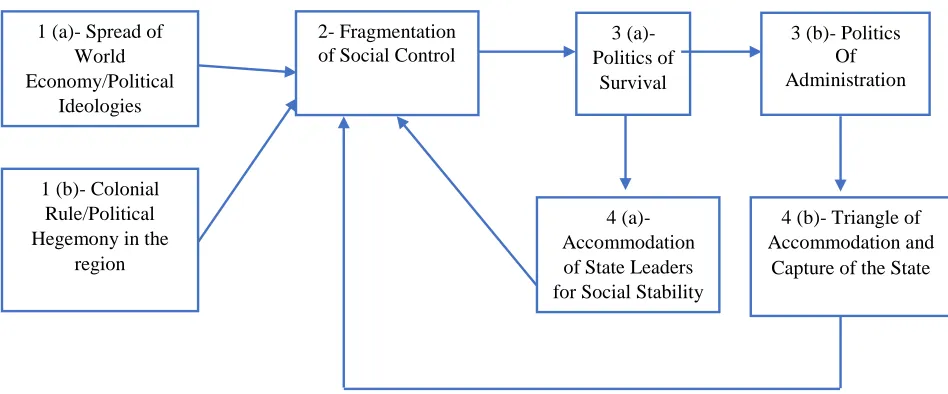
In so, we use an adaptation of Migdal’s self-reinforcing model of fragmented social
and state control to depict what happens when the status quo changes. In this case, this
Figure 2: Adaptation of Joel Migdal’s Model of Relation between State and Society (Migdal, pg. 268).
As Migdal portrays in this chart, when changes occur, there are reverberations in the inner
functions of the state a series of events and actions occur so as to attempt this balance or
power to be achieved. Applying this to the case of Uruguay, we can understand it as
follows: The new political ideologies that spread in the 1950/1960’s
(communism/socialism) and the presence of the US as the region’s political hegemony
begin to shift the balance of what society wants/needs and what the state sees as necessary.
This leads in turn to shifts in how society perceive government control and begin to create
fragmentation between state and society (protests, civil disobedience, calls for political
change). Therefore, two situations create themselves that attempt to regulate the situation.
The government enters into a mode of survival in order to protect its power and society
into a mode of survival to protect its rights and freedoms. Simultaneously, a politics of
administration happen. This is to ensure that the institutions (political and social) do not
collapse while society remains fractured. 1 (a)- Spread of
World Economy/Political
Ideologies
1 (b)- Colonial Rule/Political Hegemony in the
region
2- Fragmentation of Social Control
3 (a)- Politics of
Survival
3 (b)- Politics Of Administration
4 (a)- Accommodation of State Leaders for Social Stability
4 (b)- Triangle of Accommodation and
Ultimately, the figure shows that two potential outcomes may occur (all leading
back to the fragmentation of society). These two outcomes foreshadow two alternatives to
the social and political reality of the country: return to stability by having political and
social compromise, or a dictatorship by which the power and respect for laws is disregarded
in order to maintain control. Migdal’s figure provides this understanding by dissecting the
multiple facets that make up a society and its government. The importance of
understanding Migdal’s approach to weak states and strong societies is important in order
to understand what we will present about Uruguay.
The changes that serve as a catalyst for the dictatorship in 1973 can be understood
in part, with Migdal’s approach to the role of government and society. At the same time,
the social implications on the State, that Migdal alludes to, explains how society suffers
the changes and can be the change of a State, particularly one like Uruguay. This is not an
extensive or lengthy analysis of the theories. However, we have chosen the key aspects that
relate to the potential evolution that Uruguay underwent during and after the dictatorship.
Utilizing a political science approach and a sociological approach should allow us to better
CHAPTER 4
HISTORY
From the mid 1960’s until the mid 1980’s, Latin America was faced with a period
of lack of rule of law, violations of rights and dictatorial governments that sought to control
every aspect of life, through any means necessary. These dictatorships were “founded” on
the principle of “National Security”17 against forces that sought to destabilize the state
(Junta de Comandantes 1976). These “forces” as deemed by the dictatorships, were in fact
an embodiment of the voices of discontent and change. It was a group in society was not
content with the political, social and economic situation of the country and wanted to see
that change happen. As the introduction stated, we focus not on the history of the region
(although it did have some repercussions in Uruguay) but rather on the particularities of
Uruguay, how “it was led” to this moment of instability, how law and politics played a
crucial role in it and how it unfolded before the culmination of the dictatorship in 198518.
In its history, Uruguay was not facing a dictatorial government for the first time. In
fact, Uruguay had had a series of dictatorships in its past (albeit not as brutal as the one in
1973) that should have taught lessons to country to not have that event repeat itself. A key
aspect of Uruguay’s history is the function and role that political parties had and have for
the country. Adolfo Garcé, in his essay “Notas sobre partidos políticos e identidad
nacional en Uruguay” mentions that “political [parties] built political institutions which,
with time, ended up configuring distinct aspects of the national identity” (Garcé 2011).
17 At the time, “national security” in Latin America was focused on the fight against communism and any
force that sought to destabilize the state. This was at the aftermath of World War 2, when the USSR started to gain more power and political presence.
18 You will notice that in some instances, I will refer to the end of the dictatorship happening in 1984 or in
What this signifies is that governing Uruguay was driven and based on the political
parties19 that country had had since its foundation as a nation. Moreover, according to
Garcé,
The affirmation of the centrality of the [political] parties going against the grain of prevailing
interpretations of national history during the sixties and seventies, in line with the height of the
influence of Marxism in our culture tend to recall the historical vicissitudes of conflict between
social classes. While recognizing the influence of the role of social groups in Uruguayan politics, it
helped the party-centric hypothesis abandon the exaggerated economistic reductionism and
socio-centric approach and return the focus [to the] political parties and institutions. (Garcé 2011)
The importance and role of political parties is then crucial to understanding the history that
Uruguay carries with itself. As Garcé points out in the last quote, the shifts back and forth
from politics to society and economy always returned to politics. This, we believe, is
because of the crucial role that politics plays in the identity and democratic framework of
Uruguay. The political panorama of Uruguay’s political parties was initially one of
bi-partisan representation, which later turned into a multiparty system.
Before looking at the history of the dictatorships in Uruguay, we must first briefly
look at the political party history given its impotence as noted by Garcé. It is “divided” into
two groups: traditional or historical parties and then the “newer” parties. Uruguay’s two
traditional parties are the Partido Colorado (PC) and the Partido Nacional (Blancos- PN).
The PC, founded in 1836, has a focus on liberalism, republicanism, social democracy,
conservatism and political pragmatism. Its political agenda leans to favor the center-right
ideology (conservative) with some instances of leftist ideology in more progressive modern
ideas (Partido Colorado 2011). The PN was founded in 1872; around the same time as the
PC, hence the reference to “traditional” parties. Its ideology, similar to the PC, focuses on
19 First, the traditional political parties up until the early 20th century and then the new parties that were
more liberal, nationalist, humanist and panamericanist philosophies. It also has a political
agenda that leans to favor the center-right ideology (conservative). It is considered the
catch-all political party because it tends to favor multiple facets of Uruguayan society
(more so than the PC) (Partido Nacional 2011). These two parties, which are still very
much present in Uruguay’s politics, are not alone in today’s Uruguay.
The “newer” parties that have joined the political arena encompass more aspects of
Uruguay’s society. Besides the two traditional parties, Uruguay has six other parties that
have had a hand in changes and history of Uruguay (closer to the 20th and 21st century).
The parties include:
Party Name Ideology
Frente Amplio Leftist democracy; social democracy, progressive, moderate left
Partido Independiente Social democracy, socialist Christianity, center left
Unidad Popular Extreme left
Partido de los Trabajadores Formerly known as the “revolutionary
socialism) party, revolutionary Trotsky ideology
Asamblea Popular Leftist alternate to the Frente Amplio
Partido Ecologista Radical Intransigente Environmentalist, resource protection
Table 2- Alternative political parties to the traditional parties (Corte Electoral 2014)
For the purpose of this research, however, we must look at mainly at the Frente Amplio
(FA). This party was founded as a coalition in 1971, as a response to the deteriorating
political situation in Uruguay and to provide an alternative to the right-wing ideology of
the current government. This now party has a leftist ideology. Its main tenets are socialism,
Marxism, communism, and very little liberal ideology. The FA is a progressive party that
counters the traditional paradigm of the historical parties, meaning that it goes against the
conservative approach to governance and policy. It is a party that embodies the ideology
The crucial role that these parties play in the history of Uruguay will become evident
further down. The ideology that each one carries and the influence it has on the population
is going to be clear when we approach the ebbs and flows of democracy. In so, we then
re-assess the dictatorships that came before 1973 and what eventually led to 1973.
The first dictatorship to take place in Uruguay was from 1865-1868 by Venancio
Flores (Partido Colorado). Having been “placed” in the presidency by the governments and
military forces of Argentina and Brazil, Venancio Flores was thought of as “[the] greatest
dictator of our history.”(Rocha, et al., 1985, pg. 27). During this time, Flores and the
presidents of Brazil and Argentina signed the Tratado de la Triple Alianza20, which
established the support of the three countries to attack and divide Paraguay into pieces for
each country, respectively. In the end, Uruguay benefited only from the commerce and
business that the war brought to it, but received no “reward” in terms of land. This
dictatorship was characterized not because of the atrocities perpetrated to the Uruguayan
people (which none have been claimed) but rather to the arbitrary and at times, erroneous
actions taken by President Flores (Rocha et al., 1985 and UruguayEduca 2008). In the end,
Flores was assassinated in 1868, bringing to an end this brief period of instability and
ushering back democracy. This is short lived, however.
In 1875, Uruguay was going through a financial and rule of law crisis. It was a time
in which then-President Ellauri (Partido Colorado) was dealing with issues of individual
rights (not yet fully contemplated in the constitution of the time), human rights, religious
freedom and an economy that was quickly failing (Rocha et.al. 1985, pg.29). In 1976, after
20 The Tratado de la Triple Alianza was a treaty signed in Buenos Aires in 1965 that established an Alliance
social uprising, Cornel Latorre saw the power void and took over the government, on behalf
of the Partido Colorado. He did so by applying terror techniques to assure himself control
of the state. The tactics employed included assassinations in broad day light by platoons
patrolling the street, mysterious disappearances, forced labor and imprisonment, as well as
by firing squad (Acevedo 1932). Latorre claimed that his techniques were used in order to
make “an honorable government and not one of thieves, by punishing those civil servants
that did not fulfill their duties with honor” (Rocha, et al. 1985, pg.31). Eventually, he
resigned his post as president/dictator, claiming that Uruguay was an ungovernable
country.
In 1880, democracy was tentatively restored to Uruguay. President Francisco Vidal
was nominated to finish the presidency of Latorre. However, given that Latorre’s
presidency was militaristic in nature (authoritarian and dictatorial in nature), Vidal’s post
was merely a façade given that in key posts of government, there were still military
personnel running the government. The period that followed from 1882 (when Vidal
resigns his post) until 1903, saw a drastic change from authoritarianism, to pseudo
democracy. Attempts to gain control or re-stabilize the country were being challenged both
by the population and by governments in power (Acevedo 1932 and Rocha et.al. 1985).
There was, however a change in the pattern of governance and in society at the turn of the
20th century.
The start to the 20th century was carrying already all the social and political baggage
that had been accumulated with the dictatorships that happened in the 1800’s. What this
meant for the new government in 1903 was a push for change and attempt to stabilize the
president. His government was important because of the initiatives it sought to bring
forward to reform the state apparatus. The government sought to increase state intervention
in the economic and social life of Uruguay, as well as the political and constitutional life
of the country (UruguayEduca 2008). Economic changes included the nationalization of
the central banks (Banco de la Republica and Banco de Seguros del Estado), as well as a
of state services (Power- Usina Electrica del Estado, telegraph- Telegrafo Oriental and
train lines- Administracion de Ferrocarriles del Estado ). Socially, Batlle improved the
labor situation of many workers by limiting the workday to 8 hours and introducing
worker’s compensation (insurance). Nevertheless, we believe that the most important
reforms came in the political aspect.
President Batlle y Ordoñez, in his second presidential term21 sought to reform the
1830 Constitution and introduce the “Sistema Colegiado”or National Governing Council.
This system was designed to replace the executive power with a National Governing
Council22. “The ‘Sistema Colegiado’ provided safeguards against dictatorial pretensions
and ensured stability of the reformist policy; however, for the election of the board
members23, the rules favored the ruling party” (Sacchi 2010). This major move to shift the
power of the executive power could be perceived as an attempt to protect the institutional
framework of the democracy. Uruguay had been enjoying a democracy for some time, and
Batlle’s reforms was made to prevent the state from having another dictatorship happen.
The reform never occurred, as it received more votes against it by Batlle’s opposition and
the president that followed him, Feliciano Viera, in 1916 (Sacchi 2010, UruguayEduca
21 1911-1915
2008, Acevedo 1932). Following this period of reforms and change came a period of
political and social trial and error and constitutional changes for Uruguay, from 1916 until
1973.
In 1918, the constitution was reformed. It main changes focused on making the
constitutional amendment process more agile (less bureaucracy) as well as defining better
the structure of the executive power24. Following this new constitution, three more
constitution were enacted before the 1967 Constitution (the one used by the dictatorship to
gain power). Among the notable changes that happened during this period of constitutional
change was the enactment and recognition of induvial rights (1942 constitution), It also
created the official post of Vice President of the republic (1934 constitution) and eliminated
the Consejo Nacional de Administracion (1934 constitution). It is also during this period
that two minor coups occur (1933-1934 and 1942-1943). In 1952, along with the new
constitution that created the Consejo Nacional de Estado (similar to the proposed Sistema
Colegiado by Batlle in 1915), this council from 1952 until 1967 governed Uruguay. During
this period, the PN governed with this new council-like format. In 1967, the executive
power with president and vice-president was reinstated and the Consejo was abolished.
(UruguayEduca 2008 and Larrobla 2011).
However, the gradual crisis that the political system suffered from 1962 is what
clearly characterized the deterioration of the state. Alvaro Rico, a Uruguayan author and
survivor of the dictatorship, termed this period as “the democratic road of the dictatorship”.
This is because, until the start of coup and de-facto governments of 1973, Uruguay had
allowed its government and its people to allow the state to change and adapt to what was
24 1918 Format of the executive power: The office of the President and the creation of the Consejo
happening (guerrilla tactics, civil unrest and protests for reforms). This was pushed by a
transformation that was being pushed by political organizations, such as the
MLN-Tupamaros25 and social mobilizations that were pushed by syndicates and the political left
(Larrobla 2011). Carla Larrobla, historian, writes that “[the end of 1967 was] characterized
by the deterioration of democracy and of the rule of law, where [the people] assisted in the
auto-transformation from rule of law to a police state.”26 (Larrobla 2011). As a counter to
the changing attitude of the population and the crisis that was escalating, the government
deepened and extended its repressive tactics. In 1968, president-elect Jorge Pacheco Areco
(Partido Colorado) used the Medidas Prontas de Seguridad- Emergency Security
Measures27, under the 1967 Constitution, to systematically combat “the subversion” and
any of those who represented Marxism and its ideology (Larrobla 2011). This action further
demonstrated the crisis in which Uruguay found itself towards the end of the 1960’s. It also
began to push the weakening of rule of law and the abuse of the Constitution and its
provisions.
After Pacheco Areco’s term ended in 1972, President Juan Maria Bordaberry
(Partido Colorado) was elected. Given that the crisis had not been solved, he was tested
on April of 1972. The MLN launched its plan of attack against their counterparts, the right
wing “Escuadron de la Muerte”(Death Squads). Because of the outcome of this bloody
attack, the parliament declared an internal state of war and decreed law No 14.06828.This
25 MLN-Tupamaros- Leftist group that adopted guerilla tactics and was deemed an enemy of the state by
1967. They sought to emphasize a leftist, Marxist ideology and wanted the government to change its approach to economics and politics (away from neoliberal economics). It also wanted the improvement of social services for the population. Given that the government marked the MLN as “seditious”, they became the main target of the attacks and implentenation fo certain laws previous to 1973.
26 “[…]1967. Caracterizado por el deterioro de la democracia y del Estado de Derecho, donde se asistió a
una auto-transformación del Estado de Derecho en Estado policial.” (Larrobla 2011)
law effectively eliminated any protection and acknowledgment of individual rights
(Larrobla 2011). The political crisis continued to worsen, until finally on June 27th 1973,
Juan Maria Bordaberry signed the national decree that effectively dissolved parliament and
that would mark the coup of 1973. In the decree, the new de facto government dissolved
parliament and granted full powers to the executive power, as well a more power to the
military. This decree was signed along with the minister of defense and the minister of the
interior, who were both of the military branches. Bordaberry then became “the
constitutionally elected president that ‘in such an act (self-coup) becomes a de facto
dictator. There was no usurpation of power, nor a vacuum, but rather continuity and unity
of state power’ ”. (Larrobla 2011). This gave the state a degree of “legitimacy” and was
not stopped right away. This decree had also the power to create the “Consejo del
Estado”29. This council was granted the powers to execute the duties if the General
Assembly and to control the executive power when it came to matters of individual rights
and constitutional and legal norms. This limitation of the executive power itself gave full
power to the Council to reword, restructure and supervise the changing of laws in regards
to individual rights (right to freedom, right of movement, right to a fair trial and the right
to life, to name a few).
Additionally, the Armed forces’ participation in the dictatorship had been secured
and institutionalized under the new de facto government. Two institutions were created,
the Council for National Security (Consejo de Seguridad Nacional- COSENA) and the
Council of Joint Chiefs (Junta de Comandantes en Jefe- JCJ) and these two institutions
were crucial in planning, designing, coordinating and executing all repressive policies of
the dictatorship.
The history that Uruguay “lived” before 1973 is one of a “propensity” to fall into
a condition of lack of rule of law and lack therefore of any guarantee to protect rights. The
occurrences that led to the demise of democracy and the deterioration of law and respect
for human rights had a causal factor in how the policies and laws were enacted. The end
goal: complete control of the state and all aspects of life. We have shown that arbitrary
action together with conditions of instability led to the “pre-dictatorship” that should have
foreshadowed what was to come. The events that led to 1973 are therefore crucial to
understanding what happened. The next chapter breaks down the legal and political, as well
as societal changes that occurred during the dictatorship, as well as to the years leading to
CHAPTER 5
THE CHANGES THAT OCCURRED: The Dictatorship (1973-1984)
“Violence is the only way left for Uruguay to win over power”- Fidel Castro, 1971
Uruguay’s history, as seen in Chapter 2, was marked by periods of dictatorial
governments and democratic restoration. It is then important that we look at what where
the legal, political and societal changes that occurred from 1973 until 1985 allowed for the
dictatorship to happen. This chapter furthers the explanation of how the legal and political
changes that were being already executed in the years leading to 1973, opened the gates
for the “destruction” of rule of law and alteration of the constitution. This then led to the
deterioration of human rights (torture, detention and disappearance). In essence, this period
could be seen as a time of de-evolution, of legal and political “backwardness”, as well as
social backwardness.
Historians mention that Uruguay faced a trilogy of crisis: economic, social and
political, and that this led to the corollary deterioration of the state (Caetano and Rilla 1998,
Bertoni 2015, Fein 2015). Form this trilogy, we focus and dissect the laws, politics and
society of Uruguay. The legal and political changes that happened during the dictatorship
are crucial to understanding what happened in the 30 years after the end of the dictatorship.
This period of de-evolution could potentially demonstrate the evolution that happened after
1985. The legal and “democratic framework” used to achieve control (and the subsequent
violation of human rights) in Uruguay, is what enabled for the dictatorship and changes to
occur. We refer to “democratic framework” to the use of the means of legislative and
executive provision under the constitution, to achieve legal and political change. For
Bordaberry to assure its control by 1973, the dictatorship had to grow in power, and
“ticket” into power and control, and then use it to the whim of the dictatorship for total
control.
Politics
Although it started in 1968 under Pacehco Areco, as a response to a deterioration
of social structures, 1973 is the official start of the political and legal oppression.
Bordaberry and the Uruguayan state formed a dictatorship that would run from 1973 until
1985. It was by all intents and purposes, “legal”. The use of the constitution and the creation
of laws “that protected the state” from internal meltdown, seemed on the surface legitimate
and legal. A crucial piece that explains the changes and the dictatorship is Gerardo Caetano
and Jose Rilla’s “Breve Historia de la Dictadura (1973-1985)”, where the authors present
an “abridged” review and analysis of what happened. “Towards the beginnings of the
1970’s, it was evident that the evolution of the government’s politics, as well as the
sustaining of a situation that presented serious imbalances, could have not been a bigger
foreshadow for the progressive implant of authoritarianism.” (Caetano and Rilla 1998,
pg.19).
The political baggage that Uruguay was carrying in the 1970’s, according to
historians Gerardo Caetano and Jose Rilla, was enough to intensify the political, economic
and social situation that allowed 1973 to happen. They go on to say that “[even] when the
socio-economic crisis that anteceded [the crisis in 1973] by almost two decades, that led to
the final break of institutions in 1973, already in 1968 you could clearly distinguish the
dictatorial perspective of the Uruguayan political system. (Caetano and Rilla 1998, pg.19).
The fact that the “hints” and situation were distinguishable, allude that the system allowed
The government began to have an escalating behavior in how they used their
political power before 1973. As seen in chapter 3, the political and legal changes that began
with Jorge Pacheco Areco’s presidency, continued as a reaction to the continuing
deterioration of democratic values. Many historians mention that this deterioration began
with the use of the “Medidas Prontas de Seguridad”- emergency security measures in the
1967 Constitution. Under the Constitution, Chapter 3, Article 168 granted powers to the
president, along with the ministers or council of ministers to ensure the conservation of law
and order in the state, and the protection of the state. It also grants the president with
supreme command of the armed forces and the power to object to laws and prospective law
projects in Parliament, as well as the potential to suspend such laws30 (Poder Legislativo
2004). The emergency security measures under numeral 17 of article 168 is what contains
the emergency security measures. This measure reads as follows,
17) Take prompt security measures in grave and unforeseen cases of foreign attack or internal unrest […]/ As for individuals, prompt measures of security authorize only their arrest or transferred from one point to another within the region provided they do not elect to leave it. Also, this measure, like the others, must be submitted within twenty-four hours adopted, to the General Assembly in joint session or, if appropriate, the Commission Permanente, which will make the decision. The detention shall not be at a place intended for the incarceration of criminals. (Poder Legislativo 2004)
This small but impactful measure, as interpreted by Pacheco Areco, was used in order to
control the situation that the state was facing with the Tupamaros and other groups that
were protesting the political, economic, and social institutions. This measure allowed the
government to incarcerate and detain those it deemed dangerous for the state, those who
belonged to any of the seditious leftist groups (Junta de Comandantes 1976). As Gaetano
and Rilla mentioned, the years leading to 1973 were a precursor period filled with instances