University of New Orleans University of New Orleans
ScholarWorks@UNO
ScholarWorks@UNO
University of New Orleans Theses and
Dissertations Dissertations and Theses
Fall 12-20-2018
An Exploration into Teachers' Perceptions of School Leaders'
An Exploration into Teachers' Perceptions of School Leaders'
Emotional Intelligence
Emotional Intelligence
Lindsey E. Caillouet
University of New Orleans, [email protected]
Follow this and additional works at: https://scholarworks.uno.edu/td Part of the Education Commons
Recommended Citation Recommended Citation
Caillouet, Lindsey E., "An Exploration into Teachers' Perceptions of School Leaders' Emotional Intelligence" (2018). University of New Orleans Theses and Dissertations. 2553.
https://scholarworks.uno.edu/td/2553
This Dissertation is protected by copyright and/or related rights. It has been brought to you by ScholarWorks@UNO with permission from the rights-holder(s). You are free to use this Dissertation in any way that is permitted by the copyright and related rights legislation that applies to your use. For other uses you need to obtain permission from the rights-holder(s) directly, unless additional rights are indicated by a Creative Commons license in the record and/ or on the work itself.
An Exploration into Teachers’ Perceptions of School Leaders’ Emotional Intelligence
A Dissertation
Submitted to the Graduate Faculty of the University of New Orleans
in partial fulfillment of the requirements for the degree of
Doctor of Philosophy in
Educational Administration
by
Lindsey Ellen Caillouet
B.G.S. University of New Orleans, 2002 M.A.T. University of New Orleans, 2011
ii
iii
Acknowledgements
Thank you to my peers in the doctoral program at UNO, especially, Gini, Zina, and Ha.
Your support, encouragement, and friendship mean so much to me. I am so grateful for all of
you.
Thank you Dr. Beabout for being my committee chair and providing all of your help
throughout the entirety of the dissertation process. Also, thank you to my committee members,
Dr. Broadhurst, Dr. Bonis, and Dr. Jeffers for providing meaningful feedback and support as
well. I appreciate you all.
A special thank you to my family. I could not have done this without all of you. To my
mom, thank you for countless hours spent talking with me and truly being one of my strongest
supporters. I cannot express in words how appreciative I am. To my dad, you have always
inspired me to work hard and helped me to see the bigger picture in life. I feel honored to make
you so proud. I love you both dearly. To my sister, Laura, I remember you being the first person
I called when I made the decision to take this journey. Thank you for always bringing out
laughter and happiness, even during the most difficult times. Damon, thank you for all of your
support and encouragement along the way. You helped me to see this through to the end. Lastly,
to my dearest sons, I am so blessed to be your mom. Jude, you are my reason why this dream
became a reality. Without you, this would have never been possible. Julian, you are my joy and
inspiration too. Your excitement and love of life motivated me every step of the way. You both
iv
Table of Contents
List of Tables ... vii
Abstract ... viii
Chapter One ...1
Introduction ...1
Problem Statement ...3
Statement of Purpose ...5
Research Question ...7
Significance...7
Implications...8
Delimitations ...9
Limitations ...10
Definitions of Terms ...10
Organization of the Dissertation ...12
Chapter Two...13
Conceptual Framework ...13
Transformational Leadership Theory ...13
Idealized Influence ...15
Inspirational Motivation...16
Individualized Consideration ...17
Rationale for Transformational Leadership Theory ...17
Emotional Intelligence Defined ...20
Emotional Competence ...20
Self-Awareness ...23
Self-Regulation ...23
Motivation ...23
Empathy ...24
Social Skills ...24
Review of Literature ...26
Emotional Intelligence and Effective Leadership ...27
Role of Trust ...29
Emotional Intelligence and Teacher Job Satisfaction ...30
Emotionally Intelligent Behaviors Contributing to Job Satisfaction ...31
Current State of Leadership Preparation Programs ...33
Best Practices in Leadership Preparation ...43
Literature Summary ...38
Chapter Three...40
Methodology ...40
Research Design...40
Rationale for Constructivism ...40
Approach and Rationale ...41
Statement of the Research Question ...42
Participant Selection ...42
Description of the Participants ...43
Addie ...44
v Lisa ...44 Madeline ...44 Jenny ...44 Michelle ...44 Laura ...44 Chloe ...45 Diane ...45 Don ...45
Data Collection ...47
Data Analysis ...49
Verification Procedures ...50
Management of Researcher’s Role ...52
Limitations ...53
Chapter Four ...55
Results ...55
Four Major Themes...56
School Leader Social Skills ...56
Role of Leader Support ...57
Teacher and Leader Communication ...62
Coping Mechanisms...65
Self-Reflection ...65
Self-Motivation ...67
Summary ...68
Leadership Styles ...69
Coercive Leadership and Emotional Intelligence ...69
Transformational Leadership and Emotional Components ...71
Empathy ...71
Motivation ...73
Self-Control...74
Intuition ...75
Role of Confidence ...75
Summary ...77
Authentic Leader-Teacher Relationships ...78
Benefits of Authentic Leader-Teacher Relationships ...81
Role of Trust ...83
Summary ...85
Perceived Benefits of School Leader Emotional Intelligence ...86
Awareness of Teachers’ Emotions...86
Teacher Morale ...88
Job Satisfaction ...90
Summary ...91
Conclusion ...92
Chapter Five ...94
Discussion ...94
Discussion of Findings ...94
vi
Intuition ...106
Connection to Theory ...107
Emotional Intelligence in Leadership Preparation ...110
Recommendations for Policy and Practice ...111
Recommendations for School Districts ...111
Implications for Future Research ...114
Summary and Conclusion ...115
References ...117
Appendix A: Demographic Questionnaire...127
Appendix B: Interview Protocol ...128
Appendix C: Journal Prompt ...129
vii
List of Tables
viii
Abstract
Although the benefits of school leader emotional intelligence are well-known, leadership
preparation programs lack training in emotional intelligence, thus calling for reform
(Darling-Hammond, LaPointe, Meyerson, Orr, & Cohen, 2007; Johnson, Aiken, & Steggerada, 2005;
Guerra & Pazet, 2016; Mills, 2009; Wallace, 2010). Emotional intelligence competencies, such
as empathy, self-awareness and motivation, are closely aligned with components of
transformational leadership theory, including idealized influence, individualized consideration,
and inspirational motivation (Kumar, 2014). Highlighting these connections can provide
guidance in identifying significant components of emotional intelligence. This study examined
teachers’ perceptions of school leaders’ emotional intelligence in order to identify critical
components of emotional intelligence. This research utilized a qualitative phenomenological
approach to address the research problem, and questions. A purposeful sampling technique was
used to recruit teachers employed in public school districts in Louisiana. Consistent with
phenomenological designs, semi-structured individual interviews were the primary method of
data collection, along with document analysis. Transformational leadership theory and emotional
intelligence provided a framework to guide the construction of methodological approaches,
including: participants, data collection, data analysis and limitations. Four major themes emerged
as a result of this study: 1) school leader social skills, 2) leadership styles, 3) authentic
leader-teacher relationships, and 4) perceived benefits of school leader emotional skills.
1
Chapter One
Introduction
In the new era of accountability, the role of the school leader has become more complex
due to significant pressure being placed on educational leaders (Litchka, 2007; Moore, 2009).
This pressure is due in part to the demands for higher levels of student achievement, and
improvement of the quality of education(Litchka, 2007). Leaders are also expected to transform
schools into adaptable organizations, encompassing “professional learning communities that can
embrace change and create high performing learning environments for students as well as
teachers” (Moore, 2009, p. 20). This transformation involves restructuring and reorganizing
schools, requiring leaders “skilled in emotional intelligence” in order to handle the intense
emotions that occur during change (Moore, 2009, p.21). Although the drawbacks of a changing
school culture involve negative emotions, such as resistance, anger, frustration, and turmoil,
benefits can also occur (Moore, 2009). Emotionally intelligent leaders build trusting
relationships with teachers and staff, display empathy and social awareness, understand the
problems that occur during change, and are better skilled in addressing related issues (Moore,
2009).
According to Gray (2009), school leadership is one of the most researched topics in all of
the organizational sciences, mainly emphasizing the cognitive abilities of leaders, such as logical
decision making, rational thought, and behavior, giving minimal attention to the feelings and
emotions of school leaders. However, research suggests that leaders’ feelings and emotions play
a critical role in decision making, affecting the well-being of everyone in their learning
communities (George, 2000; Goleman, 2004; Gray, 2009). Therefore, principals’ emotional
2
and developing committed and motivated staff (Gray, 2009; Litchka, 2007; Moore, 2009; Singh
& Manser, 2009).
Emotionally intelligent leaders have been found to be more effective, and contribute to
the job satisfaction and performance of their followers (George, 2000; Goleman, 2004; Singh &
Madela, 2013). Goleman (1998) identified five main elements of emotional intelligence
contributing to personal and social competence, including: self-awareness, self-regulation,
motivation, empathy, and social skills. The contribution of emotional intelligence to effective
leadership is demonstrated in multiple ways, such as positively influencing school culture and
performance, relationship building, and viewing resistance as a means of new breakthroughs and
ideas (Fullan, 2001).Furthermore, previous research suggests that teachers’ job satisfaction and
performance is enhanced through meaningful relationship building, inspiration, and building
common visions in schools (Singh & Manser, 2009). Emotional intelligence also contributes to
the job satisfaction of teachers due to the increase in awareness of interpersonal emotions
(Mousavi, Yarmohammadi, Nosrat, & Tarasi, 2012). This increased awareness can aid in the
regulation and management of negative feelings and emotions, thus contributing to higher
measures of performance, and effectively responding to workplace stress (Ealias & George,
2012; Yahazadeh-Jeloudar & Lofti-Goodarzi, 2012). Additionally, job satisfaction can contribute
to specific behaviors of employees such as organizational citizenship, attendance, and retention
(Ealias & George, 2012).However, according to Singh & Mandela (2013), more research needs
to be conducted regarding what specific emotional intelligence behaviors of leaders contribute to
employees’ job satisfaction.
Although the benefits associated with school leaders’ emotional intelligence are
3
emotionally for the demands of the job (Bulach, Pickett, & Boothe, 2004; Schmidt, 2010;
Schultz, 2007; Trinidad Sanchez-Nunez, Patti, & Holzer, 2015; Wallace, 2010). A growing body
of literature suggests a shift in the educational community’s efforts on developing leaders with
emotional intelligence, in order to meet the challenges educational leaders face, such as
increased school accountability and pressure to improve the quality of education, while meeting
the diverse needs of students (Guerra & Pazey, 2016; Litchka, 2007). Goleman (2004) found that
although there is a genetic component to emotional intelligence; it can be learned as well.
Therefore, identifying what specific elements of emotional intelligence contribute to leadership
effectiveness could be beneficial in order to focus training on these components.
Problem Statement
In recent years, controversy has surrounded leadership preparation programs regarding
course content, methodology and rigor in targeted areas (Schultz, 2007). Programs often
prioritize leadership effectiveness, yet fail to link these aspects to social and emotional
components (Cobb, 2004; Schmidt, 2010). Research consensus is that leadership preparation
programs are not emphasizing social and emotional intelligence knowledge, competencies, and
dispositions (Johnson, Aiken, & Steggerada, 2005; Schultz, 2007; Schmidt, 2010; Wallace,
2010); however, programs should focus on emotional intelligence (Johnson, Aiken, &
Steggerada, 2005; McDowelle & Bell, 1997; Schmidt, 2010; Schultz, 2007; Trinidad
Sanchez-Nunez, Patti, & Holzer, 2015). Although programs have emphasized course content that
develops technical leadership practice, emotional intelligence needs to be “imbedded in certain
courses, or created as stand-alones” (Johnson, Aiken, & Steggerada, 2005, p. 249). Emotional
intelligence is the most important curricular goal for “meaningful change to take place in
4
preparation programs to include emotional intelligence in the curricula (Darling-Hammond,
LaPointe, Meyerson, Orr, & Cohen, 2007; Johnson, Aiken, & Steggerada, 2005; Guerra & Pazet,
2016; Mills, 2009; Wallace, 2010).
Incorporating a more unified approach to practicing and teaching social and emotional
intelligence competencies in leadership preparation programs might further develop, and better
prepare school leaders for the emotional aspects of the job (Trinidad Sanchez-Nunez, Patti, &
Holzer, 2015). Refocusing or structuring training will assist leaders in developing emotional
competence in order to prepare them for critical incidents that occur in schools (Johnson et al.,
2005). Furthermore, Taliadorou & Pashiardis (2015) find that school leaders’ emotions and
emotional skills can also influence teachers’ emotions, and motivation, thus leading to their
overall well-being and performance at work. Emotional intelligence, in combination with
cognitive intelligence, has the potential to empower leaders to perform at their highest capacity,
and inspire employees to be successful and happy (Singh & Mandela, 2013). Furthermore, in
order for schools to be successful, improving teachers’ job satisfaction is pivotal (Singh &
Manser, 2009). The emotional intelligence of school leaders is considered a crucial determinant
affecting teachers’ job satisfaction (Singh & Manser, 2009). Therefore, identifying what specific
elements of emotional intelligence contribute to job satisfaction is critical to tailoring leadership
training around these emotional intelligence components.
While existing literature has focused on the role of emotional intelligence in the school
leadership domain, studies have seldom addressed the followers’ perceptions of leaders’
emotional intelligence (Smollan & Parry, 2011; Johnson et al., 2005). It has been found that
follower’s perceptions of the emotional intelligence of leaders may have both negative and
5
providing teachers’ voice regarding their perceptions of school leaders’ emotional intelligence
helped identify the critical components of emotional intelligence, and the associated impacts.
In order to address the lack of leadership training on emotional intelligence, this study
focused on identifying emotional intelligence constructs. Teachers’ perceptions provided insight
into what specific emotionally intelligent behaviors, traits, and practices are the most impactful.
This can provide guidance for professional development and training at school district levels.
Furthermore, the implications of obtaining this understanding has addressed the call for
leadership preparation reform.
Statement of Purpose
George (2000) asserts that emotional intelligence is deserving of consideration in the
leadership domain, and may lead to effective leadership, however indicates the need to further
explore the interactions between leaders and followers to increase this understanding.
Furthermore, according to Trinidad Sanchez-Nunez, Patti, and Holzer (2015), “We need to learn
how to best identify the constructs of emotional intelligence within school leadership, measure
them, and place an intentional focus on them in the development of school leaders” (p.69).
Therefore, this study helped clarify emotional intelligence constructs, and the related impacts.
Additionally, while existing research has focused on leader emotional intelligence within
the K-12 context (Allred et al., 2016; Johnson et al., 2005; Moore, 2009; Mousavi,
Yarmohammadi, Nosrat, & Tarasi, 2012; Taliadorou & Pashiardis, 2015), there have been
limited studies emphasizing the impact on elementary teachers’ experiences. This gap in research
was addressed in this study by gaining elementary teachers input regarding their perceptions of
6
phenomenological study was to explore elementary teachers’ perceptions of school leaders’
emotional intelligence in order to focus training on these components.
A qualitative frame was employed to gain understanding of elementary teachers’
perceptions of school leaders’ emotional intelligence. Qualitative researchers are interested in
“understanding how people interpret their experiences, how they construct their worlds”, and
how they apply meaning to their experiences (Merriam, 2009, p. 23). Additionally, a
phenomenological approach was utilized to address the research problem and questions. The
purpose of phenomenological research is “to depict the essence of the basic structure of
experience” (Merriam, 2009, p. 25). In order to study the phenomenon of school leaders’
emotional intelligence from elementary teachers’ perspectives, a phenomenological approach
enabled me to delve deeply into not only understanding the teachers’ experiences, but also how
their experiences have “transformed into consciousness” (Merriam, 2009, p. 24).
Transformational leadership theory provided a framework to better understand the
specific components of emotional intelligence that are the most impactful for the job satisfaction
of teachers and school success. Existing literature identifies significant linkages between
dimensions of transformational leadership and constructs of emotional intelligence (Ayiro, 2014;
Barling, Slater, & Kelloway, 2000). According to Kumar(2014), idealized influence,
individualized consideration, and inspirational motivation have direct positive correlations with
constructs of emotional intelligence, such as self-awareness, empathy and motivation.
Transformational leadership theory focuses on the interaction between leaders and followers
(Kezar, Carducci, & Conteras-McGavin, 2006). Through these interactions, transformational
leadership suggests a wide range of positive outcomes at the personal and organizational level
7
components, and constructs of emotional intelligence provided guidance in identifying critical
components of emotional intelligence. As a result of this study, these connections were
identified, and addressed the lack of leadership training on emotional intelligence through
highlighting the related impacts.
Research Question
While research consensus is that leadership preparation programs are not giving priority
to social and emotional intelligence knowledge, competencies, and dispositions (Johnson et al.,
2005; Schultz, 2007; Schmidt, 2010; Wallace; 2010), there is also a gap in the literature
regarding followers’ perceptions of leaders’ emotional intelligence (Johnson et al., 2005;
Smollan & Parry, 2011). Exploring teachers lived experiences was beneficial in understanding
the intentionality of school leaders’ emotional intelligence. Due to individual’s unique
perspectives regarding lived experiences and events, they did have different points of view
regarding the emotional intelligence of school leaders. Therefore, teachers’ perceptions of their
respective school leaders’ emotional intelligence were central to this study. The research
problem led to the following overarching question: What are teachers’ perceptions of school
leaders’ emotional intelligence?
Significance
Bass (1990) finds that problems, changes, and ambiguity require a flexible organization
with persistent “leaders who can inspire employees to participate enthusiastically in team efforts,
and share organizational goals” (p. 31). In the educational context, inspiring teachers may
therefore be beneficial in increasing commitment and collaboration. Similarly, emotionally
8
and build efficient teams, contributing to their overall effectiveness (Schultz, 2007; Gray, 2009;
Johnson et al., 2005).
Significant advances have been made in applying transformational leadership in K-12
schools, such as teacher job satisfaction, organizational commitment, and school climate (Aydin,
Sarier, & Uysal, 2013; Haj & Jubran, 2016; Kieres & Gutmore, 2014). Leaders who demonstrate
emotionally intelligent behaviors, positively impact followers’ performance and can be a
precursor to job satisfaction (Singh & Mandela, 2013). Therefore, it was beneficial to explore the
connections between transformational leadership and emotional intelligence in order to
understand the related impacts on both the personal and organizational level.
Overall, highlighting the connections between transformational leadership and emotional
intelligence helped identify the most important components. This identification can provide
guidance for professional development and training at school district levels, thus improving the
quality of school leadership within the K-12 community.
Implications
According to Bass (1990), promoting transformational leadership will lead to the
productive performance and well-being of an organization. For that reason, K-12 leaders should
foster transformational leadership in order to conquer challenges successfully.Moreover,
existing studies have found that effective leaders are distinguished by a high degree of
emotional intelligence (Boyatis et al., 1999; George, 2000; Taliadorou & Pashiardis, 2015). This
may also influence teacher job satisfaction and organizational commitment (Batool, 2013;
George, 2000; Goleman, 2004; Moore, 2009; Prati et al., 2003; Singh & Mandela, 2013). When
teachers are more satisfied with their jobs, “they are more willing to offer high levels of
9
may also benefit from research in emotional intelligence in order to teach these skills to their
students (Opengart, 2001).This could adequately prepare students to obtain both emotional and
social skills for success in life and work (Opengart, 2001).
In order to enhance the job satisfaction and organizational commitment of teachers, and
the leaders’ effectiveness, the emotional intelligence of leaders should be developed. According
to Goleman (2004) and Muslihah (2015), emotional intelligence can be developed and enhanced
through training. A growing body of literature has emphasized the concept of emotional
intelligence training (Moore, 2009; Muslihah, 2015; Prati et al., 2003). Moore (2009)
recommends “universities, school boards, and state departments of education should strongly
consider implementing emotional intelligence development and training programs for potential
and current school administrators” (p.26). This training could also be implemented within the
school districts in which administrators are employed, thus creating dialogue between school
leaders and teachers regarding development of their emotional intelligence. This may also
improve the quality of school leadership within the K-12 community through increased
awareness of school leaders’ emotional intelligence, and teachers’ well-being, job satisfaction,
work performance, and organizational commitment. Training in emotional intelligence may not
only benefit leaders, but also teachers and students in K-12 systems, while addressing the call for
leadership preparation reform.
Delimitations
According to Leedy & Ormond (2010), delimitations involve what the researcher is not
going to do. Examining the phenomenology of emotional intelligence requires a myriad of
perspectives. While this study examined elementary teachers’ perceptions; middle and high
10
could also contribute to understanding the most important components of emotional intelligence.
Therefore, additional research will be needed to obtain multiple perspectives from not only
middle and high school teachers, but also school leaders. Additionally, there was only one
participant per school interviewed, therefore this is insufficient data to make an overall
assessment regarding school leader’s emotional intelligence. As the purpose of this study was to
was to examine teachers’ perceptions of leader EI, this limitation prevents any generalizations
about the leader as an individual, but doesn’t prevent the answering of the research question.
Limitations
Limitations are potential weaknesses in a study that are out of the control of the
researcher (Simon, 2011). This study intended to better understand elementary teachers’
perceptions of their school leaders’ emotional intelligence, and participants were recruited from a
minimum of two school districts. However, the number of different schools included in this
study was a limitation, due to teacher’s voluntary participation. This limited the variation of the
sample. Although each participant was from a different school, considering the number of
schools in Louisiana, this was a relatively small sample size. Therefore, additional research is
needed to obtain teachers’ experiences in multiple districts across numerous grade levels and
subject areas.
Definitions of Terms
Accountability
“No Child Left Behind is designed to change the culture of America’s schools by closing
the achievement gap, offering more flexibility, giving parents more options, and teaching
students based on what works. Under the act’s accountability provision, states must describe how
11
disadvantaged, achieve academic proficiency” (U.S. Department of Education, 2003).
Emotional Intelligence
Emotional intelligence is a “form of social intelligence involving the ability to monitor
one’s own and others’ feelings and emotions, to discriminate among them, and to use this
information to guide one’s feelings and actions” (Mayer & Salovey, 1990, p.189). Furthermore,
emotional intelligence is observed when one demonstrates self-awareness, self-regulation,
motivation, empathy and social skills (Boyatis, Goleman, & Rhee, 1999).
High-Performing School Leaders
In the context of K12 leadership, there are five key practices of high performing school
leaders: “(1) shaping a vision of academic success for all students; (2) creating a climate
hospitable to education; (3) cultivating leadership in others; (4) improving instruction; (5)
managing people, data and processes to foster school improvement” (The Wallace Foundation,
2013, p. 6).
Job Satisfaction
Locke (1976)described job satisfaction as “a pleasurable or positive emotional state
resulting from appraisal of one’s job or job experiences” (p.1304).
Organizational Commitment
Allen and Meyer (1996) defined organizational commitment as a psychological link
between an employee and his or her organization that makes it less likely that the employee
voluntarily leave the organization.
Reform
In the context of leadership preparation reform, this refers to “redesign concentrated on
12
and contemporary trends in the knowledge base of educational administration, and assessing
instructional techniques”(Brooks, Harvard, Tatum, & Patrick, 2010, p. 419).
School Climate
Cohen (2010) defines school climate as “the quality and character of school life. It is
based on patterns of students’, parents’ and school personnel’s experience of school life, and
reflects the norms, goals, values, interpersonal relationships, teaching and learning practices and
organizational structures” (p. 1).
Organization of the Dissertation
Chapter one presents the introduction, the problem statement, the statement of purpose,
the research question, the significance of the study, the implications, the delimitations and
limitations of the study, and the operational definitions of terms. Chapter two presents a review
of the literature relevant to the problem, and the conceptual framework of the study. Chapter
three presents an overview of the research methods. Chapter four provides an analysis of the data
collected and chapter five presents a concluding discussion connecting the data to relevant
13
Chapter Two
Conceptual Framework
While examining teachers’ perceptions of school leaders’ emotional intelligence,
transformational leadership theory provided a framework to better understand the specific
components of emotional intelligence that are the most impactful. Existing research has
identified critical linkages between dimensions of transformational leadership and constructs of
emotional intelligence. Transformational leadership theory is useful, because it links emotional
bonds to effective performance. Further examination of these related concepts can shed light on
the potential benefits of school leaders’ emotional intelligence (Kumar, 2014; Modassir & Singh,
2008). Therefore, this study utilized a conceptual framework integrating both transformational
leadership theory and emotional intelligence in order to understand teachers’ perceptions
regarding the most important components of emotional intelligence of their respective school
leaders, and the related impacts.
Transformational Leadership Theory
Burns (1978) is credited with initiating the concept of transformational leadership, and
how it is an extension of transactional leadership. Transformational leaders “motivate others to
do more than they originally intended and even more than they thought possible” (Burns, 1978,
p. 136). Researchers have noted that transformational leadership focuses on the interaction
between leaders and followers (Kezar, Carducci, & Contreras-McGavin, 2006). Through these
interactions, transformational leadership theory suggests a vast range of beneficial outcomes at
the organizational and personal level (Modassir & Singh, 2008). Transformational leaders attend
to the individual motives and needs of followers by helping them reach their full potential and
14
(1990) finds that transformational leaders inspire their followers and meet their needs
emotionally.
Significant advances have been made in applying transformational leadership in K-12
schools, including increased teacher job satisfaction and organizational commitment. Previous
research found that principals’ transformational leadership style positively impacted teachers’
job satisfaction (Aydin, Sarier, & Uysal, 2013; Haj & Jubran, 2016; Kieres & Gutmore, 2014).
Haj & Jubran (2016) found that a principal’s application of transformational leadership
contributes to the reduction of anxiety and psychological stress among teachers. In turn, teachers
feel comfortable and peaceful, and more satisfied with their job. Teachers’ commitment to their
school may also be increased due to leader’s utilizing transformational leadership components, in
particular, inspirational motivation and individualized consideration (Cemaloglun, Sezgin, &
Kilnic, 2012). For instance, principals who are motivate teachers, and provide them the
opportunity to voice their opinions and concerns, may aid in increased commitment to the school
(Chemaloglun et al., 2012).
There are four primary components of transformational leadership: (1) idealized
influence (or charismatic influence); (2) inspirational motivation; (3) intellectual stimulation; and
(4) individualized consideration (Avolio, Waldman, & Yammarino, 1991; Burns, 1978; Kumar,
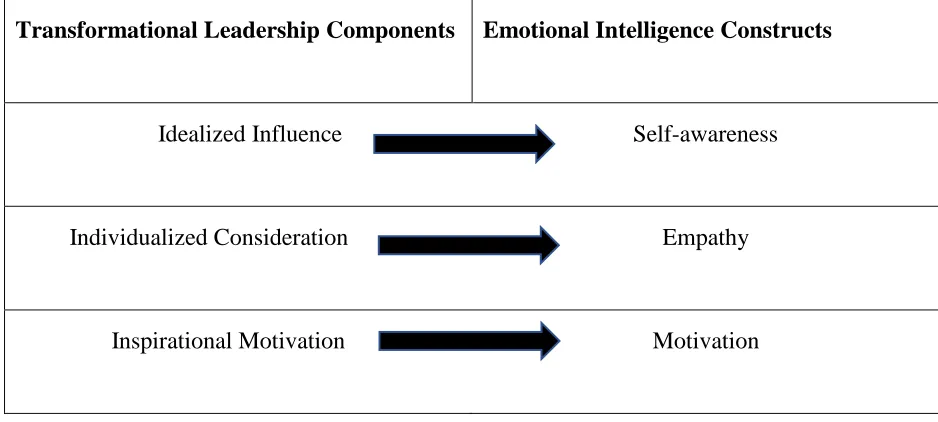
2014; Modassir & Singh, 2008). According to Kumar (2014), idealized influence, individualized
consideration, and inspirational motivation have direct positive correlation with constructs of
emotional intelligence such as self-awareness, empathy, and motivation (Table 1). However, the
findings from Barling et al. (2000), and Palmer et al. (2001), indicated that not all components of
15
influence, inspirational motivation, and individualized consideration are tied to emotional
intelligence, intellectual stimulation is not (Barling et al., 2000; Palmer et al., 2001).
Table 1. Linkages between Transformational Leadership Components and Emotional
Intelligence Constructs
Transformational Leadership Components Emotional Intelligence Constructs
Idealized Influence Self-awareness
Individualized Consideration Empathy
Inspirational Motivation Motivation
In regards to this study, these three transformational leadership components and
emotional intelligence constructs aided in further understanding the interaction that exists
between school leaders and teachers, and the associated impacts of such exchanges. These
connections between transformational leadership components and constructs of emotional
intelligence provided guidance in identifying the most important components of emotional
intelligence. These connections helped address the lack of leadership training on emotional
intelligence through highlighting the related impacts.
Idealized Influence
The first component,idealized influence or charisma, involves the emotional component
of transformational leadership, providing followers with a collective vision, while gaining their
16
intelligent leaders also create school cultures of respect and trust, along with a common vision
for their school, contributing to teachers feeling more united with their school leader, and
community (Gray, 2009; Moore, 2009). This study assessed teachers’ perceptions of how
emotionally intelligent leaders gain teachers’ trust and respect. Through individual interviews,
teachers provided insight regarding how trust and respect contributes to feeling united with both
their school leader and school community.
Inspirational Motivation
The second dimension of transformational leadership theory relevant to this study is
inspirational motivation, involving a leader’s engagement with others, and the ability to establish
connections that raise the level of inspiration, motivation and morality in both the leader and
follower (Modassir & Singh, 2008; Northouse, 2016). According to Gray (2009), emotionally
intelligent leaders inspire and motivate teachers to achieve excellence, and bring about
enthusiasm among staff. Therefore, transformational leadership offers a lens to further
understand how teachers perceive their leaders’ ability in motivating and inspiring them, thus
creating a sense of connectivity. This was analyzed through the data collected from individual
interviews with teachers.
A subset of inspirational motivation involves the relationships transformational leaders
form with followers through interactive communication (Kumar, 2014; Stone, Russell, &
Patterson, 2003). Because emotional intelligence also aids in understanding one’s relationships
with others, communication between school leaders and teachers is crucial to further explore in
order for teachers to feel supported and understood (George, 2009; Gray, 2009; Salovey &
Mayer, 1990). Regarding this study, individual interviews focusing on each component of
17
Individualized Consideration
Individualized consideration is another aspect of transformational leadership, involving
treating employees as individuals in a caring, compassionate, appreciative way, while being
responsive to their needs and concerns (Modassir & Singh, 2008). Empathy being a key
component of emotional intelligence, relates closely to individualized consideration.
Individualized consideration involves social awareness, including “understanding others’
perspectives and feelings, appreciation of others’ strengths and weaknesses”, and treating others
with respect (Modassir & Singh, 2008, p. 7). Therefore, exploring teachers’ perceptions by way
of individual interviews provided an in-depth understanding of the role empathy plays in
effective leadership. Interviews included questioning related to how school leaders’ show
appreciation and respect for teachers, as well as, their level of understanding regarding their
needs and concerns.
Rationale for Transformational Leadership Theory
Considering the complexity school leaders face, such as making challenging decisions,
managing conflict, and sharing leadership; existing research indicates that fostering
transformational leadership will lead to the well-being and effective performance of an
organization (Bass, 1990). Bass (1990) has also found that “problems, rapid changes, and
uncertainty call for a flexible organization with determined leaders who can inspire employees to
participate enthusiastically in team efforts, and share organizational goals” (p.31). In other
words, systematic change requires a specific type of leader, encompassing abilities to increase
cooperation and collaboration for the greater good of the entire organization. Individualized
consideration for example, is critical in leaders whose organizations are faced with renewal and
18
equipped to make difficult decisions, assist in conflict resolution, and build efficient teams,
contributing to their overall effectiveness (Schultz, 2007; Gray, 2009; Johnson et al., 2005).
Transformational leadership theory helped inform this study, as opposed to other theories
of leadership, due to the significant connections between transformational leaders and constructs
of emotional intelligence. For example, transactional leadership theory refers to the majority of
leadership models, which focus on exchanges that occur between leaders and their followers
(Northouse, 2016). These exchanges can be either beneficial or detrimental to the follower. For
example, Bass (1990) finds that employees who perform well will be rewarded, whereas
employees who perform below expectations will be penalized. This is often referred to as
contingent rewards, involving an exchange process between leaders and followers, in which
followers’ effort is exchanged for rewards (Northouse, 2016). While exchanges between school
leaders and teachers are central to this study, transformational leadership theory includes ethical
purposes and moral ends, aligned with emotional intelligence. Furthermore, transformational
leadership is viewed as a mutual process, focused on concern for followers, and the quest of
socially desirable ends (Kezar et al., 2006).
Similarities also exist between transformational leadership and servant leadership. In
particular, both leadership frameworks incorporate: (1) influence, (2) vision, (3) trust, (4) respect
or credibility, (5) risk-taking or delegation, (6) integrity, and (7) modeling (Stone, Russell, &
Patterson, 2003). While many of these concepts are aligned with constructs of emotional
intelligence such as empathy and emotional healing, it remains unclear if emotional intelligence
is specifically tied to servant leadership (Winston & Hatsfield, 2004).
Although similarities between transformational leadership and servant leadership do
19
their service to others, whereas the transformational leader has greater concern for getting
followers to support and engage in organizational objectives (Stone, Russell, & Patterson, 2003).
While servant leadership may be closely aligned to the transformational components of
inspiration and individualized consideration, the main objective is to serve (Stone et al., 2003). In
regards to this study, transformational leadership and emotional intelligence are both concerned
with increasing organizational satisfaction, commitment, and effectiveness, not just on the
individual (Kumar, 2014).
While the purpose of this study was to explore teachers’ perceptions of school leaders’
emotional intelligence, a leadership theory, as opposed to a theory involving only interpersonal
relations, was most appropriate given the context. Emotional intelligence is connected to
interpersonal relations, such as empathy, self-monitoring, social skills, cooperation, and
relationship ties (Schutte et al., 2001). However, transformational leadership theory encompasses
not only interpersonal relations, but also how these traits contribute to leadership effectiveness
and organizational change (Williams & Jones, 2009). Williams and Jones (2009) proclaim that
transformational leadership offers a conceptual framework that may be “beneficial in managing
and leading educational environments during changing times” (p. 5). Given the challenges school
leaders face due to the new era of accountability, transformational leadership theory was useful
as a guide to better understand how school leaders develop a shared vision and commitment with
their followers, in order to promote positive school change.
Overall, considering other theories of leadership or interpersonal relations,
transformational leadership theory better informed this study, due to the specific connections to
emotional intelligence. While exploring teachers’ perceptions of school leaders’ emotional
20
understand the related impacts on both the personal and organizational level. Through this
understanding, the most important components of emotional intelligence were better understood.
Therefore, the definition of emotional intelligence used to guide this study is highlighted below.
The five main elements of emotional intelligence are also addressed.
Emotional Intelligence Defined
Theorists have produced several unique, yet interrelated definitions of emotional
intelligence (Boyatis, Goleman, & Rhee, 1999; Goleman, 2004; Mayer & Salovey, 1990, 1997).
Salovey and Mayer (1990) first defined emotional intelligence as “form of social intelligence
involving the ability to monitor one’s own and other’s feelings and emotions, to discriminate
among them, and to use this information to guide one’s feelings and actions” (p. 189). It was
later determined that this definition limited the meaning to only include perceiving and
regulating emotion, omitting feelings (Mayer & Salovey, 1997). Therefore, this study was guided
by the revised definition of emotional intelligence given by Mayer & Salovey (1997) which is
“the ability to perceive accurately, appraise, and express emotion; the ability to access and/or
generate feelings when they facilitate thought; the ability to understand emotion and emotional
knowledge, and the ability to regulate emotions to promote emotional and intellectual growth”
(p. 10). According to Mayer & Salovey (1997), each skill addressed in this definition contributes
to specific emotional competencies as further detailed below.
Emotional Competence
Extending from the works of Mayer and Salovey (1990, 1995, 1997), Boyatis, Goleman,
& Rhee (1999) categorized the outward manifestations of emotional intelligence as five
emotional intelligence elements: (1) self-awareness, (2) self-regulation, (3) motivation, (4)
21
sufficient frequency to be effective in the situation” (Boyatis, Goleman, & Rhee, 1999, p. 3).
Furthermore, Goleman (1998) defines an emotional competence as a “learned capability based
on emotional intelligence that results in outstanding performance at work” (p. 24). Emotional
intelligence determines individual’s potential for learning skills that are based on these five
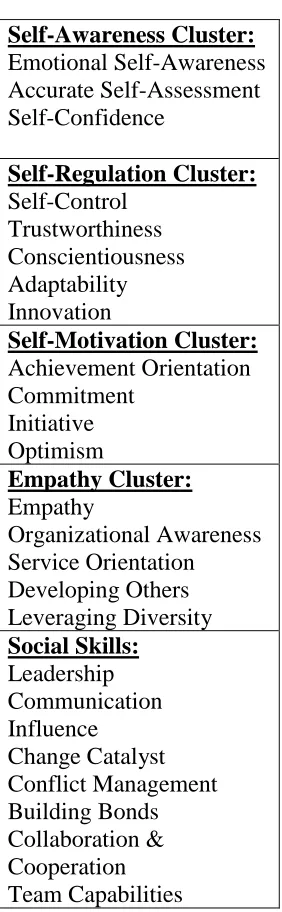
elements. Emotional competencies cluster into groups, based on similar emotional intelligence
components (Goleman, 1998). Emotional intelligence research often involves the description and
study of specific competencies that are related to effectiveness, and described within clusters
(Boyatzis, Goleman, & Rhee, 1999). This model highlights the relationship between the five
elements of emotional intelligence and the twenty-five competencies, and is further outlined in
22
Table 2. Theoretical and Empirical Clustering of the Competencies in the Emotional Intelligence
Model
(Boyatzis, Goleman, & Rhee, 1999)
23
Self-Awareness
In regards to the contribution of the five elements to emotional intelligence, Goleman
(2004), describes self-awareness as “the ability to recognize and understand one’s moods,
emotions, strengths, weaknesses, needs, and drives” (p. 3). Knowing one’s internal states,
preferences, resources, and intuition constitute self-awareness (Goleman, 1998). Self-aware
individuals know how they feel and how their emotions and actions affect people around them
(Batool, 2013). Three competencies are associated with self-awareness, including emotional
awareness, accurate self-assessment, and self-confidence (Batool, 2013; Boyatis, Goleman, &
Rhee, 1999; Goleman, 1998). In the educational leadership context, self-awareness can instill
trust, pride, and respect in followers (Bass, 1990). Batool (2013), finds that self-awareness can
be improved through the utilization of journals. Writing one’s thoughts each day through
journaling, can increase one’s level of self-awareness (Batool, 2013). Therefore, when
experiencing anger or other negative emotions, self-aware leaders examine why they are having
these emotions, and choose to respond effectively. This enables leaders to recognize how their
emotions affect others.
Self-Regulation
Self-regulation involves “the ability to control or redirect disruptive impulses and moods,
and the propensity to suspend judgement” (Goleman, 2004, p.3). It is defined as “managing
one’s internal states, impulses and resources” (Goleman, 1998, p. 26). Self-control is a key
competency associated with self-regulation (Batool, 2013). This is demonstrated through one’s
flexibility in stressful situations, while remaining personally accountable for his or her actions.
Trustworthiness, conscientiousness, adaptability, and innovation are other competencies within
24
regards to leadership, self-regulation may enhance integrity as well, which may be viewed as not
only a personal virtue, but also an organizational strength (Goleman, 2004). Self-regulation may
also be enhanced by recognizing one’s own “code of ethics”, in order to make moral and ethical
decisions successfully (Batool, 2013).
Motivation
Furthermore, motivation is referred to as “emotional tendencies that guide or facilitate
reaching goals”, while incorporating “passion to work for reasons that go beyond money or
status” (Goleman, 1998, p.3). Remaining optimistic even when facing failure is an example of
motivation (Batool, 2013; Goleman, 2004). Motivation is demonstrated when one is consistent in
reaching goals (Batool, 2013). Along with optimism, achievement drive, commitment and
initiative are additional competencies within the motivation component (Batool, 2013; Boyatis,
Goleman, & Rhee, 1999; Goleman, 1998).Within the leadership context, motivation is increased
through self-reflection, focusing on why leadership was chosen as a profession in order to
examine goals from a new perspective (Batool, 2013).
Empathy
Empathy is also considered a critical element of emotional intelligence (Batool, 2011;
Goleman, 1998, 2004; Mayer & Salovey, 1990, 1997). According to Goleman (1998), empathy
involves the awareness of others’ feelings, needs, and concerns. Empathy incorporates the skills
in “treating others according to their emotional reactions” (Goleman, 2004, p. 3). The
competencies associated with empathy include: (1) understanding others, (2) developing others,
(3) service orientation, (4) leveraging diversity, and (5) political awareness(Batool, 2013;
Boyatis, Goleman, & Rhee, 1999; Goleman, 1998).In the leadership context, empathy is crucial
25
Ferris, Ammeter, & Buckley (2003), emotional intelligence is essential for team interaction and
productivity, contributing to an overall improved performance. Therefore, empathy is an
important asset for leaders.Empathy may be enhanced through increased attention to one’s own
and other’s body language, to better understand the feelings of others, in order to respond
appropriately (Batool, 2013). Placing oneself in someone else’s situation is another way to
increase empathy (Batool, 2013).
Social Skills
The final elements of emotional intelligence concern social skills. Social skills refer to
the “adeptness at inducing desirable responses in others” (Goleman, 2004, p. 27). Building
rapport and finding common ground are primary examples of someone exhibiting social skills
(Goleman, 2004). Individuals who demonstrate effective social skills set examples with their
own behavior (Batool, 2013). Specific competencies related to social skills involve influence,
communication, conflict management, leadership, change catalyst, building bonds, collaboration
and cooperation, and team capabilities (Batool, 2013; Boyatis, Goleman, & Rhee, 1999;
Goleman, 1998). Leaders’ social skills may be improved through learning conflict resolution
skills, improving communication skills, and through praising others (Batool, 2013). Overall, the
utilization of emotional intelligence competencies is central to leadership, contributing to others
doing their jobs more effectively (Goleman, 1998).
The five elements of emotional intelligence are critical to this study due to their linkages
to leadership effectiveness. While this study’s objective is to examine teacher perceptions of
school leader emotional intelligence, highlighting the five elements will be useful as a guide to
understand how these elements are connected to leadership effectiveness, and its impact on
26
Review of Literature
The school leader’s role has become more complex as the demand for accountability has
intensified in recent years (Allred, Labat, Eadens, Labat, & Eadens, 2016; Litcha, 2007; Mills,
2009; Moore, 2009). This complexity requires making challenging decisions, managing conflict,
and sharing leadership. However, existing research indicates that emotionally intelligent leaders
are better equipped to make difficult decisions, assist in conflict resolution, and build efficient
teams, contributing to their overall effectiveness (Gray, 2009; Johnson, Aiken, & Steggerada,
2005; Mills, 2009; Schultz, 2007). Emotionally intelligent leaders also combine social
effectiveness skills such as coaching, motivating, inspiring, facilitating, and promoting positive
attitudes, with the ability to adapt their behavior to a myriad of situational demands in a sincere
way (Taliadorou & Pashiardis, 2015). This inspires support and trust, and effectively influences
others (Taliadorou & Pashiardis, 2015). Moreover, emotionally intelligent leaders have the
capacity to be more adept in influencing, inspiring, intellectually stimulating and developing
committed staff, while instilling confidence and emotional stability in their followers (Moore,
2009; Singh & Manser, 2009). Therefore, there is a growing body of research that suggests
focusing efforts on school leader development with these diverse types of skills to lead schools
(Johnson, Aiken, & Steggerada, 2005; Litcha, 2007; Moore, 2009).
Considering the importance of developing emotionally intelligent leaders who can
successfully overcome inevitable challenges within the educational leadership profession, it is
crucial to explore teachers’ perceptions of school leaders’ emotional intelligence. To frame this
study, it is critical to define emotional intelligence and the related components. The purpose of
this literature review is to illustrate linkages between emotional intelligence, effective leadership
27
intelligence, this review of literature presents an overview of the current state of leadership
preparation programs and best practices.
Emotional Intelligence and Effective Leadership
While this study emphasizes the lack of leadership training in emotional intelligence
(Johnson et al., 2005; Schultz, 2007; Schmidt, 2010; Wallace, 2010), research suggests that
emotional intelligence is a developed ability (Goleman, 2004; Moore, 2009). According to
Goleman (2004), although “scientific inquiry suggests that there is a genetic component to
emotional intelligence, psychological and developmental research indicates that nurture also
plays a role” (p. 4). Therefore, emotional intelligence can be at least partly learned through
training (Goleman, 2004; Moore, 2009; Schutte, et al., 2001). Furthermore, while Goleman
(1998) asserts that while emotional intelligence determines individuals’ potential for learning
skills associated with its five elements, emotional competence is demonstrated by one’s work
performance. Existing studies have found that effective leaders have a high level of emotional
intelligence, including self-awareness, self-regulation, motivation, empathy, and social skills
(Boyatis, Goleman, & Rhee, 1999; Goleman, 2004). Additionally, George (2000) proposes how
the four aspects of emotional intelligence contribute to leadership effectiveness. Therefore, a
thorough examination of the role emotional intelligence in effective leadership is provided.
Emotional intelligence should be an essential component of effective leadership (Allred
et al., 2016; Batool, 2013; George, 2000; Goleman, 1998, 2004; Gray, 2009; Kerr, Gavin,
Heaton, & Boyle, 2006; Mills, 2009; Modassir & Singh, 2008; Palmer, Walls, Burgess, &
Stough, 2001; Schultz, 2007; Smollan & Parry, 2001; Taliadorou & Pashiardis, 2015). Managing
emotions intelligently in any organization by a leader plays a vital role in effective leadership
28
leadership in several ways, including the development and achievement of collective goals,
appreciation of followers, increased cooperation and trust, flexibility in decision making and
change, and the establishment of meaningful identity for organizations (George, 2000). George
(2000) suggests that feelings, moods, and emotions play a critical role in the leadership process,
from both the follower and leader perspective. This literature analysis highlights the contribution
of the four aspects of emotional intelligence to leadership effectiveness. The purpose of this
analysis is to present a framework describing the role of emotional intelligence in the leadership
process (George, 2000). The analysis indicates that emotional intelligence contributes to
effective leadership, however also suggests the need to further explore the interactions between
leaders and followers to increase this understanding. Furthermore, this study will utilize
George’s literature analysis as a basis for understanding the ways in which emotional
intelligence contributes to effective leadership from teachers’ perceptions.
Similarly, Gray (2009) found that decisions principals make involve some level of
emotional intelligence, such as solving problems and making judgements. This study also noted
that the majority of existing leadership research highlights the challenges school leaders endure,
however why and how leaders exercise a positive influence on their organizations continue to be
unanswered questions (Gray, 2009). In an attempt to address this gap in leadership literature,
Gray (2009) found that a principal’s emotional intelligence skills are imperative to increase
student achievement collaboratively, and guarantee the well-being of the entire school
community.In addition, emotionally intelligent leaders motivate teachers by recognizing and
rewarding their work, produce enthusiasm among staff, and helps create a unique identity for
29
plays in the effectiveness of school leaders, but also adds the importance of mutual trust between
leaders and other members, especially when an organization faces challenges or change.
Role of Trust
While much of the literature on leader emotional intelligence emphasizes the importance
of trust during change implementation (Smollan & Parry, 2011), trust also plays a critical role in
other organizational contexts. For instance, Barling, Slater, & Kelloway (2009), find that there
are several reasons why individuals high in emotional intelligence would be more likely to use
transformational behaviors. Transformational leadership is linked to superior leadership
performance, occurring when leaders increase followers’ interest, develop acceptance and
awareness of the organization’s purpose and mission, and consider the betterment of the entirety
of the organization (Bass, 1990). Barling et al. (2000) find that emotionally intelligent leaders
who manage their emotions, and exhibit self-control and delay of gratification, could act as role
models for followers, thus enhancing their respect and trust.
Furthermore, self-awareness can instill trust, pride, and respect in followers, consistent
with the transformational leadership component idealized influence, which describes leadership
that involves trust and respect. Leaders who establish trust and respect in their subordinates, will
then contribute to establishing vision and a sense of mission in organizations (Bass, 1990;
Modassir & Singh, 2008). Moore (2009) asserts that “studying emotional intelligence provides
leaders with the awareness necessary to meet the needs of staff that is engaged with developing a
common vision for their school and creating school cultures of trust and respect” (p. 20).
Therefore, when leaders are more self-aware, they will recognize their own role in establishing
trust with teachers. Once trust is established, the fulfillment of the school’s mission may be
30
Additionally, Downey et al. (2011), find that leader emotional intelligence determined
trust in team members which also impacts organizational commitment, contributing to leadership
effectiveness. Emotionally intelligent leaders have a better understanding of group members’
emotions and being empathetic may increase organizational commitment (Downey et al., 2011).
They also find increased empathy may also help regulate their emotions and achieve workplace
goals, thus creating a trusting culture (Downey et al., 2011). As a result, individual and
organizational trust could be a result of a leader who is empathetic towards his or her employees.
While trust plays a significant role in the relationship between emotional intelligence and
leadership effectiveness, according to Taliadorou & Pashiardis (2015), leader effectiveness
positively influences the level of teachers’ job satisfaction as well. This study emphasized the
limited research regarding leaders’ emotional intelligence and teachers’ job satisfaction,
therefore their findings filled in this gap in research. They also recommend educational
researchers should examine social skills that an effective leader should have. In addition, Palmer
et al. (2001), find that future research needs to explore the relationship between emotional
intelligence and effective leadership in more depth. This may identify emotional skills, which
could be implemented in leadership preparation programs to increase the effectiveness of leaders
(Palmer et al., 2001).
Emotional Intelligence and Teacher Job Satisfaction
There is existing evidence that links principals’ emotional intelligence to teachers’ job
satisfaction and performance (Singh & Manser, 2009; Taliadorou & Pashiardis, 2015; Waruwu,
2015). Goleman (1995) proclaims that leader’s emotional intelligence is a predictor of their
followers’ job success and satisfaction. Similarly, Taliadorou & Pashiardis (2015), find that
31
motivation, thus leading to their overall well-being and performance at work. The purpose of this
proposed study is to explore the relationship of school leader’s emotional intelligence and the
effects on the job satisfaction of teachers (Taliadorou & Pashiardis, 2015). Taliadorou and
Pashiardis (2015) suggest the leadership effectiveness is increased through the implementation
of “practices and methods that target specific components of emotional intelligence” (p. 13). The
four components of emotional intelligence according to Mayer and Salovey (1997), including
self-emotional appraisal, other’s emotional appraisal, regulation of emotion in the self, and the
use of emotions to facilitate performance, all contribute to teachers’ job satisfaction (Taliadorou
& Pashiardis, 2015). This study further suggests that one way for school leaders to increase
teachers’ job satisfaction, may be to incorporate emotionally intelligent behaviors.
Emotionally Intelligent Behaviors Contributing to Job Satisfaction
While Singh & Manser (2009) find that principals’ emotional intelligence positively
impacts the job satisfaction of teachers, they also identify particular emotionally intelligent
behaviors that influence job satisfaction. “Emotionally intelligent behaviors refer to observable
actions and reactions that determine one’s level of emotional intelligence” (Goleman, 1998, p.
26). In the educational leadership context, these behaviors may help determine a leader’s degree
of emotional intelligence. Because the behaviors are observable, this is helpful for researchers to
more easily determine what behaviors leaders portray. They also comprise numerous
characteristics that make them “identifiable as manifestations of emotional intelligence”, and are
significant measures of leaders’ ability to act in a sympathetic, sensitive, and suitable manner
(Singh & Manser, 2009, p.80). They are observed in the interpersonal domain, and in the
intrapersonal domain (Singh & Manser, 2009). The purpose of this study was to explore if there
32
teachers job satisfaction (Singh & Manser, 2009). This study involved a multi-respondent survey
design, and utilized a convenience sample of both teachers and principals across 200 schools in
Eastern Cape, South Africa (Singh & Manser, 2009). The results indicate that principals who are
good communicators, demonstrate empathy, build healthy relationships, exhibit positive
self-expressions, and express optimism, not only contribute to the job satisfaction of teachers, but
will also increase the potential for organizational effectiveness to be achieved (Singh & Manser,
2009).
Waruwu (2015), suggests the emotionally intelligent behaviors of principals that increase
teacher job satisfaction are empathizing, using emotions as motivation, and establishing
interpersonal relationships with teachers. This quantitative study’s objective was to “identify a
correlation between: (1) teachers’ perceptions of principals’ emotional intelligence, and teacher
job satisfaction, (2) organizational climate and job satisfaction of teachers, and (3) teachers’
perceptions of principals’ emotional intelligence and organizational climate and job satisfaction
of teachers” (Waruwu, 2015, p. 142) . The population consisted of 170 high school teachers
(Waruwu, 2015). The results indicate that teachers’ perceptions of principals’ emotional
intelligence have a significant positive correlation with the job satisfaction of teachers. It was
further recommended for principals to improve their emotional intelligence through increased
training.
Although leaders establishing relationships with teachers is critical to increase teachers’
job satisfaction (Singh & Manser, 2009; Waruwu, 2015), trust plays a significant role in a
leader’s ability to build healthy relationships with teachers (Singh & Manser, 2009). Downey et
al. (2011), also found a significant relationship between trustworthiness of leaders and followers’
33
others is predictive of trust, and contributes to followers’ increased satisfaction due to knowing
they can demonstrate pleasure or displeasure at work, and that this information will be
interpreted correctly (Downey et al., 2011). Therefore, trust is a result of leaders’ awareness of
the emotions and needs of their followers, thus playing a key role in follower’s job satisfaction.
When leaders are considering how to contribute to teachers’ job satisfaction, establishing trust
with teachers may be beneficial. Furthermore, leaders who maintain self-awareness, may
contribute positively to building trusting relationships with teachers as well.
In addition to trust, Singh & Mandela (2013), also find that when employees are more
satisfied with their job, they are more willing to offer high levels of commitment, service, and
loyalty to the organization. Therefore, emotional intelligence, in combination with cognitive
intelligence, has the potential to empower leaders to perform at their highest capacity, and inspire
employees to be happy and lucrative (Singh & Mandela, 2013). However, while Singh & Madela
(2013) suggest emotionally intelligent leaders have the potential to improve the job satisfaction
of their followers, additional research should also be conducted regarding the impacts of leaders’
emotionally intelligent behaviors on the job satisfaction of their employees. Examining teacher
perceptions of school leader emotional intelligence is precisely the objective of the present study.
Current State of Leadership Preparation Programs
The national movement toward improved K-12 student achievement and accountability
has contributed to increasing focus on the preparation of school leaders and a resulting
disappointment regarding the efficiency of traditional programs in preparing leaders to meet the
demands of the 21st century (Chenoweth, Carr, & Ruhl, 2002; Hale & Moorman, 2003). The
general consensus is that principal preparation programs have failed to keep pace with the