Journal of Applied Linguistics and Language Research Volume 4, Issue 3, 2017, pp. 94-104
Available online at www.jallr.com ISSN: 2376-760X
* Correspondence: Firouz Kazemi, Email: firozkazemi yahoo.com © 2017 Journal of Applied Linguistics and Language Research
Brain Dominance and Gender Differences in Writing
Performance of Iranian EFL Learners
Shahrzad Salehi
MA in ancient language and culture, Azad Islamic University, Science & Research branch, Tehran, Iran
Firouz Kazemi *
MA in Applied linguistics, Imam Ali University, Tehran, Iran
Abbas Aslikhosh
PhD candidate in Russian language teaching, Tehran University, Tehran, Iran
Abstract
The present study aimed to investigate the relationship between Iranian male and female EFL learners’ brain dominance and their writing performance on two different writing tasks including an argumentative and a descriptive writing task. For this purpose, 60 EFL Students from Shokoh institute in Tehran in intermediate level were selected from available classes in intermediate level. They were mixed in terms of their gender, 30 men and 30 women, between the ages of 15 to 23 years. Among the participants, there were 48 left-brained and 12 right-brained. Instruments of the study included Oxford Placement Test (OPT) (OUP, 2001) containing 40 questions as a homogeneity test, Brain Dominance Survey (BDS) (Davis, Nur & Ruru, 1994) to discover the hemispheric preferences, and two writing tasks to assess the writing performance. The results show that female language learners are more successful in argumentative writing tasks which demand higher levels of cognition.
Keywords: brain dominance, writing performance, argumentative writing, descriptive writing, gender
INTRODUCTION
should have some kind of language faculty in their infancy which is genetically transmitted to enable them to acquire language rapidly and successfully. And cognitivists believe that the system and organization of the human brain is different from those of the other species and these differences enable them to evolve language while the other species could not. The second one is localization: where is the location of language in the human brain? The issue of the localization of language in human brain has a long history. In 1965, Chomsky found out that every normal child is capable of acquiring a first language and in this process their level of intelligence and also learning style is not important. From this fact some commentators deduced that language should be an independent faculty and it is not part of human's general power of thought and faculty. So, it will be interesting to learn about the relationship between language and other activities done in human brain. And last but not least is lateralization; are left side and right side of the brain different in contribution to language? And in what age this difference emerged? Early research on left side and right side of the brain showed that damage to the left side of the brain affected language learning in a way that damage to the right side did not. When this damage happened before the age of around five, the sufferer would be able to recover their power of speech completely. Lenneberg (1967, (cited in Field, 2003) suggested a theory noted that, in infancy, the relationship between the left side and right side of the brain is flexible in a way that when it is necessary language can be located in the right side. This theory let to a great debate on the existence of Critical Period for learning a first language, i.e. a period of flexibility after which the child is not able to achieve full competence.
By understanding the fact that the brain has specialized areas, teachers have tended to teach in ways that reflect these specialized functions. For example, findings about particular functions of the left and right brain have encouraged them to select left and right hemisphere teaching. Recent research proposes that such an approach does not reflect how the brain learns, or how it functions when learning has occurred. To the contrary, “in higher vertebrates (humans), brain systems interact together as a whole brain with the external world” (Elman, 1997, p. 340). Learning occurs when connections are made within the brain and between the brain and the outside world (Genesee, 2000).
In psycholinguistics and second language studies, the role of the brain hemispheric dominance in language learning and performance is really important. The question raised here is whether the right- or left-side dominance contributes to language processing and performance, and if yes, to what extent the different hemispheres contribute to the learning processes especially in different writing tasks which demand different levels of cognition.
REVIEW OF THE RELATED LITERATURE
hemisphere were doubtfully to have experienced them by chance and consequently he hypothesized that:
1. the left hemisphere was dominant for language,
2. the left hemisphere was responsible for right-handedness,
3. the left-hemisphere dominance for language and physical preference were associated, and
4. that cerebral dominance for language would be reversed in the left- handers. According to Balbin Tendero, (2000), based on Broca’s and related studies, it was additionally implied that despite their largely similar anatomies, the left and right hemispheres obviously had very dissimilar and diverse functions. Language seemed to be uniquely a possession of the left side; the right hemisphere seemingly was taciturn. This was universally accepted that the left hemisphere was dominant not only for language but for all psychological processes, while the right brain was perceived as simply as an unthinkable automation. From pre-19th century whole-brained beings had become half- brained ones (Levy, 1985).
The suggestion was that while the left-hemisphere was dedicated for language, the right hemisphere was specialized for numerous non-linguistic processes. Nevertheless, these opinions barely influenced the overall neurological society. Up to 1962, the rampant outlook was that people had half a thinking brain (Levy, 1985).
Levy (1985) continued that the great majority of research concluded that each side of the brain was an extremely specialized structure of thought, with the right hemisphere leading in a set of functions that complemented the left. He also stated that observations of patients with damage to one side of the brain, split-brain and normal individuals generated reliable and consistent findings and the right hemisphere was a highly complex structure of thought as well.
In spite of the fact that the hemispheres appear to be symmetrical, their functions does not seem so. Studies have shown that hemispheric dominance is related to handedness. In right-handed people, the left hemisphere processes arithmetic and language. The right hemisphere deals with imagery, spatial, musical relationships and emotions. The pattern of brain organization in left-handed people is totally different (Toga & Thompson, 2003).
Dragovic (2004) in “Towards an improved measure of the Edinburgh Handedness Inventory: a one-factor congeneric measurement model using confirmatory factor analysis” administered the inventory to 203 subjects (90 men and 113 women). The results revealed that only 10 items of the Inventory suffice for providing valid measures about being left-brain dominant or right-brain dominant.
As writing and reading are closely interrelated, the relationship of these psycholinguistic variables have been lone the matter of debate. For example, in old years, reading was assumed as a branch of listening. In this respect, Fries (1962) stated that "learning to read is not a process of learning new or other language signals than those the child has already learned. The language signals are all the same." (p. xv)
Smith (1971) provided another point of view and asserted that "written language may quite reasonably be regarded as a manifestation of language quite independent from the spoken form (p. 45)." Smith mentioned the unique features of speech such as gesture, partial sentences and then distinguished it from written language. A year later, Gibson (1972) moves further and argues that there exist signs to syntax on the printed page that are analogous, but not identical with those in heard speech at all.
So this study aims at investigating the following research question:
Is there any significant difference between left-brained and right-brained male and female learners' performance in the argumentative and descriptive writing tasks?
METHOD
Research design
The design of the study was a comparison paradigm (Mackey & Gass, 2005) with two groups: a left-brain dominant group and a right-brain dominant one; in each group 21 right- brained and 9 left- brained.
Participants
Subject selection in this study was done on the basis of brain dominance preference, writing ability, age, and also level of the participants. The participants were 60 EFL Students from Bazargan institute in Tehran in intermediate level. They were selected from available classes in intermediate level. They were mixed in terms of their gender, 30 men and 30women, between the ages of 15 to 23 years. Among the participants, there were 48 left-brained and 12 right-brained. Tables 3.1 and 3.2 depict demographic features of the participants.
Instrumentation
Homogeneity Test
Samples were selected from the population of 102 students who were studying in intermediate levels. The sampling process was performed on a continuum (from pre-intermediate to upper-pre-intermediate). Although all of the population were studying in intermediate classes and had passed the lower levels through studying the required training, in order to have homogeneous groups and real-intermediate level students, the first part of the Oxford Placement Test (OPT) containing 40 questions was performed. The test helped the researcher to make sure if all of the subjects were in intermediate level. The test has been developed by Oxford University Press in 2001, after consultation with many teachers to assess the subject's knowledge of the key language as well as their receptive and productive skills.
Brain Dominance Survey
Brain Dominance Survey (BDS) (Davis, Nur & Ruru, 1994) was used to discover the hemispheric preferences. The survey originally divided the right and left brain dominance into 11 degrees each depending on the answers given to the questions. Left brain dominance is represented by minus sign (-) while plus sign (+) indicates the right brain dominance degrees. Considering the properties of Brain Dominance Survey, it was expected to find out brain dominance degrees to be shown in the form of (+1 to +11) right brain and (-1 to -11) left brain dominance degrees.
A score of - 1 to - 3 = Slight preference toward the left A score of - 4 to - 6 = Moderate preference for the left A score of - 7 to - 9 = Left-brain dominant
A score of -10 to -11 = Left-brain dominant (very strong) A score of + 1 to + 3 = Slight preference toward the right A score of + 4 to + 6 = Moderate preference for the right A score of + 7 to + 9 = Right-brain dominant
A score of +10 to +11 = Right-brain dominant (very strong) Writing tasks
Two writing tasks were administered: argumentation and descriptive. The reasons for such a selection were as follows:
1- Argumentative tasks demand higher levels of cognition, while descriptive tasks demand lower levels of cognition (Grabe & Kaplan, 1996); and
2- According to right-brained, left-brained theory (Cherry, 2005), it was assumed that right-brained students would likely outperform left-brained students in the descriptive task; and left-brained learners would outperform right-brained students in the argumentative task.
asked to describe the pictures. For the argumentative task the following topic was selected:
Why do we use mobile phones? Give examples and reasons for your answer (at least 50 words).
Procedure for administration of the writing tasks
Based on the outcomes of the pilot study, the following procedures were selected to be applied in the main research study. Since the present research was designed to study the relationship between brain dominance and argumentative and descriptive writing tasks, it should assess proficiency components including usage/mechanics and rhetorical skills. However, since intermediate level students do not have enough proficiency to observe the rhetorical skills, these skills were not considered in the scoring procedure. The following discusses the procedure of the writing tasks administration.
Scoring procedure
Considering the objectives of the study, tasks were assessed by a trained language teachers based on the following criteria:
a) Punctuation (1 point) b) Grammar (2 point)
c) Appropriateness of expressions in relation to theme and purpose (4 points) d) Organization: order, coherence and unity (3 points)
Data collection
Procedure for eliciting OPT data
The OPT was administered among the total of 102 students studying in the intermediate-level classes at the institute a week before the main procedure of performing BDS. The administration of the test took about 60 minutes. The placement test was administered in a single session. According to the scoring procedure of the OPT, students whose total score were between 24 and 40 were known as the intermediate level students. The results of OPT revealed that 72 students (70.58%) were at the intermediate level. Among them, 30 men and 30 women were selected based on brain dominance which will be discussed in the following sub-section.
Procedure for eliciting BDS data
Whole-brained (bi-lateral). To fulfill the objectives of the present study, whole-brained students were removed from the procedure of data collection. The following table indicates the results of BDS analysis.
Table 1. Results of BDS analysis
Gender Right-brained Left-brained
Male 6 24
female 6 24
Procedure for eliciting data of writing tasks
For rating the tasks, each sheet was coded for a specific student; and the rater graded the writings. In spite of the placement test which was performed in a single session, both BDS and the writing tasks were performed during a 60-minute session, a week after the placement test.
RESULTS
In order to get the results, the research question is investigated as follows: Is there any significant difference between left-brained and right-brained male and female learners' performance in the argumentative and descriptive writing tasks?
The hypothesis for this question was as follows:
There is not any significant difference between left-brained and right-brained male and female learners' performance in the argumentative and descriptive writing tasks.
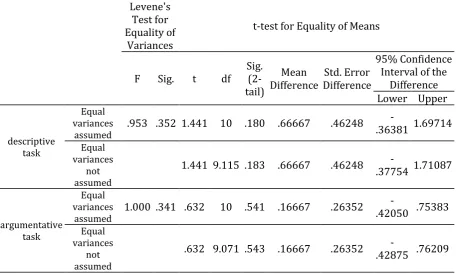
In order to compare the scores of right-brained male and female students in both tasks, an independent sample T-test was conducted. The results are provided in the following table:
Table 2. Group Statistics for Right-Brained Learners
Sex N Mean Std. Deviation Std. Error Mean
Descriptive task Male 6 8.5833 .91742 .37454 female 6 7.9167 .66458 .27131 Argumentative
task
Table 3. Results of the Independent Samples T-Test for Right-Brained Learners
Levene's Test for Equality of
Variances
t-test for Equality of Means
F Sig. t df Sig. (2-tail) Mean Difference Std. Error Difference 95% Confidence Interval of the
Difference Lower Upper
descriptive task
Equal variances
assumed
.953 .352 1.441 10 .180 .66667 .46248
-.36381 1.69714 Equal
variances not assumed
1.441 9.115 .183 .66667 .46248 .37754 - 1.71087
argumentative task
Equal variances
assumed
1.000 .341 .632 10 .541 .16667 .26352
-.42050 .75383 Equal
variances not assumed
.632 9.071 .543 .16667 .26352
-.42875 .76209
Results of the analysis of the descriptive task: An independent-samples t-test was conducted to compare the descriptive task scores for right-brained males and females. There was no significant difference in scores for males (M=8.08, SD=0.91) and females [M=7.91, SD=0.66; t(10)=1.44, p=.18].
Results of the analysis of the argumentative task: An independent-samples t-test was conducted to compare the argumentative task scores for right-brained males and females. There was no significant difference in scores for males (M=5.75, SD=0.52) and females [M=5.58, SD=0.37; t(10)=0.63, p=.54].
The above results revealed that there is not any significant difference between right-brained male and female students and their performance in the argumentative and descriptive tasks. In the following, the difference between left-brained male and female students on both tasks is evaluated.
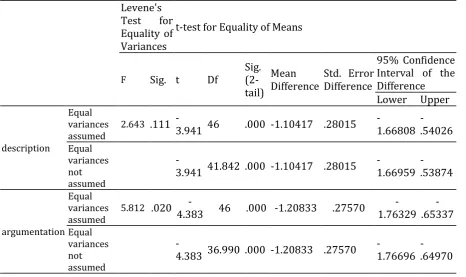
In order to compare the scores of left-brained male and female students in both tasks, an independent sample T-test was conducted. The results are provided in the following table:
Table 4. Group Statistics for left-Brained Learners
Sex N Mean Std. Deviation Std. Error Mean
Descriptive task Male 24 5.7292 1.11296 .22718 Female 24 6.8333 .80307 .16393
Table 5. Results of the Independent Samples T-Test for Left-Brained Learners
Levene's Test for Equality of Variances
t-test for Equality of Means
F Sig. t Df
Sig. (2-tail)
Mean Difference
Std. Error Difference
95% Confidence Interval of the Difference Lower Upper
description
Equal variances assumed
2.643 .111
-3.941 46 .000 -1.10417 .28015 -1.66808 -.54026 Equal variances not assumed
-3.941 41.842 .000 -1.10417 .28015 -1.66959 -.53874 argumentation Equal variances assumed
5.812 .020
-4.383 46 .000 -1.20833 .27570 -1.76329 -.65337 Equal variances not assumed
-4.383 36.990 .000 -1.20833 .27570
-1.76696 -.64970
Results of the analysis of the descriptive task: An independent-samples t-test was conducted to compare the descriptive task scores for left-brained males and females. There was a significant difference in scores for males (M=5.72, SD=1.11) and females [M=6.83, SD=0.80; t(47)= -3.941, p=.000].
Results of the analysis of the argumentative task: An independent-samples t-test was conducted to compare the argumentative task scores for left-brained males and females. There was a significant difference in scores for males (M=7.41, SD=1.16) and females [M=8.62, SD=0.67; t(46)= -4.383, p=.000].
The above results revealed that there is a significant difference between left-brained male and female students and their performance in the argumentative and descriptive tasks.
DISCUSSION
right side of the brain. So, it can be said that a "right- brained" person is more intuitive, thoughtful and subjective. They also revealed that left-side of the brain is good at tasks that are related to logic, language and analytical thinking. In other words, its abilities are mostly related to language, logic, critical thinking, numbers and reasoning. So, it can be said that a "left- brained" person is more logical, analytical and objective (Cherry, 2005). As other studies may come across some limitations, the present research study, due to the method of sampling, data analysis, and other contaminating variables has some limitations as well.
CONCLUSION
According to the results and procedures of the present study, it is concluded that:
Teachers should consider learning styles and strategies based on learners' brain dominance. It is argued that many academics and scholars feel that learning is more fruitful and productive when instructors take learning strategies and styles into account (Boylan 1984). Another important issue is that learners can acquire learning strategies that will advance and improve learning efficiency regardless of the teacher's style of teaching (Davis 1989).
Accommodating teaching to every single learner's wants and needs is actually problematic in terms of accessible teachers and rooms, administrative considerations, distribution of students, etc. Reasonably, a teacher ought to attempt to provide a variety of learning experiences to match the various learning styles that are present in the average classroom. In such situations, all students will have no less than some activities that call them according to their learning styles, and they are more expected to be successful in these activities. The feeling of victory and success will be an inspiring and motivating factor for supplementary and additional learning. As students run through a range of activities, they develop an awareness of several learning strategies that can be applied. If the instructor precisely determines how the various strategies can be executed, the capacity or ability to apply different strategies is heightened.
REFERENCES
Day, L. (2009). Left or Right Brain Dominant? From: baby sensory. Retrieved from http://baby sensory.com.
Dragovic, M. (2004). Towards an improved measure of the Edinburgh Handedness Inventory: A one factor congeneric measurement model using confirmatory factor analysis. Laterality 9, 411-419.
Field, J. (2003). Psycholinguistics. London: Routledge, Taylor & Francis Group.
Genesee, F. (2000). Brain research: Implications for second language learning. Berkeley, CA: UC Berkley, Center for Research on Education, Diversity, and Excellence. Retrieved from: http://escholarship.org/ uc/item/58n560k4
Grabe, W. and Kaplan, R. B. (1996).theory and practice of writing. New York: Longman. Mackey, A., & Gass, S. M. (2005). Second Language Research, Methodology and Design.
Mahwah, New Jersey: Lawrence Erlbaum Associates, Publishers.
Nielsen J. A., Zielinski, B.A., Ferguson, M.A., Lainhart, J. E. & Anderson, J. S. (2013). An Evaluation of the Left-Brain vs. Right-Brain Hypothesis with Resting State Functional Connectivity Magnetic Resonance Imaging. PLoS ONE 8(8).
Smith, F. (1971).Understanding Reading. New York: Holt, Rinehart & Winston.
Toga. A.W. & Thompson P.M. (2003). Mapping brain asymmetry. Nature reviews Neuroscience 4: 37–48.