R E V I E W
Open Access
2D-enabled membranes: materials and
beyond
Taehoon Hyun
1, Jinhong Jeong
1, Ari Chae
1,2, Young Kwan Kim
2*and Dong-Yeun Koh
1,3*Abstract
Membranes could reform the field of molecular separations by enabling new low energy manufacturing technologies. This review article discusses the current state of the art and the potential in the 2D-enabled membrane separation processes by highlighting emerging and existing areas in which robust 2D materials significantly impact the energy-efficient separation process. Analysis of 2D-enabled membrane classes and prospective materials for 2D-enabled membranes are also discussed with emphasis on the surface chemistry of basal plane engineered 2D materials.
Keywords:Two-dimensional material, Membrane based separation process, Membrane fabrication
Background
Molecular separation processes are a critical compartment of the world’s manufacturing infrastructure. In a current carbon-constrained world, separation processes present both challenges and opportunities for the development of low-energy, low-carbon manufacturing platform. Trad-itional thermal separation processes involving energetic-ally less-favorable phase change but efficiently purify hydrocarbon streams still comprise up to 80% of current industrial separation platforms [1]. However, in seawater
desalination, a non-thermal technique of
membrane-based reverse osmosis (RO) has been a prac-tical solution since the 1970s and currently dominates the worldwide market [2]. The drive behind this paradigm shift was simple—the operating energy cost for the pressure-driven RO process was roughly 5–10 times lower than thermal separation processes such as multi-stage flash (MSF) [3], and this revolutionary path represents the potential of membrane-based processes in diverse indus-trial areas. Indusindus-trial-scale membrane-based separation processes heavily rely on the development of more rigid polymeric barriers that can discriminate molecules with
very small size differences at high permeability [4]. Among newly emerging membrane materials with refined selectiv-ities and permeabilities, materials fabricated in low-dimensional (preferentially in two-dimensional struc-tures) architectures have the potential to combine excel-lent molecular specificity and flux when integrated into the membrane structure. Performance of the separation membranes, which exploit the effect of mass transport across a selective diffusion barrier to separate molecules, can be improved by reducing the thickness of the mem-brane. Ultimately achievable refinement in the thickness of materials is a one-atom-thick layer that can solely be achieved by 2D materials. Recently, ultrathin membranes have been fabricated using various techniques such as interfacial polymerization [5] (polyamide membrane < 10 nm), atomic-layer deposition (ZnO layer thickness ~ 200 nm, effective ZIF-8 membrane would also be < 200 nm) [6], and 3D printing (polyamide membrane < 20–80 nm)
[7]. In this review, we discuss 2D materials as building blocks for membrane structure, highlight recent develop-ment of 2D-enabled membranes, and outline future direc-tions of 2D-enabled membranes.
Indeed, similar to inorganic membranes, membranes fabricated using 2D materials with refined micropores can be used to differentiate even very similarly sized compounds. Several key industrial sectors—pharmaceut-ical manufacturing, biofuel production, semiconductor manufacturing, and petrochemical separation—have the potential to be positively impacted by the use of
© The Author(s). 2019Open AccessThis article is distributed under the terms of the Creative Commons Attribution 4.0 International License (http://creativecommons.org/licenses/by/4.0/), which permits unrestricted use, distribution, and reproduction in any medium, provided you give appropriate credit to the original author(s) and the source, provide a link to the Creative Commons license, and indicate if changes were made. The Creative Commons Public Domain Dedication waiver (http://creativecommons.org/publicdomain/zero/1.0/) applies to the data made available in this article, unless otherwise stated.
* Correspondence:[email protected];[email protected] 2Carbon Composite Materials Research Center, Institute of Advanced
Composites Materials, Korea Institute of Science and Technology, Wanju-gun, Jeollabuk-do 565-905, South Korea
1Department of Chemical and Biomolecular Engineering (BK-21 Plus), Korea
Advanced Institute of Science and Technology (KAIST), Daejeon 34141, South Korea
advanced membranes to complement and supplement existing separation needs [8]. The critical need for mem-brane scientists and engineers facing more challenging molecular mixtures is the development of more robust, thin, and selective membrane materials. Specifically, 2D materials with few-atom-thick layers with engineered in-trinsic (in-plane) micropores can be used to separate similarly sized molecules at high flux. These intrinsic pores or basal planes have the possibility to be func-tionalized with various chemical moieties, further re-fining the molecular specificity of the membranes. This review illustrates the challenges in permeability and molecular selectivity of the 2D-enabled mem-branes with variations on themes. A very distinct pat-tern in the development of the 2D-enabled membranes will be discussed followed by emerging 2D-enabled membrane materials that can be used in membrane architecture. The “molecular separations” can further be tuned via the engineered basal plane of various 2D materials, including nanocomposites, and these are discussed in respective sections. Finally, critiques and perspectives will be given on scalable development of 2D-enabled membranes with em-phasis on future directions in the emerging areas.
A transformative path for 2D-enabled membrane development
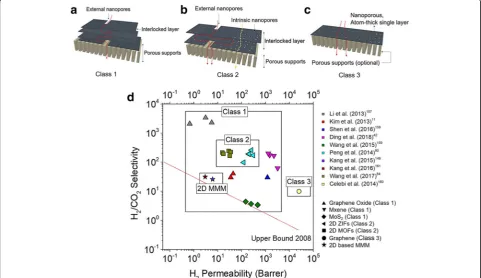
The recent development of the 2D-enabled membrane architecture shows a distinctive pattern that differs from the development of the conventional polymeric mem-brane designs. Up to this point, three well-defined clas-ses of the membrane systems have emerged with the development of 2D materials. Each class of the 2D-enabled membranes can be specified by the presence of the microporosity of the 2D building blocks and stacking structure (Fig. 1a-c). Representative molecular separation performance (for H2/CO2 gas pair) of the
2D-enabled membranes is shown in Fig.1d. The class 1 membranes are lamellar-type membranes that are com-posed of compactly interlocked 2D nanosheets. Nano-sheets used in this class have no intrinsic (in-plane) microporosity. Representative materials used in class 1 membranes are graphene (G) and graphene oxide (GO) nanosheets. Tortuous transport pathways are formed be-tween nonporous nanosheets that allow size-specific per-meation of molecules (Fig. 1a). Since these nanoscopic pathways are produced in between the sheets, we define these as an external microporosity of the class 1 mem-branes. Class 1 membranes have shown the ability to
Fig. 1Three classes of 2D-enabled membranes:aClass 1 membrane with highly interlocked 2D nanosheets.bClass 2 membrane with
interlocked 2D nanosheets that have intrinsic microporosity. Red arrow represents transport pathways through the external nanopores and yellow arrow represents transport pathways through the intrinsic nanopores.cClass 3 membrane with one- or layered membrane.dH2/CO2separation
performance (permeability and selectivity) of class 1 (graphene oxide [11,157,158], MXene [42], MoS2[159]), Class 2 (2D ZIFs [80], 2D MOFs [84]),
effectively remove solvated solutes from an aqueous feed at exceptionally high fluxes, as well as molecular size dif-ferentiation up to a 0.1 nm difference in kinetic diameter of the gas molecules. This suggests that the external microporosity spans the range from ultramicropore (< 0.7 nm) to supermicropore (0.7–2.0 nm) [9] based on different nanosheets and stacking modes.
Nair et al. [10] reported the permeation of water mole-cules through GO stacked membranes (class 1) with submicron thickness (Fig. 2a). The non-oxidized region of the GO laminate can form a nanoscopic capillary net-work for enhanced water transport in between GO sheets, while the oxide region provides mechanical sup-port to maintain the laminate structure with specific interlayer spacing (Fig. 2b, c). Kim et al. [11] reported both few-layered graphene and graphene oxide mem-branes prepared in an interlocked structure. In the case of GO membranes, due to the affinitive interaction be-tween a carboxylic acid group of GO and the effect of humidity, superior CO2permeability and selectivity were
observed. This class of the 2D membrane was further explored on a hollow fiber architecture by Huang et al. [12]. 2D membranes fabricated onto ceramic hollow fiber support showed excellent water permeation for various aqueous organic mixtures via a pervaporation process. Formation of the 2D-enabled membranes in a more scalable hollow fiber platform could open up the possibility of mass production of these newly emerging membrane architectures. For scalable manufacturing of these 2D-enabled membranes, roll-to-roll production of large area GO membranes also have been demonstrated [13]. Furthermore, various class 1 membranes based on reduced graphene oxide (rGO) membranes have recently been reported. Hung et al. [14] fabricated rGO mem-branes with a thickness of 50 nm with solvated rGO
(S-rGO). Nanoscopic channels produced in this way fell into the right size range for capably discriminating salt ions and dye molecules. Their membrane showed high water permeance of 80 Lm−2h−1bar−1with a high rejec-tion rate of Red 80 dye over 99.0%. However, the exact separation mechanism (e.g., transport mechanism) of the graphene oxide membranes have not been clearly de-fined [15]. Since 2D-enabled membranes are in the early stage of development compared to other conventional membrane systems, several different analyses of the transport mechanism through the external micropores have been reported. Recently, Ibrahim and Lin proposed two separate transport mechanisms for GO-based mem-branes that can be categorized as an inter-sheet pathway (external micropore) and inner-sheet pathway (defective pathway) (Fig. 3). The authors suggested the inconsist-ency in reported permeabilities of GO-based membranes were due to the presence of the inner-sheet pathway, which is highly correlated with the defective sites of GO sheets. With their transport model, gas permeation through GO-based membranes can be categorized as Knudsen-like transport (inter-sheet pathway with a lon-ger path length) and viscous transport (inner-sheet path-way with a shorter path length). Large gas molecules such as CH4, N2, and CO2 are primarily transported
through the inter-sheet pathway and smaller molecules like H2 and He permeates through either the inner- or
inter-sheet pathway, which have a higher permeability for smaller gas molecules. For further development of class 1 (2D) membranes, the exact mechanism of gas permeations characterized by sorptivity, diffusivity, por-osity and tortupor-osity of the nanosheets should be considered.
Conventionally, these class 1 membranes are fabri-cated using several different techniques such as vacuum
Fig. 2aPermeation through the GO membranes. Water is freely evaporated through GO membrane similar to open aperture (blue line).b
filtration, vacuum suction, spray coating, spin coating, and dip coating. The most common method is dynamic vacuum filtration of the composite suspensions on a porous support to construct layer-by-layer deposited membrane. In this method, a solution containing well-dispersed 2D nanosheets are slowly filtered onto a desired porous support. Closely packed nanosheets are obtained after filtration that can be readily used in mo-lecular separation testing. Even though the well-defined layered structure is achievable through filtration, it gen-erally requires sufficient filtration time (up to several days) and constant driving force (vacuum level) that hin-ders rapid scale-up of this method. GO membrane pre-pared on a ceramic hollow fiber [12] is a good example showing the feasibility of this method. In this case, the vacuum filtration was performed on a ceramic hollow fiber with a sealed end. It was shown that uniform 2D membrane can be prepared on support with high curva-ture and elongated surface. In addition, various coating techniques are also applied to form 2D-enabled mem-branes. In “spray coating” method [16], dilute compos-ites suspension with volatile solvents are sprayed onto the support. During the evaporation of solvents, 2D nanosheets are self-assembled into the lamellar-like structure. One advantageous feature of the spray coating method is that it can achieve ultrathin membranes by controlling the viscosity of the solution and spray pressure. In the case of "spin coating" method, the composite suspension is poured onto the center of the support and the suspension spread out via centri-fugal force. Through this “spin coating” method [11], very thin, highly uniform and highly interlocked membranes based on 2D nanosheets can be formed. In “dip coating” method [17], the support is directly dipped into the composite suspension and the draw-ing out process forms a thin layer on the outer sur-face of the support. Similar to other coating methods, the 2D structure can be formed via evaporation and self-assembly.
Class 2 membranes are classified as 2D membranes that utilize nanosheets with intrinsic (in-plane) micro-porosity on the basal plane. Nanosheets with intrinsic microporosity capable of differentiating molecular size differences up to 0.01–0.05 nm are exploited in this class of membranes [18–20]. This intrinsic microporosity is different from external microporosity of the class 1 membranes and also differentiates itself from the intrin-sic defects formed in 2D materials. Nanosheets derived (or delaminated) from 3D microporous crystalline mate-rials such as zeolite [18], metal-organic framework (MOF) [19] and, covalent-organic framework (COF) [20] are a representative building block in class 2 membranes as well as “nanoporous” graphene or graphene oxide. When these ultra-microporous building blocks are effi-ciently packed into the lamellar structure, forming exter-nal microporosity via sheet stacking, class 2 membranes gain the potential to combine high molecular selectivity and flux stems from intrinsic micropores and external micropores. Since the discovery of exfoliated zeolite nanosheets, there have been many attempts to fabricate membranes with zeolite nanosheets. Zhang et al. [21] fabricated class 2 membranes with MFI zeolite nano-sheets by a simple vacuum filtration method on a poly-meric support. 2D Zeolite membranes produced in this way showed excellent n-butane permeance (up to 1000 GPU) with n-butane/iso-butane selectivity of ~ 5. Inter-layers between zeolite nanosheets act both as a gallery for enhanced molecular transport and as size-selective transport pathways. Zeolite nanosheets have been used as seeds for further zeolite membrane growth—the hydrothermal secondary membrane growth efficiently closes the interlayer gaps and significantly enhances the membrane performances [22–24]. However, these sec-ondarily grown membranes (inter-grown) are not in the scope of this review article. Nanoporous graphene or graphene oxide can be produced via etching of carbon atoms on a basal plane, which can form a pore with an area of 2.6 Å2per single carbon atom etched [25]. Wei-wei et al. [26] used an oxygen plasma etching method to enhance the water permeation through a reduced gra-phene oxide (r-GO) membrane by modifying the hydro-philicity of the surface of r-GO layers. Triple-layered graphene oxide membranes were formed by thermal re-duction with exposure to oxygen plasma for 8–30 s. After the plasma treatment, water permeance through the r-GO membrane has significantly increased up to 4– 40 Lm−2h−1bar−1from less than 2 Lm−2h−1bar−1of the non-treated r-GO membrane. Formation of nanoporous layers can dramatically improve the membrane perform-ance by forming a shortened transport pathway (Fig. 1b, Class 2) using in-plane nanoscopic pores—which is the main difference between class 2 membranes and class 1 membranes. Peng et al. [27] fabricated a 1-nm thick
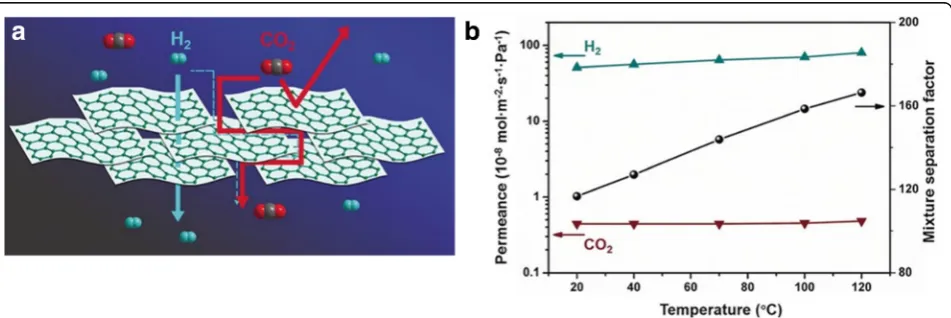
MOF nanosheet by a soft-physical exfoliation method using Zn2(benzimidazole)4 as a parent 3D framework
(Fig. 4a). Nanosheet suspension was drop coated on heated support (hot drop coating) that lead to disor-dered stacking due to the variation on the rate of evap-oration across the film. In contrast, conventional filtration method applies constant force across the film, ordered restacking of the nanosheets are obtained, which have been identified from x-ray diffraction. However, the ordered stacking of MOF nanosheets showed partially or blocked micropores, therefore hot drop coating method was preferred to efficiently fabricate class 2 membranes for these materials. Their membranes showed impressive selectivity for the H2/CO2 pair (~ 260) at 120 °C with
linearly increased H2 permeance through the
mem-branes at high temperature (Fig.4b).
The ultimate class of the 2D-enabled membranes is the class 3 membranes that are one- or a few atoms thick layers with intrinsic microporosity. Class 3 mem-branes represent the lower limits for any membrane
fab-rication (one atom thick) combined with
ultra-permeability via an atomically-thick membrane layer. Membranes in this class are a version extended from class 2 membranes by the formation of large-area atomically thin membranes. Generally, class 2 mem-branes have a wide range of thicknesses (a few tens of nanometers to a few micrometers) due to the stacking of nanosheets; however, class 3 membranes are classified as few nanometer thick membranes fabricated from 2D nanosheets. Single or few-atomic-layer membranes with tuned intrinsic micropores, such as graphene nanosheets with engineered nanoscopic pores are representative membranes in this class. The advantage of atomically thin membranes is their maximized molecular flux (min-imized transport resistance) [28]. Although the graphene
itself can form perfectly two-dimensional single atomic layers, a perfect single layer still cannot permeate a small gas such as helium. The molecular sieving potential of nanoporous graphene is gained from the fact that by se-lectively (and regularly) removing carbon atoms from the lattice, it should be possible to develop membranes that offer exquisite molecular sieving properties and ultra-high molecular fluxes. The membrane reported in Surwade et al. [25, 29] is one of the representative class 3 membranes. Surwade et al. created a one-atom-thick nanoporous graphene membrane using plasma etching. Single layer graphene was deposited on a copper surface and transferred to a silicon nitride wafer with 5-μm holes. A short burst of oxygen plasma created nano-scopic pores on the graphene layer with sufficient areal density to allow ultra-high water flux combined with a nearly perfect salt rejection. Huang et al. [30] reported a relatively large area (1 mm2
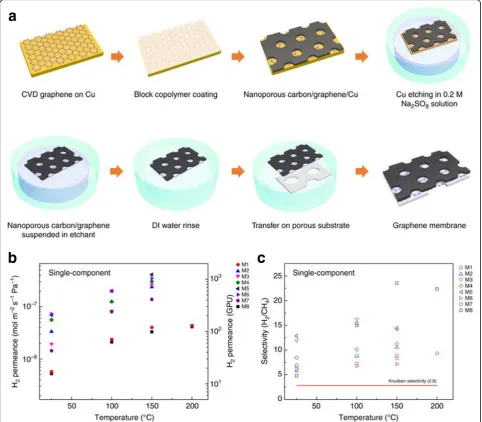
) single-layer graphene film as a class 3 gas separation membrane. To minimize the formation of cracks during transfer process from chemical-vapor deposition (CVD) derived graphene on porous supported graphene (Fig. 5a), researchers used nanoporous carbon as a sacrificial layer to protect the graphene membrane layer during the transfer process. Intrinsic defects of graphene that originated from the CVD process produced reasonably high hydrogen per-meance (up to 4 × 10⁻⁷mol m−2s−1Pa−1) (Fig. 5b) with H2/CH4selectivity up to 25 (Fig.5c), which was
compar-able to state-of-the-art polymeric membranes with 1μm thickness. Researchers further demonstrated ozone func-tionalization that enhanced the areal density of the nanoscopic pores on the basal plane of the graphene membrane, which is directly related to the productivity (flux) of the graphene-based membrane. One important question about class 3 membranes is the durability of
Fig. 4aA cartoon illustrating the gas separation through porous Zn2(Bim)3nanosheets. Only Zn atoms are shown for clarity, and the light blue
planes represent the nanosheets regardless of their amphiprotic natures. The blue line indicates the pathway of H2and the red line represents
the pathway of CO2[27].bThe change of permeance of H2/CO2and mixture separation factor of Zn2(Bim)3nanosheet membrane for different
the single layer membranes at various pressure and temperature conditions. Kumar et al. [31] tested the sta-bility of single-layer graphene membranes (5μm diam-eter) by a temperature swing cycle (25–200 °C) with transmembrane pressure up to 0.5 bar. In various condi-tions, non-porous (as synthesized) single-layer graphene membranes showed impressive stability for several days. Then, researchers introduced an oxygen etching tech-nique to create nanoscopic pores on the graphene layer to allow the transport of gas molecules. Although the pressure testing was not entirely investigated on the nanoporous graphene membrane, this result provided a guide for standardization of membrane testing
procedures for 2D-enabled membranes. Nevertheless, a fundamental understanding of the permselectivity of the class 3 membrane is still under development. A few mechanisms for gas permeation through the sub-nanometer graphene pores was proposed by Yuan et al. [32]. In their model, gas permeation through the gra-phene pores was described in a two-step process of ad-sorption and translocation. First, the gas molecules are adsorbed on the entrance of the generated pores and these are translocated along the graphene membrane via a chemical potential gradient. Then the rate coefficient of translocation obeys Arrhenius-type behavior, indicat-ing that the ‘solution-diffusion model’ defined in
Fig. 5aFabrication process of large-area graphene membrane through the nanoporous carbon film-assisted transfer method.bThe permeance of H2for 8 different graphene membranes with different temperature condition.cH2/CH4selectivity for 8 different graphene membranes with
conventional membrane systems with a continuum-level assumption might be applied to the single-layer 2D membranes. The transport models of 2D-enabled mem-branes are suggested by several reports. Graphene based class 3 membranes are often treated as a test bed for modeling work on atomically thin membranes. For class 3 membranes, the relative size of pores and the penetrat-ing molecule is a dominant factor that can ultimately modify the permeability through the membrane [33,34]. For relatively large pores (pore size larger than the pene-trants), steric regime model can be applied to describe the transport of gas molecules [35]. In this model, gas molecules are treated as a rigid sphere with specific kin-etic diameters. Steric regime model suggests no inter-action between the pore edge sites and penetrants, therefore energetic barrier for gas transport in the pore is low. On the other hand, activated regime model as-sumes that certain energy barrier exists when the pene-trants attempt to pass through the pores. In this case, Lennard-Jones potential is used to describe penetrant-pore interaction [36]. For relatively small pores (pore size smaller than the penetrants), activated regime model is used to predict molecular transport across the membrane. Limitations of these models in-clude lack of consideration of the adsorptive flux near the nanosheet surface and the detailed chemical struc-ture of nanopores. Du et al. [37] and Sun et al. [38] re-ported the significance of adsorptive flux near the surface of graphene through molecular simulations. The affinity difference between gas molecules with a carbon atom of the graphene layer will alter the permeability across the class 3 graphene membrane and eventually affect the selectivity of different gas pairs. For example, N2can form the adsorptive flux near the graphene layer
through van der Waals interaction that leads to high N2/
H2 selectivity. In summary, to consider the transport
model in 2D-enabled membranes, in addition to the pore size, the interaction between the penetrants and 2D materials should be fully considered. Although research into the nanoporous graphene membrane (class 3) is still in its early stages, these membranes will open up the new possibilities in molecularly-selective separation pro-cesses for future generations.
Newly emerging materials as“contenders”in 2D-enabled membranes
The development of the 2D-enabled membranes to date have been largely led by the use of graphene and gra-phene oxide. Particularly, gragra-phene oxide (GO) is pre-pared inexpensively on a large scale by oxidation and exfoliation of graphite. These GO nanosheets can be easily dispersed in water and provide an easy means for membrane fabrication via conventional filtration tech-nique. On the laboratory scale, a 1–10 cm2
membrane
sample is sufficient to generate transport data. However, the large-scale application requires membranes scaled up in a few orders of magnitudes in a defect-free manner [39]. Fabrication of defect-free, large-scale graphene or graphene oxide membranes for gas and liquid separation has not yet been fully exploited and is sometimes ex-tremely challenging due to their poor mechanical prop-erties. Moreover, forming uniform intrinsic micropores on the graphene layer (class 3 membranes) or tuning the uniform tortuous path (external micropores in class 1 or 2 membranes) in laminate graphene oxide membranes are still questionable [40]. In this section, we discuss the applicability of the recently emerging 2D nanosheets other than graphene-derived materials in a membrane structure that may help to advance the development of 2D-enabled membranes. More detailed surface chemis-try and functionalization of the 2D materials will be dis-cussed in the following separate section.
MXenes
MXenes are the inorganic compound that has a chem-ical formula of Mn+1XnTx(M: Transition metal, X:
Car-bon or nitrogen, T: Functional group on the basal plane). MXenes are derived from the parent MAX phases, where A consists of 3A metals or 4A elements. In the MAX phases, M-A bonds have weaker interaction than M-X bonds, so A element can be selectively removed at high temperature or etching by HF treatment. Removal of the A induces the formation of MXene nanosheets with a form of M2X, M2X2, and M4X3[41].
Representa-tive MXene family members include Ti3C2, Ti2C, Nb2C,
V2C, (Ti0.5Nb0.5)2C, (V0.5Cr0.5)3C2, Ti3CN and Ta4C3. In
MXene nanosheets, the functional groups (T) play a crit-ical role in creating the nanochannels between two MXene nanosheets. Functional groups contribute to the stability of MXene membranes by adjusting the inter-action between the individual MXene nanosheets. Using these MXene nanosheets, various class 1 membranes have been demonstrated in gas and liquid separations. Ding et al. [42] fabricated membranes with titanium-based MXenes (Ti3C2Tx) by vacuum filtration
on an anodic aluminum oxide support. The interlayer spacing between MXene layers was ~ 0.35 nm and allowed the high permeability of the gas molecules such as hydrogen (2100 Barrer) and He (2400 Barrer) (Fig.6). Due to the much smaller interlayer spacing provided in MXene based membranes compared to GO based mem-branes, MXene based membranes show promising mo-lecular sieving properties for the H2/CO2 pair with
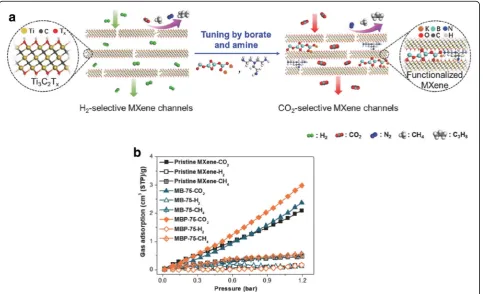
selectivity over 100. Chemical functionalization on the MXene surfaces can further refine the selectivity of spe-cific gaseous species. Jie et al. [43] used borates to select-ively transport CO2 through MXene channels by
on the surface of MXene nanosheets (Fig.7a). It reduced the interlayer distance between MXene nanosheets, thus confirming the reversible desorption of trapped CO2 in
the nanosheets. At 75 °C, the borate modified MXene membrane showed 13% enhancement of CO2adsorption
capacity compared to a pristine MXene membrane (Fig.
7b). Further interlocking between MXene nanosheets was achieved by cross-linking the borate and polyethyle-neimine (PEI). Positively charged PEI molecules help to reduce the interlayer spacing when mixed with borate and MXene flakes, tuning the interlayer spacing down to 0.34 nm at 75 °C—which fall into the range of kinetic di-ameters of CH4 (0.36 nm) and CO2 (0.32 nm). MXene
with borate and PEI achieved 5.2 times enhancement of CO2permeance compared to the pristine MXene
mem-brane (350 GPU for MXene with borate and PEI and 67 GPU for pristine MXene membrane).
MXene based membranes also show promising liquid separation performances. Chang et al. [44] reported MXene membranes that had ultrafast water flux and high ion selectivity. One interesting feature is that even with a relatively thick membrane (0.9–1.5μm), their membrane achieved very high water permeance (~ 38 Lm−2h−1bar−1), which was much higher than that of the 1.5μm thick GO membranes (~ 6.5 Lm−2h−1bar−1). Re-searchers suggested that the thin layer of water mole-cules formed between the MXene nanosheets, which provided a fast transport pathway for water molecules, was responsible for this high water permeance. In
addition, their membrane showed size and
Fig. 6Single-gas permeability of various gases with different kinetic diameters across the 2-μm-thick MXene membrane at 25 °C and 1 bar. The inner graph showed the selectivity of 3 equimolar mixed gases [42]. Adapted with permission from ref [42]. Copyright 2018 for the John Wiley and Sons
Fig. 7aStructure and gas transport pathway of gas-selective MXene nanosheets.bGas adsorption data for pristine and functionalized MXene at 25 °C [43]. Adapted with permission from ref [43] under a Creative Commons Attribution 4.0
charge-selective permeation of ions. Na+ had the highest permeation rate among differently charged cations, achieving a 25 times higher permeation rate compared to Al3+and 7 times higher than Ca2+. The ionic selectiv-ity of the MXene based membranes reflects that the MXene nanosheets are also promising building blocks for 2D-enabled membranes. Wang et al. [45] fabricated 4.5 nm thick lamellar MXene nanosheets that attained surprisingly high water permeances (~ 2300 Lm−2h−
1
bar−1) and organic solvent permeances (up to 5000 Lm−2h−1bar−1 for both acetone and acetonitrile). These permeances are at least 20 times higher than those of the 18 nm thick reduced GO membranes for acetone. The regular and ordered flow channels created between MXene nanosheets were the vehicle for the high water and solvent permeances, opening up the possibility of the use of MXene membranes in the field of organic solvent nanofiltration (OSN). Li et al. [46] used a mo-lecular dynamics simulation in a quest to find the opti-mal design of the MXene lamellar structure for selective molecular separations. Two factors, interlayer distance (d) and intercalated molecules were identified as critical factors in designing MXene based membranes for opti-mal separation performances. The interlayer distance (d), of course, provides tortuous pathways for molecular transport and plays a critical role for molecular sieving of similarly sized molecules. By simulating the variation in the interlayer distance from 5 to 13 Å, the authors showed that anhydrous MXene nanosheets with ~ 5 Å interlayer distance can effectively separate H2/CO2
(kin-etic diameter H2is 2.89 Å and CO2is 3.3 Å) mixture. In
addition, the intercalated molecules between MXene sheets can modify the transport characteristics of the permeating molecules by partially tuning the “effective interlayer distance”. Through the simulations, the diffu-sivity of several gas molecules in the hydrous (water--filled) MXene channel was calculated smaller than that of anhydrous MXene channels. When MXene sheets are hydrated, these water molecules can scatter the gas mol-ecules or even block the pores, therefore decreasing the diffusion coefficient of gas molecules. For very small interlayer distance, water molecules even can block the gas transport channel of MXene nanosheets. The sug-gestions from their molecular simulation can be broadly used in most of the class 1 type membranes.
Boron nitride (BN)
Two dimensional boron nitride nanosheets are some-times referred to as“white graphene” since they are the isomorphs of the graphene structure. 2D hexagonal boron nitride (h-BN) can be formed in a graphene-like structure by the mechanical cleavage from bulk BN crys-tal or the chemical vapor decomposition reactions of precursor molecules [47]. Its high mechanical and
chemical stability is reported by multiple studies [48– 51]. Both graphene and BN shows hexagonal atomic structure formed with strong covalent sp2bonds. How-ever, BN exhibits intrinsically inorganic nature whereas graphene shows partially organic nature, therefore BN is generally treated as a chemically more inert compared to graphene. However, for fabricating a large area of h-BN nanosheets, thermal catalytic chemical vapor deposition is highly favored over the mechanical cleavage tech-niques, partially overcoming the scalability problems re-lated to 2D materials [47]. Each h-BN nanosheet has a honeycomb structure consisting of a borazine ring (B3N3H6) with a B-N bond length of 1.45 Å. The
center-to-center distance of the adjacent borazine rings is 2.50 Å, which is slightly longer than 2.46 Å in the gra-phene basal plane [52]. In addition, the stack order of h-BN is different from that of graphene. In the graphene layers, each carbon atom is located right above the cen-ter or the carbon ring (AB stacking); however, in h-BN, each B atom eclipses an N atom on the adjacent h-BN layer (AA’stacking). Sutter et al. [53] reported the chem-ical vapor deposition (CVD) method to fabricate large-area hexagonal boron nitride (h-BN) monolayers. With the low partial pressure of borazine, h-BN sparsely nucleated the domain and merged into a single layer. They also reported that the amount of hydrogen gas in the precursor gas controlled the expansion and morph-ology of growing h-BN domains. In addition, hydrogen gas inhibited the formation of surface oxides on metal substrates. The additional H2with the borazine
precur-sor provides evidence that the B and N incorporation at the h-BN edge can be modulated to control the growth and to achieve different types of h-BN domain morph-ology. Especially, unlike graphene derivatives, h-BN has high chemical stability under both acidic and basic con-ditions. Although boron nitride has high stability in harsh conditions, it is difficult to fabricate class 1 mem-branes with h-BN nanosheets due to its hydrophobicity, which highlights the importance of functionalization of h-BN to enhance the stacking properties of BN based membranes. Chen et al. [54] reported the use of amino-functionalized h-BN membranes in organic solv-ent nanofiltration (OSN). Class 1 membranes were fabri-cated using water-dispersible (functionalized) BN nanosheets. Membranes formed using functionalized boron nitride nanosheets have a superior solvent flux while also having moderate-to-high solute rejections in both organic and aqueous solvents. Their 400 nm-thick membranes showed a water flux of 1500 Lm−2
1480 Lm−2h−1 with 54% rejection rate for Congo Red dye and 620 Lm−2h−1 with 99% rejection rate for Au nanoparticles. And for methanol it showed the flux of 600, 740, 640 and 560 Lm−2h−1with 99, 60, 88.7 and 99% rejec-tion rate for Congo Red dye, methylene blue (MB), Acid fuchsin (ACF, 586 g/mol), Evans blue (EB, 961 g/mol), re-spectively. In addition, compared to graphene derivatives, the functionalized inorganic boron nitride membrane dem-onstrated high stability for acid, alkali, and oxidative media conditions. Lei et al. [40] reported the adsorptive separation performance of BN laminates for oils, organic solvents, and water. The layered structure of the BN was synthesized via a dynamic templating approach, and BN laminate attained a notable BET surface area (~ 1400 m2g−1) and pore vol-ume (~ 1 cm3g−1) indicating the possible application of the BN lamellar structure in membrane-based separations. Liu et al. [55] fabricated a mixed-matrix membrane (MMM) of poly (vinylidene fluoride) and boron nitride nanosheets.
Mixed-matrix membranes (MMMs) formed with 2D mate-rials is further discussed in the following section, so it would be appropriate to briefly introduce the MMM formed with BN nanosheets here. Their membrane had a thickness of around 300μm and the BN nanosheets had many holes with a diameter range from 20 to 100 nm. A 300 mm thick MMM fabricated with BN nanosheets achieved largely enhanced water permeability (~ 8.2 × 10⁴ L-μm-m−2h−1bar−1) that was three orders of magnitude higher than that of the pristine polyvinylidene fluoride (PVDF) membranes. Moreover, their membrane showed excellent filtration efficiency for several pharmaceuticals, such as carbamazepine, indicating the applications in or-ganic solvent nanofiltrations.
Molybdenum disulfide (MoS2)
More than 60 types of transition metal dichalcogenide (TMD) have been discovered since 1960, and
Fig. 8aThe structure difference between 1 T, 2H and 3R [163]. Adapted with permission from ref [163]. Copyright 2016 for John Wiley and Sons.
bTop and side views for 2H (left) and 1 T (Right) phase of MoS2single layer [106]. Adapted with permission from ref [106], under a Creative
molybdenum disulfide (MoS2) is one of the popular
ma-terials in this class and also a strong contender as build-ing blocks for 2D-enabled membranes. Among various TMDs, 2D MoS2 is characterized by the well-defined,
uniform two-dimensional transport channels with lim-ited undesirable chemical defects [56]. The uniform nanoscopic channel structure of MoS2 is very
advanta-geous for studying fundamental transport mechanisms in tortuous pathways in class 1 or class 2 membranes. In general, TMDs consist of a transition metal layer sand-wiched between two chalcogen layers. Compared to other two-dimensional membrane materials, the TMD monolayer is unique for this“sandwiched structure”[57] (Fig. 8a). Due to this sandwiched structure, TMDs can have different crystal polytypes. For example, MoS2can
have four different crystal structures, 2H, 1 T, 1 T’ and 3R [58], with different coordination models. The 2H type has trigonal prismatic coordination consisting of hexago-nally packed atoms with ABA staking mode (S-Mo-S′). The 1 T type has an octahedral phase. It has a stacking mode of ABC (S-Mo-S′). 1 T’type is called‘distorted 1T type’. It also has an octahedral phase, however, superlat-tice structures can exist in each layer. The 3R type also has trigonal prismatic coordination. The multilayers of 3R type showed a rhombohedral symmetry. Although MoS2 can have diverse crystal structures, due to the
thermodynamical stability, the 2H type is dominantly formed during synthesis [57] (Fig.8a, b). Mainly, exfoli-ation and filtrexfoli-ation induced stacking of MoS2nanosheets
is similar to those of the graphene-based membranes. Recently, vapor and liquid permeation through the MoS2lamellar structure that is comparable to graphene
oxide derived membranes were reported. Lamellar (class 1) MoS2 membranes [56] showed better stability in a
harsh aqueous environment (stability under a low wide range of pH) than GO membranes while allowing per-meation of light organic vapors (e.g., MeOH, EtOH, cyclohexane, and acetone) as well as water vapor. The 2D nanoscopic channel produced in the stacked MoS2
--platelet membrane also suggests the molecular sieving of various ions and dye molecules. Hirunpinyopas et al. [59] reported a functionalized MoS2lamellar membrane
that effectively prevents MoS2membranes from swelling
from water exposure. Various dye molecules (crystal vio-let, sunset yellow, and neutral red) are used to functio-nalize the MoS2 surface and the effect of dye
functionalization was confirmed by forward-osmosis type experiments. Notably, the MoS2 membrane
func-tionalized by sunset yellow dye with a 5μm thickness showed a nearly 99% NaCl rejection and 5 times higher water flux (0.033 L m−2h−1bar−1) through the mem-brane than that of a similar thickness GO memmem-brane (0.007 L m−2h−1bar−1). Heiranian et al. [60] calculated the performance of class 3 type membranes formed by a
single layer MoS2 membrane via MD simulations. Due
to the sandwiched triple layer structure of the MoS2, edge
site chemistry played a significant role in water perme-ation via the difference in hydrophobicity of different sites. By tuning the pore area of a single layer MoS2membrane,
salt rejection of the membrane reached up to 88% with water permeability comparable to that of the GO mem-branes. Wang et al. [61] reported the effect of hydration states on the size of the nano-channels between MoS2
layers. When the MoS2membrane was fully hydrated, the
free spacing between the layers was 0.9 nm, while a per-fectly dehydrated MoS2membrane had a 0.3 nm free
spa-cing. Fully hydrated MoS2 membranes maintained the
interlayer distance by the van der Waals interaction and hydration force which created aqueous stability of the MoS2 membranes. Water molecules were transported
through the fully hydrated MoS2 membranes and their
membrane showed a high water flux of 30–250 L m−2
h−1 bar−1. However, other organic molecules (rhodamine-WT and methylene blue) are moderately cut off by their size which is larger than the free spacing between MoS2layers.
Chen et al. [62] impregnated ionic liquid (1-butyl-3--methylimidazolium tetrafluoroborate [BMIM][BF4]) into
the interlayer of the MoS2 membranes. Due to the high
solubility of CO2toward [BMIM][BF4], their ionic liquid
confined MoS2membranes showed noticeable selectivity
for various mixtures such as CO2/N2 (~ 131), CO2/CH4
(~ 43) and CO2/H2 (~ 14). MoS2 nanosheets have also
been used in desalination via forward osmosis (FO) oper-ation. Li et al. [63] stacked MoS2nanosheets on the
sur-face of polyethersulfone (PES) FO membrane by layer-by-layer (LBL) deposition method. The presence of MoS2 increase the hydrophilicity of the FO membrane
and furthermore tuned the average pore radius that po-tentially affected the water permeability of the FO mem-brane. MoS2 coated FO membrane showed ~ 35%
enhanced water flux compared to that of the pristine FO membrane. Hydrophilic and smooth MoS2 nanochannels
contribute to the higher water flux of coated FO mem-brane. Moreover, the reverse NaCl flux of MoS2 coated
membrane is decreased to 16.42 gm-2h-1, 35.91% enhanced compared to reverse NaCl flux of pristine PES FO mem-brane. Through the dynamic cross-fouling test with Bovine serum albumin (BSA) molecule, MoS2 coated FO
mem-brane showed stronger fouling resistance than pristine PES FO membrane. MoS2 is definitely an attractive candidate
for 2D-enabled membranes due to its planar characteristics of limiting defects with a uniform and well-established structure of a two dimensional transport channel.
Metal organic frameworks (MOF)
various multitopic organic linkers (or ligands). To date, more than 70,000 different MOFs have been experimen-tally confirmed in about 138,000 hypothetical frame-works [64, 65]. Unlike zeolites, which are characterized by their rigid, regular microporosity, MOFs show a higher degree of flexibility due to the rotational or trans-lational freedom of organic linkers, such as imidazolate, carboxylate, and azolate. MOFs are frequently used as a filler for fabrication of a mixed matrix membrane due to the partial organic nature of its framework—affinity to-ward a polymeric matrix is higher than other purely in-organic materials. Two dimensional (MOF nanosheets) MOFs have been also reported to show favorable appli-cations in catalysis [66, 67], gas storage and separations [68,69], and chemical sensors [70,71]. MOF nanosheets are prepared in two different ways: 1) Bottom-up synthe-sis (c.f., arresting crystallization) [72], 2) Top-down
synthesis (c.f., exfoliation of layered MOF crystals) [73,
74] (Fig.9). In bottom-up synthesis, a dominant growth of the 2D plane is achieved by using the appropriate li-gands or surfactants. For instance, specific surfactants direct the growth of a preferential plane by their select-ive attachment on the specific facets of nanocrystals. Surfactant attachment on the surface of the crystal re-duces the surface energy via dipole-dipole interaction, enabling the controlled growth of crystal facets [75]. Zhao et al. [76] reported the fabrication of ultrathin 2D M-TCPP nanosheets (M = Zn or Cu, TCPP = Tetra-kis(4-carboxyphenyl)porphyrin) using a surfactant such as poly (vinyl pyrrolidone). Conventional solvothermal synthesis without the use of a surfactant naturally cre-ates bulk crystals of M-TCPP, but with PVP, anisotropic growth of nanocrystals is observed, and ultrathin 2D nanosheets with a thickness of 8.7 ± 2 .7nm are formed.
Similarly, other small modifier molecules can bind pref-erentially to a particular facet of growing crystals. For example, the use of pyridine in synthesizing copper based 2D MOF nanosheets [77] and the use of PVP in synthesizing cobalt based 2D MOF nanosheets have been reported [78]. 2D nanosheets of MOF can also be produced using phase-interface directed crystal growth. In the top-down synthesis of MOF nanosheets, a num-ber of different exfoliation methods have been reported. Abherve et al. [73] mimicked the famous “scotch tape method” [79] to produce MOF nanosheets. Their MOF nanosheets had few micron lateral sizes with 2 nm thick-ness. Ball mill, grinder, stirrer, or ultrasonication have been used to mechanically exfoliate bulk layered MOFs [80–83]. Alternatively, the interlayer space in layered MOF materials can be enlarged by the intercalation of ionic/molecular species between MOF layers to enhance the delamination of the nanosheets.
These MOF nanosheets are frequently used to form class 2 or class 3 (2D) membranes. Peng et al. [80] re-ported 1 nm thick MOF nanosheets with a large lateral area and their application in fabricating molecular siev-ing membranes. Parent poly (Zn2(benzimidazole)4) MOF
has two-dimensional layers oriented normal to the c axis connected by weak van der Waals interactions between layers. Wet ball milling and ultrasonication can break these weak interactions to exfoliate nanosheets and the suspension of nanosheets was further deposited onto the surface of α-Al2O2 via a hot-drop coating method. The
class 2 type membrane produced by this method had sharp molecular sieving properties with high H2
perme-ance (up to 3700 GPU) and decent H2/CO2 selectivity
(up to 290). Similarly, Peng et al. [27] reported sub-10 nm thick MOF nanosheets of Zn2
(benzimidazo-le)3(OH)(H2O). Exfoliated MOF nanosheets were
depos-ited using the hot-drop coating method and tested for separation of an H2/CO2 mixture (H2permeance up to
2300 GPU and H2/CO2 selectivity up to 166). Wang et
al. [84] also used the hot-drop coating method to pre-pare 2D MOF membranes. 2D Mesh Adjustable Molecu-lar Sieve (MAMS-1) nanosheets were prepared by a freeze-thaw process of the parent 3D framework. During the freeze-thaw process, the parent MAMS-1 crystals were frozen in a liquid nitrogen bath and thawed in hot water bath, repeatedly. Due to the shear force derived from the volumetric change of solvent, the 2D MAMS-1 nanosheets were exfoliated. And then a nanoscale MAMS-1 membrane was fabricated on hot anodic aluminum oxide. This membrane also selectively perme-ated H2over CO2 with H2 permeance up to 800 GPU
with H2/CO2 selectivity up to 268. Overall, atomically
thin MOF nanosheets have been re-assembled and inter-locked on porous supports to produce class 2 type mem-branes that combine the intrinsic micropores of MOF
nanosheets and external nanopores between MOF nanosheets.
Covalent organic frameworks (COF)
Covalent organic frameworks are a novel class of micro-porous crystalline materials based on the integration of organic building blocks into highly ordered networks. These organic ligands are coordinated into a periodic two-dimensional networks structures to construct highly uniform micro- or mesoporous pores (Fig.10a, b). Com-pared to its parent 3D structures, 2D COFs form lamel-lar nanosheets that can be widely exploited in class 2 or class 3 membranes. In general, Schiff base-type COFs form pore sizes in 0.8–5.0 nm that are useful in nanofil-tration (NF) type separations, however, the pore size can further be tuned by the introduction of functional groups at the pore edge sites. Since organic linkers are covalently linked in the microporous framework, COFs show high stability under various organic conditions and further be used in organic solvent separations. A self-standing COF membrane (M-TpTD, Tp: 1,3,5-trifor-mylphloroglucinol, TD: 4,4′-p-Phenylenedianiline) with a pore size of 2.6 nm showed impressive permeance for several different aprotic solvents [85]. Especially, metha-nol recorded the highest permeance of 138 Lm−2h−1 bar−1 with high rejection rate for Rose Bengal (MW: 1017.6, 99% rejection), Congo Red (MW: 696.6, 96% re-jection) and Methylene Blue (MW: 319.8, 94% rere-jection). Zhang et al. [86] used a facile bottom-up interfacial crystallization approach to obtain a 2D COF (EB-COF:Br, EB = ethidium bromide) membrane with average pore size of 1.68 nm and an interlayer distance of 1.65 nm. Their membrane showed high permeance for protic solvents such as methanol (1272 L m−2h−1 bar−1), ethanol (564 L m−2h−1bar−1) and n-propanol (477 L m−2h−1bar−1), and for aprotic solvents such as acetone (2640 L m−2h−1bar−1), acetonitrile (2095 L m−
2
newly fabricated membrane showed 100 times higher solvent permeability. The molecular weight cutoff (MWCO) of TFP-DHF 2D COF membrane showed around 900 Da and the molecular weight retention onset (MWRO) of the membrane is around 600 Da. Zhang et al. [89] reported MD simulation of 2D COF membrane for desalination. The triformylphloroglucinol (Tp) and p-phenylenediamine (Pa) with several functional groups (X) are used to fabricate 2D COF membrane (TpPa-X) by tuning the aperture sizes in the range of 5.1–7.6 Å. Hydrophilic functional groups with larger aperture size were advantageous in high water permeance of the 2D COF membranes. Through MD simulation, their 2D COF based membranes showed 1–2 orders of magnitude higher water permeance compared to that of 3D ZIF membranes, which have totally opposite structure to 2D COF membrane, with relatively long channels.
In addition to organic solvent separations, various gas separation membranes are also demonstrated using 2D COF nanosheets. Li et al. [90] exfoliated microporous COF-1 nanosheets (average pore size ~ 0.39 nm) to fab-ricate ultrathin COF-1 membrane (COF nanosheets layer of ~ 100 nm). The COF-1 membrane was fabri-cated through solvothermal condensation of 1,4-benze-nediboronic acid (BDBA) in a 1,4-dioxane-mesitylene mixture. Their membrane showed the H2 permeance of
10−6mol m−2Pa−1s−1 (3000 GPU), which surpass the performance of ZIF-8 membrane with 100 nm thickness (5.46 × 10⁻⁸mol m−2Pa−1s−1, 163 GPU). Tong et al. [91] reported molecular dynamics simulation of triazine-based 2D COF membranes (CTF-1) with an average pore size of 12 Å. With different stacking mode, gate closing effect was studied by varying the interlayer distance of COF nanosheets. They simulated the
transport behavior of CO2/N2 mixture through their
membrane. By tuning the structure of four-layered 2D COF membrane, high CO2/N2 selectivity up to 36 was
obtained while maintaining the CO2 flux of 23
mole-cules/ns. Through their work, tuning the stacking mode of nanosheets can be one of the most effective strategies to fabricate the ultrathin membrane with high perme-ance and selectivity. Due to its inherently large pore sizes (Schiff based COFs), 2D COF based membranes show preferential applications in organic solvent separa-tions. Pharmaceutical industries or biorefinery where there is a need for solvent-resistant membranes with high permeance of organic solvents are expected to be positively impacted by 2D COF membranes.
Basal plane engineering and surface chemistry of 2D nanocomposite materials
Surface functionalization of GO
The surface characteristics of graphene oxide (GO) has been extensively investigated owing to its unique proper-ties: a tunable chemical structure, pore generation, high permeability and single-atomic thickness with lateral di-mensions [92]. It is well-known that GO presents vari-ous oxygen-containing functional groups, such as hydroxyl, epoxy, carbonyl, and carboxylic acid groups, on its surfaces, which can be reacted with their
corre-sponding chemical reactions to fabricate
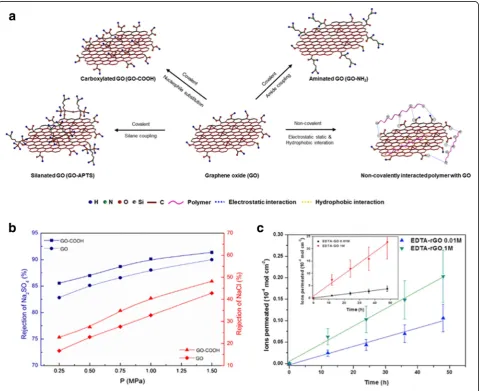
high-performance membranes. Those functional groups can be chemically modified with other functional groups using various chemical reactions: amide coupling [93], nucleophilic substitution [94], diazotization [95], silyla-tion [96], etc. (Fig.11a). Since there are several focused reviews on the surface chemistry of GO sheets, we focus on the surface modifications of GO for membrane
applications. The amide coupling reaction has been fre-quently used to functionalize GO sheets with primary amine groups to introduce positive charges on their sur-face in a colloidal state, and the negatively charged GO and positively charged GO-NH2was utilized as a
build-ing block to construct multi-layered structures of GO sheets through a layer-by-layer (LbL) assembly process to fabricate a membrane for durable reverse-osmosis ap-plication [97]. The resulting LbL multi-layers on a poly-amide membrane resulted in significantly improved antifouling properties against proteins and the resistance of membrane degradation by chlorine during a salt re-jection process. This amide coupling strategy can be also used to cross-link the assembled GO sheets with lamella-like structures by inter-connection of carboxylic acid groups of GO sheets to improve their mechanical
stability. For example, the laminated GO sheets on a polycarbonate membrane were spontaneously delami-nated in aqueous media by brief sonication or incuba-tion in basic condiincuba-tions. However, the cross-linked GO laminates with branched polyethyleneimine (BPEI) were stable in a wide range of pH values with prolonged son-ication up to 1 h, and the BPEI cross-linking process did not affect the filtration performance of laminated GO sheets, such as the rejection rate against both negatively and positively charged organic dye molecules [98]. The nucleophile substitution reaction was harnessed for carboxylation of GO and the carboxylated GO (GO-COOH) presented higher water dispersibility and chemical tailorability than pristine GO owing to the in-creased density of carboxylic acid groups. When the GO-COOH prepared by reaction with glycine was
Fig. 11aSurface functionalization of the GO sheet by covalent and non-covalent interactions.bMembrane performance of laminated GO and GO-COOH under the equal condition [99]. Adapted with permission from ref [99]. Copyright 2017 for Elsevier.cNa+ion permeation through
laminated on a polyethersulfone (PES) membrane, its laminated structures provided many wrinkles and hydro-philic surface properties, which was different from pris-tine GO, which acts as an active water transport channel [99]. As a result, the laminated GO-COOH provided a prominent water flux with improved desalting properties by enhancement of electrostatic repulsion (Fig. 11b). The silylation is also an important chemical reaction in modifying GO with desirable functional groups [96]. As GO presents many hydroxyl groups on its basal plane, it can be easily reacted with diverse silane compounds pre-senting different functional groups [100]. For the mem-brane application, the surface of GO was modified with N-(trimethoxysilylpropyl) ethylenediamine triacetic acid (EDTA-silane) to increase the density of carboxylic acid groups [101]. The EDTA-silane functionalized GO (EDTA-GO) exhibited much higher aqueous dispersibil-ity than pristine GO, and furthermore, it can be stably dispersed in water even after chemical reduction (EDTA-RGO). The laminated EDTA-RGO showed high applicability for ion separation with a significantly re-duced permeation rate of small cations such as K+ and Na+(Fig.11c). The non-covalent approach is another ef-fective strategy for surface functionalization of GO through various secondary interactions, such as electro-static, hydrogen bonding and hydrophobic interaction (Fig.11a). GO has a highly negative-charged surface and can be utilized to construct laminated structures by an LbL assembly process with poly (allylamine hydrochlor-ide) (PAAH) [102] and gelatin [103]. The resulting lami-nated structures exhibited considerably improved performance for water purification and mixed solvent separation. The surface functionalization of GO with a cationic surfactant through electrostatic and hydropho-bic interactions improved the forward osmosis process [104].
Surface functionalization of MoS2
MoS2is one of the most representative TMDs owing to
its physicochemical properties such as single-atomic thickness, tailorable surface, thermal and chemical sta-bility [105]. Despite the high potential, the membrane application of MoS2has been relatively restricted owing
to the difficulty for large-scale preparation of single-layered sheets with a large lateral dimension, but this problem is being addressed by many efforts to im-prove the exfoliation and functionalization processes of bulk MoS2. Although there is still a debate on the
func-tionalization mechanism, it is well-known that the sur-face of MoS2 can be readily functionalized with thiol
compounds by physisorption or direct coordination to S vacancies of MoS2(Fig. 12a) [106, 107]. The
functional-ized MoS2 sheets presented diverse surface properties
depending on the terminal groups of thiol ligands, and
thus they were highly dispersible in a complex aqueous media [108]. In addition, since the surface of MoS2
sheets was partially oxidized during the exfoliation process, their surface was easily functionalized by a sol-gel reaction with silane compounds [109] or electro-static interaction of polymers [63] and small molecules [110]. The non-covalent functionalization of MoS2with
poly organic dyes also greatly improved the membrane performance of laminated MoS2 sheets over their
pris-tine counterpart [59]. These previous reports indicated the importance of surface functionalization of MoS2
sheets for application as a membrane material.
Surface functionalization of h-BN
h-BN is an attractive 2D material for membrane applica-tions owing to its unique and excellent properties such as high strength, insulation, thermal stability and con-ductivity and chemical inertness [111–113]. Those prop-erties make it promising, but its extremely high chemical inertness has restricted its wide-spread applica-tion. Surface functionalization strategies for h-BN can be also classified into covalent and non-covalent ap-proaches. The covalent approach is generally a one-step process in which the exfoliation and functionalization of BN sheets occur simultaneously. The aqueous exfoliation and functionalization of h-BN sheets with hydroxyl groups was achieved through a hydrolysis reaction by prolonged-sonication of h-BN in aqueous media (Fig. 12b) [114], refluxing in concentrated strong acids or bases [115, 116], solution-phase oxygen radical reac-tion [117], using urea with a ball milling process, using molten hydroxides [118], or direct hydrothermal reac-tion with hydrogen peroxide. The hydroxylated h-BN sheets can be diversely derivatized using a silylation re-action with various silane compounds [119,120]. Despite those efforts, the membrane applications of h-BN sheets were restricted owing to their low exfoliation and pro-duction yield. By contrast, Lei et al. reported an efficient strategy to synthesize amine-functionalized h-BN (BN-NH2) on a large scale by ball-milling h-BN powder
with urea, and the resulting BN-NH2sheets were stably
dispersed at a high concentration in aqueous media (Fig. 12c) [121]. Recently, they also demonstrated that the laminated BN-NH2 sheets can be harnessed as a
stable and efficient molecular separation membrane for molecules dissolved in both aqueous and organic sol-vents with a high permeation rate under acidic, alkaline and oxidative conditions [50, 54]. In addition to lami-nated BN-NH2sheets, it was also revealed that BN-NH2
compromising rejection properties against organic mole-cules [122].
Surface functionalization of MXene (Ti3C2Tx)
Ti3C2Txis a representative material of the MXene family
and the laminated MXene (Ti3C2Tx) sheets have been
spotlighted as a promising material for membrane appli-cations based on their well-ordered subnanometer chan-nels [42], hydrophilicity, high water flux [123], salt
rejection [124], and anti-biofouling properties [125]. MXene sheets have been generally synthesized by chem-ical etching of MAX phases using fluoride-containing agents (Fig. 12d), including HF [126, 127], LiF/HCl [128], NaHF2, Na4HF2, and KHF2 [129]. During the
etching process, the composition of terminal –O,−OH and –F groups on MXenes varied with the chemical etchants, and it was recently found that LiF/HCl is an efficient etchant to synthesize MXene sheets with a large
Fig. 12aSurface functionalization of MoS2sheets with thiol compounds [107]. Adapted with permission from ref [107]. Copyright 2013 for
American Chemical Society.bExfoliation and hydroxyl functionalization process of h-BN sheets by sonication-assisted hydrolysis [114]. Adapted with permission from ref [114] Copyright 2011 for American Chemical Society.cExfoliation and amine functionalization of h-BN sheets by urea-assisted ball milling [121]. Adapted with permission from ref [121]. Copyright 2015 for Nature Publishing Group.dExfoliation process of Ti3C2Tx
sheets by chemical etching of MAX phases by using a fluoride-containing agents [126]. Adapted with permission from ref [126]. Copyright 2011 for John Wiley and Sons.eFunctionalization of Ti3C2Txsheets with phenylsulfonic groups by diazotization [130]. Adapted with permission from
lateral dimension and a single-layered and –OH group terminated structure [128]. Therefore, the etching process can be regarded as a simultaneous process of ex-foliation and surface functionalization for the large-scale production of hydroxylated MXene sheets. The surface of MXene sheets can be further modified with covalent and non-covalent approaches like graphene derivatives. As a covalent approach, Wang et al. reported that the azotization reaction of MXene sheets sulfanilic acid di-azonium salts resulted in enhanced colloidal stability [129] and electrochemical activity (Fig.12e) [130]. In the case of non-covalent approaches, MXene sheets present a negative surface charge owing to their hydroxyl groups, and thus they can have electrostatic and hydrogen-bonding interactions with poly (diallyldi-methylammonium chloride) (PDDA) and polyvinyl alco-hol (PVA) [131]. In the same line, the surface of MXenes can be functionalized with polyethyleneimine (PEI) and polydimethylsiloxane (PDMS) and the resulting lami-nates of PEI- and PDMS-functionalized MXene sheets achieved improvement in mechanical/thermal stability and solvent resistances accompanied by the enhanced transfer of alcohols and the rejection rate of solutes [132]. In addition, the complexation of positively charged Fe (OH)3 colloids with MXene sheets through
electrostatic interaction resulted in the formation of ex-panded nanochannels and then enhancement of the water flux and rejection rate for approximately 2.5 nm-sized molecules [133]. Those previous studies clearly indicated that the surface functionalization of MXene sheets provide more opportunities to develop a multi-functional and high-performance membrane material.
Nanocomposite membranes formed with 2D materials
Nanocomposites formed with 2D materials are also an extended version of the 2D-enabled membranes. At a high-level, these nanocomposites can be classified into two types: 1) Polymer-based nanocomposites and 2) 2D nanocomposites formed with elements other than poly-mers (GO + MOF, COF + MOF, or COF + COF …). In polymer-based nanocomposites formed with 2D mate-rials, the mixed-matrix membrane (MMM) architecture and the thin film composite (TFC) are the most well-known and studied membrane structure. Thin film composite (TFC) is one of the most representative asym-metric membrane architecture that is made of very thin (usually less than 200 nm) dense polymeric layer (separ-ating layer) is deposited on top of a porous support. Polyamide composited with polyethersulfone (PES) or polysulfone (PS) support membrane is widely used in water purification or desalination systems. For mass pro-duction of TFC membrane, various scalable fabrication techniques have been reported such as dual-layer slot
coating [134] or the hollow fiber spinning [135]. Com-pared to TFC membranes, MMMs have better thermal and mechanical stability arising from incorporated nano-particles (fillers) that reduce the impact of heating and membrane compaction. On the other hands, TFC mem-branes are described by much thinner separating layer thickness compared to MMMs, TFC membranes are often referred to as high permeance membranes. How-ever, TFC membranes typically suffer from membrane compaction and fouling. To overcome these limitations, TFC membranes are modified with fillers (similar to MMM). The following TFC based composite mem-branes using 2D fillers have been reported. Li et al. [136] fabricated TFC reverse osmosis membrane modified by 2D laminar MoS2. Due to membrane surface
modifica-tion of MoS2 nanosheets, the surface of MoS2-TFC
membrane showed improved hydrophilicity and rough-ness. As a result, MoS2-TFC membrane showed high
water flux with the anti-fouling property. Dong et al. [137] modified TFC by clay nanosheets. A cationic clay (montmorillonite, MMT) and an anionic clay (layered double hydroxide, LDH) were used for modification of TFC. Likewise, clay-TFC showed hydrophilicity and anti-fouling property because of hydrophilic clays. Espe-cially, MMT and LDH incorporated TFC membranes showed significantly improved the anti-fouling property to protein and cationic surfactant due to their negatively charged surface.
The original concept of the mixed-matrix membrane has evolved from the idea that incorporated filler mate-rials can enhance either the permeability or the selectiv-ity of the polymeric matrix—eventually overcoming the selectivity-permeability trade-off of conventional poly-mer based membranes. A wide range of fillers has been adopted in MMMs, ranging from nonporous inorganic nanoparticles to highly microporous frameworks includ-ing, MOFs and zeolites. Two dimensional materials (gra-phene, graphene oxide, MXene, 2D MOF, 2D zeolite …) with a high aspect ratio can also be incorporated into a mixed-matrix membrane opening up the possibility to form “ultrathin” composite membrane layers. These 2D fillers provide a tortuous diffusion pathway via stacked lamellar structures. Moreover, it is possible for few nano-meter thick 2D fillers to form a mixed-matrix with a larger volume fraction, which is not possible with the conventional 3D shape fillers.
GO based MMMs
of MMM. One important issue related to GO synthesis is the non-uniform lateral sizes of the fabricated GO nanosheets. Shen et al. [138] showed the size effects of graphene oxide on the separation performance of MMMs using the small (100–200 nm)−/medium (1– 2μm)−/large (5–10μm)-lateral sized GO. Researchers used polyether-block-amide (PEBA, Pebax®) as a poly-meric matrix and investigated the chain mobility of the GO incorporated polymer matrix. The mobility of the polymer chains was restricted with increasing lateral size of GO, while large-sized GO showed poor dispersion properties in a polymer solution. MMM fabricated with 1–2μm lateral sized GO exhibited excellent and stable separation of the CO2/N2pair with CO2permeability up
to 110 Barrer and CO2/N2selectivity up to 80. Dong et
al. [139] reported the use of porous reduced graphene oxide obtained by a dehydration reaction using NaOH as a filler for MMM fabricated with PEBA (Pebax®). In-corporation of the lamellar structure of the porous rGO was advantageous in selectivity enhancement for the
CO2/N2 pair, since the hydrated lamellar structure of
rGO favorably adsorbed CO2over N2. Furthermore, the
reduction degree of the porous rGO controlled the per-meability through the composite membrane by creating enlarged transport pathways for gas molecules. In sum-mary, their MMM showed CO2 permeability up to 119
Barrer and CO2/N2 selectivity up to 100. Shen et al.
[140] reported polyvinylamine (PVAm) and chitosan (Cs) based MMM using graphene oxide grafted with hyperbranched polyethyleneimine (HPEI-GO). Amine functionalization via incorporation of HPEI on GO sheets not only enhanced the polymer-GO adhesion properties but also increased the CO2 sorption capacity
through reversible chemisorption. Their membrane showed a slightly increased CO2/N2 selectivity (~ 107)
with moderate-to-low permeance of 36 GPU. Li et al. [141] introduced the polyethylene glycol- and polyethyleneimine-functionalized GO sheets (PEG--PEI-GO) to form a mixed-matrix membrane with Pebax®. Ethylene oxide and amine functional groups
Fig. 13aDiffusion coefficient and selectivity,bsolubility coefficient and selectivity of N2, CH4, and CO2in pure polymer membrane, GO based
MMM and functionalized GO based MMM.cRobeson plot for CO2/CH4separation.dRobeson plot for CO2/N2separation [141]. Adapted with
from PEG and PEI, respectively, had an excellent affinity toward CO2. The mixed-matrix membrane showed a
much-improved separation performance with CO2
per-meability up to 1330 Barrer with CO2/CH4selectivity up
to 45 and CO2/N2selectivity up to 120 (Fig.13).
Due to the hydrophilicity of the GO sheets, mixed-matrix membranes formed with GO generally have good aqueous or liquid stability, and GO based MMMs are frequently used in water purification or per-vaporative separations. The current state-of-the-art membrane process for desalination is illustrated by the interfacial-polymerized polyamide thin film composites. Yin et al. [142] constructed a polyamide thin-film nano-composite using a GO based polyamide mixed-matrix membrane. Typical interfacial polymerization of poly-amide film was performed on the polysulfone support layer with m-phenylenediamine (MPD) and trimesol chloride (TMC). GO nanosheets were dispersed in a TMC-hexane solution layer and the GO was incorpo-rated into the polymeric matrix of the polyamide thin film. Incorporation of the GO nanosheets enhanced salt rejection (NaCl: 93.8%, NaSO4: 97.3%) and water flux
(59.4 Lm−2h−1) through restricted interlayer spacing (~ 0.83 nm) of the lamellar structure and further increased the water permeability through the hydrophilic water channel of the GO. Instead of forming a thin-film com-posite, GO nanosheets were also exploited in a conven-tional MMM platform for water purification. Ganesh et al. [143] reported the salt rejection of GO based MMM using polysulfone as a polymeric matrix. Insertion of GO into the polymeric matrix have induced the forma-tion of macrovoids in membranes, which is responsible for high water flux. In addition, Yang et al. [144] used graphene dispersed polydimethylsiloxane (PDMS) MMM for pervaporative desulfurization. Due to the abundant population of theπ electrons on the graphene nanosheets, CH- π interaction between the high aspect ratio graphene and the PDMS chain was available. Aπ-π interaction between the thiophene and graphene was also constructed, and a favorable interfacial structure be-tween GO and PDMS was consequently formed. The GO/PDMS membrane showed an improved flux of ~ 6 kg m−2
h−1 and a selectivity of ~ 3.5 for applications in pervaporative desulfurization as well as separation of aromatics-containing mixtures.
2D MOF based MMMs
Microporous materials have also been a popular choice for filler material in the fabrication of mixed-matrix membranes. Among various microporous frameworks, MOFs have distinctive advantages over classical zeolite families due to their favorable interaction with a poly-meric matrix. MOFs form highly dispersed polymer so-lutions and can be fabricated into a dense film with
significantly reduced interfacial gaps [145]. On the other hand, conventional zeolites form a “sieve-in-a-cage” structure due to its immiscibility with the organic phase [146] (c.f., a polymeric matrix). Rodenas et al. [147] re-ported the Cu (BDC) (BDC: 1,4-benzenedicarboxylate) MOF based mixed-matrix membrane for CO2/CH4
sep-aration especially focusing on the use of MOF nano-sheets as a filler. Bulk (3D) MOF crystals leave a significant fraction of the composite volume unoccupied due to their bulky nature, but 2D MOF lamellae are uni-formly distributed over the entire MMM. This uniform distribution of nanosheets throughout the matrix is translated as improved separation performance by elim-inating the unselective transport pathways. Moreover, unlike isotropic fillers (nanocrystals or bulk MOF crys-tals) that cause swelling of the polymer matrix on the uptake of the highly plasticizing CO2, nanosheet loaded
MMMs effectively suppressed the swelling and therefore maintained a high CO2/CH4separation factor (up to 90)
at a transmembrane pressure up to 8 bar. Shete et al. [148] also reported the use of Cu (BDC) nanosheets in mixed-matrix membranes. Cu (BDC) nanosheets were prepared in the bottom-up direct synthesis and the syn-thesized nanosheets had aspect ratios as high as 100 (average lateral size 2.5μm and thickness of 25 nm). Polyimide (Matrimid®) was used to provide a polymeric matrix and a Cu (BDC) nanosheet dispersed MMM showed much-improved separation performance in terms of CO2/CH4 selectivity compared to neat
poly-imide membranes. Jungle-gym-like [149] Cu2(ndc)2
(-dabco) (ndc: 1,4-naphthalenedicarboxylate, dabco: 1.4-diazabicyclo[2.2.2]octane) nanosheets were reported and these nanosheets were blended with polybenzimida-zole (PBI) to form a mixed-matrix membrane used in a pre-combustion CO2 capture process. Similar to Cu
(BDC), Cu2(ndc)2(dabco) nanosheets showed a larger
improvement when incorporated into a MMM com-pared to bulk 3D crystals. For a high-pressure (up to 5 bars of CO2) pre-combustion CO2capture process, the
mixed-matrix membrane showed H2permeability up to
6.1 Barrer with H2/CO2selectivity up to 26. The concept
of the mixed-matrix membrane has been further ex-panded to microporous, rigid polymers such as “poly-mers of intrinsic microporosity (PIMs)”. Cheng et al. [150] reported a PIM-1 based mixed-matrix membrane with Cu (BDC) nanosheets. Notably, ultrathin mixed-matrix membranes with a thickness of 660 nm have been fabricated with 2D nanosheets and achieved high CO2 permeance (up to 400 GPU) with moderate
CO2/CH4selectivity (up to 15). MMMs with a thickness
of 60μm had a relatively low performance in terms of CO2permeance (up to 196 GPU) with low CO2/CH4

![Fig. 3 Predicted transport model through GO membranes [A] pathdenotes the pathway through external nanopores and interlayerchannel](https://thumb-us.123doks.com/thumbv2/123dok_us/370401.2034205/4.595.57.291.89.200/predicted-transport-membranes-pathdenotes-pathway-external-nanopores-interlayerchannel.webp)
![Fig. 8 abCommons Attribution 4.0 License ( The structure difference between 1 T, 2H and 3R [163]](https://thumb-us.123doks.com/thumbv2/123dok_us/370401.2034205/10.595.60.537.317.691/fig-abcommons-attribution-license-structure-difference-t-h.webp)
![Fig. 9 a A cartoon showing the mass transport through COF membranes [86] Adapted with permission from ref [86]](https://thumb-us.123doks.com/thumbv2/123dok_us/370401.2034205/12.595.58.539.308.695/fig-cartoon-showing-mass-transport-membranes-adapted-permission.webp)
![Fig. 10 Scheme of various bottom-up and top-down synthesis [74]. Adapted with permission from ref [74] under a Creative CommonsAttribution 4.0 License (http://creativecommons.org/licenses/by/4.0/)](https://thumb-us.123doks.com/thumbv2/123dok_us/370401.2034205/14.595.57.539.86.286/synthesis-adapted-permission-creative-commonsattribution-license-creativecommons-licenses.webp)