Volume 2, Issue 3, 2015, pp. 185-203 Available online at www.jallr.ir ISSN: 2376-760X
Correspondence: Gholam-Reza Abbasian, Email: [email protected] © 2015 Journal of Applied Linguistics and Language Research
A Study of Translation Errors in Relation to Text Rhetorical Modes
and Genre Types
Sarah Yousefi
M.A Student in Translation Studies, Islamic Azad University Science and Research Branch Tehran, Iran
Gholam-Reza Abbasian
Assistant Professor, Imam Ali University and Islamic Azad University, South Tehran Branch, Tehran, Iran
Abstract
Delivering a high quality translation has always been important to translators and translation studies’ scholars. In recent years Translation Quality Assessment (TQA) has received a lot of attention and translation scholars have tried their best to find a way that would lead translators to a higher quality translation and to find a method based on which quality of translation could be assessed. Every text has a genre and rhetorical mode, and both of them have specific characteristics which every translator must take into account before starting the translation. Therefore in the present study the researcher tried to combine both of these subjects to see if there is any relationship between text rhetorical modes, genre types and translation quality. Waddington’s Model (2001) was used to assess the quality of translation of four texts with religious, legal, technical, and literary genres with explanation, argumentation, exposition and narration rhetorical modes respectively. The texts were translated by 30 students of English Translation major. The analyses revealed that text type and translation quality are related such that among the four texts they delivered the highest quality translation for religious texts. It was concluded that there was a significant difference between the translators perceptions regarding the errors they might had in translation of different texts and their perceptions were lower than average, and also ‘selection of wrong words and equivalents’, ‘source text perception’, ‘addition’, ‘untranslated elements’, ‘grammatical error’, and ‘loan words’ were the problems that occurred in translations of the aforementioned texts.
Keywords: genre, rhetorical modes, translation quality, translation errors
INTRODUCTION
In this regards, Hervey, Higgins, and Loughridge (2005, p.114) suggest that “translators should be familiar with the characteristics of SL and TL genre”. The scholars who have worked specifically on genres and genre translation are aware of the probable errors that commonly happen in this process. Most probably genre type brings about certain type of translation errors. In line with this assumption, Munday (2009) considering the genre and genre shifts believes that when it comes to “serious language use” and “errors of translation”, genre shifts commonly happen just like the text shifts. He holds that the errors that might happen in translation can change the supposed genre of a text and then twist the rhetorical structure of the original, which is called “genre violation”. Then, it seems that three factors including translation genres, text type and text rhetorical organization are interwoven; an integration which, to the best of the researchers’ knowledge, has not been empirically investigated.
Malcolm Williams (2009) believes that nowadays professional translators, their clients, translatological researchers and trainee translators have more justification observing TQA. Williams (2009) believes TQA is a kind of evaluation. Michael Scriven (2007,p.2), defines it as “Evaluation is taken to mean the determination of merit, worth, or significance” then he (2009) argues that TQA can be qualitative or qualitative just like evaluation. In the broad sense, it can be based on mathematical/statistical measurement or on reader’s response, interviews and questionnaires for the purposes of diagnostic, formative or summative evaluations. There are a number of rubrics in the literature of translation studies. Rubrics that are more commonly used and are practical in the literature, according to Khanmohammad and Osanlo (2009) are of Farahzad (1992), Sainz (1992), Beeby (2000), and Waddington (2001). However, given its comprehensiveness and practicality, Waddington’s models are first taken into account. This model has four different methods which deal differently with texts to assess the quality of their translations.
the question: "What happened?" It tells a story.” According to Weaver and Kintsch (1991) narrative texts are “poems and novels and their purpose is to entertain.”(as cited in Alamargot, Terrier, and Cellier, 2007, p.201). Definitely, each mode, in light of its purpose, is structurally and lexically realized differently, which might affect the way each can be processed and understood. Similarly, genre type, according to Hervey, Dickins, and Higgins (2005), are of five broad categories including “literary, religious, empirical, philosophical, and persuasive”. Hervey, and Higgins (1992) note that the literary genre has two features that based on one of them, the writer creates an auto nomous world in the text which the earthy world cannot control or manage it, and “features of expressions” are realized based on the other one.
As the other modes, religious genre possesses its own features. According to Hervey, Dickins, and Higgins (2002, p.178) “…… the subject matter of religious texts implies the existence of a spiritual world that is not fictive, but has its own external realities and truths.” Hervey, and Higgins (1992, p.139) believe that “The subject matter of theological and religious works implies the existence of a spiritual world.” On the contrary, Hervey, Dickins, and Higgins (2002) hold that empirical genre is informative, and copes with the real world just like the way that the observer experiences it. They (2002, p.179) also believe that “scientific, technological and many scholarly texts fall into this category. It thus goes on diversifying into new genres and sub-genres as new scientific and academic disciplines are created.”
Philosophical genre is more conceptual and subjective. According to Harvey, Higgins, (2005, p.140) explain philosophical genres as “have as their subject matter a ‘world’ of ideas”. Pure mathematics is the best example of the kind of subject matter that defines philosophical genres. Even in the field of metaphysics, the author is understood not to be free to develop theoretical structures at will, but to be constrained by some standard of rationality. Philosophical genres have not proliferated as much as literary ones, but they are strikingly diverse nonetheless”. On the contrary, in persuasive genre, the aim of the author or speaker is to encourage the reader or listener to act in the way expected (Hervey, Higgins, Cragie & Gambarotta 2005). They also believe that readers or listeners can be encouraged or persuaded in different ways. Each of these five categories of genres has some unique characteristics which should be considered during the process of translation. Knowing these characteristics can help translators a lot to provide higher quality translations. The first category is “technical genre”.
literature. According to some scholars such as Kingscott (2002), only 10% of the translations done in the world are non- technical translations, as an indication of the importance of this genre in translation. Technical information is transmitted to different people who are from different countries with different languages.
As Byrne (2006) mentions, there are, however, some misconceptions about technical translation. She (2006) believes sometimes people think every kind of a text that has some terminologies falls under the category of technical genre. It is good to make a difference between as she says “specialized” and “technical” texts. As she (2006, p.3) believes “technical” means precisely that, something to do with technology and technological texts.”
Some of the scholars including Hervey and Higgins (1992) believe that translators of technical texts face some problems which fall under two categories including lexical problems and conceptual problems. According to Muslat (2012) all types of literature no matter written in the form of prose or verse falls in this category. They include shor t stories, novels, dramas and essays which all are literary texts.
Every types of text translating literary texts have their own challenges and difficulties. As ZiaulHaque (2012) believes, translation needs a lot of efforts and because of the grammatical, syntax and structural differences between the source and target texts the difficulties emerge in translation process. Xiaocong Huang (2011) mentions some of the challenges of literary translation. According to him the complexity of poetic language and subtleness of the effects make translation of literary texts hard for literary translators. Rabbani (2007) holds that in every religion, religious texts are the source of divine lessons and by using words and their holy voice it helps human beings to understan d spiritual meanings. Jacobus A. Naudé (2002, 2006, 2008 as cited in Gambier and Doorslaer, 2010) does not consider any difference between translation of religious texts and translation of other texts. Naudé (as cited in Gambier and Doorslaer, 2010) believ es that translator of religious texts should try to provide the best translation and use the best approach at hand, and also they should have been trained before translating religious texts. According to Cao (2007), not only language of law falls under the category of legal language but also all the communications which occur in the legal settings do. Cao (2007) argues that because of the nature of legal language the translation of these texts is complex. He (2007) believes that there is a difference in legal culture in the Common Law and in the Civil Law of the two languages the linguistic difficulties occur in translation. This problem comes from the difference in legal histories, cultures and systems.
THIS STUDY
any relationship between text rhetorical modes, genre types and translations’ quality. The problem, then, was raised into three specific research questions investigated in the form of respective hypotheses.
Is there any relationship between text rhetorical modes, and genre types and translations’ quality?
To what extent do the translators’ perceptions of the errors matches with what happens in reality?
What are the errors of translators in relation to text rhetorical modes and genre types?
METHOD
Participants
The participants were a group of B.A. students of English Translation from Islamic Azad University South Tehran Branch. They were in their last semester and had passed several courses in grammar, reading, conversation and writing up to advance level, and they had also passed some specialized theoretical and practical courses in Translation Field. So, they were in their advanced level of their translation knowledge. They were selected randomly and were both male and female. All of them were in the age range of 20 to 25 years old.
Instrumentations
To conduct the study a likert scaled questionnaire was designed. The questionnaire had 60 statements, and there were 15 statements for each text. The erro r types stated in the questionnaire were gathered and put together according to Corder’s (1973) and Stienbach’s (1981) category. Through the questionnaire the student-translators were asked about the errors that they would face in translating different types of the texts.The reliability of the instrument was estimated using Cronbach’s alpha formula proving .95, as an acceptable index.
Procedure
literary, religious and technical and legal and rhetorical modes were narration, explanation, argumentation and exposition respectively, and their perceptions and experiences in the translation of each genre type were solicited through the questionnaire seeking to explore the type of the problems they had in the translation of each genre. Their translations were scored based on Waddington’s Model C by two experts to enhance the reliability index reported as follows:
Inter-Rater Reliability
As displayed in Table 1 there was a significant agreement between the two raters who rated the subjects’ translations of: A: literary text (R = .87, P < .05), B: legal text (R = .89, P < .05), C: Technical text (R = .86, P < .05), D: Religious text (R = .78, P < .05).
Table1. Inter-rater Reliability Indices
LitR2 LegalR2 TechR2 RelR2
LitR1 Pearson Correlation .871
**
Sig. (2-tailed) .000
N 30
LegalR1 Pearson Correlation .894
**
Sig. (2-tailed) .000
N 30
TechR1 Pearson Correlation .861
**
Sig. (2-tailed) .000
N 30
RelR1
Pearson Correlation .784**
Sig. (2-tailed) .000
N 30
**. Correlation is significant at the 0.01 level (2-tailed).
RESULTS
Given the nature of the research questions, both qualitative and quantitative data were collected. The first section is a report of the quantitative data in a bid to answer the research questions 1 and 2. The second section, which accommodates both qualita tive and quantitative data, is more concerned with addressing the research question 3. Investigation of Research Question 1
Table 2. Multivariate Tests
Effect Value F Hypothesis df Error df Sig. Partial Eta Squared
Moods
Pillai's Trace .563 11.578 3 27 .000 .563 Wilks' Lambda .437 11.578 3 27 .000 .563 Hotelling's Trace 1.286 11.578 3 27 .000 .563 Roy's Largest Root 1.286 11.578 3 27 .000 .563
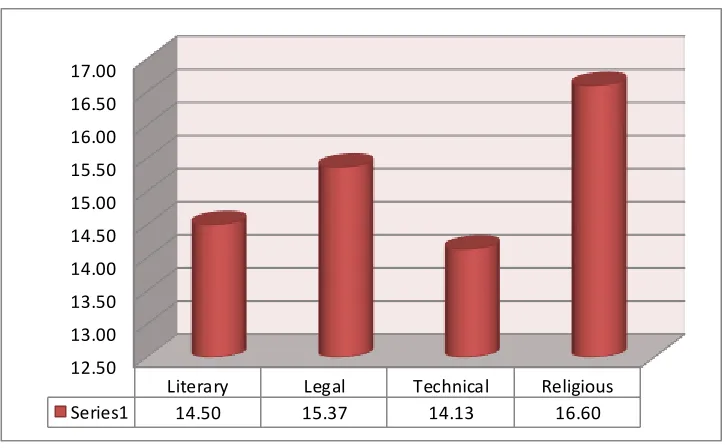
As displayed in Table 3,the participants showed the highest mean on the translation of religious texts (M = 16.60, SE = .36). This was followed by legal (M = 15.36, SE = .45), literary (M = 14.50, SE = .56) and technical (M = 14.13, SE = .45).
Table3. Descriptive Statistics
Moods Mean Std. Error 95% Confidence Interval Lower Bound Upper Bound Literary 14.500 .563 13.349 15.651
Legal 15.367 .454 14.439 16.294 Technical 14.133 .554 12.999 15.267 Religious 16.600 .364 15.856 17.344
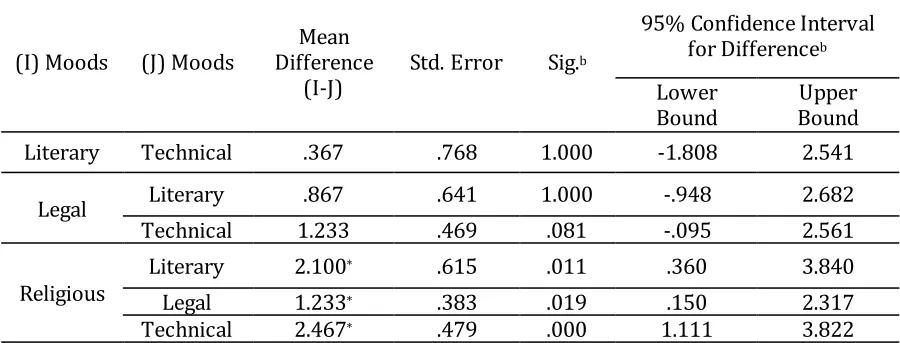
Although the F-value of 11.57 indicated significant differences between the participants’ means on the four translation moods, the post-hoc comparison tests should be used to compare the means two by two. Based on the results displayed in Table 4, it can be concluded that:
A: There was a significant difference between the participants’ means on the translation of literary (M = 14.50) and religious (M = 16.60) texts (MD = 2.1, P < .05). The subjects showed a significantly higher mean on the translation of religious texts. B: There was a significant difference between the participants’ means on the translation of technical (M = 14.13) and religious (M = 16.60) texts (MD = 2.46, P < .05). The participants showed a significantly higher mean on the translation of religious texts.
Table 4. Post-Hoc Comparisons
(I) Moods (J) Moods Difference Mean
(I-J) Std. Error Sig.
b
95% Confidence Interval for Differenceb
Lower
Bound Bound Upper Literary Technical .367 .768 1.000 -1.808 2.541
Legal Literary .867 .641 1.000 -.948 2.682 Technical 1.233 .469 .081 -.095 2.561
Religious Literary 2.100
* .615 .011 .360 3.840
Legal 1.233* .383 .019 .150 2.317
C: There was a significant difference between the subjects’ means on the translation of legal (M = 15.36) and religious (M = 16.60) texts (MD = 1.23, P < .05). The subjects showed a significantly higher mean on the translation of religious texts.
Graph 1. Means on Translation Moods
Furthermore, Graph1, in line with the respective statistics, illustrates that the mean score of the translation of the religious texts is the highest of all modes
Investigation of Research Question 2
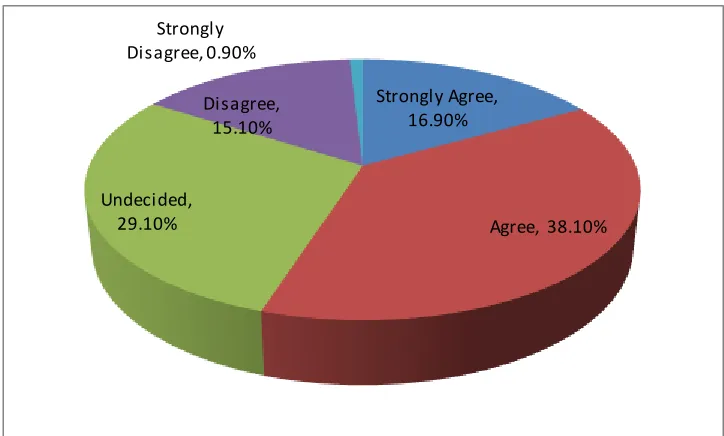
The second research question was entitled “To what extent do the translators’ perceptions of the errors matches with what happens in reality?” Table 5 displays the frequencies and percentages of the translators’ perceptions of the errors matches with what happens in reality. Based on these results it can be concluded that majority of the participants, i.e. 55 percent (16.9% strongly agree + 38.1% agree) believed that their perceptions of the errors matched with what happened in reality. About 29 percent have taken a neutral position and 16 percent (.9% strongly disagree + 15.1% disagree) believed that their perceptions of the errors did not match with what happens in reality.
Table 5. Frequencies and Percentages; Perceptions of Errors
Responses N Percent Strongly Agree 273 16.9%
Agree 615 38.1% Undecided 470 29.1% Disagree 244 15.1% Strongly Disagree 14 0.9%
Total 1616 100.0%
12.50 13.00 13.50 14.00 14.50 15.00 15.50 16.00 16.50 17.00
Literary Legal Technical Religious
Graph 2. Percentages Perceptions of Errors
In addition, Graph 2, in line with the respective statistics, illustrates 38.1% of the participants believed that their perceptions of the errors matched with what happened in reality.
An analysis of chi-square was also run to probe significant differences between the participants’ perceptions towards the conformity of their errors with what happens in reality. The chi-square results (χ2 (4) = 653.140, P < .05) indicated that there were significant differences between the participants’ conformity of their errors with what happens in reality. This means that their perceptions of the errors do not match with what happens in reality.
Table 6. Chi-Square Test Statistics
VAR00001 Chi-Square 653.140a
Df 4
Asymp. Sig. .000
As displayed in Table 7 the participants have selected the “agree” (Residual = 291.8) and neutral position (Residual = 146.8) more than what was expected while their selections of the other choices were less than their expectations.
Table 7. Observed, Expected and Residual Values
Observed N Expected N Residual Strongly Agree 273 323.2 -50.2 Agree 615 323.2 291.8 Undecided 470 323.2 146.8 Disagree 244 323.2 -79.2 Strongly Disagree 14 323.2 -309.2
Total 1616
Strongly Agree, 16.90%
Agree, 38.10% Undecided,
29.10%
Investigation of Research Question 3
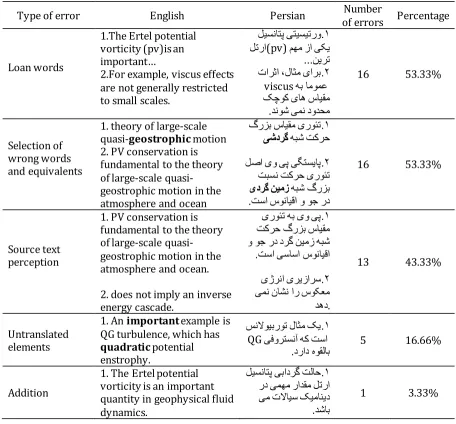
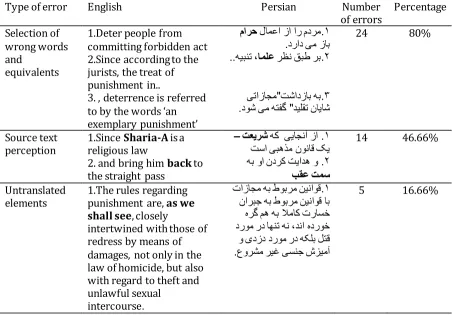
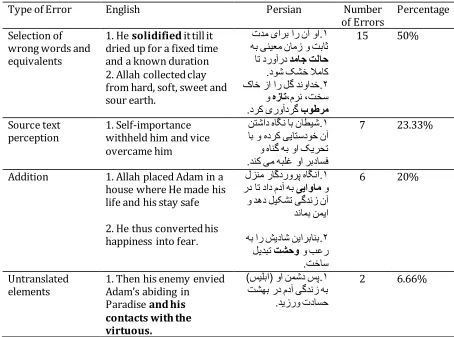
The third research question was entitled “What are the errors of translators in relation to text rhetorical modes and genre types?” This question was addressed both qualitatively and quantitatively. In order to answer this question the translations of 3 0 participants were checked to see which of the errors in the questionnaire had occurred most in their translations. Tables 8, 9, 10, and 11 present the type and number of the errors that have occurred in translation of every text.
Table 8. Translators’ Errors in Translation of Technical (exposition) Texts
Type of error English Persian of errors Number Percentage
Loan words
1.The Ertel potential vorticity (pv)is an important…
2.For example, viscus effects are not generally restricted to small scales.
1 . لیسناتپ یتیسیترو لترا(pv) مهم زا یکی
نیرت ...
2 . تارثا ،لاثم یارب
viscus هب امومع کچوک یاه سایقم
دنوش یمن دودحم .
16 53.33%
Selection of wrong words and equivalents
1. theory of large-scale quasi-geostrophic motion 2. PV conservation is fundamental to the theory of large-scale quasi-geostrophic motion in the atmosphere and ocean
1 . گرزب سایقم یروئت
هبش تکرح
یشدرگ
2 . لصا یو یپ یگتسیاپ
تبسن تکرح یروئت هبش گرزب
یدرگ نیمز
تسا سونایقا و وج رد .
16 53.33%
Source text perception
1. PV conservation is fundamental to the theory of large-scale quasi-geostrophic motion in the atmosphere and ocean.
2. does not imply an inverse energy cascade.
1 . یروئت هب یو یپ تکرح گرزب سایقم و وج رد درگ نیمز هبش تسا یساسا سونایقا .
2 . یژرنا یریزارس یمن ناشن ار سوکعم
دهد.
13 43.33%
Untranslated elements
1. An important example is QG turbulence, which has
quadratic potential enstrophy.
1 . سنلاویبروت لاثم کی
QG یفورتسنآ هک تسا دراد هوقلاب
. 5 16.66%
Addition
1. The Ertel potential vorticity is an important quantity in geophysical fluid dynamics.
1 . لیسناتپ یبادرگ تلاح
رد یمهم رادقم لترا یم تلاایس کیمانید دشاب .
1 3.33%
Table 9. Translators’ Errors in Translation of Literary (narration) Texts
Type of error English Persian Number
Selection of wrong words and equivalents
1.Lord of flies
2. Boys who had not known each other before the evacuation.
3.He passed a hand through his fair hair.
1 . بابرا ناتسد هریچ 2 . زا لبق هک ینارسپ
مامتا
هسلج
یمن ار رگیدمه دنتخانش .
3 . نایم هب ار شتسد
یاهوم
شفیطل
دیشک
21 70%
Source text
perception 1.most of the children, feeling too late the smart of the sunburn, had put their clothes on.
1 . نیا اب اه هچب رثکا باتفآ تدش هک ساسحا
دشاب هدش مک یگتخوس نت هب ار ناشیاه سابل دندرک .
20 66.66%
Untranslated
elements 1. The afternoon sun slanted in from the other side of the platform.
2. He passed a hand through his fair hair.
1 . تمس رد رصع باتفآ
هتفرگ رارق وکس رگید دوب .
2 . نایم هب ار شتسد
دیشک شیاهوم .
7 23.33%
Grammatical
error 1.By the time Ralph finished blowing the conch the platform was crowded.
1 . رد فلار هک ینامز
ینوزلح فدص
دیمد یم
دوب هدش غولش وکس
. 3 10%
Loan words 1.The afternoon sun slanted in from the other side of the platform.
1 . زا رهظ زا دعب دیشروخ
رگید فرط
مرف تلپ
جک
دوب هدش
1 3.33%
Table 10. Translators’ errors in Translation of Legal (argumentation) Texts
Type of error English Persian Number
of errors Percentage Selection of
wrong words and
equivalents
1.Deter people from committing forbidden act 2.Since according to the jurists, the treat of punishment in..
3. , deterrence is referred to by the words ‘an exemplary punishment’
1 . لامعا زا ار مدرم
مارح
دراد یم زاب .
2 . رظن قبط رب
املع هیبنت ، .. 3 . تشادزاب هب " یتازاجم دیلقت نایاش "
دوش یم هتفگ .
24 80%
Source text
perception 1.Since religious law Sharia-A is a 2. and bring him back to the straight pass
1 . هک ییاجنآ زا
تعیرش
–
تسا یبهذم نوناق کی 2 . هب وا ندرک تیاده و
بقع تمس
14 46.66%
Untranslated
elements 1.The rules regarding punishment are, as we shall see, closely
intertwined with those of redress by means of damages, not only in the law of homicide, but also with regard to theft and unlawful sexual
intercourse.
1 . تازاجم هب طوبرم نیناوق
ناربج هب طوبرم نیناوق اب هب لاماک تراسخ هرگ مه
دروم رد اهنت هن ،دنا هدروخ و یدزد دروم رد هکلب لتق عورشم ریغ یسنج شزیمآ .
2. some of the laws of punishment also have a
‘vertical’ dimension
2 . اه تازاجم زا رگید یخرب
دنتسه یداعبا لماش
Addition 1. The threat of punishment in the Hereafter does not sufficiently deter people from committing forbidden acts.
1 . ناهج رد تازاجم هب دیدهت یرود یارب ییاهنت هب ترخآ
و
ندناسرت
باکترا زا مدرم
تسین یفاک هعونمم لامعا هب
1 3.33%
Table 11. Translators’ Errors in Translation of Religious (explanation) Texts
Type of Error English Persian Number
of Errors Percentage Selection of
wrong words and equivalents
1. He solidified it till it dried up for a fixed time and a known duration 2. Allah collected clay from hard, soft, sweet and sour earth.
1 . تدم یارب ار نآ وا هب ینیعم نامز و تباث
دماج تلاح
ات دروآرد
دوش کشخ لاماک .
2 . کاخ زا ار لگ دنوادخ
،مرن ،تخس هزات و بوطرم درک یروآدرگ .
15 50%
Source text
perception 1. Self-importance withheld him and vice overcame him
1 . نتشاد هاگن اب ناطیش اب و هدرک ییاتسدوخ نآ
و هانگ هب وا کیرحت دنک یم هبلغ وا ربداسف .
7 23.33%
Addition 1. Allah placed Adam in a house where He made his life and his stay safe
2. He thus converted his happiness into fear.
1 . لزنم راگدرورپ هاگنآ
و
ییاوام
رد ات داد مدآ هب
و دهد لیکشت یگدنز نآ دنامب نمیا
2 . هب ار شیداش نیاربانب
و بعر
تشحو
لیدبت
تخاس .
6 20%
Untranslated
elements 1. Then his enemy envied Adam’s abiding in Paradise and his
contacts with the virtuous.
1 . وا نمشد سپ (
سیلبا )
تشهب رد مدآ یگدنز هب دیزرو تداسح .
2 6.66%
It can be concluded that “selection of wrong words and equivalents”, “source text perception”, “addition”, “untranslated elements”, “grammatical error”, and “loan words” are the errors occurred in translations of the aforementioned texts, and more specifically “selection of wrong words and equivalents” is the most frequently occurred error in all of the four texts.
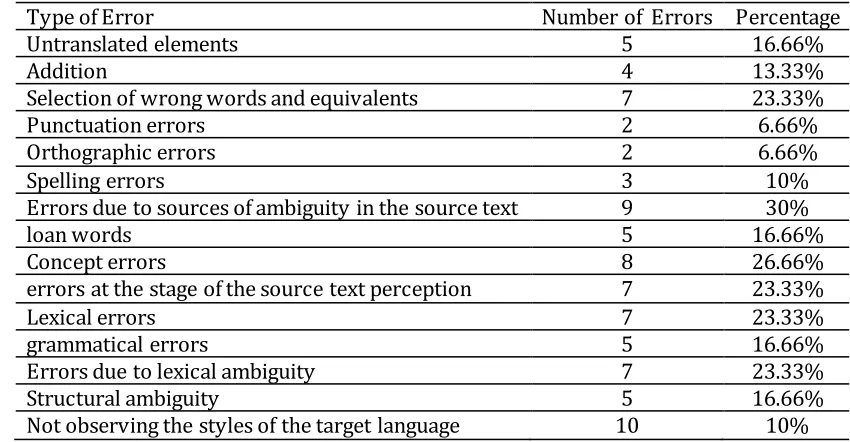
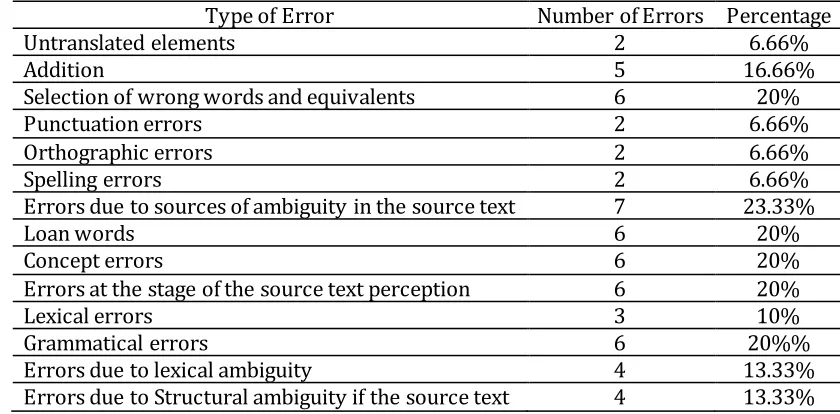
The perceptions of translators toward the possible errors were measured separately by 15 questions, and then by calculating the mean of the answers the perceptions of translators regarding the possible errors were investigated.
Table 12. Translators’ Perceptions towards the Errors that might happen in Technical (exposition) Texts
Type of Error Number of Errors Percentage
Untranslated elements 5 16.66%
Addition 4 13.33%
Selection of wrong words and equivalents 7 23.33%
Punctuation errors 2 6.66%
Orthographic errors 2 6.66%
Spelling errors 3 10%
Errors due to sources of ambiguity in the source text 9 30%
loan words 5 16.66%
Concept errors 8 26.66%
errors at the stage of the source text perception 7 23.33%
Lexical errors 7 23.33%
grammatical errors 5 16.66%
Errors due to lexical ambiguity 7 23.33%
Structural ambiguity 5 16.66%
Not observing the styles of the target language 10 10%
Table 13. Translators’ Perceptions towards the Errors that might happen in Religious (explanation) Texts
Type of Error Number of Errors Percentage
Addition 3 10%
Selection of wrong words and equivalents 1 3.33%
Punctuation errors 1 3.33%
Orthographic errors 1 3.33%
Spelling errors 3 3.33%
Errors due to sources of ambiguity in the source text 3 10%
loan words 4 3.33%
Concept errors 6 20%
Errors at the stage of the source text perception 3 10%
Grammatical errors 4 13.33%
Lexical ambiguity 5 16.66%
Errors due to structural ambiguity in the source text. 4 10% Not observing the styles of the target language 3 10%
Table 14. Translators’ Perceptions towards the Errors that might happen in Literary (narration) Texts
Type of Error Number of Errors Percentage
Untranslated elements 4 13.33
Addition 4 13.33
Selection of wrong words and equivalents 4 13.33
Orthographic errors 2 6.66
Spelling errors 1 3.33
Errors due to sources of ambiguity in the source text 11 36.66
Loan words 7 23.33
Concept errors 4 13.33
Errors at the stage of the source text perception 5 16.66
Lexical errors 3 20
Grammatical errors 6 10
Errors due to lexical ambiguity 5 16.66
Structural ambiguity 6 20
Not observing the styles of the target language 4 13.33
Table 15. Translators’ Perceptions towards the Errors that might happen in Legal (argumentation) Texts
Type of Error Number of Errors Percentage
Untranslated elements 2 6.66%
Addition 5 16.66%
Selection of wrong words and equivalents 6 20%
Punctuation errors 2 6.66%
Orthographic errors 2 6.66%
Spelling errors 2 6.66%
Errors due to sources of ambiguity in the source text 7 23.33%
Loan words 6 20%
Concept errors 6 20%
Errors at the stage of the source text perception 6 20%
Lexical errors 3 10%
Grammatical errors 6 20%%
Errors due to lexical ambiguity 4 13.33% Errors due to Structural ambiguity if the source text 4 13.33%
Quantitatively, as the tables represent, students predicted that almost all of the types of the error could happen in translation of the aforementioned texts. In order to choose the best statistical test, it was necessary to know about the data distribution. Kolmogorov– Smirnov test was run to see if the distribution of data was normal. The results of this test are shown in table16.
Table 16. One-Sample Kolmogorov-Smirnov Test
technical.text religious.text literary.text legal.text
N 30 30 30 30
Normal
Parametersa,b Std. Deviation Mean 1.17901 2.0778 2.0044 .87027 2.3778 .70125 2.3378 .58642 Most Extreme
Differences
Absolute .250 .228 .147 .164 Positive .161 .126 .147 .087 Negative -.250 -.228 -.146 -.164 Kolmogorov-Smirnov Z 1.371 1.252 .808 .898
As the results of the table 16 show “Sig” for the variable of “translators’ perception in technical, religious, literary and legal texts in the four texts” is more than 0.05, so it means all of the variables have normal distributions. Then, parametric statistics were run. In this part of the analysis, in order to investigate the perceptions of translators regarding the possible error, the mean of the scores of each text was compared with (3). The number 3 is the number which had been given to “Neither agree nor disagree” option in the questionnaire. In order to do the investigation, a t-test was run. Table 16 shows the perceptions of translators regarding the possible errors that they may face in translating 4 different types of texts.
Table 17. Descriptive Statistics
N Minimum Maximum Mean Std. Deviation technical.text 30 0 3.53 2.0778 1.17901 religious.text 30 0 3.00 2.0044 .87027 literary.text 30 0 4.13 2.3778 .70125 legal.text 30 1 3.13 2.3378 .58642 Valid N (listwise) 30
Paired-samples t-test results are presented. T-test results for every of the four texts are shown in table 18.
Table 18. One-Sample Test
Test Value = 3
t df Sig. (2-tailed) Difference Mean 95% Confidence Interval of the Difference Lower Upper technical.text -4.284 29 .000 -.92222 -1.3625 -.4820 religious.text -6.266 29 .000 -.99556 -1.3205 -.6706 literary.text -4.860 29 .000 -.62222 -.8841 -.3604 legal.text -6.185 29 .000 -.66222 -.8812 -.4432
As table 18 shows the amount of “Sig” for all of the four texts is lower than 0.05. According to the amount of mean mentioned in table 18, the perceptions of translator in possible errors that they may face in translation of the aforementioned texts are lo wer than the average.
A Friedman test was run to see if there was any difference between the translators’ perceptions regarding the errors that may face in translation of the aforementioned texts. The results of this test are shown in table 19.
Table 19. Friedman test
Mean Rank Chi-Square df Sig technical.text 2.73
4.759 3 0.190 religious.text 2.18
As table 19 demonstrates “Sig” for Friedman test is 0.19 and it is higher than 0.05, so it can be concluded that there is not a significant difference between the perceptions of translators regarding the possible errors they may face in translation 4 types of texts.
DISCUSSION AND CONCLUSION
The analysis of the data presented indicated that both hypotheses of the study were rejected. The findings are in line with Farrokh’s (2011) study though the focus of her study was on the frequent errors made by English translation students. Her study shows that wrong selection of words (substitution); misordering of elements (permutation) and incorrect use of tenses are the most frequent linguistic errors. Similarly, Silviana’s (2008) report on the analysis of student’s difficulties in translating narrative texts is also sustained as she found some 210 difficulties of the students’ difficulties in translating the narrative texts at the eleventh grade of SMK Hass AshabulYamin Cianjur. It can be concluded that the present study and the second study are to some extent similar as far as they both are concerned with narrative text and the results of the present study show that the most frequently occurred error in literary (narrative) text is wrong selection of words which can be a noun, verb or adverb, and the second study also indicates that the students had difficulties in using nouns, verbs and adverbs. It can be concluded that in spite of minor similarities between these study and other related works it can be said that the findings of this study are in line with the previous studies. The findings then indicated that there is significant differences between the participants’ mean and the highest mean belong to the translation of religious text and it follows by legal, literary and technical texts. So for the first research question it can be said that there is a significant relation between text rhetorical modes, and genre types and translations’ quality, which means genre types and rhetorical modes affect the quality of translation.
was also concluded that between the translators there was a significant difference regarding the errors they thought they would have in translation of the four texts. By analyzing the data gathered from the questionnaires it was concluded that 55 percent believed that their perceptions of the errors matched with what happened in reality. About 29 percent have taken a neutral position and 16 percent believed that their perceptions of the errors did not match with what happens in reality. Also by running a chi-square it was concluded that there was a significant difference between the participants’ perceptions towards the conformity of their errors with what happens in reality.
Teachers and professors can benefit from the results of this study in their courses to develop their pedagogical materials, and instructing their students toward translating more efficiently. By knowing which errors are more common in translation of the aforementioned genres and rhetorical modes they can look after these errors in translations of their own students and let them know how they can make less of these types of the errors. Also the official in charge most probably can enjoy the results of the present study so they can make better decisions in planning the programs and courses for the undergraduate students, and provisions of material courses, to make an evolution in the learning progress of the students. They can assemble new syllabus that focus on importance of genre study and make the students familiar with the characteristics of every specific genre and rhetorical mode, and providing them the materials that inform them about the writing features of each genre in the source and target language and on the whole to improve the quality of translation of the future translators. Once the student get to know the linguistic characteristics of the genres and became familiar with rhetorical modes they can deliver the higher quality translation and the translations that sound more natural.
REFERENCES
Alamargot, D., Terrier, P., &Cellier, J. (2007).Written documents in the workplace. Elsevier Ltd.
Brooks, C., & Warren, R.P. (1949). Modern rhetoric. Retrieved from http://archive.org/details/modernrhetoric030264mbp
Byrne, J. (2006). Technical translation usability strategies for translating technical documentation. Published by Springer, P.O. Box 17, 3300 AA, Dordrecht, The Netherlands.
Cao, D. (2007). Translating law. Retrieved from http://lib.estrorecollege.org/view.php? id=2693.
Corder, S. P. (1973). Introducing applied linguistics (PP. 274-277). Harmondsworth: Penguin.
Dickins, J., Hervey, S., & Higgins, I. (2002). Thinking Arabic translation, a course in translation method: Arabic to English. Retrieved from http://lib.estrorecollege.org /view.php?id=269373
Farrokh, P. (2011). Analysing of EFL learners' linguistic errors: Evidence from Iranian translation trainees. Retrieved from http://ojs.academypublisher.com/index.php /tpls/article/viewFile/0106676680/3143
Gambier, Y., &Doorslaer, L. (2010). Handbook of translation studies. John Benjamins Publishing Company. (Vol. 1). Retrieved from http://libgen.info/view.php? id=919579
Haque, Z. (2012). Translating literary prose: Problems and solutions. Retrieved from http://www.ccsenet.org/journal/index.php/ijel/article/download/22598/14599 Hervey, S., & Higgins, I. (1992). Thinking translation: A Course in Translation Method,
French-English. Retrieved from: www.libgen.com
Hervey, S., & Higgins, I. (2002). Thinking French Translation Student Book: A Course in Translation Method: French to English (Thinking Translation). Retrieved form http://elibgen.org/view.php?id=482368
Hervey, S., Higgins, I., Cragie, S., & Gambarotta, P. (2005). Thinking Italian translation method: Italian to English. Retrieved from www.libgen.com
Hervey, S., Higgins, I., &Loughridge, M. (2005).Thinking German translation: A course in translation method, German to English. Taylor & Francis e-Library.
Huang, X. (2011). Stylistic approaches to literary translation: with particular reference to
English-Chinese and Chinese-English translation. Retrieved from
etheses.bham.ac.uk/2949/1/Huang_X_11_PhD.pdf
Khanmohammad, H &Osanloo, M. (2009). Moving toward objective scoring: A rubric for translation assessment. Retrieved from http://sid.ir/en/VEWSSID/Jpdf/ 1032120090108.pdf
Kingscott, G. (2002).Technical translation and related disciplines. Perspectives: Studies in translatology. (Vol, 10:4, pp, 247-255)
Meurer, J.L. (2002). Genre as diversity, and rhetorical modes as unity in language use. Retrieved from www.periodicos.ufsc.br/index.php/desterro/article/view/7602 Munday, J. (2009). The Routledge companion to translation studies. Simultaneously
published in the US and Canada by Routledg.
Muslat, A. W. M. (2012). Translation and the characteristics of literary text. Retrieved from http://www.awej.org/index.php?option=com_content&view=article&id=234:abd
ul-wahid-mohammed-muslat-phd&catid=39&Itemid=138
Rabani, H. (2007). Difficulties of translating religious texts. Seasonal journal of hadith and scientific research. 4th and 3rd No, 12th year.
Rothwell, A., Guijarro, A., & Hernández, J. (1998).Speech analysis essays in Englishlanguage [Ensayos de Análisis Del Discurso en LenguaInglesa]. Servicio de Publicaciones de la Universidad de Castilla-La Mancha.
Scriven, M. (2007). Key evaluation checklist. Retrieved from: http://www.wmich.edu/ evalctr/archive_checklists/kec_feb07.pdf
Steinbach, H.-R. (1981).On the classification of errors in translation papers with some consideration of interference phenomena. Pages: 249-25. Retrieved from http://ifa.amu.edu.pl/psicl/PSiCL_13
Waddington, C. (2001). Different methods of evaluating student translations: The question of validity. Retrieved fromhttp://id.erudit.org/iderudit/004583ar